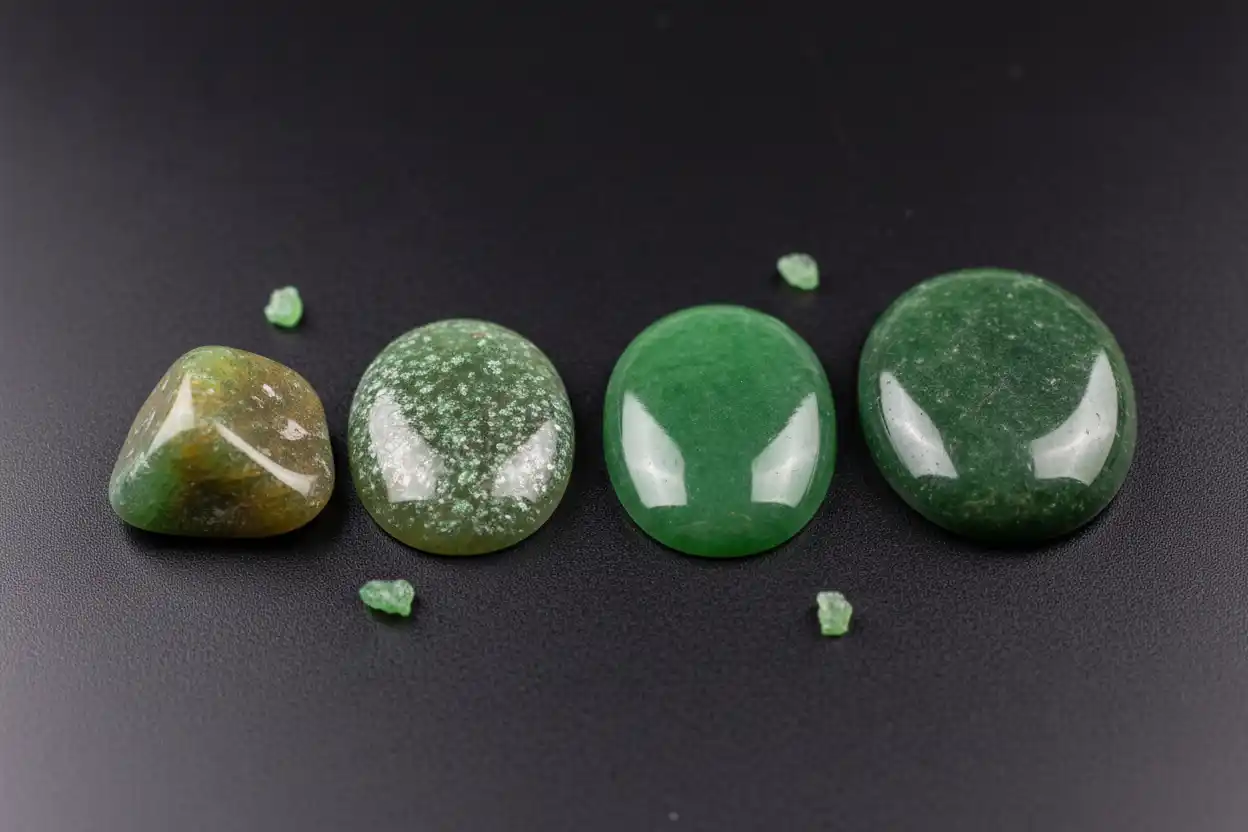
Aventurine vs Jade: Differences, Tests, Wear & Value
Aventurine vs jade can be difficult to resolve from color alone because both materials are commonly fashioned into green cabochons, beads, bangles, carvings, pendants, and polished ornamental objects. The resemblance becomes especially convincing when aventurine contains very fine mica rather than obvious glitter, or when pale translucent material is polished into a smooth bangle that resembles lighter jadeite. Mineralogically, however, the materials are fundamentally different. Green aventurine is a quartz-rich aggregate whose color and aventurescence commonly come from chromium-bearing mica such as fuchsite, while jade is a gemological name applied principally to jadeite jade and nephrite jade, with some green omphacite material also falling under jade terminology in specific classification contexts.
The distinction matters because jade’s exceptional toughness, cultural significance, treatment market, value structure, and identification methods differ sharply from those of aventurine quartz. Aventurine is harder than nephrite on the Mohs scale and comparable to jadeite in scratch resistance, yet genuine jade is generally much tougher because its tightly interlocking microstructure resists breaking and chipping exceptionally well. Density and refractive index also separate the materials efficiently: aventurine quartz is typically near specific gravity 2.66 with a spot refractive index around 1.54, nephrite is commonly around 2.95 with refractive readings in the low 1.60s, and jadeite is typically around specific gravity 3.34 with refractive index near 1.66–1.68.
The practical conclusion is straightforward. Choose aventurine when attractive green color, natural mica sparkle, quartz durability, ornamental use, and generally accessible cost are the priorities. Choose genuine jade when exceptional toughness, traditional carving or bangle use, cultural importance, finer translucent texture, or the specific jade market matters enough to justify stronger identification and treatment scrutiny.
The broader Identification collection follows the same principle: visible resemblance can narrow possibilities, but material identity should be established through structure and measurable properties.
Aventurine vs Jade at a Glance
| Property | Green Aventurine | Jadeite Jade | Nephrite Jade |
|---|---|---|---|
| Material identity | Quartz-rich aggregate containing reflective inclusions | Sodium-aluminium pyroxene aggregate | Calcium-magnesium-iron amphibole aggregate |
| Main chemistry | Dominantly SiO₂ | NaAlSi₂O₆ | Ca₂(Mg,Fe)₅Si₈O₂₂(OH)₂ |
| Typical green influence | Commonly fuchsite mica | Primarily chromium in prized green material; chemistry varies | Iron-related coloration commonly important |
| Texture | Granular quartz aggregate with mica plates | Interlocking granular crystals | Densely interwoven fibrous crystals |
| Mohs hardness | About 7 for quartz-rich material | About 6.5–7 | About 6–6.5 |
| Specific gravity | Around 2.65–2.67 | Around 3.34 | Around 2.95 |
| Typical RI/spot RI | Around 1.54 | About 1.66–1.68 | About 1.61–1.63 |
| Toughness | Good, but fractures and grain boundaries matter | Exceptional | Exceptional |
| Characteristic visual clue | Reflective mica platelets or aventurescence | Fine granular texture and potentially high translucency | Dense fibrous texture and waxy-to-vitreous appearance |
| Common treatments | Dye, polymer impregnation and other enhancements can occur | Wax, dye, bleaching, polymer impregnation and combinations | Dye, wax and other enhancement can occur |
| Common jewelry | Beads, cabochons, carvings, rings, pendants | Bangles, cabochons, beads, carvings, rings | Bangles, carvings, beads, cabochons |
| Market value | Usually comparatively accessible | Fine material can be exceptionally valuable | Fine material can also be valuable, typically a different market from top jadeite |
| Visual identification alone | Unreliable in subtle material | Unreliable | Unreliable |
This table explains why a scratch test is unnecessary and often unhelpful. The materials have enough separation in density, refractive index, internal structure, and microscopic texture to support nondestructive identification.
“Jade” Is Not One Mineral
The word jade does not identify one chemical species. The two principal materials traditionally recognized as jade are jadeite and nephrite. Jadeite belongs to the pyroxene mineral family, while nephrite is a compact aggregate composed predominantly of extremely fine amphibole minerals in the tremolite-actinolite series. Under specific gemological classification conditions, green omphacite-rich material may also be accepted within jade terminology.
This matters immediately in an aventurine vs jade comparison because jadeite and nephrite do not have identical properties. Jadeite is denser and slightly harder, while nephrite’s densely interwoven fibrous structure gives it extraordinary toughness. Both are structurally very different from a quartz-rich aventurine aggregate.
A seller who describes an object simply as “jade” has therefore provided only part of the identification. For a low-cost ornamental object that may be sufficient for casual retail description, but a significant purchase should determine whether the material is jadeite, nephrite, another qualifying jade material, or an imitation.
Aventurine Is Quartz With an Inclusion-Driven Identity
Green aventurine is dominated by quartz. Its distinctive green appearance commonly comes from fuchsite, a chromium-bearing mica dispersed through the quartz-rich material. When flat mica plates reflect light, they create the shimmering phenomenon known as aventurescence.
The amount of visible sparkle varies considerably. Coarse reflective plates can produce obvious glitter, while very fine fuchsite can give the stone a smoother green appearance that resembles jade more closely. Some aventurine pieces show only scattered flashes under strong directional light, especially when the material is compact and heavily polished.
This variation explains why the shortcut “sparkly means aventurine, non-sparkly means jade” is unreliable. Obvious glitter strongly favors aventurine, but weak aventurescence does not transform quartz into jade.
Magnification is more informative than casual viewing because even subtle material may reveal flat mica platelets, granular quartz boundaries, or reflective inclusions inconsistent with the interlocking structure of jade.
Texture Is the Best Visual Starting Point
Aventurine and jade often separate visually through texture before any instrument is used. Aventurine commonly has a granular or sugary internal appearance under magnification, with mica flakes distributed through quartz grains. The material may contain tiny fractures, reflective plates, color concentrations, and locally variable translucency.
Jadeite tends to show an interlocking granular crystalline texture. Depending on grain size and quality, polished material can range from relatively coarse and granular to extremely fine and translucent. Fine green jadeite can appear internally smooth at normal viewing distance while still revealing a crystalline aggregate structure under magnification.
Nephrite has a different microtexture again. Its tightly felted or interwoven amphibole fibers create remarkable toughness and can produce a smooth, sometimes slightly fibrous or cloud-like appearance. Fine nephrite can polish beautifully and may display a waxy-to-vitreous surface character.
These structural differences are more reliable than shade. Any of the three materials can occur in pale, medium, mottled, dark, yellowish, grayish, or uneven green.
Aventurescence Is Strong Evidence for Aventurine
When a green stone clearly contains many flat reflective plates that flash as it moves, aventurine becomes a strong possibility. Classic green aventurine’s fuchsite flakes can appear silvery green, brighter green, or slightly metallic depending on orientation and illumination.
True jade normally does not display this characteristic field of mica-driven aventurescence.
Reflective areas in jade can still occur from fractures, grain surfaces, inclusions, polishing features, or internal structures, so one isolated flash should not be labeled aventurescence automatically. The pattern matters. Aventurine typically shows many reflective inclusions distributed through the quartz-rich host.
A useful test is controlled rotation under one fixed point light source. Aventurescent flakes brighten individually as their reflecting planes align with the light, while surrounding flakes become darker.
This observation is nondestructive and can be particularly helpful when comparing polished beads or cabochons.
Density Provides a Powerful Separation
Specific gravity is one of the clearest ways to separate these materials when a loose object can be measured accurately.
Aventurine quartz generally falls around 2.65–2.67.
Nephrite commonly falls around 2.95.
Jadeite commonly falls close to 3.34.
The difference between aventurine and jadeite is especially large. A jadeite object of the same volume and broadly similar construction should contain substantially more mass than aventurine.
Casual hand-heft remains unreliable because differently shaped objects have different volumes. A thick aventurine bangle may feel heavier than a thin jadeite bangle even though jadeite itself is denser.
Hydrostatic measurement converts the observation into useful evidence.
Refractive Index Separates Them Without Damage
Refractive index is equally valuable. Quartz-rich aventurine commonly gives a spot reading around 1.54 on polished aggregate material. Nephrite generally reads in the low 1.60s, while jadeite commonly gives a spot refractive index near 1.66.
These ranges are sufficiently different to make a good reading highly informative.
A reading around 1.54 strongly contradicts jadeite and nephrite and supports quartz-rich material.
A reading near 1.66 strongly favors jadeite over aventurine.
A reading near the low 1.60s is much more consistent with nephrite than quartz.
Curved bangles and carvings may make refractometer contact difficult, but experienced gemological examination can often find an appropriate polished surface. When standard RI measurement is impractical, density, microscopy, spectroscopy, and other tests become more important.
Hardness Alone Can Mislead
Quartz in aventurine has Mohs hardness 7. Jadeite is approximately 6.5–7, while nephrite is approximately 6–6.5. At first glance this seems to give aventurine the strongest durability.
That conclusion confuses hardness with toughness.
Hardness measures resistance to scratching. Toughness describes resistance to breaking, chipping, and fracture propagation. Jade’s extraordinary reputation as a carving material comes from toughness rather than exceptional hardness.
Nephrite is especially remarkable because its microscopic amphibole fibers interlock into a dense felted structure. Jadeite’s granular crystals also interlock strongly. These textures allow jade objects to tolerate impacts that might fracture another stone with a similar or even higher Mohs hardness.
Aventurine is durable enough for many jewelry and carving uses, but quartz grain boundaries, fractures, mica-rich bands, and internal weaknesses generally make it less impact-resistant than good jade.
Why Jade Became a Historic Tool and Carving Material
Jade’s toughness helps explain its long cultural and technological history. Nephrite in particular was fashioned into durable tools, blades, ornaments, ritual objects, and carvings because the interlocking structure resists catastrophic breakage unusually well.
This historical use provides physical evidence of toughness, not proof of supernatural protection.
A carved jade object can survive repeated mechanical stress because of mineral structure. A jade amulet believed to protect its owner represents a cultural or symbolic interpretation. Both facts can coexist without being confused.
Aventurine has its own ornamental history but does not share jade’s same long-standing material role as one of the world’s exceptionally tough carving stones.
Original Same-Light Comparison Protocol
A fair visual comparison should use identical conditions rather than comparing unrelated seller photographs.
| View | What to examine |
|---|---|
| Same neutral daylight-equivalent light | Relative hue, tone and saturation |
| Same neutral background | Prevent green color from being exaggerated differently |
| Face-up image | Overall texture, translucency and color distribution |
| Strong point-light rotation | Look specifically for mica-driven aventurescence |
| Backlit image | Compare internal grain structure and translucency |
| Macro surface image | Look for quartz grains, mica plates, jade texture and treatment clues |
| Edge or thin-section view | Evaluate internal structure more clearly |
| Weight plus dimensions | Provide a basis for density comparison |
| Transmitted flashlight view | Look for color concentration, fractures, granular structure or fibrous texture |
| Magnified image | Separate reflective inclusions from fine jade grain |
The protocol is especially useful for bangles, because pale polymer-impregnated aventurine quartz can imitate translucent jadeite convincingly in ordinary photographs.
A photo series can narrow the identification, but it should not replace laboratory testing when a high-value jade claim is involved.
Polymer-Impregnated Aventurine Can Imitate Jadeite
One particularly important identification problem involves light green aventurine quartz that has been polymer impregnated and fashioned into jade-like bangles. Impregnation can improve apparent transparency, fill pores or fractures, and make the quartz-rich aggregate resemble translucent material marketed as “ice jade.”
The underlying gemological properties remain different. Aventurine quartz retains a quartz-range spot refractive index around 1.54 and specific gravity near 2.66, while jadeite normally sits much higher in both measurements. Microscopic fuchsite inclusions can provide additional evidence.
This makes testing especially important when a pale green bangle is represented as valuable jadeite. Attractive translucency alone is not proof of jade.
Treatment of an imitation and treatment of genuine jade are also separate issues. Polymer-impregnated aventurine is still aventurine quartz rather than treated jadeite.
Jade Treatment Requires Much More Scrutiny
Jadeite has an established treatment vocabulary because enhancement can change both appearance and commercial value significantly. Common terminology includes A jade, B jade, C jade, and combinations of these categories.
A jade generally refers to jadeite that has not undergone bleaching and polymer impregnation or dyeing, apart from accepted surface waxing associated with traditional finishing.
B jade refers to jadeite that has been chemically bleached and then impregnated with polymer or similar material to improve appearance and fill altered areas.
C jade refers to dyed jadeite.
B+C material has undergone both impregnation-related treatment and color enhancement.
These terms concern treatment, not quality. An A-jade piece can be unattractive and inexpensive, while an aesthetically attractive B-jade piece remains treated material whose value and care requirements differ from untreated jadeite.
Nephrite can also be dyed, waxed, impregnated, or otherwise altered, so “natural jade” should not be accepted as a complete disclosure without knowing which material and treatments are being discussed.
Treatment Cannot Be Judged Reliably From Color
Bright emerald green can occur naturally in fine jadeite, while dyed material can imitate the appearance. Aventurine can also be dyed or enhanced. Color intensity therefore cannot establish treatment status.
Under magnification, dye may concentrate along fractures, grain boundaries, or porous areas, but subtle treatment can escape visual detection. Polymer impregnation may require infrared spectroscopy or other laboratory methods for reliable confirmation.
This is why high-value jade purchases deserve a stronger evidence standard than inexpensive decorative aventurine. The financial consequence of confusing untreated fine jadeite with treated material can be substantial.
Original Diagnostic Decision Matrix
| Observation or test | Aventurine | Jadeite Jade | Nephrite Jade | Diagnostic strength |
|---|---|---|---|---|
| Numerous reflective mica flakes | Strongly supportive | Uncharacteristic | Uncharacteristic | High |
| Spot RI near 1.54 | Strongly supportive | Contradicts | Contradicts | Very high |
| RI near 1.66 | Contradicts | Strongly supportive | Contradicts | Very high |
| RI in low 1.60s | Contradicts | Usually too low | Strongly supportive | Very high |
| SG near 2.66 | Strongly supportive | Too low | Lower than expected | High |
| SG near 2.95 | Too high | Usually too low | Strongly supportive | High |
| SG near 3.34 | Too high | Strongly supportive | Too high | High |
| Granular quartz texture with mica | Strongly supportive | Contradicts | Contradicts | High |
| Fine interlocking granular texture | Possible superficial resemblance | Characteristic | Different texture | Moderate to high |
| Dense felted/fibrous texture | Uncharacteristic | Uncharacteristic | Characteristic | High |
| Mohs near 7 | Compatible | Compatible | Slightly high | Low alone |
| Exceptional resistance to chipping | Good but not diagnostic | Characteristic | Characteristic | Moderate |
| Polymer detected | Possible treatment | Possible B-jade treatment | Possible enhancement | Treatment evidence, not identity |
| Raman spectrum identifies quartz | Strongly supportive | Contradicts | Contradicts | Very high |
| Raman identifies jadeite | Contradicts | Confirmatory | Contradicts | Very high |
| Raman identifies tremolite-actinolite aggregate | Contradicts | Contradicts | Strong nephrite evidence | Very high |
This matrix demonstrates why three independent tests can resolve what photographs cannot. A quartz-range RI, quartz-range density, and visible mica inclusions together make aventurine far more plausible than jade.
Jewelry Wear: Jade Wins on Toughness
For most ordinary jewelry, both aventurine and jade can perform well. Aventurine’s quartz-rich hardness provides good scratch resistance, making it suitable for cabochons, beads, pendants, earrings, bracelets, and rings when the material is sound. Jadeite and nephrite are somewhat softer in scratch resistance but substantially tougher, which is particularly valuable for bangles and carvings that experience knocks and mechanical stress.
Jade’s toughness does not make it indestructible. A thin jade bangle can still break after a severe impact, and treated material may require additional care. Aventurine can likewise last for many years if obvious fractures and weak mica-rich zones are protected.
The useful distinction is that jade has an exceptional structural advantage against breakage, while aventurine has excellent quartz-based surface hardness at a generally more accessible price.
Bangles Expose the Difference Clearly
Bangles are one of the most important formats in the aventurine vs jade identification problem because both materials can be carved into continuous green rings.
Aventurine bangles can be attractive and durable, particularly when the quartz aggregate is compact. Fine mica can give them a subtle shimmer that may not be obvious in every light.
Jade bangles benefit from the remarkable toughness of jadeite or nephrite, which is one reason jade has such a long tradition in this format. Fine jadeite can also achieve translucency and color quality that occupy a dramatically different market category from ordinary aventurine.
The material should therefore be identified before price is interpreted. A green bangle is not valuable jade merely because the seller uses jade terminology.
Care Depends on Treatment as Much as Identity
Warm soapy water and a soft cloth are conservative cleaning choices for sound untreated aventurine and jade. Strong acids, harsh chemicals, severe heat, and abrasive cleaners are unnecessary for either material.
Treatment changes the decision. Dyed, polymer-impregnated, coated, repaired, or composite material may be more sensitive to heat or chemicals than an untreated stone. Genuine B-jade, for example, contains polymer introduced after chemical bleaching, while an impregnated aventurine imitation contains a different treated base material but may share similar cleaning concerns.
When treatment status is uncertain, gentle cleaning is a better default than assuming the stone can tolerate aggressive methods.
Value Differences Can Be Enormous
Most green aventurine occupies an accessible ornamental and jewelry market. Attractive color, strong aventurescence, even pattern, carving quality, size, and craftsmanship can raise value, but common material is generally available enough that exceptionally high prices require clear justification.
Jade is different because the word covers markets ranging from inexpensive commercial nephrite to extraordinarily valuable fine jadeite. Fine translucent jadeite with highly desirable saturated green color, fine texture, excellent craftsmanship, and appropriate treatment status can command prices far beyond ordinary aventurine.
Nephrite has its own value structure, with color, texture, translucency, provenance, carving quality, size, and cultural demand all affecting price.
A seller’s use of the word jade therefore has substantial financial consequences. When a purchase is meaningful in value, laboratory identification and treatment testing can be economically justified.
Jade’s Cultural Value Cannot Be Reduced to Color
Jade carries deep cultural importance across multiple societies, with particularly extensive traditions in East and Central Asia, Mesoamerica, and other regions. Toolmaking, ritual objects, burial goods, status symbols, ornaments, carvings, and jewelry all contribute to its historical importance.
That context can influence market demand and personal meaning independently of mineral color.
Aventurine has decorative and symbolic traditions of its own, but buying green aventurine as a cheaper stone does not provide the same material, cultural history, or gemological identity as jade.
Likewise, choosing aventurine because one prefers its sparkle is not an inferior choice. It is simply a different material decision.
Original Buyer Decision Matrix
| Buyer priority | Better default choice | Reason |
|---|---|---|
| Visible natural sparkle | Aventurine | Fuchsite-driven aventurescence is characteristic |
| Exceptional toughness | Jade | Jadeite and especially nephrite have highly interlocking structures |
| Lower-cost green ornamental stone | Aventurine | Common material is generally accessible |
| Traditional jade bangle | Jade | Material identity is central to the object |
| Large carvings on a moderate budget | Aventurine can be practical | Quartz-rich material is available in sizeable blocks |
| Fine translucent green gem | Jadeite | High-quality jadeite occupies a distinctive gem market |
| Smooth non-sparkling green appearance | Jade often preferred | Texture rather than glitter defines visual appeal |
| High scratch resistance | Aventurine or jadeite | Both perform well; toughness still differs |
| Maximum impact resistance | Jade | Interlocking microstructure provides major advantage |
| Easy home identification | Neither for expensive material | Testing is preferable |
| High-value purchase | Properly identified jade with treatment disclosure | Documentation becomes economically important |
| Decorative beads | Either | Appearance and budget can lead |
| Strong geological mica character | Aventurine | Reflective mineral inclusions are part of its identity |
| Cultural jade significance | Jade | Aventurine is not a substitute for jade identity |
| Guaranteed investment | Neither | Future appreciation and resale cannot be guaranteed |
The matrix shows why the best choice changes with the buyer’s objective. A person seeking green sparkle has little reason to pay a jade premium, while someone specifically seeking jade’s toughness, cultural history, or high-end market identity should not accept aventurine as an equivalent substitute.
Laboratory Limits Matter Most at the High End
A routine gemological examination can often separate aventurine, jadeite, and nephrite using refractive index, specific gravity, magnification, and spectroscopy. The harder question may be treatment.
Polymer-impregnated jadeite can retain a convincing jadeite appearance because it really is jadeite; the treatment modifies existing material rather than replacing its mineral identity. Dye can likewise intensify genuine jade. Identifying the species therefore does not complete the commercial evaluation.
An independent laboratory becomes most useful when the price depends strongly on natural color, lack of impregnation, precise jade type, or another treatment-sensitive claim.
The same principle applies to comparisons such as Aquamarine vs Topaz, Citrine vs Yellow Sapphire, and Aquamarine vs Blue Topaz: first identify the material, then evaluate treatment and value separately.
Similar Color Is a Recurring Identification Trap
Green is not the only color that creates this problem. Amazonite vs Turquoise compares materials that can overlap in blue-green appearance but differ completely in mineral identity. Fluorite vs Amethyst shows how purple color can hide a large difference in hardness and crystal structure, while Amethyst vs Charoite separates transparent-to-translucent quartz from a very different fibrous-looking silicate material.
The same evidence principle extends to Apatite vs Aquamarine, Clear Quartz vs Selenite, Citrine vs Yellow Topaz, and Carnelian vs Red Jasper. Color and general appearance narrow possibilities; measurable properties establish identity.
What Not to Use as an Identification Test
Do not assume that deep green means jade.
Do not assume that sparkle automatically means aventurine unless the reflective structure is actually visible.
Do not use price as proof of identity.
Do not scratch a valuable object simply to compare hardness.
Do not decide that a stone is jade because it feels cold; many minerals conduct heat well enough to feel cool initially.
Do not rely on sound alone. Nephrite can produce an attractive ringing response in suitable objects, but object shape, thickness, suspension, cracks, and other materials affect sound.
Do not assume translucency means jadeite.
Do not assume polymer treatment means the material is genuine jade.
Do not assign geographic origin from shade.
And do not accept A, B, or C terminology until the underlying material is first established as jadeite jade.
Frequently Asked Questions
What is the main difference between aventurine and jade?
Aventurine is a quartz-rich material commonly containing reflective mica, while jade principally refers to jadeite or nephrite. Their chemistry, texture, density, refractive index, toughness, treatment markets, and value are different.
Is green aventurine real jade?
No. Green aventurine is quartz-rich material and is not jadeite or nephrite.
Why does aventurine look like jade?
Both can be compact, green, translucent, polishable, and suitable for carvings or bangles. Fine-grained aventurine with subtle mica can resemble jade particularly closely.
Does real jade sparkle?
Jade does not normally display the field of mica-driven aventurescence characteristic of aventurine quartz. Individual reflections can occur, but obvious distributed sparkling flakes favor aventurine.
Which is harder?
Aventurine’s quartz component is about Mohs 7. Jadeite is approximately 6.5–7, while nephrite is about 6–6.5.
Which is tougher?
Jade. Both jadeite and nephrite are exceptionally tough because of their interlocking aggregate textures, with nephrite particularly famous for resistance to breakage.
Which is heavier?
Jadeite is substantially denser than aventurine. Nephrite is also denser than typical aventurine quartz.
What is aventurine’s specific gravity?
Typical green aventurine quartz is around 2.65–2.67.
What is jadeite’s specific gravity?
Jadeite commonly falls around 3.34.
What is nephrite’s specific gravity?
Nephrite commonly falls near 2.95, with natural variation.
Can specific gravity separate aventurine from jade?
Yes. Accurate hydrostatic measurement provides a strong nondestructive distinction, particularly between aventurine and jadeite.
What is aventurine’s refractive index?
Polished aventurine quartz commonly gives a spot refractive-index reading around 1.54.
What is jadeite’s refractive index?
Jadeite typically gives readings in approximately the 1.66–1.68 range.
What is nephrite’s refractive index?
Nephrite commonly falls in approximately the 1.61–1.63 range.
Can a refractometer distinguish them?
Usually, yes. Their typical readings are sufficiently separated to provide strong evidence when a suitable polished surface is available.
Is aventurine good for bangles?
Yes. Compact aventurine quartz can make attractive, durable bangles, but it should be sold as aventurine rather than jade.
Why is jade especially good for bangles?
Jade’s interlocking microstructure gives it exceptional toughness, helping it resist breaking and chipping despite only moderate Mohs hardness.
Can aventurine imitate jadeite?
Yes. Fine-grained pale green aventurine can resemble jadeite, and polymer impregnation can increase translucency enough to make some bangles particularly convincing imitations.
What is A jade?
A jade generally refers to jadeite that has not undergone bleaching and polymer impregnation or dyeing, apart from conventional surface waxing.
What is B jade?
B jade refers to jadeite that has been chemically bleached and subsequently impregnated with polymer or similar material.
What is C jade?
C jade refers to dyed jadeite.
Is B jade fake?
B jade is genuine jadeite material that has undergone significant treatment. It is not an aventurine imitation, but its treatment status affects value and care.
Can aventurine be treated?
Yes. Dye, polymer impregnation, coatings, and other enhancement can occur in quartz-rich ornamental material.
Can color prove treatment?
No. Natural and treated materials can overlap visually. Microscopy and laboratory analysis may be required.
Which is more valuable?
Most aventurine is considerably less expensive than fine jadeite. Jade values vary enormously, however, and inexpensive jade material also exists. Identity, treatment, color, texture, translucency, craftsmanship, size, and market context all matter.
Is nephrite less valuable than jadeite?
They occupy different markets. Fine jadeite can reach extremely high values, while exceptional nephrite also has substantial collector and cultural value. Neither should be judged from species name alone.
Which is better for everyday jewelry?
Both can work well. Aventurine offers quartz-level scratch resistance, while jade provides exceptional toughness. Treatment, fractures, design, and expected impact determine the practical choice.
Should I scratch-test a green stone?
No. Scratch testing can permanently damage a finished object. Refractive index, density, magnification, and spectroscopy are better options.
Can a photograph prove jade?
No. Photographs can show texture, color, translucency, and possible treatment clues but cannot reliably establish jade species or treatment status in significant purchases.
When should jade be laboratory tested?
Testing is especially useful when a substantial price depends on jade identity, natural color, absence of polymer impregnation, or another treatment-sensitive claim.
Where can I learn how Gems Lore separates visual clues from proof?
The site’s evidence-led approach is described on About Gems Lore and its Disclaimer.
Where can I ask about a specific green stone?
Clear photographs under neutral light, dimensions, weight, seller description, any laboratory report, and treatment claims can be submitted through Contact Gems Lore. Submitted information is handled according to the Privacy Policy.
Aventurine vs jade becomes much easier when the comparison moves from green color to internal structure. Aventurine is quartz-rich material whose identity commonly includes reflective fuchsite mica and aventurescence. Jadeite is a dense interlocking pyroxene aggregate, while nephrite is an exceptionally tough interwoven amphibole aggregate. These structural differences produce measurable gaps in refractive index, density, toughness, texture, and commercial behavior.
The practical choice follows from those differences. Aventurine provides durable quartz-based ornamental material, attractive natural sparkle, and generally accessible pricing. Genuine jade offers exceptional toughness, distinctive cultural history, specialized carving traditions, and—in fine jadeite—an entirely different high-value gem market. Neither material is improved by confusing it with the other.
A controlled visual comparison can reveal mica sparkle and texture, while refractive index and specific gravity provide far stronger separation. When significant jade value depends on treatment status, laboratory analysis becomes more important because genuine jadeite itself can be bleached, polymer impregnated, dyed, or otherwise enhanced. Material identity is therefore the first question, not the last.