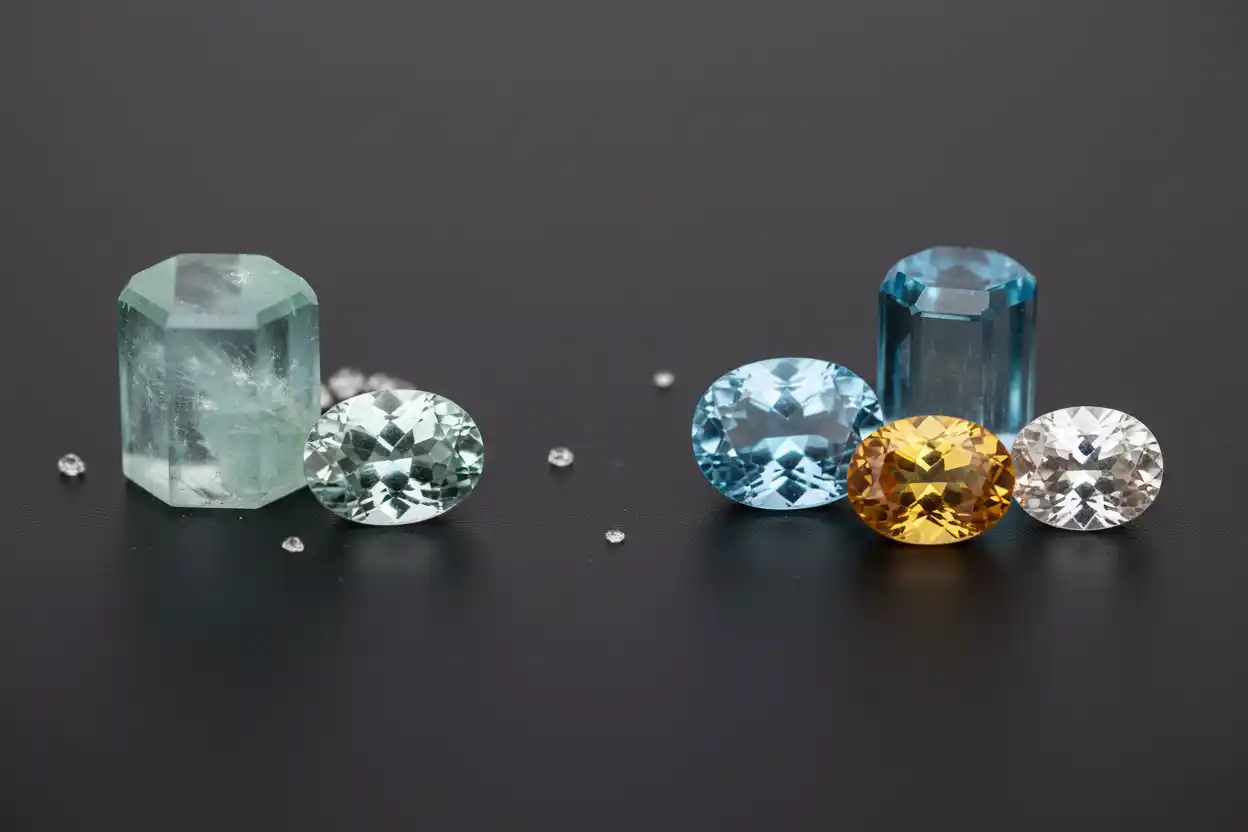
Aquamarine vs Topaz: Differences, Tests, Wear & Value
Aquamarine vs topaz is not simply a comparison between two blue gemstones. Aquamarine is the blue to greenish-blue variety of beryl, while topaz is a separate mineral species that occurs naturally in colorless, yellow, orange, brown, pink, red, blue, violet, and occasionally green material. Their visual overlap is greatest when blue topaz is involved, but the broader comparison matters because buyers also encounter golden, pink, imperial-type, colorless, and coated topaz sold alongside aquamarine in jewelry and gem collections.
The mineral properties separate them clearly. Aquamarine has the beryl composition Be₃Al₂Si₆O₁₈, a Mohs hardness of about 7.5–8, a specific gravity near 2.72, and refractive indices commonly around 1.577–1.583. Topaz is an aluminium fluorosilicate commonly represented as Al₂SiO₄(F,OH)₂, has Mohs hardness 8, is much denser at roughly 3.49–3.57, and commonly shows higher refractive indices, with typical gem material around 1.619–1.627. Aquamarine is optically uniaxial negative; topaz is biaxial positive.
For practical ownership, aquamarine is generally more forgiving in frequently worn jewelry because topaz has perfect basal cleavage. Topaz may resist scratching slightly better, but a hard blow, concentrated setting pressure, or sharp temperature change can exploit that cleavage and split the stone. Aquamarine remains brittle and can chip, yet it lacks topaz’s pronounced perfect cleavage plane.
The broader Identification collection follows the same principle: visual resemblance is useful for forming a hypothesis, while physical and optical evidence determines whether the hypothesis survives testing.
Aquamarine vs Topaz at a Glance
| Property | Aquamarine | Topaz |
|---|---|---|
| Mineral identity | Blue to greenish-blue variety of beryl | Distinct mineral species |
| Formula | Be₃Al₂Si₆O₁₈ | Al₂SiO₄(F,OH)₂ |
| Crystal system | Hexagonal | Orthorhombic |
| Common colors | Pale blue, greenish blue, blue-green, stronger blue | Colorless, yellow, brown, orange, pink, red, blue, violet, rare green |
| Mohs hardness | 7.5–8 | 8 |
| Specific gravity | About 2.72 | About 3.49–3.57 |
| Typical gem RI | About 1.577–1.583 | Commonly about 1.619–1.627; composition can broaden the range |
| Optical character | Uniaxial negative | Biaxial positive |
| Birefringence | About 0.005–0.009 | Commonly around 0.008–0.010 |
| Pleochroism | Often blue to near-colorless directional difference | Variable with color; can be visible |
| Cleavage | Indistinct to poor | Perfect basal cleavage |
| Typical clarity | Frequently highly transparent and eye clean | Frequently highly transparent and eye clean |
| Major treatment context | Heating commonly reduces the green component | Treatment depends strongly on color |
| Ring suitability | Generally very good with sensible protection | Good when cleavage is respected |
| Strongest identification tests | RI, SG, optic character | RI, SG, optic character, cleavage |
| Color alone reliable? | No | No |
The table also exposes why the phrase “topaz versus aquamarine” needs more context than “blue topaz versus aquamarine.” Topaz is a broad color family with treatment, rarity, and value patterns that change substantially from one color category to another.
Beryl and Topaz Are Structurally Unrelated
Aquamarine belongs to beryl, a ring silicate whose hexagonal crystals can grow as long six-sided prisms. Emerald, morganite, goshenite, heliodor, and aquamarine all share the same underlying beryl structure even though trace chemistry creates very different colors.
Topaz is an orthorhombic mineral rather than a beryl variety. Its fluorine-hydroxyl chemistry, crystal symmetry, density, cleavage, and optical character are different. Natural topaz crystals may be short or elongated prisms with complex terminations, and the species can occur in granite pegmatites, rhyolitic environments, greisens, hydrothermal systems, and certain metamorphic settings.
The chemical distinction is more useful than appearance because both minerals can be transparent, highly polished, pale, and remarkably clean. A clear pale blue stone does not reveal whether its crystal structure is beryl or topaz merely by looking attractive.
Visual Clues Help Most When the Topaz Is Not Blue
When the topaz is orange, pink, yellow, reddish, or colorless, confusion with aquamarine is usually limited because aquamarine’s variety definition occupies the blue-to-greenish-blue range. Warm-colored topaz can therefore be separated visually from aquamarine before any instrument is used, although visual identification still does not prove that the warm-colored stone is actually topaz.
The problem becomes much harder with blue topaz. Pale Sky-type blue topaz can resemble aquamarine closely, while strongly colored aquamarine can be deeper blue than many buyers expect. Commercial photography can narrow the apparent difference even further through white balance, exposure, background choice, and saturation adjustments.
For a decision specifically between those two blue materials, Aquamarine vs Blue Topaz focuses on the blue-market treatment and jewelry tradeoffs in greater detail. The broader comparison here is more useful when the word topaz is being used without specifying color.
Topaz Color Is a Much Wider Commercial Variable
Topaz occurs naturally across a broad palette. Colorless topaz is common, while yellow, brown, orange, pink, red, violet, blue, and other colors can develop through trace elements, color centers, and structural defects. Fine reddish, pinkish, and saturated orange-to-red material occupies a very different rarity and value category from inexpensive commercial blue topaz.
Terms such as “imperial topaz” require caution because no single universal definition governs the trade name. It is most commonly applied to highly desirable orange, reddish-orange, pinkish-orange, pink, or related warm colors, but sellers do not all draw the boundary in exactly the same place. Color quality matters more than the prestige of the label itself.
Yellow topaz can also be confused commercially with quartz varieties, which is why Citrine vs Yellow Topaz requires a different test sequence from an aquamarine comparison.
Refractive Index Is One of the Cleanest Tests
For a loose polished stone with a suitable facet, refractive index provides a strong separation. Aquamarine typically falls around 1.577–1.583, while ordinary gem topaz commonly reads around 1.619–1.627. The broader mineralogical range of topaz can shift with fluorine-hydroxyl composition, but it remains sufficiently different from normal aquamarine that proper measurements are highly diagnostic.
This test is preferable to trying to identify the gem from saturation, sparkle, or a seller’s color terminology. It is also nondestructive when performed correctly.
A refractometer may be difficult to use on some mounted stones, very small gems, heavily curved surfaces, or damaged facets. In those situations, other measurements can support the conclusion instead of forcing an uncertain reading.
Density Provides an Independent Confirmation
Topaz is considerably denser than aquamarine. A measured specific gravity around 2.72 is consistent with aquamarine, whereas topaz typically sits around 3.49–3.57.
The difference is large enough to be useful when the stone is loose and hydrostatic weighing can be performed accurately. Two stones with identical external dimensions and broadly similar cutting proportions should not have similar weights if one is aquamarine and the other topaz.
Casual heft in the hand is much weaker evidence because cut depth changes volume. A deep aquamarine may weigh more than a shallow topaz of similar face-up dimensions even though the underlying material is less dense.
The measured property matters; the sensation of heaviness does not.
Optic Character Separates the Crystal Systems
Aquamarine is uniaxial because it belongs to the hexagonal beryl structure. Topaz is biaxial because it crystallizes orthorhombically. A properly observed optic figure can therefore provide another strong separation when instrument conditions permit.
Pleochroism is less decisive. Aquamarine can show stronger blue in one direction and weaker blue or near-colorless appearance in another. Topaz can also be pleochroic, particularly in naturally colored warm stones.
Seeing directional color therefore supports mineralogical examination without determining the species by itself.
The same evidence hierarchy appears in Apatite vs Aquamarine, where attractive blue-green color is far less diagnostic than optical measurements.
Hardness Should Guide Wear, Not Scratch Testing
Topaz defines Mohs hardness 8, while aquamarine falls around 7.5–8. Both resist ordinary scratching better than many popular decorative minerals, and either can take an excellent polish.
That known hardness difference should not encourage scratching a finished gemstone.
A scratch test can permanently damage a polished surface while providing less information than a refractive-index measurement. It is particularly unnecessary when the stones already have well-established nondestructive diagnostic differences.
Hardness is most useful when deciding how a stone will wear over time.
Topaz Cleavage Changes the Durability Decision
Perfect basal cleavage is topaz’s major structural disadvantage. Although its hardness is excellent, it can split when force is applied in a favorable cleavage direction. Concentrated setting pressure, hard knocks, and sharp thermal changes therefore deserve greater attention with topaz than the Mohs number alone suggests.
Aquamarine does not possess the same perfect cleavage and is generally considered suitable for normal ring wear when protected from hard impacts. Its slightly lower scratch resistance is usually outweighed by more forgiving structural behavior in everyday jewelry.
This distinction is why “topaz is harder, therefore topaz is more durable” is incomplete. Hardness measures scratching. Toughness and cleavage influence breakage.
Treatment Depends Heavily on Which Topaz You Mean
Aquamarine has a relatively straightforward mainstream treatment pattern. Heating commonly reduces a natural green component and leaves a bluer appearance, while fracture filling is much less routine and should be disclosed when present. The heat-induced color is generally stable during normal ownership.
Topaz is more complicated because treatment varies with color. Much commercial blue topaz begins as colorless material that is irradiated and then heated. Yellowish-pink or reddish-brown material may be heated to intensify pink, and colorless topaz can receive thin surface coatings that create highly unusual or iridescent appearances such as material sold under “Mystic Topaz” terminology.
The word “treated” therefore gives too little information. A permanently heated pink topaz and a surface-coated iridescent topaz have different durability considerations even though both have undergone enhancement.
Natural origin is another question again. A naturally formed topaz remains natural topaz after treatment.
A Compact Treatment Comparison
| Material | Common treatment context | Practical implication |
|---|---|---|
| Aquamarine | Heat used to reduce greenish color | Common and generally stable |
| Fracture-filled aquamarine | Filler introduced into surface-reaching fractures | Requires disclosure and gentler cleaning |
| Blue topaz | Irradiation followed by heat | Extremely common in commercial blue material |
| Pink topaz | Some material produced or intensified through heating | Treatment must be evaluated independently of color quality |
| Coated topaz | Thin surface layer creates unusual colors or iridescence | Coating can abrade or be damaged during polishing |
| Naturally colored warm topaz | May be untreated or treated depending on individual stone | Do not assume status from hue alone |
Strongly colored natural blue topaz is much less common than treated commercial blue topaz, while fine natural pink, red, and imperial-type colors occupy completely different market tiers.
Care Is Similar Until Cleavage or Coating Enters the Picture
Warm soapy water is a conservative cleaning method for both aquamarine and topaz. Sound aquamarine can tolerate routine jewelry care well, although stones containing significant liquid inclusions, fractures, or filling deserve more conservative treatment.
Topaz should generally be kept away from steam, ultrasonic cleaning, sharp thermal changes, and unnecessary impact because of its cleavage. Coated topaz needs additional protection because abrasive cleaners and repolishing can remove the surface treatment.
The practical difference is therefore not that one gem is universally easy to clean and the other difficult. Treatment and structural condition determine the safest method.
Value Cannot Be Compared Until the Topaz Color Is Specified
Aquamarine versus topaz becomes commercially meaningless if all topaz colors are placed in one bucket.
Ordinary treated blue topaz is abundant and generally inexpensive relative to fine aquamarine. Colorless and common yellow or brown topaz can also be modestly priced. Fine saturated pink, red, and imperial-type topaz, however, can be significantly rarer and more valuable than ordinary aquamarine. Warm topaz with prized red or pink components belongs to a specialized market where color rarity changes the comparison completely.
Aquamarine’s strongest value drivers are normally blue color quality, transparency, cut, size, treatment context, and condition. Large eye-clean stones are available because beryl can form substantial clean crystals, so size alone does not guarantee exceptional value.
A seller asking “Which is more valuable, aquamarine or topaz?” must first identify which topaz and which aquamarine are actually being compared.
Decision Matrix: Which Stone Fits the Use?
| Priority | Better default choice | Why |
|---|---|---|
| Frequent everyday ring | Aquamarine | Strong hardness without topaz’s perfect cleavage |
| Maximum scratch resistance | Topaz | Mohs hardness 8 |
| Lowest cleavage concern | Aquamarine | No equivalent perfect basal cleavage |
| Pale watery blue | Aquamarine | Characteristic beryl appearance |
| Large inexpensive saturated blue | Treated blue topaz | Broad commercial availability |
| Fine orange-pink collector gem | Topaz | Valuable warm topaz occupies a category aquamarine does not |
| Classic blue luxury gemstone | Aquamarine | Strong established market identity |
| Wide natural color collection | Topaz | Much broader color range |
| Simple treatment expectations | Aquamarine | Mainstream heat treatment is relatively straightforward |
| Highly unusual iridescent color | Coated topaz | Surface treatments can create effects not typical of aquamarine |
| Large transparent specimen crystal | Either | Crystal form, locality, condition, and provenance decide |
| Minimal breakage concern in a ring | Aquamarine | More forgiving structural behavior |
| Low-cost statement pendant | Blue topaz | Large clean stones are economical |
| Warm-color heirloom gem | Fine topaz | Pink, red, orange, and imperial-type material can be exceptional |
| Guaranteed investment | Neither | Future resale and appreciation cannot be guaranteed |
The matrix shows why one winner cannot be declared without first defining the intended use and topaz variety.
Four Practical Decision Cases
A buyer choosing a pale blue stone for an everyday ring will usually get the more forgiving structural choice from aquamarine. Its combination of good hardness, poor rather than perfect cleavage, established ring use, and classic blue-green beryl appearance makes it easier to own over long periods. A pale treated blue topaz may cost less, but the setting should protect it from hard knocks.
A buyer seeking a large saturated blue pendant at moderate cost may rationally prefer treated blue topaz. Pendant wear exposes the gem to less impact than a ring, while topaz’s large clean crystals and established treatment market allow substantial visual presence without the price expected for fine saturated aquamarine.
A collector deciding between a fine blue aquamarine and vivid pink or orange-red topaz faces a completely different comparison. Topaz’s rare warm colors can command high desirability and should not be judged using mass-market blue-topaz assumptions.
A buyer whose main priority is mineral identification rather than jewelry style should ignore these aesthetic decisions and test the material. Refractive index, density, and optic character can resolve the basic species question far more reliably than price, saturation, or seller terminology.
Laboratory Limits: One Test Does Not Answer Every Question
Confirming that a gem is beryl or topaz does not automatically determine natural versus laboratory-grown origin, treatment history, mine origin, or value.
A basic gemological examination can usually separate aquamarine from topaz through refractive index, density, optic character, microscopy, and related observations. More advanced testing becomes useful when a seller makes claims about natural color, unusual treatment status, laboratory growth, or exceptional provenance.
A report can identify material and detectable treatments without establishing a universal quality grade or retail price. Both aquamarine and topaz are evaluated as colored stones rather than being assigned a standardized diamond-style quality score.
The same distinction between visual clue and material proof applies in comparisons such as Amazonite vs Turquoise, Aventurine vs Jade, and Carnelian vs Red Jasper. Similar color or texture may start an identification, but it rarely finishes one.
A Practical Identification Sequence
Begin by recording color, transparency, dimensions, weight, visible inclusions, cut, and any treatment or origin statement supplied with the stone. If the gem is loose, obtain a refractive-index reading before considering destructive tests. An aquamarine-compatible reading near the upper 1.57s to low 1.58s immediately pushes the identification toward beryl, while a typical topaz reading in the low 1.62 region strongly favors topaz.
Specific gravity then provides an excellent independent check because topaz is dramatically denser. If uncertainty remains, optical character distinguishes uniaxial beryl from biaxial topaz. Microscopy can document internal features, surface coatings, fractures, and other clues, while spectroscopy or additional laboratory methods can address questions the conventional tests cannot resolve.
This sequence is efficient because every step adds independent evidence rather than repeating the same visual judgment in a different form.
Claims That Should Not Decide the Identification
A stone is not aquamarine because the seller calls its color “ocean blue.”
A stone is not topaz because it is heavy unless density was actually measured.
A stone is not untreated because its color looks natural.
A pale blue topaz is not necessarily more durable merely because Mohs hardness is slightly higher.
A warm orange topaz is not automatically “imperial” because the term appears on an invoice.
A laboratory report proving topaz does not prove a particular mine.
A high price does not authenticate either species.
These distinctions also matter in Citrine vs Yellow Sapphire, Amethyst vs Charoite, Clear Quartz vs Selenite, and Carnelian vs Sunstone, where apparently simple appearance-based choices hide major structural differences.
Which Stone Is Better for Jewelry?
Aquamarine is the stronger all-around choice for frequent rings because its durability profile is easier to manage. Topaz works extremely well in pendants, earrings, brooches, and protected rings, and its hardness gives it excellent resistance to surface scratching. The perfect cleavage simply means design and impact protection matter more.
Neither stone is indestructible. Aquamarine can chip at exposed corners, fracture after severe impact, or suffer damage when existing inclusions are stressed. Topaz can remain beautiful for decades when the setting avoids concentrated pressure and the owner protects it from sharp impacts and temperature extremes.
Jewelry suitability should therefore be judged from the complete material behavior rather than one hardness number.
Which Stone Offers Better Value?
For a buyer wanting a conventional blue gemstone, aquamarine generally occupies the higher-value category than common treated blue topaz. Blue topaz is abundant, large clean stones are readily available, and treatment has made saturated blue color accessible at mass-market prices.
The result reverses when exceptional warm topaz enters the comparison. Fine pink, red, purplish-pink, and prized orange-to-red material can be rare and commercially important. Topaz is therefore not inherently a cheaper substitute for aquamarine; only some sectors of the topaz market fit that description.
The best value is the stone whose identity, treatment, quality, durability, and price fit the buyer’s purpose rather than whichever species carries the stronger name recognition.
Frequently Asked Questions
What is the main difference between aquamarine and topaz?
Aquamarine is blue to greenish-blue beryl, while topaz is a separate aluminium fluorosilicate mineral. Their chemistry, crystal structure, density, refractive index, optic character, cleavage, colors, and treatment patterns differ.
Is aquamarine a type of topaz?
No. Aquamarine belongs to beryl. Topaz is its own mineral species.
Can topaz be the same color as aquamarine?
Yes. Blue topaz can overlap closely with aquamarine, especially in pale and medium blue shades.
Does topaz only come in blue?
No. Topaz occurs in colorless, yellow, brown, orange, pink, red, violet, blue, and other colors.
Which is harder?
Topaz is Mohs 8, while aquamarine is approximately 7.5–8.
Which is tougher?
Aquamarine is generally more forgiving for everyday jewelry because topaz has perfect basal cleavage despite its excellent hardness.
Which stone is heavier?
Topaz. Its specific gravity is roughly 3.49–3.57 compared with about 2.72 for aquamarine.
Can weight distinguish aquamarine from topaz?
Measured specific gravity can provide strong evidence. Casual hand-heft is unreliable because different cuts contain different volumes.
What is aquamarine’s refractive index?
Typical aquamarine is approximately 1.577–1.583.
What is topaz’s refractive index?
Typical gem topaz is commonly around 1.619–1.627, although mineralogical values vary somewhat with composition.
Can a refractometer separate them?
Yes. The normal ranges are sufficiently different that a proper refractive-index measurement is one of the strongest routine tests.
Is aquamarine better for rings?
Usually. Aquamarine combines good hardness with a more forgiving cleavage profile.
Can topaz be worn in rings?
Yes. Protective design and avoidance of hard impacts are especially important because of perfect basal cleavage.
Which stone is usually more expensive?
Fine aquamarine is generally more expensive than common treated blue topaz, but rare pink, red, or imperial-type topaz can be considerably more valuable than ordinary aquamarine.
Is blue topaz naturally blue?
Natural blue topaz exists, but strongly colored commercial blue topaz is commonly produced by irradiating and heating colorless material.
Is treated topaz fake?
No. A naturally formed topaz remains natural topaz after treatment.
Is aquamarine treated?
Heat treatment is common and usually reduces the green component to create a purer blue appearance.
Does heating make aquamarine synthetic?
No. Synthetic origin describes laboratory growth, while heat treatment modifies a naturally formed stone after mining.
What is imperial topaz?
Imperial topaz is a trade term generally associated with desirable warm orange, pink, reddish, or related colors. There is no single universally standardized boundary for the term.
Is imperial topaz more valuable than aquamarine?
Fine examples can be. Value depends on the specific color, saturation, clarity, cut, size, treatment, and market context of both stones.
Is topaz clearer than aquamarine?
Both can be exceptionally transparent and eye clean. Clarity alone is not a reliable way to distinguish them.
Which gemstone has more colors?
Topaz. Aquamarine occupies a blue-to-greenish-blue beryl range, while topaz occurs across a much broader palette.
Can photographs distinguish aquamarine from topaz?
Not reliably when their colors overlap. Lighting, camera processing, and cut can make different minerals look nearly identical.
Should I use a scratch test?
No. Finished gemstones can be permanently damaged. Refractive index, density, optical examination, and spectroscopy provide nondestructive alternatives.
Does a gem report determine value?
No. A report can provide material and treatment information, but beauty, rarity, cut, condition, demand, and retail context still determine commercial value.
Which should I choose?
Choose aquamarine when blue beryl identity, everyday ring wear, restrained sea-like color, and easier structural durability are priorities. Choose topaz when a wider color range, large clean stones, stronger scratch resistance, inexpensive treated blue, or rare warm colors better match the intended use.
Where can I ask about a specific stone?
Clear photographs, dimensions, weight, report details, treatment statements, and the exact question can be submitted through Contact Gems Lore. Information submitted through the site is handled according to the Privacy Policy.
Aquamarine vs topaz becomes straightforward once the comparison begins with mineral identity instead of color. Aquamarine is lighter, lower in refractive index, hexagonal and uniaxial, while topaz is denser, higher in refractive index, orthorhombic and biaxial. Topaz is marginally harder but has perfect cleavage; aquamarine generally offers the more forgiving durability profile for frequent ring wear.
The commercial decision depends strongly on which topaz is involved. Common treated blue topaz offers large saturated stones at accessible prices, whereas fine pink, red, orange, and imperial-type topaz can occupy an entirely different rarity and value class. Aquamarine remains distinctive for its blue-to-greenish-blue beryl identity, excellent transparency, and practical jewelry durability.
A strong comparison therefore uses measurable properties first and personal preference second. The broader Gems Lore standards for separating identification evidence, treatment claims, value judgments, and belief-based language are described on About Gems Lore and in the site’s Disclaimer.