Beryl Meaning: Mineral Identity, Colors & Symbolism
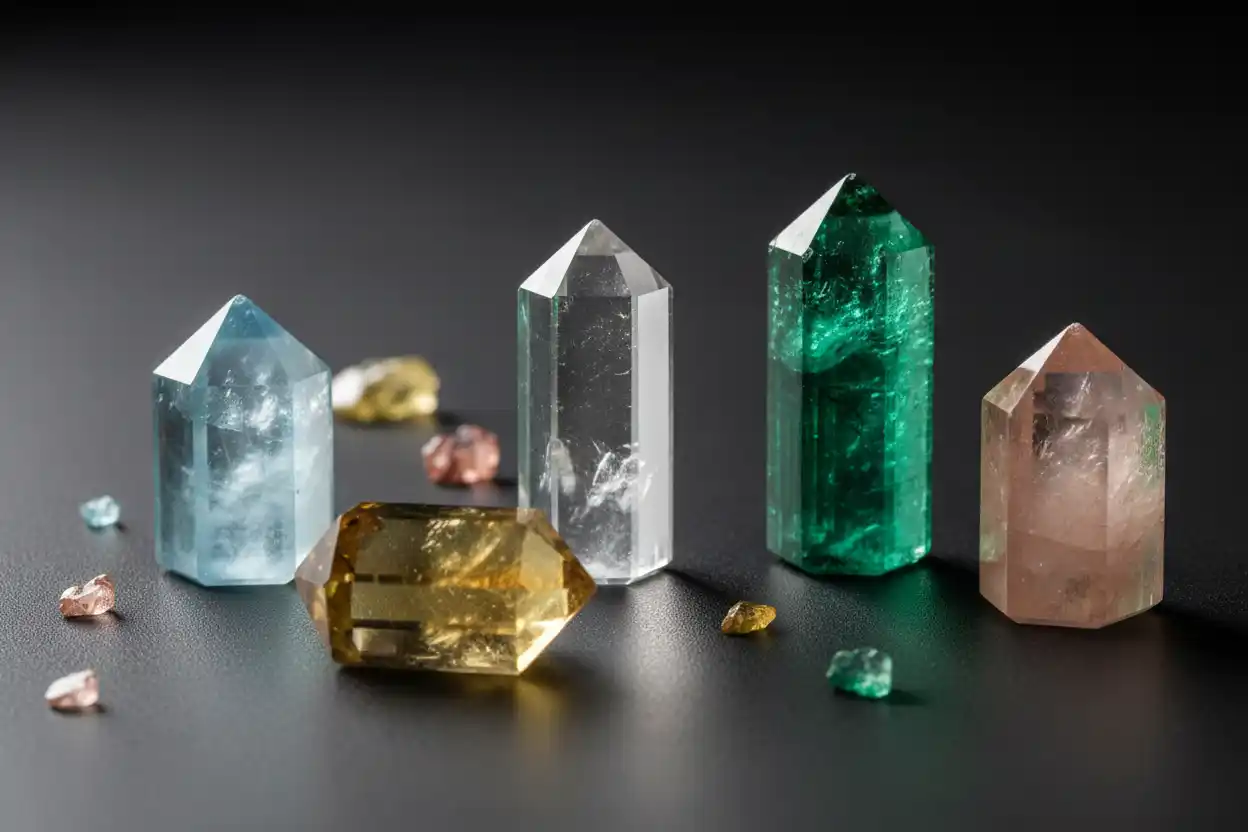
Beryl meaning begins with a mineral species that includes several of the world’s best-known colored gemstones. Beryl is a beryllium aluminum silicate with the formula Be₃Al₂Si₆O₁₈ and crystallizes in the hexagonal system, commonly producing long six-sided prisms with flat or modified terminations. Pure beryl can be colorless, but trace elements, structural defects, and color centers create a remarkably broad palette that includes the green of emerald, blue to blue-green of aquamarine, pink of morganite, yellow to golden hues traditionally called heliodor or golden beryl, colorless goshenite, and extremely rare red beryl.
This shared mineral identity is important because emerald, aquamarine, morganite, and other named beryl varieties are not unrelated stones that happen to resemble one another. Their basic crystal structure and major-element chemistry are the same. What changes are relatively small components within the crystal, along with inclusions, geological environment, treatment history, and optical absorption. A chromium-bearing emerald and an iron-bearing aquamarine can therefore look dramatically different while remaining members of the same mineral species.
Beryl is also physically well suited to gemstone use. Its Mohs hardness is about 7.5–8, giving it good resistance to ordinary scratching, while specific gravity commonly falls around 2.63–2.92 depending on composition. It has vitreous luster, generally poor or indistinct basal cleavage, and brittle tenacity. Transparent crystals can display excellent clarity, although many natural specimens contain mineral inclusions, fluid inclusions, growth tubes, fractures, zoning, or other internal features that help document how the crystal formed.
Modern beryl meaning often includes clarity, communication, courage, adaptability, emotional balance, confidence, or personal growth. Those interpretations vary substantially among individual beryl varieties and modern metaphysical traditions. They can function as personal symbolism, but they are not measurable effects of Be₃Al₂Si₆O₁₈. Beryl has not been demonstrated to heal disease, alter emotions through mineral energy, activate chakras, improve intelligence, attract wealth, or transfer beneficial beryllium into the body.
Readers exploring other evidence-led mineral references can browse the wider Gemstone Guides.
Beryl Identity at a Glance
| Property | Beryl |
|---|---|
| Mineral species | Beryl |
| Chemical formula | Be₃Al₂Si₆O₁₈ |
| Mineral class | Cyclosilicate |
| Crystal system | Hexagonal |
| Common habit | Six-sided prismatic crystals, commonly elongated |
| Typical colors | Colorless, green, blue, blue-green, yellow, golden, pink, red |
| Transparency | Transparent to translucent; some material opaque |
| Luster | Vitreous |
| Mohs hardness | Approximately 7.5–8 |
| Specific gravity | Commonly about 2.63–2.92 |
| Cleavage | Poor to indistinct basal cleavage |
| Tenacity | Brittle |
| Optical character | Uniaxial negative |
| Typical refractive index | Roughly 1.56–1.60 depending on composition |
| Birefringence | Generally low |
| Major gem varieties | Emerald, aquamarine, morganite, heliodor/golden beryl, goshenite, red beryl |
| Common geological setting | Granitic pegmatites; also hydrothermal and metamorphic environments |
| Main ownership concern | Fractures and inclusions can reduce toughness despite good hardness |
| Identification limit | Color alone cannot establish a beryl variety or treatment status |
The identity table explains why beryl meaning should not begin with color symbolism. First establish that the material is beryl. Then determine variety, color mechanism, inclusions, treatment, provenance, and only afterward discuss symbolic associations.
Beryl Is a Ring Silicate
Beryl belongs to the cyclosilicate, or ring-silicate, mineral class. Its structure contains rings of six linked silica tetrahedra, creating channels that run along the crystallographic c-axis.
Those structural channels can accommodate small amounts of additional ions, molecules, or other constituents. Their presence helps explain some of the chemical variability found in natural beryl and contributes to differences in physical and spectroscopic behavior among specimens.
Beryllium and aluminum occupy other important positions within the structure, giving the mineral its characteristic framework.
This structural arrangement explains why beryl is not simply “colored quartz.” Quartz is SiO₂ and has a fundamentally different framework, chemistry, density, optical behavior, and crystal morphology.
The hexagonal-looking crystal shape may make the two appear superficially related, but their structures are not interchangeable.
Pure Beryl Is Colorless
Ideally pure beryl lacks the strong color associated with emerald, aquamarine, or morganite. Colorless gem beryl is known as goshenite.
The familiar colors arise when trace elements substitute into structural sites, when different oxidation states alter light absorption, or when defects and color centers change how wavelengths pass through the crystal.
This means color is not simply painted onto the outside.
It is produced by interactions between visible light and the crystal’s atomic-scale chemistry.
The same basic beryl structure can consequently produce gems that appear saturated green, pale sky blue, warm yellow, soft pink, or colorless.
Emerald Is Green Beryl
Emerald is the best-known green variety of beryl. Its color is associated primarily with chromium and/or vanadium incorporated into the crystal structure.
Not every green beryl is automatically emerald.
Gemological naming depends on color character and the cause of that coloration, while lighter or differently colored iron-bearing green material may be described simply as green beryl rather than emerald.
This distinction matters because the commercial, geological, treatment, and inclusion characteristics of emerald can differ considerably from other beryls.
Emerald is also commonly more included than aquamarine or morganite, partly because the geological environments capable of bringing beryllium together with chromium or vanadium can be unusually reactive and structurally complex.
The presence of inclusions does not automatically make an emerald poor quality.
It does, however, influence transparency and durability.
Aquamarine Is Blue to Blue-Green Beryl
Aquamarine owes its blue to blue-green color mainly to iron in suitable oxidation states and structural environments.
Natural crystals can range from very pale blue through greenish blue to stronger blue. Color intensity often varies through a crystal because trace-element concentration and growth conditions change during formation.
Iron-related absorption also helps explain why heating can modify the apparent green component in some aquamarine, although treatment questions should be evaluated independently from basic mineral identity.
The underlying mineral remains beryl.
Aquamarine’s comparatively common occurrence in granitic pegmatites can allow much larger clean crystals than are typical for fine emerald.
This difference in geological supply helps explain why size alone has very different commercial significance across beryl varieties.
Morganite Is Pink Beryl
Morganite is the pink to peach-pink variety of beryl. Manganese plays an important role in its coloration, with natural crystals ranging from very pale blush tones to more distinct pink and peach.
Like aquamarine, morganite can occur in relatively large pegmatite crystals.
Its color may vary through one crystal, and inclusions can include fluid-filled features, tubes, fractures, or other growth-related structures.
The name identifies color variety rather than a separate mineral species.
A pink beryl and blue aquamarine remain structurally much more closely related than their appearance suggests.
Golden Beryl and Heliodor
Yellow, golden-yellow, yellow-green, and related beryl colors are commonly associated with iron, particularly ferric iron-related absorption.
The terms golden beryl and heliodor are often encountered in the gem trade. Their exact usage can overlap rather than following one universally rigid color boundary.
This is a useful example of the difference between mineral species and variety terminology.
“Beryl” is a mineralogical species.
Color-variety names can carry historical and trade conventions that are less chemically absolute.
A stone should not be assigned an expensive-sounding variety name merely because it occupies a vaguely similar color range.
Red Beryl Is Exceptionally Uncommon
Red beryl is a rare red to raspberry-red variety whose color is associated with manganese-related processes within the beryl structure.
Its geological occurrence is much more restricted than aquamarine or common pale beryl, and gem-quality crystals are generally small.
Red beryl should not be confused with red corundum, spinel, garnet, tourmaline, or other red gemstones.
The color category describes appearance.
Mineral identity still comes from structure, chemistry, optical properties, and appropriate analytical testing.
Its scarcity also illustrates an important principle: varieties of the same mineral can have dramatically different supply because the geological ingredients required to create each color are not equally common.
Goshenite Is Colorless Beryl
Goshenite is the traditional name for colorless beryl.
Because most famous beryl varieties are defined by color, goshenite represents material in which strong coloring effects are absent or very weak.
Well-formed crystals can be transparent and attractive, but colorless beryl occupies a different commercial position from emerald or aquamarine because rarity of attractive color often drives demand in the beryl family.
Colorless beryl can also be useful for studying the mineral’s underlying optical behavior without strong body-color absorption dominating the view.
The existence of goshenite reinforces an important point: blue, green, pink, yellow, and red are modifications of the same basic mineral framework rather than necessary properties of beryl itself.
How Beryl Forms
Beryl requires beryllium, and beryllium is not abundant enough in most ordinary rocks to produce beryl freely. It tends to become concentrated during specialized geological processes, particularly late stages of granitic magmatism.
Granitic pegmatites are therefore among the most familiar beryl environments. As a granitic melt evolves, common elements crystallize into feldspar, quartz, mica, and other minerals while less-compatible elements become concentrated in the residual melt and fluids.
Beryllium can become sufficiently enriched for beryl to crystallize.
Pegmatites may produce enormous beryl crystals because they contain volatile-rich late-stage melts and fluids and can develop large open or chemically favorable growth environments. Quartz, feldspar, muscovite, tourmaline, topaz, spodumene, lepidolite, and other minerals may occur nearby depending on pegmatite chemistry.
Beryl also forms outside pegmatites. Hydrothermal veins, metamorphic rocks, schists, greisens, and specialized replacement environments can produce beryl where beryllium-bearing fluids or rocks interact with suitable aluminum- and silica-rich conditions.
The detailed distinctions among pegmatitic, hydrothermal, and metamorphic beryl are covered in Beryl formation and deposit geology.
Emerald Often Forms in Different Geological Conditions From Aquamarine
The geological contrast between emerald and aquamarine is one of the most informative examples within the beryl family.
Beryllium is commonly associated with evolved granitic systems.
Chromium and vanadium, which can produce emerald color, are often concentrated in chemically different rocks.
Producing emerald therefore requires geological processes that bring these otherwise separated chemical ingredients together.
Aquamarine commonly forms more directly in granitic pegmatitic systems where iron is available.
This difference helps explain why emerald deposits can involve complex fluid-rock interaction, deformation, metamorphism, or unusual host rocks rather than simply large open pegmatite cavities.
The same mineral species can therefore record very different geological histories depending on color variety.
Crystal Shape Can Be Strongly Characteristic
Beryl commonly forms hexagonal prisms whose six-sided cross-sections are easily recognizable in good crystals.
Some are short and stout.
Others are extremely elongated.
Flat basal terminations are common, while additional faces can modify the ends and edges.
Longitudinal striations or growth features may occur on prism faces, and natural surfaces can be etched, frosted, coated, fractured, or partly replaced by later minerals.
Crystal habit provides strong supporting evidence, especially in matrix specimens.
It does not prove beryl by itself.
Apatite, quartz, tourmaline, and several other minerals can form prismatic crystals that may look superficially similar in incomplete photographs.
Beryl Has Good Hardness but Is Still Brittle
With Mohs hardness around 7.5–8, beryl resists scratching better than quartz and substantially better than fluorite, apatite, calcite, or most soft collector minerals.
That hardness makes many beryl varieties excellent jewelry stones.
Hardness is not the same as toughness.
Beryl remains brittle, and fractures or inclusions can create weak points. Emerald is especially important in this respect because many gems contain extensive fissures or inclusions that make them more vulnerable to impact than a relatively clean aquamarine of identical mineral species.
A strongly included beryl should therefore be handled according to its actual internal condition rather than relying on the hardness number alone.
Cleavage Is Usually Not Beryl’s Main Durability Problem
Beryl has poor or indistinct basal cleavage rather than the strong easy cleavage found in topaz or some softer collector minerals.
This is favorable for jewelry.
In practice, fractures, inclusions, thin corners, drill holes, facet edges, and treatment-filled fissures can create greater durability concerns than cleavage itself.
The individual variety matters.
A clean aquamarine can tolerate routine jewelry wear better than a heavily fissured emerald despite both sharing essentially the same hardness.
This is why species-level durability should never replace examination of the actual stone.
Setting pressure, vulnerable inclusions, protective design, and daily-wear considerations are treated in Beryl setting and wear engineering.
Beryl’s Optical Properties Are Useful for Identification
Beryl is uniaxial negative and generally has refractive indices in roughly the mid-1.56 to upper-1.59 range, with composition causing some variation.
Its birefringence is relatively low.
These properties help distinguish faceted beryl from visually similar gemstones once natural crystal habit is gone.
Aquamarine can be separated from blue topaz, blue zircon, glass, or sapphire through refractive index, density, optic character, pleochroism, and other tests.
Emerald can be distinguished from green glass, garnet, tourmaline, sapphire, and several simulants through similar combinations.
Beryl varieties can overlap optically enough that color variety itself is not always determined by basic refractive measurements. Chemistry and spectroscopy can provide more detail where needed.
The relationship among refractive index, pleochroism, absorption, color centers, birefringence, and crystal orientation is explored in Beryl optical properties and color behavior.
Inclusions Can Reveal Growth History
Natural beryl may contain fluid inclusions, mineral crystals, growth tubes, healed fractures, hollow channels, fingerprints, zoning, and other features.
Different geological environments create different inclusion populations.
An emerald formed through fluid-rock interaction may contain a very different internal scene from aquamarine crystallized in a granitic pegmatite.
Inclusions can therefore provide evidence about formation and, in some circumstances, geographic origin.
They are not automatically flaws.
For a mineralogist, inclusions may preserve tiny samples of the environment present while the host beryl grew.
For a gemstone buyer, the same inclusions can affect transparency, appearance, durability, and value.
More detailed examination of these internal structures belongs in the Beryl microscope inclusion notebook.
Original Beryl Specimen and Photo Checklist
| Observation | What it may reasonably support | What it cannot prove alone |
|---|---|---|
| Six-sided prismatic crystal | Strong compatibility with beryl | Exact species without other tests |
| Pale blue transparent prism | Compatible with aquamarine | Natural untreated status |
| Rich green included crystal | Compatible with emerald | Chromium or vanadium without analysis |
| Pink prismatic crystal | Compatible with morganite | Manganese mechanism automatically |
| Yellow beryl crystal | Compatible with golden beryl | Exact trade-variety terminology |
| Colorless six-sided crystal | Compatible with goshenite | Beryl identity by sight alone |
| Longitudinal surface striations | Useful morphology | Geographic origin |
| Pegmatite with quartz and feldspar | Plausible formation context | Exact variety |
| Fluid inclusions | Evidence of natural growth processes | Geographic origin by themselves |
| Filled surface-reaching fractures | Possible treatment clue | Filling material without analysis |
| RI in expected beryl range | Strong identification evidence | Variety origin |
| SG in expected range | Strong supporting evidence | Treatment status |
| Spectroscopy matching emerald chromophores | Strong color-mechanism evidence | Provenance |
| Raman result matching beryl | Strong species evidence | Natural versus synthetic origin automatically |
| Original mine label | Valuable provenance evidence | Independent identity confirmation |
This checklist separates recognition from proof. A six-sided pale-blue crystal can strongly suggest aquamarine, but the photograph cannot establish treatment, exact chemistry, mine, or market value.
Beryl Claims That Need Qualification
| Claim | More accurate interpretation |
|---|---|
| “Beryl is one color” | Pure beryl can be colorless, while trace chemistry creates many varieties |
| “Emerald and aquamarine are different minerals” | Both are varieties of beryl |
| “Every green beryl is emerald” | Green beryl terminology depends on color and coloring chemistry |
| “Every yellow beryl is heliodor” | Trade usage varies; golden beryl and heliodor can overlap |
| “Pink beryl is rose quartz” | False; morganite is beryl, while rose quartz is quartz |
| “Beryl is always safe because it is hard” | It is brittle, and fractures can reduce durability |
| “Beryllium in beryl benefits the body” | Wearing beryl does not provide a controlled nutritional or therapeutic beryllium dose |
| “Emerald inclusions mean the stone is fake” | Natural emerald commonly contains inclusions |
| “A perfect-looking emerald must be natural” | Synthetic emerald can show excellent appearance |
| “Color proves locality” | Geographic origin requires additional evidence |
| “Beryl activates communication scientifically” | Communication symbolism is not a measured mineral effect |
| “All beryl varieties have identical value” | Supply, color, size, clarity, treatment, and demand differ drastically |
These boundaries prevent one mineral family from being divided into misleading myths based purely on color.
Natural and Synthetic Beryl Need Separate Identification
Laboratory-grown beryl exists, especially synthetic emerald.
A synthetic emerald is chemically and structurally beryl, not green glass.
The important distinction is origin: one grew through natural geological processes, while the other was produced under controlled manufacturing conditions.
Because synthetic material can reproduce many optical properties of natural beryl, species identification alone does not establish natural origin.
Microscopic growth features, inclusions, spectroscopy, trace-element chemistry, and laboratory methods may be required.
This is particularly important for commercially significant emeralds where origin materially affects value.
Treatments Vary Across Beryl Varieties
The beryl family contains several treatment traditions, but they should not be generalized across every variety.
Fracture filling with oils or resins is particularly associated with emerald because natural fissures are common.
Heating is widely associated with some aquamarine and morganite to modify color.
Other forms of enhancement may occur depending on material and market.
A treatment does not change the basic species from beryl to something else.
It changes the condition and disclosure requirements of the individual gemstone.
Because treatment evaluation is a separate question from beryl meaning, it should not overwhelm the mineral reference itself.
Beryl Can Produce Extremely Large Crystals
Pegmatitic beryl can grow to dimensions far beyond those typical of faceted gemstones.
Large crystals can be opaque or heavily fractured and may be valued as mineral specimens or even as industrial sources of beryllium rather than gem rough.
Physical size therefore should not be confused with gem quality.
A small transparent crystal may be much more valuable as gem material than a massive opaque beryl several orders of magnitude larger.
This distinction reflects the difference between mineral abundance and usable gem quality.
Cutting Beryl Depends Strongly on Variety
Transparent beryl is an important faceting material, but cutting strategy changes with color and inclusions.
Aquamarine rough may be elongated and relatively clean, allowing cutters to balance weight retention with color orientation.
Morganite may require decisions about pale color concentration.
Emerald commonly demands much greater attention to fissures, inclusions, and durability.
Red beryl often begins with very small crystals, making weight preservation especially important.
Orientation also affects pleochroism and perceived saturation.
The technical decisions involving crystal axis, inclusions, yield, polishing, windowing, facet design, and rough preservation are explored in Beryl cutting, orientation and polish.
Natural Beryl Specimens Can Be More Informative Than Cut Gems
A complete beryl crystal preserves natural faces, growth zoning, matrix relationships, etching, mineral associations, and evidence about the environment in which it formed.
Faceting deliberately removes that information to maximize optical beauty.
Neither form is inherently superior.
They answer different questions.
A fine aquamarine crystal on matrix may be more significant as a specimen than as rough, while broken transparent material with little morphological context may make excellent cutting material.
Original labels, matrix support, repairs, surface preservation, and storage are covered in the Beryl specimen conservation record.
Provenance Matters Differently Across Beryl Varieties
For some beryl, locality is an interesting additional fact.
For fine emerald, geographic origin can materially influence collector interest and commercial interpretation.
Certain aquamarine, morganite, red beryl, or specimen localities can also carry strong reputations.
Appearance alone does not establish origin.
A vivid green emerald cannot be assigned to one country from hue.
An aquamarine cannot be assigned to a famous pegmatite because it is especially clean.
Reliable provenance may involve mine documentation, trusted dealer records, original collection labels, laboratory origin analysis, or a combination of evidence.
The Beryl provenance and disclosure checklist provides a structured way to separate identity, treatment, locality, and seller claims.
Beryl and Benitoite Can Both Be Blue but Are Unrelated
Benitoite meaning concerns a rare blue barium titanium silicate with high refractive index, strong birefringence, triangular crystal habit, and a very different geological story.
Aquamarine is beryl.
Benitoite is not.
The two can overlap in pale-to-strong blue color, but refractive index, density, birefringence, fluorescence, crystal habit, and chemistry separate them efficiently.
This is another example of why gemstone color should never be treated as mineral identity.
Beryl and Bauxite Share Aluminum but Little Else
Bauxite meaning concerns an aluminum-rich ore rock composed of several minerals, whereas beryl is one precisely defined crystalline species.
Both contain aluminum.
That shared element does not make them close mineralogical relatives.
Bauxite’s aluminum commonly occurs in gibbsite, boehmite, and diaspore, while beryl incorporates aluminum within a beryllium silicate ring structure.
The difference illustrates why complete chemistry and crystal structure matter more than identifying one common element.
Beryl and Bismuth Are Different Types of Natural Material
Bismuth meaning concerns a native metallic element rather than a silicate mineral.
Bismuth is opaque, metallic, very dense, and soft.
Beryl is commonly nonmetallic, substantially harder, less dense, and may be transparent enough for fine gemstones.
Colorful laboratory-grown hopper bismuth crystals can look visually dramatic, but their metallic iridescence has no structural relationship with colored beryl.
The comparison helps separate elemental minerals from complex silicates.
Beryl and Bixbyite Differ in Chemistry and Appearance
Bixbyite meaning concerns a manganese-iron oxide mineral commonly appearing dark, opaque, and metallic-to-submetallic.
Beryl is a beryllium aluminum silicate commonly associated with transparent prismatic crystals.
Their mineral classes, crystal structures, density, hardness, transparency, and geological settings are entirely different.
The fact that both may occur in specialized mineral deposits does not imply close mineralogical relationship.
Beryllium Requires a Proportionate Safety Boundary
Beryllium is an essential part of the beryl crystal structure, and beryllium exposure can be hazardous in certain occupational forms, particularly when respirable particles or fumes from beryllium-containing materials are generated.
That does not mean an intact aquamarine, emerald, or beryl crystal is equivalent to industrial exposure to respirable beryllium dust.
Exposure pathway matters.
Normal ownership and ordinary handling of stable polished beryl are fundamentally different from crushing, grinding, pulverizing, or processing large quantities of beryllium-bearing material.
This distinction avoids both extremes: pretending chemistry never matters and treating every intact beryl gemstone as dangerous.
Do Not Grind Beryl for Wellness Use
Beryl should not be pulverized for ingestion, deliberately added to drinking water as a source of minerals, or consumed as a supposed healing preparation.
The beryllium in the crystal is not a beneficial nutritional ingredient.
Natural specimens can also contain additional minerals, trace elements, coatings, polishing compounds, filling materials, matrix, or contaminants not represented by the ideal beryl formula.
Symbolic crystal use does not require ingestion.
Leaving the stone intact is both safer and better for preservation.
Lapidary Work Needs Dust Control
Sawing, grinding, drilling, faceting, or polishing beryl creates fine particles.
Professional lapidary practice should minimize airborne dust through appropriate wet methods, extraction, housekeeping, eye protection, and respiratory controls suited to the operation.
Matrix specimens require additional attention because associated quartz, feldspar, mica, sulfides, or other minerals contribute to the dust mixture.
These are workshop precautions.
They are not evidence that wearing a finished aquamarine pendant or storing an emerald specimen is inherently unsafe.
Modern Beryl Meaning and Clarity
Clarity is one of the broadest modern beryl meaning themes, especially because many beryl varieties can form transparent crystals with well-defined hexagonal geometry.
Someone may use a beryl crystal as a reminder to identify the central issue in a complicated situation, organize information, or distinguish observation from assumption.
That can be a practical symbolic use.
The mineral has not been demonstrated to improve cognition, memory, concentration, or neurological clarity through an energetic field.
Mental clarity remains a human process.
Beryl Meaning and Communication
Beryl varieties, particularly blue aquamarine, are frequently associated with communication in modern symbolic systems.
A person might use the stone as a reminder to speak precisely, prepare for an important conversation, listen before responding, or communicate boundaries calmly.
Those behaviors can improve communication.
Beryl itself has not been demonstrated to alter vocal function, language processing, confidence, or another person’s willingness to understand.
The stone can cue an intention without producing the result biologically.
Beryl Meaning and Courage
Emerald, aquamarine, and other beryls have accumulated modern themes involving courage, emotional steadiness, and confidence.
The symbolism can be useful when it is translated into action.
A person might associate a beryl ring with a commitment to speak up, complete a difficult task, or remain composed under pressure.
The object marks the decision.
It does not manufacture courage.
Psychological resilience develops through experience, support, skills, circumstances, and behavior rather than mineral contact.
Beryl Meaning and Adaptability
The beryl family offers an unusually good metaphor for adaptability because one basic mineral structure can accommodate trace chemical differences that create dramatically different colors.
Emerald, aquamarine, morganite, golden beryl, goshenite, and red beryl remain the same mineral species despite their visual differences.
Symbolically, that can represent maintaining core identity while responding differently to changing circumstances.
This interpretation arises from real mineral chemistry.
It remains a metaphor rather than evidence that the crystal makes a person more adaptable.
Beryl Does Not Have Established Healing Properties
There is no established scientific evidence that wearing, holding, or meditating with beryl treats disease or produces physiological healing.
Claims involving the heart, lungs, liver, eyes, nervous system, hormones, immune function, anxiety, fertility, circulation, detoxification, or metabolism require medical evidence rather than gemstone analogy.
Beryllium chemistry does not provide a therapeutic mechanism through skin contact.
Color does not provide a medical mechanism either.
Someone can value a gemstone emotionally or culturally while using qualified healthcare for actual health concerns.
The wider distinction between symbolism, spiritual belief, and medical claims is explained in the Gems Lore Disclaimer.
The Name Beryl Has a Long Gemological History
The word beryl has travelled through older Greek and Latin terminology associated with precious greenish or blue-green stones, although ancient mineral names did not always correspond exactly to modern mineral species.
This distinction matters whenever old references are interpreted.
An ancient text using a word related to beryl does not automatically prove that the object was chemically verified Be₃Al₂Si₆O₁₈.
Modern mineral classification did not exist in the same form.
Historical use should therefore be connected with surviving objects, archaeological analysis, documented trade, or other evidence rather than assuming every old color-based gemstone name maps perfectly onto current mineralogy.
Beryl’s actual historical importance is already substantial because emerald and aquamarine have long occupied major positions in jewelry, ornament, trade, and mineral collecting.
Original Evidence Ladder for Beryl Claims
Direct observation can establish crystal shape, color, transparency, luster, zoning, inclusions, fractures, matrix, surface features, and general condition.
Basic gemological examination can establish refractive index, birefringence, optic character, density, pleochroism, hardness context, and other properties consistent with beryl.
Microscopy can document fluid inclusions, mineral inclusions, growth tubes, zoning, healed fissures, treatment-filled fractures, synthetic growth features, and polishing characteristics.
Spectroscopy can investigate color-causing elements and absorption features in emerald, aquamarine, morganite, yellow beryl, and related material.
Chemical analysis can identify chromium, vanadium, iron, manganese, alkalis, and other constituents relevant to variety and provenance questions.
Structural identification can establish that the material is beryl when visual appearance is ambiguous.
Natural-versus-synthetic determination requires evidence about growth origin rather than species identity alone.
Geological interpretation requires matrix, host-rock relationships, pegmatite or metamorphic context, associated minerals, and evidence of fluid-rock interaction.
Provenance requires laboratory evidence, documentation, original labels, trusted collection records, or other traceable information.
Historical-use claims require archaeological or documentary evidence connecting actual beryl material with the stated use.
Metaphysical claims remain belief-based even when culturally documented. Evidence that people associated beryl with courage or communication does not demonstrate that the mineral physically creates those qualities.
This evidence ladder is particularly important for beryl because the same mineral species appears under several famous gemstone names with very different markets and histories.
What Beryl Meaning Can Responsibly Represent
Beryl’s actual mineral structure offers unusually strong symbolic possibilities. One crystal framework producing multiple distinct colors can represent individuality within continuity. Transparent varieties can represent clarity. Long prismatic growth can represent development, while the geological concentration of scarce beryllium into large pegmatite crystals can symbolize how unusual conditions can produce uncommon results.
Emerald can carry its own cultural associations.
Aquamarine can carry others.
Morganite, golden beryl, red beryl, and goshenite can be interpreted differently again.
The common foundation is beryl.
These interpretations remain personal or cultural meanings rather than hidden physical properties of the mineral.
The evidence-led approach used throughout Gems Lore is described on About Gems Lore. Questions about an individual specimen or gemstone can be submitted through Contact Gems Lore.
Frequently Asked Questions
What is beryl?
Beryl is a beryllium aluminum silicate mineral with the formula Be₃Al₂Si₆O₁₈.
What gemstones are varieties of beryl?
Major varieties include emerald, aquamarine, morganite, golden beryl or heliodor, goshenite, and red beryl.
Is emerald beryl?
Yes. Emerald is a green variety of beryl colored primarily by chromium and/or vanadium.
Is aquamarine beryl?
Yes. Aquamarine is the blue to blue-green variety of beryl, with iron playing the major role in its coloration.
Is morganite beryl?
Yes. Morganite is pink to peach-colored beryl associated principally with manganese-related coloration.
What is goshenite?
Goshenite is colorless beryl.
What is red beryl?
Red beryl is a rare red variety of beryl whose coloration involves manganese-related processes.
What is heliodor?
Heliodor is a traditional name used for yellow to golden beryl, although usage can overlap with the term golden beryl.
What color is pure beryl?
Ideally pure beryl can be colorless.
Why does beryl come in so many colors?
Trace elements, oxidation states, structural defects, and color centers alter how the crystal absorbs visible light.
What crystal system is beryl?
Beryl crystallizes in the hexagonal system.
Why does beryl form six-sided crystals?
Its hexagonal crystal symmetry commonly produces six-sided prismatic forms.
How hard is beryl?
Beryl has a Mohs hardness of approximately 7.5–8.
Is beryl harder than quartz?
Yes. Quartz has Mohs hardness 7, while beryl is approximately 7.5–8.
Is beryl durable?
Beryl has good scratch resistance, but it remains brittle. Fractures and inclusions can reduce practical durability.
Does beryl have cleavage?
Beryl has poor to indistinct basal cleavage, so cleavage is usually less problematic than fractures and inclusions.
Where does beryl form?
Beryl commonly forms in granitic pegmatites and can also occur in hydrothermal veins, metamorphic rocks, schists, greisens, and specialized replacement environments.
What minerals occur with beryl?
Depending on geology, associations can include quartz, feldspar, mica, tourmaline, topaz, spodumene, fluorite, and many other pegmatitic or metamorphic minerals.
Why are some beryl crystals huge?
Late-stage granitic pegmatites can provide beryllium-rich, volatile-rich environments and sufficient space for unusually large crystals to grow.
Is every green beryl emerald?
No. Not all green beryl meets the gemological or color criteria generally associated with emerald.
Can beryl be synthetic?
Yes. Laboratory-grown beryl exists, particularly synthetic emerald.
Does a gemological test distinguish synthetic emerald from natural emerald?
Species-level testing establishes beryl, while natural-versus-synthetic determination relies on growth features, inclusions, spectroscopy, chemistry, and other evidence.
Is beryl treated?
Treatments depend on variety. Emerald may be fracture filled, while heating is associated with some aquamarine and morganite.
Can a photograph identify beryl?
A photograph can strongly suggest beryl from hexagonal habit, color, and geological context, but exact variety, treatment, natural origin, and provenance may require additional examination.
How is beryl identified?
Refractive index, density, optic character, pleochroism, crystal morphology, microscopy, spectroscopy, Raman analysis, and chemistry can all contribute.
Is beryllium in beryl dangerous?
Exposure risk depends on form and pathway. Normal handling of intact beryl is different from industrial exposure to respirable beryllium-bearing dust or fumes.
Can beryl go in drinking water?
Beryl should not be deliberately used to prepare ingestible crystal remedies. Its beryllium content does not create a nutritional benefit.
Should beryl be ground into powder?
No wellness practice requires grinding beryl. Dust-producing lapidary work should instead use appropriate engineering controls and protective measures.
What does beryl symbolize?
Modern beryl meaning commonly includes clarity, communication, adaptability, confidence, courage, growth, and emotional balance, with different varieties carrying additional symbolic themes.
Does beryl have healing properties?
There is no established scientific evidence that wearing or holding beryl treats medical or psychological conditions.
Can beryl improve communication?
It may serve as a personal symbolic reminder to communicate clearly, but no established mineralogical mechanism changes communication ability.
Why is provenance important for beryl?
Locality can provide geological and commercial context, particularly for emerald and important collector specimens. Color alone cannot establish origin.
Beryl meaning becomes much clearer when emerald, aquamarine, morganite, golden beryl, goshenite, and red beryl are understood as variations of one mineral species rather than unrelated stones. They share the Be₃Al₂Si₆O₁₈ crystal framework, hexagonal symmetry, good hardness, broadly similar optical properties, and a geological dependence on environments capable of concentrating uncommon beryllium.
Their differences are equally important. Chromium and vanadium can produce emerald green, iron-related processes create aquamarine blue and yellow beryl, manganese contributes to pink and red varieties, and the geological conditions capable of producing each combination vary substantially. The result is one mineral species with several distinct gemstone identities.
That real diversity provides a stronger foundation for beryl meaning than unsupported healing claims. Beryl can symbolize continuity through change, clarity, growth, individuality, or adaptability precisely because one stable mineral framework can appear in such dramatically different forms. Those meanings remain human interpretations, while the mineral’s chemistry, crystal structure, color mechanisms, geological history, and gemological properties remain measurable facts.