
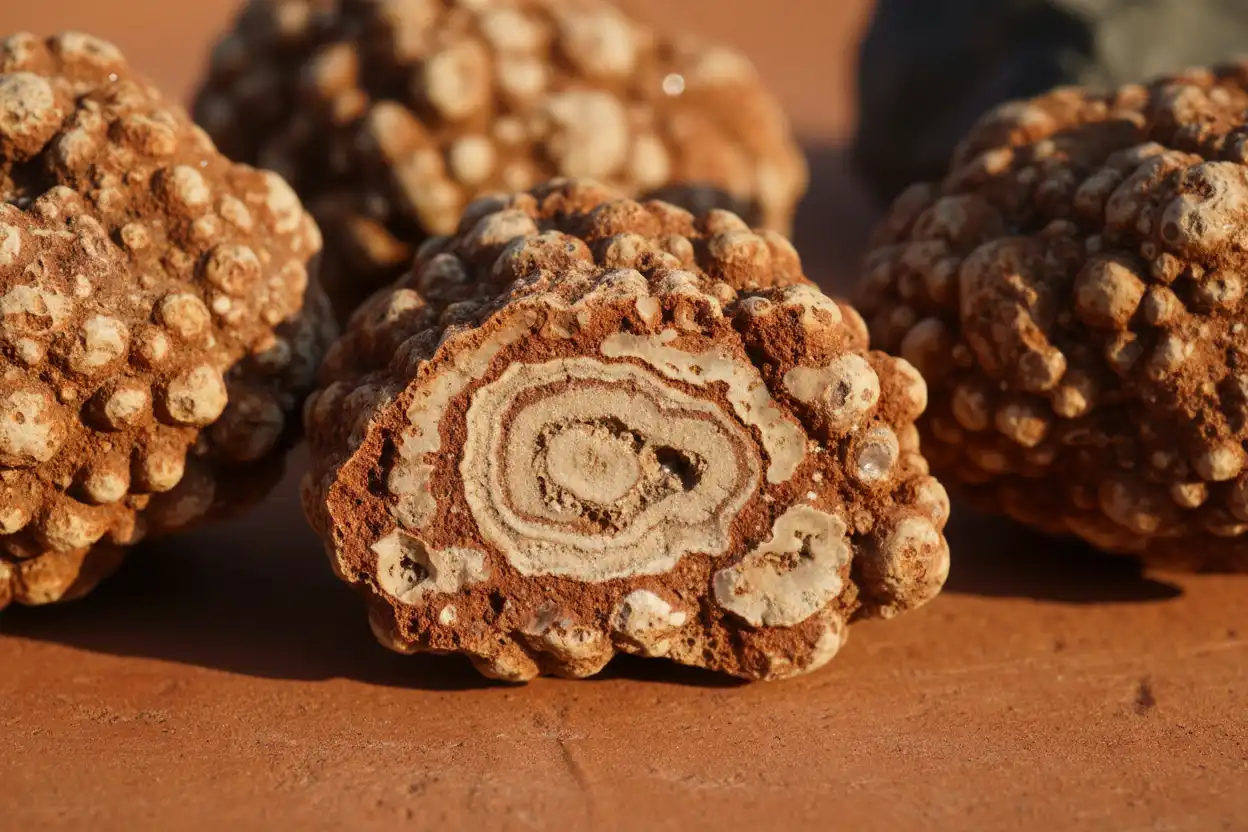

Bauxite is an aluminum-rich rock and the world’s principal commercial source of alumina and aluminum. It is not one mineral with a fixed formula; instead, it is a variable mixture of aluminum hydroxides, iron oxides, clay minerals and titanium oxides, often recognized by its red-brown color and rounded pisolitic texture.
Bauxite at a Glance
| Property | Bauxite |
|---|---|
| Mineral group | Aluminum-rich sedimentary or residual rock; principal aluminum ore |
| Composition | Variable mixture dominated by gibbsite, boehmite and/or diaspore, with iron oxides, clay and titanium minerals |
| Colors | White, cream, gray, yellow, tan, brown, orange and deep red |
| Crystal system | None at the rock scale; constituent minerals have separate crystal systems |
| Habit | Massive, earthy, clay-like, nodular, oolitic and pisolitic |
| Luster | Dull, earthy or locally waxy |
| Transparency | Opaque |
| Mohs hardness | Commonly about 1–3, but variable with composition and cementation |
| Cleavage | None as a mixed rock; constituent minerals may show cleavage |
| Tenacity | Friable, earthy or brittle depending on consolidation |
| Common use | Alumina and aluminum production, refractories, abrasives, cement and educational specimens |
| Main care concern | Dust, staining, crumbling surfaces and confusion with laterite or ironstone |
Is Bauxite a Mineral?
Bauxite is a rock and ore, not an approved mineral species.
Its composition varies from deposit to deposit. The principal aluminum-bearing components are usually:
- Gibbsite, Al(OH)₃.
- Boehmite, AlO(OH).
- Diaspore, AlO(OH).
Although boehmite and diaspore share the same ideal formula, they have different crystal structures and physical properties.
Bauxite may also contain kaolinite, quartz, hematite, goethite, anatase and rutile. These associated minerals influence the rock’s color, density, hardness and suitability for refining.
The gem-quality aluminum oxyhydroxide is discussed separately in the Diaspore guide.
How Bauxite Forms
Most bauxite forms through prolonged chemical weathering in warm, humid environments.
Rainwater and groundwater break down aluminum-bearing rocks such as granite, basalt, shale, limestone-hosted sediments and nepheline syenite. Mobile elements—including sodium, potassium, calcium and much of the silica—are gradually removed.
Aluminum is comparatively resistant to this leaching and becomes concentrated near the surface. Iron and titanium may remain with it, creating the familiar red, brown and yellow colors.
Successful bauxite formation generally requires:
- An aluminum-bearing parent rock.
- Intense chemical weathering.
- Good drainage that removes dissolved silica.
- A sufficiently stable land surface.
- Long periods without rapid burial or erosion.
The resulting deposit may occur as a thick blanket, irregular pockets, lenses or material filling depressions in older limestone.
Lateritic and Karst Bauxite
Bauxite deposits are commonly divided into lateritic and karst types.
Lateritic Bauxite
Lateritic deposits develop directly above strongly weathered silicate rocks in tropical or subtropical climates.
They frequently form broad layers over basalt, granite, gneiss or other aluminum-bearing rocks. Gibbsite commonly dominates deposits formed under intense tropical weathering.
Important lateritic regions include Guinea, northern Australia, Brazil, India, Indonesia and parts of West Africa.
Karst Bauxite
Karst bauxite forms in depressions, cavities and irregular surfaces developed on limestone or dolomite.
The aluminum-rich material may have been transported from nearby weathered rocks or concentrated from sediments deposited on the carbonate surface.
Karst deposits are important in parts of Europe, Jamaica, China and the Mediterranean region. Boehmite and diaspore may be more prominent in some of these deposits than in low-temperature tropical bauxite.
Why Is Bauxite Red?
Bauxite’s red and reddish-brown colors usually come from iron oxides and iron oxyhydroxides.
Hematite contributes red tones, while goethite commonly produces yellow-brown or ochre colors. A deposit with relatively little iron may appear cream, pale gray or almost white.
Color is not a dependable measure of aluminum content. Bright red material may contain substantial iron but only moderate recoverable alumina, while pale material can be commercially valuable.
Explore the principal red iron oxide in the Hematite guide and the yellow-brown oxyhydroxide in the Goethite guide.
What Is Pisolitic Bauxite?
Pisolitic bauxite contains rounded grains called pisoliths, commonly ranging from a few millimeters to more than one centimeter.
Each pisolith may contain concentric mineral layers built around a small nucleus. Repeated precipitation, movement and reworking within the weathering profile contribute to the rounded form.
A fresh broken surface can resemble a mass of peas or fish eggs embedded in finer matrix. The name comes from a Greek word meaning pea.
Not every pisolitic red rock is bauxite. Ironstone, laterite and sedimentary concretions can produce similar textures, so chemistry and mineralogical testing may be needed.
Bauxite Meaning and Symbolism
Bauxite is traditionally associated with recognizing the value of raw materials, long-term development and extracting useful results from an unrefined starting point.
Its geological formation through gradual concentration may symbolize patience and removing distractions from a complicated process. Its industrial transformation into aluminum also makes it a practical metaphor for converting an ordinary-looking resource into something widely useful.
These interpretations are symbolic. Bauxite’s measurable importance comes from its aluminum-bearing composition and industrial role.
Important Bauxite Regions
Boké Region, Guinea
The Boké region contains major high-grade bauxite deposits and extensive modern mining operations.
Guinea has become the world’s largest bauxite producer and a dominant supplier to international alumina refineries. Its deposits commonly occur as thick lateritic layers close enough to the surface for open-pit mining.
Industrial ore from Guinea is valued for alumina content, reactive silica levels, moisture and shipping economics rather than specimen appearance.
Weipa, Queensland
Weipa on Australia’s Cape York Peninsula is one of the world’s best-known bauxite mining regions.
The deposits developed through deep tropical weathering and occur near the surface over extensive areas. Australian bauxite supports large domestic alumina-refining and aluminum industries.
Boddington and Darling Range, Western Australia
The Darling Range contains major lateritic bauxite deposits associated with weathered ancient rocks.
Material from this region is normally mined as refinery feed rather than sold as collector-grade crystal material. Polished slices may show attractive red, cream and brown patterns.
Pará and Minas Gerais, Brazil
Brazil hosts extensive bauxite resources in Pará and several other states.
Some deposits supply large alumina operations, while smaller pieces appear in geological collections as examples of tropical weathering and ore formation.
Jamaica
Jamaica is historically important for karst bauxite developed over limestone.
The ore commonly fills depressions and irregular surfaces in carbonate terrain. Jamaican bauxite has been an important refinery feed and export commodity.
Arkansas, United States
The town of Bauxite and surrounding areas in central Arkansas developed around deposits formed near nepheline syenite.
Arkansas material is now particularly familiar in educational collections, regional mineral displays and polished slabs. Local specimens may show red, yellow, cream and gray pisolitic patterns.
Les Baux, France
Bauxite was named after Les Baux-de-Provence in southern France, where aluminum-rich material was studied during the nineteenth century.
The historic locality explains the name but is not comparable in production scale with major modern deposits in Guinea or Australia.
Bauxite vs. Laterite
Laterite is a broader weathering product enriched in iron and aluminum.
Bauxite is specifically aluminum-rich enough to be considered an aluminum ore under suitable economic and processing conditions. A laterite may contain abundant iron but insufficient recoverable alumina to qualify as bauxite.
The distinction depends on chemical composition, mineralogy and economics rather than red color alone.
Bauxite vs. Ironstone
Bauxite and ironstone can both be reddish, earthy and pisolitic.
Ironstone is dominated by iron minerals such as hematite, goethite or siderite. Bauxite contains a higher proportion of aluminum hydroxide minerals.
A simple visual inspection cannot reliably distinguish every sample. Chemical analysis, X-ray diffraction or portable analytical equipment may be required.
Bauxite vs. Diaspore
Bauxite is a multi-mineral rock. Diaspore is one individual aluminum oxyhydroxide mineral that may occur within bauxite.
Transparent color-change diaspore is cut as a gemstone. Ordinary bauxite is opaque, fine-grained and used primarily as an industrial ore.
A polished bauxite specimen should not be marketed as gem diaspore merely because diaspore may be present microscopically.
Bauxite and the Bayer Process
Most metallurgical bauxite is refined into alumina through the Bayer process.
The simplified sequence is:
- Bauxite is crushed and ground.
- It is treated with hot concentrated sodium hydroxide.
- Aluminum-bearing minerals dissolve into the caustic solution.
- Insoluble iron-rich residue is separated as red mud.
- Aluminum hydroxide is precipitated from the purified solution.
- Heating converts the hydroxide into alumina, Al₂O₃.
The alumina can then be converted into aluminum metal through electrolytic reduction.
As a broad industrial rule, approximately four metric tons of dried bauxite may produce two tons of alumina, which can yield roughly one ton of aluminum. Exact recovery varies with grade, mineralogy and processing efficiency.
Other Uses of Bauxite
Not all bauxite is refined into aluminum metal.
Nonmetallurgical grades are used in:
- Refractory bricks and castable materials.
- Abrasive grains.
- High-alumina cement.
- Road and flooring aggregates.
- Petroleum-industry proppants.
- Welding fluxes.
- Steelmaking slag adjustment.
- Chemical-grade aluminum compounds.
Calcined bauxite has been heated to remove water and increase hardness and stability. It is an industrial product rather than an untreated collector specimen.
Is Bauxite a Gemstone?
Bauxite is not a conventional gemstone.
It is opaque, generally soft and lacks the individual crystal transparency or toughness expected in jewelry material. Pisolitic patterns can nevertheless become attractive after cutting and polishing.
Bauxite is occasionally fashioned into:
- Slabs.
- Bookends.
- Spheres.
- Educational cabochons.
- Paperweights.
- Regional souvenir items.
Such pieces are valued as geological curiosities or decorative rocks, not as faceted gems.
There is no established faceted-bauxite market. A transparent crystal claimed to be faceted bauxite is more likely to be an individual constituent mineral or a misidentified material.
How Bauxite Is Sold
Bauxite appears in very different commercial markets.
| Commercial form | Typical use |
|---|---|
| Bulk metallurgical ore | Alumina refining |
| Calcined aggregate | Refractories, abrasives and industrial flooring |
| Small hand specimen | Education and geology collections |
| Pisolitic display specimen | Rock and mineral collections |
| Polished slab | Decorative display |
| Historic Arkansas or French specimen | Regional and mining-history collection |
Bulk ore is graded by chemistry, moisture, reactive silica and logistics. Collector pieces are priced according to locality, texture, color, size and presentation.
Industrial pricing should not be used to appraise one polished specimen.
Bauxite Price and Value
Indicative July 2026 ranges are:
| Bauxite form | Approximate price range |
|---|---|
| Small educational specimen | $4–$15 |
| Hand-sized pisolitic piece | $10–$40 |
| Documented Arkansas or historic-locality specimen | $25–$75 |
| Polished slice or slab | $30–$100+ |
| Large decorative specimen | $60–$200+ |
| Bulk metallurgical bauxite | Roughly $60–$85 per metric ton in current international trade |
| Faceted stone | No recognized market |
The bulk price depends on origin, alumina content, reactive silica, moisture, freight and contract terms.
A specimen can cost thousands of times more per kilogram than industrial ore because retail preparation, documentation and shipping dominate its value.
How to Identify Bauxite
Possible identification features include:
- Earthy red, brown, yellow or cream color.
- Pisolitic or oolitic texture.
- Relatively low hardness.
- Porous or clay-like surfaces.
- Dull luster.
- Low-to-moderate density compared with iron ore.
- Occurrence within a documented lateritic or karst deposit.
These features are not unique. Laterite, limonite-rich ironstone, clay and slag can resemble bauxite.
A professional identification may use:
- X-ray diffraction.
- X-ray fluorescence.
- Chemical alumina and silica testing.
- Microscopy.
- Loss-on-ignition analysis.
The general observation workflow in How to Identify Crystals can help document the specimen before laboratory testing.
How to Clean Bauxite
Use a soft dry brush for routine dust.
A stable consolidated piece may be wiped with a slightly damp cloth, but porous or clay-rich material should not be soaked. Water can loosen earthy matrix, create muddy residue and alter the appearance of iron-stained surfaces.
Avoid acids, bleach, abrasive cleaners and ultrasonic equipment.
Polished slabs can be cleaned according to the coating or sealant applied by the lapidary. A waxed or resin-stabilized piece may require different care from untreated rock.
How to Store Bauxite
Keep friable specimens in a tray or specimen box so that loose grains do not spread across a shelf.
Avoid repeated handling of powdery surfaces. Store historic labels separately from iron-rich material that may stain paper.
Large polished pieces should be supported evenly because internal clay layers or porous zones may crack under uneven pressure.
Frequently Asked Questions
Is bauxite a mineral?
No. Bauxite is a heterogeneous rock composed of several aluminum-bearing minerals and associated impurities.
What minerals are found in bauxite?
The principal aluminum minerals are gibbsite, boehmite and diaspore. Hematite, goethite, kaolinite, quartz, anatase and rutile may also occur.
What is bauxite used for?
Its main use is producing alumina and aluminum. Selected grades are also used in refractories, abrasives, cement and industrial aggregates.
Why is bauxite red?
Iron oxides and oxyhydroxides—especially hematite and goethite—produce red, orange, yellow and brown colors.
Can bauxite be polished?
Yes. Compact pisolitic material can be cut and polished into slabs and decorative objects, although it is not a conventional gemstone.
Is bauxite rare?
No. Major deposits occur worldwide, but economically mineable grade depends on mineralogy, chemistry, thickness, infrastructure and market conditions.
Continue alphabetically with Bastnäsite or Benitoite, and explore the wider Gemstone Guides collection.
Disclaimer: Bauxite symbolism is based on traditional interpretation, not scientifically proven emotional or medical effects. Avoid inhaling bauxite or red-mud dust, do not ingest specimen material, and use professional controls when cutting or grinding aluminum-rich rock.