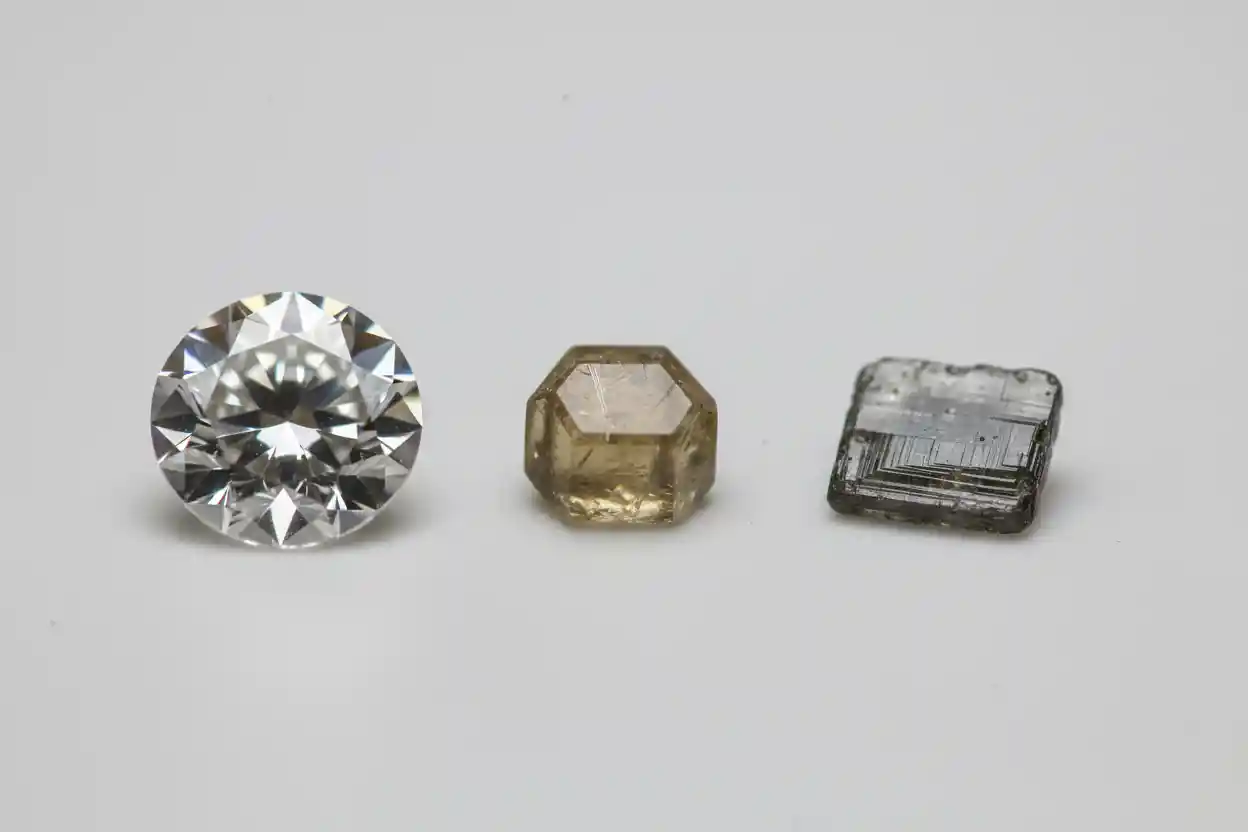
Lab Diamond Meaning: Properties, Uses & Symbolism
Lab diamond meaning starts with the material itself. A laboratory-grown diamond is diamond: crystalline carbon arranged in the cubic diamond structure, possessing essentially the same fundamental chemical, physical, and optical properties as natural diamond. Its origin is different. Natural diamonds crystallize through geological processes deep within Earth, whereas laboratory-grown diamonds are produced through controlled technological growth, principally high-pressure, high-temperature synthesis or chemical vapor deposition. GIA emphasizes that both materials are diamonds while also noting that their very different growth histories leave structural defects, fluorescence patterns, inclusions, and growth features that sophisticated testing can use to distinguish them.
That distinction also separates laboratory-grown diamond from diamond simulants. Cubic zirconia, moissanite, glass, and other look-alikes may imitate parts of a diamond’s appearance, but they are not diamond because their chemistry and crystal structures differ. The U.S. Federal Trade Commission specifically distinguishes laboratory-created diamonds from simulated or imitation products and permits terms such as “laboratory-grown,” “laboratory-created,” or appropriately qualified “synthetic” only when the product has essentially the same optical, physical, and chemical properties as mined diamond.
The symbolism is a separate question. Because laboratory-grown diamond is a comparatively modern material category, there is no defensible ancient spiritual tradition specifically centered on “lab diamonds.” Contemporary owners may nevertheless associate them with commitment, technological achievement, deliberate creation, modern relationships, transparency about origin, or choosing symbolism independently from geological rarity. Those meanings can be personally or culturally significant without becoming physical properties of carbon. This article keeps material science, documented history, and modern symbolism separate within the broader Gemstone Guides.
Lab Diamond at a Glance
| Feature | Evidence-based description |
|---|---|
| Material | Diamond |
| Main chemistry | Carbon, C |
| Crystal system | Cubic / isometric |
| Laboratory origin | Human-controlled crystal growth |
| Principal growth methods | HPHT and CVD |
| Same mineral material as natural diamond? | Yes, in fundamental chemical composition and crystal structure |
| Same geological origin as natural diamond? | No |
| Diamond simulant? | No |
| Mohs hardness | 10 |
| Refractive index | About 2.42 |
| Specific gravity | About 3.52 |
| Birefringence | None in ideal cubic diamond |
| Luster | Adamantine when polished |
| Typical colors | Colorless to near-colorless; yellow, blue, pink, brown, green, and other colors are possible |
| Important color influences | Nitrogen, boron, vacancies, growth defects, irradiation, annealing, and other defect chemistry |
| Can ordinary observation always separate it from natural diamond? | No |
| Can advanced gemological testing separate them? | Yes |
| Common HPHT clues | Growth-sector patterns, metallic flux inclusions, characteristic fluorescence/phosphorescence |
| Common CVD clues | Layered/banded growth, graphitic pinpoints, silicon-vacancy-related features, characteristic fluorescence |
| Major durability issue despite hardness | Diamond has cleavage directions and can chip or split from a sharp blow |
| Proven healing effect | None established |
GIA lists diamond at Mohs 10, refractive index 2.42, and specific gravity approximately 3.52. Laboratory-grown diamond shares these fundamental diamond properties because the resulting crystal is diamond rather than a visually similar substitute.
What a Lab Diamond Actually Is
The clearest definition is “diamond with a laboratory growth origin.” Carbon atoms become arranged in the same three-dimensional diamond lattice responsible for natural diamond’s extreme hardness, high refractive index, brilliance, dispersion, thermal properties, and characteristic cleavage.
That does not mean laboratory-grown and natural diamonds are indistinguishable in every scientific sense. Their growth histories are dramatically different. Natural diamond records prolonged residence and geological processes in the mantle, while laboratory material grows under engineered conditions. Those differences affect impurity distribution, strain, defects, inclusion populations, fluorescence, crystal morphology, and spectroscopic behavior. GIA therefore cautions against calling the two origins completely identical even while recognizing that they share essentially the same material properties.
A useful way to state the distinction is:
Material identity: diamond.
Growth origin: laboratory.
Natural geological origin: no.
That three-part distinction prevents both common extremes: calling lab-grown diamond “fake,” which misidentifies the material, or calling it completely identical to natural diamond in origin and growth record, which erases measurable differences.
Lab Diamond Identity Table
| Question or claim | Evidence-based answer | Why it matters |
|---|---|---|
| Is it carbon? | Yes, essentially crystalline carbon | Core material identity |
| Is it diamond? | Yes | Separates it from simulants |
| Is it naturally mined diamond? | No | Origin must be disclosed |
| Is it cubic zirconia? | No | CZ has different chemistry and properties |
| Is it moissanite? | No | Moissanite is silicon carbide |
| Is it “fake diamond”? | Misleading | It is laboratory-grown diamond, not imitation diamond |
| Is “synthetic diamond” scientifically meaningful? | Yes, when used correctly | Synthetic means laboratory-produced counterpart of the natural mineral, not merely imitation |
| Can it be HPHT-grown? | Yes | One major manufacturing route |
| Can it be CVD-grown? | Yes | Other major manufacturing route |
| Does HPHT always mean post-growth treatment? | No | HPHT can describe a growth method or a later treatment |
| Is every CVD stone a surface coating? | No | CVD creates crystalline diamond on a seed/substrate |
| Can laboratory-grown diamonds contain inclusions? | Yes | Growth does not guarantee flawless material |
| Can they be colored? | Yes | Impurities and lattice defects can produce many colors |
| Can a standard thermal tester prove laboratory origin? | Generally no | Diamond material responds like diamond |
| Can specialist laboratories identify growth origin? | Yes | Growth defects and spectroscopy allow separation |
HPHT Growth: Diamond Under Engineered Pressure and Temperature
HPHT stands for high pressure, high temperature. In this process, a small diamond seed is placed in a growth capsule with a carbon source and metallic flux containing elements such as iron, nickel, or cobalt. Extreme pressure and temperature dissolve carbon into the molten metal, after which carbon crystallizes onto the cooler diamond seed. The growing crystal can develop distinctive sectors because different crystal faces incorporate impurities at different rates.
These sectors can become valuable identification evidence. Nitrogen may concentrate more strongly in some growth directions, boron in others, and relatively impurity-poor areas elsewhere. Under suitable imaging, HPHT-grown diamonds can display cuboctahedral or cross-like fluorescence patterns reflecting that growth morphology. Metallic flux can also become trapped as inclusions, sometimes producing dark opaque features with metallic reflections.
Not every HPHT-grown diamond displays every classic feature. Manufacturing techniques continue to improve, and attractive stones may contain very few obvious microscopic clues. Identification therefore relies on multiple independent observations rather than one inclusion or fluorescence color.
The broader growth-versus-geology distinction is mapped in the separate Lab Diamond formation and deposit geology reference rather than being expanded here into a production manual.
CVD Growth: Building Diamond From Carbon-Rich Gas
CVD means chemical vapor deposition. A polished diamond substrate is placed in a chamber containing a carbon-rich gas, commonly involving methane and hydrogen. Energy breaks the gas molecules apart, and carbon is deposited atom by atom onto the diamond substrate, allowing new diamond crystal to grow layer by layer. The result is genuine crystalline diamond rather than a diamond-colored coating applied to another gem.
CVD crystals typically begin with a more tabular geometry than HPHT rough. Their layered growth can produce banded strain patterns and distinctive fluorescence behavior, while dark graphitic inclusions or pinpoints can occur. Silicon-related defects are also particularly important in the identification of some CVD-grown material. GIA uses fluorescence imaging, absorption spectroscopy, photoluminescence, and other advanced techniques because visual clues alone are not consistently conclusive.
Post-growth treatment may also be applied. Some CVD material is subjected to HPHT conditions after growth to modify undesirable brownish coloration, while irradiation and annealing can create or alter fancy colors.
That introduces an important vocabulary point: HPHT-grown and HPHT-treated are not necessarily the same thing.
Why Lab Diamonds Can Be Colorless
Colorless diamond requires relatively little absorption within the visible spectrum. Many colorless-to-near-colorless laboratory-grown diamonds contain very low concentrations of detectable nitrogen impurities and are categorized as type II material. GIA notes that type II material is far more common among colorless laboratory-grown diamonds than among natural diamonds submitted for comparable analysis.
Growth conditions matter because tiny concentrations of impurities or atomic-scale defects can influence visible color dramatically. A diamond that is overwhelmingly carbon can shift from colorless to yellow, blue, pink, brown, or another color because trace defects absorb specific wavelengths.
Color therefore provides information, but it does not establish origin by itself.
The detailed relationship among defects, impurity chemistry, optical absorption, fluorescence, and directional growth belongs in Lab Diamond optical properties and color behavior.
Yellow, Blue, Pink, and Other Laboratory-Grown Colors
Yellow laboratory-grown diamond is commonly associated with isolated nitrogen incorporated during growth. HPHT material can show geometric yellow zoning because nitrogen concentration varies between growth sectors.
Blue can be associated with boron in type IIb laboratory-grown material. GIA has documented HPHT-grown stones containing adjacent nitrogen-rich yellow and boron-rich blue sectors, making their engineered growth architecture visible through color itself.
Pink and red laboratory-grown diamond frequently involve nitrogen-vacancy centers. One common route begins with nitrogen-containing laboratory-grown diamond, followed by irradiation that creates vacancies and annealing that allows vacancies to combine with nitrogen. The resulting defect centers absorb light in a way that produces pink-to-red coloration.
Brown CVD material can originate from structural defects created during growth, and subsequent HPHT treatment can reduce or alter that coloration. Other defect combinations can create green, blue, black, or unusual color effects.
The reader-facing interpretation of those colors is intentionally kept separate in Lab Diamond color meaning so physical chromophore science is not confused with symbolic associations.
Diagnostic Traits: Why a Diamond Tester Is Not Enough
A conventional diamond tester can often determine that a stone behaves like diamond rather than cubic zirconia or another lower-thermal-conductivity simulant. That is useful—but it does not reliably establish whether the diamond grew naturally or in a laboratory.
GIA states that because laboratory-grown diamonds possess essentially the same chemical and optical properties as natural diamonds, traditional gemological observations and older-style diamond detectors cannot by themselves make a definitive origin determination. Advanced instruments and professional laboratory analysis are needed when certainty matters.
This is one of the most important ownership boundaries on the page:
“Tests as diamond” does not necessarily mean “natural diamond.”
Likewise:
“Laboratory-grown diamond” does not mean “diamond simulant.”
Microscopic Features Can Suggest Growth Method
HPHT-grown diamonds may contain metallic flux inclusions created by the catalyst system used during growth. These can appear dark in transmitted light but metallic in reflected light. Some inclusions contain enough ferromagnetic metal that unusual magnetic behavior can occur, although magnet response is not a universal identification test.
CVD-grown diamonds do not generally contain HPHT metal-flux inclusions. Instead, dark graphitic pinpoints, layered growth features, banded strain patterns, and other characteristic internal structures may occur.
Natural diamonds have their own wide inclusion population derived from mantle growth and geological transport. None of these broad categories should be converted into an absolute checklist because individual stones can be remarkably clean or lack stereotypical features.
The detailed observation workflow belongs in the Lab Diamond microscope inclusion notebook rather than turning one inclusion into a species-level verdict.
Fluorescence and Spectroscopy Provide Stronger Evidence
Deep-ultraviolet fluorescence imaging can reveal growth structures that ordinary visible-light microscopy misses. HPHT-grown material commonly shows growth-sector-related patterns, while CVD material can show layered or differently organized fluorescence linked to its deposition process. Natural diamond generally preserves different growth architecture.
Photoluminescence spectroscopy can identify atomic-scale defects associated with growth method or treatment. Silicon-vacancy-related features are especially useful in many CVD diamonds, while combinations of nitrogen, boron, nickel, vacancies, and other defects can help laboratories distinguish growth histories.
No single fluorescence color should be used as a home authenticity rule. A professional conclusion comes from patterns, spectroscopy, microscopy, and other observations working together.
Original Claim Audit: Lab Diamond Statements Tested
| Common claim | Evidence status | More defensible interpretation |
|---|---|---|
| “Lab-grown diamonds are fake diamonds.” | Incorrect | They are laboratory-grown diamond, not imitation diamond |
| “Lab diamond is cubic zirconia.” | Incorrect | CZ is a different material |
| “Lab diamond is moissanite.” | Incorrect | Moissanite is silicon carbide |
| “Synthetic means fake.” | Misleading | In gemology, synthetic refers to a laboratory-produced counterpart with essentially the same material properties |
| “Lab-grown and natural diamonds are identical in every sense.” | Too broad | Fundamental material properties are essentially the same, but origin, growth structure, defects, and history differ |
| “No laboratory can tell them apart.” | Incorrect | Advanced testing can identify laboratory growth |
| “A basic diamond tester proves natural origin.” | Incorrect | It may confirm diamond-like properties without establishing growth origin |
| “CVD diamond is just a diamond coating.” | Incorrect | CVD grows crystalline diamond from carbon onto a diamond substrate |
| “HPHT always means treatment.” | Incorrect | HPHT can be the original growth method or a separate post-growth treatment |
| “Lab diamonds have no inclusions.” | Incorrect | HPHT and CVD material can contain characteristic inclusions and defects |
| “Every HPHT diamond contains metal.” | Incorrect | Metallic inclusions are useful clues but not mandatory |
| “Every CVD diamond has graphite inclusions.” | Incorrect | Such features may occur but are not universal |
| “All lab diamonds are colorless.” | Incorrect | Yellow, blue, pink, brown, green, and other colors occur |
| “Lab diamonds are ancient crystals.” | Incorrect | Their crystal growth is technological and modern |
| “Lab diamond has scientifically proven healing energy.” | Unsupported | No established physical or medical mechanism demonstrates this |
| “Laboratory origin automatically proves sustainability.” | Unsupported as a material-only claim | Environmental impact depends on production energy, manufacturing, transport, and the comparison method used |
The last claim deserves particular care. “Laboratory-grown” describes origin, not a complete environmental assessment. A specific producer may document energy sourcing or manufacturing impacts, but those are supply-chain facts rather than intrinsic physical properties of diamond.
Documented History
The history of laboratory-grown diamond is technological rather than archaeological. Reliable industrial laboratory synthesis was achieved during the middle of the twentieth century after extensive experiments with high pressure and temperature. Early production emphasized industrial applications where diamond hardness, thermal properties, and wear resistance were valuable.
Gem-quality laboratory crystals followed later. HPHT became the first major route for producing gem-quality material, while CVD technology eventually developed into another commercially important method. Improvements in purity, growth control, post-growth processing, and cutting expanded laboratory-grown diamond from specialist research and industrial use into mainstream jewelry. GIA continues to research both HPHT and CVD production because manufacturers repeatedly improve crystal quality, size, color, and growth efficiency.
This documented history creates a clear boundary around claims of ancient lab-diamond lore. Diamond symbolism has an older human history, but laboratory-grown diamond as an origin category does not.
Modern Lab Diamond Symbolism
A laboratory-grown diamond can inherit some symbolism already associated with diamond because the finished material has the same familiar brilliance, hardness, and visual identity. Commitment, endurance, clarity, and celebration are common contemporary diamond themes.
Laboratory origin can add newer layers. Some owners interpret deliberately grown diamond as representing intentional creation rather than geological chance. Others associate it with technological progress, modern partnership, accessibility, or consciously choosing one origin over another. A person may also value transparent disclosure itself and treat an accurately identified laboratory-grown stone as a symbol of making informed decisions.
None of those interpretations requires claiming that the crystal changes the nervous system, heals emotional trauma, attracts wealth, guarantees relationship success, strengthens commitment, or generates a measurable spiritual frequency.
The symbolism belongs to people and cultural use. The diamond lattice does not encode a relationship outcome.
A Responsible Symbolism Boundary
Three evidence categories should remain separate.
A material fact can establish that laboratory-grown diamond consists of crystalline carbon and shares diamond’s core physical and optical properties.
A growth-origin fact can establish whether the material formed naturally or through HPHT/CVD technology.
A symbolic interpretation can describe what an individual, couple, jeweler, or community chooses the diamond to represent.
Confusion begins when symbolic statements are presented as measurable science. Diamond’s Mohs hardness of 10 does not make a relationship physically stronger. High thermal conductivity does not remove emotional distress. Laboratory precision does not guarantee clarity of thought.
Personal symbolism does not become less meaningful when its category is stated honestly.
Is a Lab Diamond a “Real Diamond”?
In material terms, yes: it is diamond.
In origin terms, it is not a naturally mined diamond.
FTC guidance reflects exactly this distinction. Laboratory-created diamond terminology is appropriate when the product has essentially the same optical, physical, and chemical properties as mined diamond, but advertising should clearly disclose that the stone is laboratory-grown or laboratory-created rather than mined.
The word “real” is therefore less precise than the two questions that actually matter:
Is the material diamond? Yes.
Did it grow naturally inside Earth? No.
Lab Diamond Versus Diamond Simulants
Moissanite and cubic zirconia can both resemble a polished diamond but remain different substances. This distinction affects hardness, refractive behavior, density, thermal properties, double refraction, dispersion, durability, and price.
A laboratory-grown diamond should therefore never be grouped with simulants merely because all three can be manufactured. Manufacturing origin and mineral identity are separate concepts.
FTC consumer guidance similarly distinguishes lab-created gemstones—which reproduce the corresponding gem material—from imitations made from another substance.
The dedicated Lab Diamond vs Moissanite comparison owns the detailed side-by-side identification boundary rather than duplicating it here.
Hardness Does Not Mean Unbreakable
Diamond is the standard Mohs 10 mineral and has exceptional resistance to scratching. That is why polished diamond facets can remain crisp through extensive wear.
Yet hardness and toughness are different. Diamond has cleavage directions where atomic bonding is more vulnerable to splitting. GIA explains that a sharp blow in one of these directions can cleave a diamond during cutting, setting, or wear. Sudden extreme temperature changes can also propagate existing fractures or cleavage.
Laboratory-grown diamond shares this fundamental diamond behavior. It should not be treated as structurally invincible merely because it is laboratory-produced.
The practical consequences of prong pressure, exposed points, girdle protection, and impact geometry belong in Lab Diamond setting and wear engineering.
Cutting and Polishing
Because laboratory-grown diamond is diamond, it requires diamond-cutting methods rather than the techniques used for softer simulants. Rough growth morphology can influence planning before faceting: HPHT rough commonly differs in external growth form from tabular CVD material.
Once polished, the cutter’s priorities become familiar diamond problems—yield, symmetry, proportions, inclusions, strain, color zoning, cleavage direction, and final optical performance.
Growth origin can still matter. A sector of HPHT rough containing stronger color may be oriented differently from another sector, while CVD layers or post-growth color modification can influence planning in unusual colored material.
Those lapidary considerations belong in Lab Diamond cutting, orientation, and polish.
Price Is a Separate Question From Material Identity
Being genuine diamond material does not mean laboratory-grown and natural diamonds must command the same market price. Price reflects supply, demand, production economics, rarity, brand positioning, consumer preferences, cut quality, size, grading, and resale conditions—not chemical composition alone.
A laboratory-grown diamond can therefore possess the same fundamental diamond optical properties while occupying a very different pricing market.
The dedicated Lab Diamond price guide owns current price comparisons and value factors so this meaning page does not turn identity into a valuation claim.
Buying: Verify Origin as Well as the 4Cs
A buyer should confirm that a stone marketed as laboratory-grown diamond is actually represented consistently in the seller’s documentation. Carat weight, color, clarity, and cut remain relevant, but growth method, report details, laser inscriptions, treatment disclosures, return terms, and seller representations may also matter.
A listing that merely says “diamond” without making laboratory origin clear is less informative than one that expressly identifies the stone as laboratory-grown or laboratory-created.
For purchase-specific screening, seller documentation, reports, and transaction checks, use buy Lab Diamond rather than treating symbolism as evidence of value or authenticity.
Safe Ownership
A finished laboratory-grown diamond is stable under ordinary jewelry use and does not require a special chemical-safety regime simply because it was manufactured. The main ownership concerns are mechanical: losing a stone from a setting, chipping a vulnerable point, striking a cleavage direction, or damaging jewelry during inappropriate cleaning or repair.
Routine cleaning questions belong in how to clean Lab Diamond jewelry. A diamond may tolerate many cleaning environments, but mounted jewelry contains metals, solder joints, coatings, adhesives, and sometimes additional gemstones whose care requirements can be more restrictive than those of the diamond itself.
Diamond should not be powdered or consumed for supposed wellness effects. Its carbon structure is not a medicine, nutritional supplement, or evidence-based therapeutic device.
Specimen and Documentation Preservation
A loose laboratory-grown diamond may have limited mineral-specimen context compared with a natural crystal on matrix, but documentation can still matter greatly. Growth-method information, laboratory reports, laser inscriptions, manufacturer records, treatment statements, rough photographs, and research provenance can make a laboratory-grown crystal scientifically or historically interesting.
This is particularly relevant as manufacturing technology changes. An early-generation HPHT crystal, experimental CVD plate, unusually colored research sample, or diamond with characteristic growth sectors can preserve information about a specific stage in diamond technology.
Long-term documentation and research-sample record keeping belong in the Lab Diamond specimen conservation record.
What a Photograph Can Establish
A photograph can document cut, apparent color, facet condition, visible inclusions, rough growth shape, color zoning, inscription position, and some surface characteristics.
A photograph usually cannot establish natural versus laboratory growth with confidence once the material has been expertly cut. GIA emphasizes that faceted laboratory-grown diamonds can appear essentially identical to natural diamonds by eye, and definitive separation relies on advanced testing.
A rough crystal photograph can sometimes provide more clues because HPHT and CVD growth morphologies differ from common natural rough forms, but morphology still should not be treated as a substitute for laboratory confirmation in a valuable specimen.
Laboratory Evidence Hierarchy
For a polished stone, an ordinary visual impression is weak origin evidence. A basic diamond tester can help separate many simulants but does not reliably establish whether a genuine diamond is natural or laboratory-grown.
Microscopy can reveal flux metal, graphite, strain patterns, graining, or unusual inclusions. Fluorescence and phosphorescence can reveal characteristic growth-sector patterns. Deep-UV imaging can visualize growth architecture. Infrared, absorption, Raman, and photoluminescence spectroscopy can characterize impurities and atomic defects.
The strongest origin conclusion emerges when several analytical observations agree.
This page does not claim private laboratory testing of any individual stone, unpublished manufacturer data, or first-hand observation of a specific growth run.
Common Lab Diamond Misunderstandings
One misconception is that laboratory-grown diamond is a fake gemstone. It is diamond material with a laboratory origin.
A second is that it is the same as cubic zirconia or moissanite. Those are separate substances.
A third is that laboratory-grown and natural diamonds are impossible to distinguish. Advanced gemological laboratories routinely distinguish them through growth structures, spectroscopy, and fluorescence imaging.
A fourth is that a home diamond tester proves natural origin. It generally does not.
A fifth assumes HPHT always means a treated natural diamond. HPHT can also describe the original growth method for a laboratory-grown diamond.
A sixth assumes CVD creates a thin artificial diamond layer on glass or another simulant. Commercial CVD gem diamond is crystalline diamond grown from a diamond substrate.
A seventh assumes laboratory-grown diamonds contain no inclusions. HPHT flux and CVD graphitic features demonstrate otherwise.
An eighth assumes every lab diamond is colorless. Controlled impurities and defect engineering can create numerous fancy colors.
A ninth gives the category an ancient metaphysical history. Laboratory-grown diamond technology is modern even though diamond symbolism itself is much older.
A tenth assumes laboratory origin proves either ethical perfection or environmental harm. Those conclusions require supply-chain and production evidence beyond mineral identity.
Reading Evidence Without Confusing Categories
The publication’s broader material-first methodology is summarized on About, while the limits of educational identification, health, and value discussion appear in the Disclaimer. Contact serves general website communication, and the Privacy Policy covers the site’s data-handling framework rather than gemstone identification.
Frequently Asked Questions
What is a lab diamond?
A lab diamond is crystalline diamond produced through a controlled technological growth process rather than natural geological formation. Its fundamental chemistry and crystal structure are diamond.
Is a lab-grown diamond a real diamond?
Yes in material identity. It is crystalline carbon with essentially the same fundamental physical and optical properties as natural diamond. Its origin is laboratory rather than geological.
Is a lab diamond fake?
Calling it fake is misleading. A laboratory-grown diamond is distinct from simulated diamonds such as cubic zirconia because it is actually diamond material.
Is a lab diamond the same as cubic zirconia?
No. Cubic zirconia is zirconium oxide and only imitates diamond visually.
Is a lab diamond the same as moissanite?
No. Moissanite is silicon carbide. It differs from diamond in chemistry, optical properties, crystal structure, and several measurable gemological characteristics.
What are HPHT lab diamonds?
HPHT diamonds are grown under engineered high-pressure and high-temperature conditions using a carbon source, metallic flux, and diamond seed.
What are CVD lab diamonds?
CVD diamonds grow when carbon from a carbon-rich gas is deposited onto a diamond substrate inside a controlled chamber, building crystalline diamond layer by layer.
Is CVD diamond only a coating?
No. Gem-quality CVD production creates crystalline diamond. It is not simply paint or a decorative diamond-colored film.
Can HPHT mean both growth and treatment?
Yes. HPHT is a laboratory diamond growth method, but high-pressure/high-temperature processing can also be used after growth or on other diamond material to modify characteristics such as color.
Are lab diamonds as hard as natural diamonds?
They have diamond’s Mohs hardness of 10 because they possess the diamond crystal structure.
Can lab diamonds chip?
Yes. Diamond has cleavage directions and can chip, fracture, or split from a sufficiently sharp impact despite its exceptional scratch resistance.
Do lab diamonds have inclusions?
Yes. HPHT material can contain metallic flux inclusions, while CVD material may contain dark graphitic features and other growth-related inclusions.
Can lab diamonds be flawless?
Very clean laboratory-grown diamonds exist, but laboratory growth does not guarantee flawless clarity. Inclusions, growth defects, and strain-related features can occur.
Can lab diamonds be colored?
Yes. Laboratory-grown diamonds can be colorless, yellow, blue, pink, brown, green, or other colors depending on impurities, defects, growth conditions, and post-growth treatment.
What causes yellow lab diamond color?
Isolated nitrogen incorporated into the diamond lattice is an important cause of yellow coloration in laboratory-grown diamond.
What causes blue lab diamond color?
Boron can create blue coloration in laboratory-grown type IIb diamond.
What causes pink laboratory-grown diamond?
Nitrogen-vacancy centers are responsible for many laboratory-grown pink and red diamonds, often after irradiation followed by annealing.
Can you tell a lab diamond from a natural diamond by eye?
Usually not reliably once both are polished. Their visible appearance can be essentially indistinguishable, so advanced testing is needed for definitive origin identification.
Can a diamond tester detect a lab-grown diamond?
A conventional tester may confirm that the material behaves as diamond, but that does not necessarily establish whether it is natural or laboratory-grown.
How do laboratories identify lab diamonds?
They combine microscopy, fluorescence imaging, growth patterns, absorption spectroscopy, photoluminescence, impurity analysis, and other advanced techniques.
What does lab diamond symbolize?
Contemporary symbolism can include commitment, intentional creation, technological achievement, modernity, or personal choice. These are cultural or personal meanings rather than measurable physical properties.
Does lab diamond have healing properties?
No established scientific evidence shows that wearing or holding laboratory-grown diamond treats physical or psychological illness.
Is a lab diamond better than a natural diamond?
“Better” depends on the buyer’s priorities. They share diamond’s fundamental material properties but differ in origin, growth history, market pricing, rarity framework, documentation, and personal significance.
Is lab-grown diamond automatically sustainable?
No environmental conclusion follows from material identity alone. Any sustainability claim should be evaluated using production energy, manufacturing, transport, supply-chain boundaries, and credible supporting evidence.
Is lab-grown diamond automatically ethical?
No origin label by itself proves every labor, sourcing, manufacturing, or business practice in a supply chain. Those questions require company- and product-specific evidence.
Can a lab diamond last for generations?
The diamond material is highly durable, but long-term survival also depends on cutting, inclusions, setting condition, impacts, repairs, and how the jewelry is stored and worn.
Can a photograph prove that a diamond is laboratory-grown?
No. Photography can reveal some rough-growth or inclusion clues, but polished laboratory-grown and natural diamonds can look virtually identical. Definitive origin identification may require advanced gemological testing.