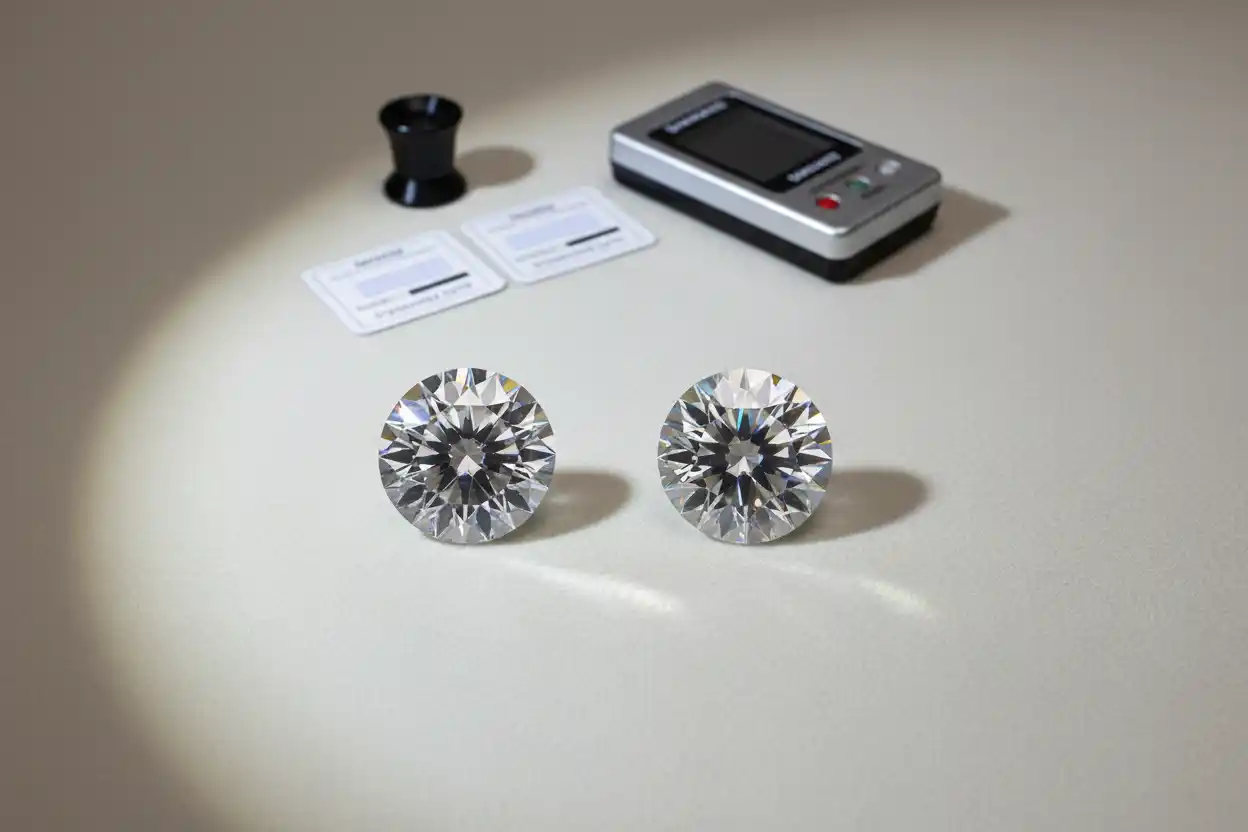
Lab Diamond vs Moissanite: Key Differences & How to Choose
The lab diamond vs moissanite comparison starts with a distinction that product photographs often hide: a laboratory-grown diamond is diamond, while moissanite is silicon carbide. Laboratory-grown diamond consists predominantly of crystalline carbon arranged in the cubic diamond structure and has essentially the same fundamental optical and physical properties as mined diamond, although its engineered growth history can be identified through specialist testing. Gem-quality moissanite is manufactured silicon carbide, SiC, with a different crystal structure, refractive behavior, density, dispersion, and chemical composition. The Federal Trade Commission therefore treats laboratory-created diamond and diamond simulants as different product categories: a laboratory-grown diamond must possess essentially the same optical, physical, and chemical properties as mined diamond, while an imitation or simulated stone such as moissanite must be disclosed as something other than diamond.
That material difference produces a surprisingly nuanced buying choice. Diamond is harder, singly refractive, denser, and has lower dispersion. Moissanite is slightly softer but still extremely durable, doubly refractive, less dense, and far more dispersive, producing substantially stronger spectral fire. GIA records diamond at RI about 2.417, SG about 3.52, Mohs 10, and dispersion around 0.044. Classic gemological measurements for synthetic moissanite give refractive indices near 2.648 and 2.691, SG about 3.22, Mohs about 9¼, birefringence around 0.043, and dispersion around 0.104.
Neither set of numbers says which stone looks better. Some buyers want diamond’s sharper facet pattern, familiar optical character, and the fact that the material is genuinely diamond. Others prefer moissanite’s stronger rainbow fire, lower typical purchase cost for a similar apparent size, and excellent durability. The correct choice depends on which attributes matter in the actual jewelry rather than which marketing label sounds more prestigious. Comparable material-first guides are organized under Identification.
Lab Diamond vs Moissanite at a Glance
| Property | Laboratory-Grown Diamond | Moissanite |
|---|---|---|
| Material | Diamond | Silicon carbide |
| Main chemistry | Carbon, C | SiC |
| Gem origin | Laboratory grown | Gem-quality material is laboratory produced |
| Crystal/optical behavior | Cubic, singly refractive | Common gem polytypes are anisotropic and doubly refractive |
| Refractive index | About 2.417 | About 2.648–2.691 |
| Birefringence | None in ideal cubic diamond | About 0.043 |
| Dispersion | About 0.044 | About 0.104 |
| Specific gravity | About 3.52 | About 3.22 |
| Mohs hardness | 10 | About 9.25 |
| Facet doubling | No normal double refraction | Often visible through appropriate directions |
| Fire | Strong | Significantly stronger |
| Thermal conductivity tester | Reads as diamond | Older thermal testers may also read as diamond |
| Basic material identification | Diamond tests | Requires separation from diamond |
| Natural-vs-lab origin question | Separate advanced-testing step | Not applicable as diamond origin |
| Post-growth treatments | Possible | Coatings/color modification can occur |
| Everyday jewelry | Excellent | Excellent |
| Scratch resistance | Highest among gemstones | Extremely high, below diamond |
| Best reason to choose | You want actual diamond material | You prioritize fire, durability, and usually lower cost |
| Best routine separation | Optical/gemological testing | Optical/gemological testing |
The comparison is therefore not “real versus fake.” It is diamond versus a different high-performance gemstone that imitates some of diamond’s visual characteristics. GIA explicitly describes synthetic moissanite as a diamond imitation but distinguishes laboratory-grown diamonds from such simulants because the laboratory-grown material actually has diamond’s chemical and structural identity.
Identity: Diamond Versus Silicon Carbide
Laboratory-grown diamond has the same basic carbon lattice that defines natural diamond. HPHT and CVD production create that crystal under engineered conditions rather than geological ones. Those growth environments leave features that can distinguish laboratory-grown diamond from natural diamond, but they do not turn it into another mineral. GIA emphasizes that calling lab-grown diamonds imitations or simulants is incorrect.
Moissanite has a different identity altogether. Its chemistry is silicon carbide, and most gem material uses hexagonal SiC polytypes rather than diamond’s cubic carbon structure. That anisotropic crystal structure is responsible for one of moissanite’s most useful visual clues: double refraction. Light traveling through the stone can split into two rays, making some facet junctions appear doubled when viewed through suitable directions. Diamond is optically isotropic and does not show that normal birefringent doubling.
This species-versus-appearance distinction is also why the exact material needs to be established before value or durability is discussed. Similar logic applies in Kyanite vs Sapphire, where two convincing blue gems remain structurally and mechanically different.
Original Identity Matrix
| Question | Lab Diamond | Moissanite | Diagnostic usefulness |
|---|---|---|---|
| Is it diamond material? | Yes | No | Fundamental |
| Is it carbon? | Predominantly yes | No | Fundamental |
| Is it silicon carbide? | No | Yes | Fundamental |
| Is it singly refractive? | Yes | No for common gem moissanite | Strong |
| Does it show measurable birefringence? | No | Yes | Strong |
| RI around 2.42? | Expected | Too low for moissanite | Strong analytically |
| RI above 2.64? | Too high for diamond | Expected | Strong analytically |
| SG near 3.52? | Expected | Higher than normal moissanite | Strong |
| SG near 3.22? | Too low for normal diamond | Expected | Strong |
| Mohs 10? | Yes | No | Strong but destructive testing unnecessary |
| Thermal tester may say “diamond”? | Yes | Yes, with some older thermal devices | Weak by itself |
| Double facet junctions? | No normal optical doubling | Often observable | Useful visual clue |
| Exceptional rainbow fire? | Moderate diamond dispersion | Much stronger dispersion | Supporting clue |
| Seller calls it “diamond-like” | Not needed | Common marketing context | No diagnostic value |
The important point is that several clean routine separations exist. A buyer does not need to damage the stone to distinguish the materials.
Visual Clue 1: Moissanite Usually Shows More Fire
Dispersion separates white light into spectral colors. Diamond’s dispersion is approximately 0.044, while classic gemological data for synthetic moissanite place it around 0.104—well over twice as high. GIA therefore describes moissanite as displaying more than twice diamond’s fire.
Under point-source lighting, this can create noticeably stronger red, orange, yellow, green, and blue flashes. In larger moissanite, the effect may become conspicuous enough that an experienced observer suspects the material immediately.
That is still not a definitive home test. Cut quality, stone size, lighting type, cleanliness, camera processing, and facet pattern all affect visible fire. A poorly cut moissanite can look less lively than an excellent diamond, and digital video can exaggerate rainbow flashes in either material.
The correct use of fire is therefore as a clue, not a verdict.
Visual Clue 2: Facet Doubling Can Reveal Moissanite
Because common gem moissanite is doubly refractive, facet junctions on the far side of the stone may appear doubled when observed through certain directions under magnification. GIA’s foundational work on gem moissanite identified this doubling as one of the practical ways to separate it from singly refractive diamond.
The effect can make the interior look slightly blurred or duplicated, especially when the observer focuses through the crown toward pavilion facets.
It is not equally obvious in every viewing direction. Cutters can orient material to reduce conspicuous doubling through the face-up direction, and some mounted stones are harder to examine than loose ones. Failure to see doubling therefore does not prove diamond.
A comparison such as Labradorite vs Moonstone demonstrates the same broader principle: directional optical behavior needs controlled viewing geometry before it becomes useful evidence.
Visual Clue 3: Brilliance Alone Is Not Reliable
Moissanite’s refractive indices are even higher than diamond’s, and GIA describes it as having slightly more brilliance together with substantially greater fire.
That can lead to the consumer shortcut “the sparklier stone is moissanite,” but real jewelry does not behave that cleanly. Cut proportions, polish, dirt, setting style, lighting, and facet architecture can all outweigh modest theoretical differences in brilliance.
A well-cut laboratory-grown diamond can look exceptionally bright. A poorly cut moissanite can leak light. Brilliance should therefore be judged as an aesthetic quality rather than used as the principal species test.
Original Same-Lighting Comparison Protocol
The workbook requires original comparative evidence, so a controlled side-by-side procedure is more useful than unrelated product photographs.
| Control | Method | What it reveals |
|---|---|---|
| Stone size | Use similar face-up diameters | Prevents larger stone from dominating visually |
| Shape | Compare same or similar cuts | Reduces facet-pattern differences |
| Background | Neutral matte gray | Prevents environmental color casts |
| Diffuse light | Use one daylight-balanced source | Compares white-light brightness |
| Point-source light | Use one small directional source | Compares spectral fire |
| Camera | Lock exposure and white balance | Makes images comparable |
| Face-up view | Photograph tables toward camera | Normal jewelry impression |
| Tilt sequence | Rotate each slowly | Reveals fire and possible doubling |
| 10× view | Focus through crown toward pavilion | Looks for doubled facet junctions |
| Side profile | Record depth and girdle | Prevents weight/size confusion |
| Editing | No selective saturation or sparkle enhancement | Preserves fair comparison |
If the stones still look similar under this protocol, move to physical testing rather than inventing a visual rule.
The same approach is useful in Kunzite vs Morganite because lighting can make two legitimately different gems appear far closer than their gemological data suggest.
Optical Data: The Materials Are Not Close Once Measured
Diamond has refractive index about 2.417 and no birefringence because its cubic structure is optically isotropic. Synthetic moissanite’s refractive indices are around 2.648 and 2.691, producing birefringence near 0.043.
That is a substantial physical difference. Conventional refractometers used for many colored gems generally reach their measurement limit below moissanite and diamond’s extremely high RI, so identification often relies on other gemological methods rather than a normal direct RI reading.
Specific gravity offers a clearer numerical distinction when a loose stone can be measured accurately: diamond is around 3.52 and moissanite around 3.22. GIA has used that density difference successfully when identifying deceptive moissanite carrying fraudulent diamond inscriptions.
The combination of optic character, density, dispersion, microscopy, and appropriate electronic testing is much stronger than perceived sparkle.
Why an Old Thermal Diamond Tester Can Fail
Thermal conductivity is a famous diamond property, and many inexpensive diamond testers were designed to distinguish diamond from lower-thermal-conductivity simulants such as cubic zirconia.
Moissanite complicated that method because its thermal behavior is sufficiently diamond-like that older thermal probes can register moissanite as diamond. Both the FTC and GIA warn about this limitation.
That gives one of the most important buying rules on this page:
A thermal tester that says “diamond” does not automatically rule out moissanite.
Modern combination testers may use electrical conductivity or additional measurements to separate the materials more effectively, but the exact instrument and its limitations matter.
For another example of why a single consumer test can be misleading, see Is My Moldavite Real?, where appearance or one physical clue cannot establish a complete identification.
Two Different Questions Often Get Mixed Together
When a tester encounters an unknown colorless stone, there can actually be two separate identification problems.
Question 1: Is this diamond or moissanite?
That can usually be resolved through standard gemological differences because the materials have different chemistry, density, optical character, dispersion, and internal behavior.
Question 2: If it is diamond, is the diamond natural or laboratory-grown?
That is harder. GIA explains that traditional observations and old-style diamond detectors cannot reliably separate natural from laboratory-grown diamond because their fundamental chemical and optical properties are essentially the same. Advanced fluorescence imaging, spectroscopy, and specialist laboratory methods are used for origin determination.
This two-stage logic prevents a common error: successfully proving “diamond” and then assuming that means “natural diamond.”
Laboratory-Grown Diamond Identification Features
HPHT-grown diamond can display growth-sector patterns, unusual fluorescence or phosphorescence, metallic flux inclusions, and characteristic graining. CVD-grown material can show layered or striated growth patterns, dark pinpoint inclusions, banded strain, and distinctive fluorescence responses. GIA uses these features together with advanced instruments to determine growth method and detect post-growth processing.
These features are about diamond origin, not about separating diamond from moissanite. A moissanite identified as silicon carbide does not then need an HPHT-versus-CVD determination because those terms describe diamond growth technologies.
This distinction keeps the comparison focused rather than repeating full laboratory-grown diamond reference material.
Moissanite Identification Features
The most useful moissanite clues include high dispersion, double refraction, SG near 3.22, anisotropic optical behavior, and—depending on the specimen—internal features such as needles or growth structures. GIA has identified deceptive rough and polished moissanite through combinations of double refraction, SG, optic character, Raman spectroscopy, and other standard or advanced tests.
No one microscopic inclusion is required. High-quality synthetic moissanite can be very clean, making optical properties more reliable than searching for one “moissanite inclusion.”
The same evidence hierarchy is useful in Lapis Lazuli vs Sodalite, where one visible feature should not outweigh the complete material profile.
Durability: Both Are Excellent, but Diamond Is Harder
Diamond is Mohs 10 and has the greatest scratch resistance of standard gem materials. Moissanite at roughly Mohs 9.25 is also extremely hard and suitable for regular jewelry wear.
The practical difference is real but should not be exaggerated. Ordinary household materials are unlikely to scratch either gem easily. Diamond can scratch moissanite; moissanite should not scratch diamond under ordinary mineral-hardness relationships.
For rings, bracelets, and other frequently worn jewelry, both materials therefore outperform most colored gemstones in surface durability.
Compare this with Jadeite vs Nephrite, where toughness rather than extreme hardness is often the defining mechanical advantage.
Diamond Is Hard, Not Unbreakable
Diamond has cleavage directions. GIA notes that a sufficiently sharp impact in an unfavorable direction can chip, fracture, or cleave a diamond despite Mohs hardness 10. Points and corners on shapes such as pear, marquise, and princess cuts can be particularly vulnerable if struck.
Laboratory-grown diamond shares that diamond crystal structure, so laboratory origin does not eliminate cleavage.
Moissanite is also not indestructible, but classic GIA gemological comparisons rate its toughness as excellent and record no comparable cleavage behavior for the common gem material.
This means diamond wins the scratch-resistance comparison while moissanite remains an extremely robust jewelry stone in its own right.
Original Durability Matrix
| Use case | Lab Diamond | Moissanite | Practical conclusion |
|---|---|---|---|
| Daily engagement ring | Excellent | Excellent | Either |
| Earrings | Excellent | Excellent | Either |
| Pendant | Excellent | Excellent | Either |
| Bracelet | Excellent with secure setting | Excellent | Either |
| Frequent abrasion exposure | Best scratch resistance | Very strong | Diamond advantage |
| Pointed fancy shape | Protect points from impact | Still protect points | Setting matters |
| Stone-to-stone storage | Can scratch nearly every other gem | Can scratch most other gems | Store separately |
| Heavy manual work | Remove jewelry | Remove jewelry | Neither needs unnecessary impact |
| Long-term polish retention | Exceptional | Excellent | Diamond advantage |
| Resistance to chipping | Good but cleavage exists | Excellent in classic GIA comparison | Depends on impact and cut |
The choice should therefore not be made on the assumption that moissanite is fragile. It is one of the most durable diamond alternatives available.
Treatments: Lab Diamond Has a Growth-and-Post-Growth Layer
Laboratory-grown diamond can be produced by HPHT or CVD, and the resulting crystal can sometimes undergo additional processing. GIA reports that much recent CVD material submitted for examination has also received post-growth HPHT treatment to improve color. Other treatments such as irradiation and annealing can be used to create or alter fancy colors.
This means “CVD” does not automatically mean “untreated,” and “HPHT” can refer either to original growth or to a later processing step.
Treatment disclosure becomes especially important when a seller attaches a premium to a particular color origin, production route, or no-post-growth-treatment claim.
Treatments and Modifications in Moissanite
Moissanite is itself a laboratory-manufactured gemstone in ordinary jewelry commerce. Its color can be influenced during production through crystal chemistry, and GIA has also documented coated synthetic moissanite used to produce particular surface colors.
A coating is materially different from growing a specific body color throughout the SiC crystal. Surface treatment can be vulnerable to wear or damage in ways that the bulk gemstone is not.
Colorless-to-near-colorless moissanite should therefore not be assumed to have the same treatment story as every colored moissanite product.
The key buying principle is disclosure rather than assuming one manufacturing route from appearance.
Fire: More Is Not Automatically Better
Moissanite’s much higher dispersion makes it the obvious choice for someone who wants strong rainbow flashes. GIA describes its fire as more than twice that of diamond.
Some buyers find that spectacular. Others prefer diamond’s comparatively restrained spectral fire because it preserves a different balance between white brightness and colored flashes.
There is no scientific basis for calling one appearance superior.
This is a design preference similar to choosing between phenomena in Larimar vs Turquoise: the material difference matters, but aesthetics remain personal.
Which Looks More “Diamond-Like”?
Laboratory-grown diamond does, because it is diamond.
Its brilliance, dispersion, refractive behavior, hardness, density, and facet optics are diamond properties rather than an approximation.
Moissanite is deliberately attractive in its own way. It resembles diamond strongly but can reveal itself through stronger fire, double refraction, lower density, and different optical behavior.
A buyer who wants diamond’s exact material identity should therefore choose the laboratory-grown diamond rather than asking which simulant comes closest.
Which Looks More Sparkly?
The word “sparkly” combines several different optical effects.
Moissanite generally produces stronger spectral fire because of its high dispersion. It can also appear extremely bright due to high refractive indices.
Diamond produces its characteristic combination of white brilliance, scintillation, and more restrained spectral fire.
Cut quality can reverse simple expectations. A precision-cut diamond may look livelier than a poorly proportioned moissanite, and vice versa.
Compare actual stones rather than choosing from one optical number.
Value: Moissanite Usually Buys More Apparent Size for Less
Moissanite generally occupies a lower price tier than a laboratory-grown diamond of comparable apparent size and jewelry quality, although exact retail pricing depends on brand, shape, cut, setting, warranties, seller markup, and whether the comparison is loose stones or finished jewelry.
Laboratory-grown diamond pricing itself can change quickly as manufacturing supply, cutting inventories, grading systems, and retailer competition evolve. That makes a permanent statement such as “lab diamond always costs X times moissanite” unreliable.
For a buyer, value should therefore be defined by purpose.
If actual diamond material matters, moissanite is not an equivalent substitute regardless of price.
If the objective is a durable colorless center stone with high brilliance and maximum visual size per budget, moissanite can be extremely competitive.
Resale and “Investment” Claims
Neither purchase should be justified with guaranteed-return language.
Laboratory-grown diamond supply can expand through manufacturing, while moissanite is also produced industrially rather than being constrained by rare natural gem deposits. Retail purchase prices include cutting, grading, branding, sales overhead, service, and setting costs that a future buyer may not reimburse.
A grading document identifies material and quality; it does not guarantee future financial performance.
The site’s broader boundaries around value and professional advice are stated in the Disclaimer.
Original Decision Matrix
| Your priority | Better starting choice | Reason |
|---|---|---|
| Must be actual diamond | Lab diamond | It is crystalline diamond |
| Lowest typical cost for large visual size | Moissanite | Usually lower-priced at comparable face-up scale |
| Maximum scratch resistance | Lab diamond | Mohs 10 |
| Excellent everyday durability | Either | Both are highly durable |
| Strongest rainbow fire | Moissanite | Much higher dispersion |
| Classic diamond optical balance | Lab diamond | Diamond’s own dispersion and facet behavior |
| No facet doubling | Lab diamond | Diamond is singly refractive |
| You enjoy unusually intense sparkle | Moissanite | Strong dispersion is central to its appearance |
| You want standard diamond cut/quality language | Lab diamond | Diamond grading infrastructure applies |
| You do not care whether the material is diamond | Moissanite | Excellent practical alternative |
| You want a lab report confirming diamond growth origin | Lab diamond | HPHT/CVD origin can be determined |
| You want the simplest budget decision | Moissanite | Often provides greater size per spend |
| You expect guaranteed resale appreciation | Neither | No guaranteed investment case |
| You want a traditional-looking solitaire but not mined diamond | Lab diamond | Same diamond material, laboratory origin |
| You want something deliberately different from diamond | Moissanite | Distinct SiC material with its own optical identity |
The matrix deliberately avoids naming one universal winner.
Decision Case 1: Everyday Engagement Ring
Both materials are excellent candidates.
Choose laboratory-grown diamond if the wearer specifically wants diamond, wants the greatest scratch resistance, or prefers diamond’s optical character.
Choose moissanite if the wearer likes stronger rainbow fire and would rather direct more of the budget toward size, setting, or other priorities.
The setting should still protect vulnerable corners and keep the stone secure regardless of material.
Decision Case 2: You Want the Largest Center Stone Within a Fixed Budget
Start with moissanite.
At similar visual sizes, moissanite usually allows the buyer to spend less on the center stone. That can make a substantial difference in larger solitaires.
Do not use carat weight alone, however. Diamond and moissanite have different densities, so the same dimensions do not necessarily produce the same carat weight. Face-up millimeter dimensions are the more meaningful way to compare visual size.
Decision Case 3: You Want the Stone to Be Diamond, but Not Mined
Choose laboratory-grown diamond.
Moissanite cannot meet that requirement because it is silicon carbide regardless of how convincingly it resembles diamond.
FTC terminology makes this distinction explicit: laboratory-grown diamond must be disclosed as non-mined diamond, while imitation stones must be disclosed as not being diamond.
Decision Case 4: You Prefer Strong Rainbow Flashes
Choose moissanite.
Its dispersion of roughly 0.104 versus diamond’s approximately 0.044 provides a genuine optical basis for the difference.
View the stone in several lighting environments first. Some people love the effect; others find large moissanite too spectrally active for the look they want.
Decision Case 5: You Prefer Crisp Facet Reflections
Begin with laboratory-grown diamond, particularly if doubled pavilion facets in moissanite are visually distracting to you.
That said, doubling visibility depends on orientation, cut, magnification, and the observer. It is much more useful for identification than as a universal criticism of moissanite appearance.
Decision Case 6: The Seller Demonstrates a Diamond Tester
Ask what kind of tester it is.
An older thermal conductivity instrument can register moissanite as diamond. The FTC specifically warns that such testers may not accurately identify moissanite.
A seller therefore should not use a thermal beep by itself as proof that an unknown stone is laboratory-grown diamond.
Decision Case 7: The Stone Has a Diamond Report Number Laser-Inscribed
Verify the report and verify that the inscription belongs to the actual material.
GIA has documented synthetic moissanite carrying a fraudulent GIA inscription corresponding to a diamond report. Gemological testing revealed the substitution through SG, double refraction, microscopy, and spectroscopy.
An inscription is useful evidence only when it matches a genuine report and the stone itself matches the reported material.
Decision Case 8: You Want the Easier Material to Identify at Home
Neither should be authenticated solely at home when the purchase is significant.
Moissanite-versus-diamond separation is easier than natural-versus-lab-diamond separation, but misleading inscriptions, mounted stones, unusual cuts, and imperfect consumer testers can still produce errors.
For meaningful purchases, the report and competent gemological verification are more reliable than internet tricks.
Care: Both Are Low-Maintenance Compared With Most Gems
For diamond jewelry, GIA recommends mild cleaning approaches such as household detergent or commercial jewelry cleaner and warns that home ultrasonic or steam use can loosen stones if the setting is compromised.
A conservative method suitable for both lab diamond and moissanite jewelry is lukewarm water, mild soap, a soft brush, thorough rinsing, and careful drying.
The setting can be the weakest component. Pavé stones, worn prongs, soft precious metals, adhesives, and accompanying gemstones may require more caution than the center stone itself.
Storage
Store both separately from softer gemstones.
Diamond can scratch virtually every other common jewelry gemstone. Moissanite at approximately Mohs 9.25 can also scratch the vast majority of jewelry materials.
A soft individual pouch or separate compartment reduces both stone-to-stone scratching and metal abrasion.
A durability comparison such as Jade vs Jadeite shows why storage rules should follow physical properties rather than assumed prestige.
Lab Limits: What Routine Testing Can Establish
A trained gemologist can usually distinguish diamond from moissanite relatively easily because the materials have different optical character, density, dispersion, and internal behavior. GIA describes synthetic moissanite as readily separable from diamond through its anisotropic optical character and double refraction, supported by other gemological tests.
Once the material is confirmed as diamond, determining whether it is natural or laboratory-grown becomes a different and more advanced problem. GIA uses sophisticated fluorescence imaging, spectroscopy, and specialized instruments because traditional diamond-testing observations may not resolve growth origin reliably.
That is the central laboratory limit readers should remember.
Lab Limits: What Testing Cannot Decide
Testing can establish material identity and, for diamond, investigate growth origin and post-growth processing.
It cannot decide whether you prefer moissanite’s stronger fire, whether owning actual diamond matters to you, whether one retailer’s brand premium is worthwhile, or whether a particular ring design fits your lifestyle.
It also cannot guarantee future resale value.
A laboratory result answers gemological questions. A purchasing decision still requires personal priorities and market judgment.
Common Misunderstandings
The first misconception is that laboratory-grown diamond and moissanite are two types of synthetic diamond. They are not. One is diamond; the other is silicon carbide.
A second misconception is that moissanite is “fake lab diamond.” It is better described as its own manufactured gemstone and diamond simulant.
A third is that a thermal tester conclusively separates them. Older thermal instruments can identify moissanite as diamond.
A fourth assumes more rainbow fire means better quality. High dispersion is an inherent moissanite property, not a universal quality ranking.
A fifth assumes diamond cannot chip because it is Mohs 10. Diamond possesses cleavage directions and can fracture from a sharp blow.
A sixth assumes moissanite is fragile because it is not diamond. Its Mohs hardness is about 9.25 and GIA describes it as a very hard, durable gemstone.
A seventh assumes a diamond report number etched on the girdle proves the stone is diamond. Fraudulent inscriptions have been documented.
An eighth assumes confirming diamond automatically proves mined origin. Laboratory-grown and natural diamond require a separate origin determination.
A ninth assumes CVD diamond is a coating. CVD creates crystalline diamond through carbon deposition on a diamond substrate.
A tenth assumes all moissanite has identical appearance. Cut, size, color grade, polytype, treatment, and viewing conditions can change what the observer sees.
A Practical Evidence Hierarchy
The weakest evidence is a seller saying “it passes a diamond tester.”
A clear same-lighting video adds useful clues about fire and facet doubling.
10× microscopy can strengthen the hypothesis.
Specific gravity and optic-character observations provide stronger material evidence.
Modern diamond/moissanite testing instruments can separate the materials more reliably than an old thermal probe.
If the stone is confirmed as diamond, professional screening and advanced laboratory analysis can then address natural versus laboratory-grown origin.
The strongest conclusion comes when the appropriate tests answer the correct question in the correct order.
This evidence-first approach is consistent with comparisons such as Malachite vs Azurite and Moissanite vs Cubic Zirconia, where visual similarity is only the first observation rather than the final identification.
Which Should You Choose?
Choose laboratory-grown diamond if actual diamond material matters, if you want Mohs 10 scratch resistance, if you prefer diamond’s balance of white brilliance and spectral fire, or if a diamond report and documented HPHT/CVD growth origin are part of the purchase you want.
Choose moissanite if you want a highly durable colorless center stone with much stronger rainbow fire and usually a lower cost at a comparable visual size. It is not a lesser form of diamond; it is a different gemstone with a different optical personality.
If you cannot decide from photographs, do not force the decision from appearance alone. Compare both under identical lighting, at similar face-up dimensions, and in the same style of setting. The correct choice is the material whose documented properties match the way you actually want the jewelry to look, wear, and fit your budget.
Gems Lore’s broader material-first methodology is described on About. General website communication is available through Contact, while the Privacy Policy explains the site’s data practices without changing the gemological evidence required to identify a stone.
Frequently Asked Questions
Is a lab diamond the same as moissanite?
No. A laboratory-grown diamond is crystalline carbon with diamond’s fundamental material properties. Moissanite is silicon carbide and has different optical and physical properties.
Is moissanite a lab-grown diamond?
No. Gem moissanite is laboratory manufactured, but it is not diamond. Its chemistry is SiC rather than carbon.
Is a lab diamond a real diamond?
Yes in material identity. It is diamond with laboratory rather than geological growth origin. The FTC requires laboratory origin to be disclosed clearly.
Is moissanite fake?
Moissanite is not fake silicon carbide; it is a real manufactured gemstone. It is considered a diamond simulant because it resembles diamond without being diamond.
Which is harder, lab diamond or moissanite?
Lab diamond. Diamond is Mohs 10, while moissanite is approximately 9.25.
Is moissanite durable enough for an engagement ring?
Yes. Its very high hardness and excellent durability make it suitable for frequent jewelry wear, although any gemstone can be damaged by sufficient impact.
Which has more fire?
Moissanite. Its dispersion is around 0.104 compared with diamond’s approximately 0.044, producing substantially stronger spectral flashes.
Which has more brilliance?
Moissanite can show slightly more theoretical brilliance because of its very high refractive indices, but cut quality and lighting strongly affect real-world appearance. GIA also notes that it displays more than twice diamond’s fire.
Why does moissanite sometimes look blurry inside?
Its double refraction can create visible doubling of pavilion facet junctions, making internal reflections appear duplicated from certain viewing directions.
Does lab diamond show double refraction?
No normal birefringent doubling. Diamond is cubic and optically singly refractive.
Can a diamond tester mistake moissanite for diamond?
Yes. Older thermal conductivity testers can respond to moissanite as if it were diamond.
How can moissanite be separated from diamond?
Gemologists can use double refraction, specific gravity, optic character, microscopy, and appropriate electronic or spectroscopic testing.
If a tester proves diamond, does that prove it is natural?
No. After material identity is established as diamond, natural versus laboratory-grown origin is a separate question requiring appropriate screening or advanced testing.
How do laboratories identify a lab-grown diamond?
They examine growth structures, fluorescence and phosphorescence patterns, inclusions, spectroscopy, and atomic-scale defects associated with HPHT or CVD growth.
Is CVD diamond just a coating?
No. CVD technology grows crystalline diamond from carbon-containing gas onto a diamond substrate.
Does HPHT always mean treated?
No. HPHT can describe the original laboratory growth process or a separate post-growth treatment.
Can moissanite be coated?
Yes. GIA has documented coated synthetic moissanite, particularly where surface treatments were used to create colors not present throughout the bulk crystal.
Which stone is heavier at the same physical size?
Diamond. Diamond’s specific gravity is about 3.52 compared with roughly 3.22 for moissanite.
Which is better for everyday jewelry?
Both are excellent. Diamond offers superior scratch resistance; moissanite remains harder than nearly all common colored gemstones.
Can a lab diamond chip?
Yes. Diamond has cleavage directions and can chip or split after a sufficiently sharp blow despite Mohs hardness 10.
Which normally costs less?
Moissanite usually costs less than a laboratory-grown diamond of broadly similar visible size, but exact pricing depends on shape, cut, brand, setting, retailer, and current market conditions.
Which is better value?
Choose lab diamond if actual diamond identity is part of the value you want. Choose moissanite if visual size, intense fire, durability, and lower typical purchase cost matter more than owning diamond material.
Can I trust a laser inscription?
Treat it as one evidence point, not the entire identification. GIA has documented moissanite carrying a fraudulent diamond report inscription.
Can photographs reliably distinguish lab diamond and moissanite?
Not always. Strong moissanite fire or facet doubling may suggest the answer, but controlled testing is more reliable, especially in well-cut smaller stones.
Which one should I choose for an engagement ring?
Choose lab diamond if the word and material “diamond” matter to you and you prefer classic diamond optics. Choose moissanite if you favor stronger rainbow fire and want to maximize apparent size or reduce center-stone cost. Both are durable enough for regular ring wear when properly set.