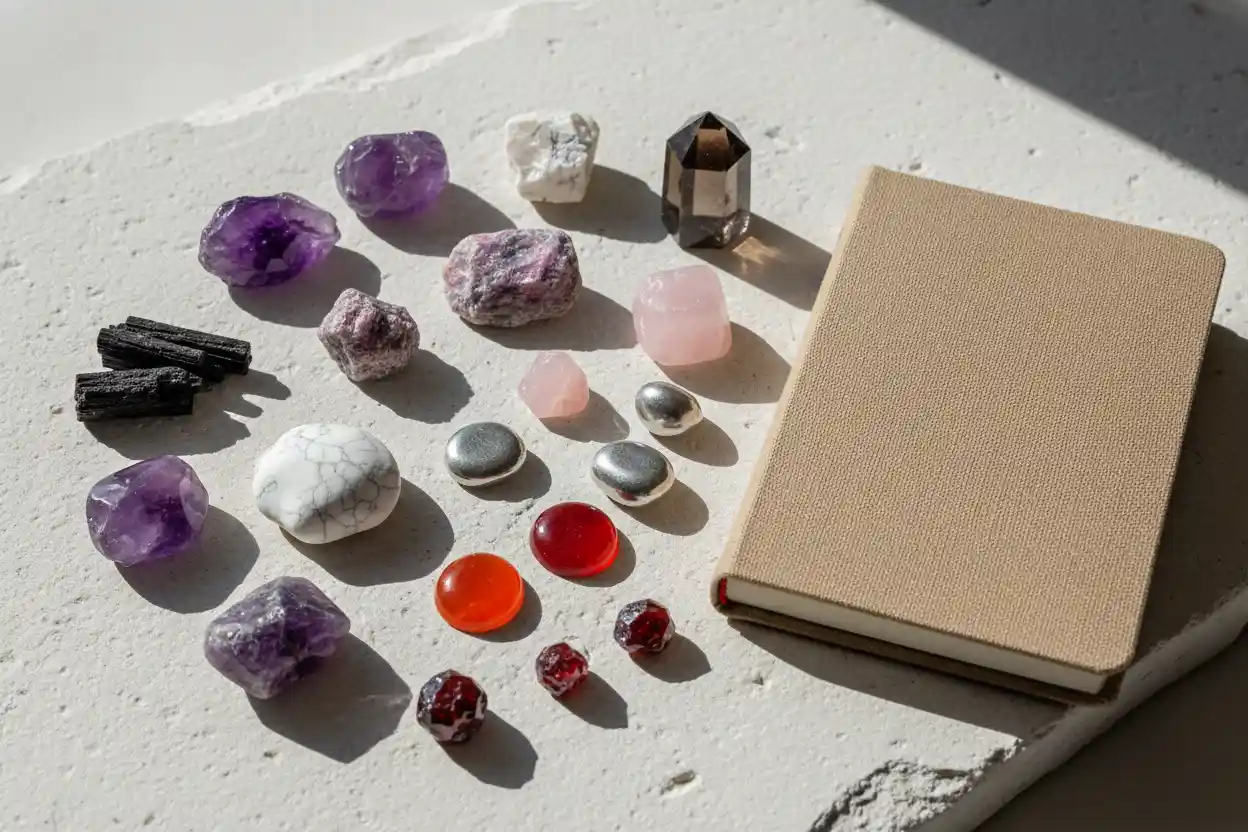
9 Trusted Crystals for Addiction Recovery: Calming Traditions & Important Safety Limits
Crystals for addiction recovery can be used as symbolic reminders of goals, coping skills, boundaries, self-compassion, and commitment, but they do not treat substance use disorders, stop withdrawal, prevent overdose, or replace professional care. Recovery is a health process that may involve medical assessment, counseling, behavioral treatment, prescribed medications for certain substance use disorders, peer support, practical changes to daily life, and an overdose-prevention plan when relevant.
Amethyst, smoky quartz, black tourmaline, hematite, lepidolite, rose quartz, clear quartz, Apache tears, and black obsidian are commonly chosen in crystal traditions because their symbolic themes can be connected with reflection, routine, letting go, boundaries, and resilience. Their safest role is simple: use a stone as a physical prompt for an evidence-based action you already intend to take, such as contacting support, following a treatment plan, leaving a high-risk situation, practicing a coping skill, or reviewing the reasons you chose recovery.
Amethyst, Smoky Quartz, and Black Tourmaline as Reminders for Pausing Before Acting
Amethyst has a long cultural association with sobriety and restraint, although that history does not mean the stone can prevent intoxication or addiction. Physically, amethyst is purple quartz with Mohs hardness 7, making polished stones practical for pockets, desks, jewelry, and frequent handling.
Traditional amethyst healing properties often emphasize reflection, restraint, and thoughtful decision-making. Within recovery, a safer interpretation is to use an amethyst stone as a pause cue. When a craving or familiar trigger appears, touching the stone can remind you to use a previously planned response such as contacting a trusted person, changing environments, reviewing a coping card, or following advice from your treatment team.
The stone is not what reduces the medical risk. The value comes from connecting a visible object with a concrete action that supports the recovery plan.
Smoky quartz is traditionally associated with grounding, practical thinking, and releasing distractions. The themes around smoky quartz healing properties can fit recovery when the stone is used as a cue to return attention to what is happening now rather than becoming overwhelmed by the entire future.
A simple routine might involve holding a smoky quartz stone while identifying the immediate situation: what triggered the urge, what emotion is present, where the risk is highest, and which safe action is available next. This resembles structured self-observation rather than relying on the crystal itself to remove cravings.
Black tourmaline is commonly linked with protection and boundaries. The traditions surrounding black tourmaline healing properties can therefore be translated into practical recovery boundaries such as avoiding high-risk environments, limiting contact that repeatedly undermines recovery, removing substances from the home, or planning an exit from situations where use becomes more likely.
A stone near the door, keys, or phone can represent those boundaries. It cannot physically block a trigger, but it can reinforce a decision already made.
Hematite, Lepidolite, and Rose Quartz for Routine, Transition, and Self-Compassion
Hematite is a dense iron oxide with a metallic gray appearance. Traditional symbolism often connects it with stability, practical focus, and staying grounded in ordinary responsibilities. The themes within hematite healing properties can be useful when recovery feels dominated by large emotional questions and everyday structure needs attention.
Recovery often becomes stronger through repeated ordinary actions: attending appointments, taking prescribed medication correctly, sleeping at consistent times, eating regularly, avoiding known triggers, checking in with support, and planning difficult periods in advance. A hematite stone beside a daily schedule can symbolize following through on those routines.
Lepidolite is a lithium-bearing mica often found in lilac or lavender colors. The traditions surrounding lepidolite healing properties commonly emphasize transition, patience, and gradual change. Those ideas can fit recovery because progress is rarely a single dramatic event.
The presence of lithium in lepidolite does not make touching or carrying the stone equivalent to receiving a medical lithium treatment. A mineral containing an element does not deliver a therapeutic dose through ordinary handling. Lepidolite is also relatively soft and splits easily along its mica layers, so a palm stone or protected specimen is usually more practical than rough pocket use.
Rose quartz is traditionally associated with compassion, kindness, and emotional gentleness. The themes around rose quartz healing properties can be applied carefully to recovery by using the stone as a reminder that accountability and self-compassion can coexist.
Shame can make it harder to ask for help after a difficult day or return to care after a recurrence of use. A rose quartz stone cannot resolve that situation, but it can symbolize one useful principle: respond to a setback by seeking support and reassessing the plan rather than hiding the problem.
Clear Quartz, Apache Tears, and Black Obsidian for Intention, Grief, and Honest Reflection
Clear quartz is often associated with intention, clarity, and focus. The traditions connected with clear quartz healing properties can fit a recovery routine when the stone represents one clearly written commitment rather than a vague wish.
That commitment might be attending the next appointment, calling someone before using, carrying prescribed overdose-reversal medication when appropriate, or avoiding a specific high-risk environment. Writing the action down and placing clear quartz beside it turns the stone into a reminder rather than a supposed treatment.
Apache tears are small forms of obsidian associated in modern crystal traditions with grief, acceptance, and emotional transition. The Apache tears healing properties are often framed around acknowledging loss. Recovery can involve real grief, including changes in friendships, routines, identity, social environments, or expectations.
A stone can accompany journaling about those losses, but significant grief, trauma, depression, or anxiety may require professional support. Trying to suppress difficult emotions through crystal rituals alone can leave important needs unaddressed.
Black obsidian is volcanic glass commonly associated with truth, reflection, and confronting patterns that are uncomfortable to examine. The traditions around black obsidian healing properties can be translated into practical review: What situations tend to precede use? Which thoughts appear before a high-risk choice? Which people or places make recovery more difficult? What has helped previously?
That kind of reflection is most useful when it feeds back into a real plan with clinicians, counselors, peer supporters, family members, or other trusted people rather than remaining a private ritual.
Crystals Cannot Treat Withdrawal or Replace Addiction Treatment
Substance withdrawal is not one condition with one level of risk. Symptoms and medical danger depend on the substance, amount, duration of use, other health conditions, and whether several substances are involved.
Alcohol and benzodiazepine withdrawal can become medically dangerous, including risk of seizures and other serious complications. Suddenly stopping heavy or dependent use without appropriate medical guidance can therefore be unsafe. Opioid withdrawal is often intensely uncomfortable, and evidence-based medications can be important both for managing opioid use disorder and supporting longer-term recovery.
Behavioral therapies and counseling can help people identify triggers, develop coping strategies, improve problem-solving, repair relationships, and build rewarding alternatives to substance use. Medications are also established treatments for certain substance use disorders. A crystal should never be substituted for prescribed treatment because it seems more natural, spiritual, or personally meaningful.
The traditions around crystals for inner peace can still have a place as optional personal symbolism, but the medical and psychological parts of recovery need care appropriate to the actual condition.
Cravings Need a Response Plan, Not a Promise From a Stone
Cravings can feel urgent, but their presence does not mean a person has failed. A prepared response can reduce the amount of decision-making required during a difficult moment.
A crystal can become one small part of that response by acting as a cue. When you notice it, the next step might be leaving the triggering location, contacting a support person, attending a meeting, using a therapist-taught coping technique, eating or sleeping if basic needs have been neglected, or following another action already included in the treatment plan.
The key is to attach the stone to behavior. Carrying amethyst without a plan offers no protection from overdose or recurrence of use. Carrying amethyst as a reminder to call someone before entering a high-risk situation gives the object a practical function without exaggerating what the crystal itself does.
Triggers also change over time. Recovery plans should be reviewed when circumstances, medications, relationships, housing, work stress, or patterns of use change.
Recurrence of Use Should Trigger Safety and Support, Not Abandonment of Recovery
A return to substance use can happen during recovery and should be taken seriously. It may show that treatment, support, medication, coping strategies, or environmental protections need to be adjusted.
One major danger is reduced tolerance after a period of abstinence. Returning to an amount previously used can create a much greater overdose risk. This is particularly important with opioids and with unpredictable illicit drug supplies.
After a recurrence of use, the safest response is to reconnect with professional or recovery support promptly rather than assuming all previous progress has been lost. Review what happened before the episode, what warning signs were missed, and what changes could reduce risk next time.
Crystals can represent recommitment, but they should never be used to frame recurrence as an energy problem, failure to cleanse correctly, or proof that someone lacked enough willpower. Substance use disorders involve health, behavioral, social, and environmental factors that require more serious support than symbolic objects can provide.
Opioid Overdose Safety Matters More Than Any Crystal Practice
An opioid overdose can suppress breathing and become fatal quickly. A person who cannot be awakened, has very slow or stopped breathing, makes unusual choking or gurgling sounds, or develops blue or purple lips or fingertips may be experiencing a medical emergency.
Call local emergency services immediately. If naloxone or another approved opioid overdose reversal medicine is available, use it according to its instructions and continue emergency care until professional help arrives. Do not rely on crystals, cold showers, walking the person around, or waiting for the effects to pass.
People at risk of opioid overdose and those close to them can benefit from learning how to recognize overdose, having naloxone available where accessible, and discussing risk reduction with qualified health professionals.
A crystal may carry personal meaning after an emergency or during recovery, but it has no role in reversing an overdose.
How to Use Crystals Without Letting Them Interfere With Recovery
Keep the role of the stone small and specific. It might represent one coping skill, one boundary, one person to call, or one commitment you want to remember. This reduces the temptation to turn crystals into a substitute treatment system.
Avoid spending large amounts of money on products claiming to cure addiction, eliminate cravings, detox the body, remove addictive energy, or guarantee sobriety. Those promises are not supported by established evidence.
Do not place crystals in drinking water or ingest powders as a detox method. The composition, treatments, surface contaminants, and safety of individual stones may be uncertain, and crystal products do not medically detox alcohol or drugs from the body.
Recovery support can also extend beyond formal treatment. Trusted family, peer-support communities, recovery coaches, structured routines, stable housing, and meaningful daily activities may all contribute to a stronger recovery environment when appropriate for the individual.
Conclusion
Crystals for addiction recovery can provide symbolism, tactile reminders, and structure around intentions, but they cannot treat substance use disorders or protect against withdrawal and overdose. Amethyst, smoky quartz, black tourmaline, hematite, lepidolite, rose quartz, clear quartz, Apache tears, and black obsidian are best used as reminders of practical actions such as pausing, maintaining boundaries, following treatment, asking for support, reviewing triggers, and returning to a recovery plan after a setback.
FAQs
Can crystals cure addiction?
No. There is no established evidence that crystals cure substance use disorders. Effective recovery may involve professional assessment, counseling, behavioral treatment, medications, peer support, and other evidence-based care.
Which crystal is traditionally associated with sobriety?
Amethyst has a long cultural association with sobriety and restraint, but carrying or wearing it does not prevent intoxication, cravings, or recurrence of use.
Can amethyst stop alcohol cravings?
There is no established evidence that amethyst directly reduces alcohol cravings. It can be used as a reminder to follow a coping plan or seek support.
Can crystals help during withdrawal?
Crystals cannot treat withdrawal. Some forms of withdrawal, especially from alcohol or benzodiazepines, can become medically dangerous and require professional assessment.
Can lepidolite provide lithium through the skin?
No therapeutic lithium dose is delivered by ordinarily touching or carrying lepidolite. Its lithium content should not be confused with prescription medical treatment.
What should I do if someone may be experiencing an opioid overdose?
Call local emergency services immediately. Use naloxone or another approved opioid overdose reversal medicine if available and follow its instructions while emergency help is on the way.
Can crystals prevent relapse?
No crystal can prevent a recurrence of substance use. A stone can act as a reminder to use coping skills, contact support, avoid a trigger, or follow a treatment plan.
Is a setback proof that recovery has failed?
No. A return to use should prompt attention to safety and a review of treatment, triggers, support, and coping strategies rather than abandonment of recovery efforts.
Is it safe to use crystal water as a detox?
Crystal water does not medically detox drugs or alcohol, and placing unknown stones in drinking water can introduce avoidable risks.
Crystal symbolism can complement personal reflection, but substance use disorders, withdrawal, overdose risk, and mental health symptoms require evidence-based professional care.