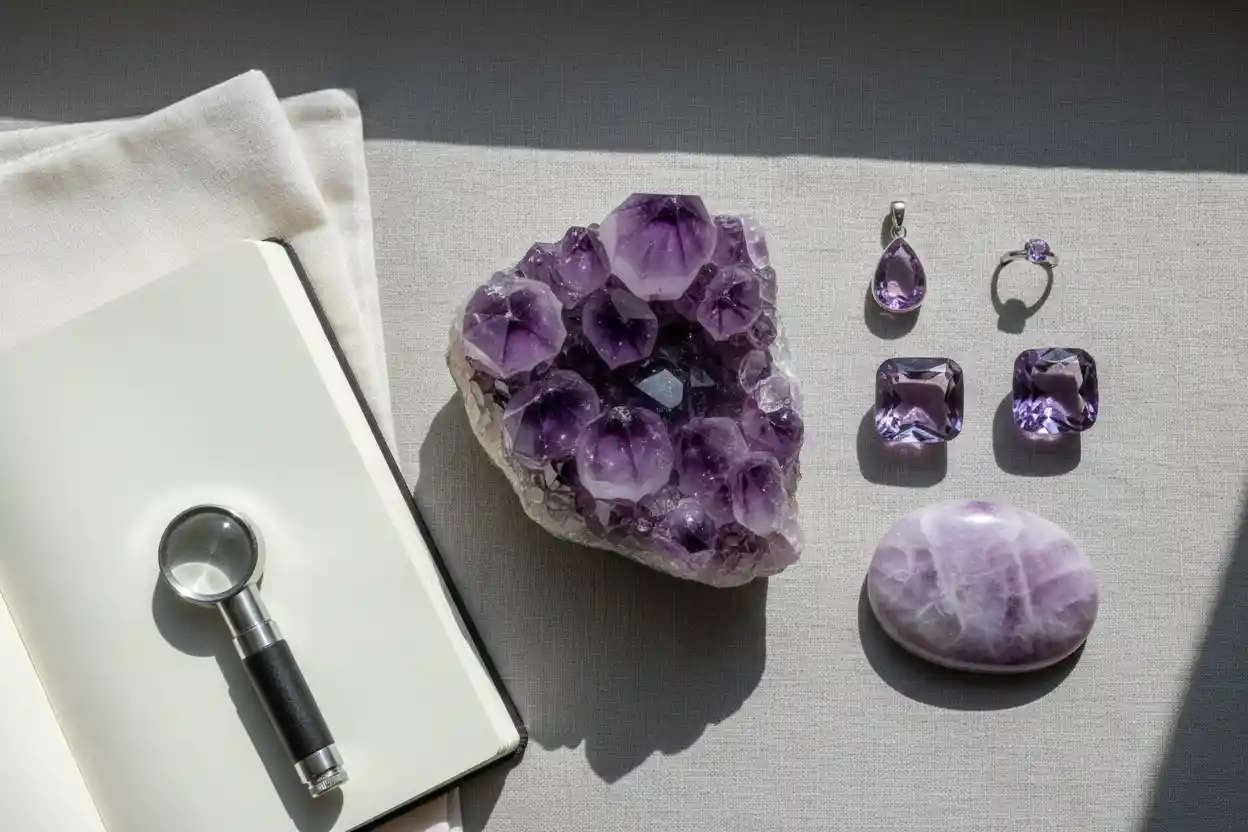
11 Amethyst Healing Properties: Popular Claims, Clear Evidence Limits & Safe Use
Amethyst healing properties are traditionally associated with calm reflection, emotional steadiness, sleep routines, mental clarity, restraint, intuition, confidence, grief support, creativity, spiritual contemplation, and healthier personal boundaries. These meanings have deep roots in cultural and modern crystal traditions, but amethyst does not treat anxiety, insomnia, addiction, depression, headaches, hormonal problems, neurological conditions, or other illnesses through ordinary contact with the body. Its safest role is symbolic: a purple quartz crystal can become a reminder to pause, reflect, prepare for rest, examine a difficult thought, or follow a personally meaningful routine.
Amethyst is the purple variety of quartz, with a Mohs hardness of 7 and the same basic silicon dioxide chemistry as clear quartz and citrine. Its violet color develops from iron-related color centers within the quartz structure and natural irradiation during geological formation. Colors range from pale lilac through medium violet to deep purple, sometimes with reddish or bluish flashes, while uneven color zoning is common in natural crystals. These physical properties are real and measurable. Claims that amethyst emits a medically active energy, changes hormones, or directly alters brain chemistry are not established by comparable evidence.
Amethyst Calm and Stress-Relief Claims Work Best as Reflection Cues
Calm is one of the most common themes attached to amethyst. Crystal traditions often describe the stone as soothing, peaceful, or helpful during emotionally demanding periods, yet there is no established evidence that wearing amethyst lowers stress hormones or directly changes anxiety physiology. A more useful interpretation is to connect the stone with a specific calming behavior. An amethyst on a desk might represent pausing before replying to an upsetting email, closing unnecessary tabs when concentration becomes scattered, or taking a planned break before frustration turns into poor judgment.
This approach preserves the traditional symbolism without asking the gemstone to perform a medical function. A person can genuinely find a familiar stone comforting because it has aesthetic appeal, personal history, or ritual meaning. That subjective response can be valuable, but it should remain distinct from treatment. The traditional amethyst benefits are most responsibly understood when emotional comfort, reflective practice, and decorative enjoyment are separated from unsupported health claims.
Amethyst also fits the symbolism of crystals for inner peace because quiet routines often require deliberate boundaries around stimulation. A person may place the stone where work ends for the day, beside a journal used for reflection, or near a reading area where devices are put aside. The helpful element is the behavior associated with the object, not a calming substance entering the body.
Amethyst Sleep Claims Should Support Bedtime Habits, Not Insomnia Treatment
Amethyst is one of the best-known stones in sleep and dream traditions. It is frequently placed on bedside tables, worn before bed, or associated with quiet evening routines because purple coloration and longstanding spiritual symbolism have made it culturally linked with rest and contemplation. These associations can make amethyst a useful bedtime cue, but the stone does not induce sleep, regulate melatonin, prevent waking during the night, or treat insomnia.
A practical amethyst routine can mark the beginning of a consistent wind-down period. The stone may represent putting away work, reducing stimulating activity, writing tomorrow’s important tasks so they no longer need to be mentally rehearsed, and preparing the sleeping environment. These habits have understandable roles in sleep routines, whereas claims that amethyst directly changes sleep physiology do not have established support.
The connection between amethyst and crystals for dreams should also remain symbolic. A stone beside a dream journal can remind someone to record a dream soon after waking, but it does not guarantee vivid dreams, lucid dreams, prophetic information, or protection from nightmares. Persistent sleep problems or frequent disturbing dreams deserve appropriate assessment according to their severity and context rather than a stronger crystal ritual.
Amethyst Clarity and Focus Traditions Reflect Deliberate Decision-Making
Amethyst is often described as a clarity stone, particularly when someone feels mentally overloaded or uncertain. There is no evidence that it increases intelligence, improves memory, or produces sharper cognition through contact with the skin. The symbolism becomes much more useful when clarity is defined as separating facts, assumptions, values, and predictions before making a decision.
A polished amethyst stone beside a notebook can represent slowing down enough to write the actual question being considered. If the issue involves work, money, relationships, or another important choice, the next step may be gathering missing information rather than searching for a mystical sign. The crystals for clarity tradition becomes practical when it encourages structured thinking instead of treating intuition as certainty.
Amethyst can also support focus symbolically by becoming a cue for a defined work period. If a person always places the stone beside a notebook before writing or studying, the object may become associated with beginning the task. The concentration still comes from environmental control, attention management, and practice. The stone simply provides a visible transition into that routine.
Amethyst Restraint and Habit Claims Should Never Replace Addiction Treatment
Amethyst has a historical association with sobriety and restraint, and even its name is traditionally linked with the idea of not being intoxicated. This history has encouraged modern claims that the stone reduces cravings, supports addiction recovery, or prevents overindulgence. There is no established evidence that amethyst changes alcohol metabolism, suppresses cravings, or treats substance use disorders.
Its symbolism can still be meaningful if used carefully. Someone in recovery might associate amethyst with a commitment already supported by counseling, peer support, medication when appropriate, structured treatment, or another evidence-based plan. The stone can represent one decision, such as calling a support person, leaving a high-risk environment, or following a recovery routine, but it should never be treated as the mechanism preventing relapse.
The crystals for addiction recovery tradition requires especially clear limits because addiction can involve serious medical and psychological risks. Withdrawal from some substances can also be dangerous. Crystal practice should remain secondary to appropriate professional care, emergency support when needed, and established recovery resources.
Amethyst Emotional Healing and Grief Claims Need Realistic Limits
Amethyst is often associated with emotional healing because its calm symbolism fits reflection after disappointment, grief, relationship changes, or stressful transitions. A personally meaningful stone may become part of a quiet routine in which someone writes, remembers, talks with trusted people, or simply allows difficult feelings to exist without immediately trying to remove them. These uses can be personally supportive without requiring a claim that the crystal is altering emotional health biologically.
The crystals for emotional healing tradition is most responsible when healing means processing an experience rather than erasing it. Grief, for example, does not follow one predictable timeline, and sadness after loss does not indicate that a crystal has failed. Amethyst can symbolize patience with an emotional process while human connection, time, counseling, and other forms of support address the actual experience.
The same principle applies to depression and severe anxiety. A stone may feel familiar or comforting, but it cannot replace assessment, therapy, medication, crisis support, or another appropriate intervention. Any crystal language that promises to cure emotional disorders risks placing too much responsibility on the person to believe correctly or use the stone correctly.
Amethyst Intuition and Spiritual Claims Should Stay Separate From Factual Knowledge
Amethyst has a strong place in spiritual traditions and is often associated with intuition, meditation, contemplation, and insight. These uses can be meaningful for people who value spiritual practice, but they do not establish that the stone provides hidden information, predicts future events, reveals another person’s thoughts, or guarantees that an intuitive impression is accurate.
A safer way to use amethyst for intuition is to connect it with reflective questions. What do I already know? Which part of this reaction comes from experience? What evidence would change my mind? Is fear influencing the conclusion? The crystals for intuition approach becomes more useful when intuition is treated as one source of personal information that should be checked against facts in high-stakes situations.
Meditation with amethyst can also be approached simply. The stone provides a visual or tactile focus while the person practices attention. Any relaxation or insight comes from the contemplative practice and personal interpretation rather than from a proven energy emitted by the quartz.
Amethyst Creativity and Confidence Symbolism Can Support Starting Difficult Work
Purple gemstones have long carried associations with dignity, imagination, and individual expression, which helps explain why amethyst is frequently linked with creativity and confidence. These themes can work well for writers, artists, students, or anyone facing a task that feels intimidating. A stone can symbolize beginning before the outcome is certain, returning to a draft after criticism, or showing work to someone else even when it is not perfect.
There is no established evidence that amethyst increases creative brain function or directly improves confidence. Practical confidence develops through experience, preparation, and repeated exposure to manageable challenges. Creativity develops through observation, experimentation, revision, and practice. Amethyst can mark those behaviors without being credited for producing them.
This makes the stone particularly useful as a transition object. Placing it on a desk can mean that planning has ended and work begins. Moving it away can signal that the session is finished. The ritual is simple, repeatable, and does not depend on extraordinary claims.
Chevron Amethyst Shares Quartz Chemistry but Has Distinct Visual Symbolism
Chevron amethyst displays alternating purple and white or clear quartz zones, often forming V-shaped or banded patterns. It is still quartz, but its distinctive structure has led crystal traditions to give it somewhat different symbolism from evenly colored amethyst. Traditional chevron amethyst healing properties often emphasize direction, pattern recognition, focus, and layered reflection.
Those meanings come from appearance and tradition rather than a distinct medical mechanism. A person might prefer chevron amethyst because its visible bands make it an intuitive symbol for breaking a complex problem into stages. Another collector may simply prefer evenly saturated faceted amethyst because of its gem quality and color.
Neither variety has established healing power. The difference lies in appearance, geological growth patterns, personal association, and market preferences rather than measurable therapeutic action.
Amethyst Color, Hardness, Heat Treatment, and Sunlight Affect Practical Use
Amethyst has a Mohs hardness of 7, making it suitable for many types of jewelry, although it can still chip from a hard impact. Color is one of its most important visual characteristics, with stronger saturation and attractive tone usually receiving greater attention in gem-quality stones. Natural color zoning is common, and cutting can either emphasize or reduce visible unevenness.
Heat treatment is also relevant because some amethyst can be heated to produce yellow, orange, brownish, or greenish colors depending on its geological origin and response. Much commercial citrine is produced by heating suitable amethyst. Treatment does not make a gemstone fake, but disclosure is important when treatment affects identity, appearance, and value.
Prolonged strong light and heat can also affect some amethyst colors over time, so valuable pieces are better stored away from unnecessary extended exposure. The article on can crystals go in the sun is relevant because the popular idea of sunlight cleansing does not automatically suit every gem. A crystal practice never requires risking color stability simply to follow a ritual.
Amethyst Buying Decisions Should Focus on Color and Disclosure, Not Healing Strength
When choosing amethyst, buyers sometimes encounter claims that darker stones, certain origins, or particular crystal shapes have stronger healing energy. These claims are not objectively measurable. Gem quality and value are better assessed through visible color, clarity appropriate to the piece, cutting, workmanship, size, treatment disclosure, and overall appeal.
The buy amethyst process should therefore focus on what can actually be evaluated. A specimen may be worth purchasing because it has attractive natural crystal form, rich purple zoning, unusual inclusions, appealing faceting, or personal significance. None of those qualities proves stronger healing ability.
The amethyst price also reflects market factors rather than spiritual potency. Two stones can carry very different prices because of saturation, size, cut quality, origin claims, or presentation while having identical status as unproven healing objects. Buyers are better protected when gemological value and symbolic value remain separate.
Amethyst Is Safe for External Symbolic Use but Does Not Belong in Medical Remedies
Amethyst is generally convenient for jewelry, desk display, meditation objects, and decorative use. Routine cleaning with lukewarm water, mild soap, and a soft brush is usually appropriate for untreated pieces, while harsh chemicals and extreme heat should be avoided when treatments or inclusions are uncertain. Jewelry should also be protected from hard blows despite quartz’s useful hardness.
There is no need to grind amethyst, ingest powder, or prepare crystal water for health purposes. Direct ingestion creates unnecessary uncertainty and has no established therapeutic advantage. External use provides the visual, tactile, and symbolic qualities people usually seek from the stone.
Claims about treating headaches, blood disorders, hormone problems, insomnia, addiction, pain, immune conditions, or mental health concerns should therefore be kept separate from ordinary crystal use. A gemstone can be personally meaningful without being a medicine.
Conclusion
Amethyst healing properties are best understood as traditional themes of calm reflection, sleep routines, clarity, restraint, intuition, emotional support, confidence, creativity, spiritual contemplation, and personal boundaries. The gemstone itself is purple quartz with a hardness of 7, natural color zoning, and genuine geological interest. Amethyst can support meaningful routines and reflection, but it does not treat disease, regulate the nervous system, cure addiction, or provide hidden knowledge.
FAQs
What are the main traditional amethyst healing properties?
Amethyst is commonly associated with calm, reflection, sleep symbolism, clarity, restraint, intuition, emotional support, confidence, creativity, and spiritual contemplation.
Is amethyst scientifically proven to heal?
No. There is no established evidence that amethyst treats physical or mental health conditions through ordinary contact.
Can amethyst help with sleep?
It can serve as a bedtime routine cue, but it does not treat insomnia or directly induce sleep.
Does amethyst reduce anxiety?
Amethyst may feel personally comforting, but it is not an established treatment for anxiety disorders.
Can amethyst help addiction recovery?
It can symbolize restraint or recovery commitments, but it does not reduce cravings or replace evidence-based addiction treatment.
What causes amethyst’s purple color?
Its purple color is linked with iron-related color centers and natural irradiation within quartz.
How hard is amethyst?
Amethyst has a Mohs hardness of 7, making it suitable for many jewelry uses while still requiring protection from hard impacts.
Can amethyst fade in sunlight?
Some amethyst can lose color with prolonged strong light or heat exposure, so unnecessary extended exposure is best avoided.
Is chevron amethyst different from regular amethyst?
Chevron amethyst has visible purple and white or clear quartz banding, but both are quartz and neither has established healing effects.
Can amethyst go in drinking water?
There is no need to use amethyst in drinking water for wellness purposes. External use is simpler and avoids unnecessary uncertainty.
Does darker amethyst have stronger healing properties?
No objective evidence shows that darker color, origin, size, or shape produces stronger healing effects.
Amethyst healing meanings are traditional or personal practices, not established treatments for physical or mental health conditions.