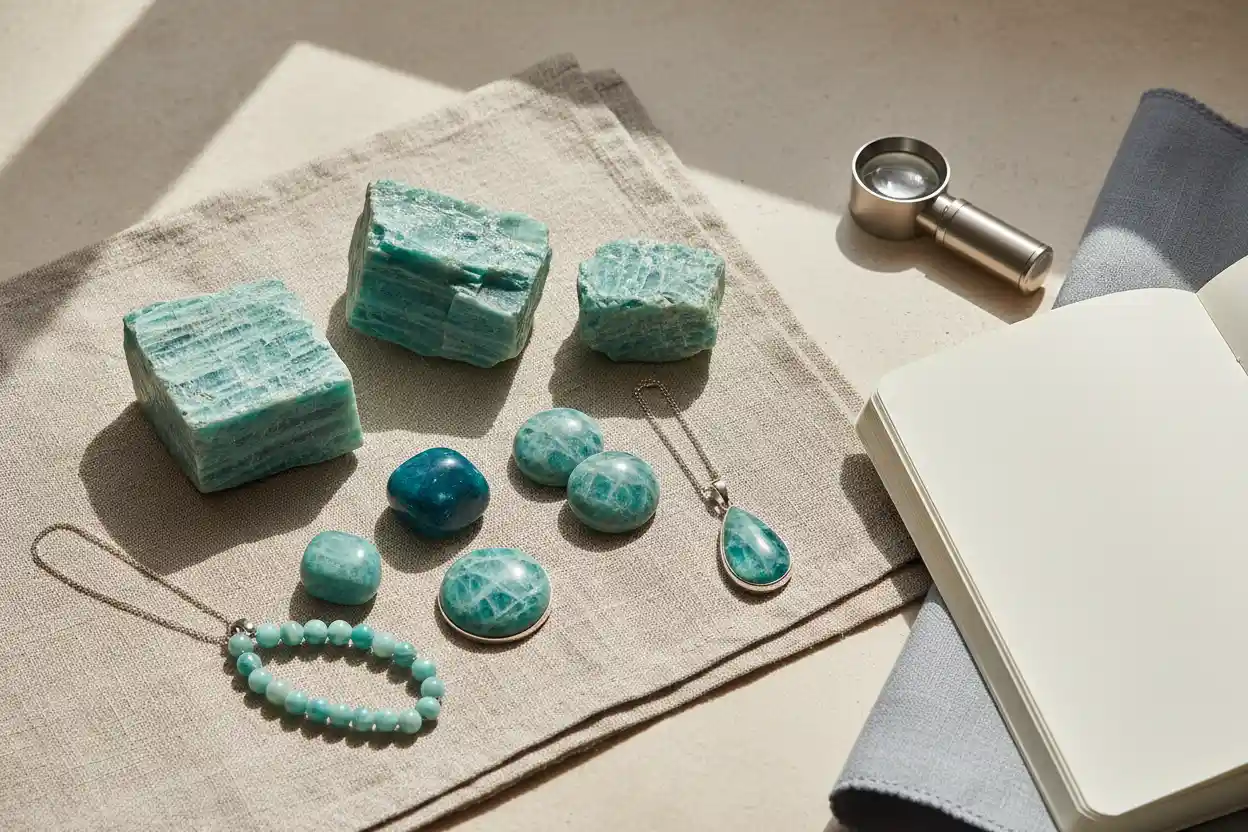
Amazonite Healing Properties: 9 Essential Claims, Hopeful Traditions & Safe Limits
Amazonite healing properties are traditionally associated with honest communication, emotional balance, confidence, boundaries, hope, clarity, creativity, relationship understanding, and adapting to change. These meanings come from crystal traditions rather than established medical evidence. Amazonite does not treat anxiety, regulate hormones, improve thyroid function, lower blood pressure, relieve physical pain, detoxify the body, or change neurological function through ordinary contact with the skin.
Amazonite is a blue-green to green variety of microcline, a potassium feldspar. It typically has a Mohs hardness around 6 to 6.5 and shows two strong cleavage directions, which means it can scratch less easily than many soft decorative stones but may still chip along internal planes if struck. Its distinctive color is linked to trace elements and structural features within the feldspar rather than any therapeutic property. Understanding those physical facts makes it easier to appreciate amazonite as a genuine mineral while treating its wellness associations as symbolic practices rather than physiological effects.
Amazonite Communication Properties Symbolize Clearer Speech and Honest Expression
Communication is one of the strongest themes attached to amazonite in modern crystal practice. The stone is often described as encouraging honest speech, helping someone say what they mean, or making difficult conversations feel less intimidating. There is no evidence that amazonite changes speech centers in the brain or directly reduces social anxiety, but it can work well as a visual cue for preparing and delivering a clear message. A polished stone beside a notebook might represent writing down the central point before an important conversation, choosing specific language instead of vague accusations, or asking for clarification instead of silently assuming what another person intends.
The traditional amazonite benefits become more useful when communication is treated as a behavior that can be practiced. Someone discussing workload with a manager might use the stone to remember three concrete examples rather than saying that everything feels overwhelming. In a relationship, amazonite can represent explaining what support would actually help instead of expecting another person to infer it. The crystals for communication tradition can support the same approach when the focus remains on listening, timing, word choice, and mutual understanding rather than assuming a stone will change how another person responds.
Amazonite symbolism also fits situations where honesty feels uncomfortable. Speaking clearly does not guarantee agreement, and being authentic does not require revealing every private thought. A healthier interpretation is that the stone represents communicating what is relevant while maintaining appropriate boundaries. This makes the tradition compatible with professional settings, friendships, family relationships, and private reflection without turning crystal use into a promise of effortless confidence.
Amazonite Emotional Balance Claims Work Best as Reflection and Boundary Cues
Amazonite is frequently described as emotionally balancing, calming, or soothing. These phrases can sound medical if they are taken literally, so it is more accurate to understand them as traditional symbolism. A stone cannot directly regulate stress hormones, stop panic, or correct an anxiety disorder. It can, however, become associated with a calming routine such as pausing before replying to an upsetting message, writing down what actually happened, or distinguishing what is within your control from what is not.
The stone’s green-blue appearance also contributes strongly to its emotional symbolism. Colors associated culturally with water, open skies, and natural landscapes often feel calm to many people, but that response is subjective. One person may find amazonite visually relaxing while another simply enjoys it as a decorative feldspar. Neither reaction proves a biological effect. The crystals for inner peace approach is most responsible when peace refers to routines that reduce unnecessary stimulation, improve boundaries, or support reflection rather than a healing force emitted by the crystal.
Boundary symbolism deserves particular attention because it prevents emotional balance from becoming passive tolerance. Amazonite is sometimes associated with harmony, but genuine harmony does not require agreeing with everyone or remaining in an unhealthy situation. The stone can instead represent saying no clearly, asking for space, limiting repeated demands, or declining an obligation that exceeds available time. These are practical actions with understandable consequences, which makes them much more useful than vague claims about balancing energy.
Amazonite Confidence and Courage Traditions Support Prepared Action, Not Fearlessness
Amazonite is often included in confidence and courage practices because communication and self-expression can require acting while uncertainty remains. Traditional crystal descriptions may say the stone removes fear or strengthens personal power, but there is no established evidence that holding amazonite changes fear responses. A more practical use is to connect the stone with preparation. Before a presentation, interview, negotiation, or difficult conversation, amazonite can symbolize reviewing the key point, practicing an opening sentence, or deciding what outcome would be acceptable.
Confidence rarely means feeling no nervousness. It more often means knowing what you intend to do despite some nervousness. The crystals for courage tradition supports this distinction when courage is understood as reasonable action rather than reckless certainty. Someone may still feel anxious before asking a question in public but decide to ask it anyway. Amazonite can mark that decision without claiming to remove the underlying feeling.
The stone can also symbolize confidence in values rather than performance. There are situations where the courageous response is not speaking more loudly but declining to participate, admitting uncertainty, or changing an opinion after receiving better information. This makes amazonite particularly suitable for communication-based confidence because the theme can include both expression and willingness to listen.
Amazonite Clarity and Decision-Making Claims Need Evidence and Specific Questions
Amazonite is sometimes described as a clarity stone that aligns thoughts and feelings or helps reveal the truth. Such language is best interpreted as a reflective metaphor. The mineral cannot determine whether a business decision, relationship choice, medical option, or financial commitment is correct. It cannot access hidden information or guarantee that intuition is accurate.
A useful amazonite clarity routine begins by defining the question precisely. Instead of asking whether a decision “feels right,” write down the available facts, the assumptions being made, the possible consequences, and the values that matter most. The crystals for clarity tradition becomes much more useful when clarity means reducing ambiguity rather than receiving supernatural answers.
This distinction is especially important for high-stakes choices. Medical decisions need appropriate professional advice, financial commitments require real numbers and risk assessment, and relationship decisions depend on behavior rather than gemstone interpretation. Amazonite can accompany reflection, but evidence and experienced guidance should carry the decision.
Amazonite Relationship Symbolism Centers on Communication Rather Than Control
Amazonite is sometimes promoted as a stone for relationship harmony, reconciliation, or attracting healthier connections. The communication symbolism makes this understandable, yet no crystal can make another person become more loving, faithful, cooperative, or emotionally available. Relationship quality still depends on reciprocal behavior.
Amazonite can instead symbolize habits that improve the conditions for a productive relationship. This might include asking rather than assuming, expressing appreciation specifically, discussing recurring problems before resentment becomes entrenched, and stating boundaries respectfully. In this form, the stone serves as a reminder that harmony requires participation from more than one person.
It is equally important to recognize the limits of relationship symbolism. A crystal should never be used to encourage someone to remain in a coercive, threatening, or abusive situation because the relationship is supposedly spiritually connected. Communication tools are useful only where communication is safe. When safety is compromised, practical support takes priority over crystal rituals.
Amazonite Creativity and Hope Claims Reflect Perspective Rather Than Brain Changes
Amazonite’s blue-green color and variable white streaking make it visually distinctive, which may explain why crystal traditions connect it with creativity, inspiration, and hopeful thinking. There is no evidence that the stone increases creative brain activity or produces ideas directly. It can nevertheless function as a useful object in a creative workspace if it becomes associated with changing perspective, beginning a draft, or returning to a project after frustration.
Hope symbolism can be approached similarly. Hope is not the prediction that everything will work out exactly as desired. A more durable form of hope recognizes uncertainty while identifying actions that remain possible. An amazonite stone can represent the intention to keep looking for options rather than assuming the first setback ends the process. This connects naturally with crystals for positivity when positivity is realistic and does not require denying disappointment.
Creative and hopeful routines become more effective when they lead toward action. Write the next paragraph, make the call, revise the plan, submit the application, or ask for feedback. The stone remains a cue while the behavior creates the actual possibility of change.
Amazonite Mineral Facts Explain Its Color, Hardness, and Cleavage
Amazonite is a variety of microcline, part of the feldspar group. Its typical green to blue-green color can range from pale pastel shades to stronger saturated tones, often interrupted by whitish streaks or patches. The coloration is associated with trace lead and structural effects within the feldspar, not with copper content as some informal descriptions suggest. Color alone is therefore not enough to identify every blue-green stone as amazonite, especially because turquoise, dyed stones, glass, and other gems may resemble it superficially.
Its hardness of roughly 6 to 6.5 gives amazonite reasonable resistance to ordinary scratching, but hardness should not be confused with toughness. Microcline has strong cleavage in two directions near right angles, so a sharp impact can split or chip the stone even when the surface has resisted abrasion. This is particularly relevant for rings and bracelets, which experience more knocks than pendants or earrings.
Amazonite commonly forms in granitic and pegmatitic geological environments where large feldspar crystals can develop. Its natural mineral structure makes it interesting without wellness claims, and learning these physical properties helps buyers distinguish real gem characteristics from spiritual descriptions.
Amazonite Jewelry Care Should Account for Feldspar Cleavage
Amazonite can be worn regularly when its cleavage and treatment history are respected. Pendants, earrings, and protected bracelet designs generally expose the stone to less impact than rings worn during manual work. Cabochons are common because the smooth shape highlights color while avoiding vulnerable facet corners.
For routine cleaning, mild soap, lukewarm water, and a soft cloth or soft brush are usually sufficient. Harsh chemicals, high heat, and aggressive cleaning methods should be avoided, particularly when the stone’s treatment or structural condition is uncertain. Sudden impact remains one of the most important physical risks because cleavage can allow a stone to break even when it is not especially soft.
Crystal water is unnecessary. Amazonite does not need to touch drinking water to support symbolic use, and a finished piece may include coatings, polishing compounds, adhesives, metal findings, or surface contamination. Jewelry, desk display, or a polished palm stone provides the same personal symbolism without introducing ingestion concerns.
Amazonite Cannot Treat Medical or Mental Health Conditions
Amazonite is sometimes claimed to benefit the thyroid, nervous system, calcium balance, heart, metabolism, pregnancy, headaches, or emotional disorders. These claims do not have established medical evidence. Wearing a necklace does not deliver a therapeutic dose of any substance into the body, and the mineral does not act as medication through ordinary skin contact.
Mental health claims deserve the same caution. Amazonite may become a comforting object or reminder within a routine, but it does not treat anxiety, depression, trauma, panic disorders, or other mental health conditions. Persistent symptoms deserve appropriate professional assessment rather than increasingly elaborate crystal practices.
Personal symbolism does not have to disappear when medical care is needed. Someone can wear amazonite during an appointment because it feels meaningful while still relying on evidence-based diagnosis and treatment. The important distinction is that the person and their care plan do the health-related work, not the gemstone.
Conclusion
Amazonite healing properties are best understood as traditional themes of communication, emotional balance, confidence, boundaries, hope, clarity, creativity, relationship understanding, and adapting to change. Its real mineral identity is equally interesting: amazonite is a blue-green microcline feldspar with moderate hardness, strong cleavage, and distinctive color created by features within its crystal structure. It can support personal reflection and meaningful routines, but it does not treat disease, control emotions, reveal hidden truth, or determine relationship outcomes.
FAQs
What are the main traditional amazonite healing properties?
Amazonite is commonly associated with communication, confidence, emotional balance, boundaries, clarity, hope, creativity, relationship understanding, and adaptability.
Is amazonite scientifically proven to heal the body?
No. There is no established evidence that amazonite treats physical illness or changes body function through ordinary contact.
What type of mineral is amazonite?
Amazonite is a green to blue-green variety of microcline, which belongs to the feldspar group.
How hard is amazonite?
Amazonite is generally around 6 to 6.5 on the Mohs scale, but its strong cleavage means it can still chip from impact.
Can amazonite improve communication?
It can serve as a symbolic reminder to communicate clearly and prepare difficult conversations, but it does not directly alter speaking ability.
Can amazonite reduce anxiety?
Amazonite may be personally comforting, but it is not an established treatment for anxiety disorders.
Is amazonite linked with relationships?
Crystal traditions associate amazonite with honest communication and understanding, but it cannot control another person’s feelings or behavior.
Does amazonite improve intuition or reveal truth?
No. It cannot provide hidden information or guarantee accurate intuition. It can only serve as a reflection cue.
Can amazonite go in drinking water?
There is no need to make crystal water. External use through jewelry or display is simpler and avoids unnecessary uncertainty around treatments or contamination.
Amazonite healing meanings are traditional or personal practices, not established treatments for physical or mental health conditions.