
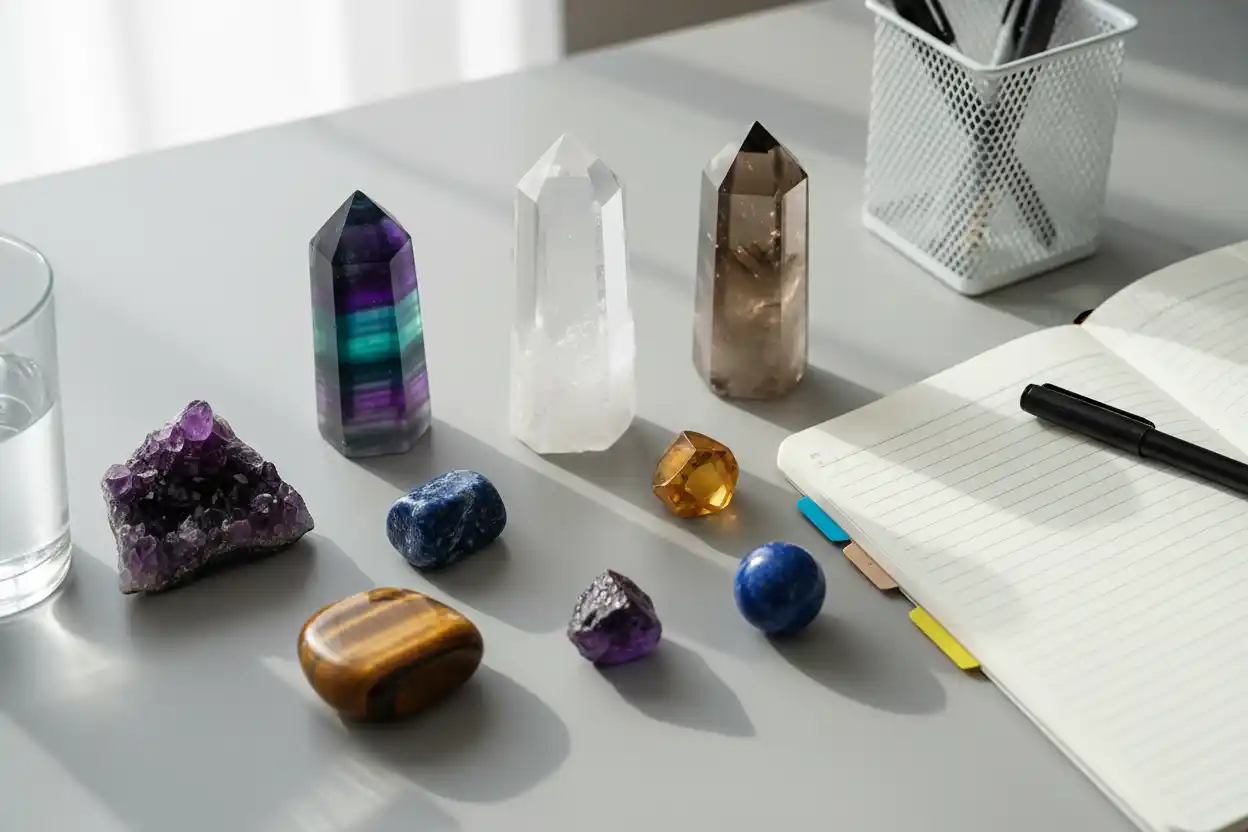

Crystals commonly associated with mental clarity include clear quartz, fluorite, sodalite, tiger’s eye, amethyst, smoky quartz, iolite and lapis lazuli. Their traditional meanings involve defining an intention, organizing information, separating evidence from assumptions and returning attention to present conditions.
A crystal cannot medically improve cognition, restore memory or diagnose the cause of confusion. Its most responsible use is as a visual or tactile prompt connected with a practical clarity routine, such as writing down the decision, reducing competing inputs or checking whether sleep, stress, medication or illness may be affecting thinking.
Mental-Clarity Crystals at a Glance
| Crystal | Traditional clarity theme | Grounded practical use |
|---|---|---|
| Clear quartz | Clarity and defined intention | State the exact question or outcome |
| Fluorite | Organization and categorization | Sort information into useful groups |
| Sodalite | Evidence and reason | Separate facts, interpretations and unknowns |
| Tiger’s eye | Observation and practical judgment | Review risk before deciding |
| Amethyst | Reflection and moderation | Pause before reacting to the first interpretation |
| Smoky quartz | Grounding and perspective | Return attention to immediate conditions |
| Iolite | Direction and internal navigation | Compare the current path with the intended destination |
| Lapis lazuli | Knowledge and responsible communication | Verify information before repeating it |
| Citrine | Purposeful optimism | Choose an opportunity based on resources |
| Hematite | Structure and practical orientation | Check sequence, posture and surroundings |
| Labradorite | Changing perspective | Examine the problem from another angle |
| Aquamarine | Composed expression | Explain the conclusion concisely |
What Mental Clarity Means
Mental clarity is not one single cognitive ability.
It may involve:
- Understanding the actual question.
- Distinguishing relevant information from distraction.
- Remembering enough context to make a decision.
- Recognizing an assumption.
- Prioritizing several competing tasks.
- Communicating a conclusion accurately.
- Knowing when more information is needed.
- Identifying when fatigue or stress is affecting judgment.
- Accepting that uncertainty remains.
- Choosing the next action without solving every future problem.
Clarity is also different from sustained focus.
A person may understand a problem clearly yet struggle to maintain attention on it. Conversely, someone may concentrate intensely on a task while working from an incorrect assumption.
This page focuses on understanding, organizing and interpreting information rather than promising stronger concentration through crystal energy.
Best Overall Crystal: Clear Quartz
The drafted clear quartz guide explains this silicon-dioxide mineral and its traditional symbolism.
Clear quartz is the most direct mental-clarity crystal because transparency provides an obvious visual metaphor for definition and visibility.
Begin by writing one question.
Avoid broad wording such as:
“How do I fix everything?”
Use a defined version:
“Which proposal should be submitted by Friday?”
“What information do I need before signing this agreement?”
“Which task is preventing the project from moving?”
“What symptom should I describe to my healthcare provider?”
Place the quartz beside the question, then write the decision standard.
The stone does not amplify thought or provide an answer. It marks the point at which a vague concern becomes a specific inquiry.
Fluorite for Organizing Information
Fluorite is calcium fluoride and commonly appears in purple, green, blue, yellow and color-zoned material.
Modern crystal traditions associate it with mental organization and sorting complex information.
A practical fluorite exercise divides material into four categories:
| Category | Question |
|---|---|
| Relevant | Does this information affect the decision? |
| Interesting but unnecessary | Is it useful later but not now? |
| Unverified | What evidence or source is missing? |
| Actionable | What can be done with this information? |
This process prevents every available detail from receiving equal weight.
Fluorite itself requires careful handling. It ranks only 4 on the Mohs scale and has perfect cleavage.
Keep it on a protected desk rather than loose in a bag with quartz, keys or metal objects.
The stone cannot improve memory, treat attention difficulties or organize information independently.
Sodalite for Facts, Interpretations and Unknowns
Sodalite is a blue feldspathoid mineral commonly marked by white calcite.
Its traditional symbolism involves reason, evidence and communication.
Use a sodalite stone beside three columns:
| Confirmed facts | Interpretations | Unknowns |
|---|---|---|
| What can be verified | What I think the facts mean | What must still be asked or researched |
For example:
| Confirmed fact | Interpretation | Unknown |
|---|---|---|
| A manager requested revisions | The work is considered poor | Which standards were not met |
| A friend did not reply today | They are avoiding me | Whether they are available |
| One test result changed | The condition is worsening | The clinical significance |
An interpretation may prove correct, but it should not become a fact merely because it feels convincing.
Sodalite cannot reveal another person’s motives or diagnose a situation.
Tiger’s Eye for Decision Clarity
Tiger’s eye is chatoyant quartz with a moving band of reflected light.
It traditionally symbolizes observation, confidence and risk awareness.
Mental clarity sometimes requires making a decision rather than continuing to collect information.
A tiger’s-eye review asks:
- What is the objective?
- Which options are realistic?
- What is the likely benefit of each?
- What is the cost?
- Who carries the risk?
- Which assumption is least secure?
- Can the decision be reversed?
- When should the result be reviewed?
The stone’s moving band makes a useful visual reminder to examine the choice from more than one position.
It cannot calculate probability, predict outcomes or prevent a poor decision.
Amethyst for Reflective Distance
The drafted amethyst guide associates purple quartz with reflection and moderation.
The first explanation that appears in the mind is not always the strongest one.
An amethyst practice introduces a pause:
“My current interpretation is…”
“One alternative explanation is…”
“The evidence that would distinguish them is…”
This process is especially useful when emotion, urgency or personal history makes one conclusion feel certain.
Reflection should not become endless delay.
After identifying the strongest available explanation, choose whether to act, investigate or wait for a defined period.
Amethyst cannot medically improve cognition or treat anxiety, insomnia or neurological conditions.
Smoky Quartz for Grounding
Smoky quartz traditionally represents grounding and practical perspective.
When the mind is crowded, clarity may begin with the body and immediate environment.
Ask:
- Have I slept adequately?
- Have I eaten or had water?
- Am I trying to decide while highly distressed?
- Is the room too noisy?
- Am I switching between several screens?
- Is there an urgent safety issue?
- Can the decision wait until conditions improve?
- What needs attention in the next ten minutes?
Grounding does not solve the full problem.
It establishes whether the present state is suitable for complex reasoning.
Smoky quartz cannot medically stop dissociation, panic, confusion or cognitive impairment.
Iolite for Direction
Iolite is cordierite known for strong pleochroism, showing different colors from different viewing directions.
That optical property makes it an effective symbol for orientation and direction.
An iolite exercise compares:
| Current direction | Intended direction |
|---|---|
| What I am actually doing | What the stated goal requires |
| Where time is going | Where time was meant to go |
| Which information I am collecting | Which information the decision needs |
| Which result I am optimizing | Which result matters most |
The exercise may reveal that the problem is not insufficient effort but effort aimed at the wrong outcome.
Iolite cannot reveal destiny or identify the correct life path supernaturally.
Lapis Lazuli for Information Integrity
Lapis lazuli is a multi-mineral blue rock composed mainly of lazurite with variable calcite, pyrite and other minerals.
Its traditional meanings include knowledge, truth and responsibility in communication.
Mental clarity is weakened when information is repeated without checking its origin.
A lapis prompt asks:
- Where did this claim come from?
- Is the source qualified?
- Is the information current?
- Does the evidence support the exact conclusion?
- Am I repeating a headline rather than the underlying information?
- Which limitation must be disclosed?
Natural lapis may contain white calcite and golden pyrite.
Dyeing, waxing and reconstructed material occur commercially.
The stone cannot make information true or prevent misinformation by itself.
Citrine for Opportunity Clarity
The drafted citrine guide associates yellow-to-orange quartz with optimism, resources and purposeful growth.
Optimism can support action, but it can also cause a person to minimize cost or uncertainty.
A citrine opportunity review asks:
- What resource does this opportunity require?
- What evidence suggests it is viable?
- What is the smallest useful test?
- What would make me stop?
- Which cost may continue after the initial decision?
- Does the opportunity fit the actual goal?
Most commercial citrine is heat-treated amethyst.
The treatment is generally stable but should be disclosed.
Citrine cannot guarantee success, profit or a positive outcome.
Hematite for Sequence and Orientation
Hematite is iron oxide traditionally associated with structure and practical attention.
A hematite-style object can mark a sequence check:
- What happened first?
- What happened next?
- Which part is documented?
- Where did the assumption enter?
- What decision followed?
- Which step should be reviewed?
Strongly magnetic metallic beads sold as hematite are often manufactured hematine or another material.
The iron content of hematite does not improve blood iron or cognitive function through ordinary handling.
Its usefulness here is organizational rather than medical.
Labradorite for Alternative Perspectives
Labradorite is feldspar that displays labradorescence as the viewing angle changes.
Its shifting appearance can symbolize the fact that one problem may look different from another position.
Ask:
- How would someone with less information view this?
- What changes over a longer time frame?
- Who experiences the consequence differently?
- Which assumption reflects my role or privilege?
- What evidence would contradict my preferred conclusion?
- What becomes visible after the problem is reframed?
Considering another perspective does not mean every interpretation is equally accurate.
Evidence still matters.
Labradorite cannot reveal hidden motives or supernatural knowledge.
Mental Clarity and Memory Are Different
Clarity concerns understanding and organizing the present issue.
Memory concerns retaining and retrieving information.
A person may feel mentally clear but forget a name, date or instruction. Another person may remember extensive detail yet remain uncertain about the decision.
When memory matters, use external supports:
- Written notes.
- Calendar reminders.
- Checklists.
- Recorded instructions where permitted.
- Medication organizers.
- Labels.
- Summaries after meetings.
- A consistent file system.
- Confirmation emails.
A crystal should not become the memory system.
It can sit beside the notebook or planner as a cue to use the actual support.
Mental Clarity and Sleep
Thinking may become slower, less flexible or less reliable when sleep is inadequate.
A crystal cannot compensate for severe fatigue.
When possible, delay irreversible decisions until after rest.
If the decision cannot wait, reduce complexity:
- Write down the options.
- Ask another qualified person to review them.
- Use established procedures.
- Avoid multitasking.
- Confirm important details in writing.
- Do not drive or operate dangerous equipment when too sleepy to do so safely.
Amethyst or smoky quartz can mark the rest-and-review routine, but neither stone restores the effects of lost sleep medically.
Mental Clarity and Stress
Stress can narrow attention toward immediate threat and reduce the mental space available for comparison or planning.
A clarity practice should not insist that the person simply think more positively.
Instead, identify whether the stressor can be reduced.
This may involve changing the environment, asking for more time, delegating work, seeking financial guidance, leaving an unsafe interaction or obtaining healthcare.
The drafted crystals-for-anxiety guide explains how stones may cue coping actions without treating an anxiety disorder.
Mental clarity sometimes improves only after the underlying pressure is addressed.
Mental Clarity at Work
Use one desk stone for one purpose.
A clear quartz point can represent the current decision. Fluorite may accompany the information sort, while sodalite supports fact checking.
Avoid covering the workspace with several towers, spheres and cards.
Visual clutter can work against the intended goal.
A simple professional clarity sequence is:
- State the decision.
- Identify the decision-maker.
- List required information.
- Separate facts from assumptions.
- Set the deadline.
- Record the outcome.
The drafted crystals-for-career guide covers broader professional goals, boundaries and career development.
Mental Clarity During Study
Begin with the learning objective.
Do not write “study biology.”
Write:
“Explain the stages of mitosis without notes.”
“Complete ten practice problems and review errors.”
“Compare the two theories in one paragraph.”
Use fluorite for sorting topics, clear quartz for defining the target and sodalite for checking whether the explanation is supported.
Crystals do not improve grades, attention, intelligence or memory scientifically.
Learning depends on appropriate instruction, practice, rest, feedback and support.
Mental Clarity in Relationships
Relationship clarity is not the same as obtaining certainty about another person’s thoughts.
Ask questions that concern observable behavior and personal choices:
- What has the person said directly?
- What pattern has occurred?
- Which expectation was never discussed?
- What boundary belongs to me?
- Does continued contact remain safe and consensual?
- What information can only the other person provide?
- Which answer might not be available?
Rose quartz and rhodonite can add compassion and accountability, but they cannot reveal whether someone is a soulmate or secretly intends to return.
When Confusion Needs Medical Attention
A gradual sense of mental fog can have many possible causes, including stress, sleep disruption, illness, medication effects and mental health conditions.
It should not be diagnosed through crystals.
Sudden confusion, new difficulty speaking or understanding speech, one-sided weakness, severe sudden headache, loss of balance or sudden visual changes may indicate a medical emergency.
Seek urgent local emergency help rather than attempting a grounding ritual.
Persistent or worsening changes in memory, concentration, behavior or daily functioning also deserve qualified assessment.
A Four-Stone Clarity Set
A coherent set might include:
| Crystal | Role |
|---|---|
| Clear quartz | Define the question |
| Fluorite | Sort the information |
| Sodalite | Check facts and assumptions |
| Tiger’s eye | Decide and review risk |
The sequence becomes:
Define → Organize → Verify → Decide
Add smoky quartz when stress or overstimulation is the main obstacle.
Add amethyst when the first interpretation needs a deliberate pause.
Using more stones does not create more clarity.
Choosing a Crystal Form
A smooth adult palm stone suits journaling and desk reflection.
A tower provides a visible vertical focus but needs a stable base.
A natural point can mark direction, while a sphere encourages viewing the issue from several angles.
The drafted crystal-shapes guide explains form-specific symbolism and safety.
Avoid sharp points during intense emotional states and keep spheres on fitted stands.
The shape does not increase cognitive effects.
Frequently Asked Questions
1. What is the best crystal for mental clarity?
Clear quartz is the most versatile choice because it symbolizes clarity and defining an intention precisely.
2. Which crystal is associated with organizing thoughts?
Fluorite commonly symbolizes categorization, organization and separating useful information from distraction.
3. Which crystal supports logical thinking symbolically?
Sodalite is associated with evidence, reason and distinguishing facts from interpretations.
4. Is tiger’s eye suitable for decision-making?
Yes. Its traditional meanings involve observation, confidence and practical risk assessment.
5. Can amethyst clear brain fog?
No. Amethyst may cue reflection, but it cannot medically treat brain fog or cognitive symptoms.
6. Which crystal is associated with direction?
Iolite traditionally symbolizes navigation, orientation and comparing the current path with the intended destination.
7. Can crystals improve memory?
No. Crystals do not scientifically improve memory. Notes, calendars, practice, sleep and qualified care provide practical support.
8. Can crystals improve concentration?
They may serve as task cues, but they do not medically improve attention or treat attention disorders.
9. What crystal combination is best for clarity?
Clear quartz, fluorite, sodalite and tiger’s eye create a coherent define-organize-verify-decide sequence.
10. Can I use a clarity crystal during study?
Yes, as a visual reminder connected with a specific learning objective, but not as a replacement for practice and instruction.
11. When should mental confusion receive urgent attention?
Sudden confusion, trouble speaking, weakness, major balance changes or other abrupt neurological symptoms require urgent medical help.
12. Are mental-clarity crystal effects scientifically proven?
No. Their clarity, focus and insight meanings reflect spiritual traditions rather than established cognitive effects.
Clear Thinking Begins With a Clear Question
Mental clarity rarely comes from adding more information indiscriminately. It begins by identifying the actual question, organizing what is known and accepting which parts remain uncertain.
Choose one crystal for definition and another for verification or decision-making. The objects can structure the process, while sleep, evidence, practical support and qualified care protect the quality of the conclusion.
Disclaimer: Crystal clarity, memory, concentration and insight properties reflect cultural and spiritual traditions rather than established cognitive or medical effects. Crystals cannot diagnose or treat confusion, memory loss, attention disorders or neurological conditions. Seek urgent local medical help for sudden confusion, speech difficulty, weakness, severe headache, loss of balance or other abrupt neurological changes.