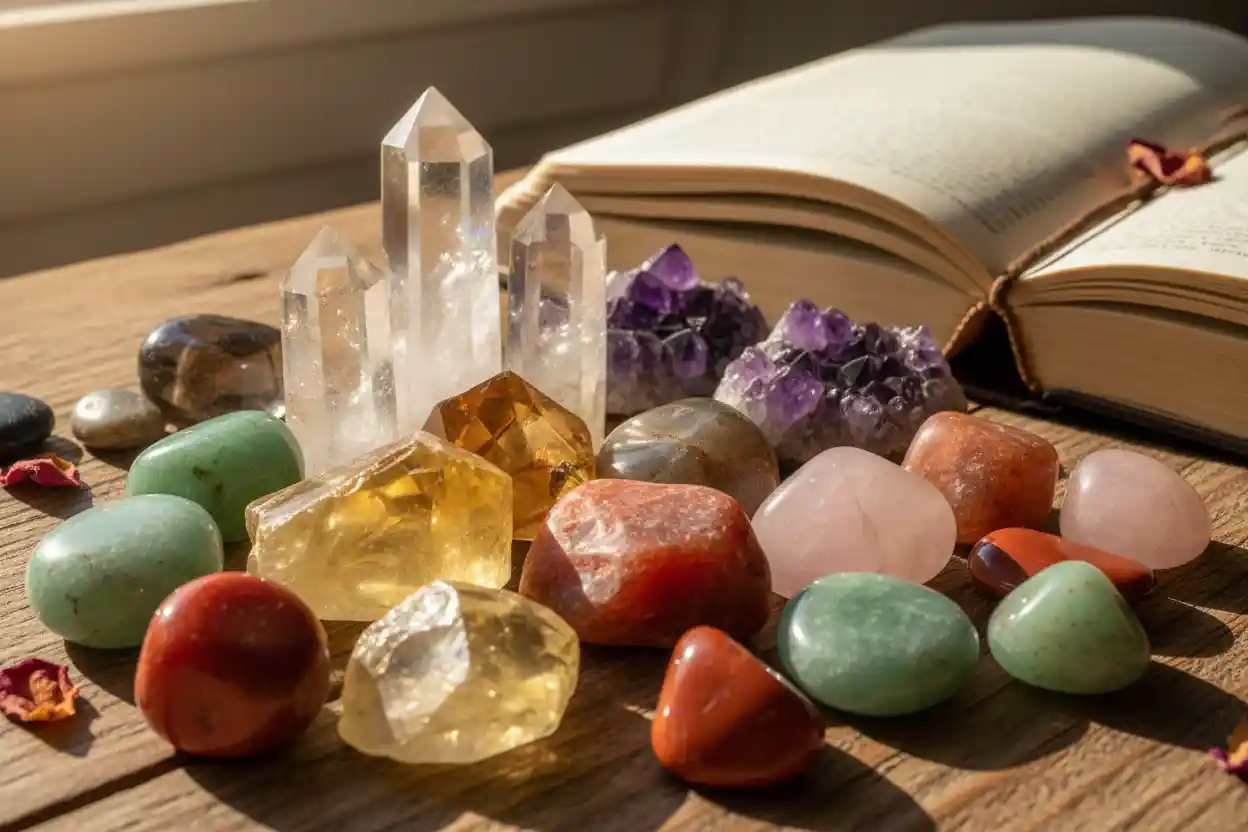
11 Inspiring Crystals for Positivity: Positive Meanings & Smart Everyday Uses
Crystals for positivity can serve as visual reminders to notice progress, challenge unnecessarily negative assumptions, express gratitude, take constructive action, and remain open to good experiences without pretending that every situation is pleasant. They do not create happiness, eliminate depression, guarantee good luck, or make difficult circumstances disappear. Their most practical role is symbolic: connect a stone with a behavior that makes everyday thinking and action more constructive.
Citrine, sunstone, carnelian, green aventurine, rose quartz, amethyst, clear quartz, tiger’s eye, amazonite, moonstone, and moss agate each offer a different traditional interpretation of positivity. Some emphasize optimism and confidence, while others fit self-compassion, patience, communication, perspective, or gradual growth. Positive thinking works best when it remains realistic. A useful crystal routine should help you respond to life more deliberately, not pressure you to deny disappointment, anger, grief, or uncertainty.
Citrine and Sunstone for Optimism That Leads to Constructive Action
Citrine is yellow to orange quartz traditionally associated with optimism, confidence, generosity, motivation, and prosperity symbolism. Its bright color gives it an obvious visual connection with sunlight and warmth, but the most useful interpretation of those themes is behavioral rather than mystical.
Traditional citrine healing properties can support a routine built around recognizing what is going well and deciding what useful step should come next. A citrine stone beside a planner might represent identifying one task that could improve the day instead of beginning with everything that might go wrong.
This does not require ignoring genuine problems. If a project is behind schedule, positivity does not mean pretending the delay does not exist. It can mean acknowledging the delay accurately and then identifying the most effective next action.
Sunstone adds symbolism around confidence, independence, enjoyment, and recognizing personal progress. The traditions connected with sunstone healing properties can fit people who dismiss their achievements as soon as they happen.
A sunstone piece can symbolize pausing long enough to recognize something handled better than before, whether that means speaking more confidently, completing a difficult task, maintaining a useful habit, or recovering more quickly from a setback.
Optimism becomes more durable when it is supported by evidence of progress.
Carnelian and Tiger’s Eye for Positive Momentum Without Reckless Optimism
Carnelian is orange to reddish chalcedony traditionally associated with motivation, courage, creativity, and action. Its symbolism works particularly well when negativity appears as hesitation.
The traditions around carnelian healing properties can support a simple rule: take the smallest useful action before deciding that the entire goal is impossible.
A person who feels discouraged about exercise might begin with a short walk. Someone intimidated by a project might complete the first small section. Progress often changes how a task feels once it is no longer entirely hypothetical.
Tiger’s eye adds practical judgment to that momentum. Its golden-brown chatoyancy has contributed to traditional associations with observation, confidence, and deliberate choices.
Traditional Tiger’s Eye healing properties can symbolize checking whether optimism is realistic. Positive thinking should not mean ignoring risk, overspending, trusting an unreliable person, or assuming every opportunity will succeed.
A tiger’s eye stone can represent asking what evidence supports your confidence and what risks still need attention.
The combination of carnelian and tiger’s eye creates a useful balance: act rather than remain stuck, but examine the situation before committing too much.
Green Aventurine and Moss Agate for Growth That Happens Gradually
Green aventurine is a quartz variety traditionally connected with opportunity, optimism, growth, and good-fortune symbolism. Those ideas are most useful when opportunity is understood as something that often becomes valuable only through preparation and participation.
The themes around green aventurine healing properties can support trying something new without demanding a guaranteed result. Attend the event, submit the application, begin the class, or speak with the person who may have useful information.
The stone does not make the opportunity succeed. It can simply represent remaining open enough to participate.
Moss agate provides a quieter interpretation of positivity. Its translucent body can contain green dendritic inclusions that resemble moss, branches, or miniature landscapes, and traditional symbolism frequently emphasizes patience, nature, steady growth, and gradual progress.
The traditions within moss agate healing properties can help when meaningful change feels too slow to notice. A habit that becomes slightly easier, a skill that improves gradually, or a relationship that becomes more comfortable may be easy to overlook because nothing dramatic happened.
Moss agate can symbolize paying attention to those small changes rather than judging progress only by major milestones.
Rose Quartz and Amazonite for Positive Relationships Without Avoiding Boundaries
Rose quartz is pink quartz traditionally associated with compassion, affection, kindness, and emotional warmth. Positivity in relationships is often more sustainable when it involves appreciation rather than simply expecting people to make you feel good.
Traditional rose quartz healing properties can support a habit of expressing specific appreciation. Instead of merely thinking that a friend, partner, colleague, or family member is helpful, say what you appreciated.
Rose quartz can also symbolize self-compassion. A mistake becomes easier to learn from when it is examined honestly without turning it into proof that everything about you is inadequate.
Amazonite contributes themes of balanced communication and expressing needs clearly. The symbolism around amazonite healing properties can support a more realistic form of positive relationships in which boundaries remain important.
Being positive does not require agreeing with everyone, avoiding difficult conversations, or tolerating repeated disrespect. Sometimes the constructive response is to say that something needs to change.
Amazonite can symbolize addressing the issue directly enough that resentment does not have to grow silently.
Amethyst and Clear Quartz for Perspective and Intentional Thinking
Amethyst is purple quartz traditionally associated with reflection, restraint, and thoughtful choices. These themes are helpful when negativity grows through rapid assumptions rather than established facts.
The traditions surrounding amethyst healing properties can support a pause before deciding what an event means. A delayed reply does not automatically mean rejection. One poor performance does not prove permanent failure. A difficult day does not establish that the entire week will be bad.
An amethyst stone can simply mark the moment where interpretation slows down enough for alternative explanations to appear.
Clear quartz is traditionally associated with focus, clarity, and intention. Traditional clear quartz healing properties can support defining what positivity should actually look like in a specific situation.
Instead of vaguely trying to think positively, identify the behavior you want. Maybe the goal is to complain less about something you cannot change, notice progress more accurately, or stop assuming the worst before enough information exists.
Clear intention makes positivity easier to practice because there is something observable to do.
Moonstone for Staying Hopeful While Life Is Changing
Moonstone is a feldspar gem known for adularescence, a floating sheen that shifts across the stone as it moves. Its changing appearance has encouraged traditional associations with cycles, transition, and adapting to new circumstances.
The themes around moonstone healing properties can fit periods when positivity feels difficult because life is unsettled.
Moving home, changing work, ending or beginning a relationship, becoming responsible for someone else, or entering a new stage of life can produce excitement and discomfort simultaneously.
Moonstone can symbolize allowing those emotions to coexist. A transition does not have to feel completely positive to lead somewhere worthwhile.
This approach prevents optimism from becoming emotional pressure. Someone can feel nervous about a change and still believe they are capable of adapting.
Moonstone has feldspar cleavage, so it deserves more impact protection than quartz stones when used in jewelry.
Positive Thinking Should Not Turn Into Forced Positivity
There is an important difference between constructive thinking and insisting that everything happens for a good reason. Difficult experiences can remain difficult.
Grief, anger, fear, disappointment, frustration, and uncertainty are normal responses to many situations. Trying to replace every uncomfortable feeling immediately with gratitude can make a person feel as though the emotion itself is a failure.
The traditions around crystals for emotional healing are more useful when reflection allows the difficult emotion to exist while still asking what response is available.
A person can acknowledge that something hurts and still decide to contact support. Someone can feel disappointed and still try again. You can be angry about unfair treatment while choosing a measured response.
Realistic positivity expands available options without denying reality.
Gratitude Makes Positivity More Specific
Positivity often becomes vague when it is reduced to general affirmations. Gratitude can make it more concrete because it asks you to identify what is actually worth appreciating.
A crystal can support this by providing a repeated cue. Citrine might represent progress, rose quartz a relationship, and moss agate an ordinary part of daily life that has become easy to overlook.
The traditions around crystals for gratitude fit especially well when appreciation is specific.
Instead of writing that you are grateful for friends, name what someone did. Instead of being grateful for work generally, identify a useful opportunity, supportive colleague, or skill you developed.
Specific observations create stronger evidence for positivity than repeating broad statements that no longer require attention.
Build a Positivity Routine Around What You Can Influence
A simple routine works better than an elaborate system. Choose one crystal and one behavior.
Carnelian can mean begin the task. Citrine can mean notice progress. Rose quartz can mean express appreciation. Amethyst can mean challenge the first negative assumption. Moss agate can mean notice slow improvement.
Place the stone where the behavior naturally happens. A desk crystal can sit beside a planner. A bracelet can serve as a cue during the day. A bedside stone can mark a short evening reflection routine.
Avoid judging whether the stone worked according to external outcomes. A job rejection, difficult conversation, or bad day does not mean the crystal failed.
The better question is whether the reminder helped you respond more constructively.
Positivity Cannot Replace Mental Health Care
Persistent low mood, loss of interest, severe anxiety, trauma symptoms, major sleep or appetite changes, inability to function normally, or thoughts of self-harm deserve appropriate support.
Crystals should not be used to explain those experiences as a failure to remain positive, maintain good energy, or believe strongly enough.
The traditions around crystals for depression support should remain secondary to evidence-based professional care when depression is present.
Personal symbolism can coexist with counseling, medication, supportive relationships, or other treatment when it does not interfere with them.
Positivity is a useful way of relating to some experiences. It is not a medical treatment.
Conclusion
Crystals for positivity can symbolize optimism, motivation, gratitude, compassion, perspective, confidence, communication, and gradual growth. Citrine, sunstone, carnelian, green aventurine, rose quartz, amethyst, clear quartz, tiger’s eye, amazonite, moonstone, and moss agate each offer a different traditional theme. Their practical value comes from connecting those meanings with realistic habits that help you notice progress, take useful action, appreciate good experiences, and respond to difficulties without denying them.
FAQs
Which crystals are traditionally associated with positivity?
Citrine, sunstone, carnelian, green aventurine, rose quartz, and several other stones are commonly associated with optimism, motivation, confidence, and positive change.
Which crystal is commonly linked with optimism?
Citrine is one of the stones most strongly associated with optimism, confidence, and constructive opportunity symbolism.
Can crystals make someone happier?
There is no established evidence that crystals directly create happiness. They can act as reminders for constructive habits and reflective routines.
Which crystal symbolizes positive action?
Carnelian is commonly associated with motivation, courage, creativity, and beginning.
Which crystal is associated with gradual growth?
Moss agate and green aventurine are frequently connected with growth, patience, and opportunity traditions.
Can positivity include difficult emotions?
Yes. Realistic positivity can coexist with sadness, anger, fear, grief, and disappointment.
Which crystal can symbolize self-compassion?
Rose quartz is commonly associated with compassion, kindness, and emotional gentleness.
Can crystals guarantee good luck?
No. Crystals cannot guarantee favorable events or control chance.
What is a practical positivity crystal routine?
Choose one stone and connect it with one action, such as noticing progress, expressing gratitude, starting a task, or checking a negative assumption.
Can crystals replace therapy for persistent low mood?
No. Persistent or severe emotional symptoms may require appropriate professional support.
Crystal meanings and positivity associations are traditional or personal practices, not established mental health treatments or methods for controlling life outcomes.