Blue Aventurine Healing Properties: 11 Essential Claims, Hopeful Traditions & Safe Limits
Blue aventurine healing properties are traditionally associated with communication, self-discipline, mental clarity, confidence, emotional steadiness, concentration, creativity, patience, decision-making, personal growth, and adapting to change. These meanings come from modern crystal traditions rather than established medical or psychological evidence. Blue aventurine does not improve brain function, treat anxiety, regulate hormones, lower blood pressure, cure sleep problems, increase intelligence, or alter physical health through ordinary handling. Its most responsible use is symbolic, particularly when a polished blue stone becomes a reminder to slow down, organize thoughts, communicate clearly, and follow through on a chosen routine.
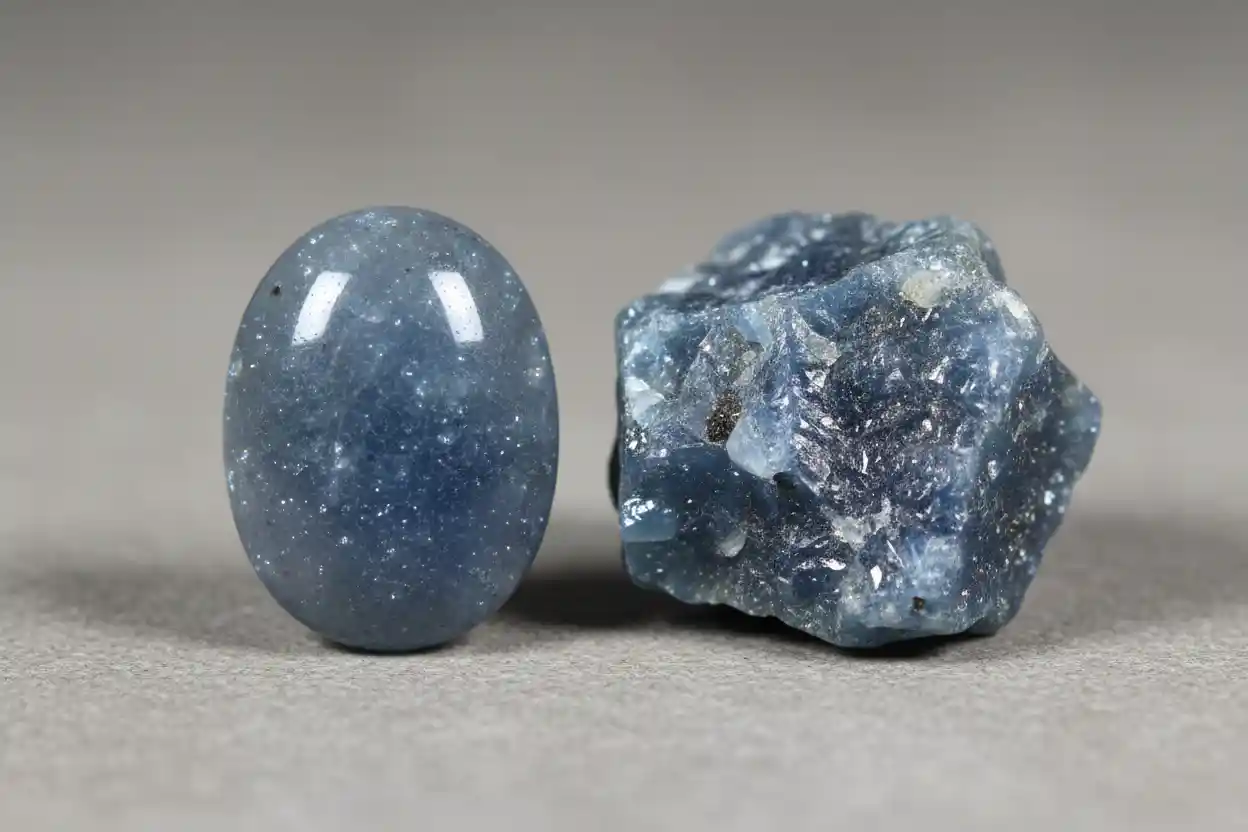
Blue aventurine is commonly sold as a blue quartz-rich stone whose color may come from fine inclusions of blue minerals such as dumortierite. It is generally hard enough for regular jewelry use because the quartz component sits near 7 on the Mohs scale. Natural blue aventurine can range from pale blue and blue-gray to deeper tones, often with a granular or softly sparkling appearance rather than the stronger aventurescence seen in some green aventurine. Identification can become confusing because blue quartz, dumortierite quartz, dyed quartz, and other blue stones can resemble one another, so color alone should never be treated as proof of identity.
Blue Aventurine Communication Claims Support Clear Speech, Listening, and Better Timing
Communication is one of the most persistent symbolic themes attached to blue aventurine. Its color naturally places it alongside other blue gemstones in crystal traditions that emphasize self-expression, honesty, calm speech, and thoughtful conversation. There is no established evidence that blue aventurine changes language processing, vocal ability, social confidence, or neurological function, but it can become a useful reminder to prepare what needs to be said rather than entering a difficult conversation with only a general feeling of frustration.
A polished stone placed beside a notebook can represent identifying the central issue, choosing one or two concrete examples, and deciding what outcome would actually help. The crystals for communication tradition becomes more useful when communication includes listening as well as speaking. Asking a clarifying question, allowing the other person to finish, and checking whether an assumption is accurate can improve a conversation in ways that crystal energy cannot.
Blue aventurine symbolism also fits situations where timing matters. A true statement delivered impulsively can still create unnecessary conflict. The stone can represent waiting until the discussion can happen productively without turning patience into silence. Clear communication may involve speaking directly, asking for time, correcting an error, or setting a boundary.
Blue Aventurine Self-Discipline Claims Work Best as Consistent Habit Cues
Self-discipline is another major blue aventurine theme, especially in modern crystal practice. The stone is often described as helping people overcome procrastination, resist impulsive choices, or stay committed to goals. These effects are not established physiological properties of quartz, but the symbolism can work well when tied to a specific routine.
Someone trying to study consistently might place blue aventurine beside a planner and use it as the cue that a focused work period has begun. Someone trying to reduce an unwanted habit can associate the stone with one alternative response already chosen in advance. Traditional blue aventurine benefits become more practical when discipline means designing repeatable behavior rather than waiting for a crystal to produce willpower.
Discipline should also include recovery after lapses. Missing one planned session does not erase progress, and rigid perfection often makes routines harder to maintain. Blue aventurine symbolism is more constructive when it represents returning to the plan at the next reasonable opportunity.
Blue Aventurine Mental-Clarity Claims Should Support Structured Thinking Rather Than Cognitive Enhancement
Blue aventurine is frequently associated with clear thinking, concentration, and better decisions. There is no established evidence that it increases intelligence, memory, attention span, or executive function. A more useful interpretation is to use the stone as a reminder to define what the decision actually requires.
The crystals for clarity tradition fits this approach well. If a problem feels confusing, write down what is known, what remains uncertain, and what information would resolve the uncertainty. Separating facts from assumptions often creates more clarity than repeatedly thinking about the problem without structure.
Blue aventurine can also symbolize reducing competing demands. Someone may decide to finish one task before opening another, close unnecessary browser tabs, or work from a shorter priority list. These environmental changes support focus directly, while the stone provides continuity to the routine.
Blue Aventurine Confidence Claims Encourage Prepared Action Without Promising Success
Confidence is commonly included among blue aventurine healing claims, especially when the stone is used before interviews, presentations, examinations, or important conversations. No gemstone can remove fear or build self-esteem biologically, but a personally meaningful object can reinforce preparation.
A student might associate blue aventurine with reviewing key concepts before an exam rather than relying on last-minute reassurance. Someone preparing for a presentation may use it as a cue to practice the opening, check the main evidence, and anticipate likely questions. The crystals for studying tradition becomes more responsible when stones support preparation rather than being credited with memory enhancement.
Confidence built this way does not require certainty. A person can feel nervous and still be ready. Blue aventurine symbolism becomes most useful when it represents acting after enough preparation rather than expecting a favorable outcome simply because the stone is present.
Blue Aventurine Emotional-Steadiness Claims Should Not Replace Anxiety or Depression Care
Blue aventurine is often described as emotionally calming or stabilizing because its color is associated with quietness and composure. These descriptions should remain symbolic. There is no established evidence that blue aventurine regulates stress hormones, changes brain chemistry, or treats anxiety, depression, panic, trauma, or another mental health condition.
A practical use is to associate the stone with creating a pause before responding to something emotionally charged. The person may write down what happened, identify the strongest assumption they made, and decide whether more information is needed before acting. This can reduce impulsive reactions because the person is slowing the process down.
Persistent emotional distress requires a different level of response. Severe anxiety, depression, trauma symptoms, or major disruption to ordinary life deserves appropriate professional support. Blue aventurine can remain a familiar object within that process without being treated as therapy.
Blue Aventurine Creativity and Problem-Solving Claims Reflect Flexible Thinking
Blue aventurine is also associated with creativity and flexible problem-solving. Its blue color and sparkling quartz texture can make it an appealing object in writing, design, planning, or brainstorming spaces, but the stone does not directly increase creative brain activity.
A productive creativity ritual might involve using blue aventurine to mark a period where several ideas are generated before any are judged. This can help separate exploration from evaluation, which often makes creative work less constrained. The crystals for creativity tradition becomes useful when the stone supports a repeatable process rather than being credited for producing inspiration.
Problem-solving follows the same principle. If the first approach fails, blue aventurine can symbolize looking for another route, asking a different question, or combining parts of several ideas. The improvement comes from changing the reasoning process.
Blue Aventurine Patience and Decision-Making Traditions Emphasize Deliberate Choices
Patience is often linked with blue aventurine because the stone’s communication and discipline themes naturally support slower, more deliberate decisions. Patience does not mean delaying every choice. It means allowing enough time to gather relevant information when the consequences justify it.
Someone considering a significant purchase, job change, relationship decision, or financial commitment may use blue aventurine as a reminder to define the decision criteria before choosing. A stone cannot determine which option is correct, but it can symbolize the intention to avoid unnecessary impulsiveness.
High-stakes choices still require evidence. Medical decisions need qualified guidance, financial decisions require actual numbers, and relationship decisions should be based on behavior rather than gemstone interpretations. Blue aventurine can support reflection without replacing judgment.
Blue Aventurine and Green Aventurine Share a Quartz Base but Carry Different Traditional Meanings
Blue and green aventurine are often placed in the same crystal family because both are quartz-rich stones with included minerals that influence color and appearance. Their traditional symbolism differs mainly because color strongly shapes crystal culture. Green aventurine is commonly associated with opportunity, optimism, and prosperity, while blue aventurine is more often linked with communication, discipline, clarity, and thoughtful action.
The general aventurine healing properties tradition therefore includes themes that overlap across colors while allowing each variety to develop its own symbolic identity. These metaphysical distinctions are not scientifically demonstrated differences in therapeutic effect.
The physical similarities matter more for ordinary care. Both varieties are quartz-rich and generally have useful scratch resistance, although individual stones can contain fractures, inclusions, granular textures, or treatments that influence durability.
Blue Aventurine Color Can Come From Mineral Inclusions Within Quartz
Natural blue quartz-rich stones can owe their color to included minerals rather than blue pigment within pure quartz itself. Dumortierite is one well-known blue inclusion associated with quartz and can occur as fine fibers, clusters, or dense areas that produce blue coloration. Some stones sold as blue aventurine may overlap commercially with dumortierite quartz or blue quartz terminology.
This naming overlap means buyers should be cautious about treating every blue polished stone as the same gem variety. A vivid blue color alone does not prove that a specimen is natural blue aventurine, and dyed quartz can also appear in the market. Traditional blue aventurine meaning should therefore remain separate from identification.
For most everyday buyers, the useful questions are whether the color appears natural, whether treatments are disclosed, whether the stone has the expected quartz-like hardness and texture, and whether the seller uses a consistent identification.
Blue Aventurine Jewelry Care Benefits From Quartz Hardness but Still Requires Impact Protection
Blue aventurine’s quartz-rich composition generally gives it a Mohs hardness around 7, making it suitable for pendants, beads, bracelets, carvings, cabochons, and many rings. Scratch resistance does not make every piece unbreakable, because fractures, inclusions, and thin edges can still chip under strong impact.
Routine cleaning with lukewarm water, mild soap, and a soft cloth or brush is usually appropriate when treatments and settings are known. Harsh chemicals and unnecessary heat should be avoided, particularly with dyed or composite pieces. Jewelry containing several stones should be cleaned according to the needs of the most delicate gem in the piece.
There is no need to place blue aventurine into drinking water or grind it for wellness use. Jewelry, desk display, or a polished palm stone provides the same symbolic value without introducing unnecessary ingestion concerns.
Blue Aventurine Healing Claims Cannot Treat Sleep, Hormonal, Neurological, or Mental Health Conditions
Some wellness descriptions extend blue aventurine traditions into claims about sleep, hormones, headaches, nervous-system health, metabolism, blood pressure, or mental illness. These claims are not established therapeutic effects of quartz-rich stone. Wearing or holding blue aventurine does not deliver a medicine into the body.
The same limit applies to claims that its blue color targets a particular organ or energy center in a medically meaningful way. Color symbolism can be personally useful, but it does not establish physiology.
Blue aventurine can still have a legitimate place in personal routines because symbolism, visual appeal, and tactile familiarity do not require medical proof. Problems arise only when those personal uses are presented as treatment.
Conclusion: Blue Aventurine Healing Properties Stay Symbolic While Quartz and Blue Inclusions Explain Its Real Character
Blue aventurine healing properties are best understood as traditional themes of communication, discipline, clarity, confidence, emotional steadiness, focus, creativity, patience, decision-making, growth, and adaptability. Blue aventurine is generally a quartz-rich stone whose blue color can be associated with included minerals such as dumortierite, while its quartz base provides useful hardness for jewelry and polished objects. It can support meaningful routines and reflective habits, but it does not improve cognition, treat mental health conditions, regulate hormones, or change physical health.
FAQs About Blue Aventurine Healing Properties, Quartz Inclusions, and Safe Use
What are the main traditional blue aventurine healing properties?
Blue aventurine is commonly associated with communication, self-discipline, clarity, confidence, emotional steadiness, concentration, creativity, patience, and decision-making.
Is blue aventurine scientifically proven to heal?
No. There is no established evidence that blue aventurine treats physical or mental health conditions through ordinary contact.
What makes blue aventurine blue?
Blue coloration can come from fine mineral inclusions within quartz, with dumortierite among the best-known blue inclusions associated with blue quartz varieties.
Is blue aventurine the same as dumortierite quartz?
Commercial naming can overlap, so stones sold under these names may resemble one another closely. Reliable identification depends on the actual mineral composition rather than the trade label alone.
Can blue aventurine improve communication?
It can serve as a symbolic reminder to prepare, speak clearly, and listen carefully, but it does not directly change communication ability.
Can blue aventurine improve concentration?
It can support a focus routine as a visual cue, but it does not directly increase memory, intelligence, or attention.
How hard is blue aventurine?
Quartz-rich blue aventurine is generally around 7 on the Mohs scale.
Is blue aventurine good for studying?
It can be used as a personal study cue, while actual learning still depends on preparation, practice, sleep, and effective study methods.
Can blue aventurine reduce anxiety?
It may feel personally calming, but it is not an established treatment for anxiety disorders.
Can blue aventurine go in drinking water?
There is no need to put blue aventurine in drinking water for wellness purposes. External symbolic use is simpler and safer.
Blue aventurine healing meanings are traditional or personal practices, not established treatments for physical or mental health conditions.