12 Real Crazy Lace Agate Healing Claims: Gentle Traditions, Verified Facts & Safe Use
Crazy lace agate healing properties are commonly described in modern crystal practice through themes of joy, emotional steadiness, confidence, optimism, grounding, social ease, concentration, resilience, and mindful relaxation. Its intricate looping bands and warm colors have also encouraged symbolic associations with movement, playfulness, and adapting to change. These ideas can give a personal ritual structure, but crazy lace agate has not been demonstrated to treat anxiety, depression, chronic stress, pain, fatigue, digestive disorders, immune problems, cardiovascular disease, or any other medical condition, and there is no established mechanism through which its silica structure changes mood or physiology. What can be verified is its mineral identity: crazy lace agate is a patterned variety of agate, which is predominantly microcrystalline to cryptocrystalline quartz, with the ideal quartz composition SiO₂. Its banding, hardness, fracture, color, geology, and Mexican occurrence are genuine properties that can be discussed separately from wellness beliefs.
12 Crazy Lace Agate Healing Claims Commonly Used in Crystal Practice
- Joy and a lighter emotional outlook
- Calm during stressful periods
- Emotional balance and steadiness
- Confidence and self-acceptance
- Optimism during difficult changes
- Grounding and present-moment awareness
- Motivation and renewed momentum
- Social ease and open communication
- Focus and mental organization
- Resilience after setbacks
- Creativity and playful thinking
- Rest, reflection, and emotional reset
These twelve themes are meaningfully different as ritual or reflective practices, but none should be confused with twelve medically verified effects. Many of the crazy lace agate benefits described in crystal culture make more practical sense when translated into behaviors a person can actually control, such as breathing slowly, planning a next step, journaling, initiating a conversation, or taking a structured pause.
Crazy Lace Agate Mineral Facts: Quartz Composition, Banding, Hardness, and Color
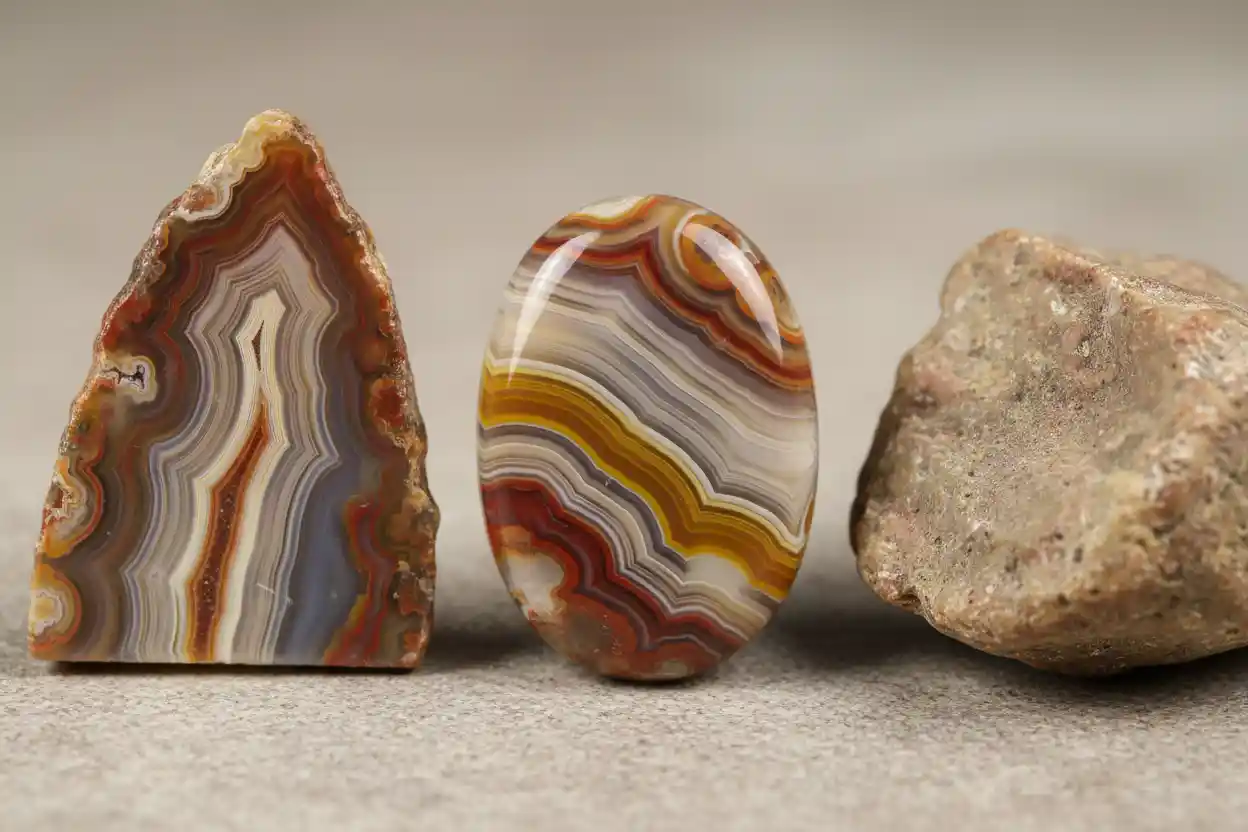
Crazy lace agate is a decorative agate variety known for complex curved, fortification-like, circular, and lace-like patterns. Agate belongs to the chalcedony family of silica gemstones and consists predominantly of extremely fine intergrowths of quartz, commonly with moganite and minor impurities or mineral phases contributing to color and pattern. Its idealized chemical composition is therefore SiO₂. Quartz belongs to the trigonal crystal system, although agate does not usually show the obvious external crystal faces associated with large rock-crystal points because its silica is extremely fine-grained.
The stone is typically opaque to translucent and displays combinations of white, cream, gray, tan, yellow, orange, brown, and red. Iron-bearing compounds and other impurities can contribute to some of these warm colors, while repeated silica deposition creates the characteristic banding. Its polished surface usually has a vitreous to somewhat waxy appearance, depending on texture and finish.
Agate is commonly around 6.5 to 7 on the Mohs hardness scale. It has no useful cleavage and tends to break with conchoidal to uneven fracture because of its silica-rich structure. Those characteristics explain why crazy lace agate takes a good polish and survives ordinary jewelry wear relatively well, yet can still chip along an edge or fracture if dropped onto tile, concrete, or another hard surface.
Crazy lace agate should not be identified from color alone. Other patterned agates, jasper, rhyolite, dyed chalcedony, printed or resin composites, and imitation stone can reproduce parts of its visual appearance. The swirling band structure, polish, translucency, hardness, and microscopic texture provide more meaningful clues than marketing names by themselves. The crazy lace agate meaning attached to those patterns belongs to symbolism rather than mineral identification.
Crazy Lace Agate Origin, Geological Formation, and Mexican Localities
Crazy lace agate is strongly associated with Chihuahua, Mexico. Documented occurrences include Sierra Santa Lucia near Ejido Benito Juarez in Buenaventura Municipality, a locality known for characteristically intricate agate. Because crazy lace agate is a variety rather than an independent mineral species, it does not have a type locality in the formal mineralogical sense used for newly described species.
Agates form when silica-bearing fluids deposit microscopic quartz and related silica phases into cavities, fractures, or voids in host rocks. Changes in fluid chemistry, impurities, growth conditions, and repeated deposition can produce banding, color shifts, concentric patterns, and intricate textures. Crazy lace agate’s appearance is therefore a geological growth record rather than evidence of stored therapeutic energy.
The commercial name emphasizes the visually tangled “lace” pattern. Unlike historical gemstone identities with documented ancient lapidary traditions, the specific trade identity “crazy lace agate” belongs to the modern mineral and lapidary market. General agate has a long human history, but that should not be used to imply that today’s specific crazy lace agate healing beliefs were practiced in antiquity.
Joy, Calm, Emotional Balance, and Confidence Claims
1. Joy as a Deliberate Attention Practice
Crazy lace agate is sometimes called a joyful or cheerful stone because of its energetic patterns and warm colors. The mineral itself has not been shown to increase neurotransmitters or create happiness. A practical way to use the symbolism is to pair the stone with a daily question such as, “What was one genuinely enjoyable moment today?” Repeatedly noticing positive experiences can become a reflective habit without assigning the physiological effect to the agate.
2. Calm During Stressful Periods
Holding a polished stone during slow breathing can feel stabilizing, especially when the surface and pattern give attention somewhere neutral to rest. There is no mechanism by which agate directly suppresses a stress response. The useful part is the pause: breathe more slowly, relax the jaw and shoulders, identify the immediate problem, and decide whether action is needed now or later.
3. Emotional Balance Through Naming What Is Happening
Another common belief is that crazy lace agate balances emotions. A reader-controlled version is to use the stone as a journaling cue and identify the emotion, its trigger, the facts surrounding it, and the response they want to choose. The agate does not regulate the nervous system simply by being present. The reflective routine can nevertheless help turn an unclear feeling into something more manageable.
4. Confidence and Self-Acceptance
Crazy lace agate is also linked with confidence and accepting one’s imperfections, perhaps because its irregular patterns are visually distinctive rather than perfectly uniform. This is best treated as a metaphor rather than a mechanism. Before an uncomfortable task, a person can use the stone as a prompt to name one strength, one area of uncertainty, and one action they are prepared to take despite that uncertainty.
Optimism, Grounding, Motivation, and Social Connection Claims
5. Optimism During Change
The looping bands of crazy lace agate are sometimes interpreted symbolically as movement through life’s changes. The stone does not predict favorable outcomes or cause events to improve. It can instead cue a useful reframing exercise: distinguish what has already changed, what remains under personal control, and what small adjustment can be made next. The optimism comes from finding workable options rather than from the silica itself.
6. Grounding and Present-Moment Awareness
In crystal practice, “grounding” often means feeling more settled and connected to the present. Crazy lace agate cannot electrically or biologically ground the body in the therapeutic sense implied by some wellness claims. A tactile stone can, however, support a sensory exercise: notice its temperature, weight, smoothness, pattern, and edges while paying attention to breathing and surroundings. The practice redirects attention to immediate sensory information.
7. Motivation and Forward Momentum
Crazy lace agate is sometimes used when people feel stuck. Instead of treating it as a source of invisible motivational energy, assign it to one concrete action. Each time it is handled, complete a task that takes five or ten minutes, send the needed message, open the document, or prepare the tools required for the next job. The routine built around the object might reduce procrastination; the stone itself does not generate motivation.
8. Social Ease and Open Communication
Some users associate the stone with sociability and laughter. No mineral can ensure that another person responds warmly or remove clinically significant social anxiety. A practical ritual might involve rehearsing the first sentence before entering a social situation, deciding on one question to ask, or writing down what needs to be communicated before a difficult conversation. Preparation, not agate chemistry, provides the plausible benefit.
Focus, Resilience, Creativity, and Rest Claims
9. Focus and Mental Organization
The complex patterns of crazy lace agate can make it an appealing desk object, and some practitioners say it helps concentration. There is no evidence that the gemstone improves memory, attention, or executive function through a crystal-specific mechanism. It can serve as a visible boundary around focused work: when the stone is placed beside the keyboard, silence notifications and work on one clearly defined task until the planned interval ends.
10. Resilience After Setbacks
Crystal traditions sometimes link crazy lace agate with persistence and emotional recovery. The mineral cannot make a person resilient, but symbolism can support a reflection exercise after disappointment. Ask what happened, what was learned, what still matters, and what the next recoverable step is. That process can shift attention from an irreversible setback toward an actionable response.
11. Creativity and Playful Thinking
The stone’s unpredictable bands and color transitions make creativity an intuitive symbolic association. Someone can place it beside a sketchbook, notebook, or brainstorming space and intentionally generate ideas without judging them for a fixed period. Crazy lace agate has not been shown to increase creativity neurologically. Its visual complexity may simply make it a pleasing prompt for entering a more exploratory state of mind.
12. Rest, Reflection, and Emotional Reset
Crazy lace agate is also used at the end of a demanding day as a symbol of releasing mental clutter. Rather than expecting the stone to remove stress or improve sleep biologically, use it to mark the beginning of a wind-down routine: put away work, lower stimulation, write unresolved tasks for tomorrow, and sit quietly for several minutes. The ritual creates a boundary. That part is behavior, not mineral therapy.
Crazy Lace Agate Chakra Associations and Spiritual Symbolism
Modern crystal systems commonly connect crazy lace agate with the root chakra and sometimes the sacral or solar plexus chakra, depending on which colors dominate a specimen. Root-chakra associations emphasize stability and grounding, sacral symbolism emphasizes creativity and enjoyment, while solar plexus interpretations focus on confidence and purposeful action. Chakras are a spiritual framework rather than an anatomical one, so these connections should not be presented as physiological pathways.
A person who values chakra practice might hold the stone during meditation and use its patterns as a prompt to move attention through stability, creativity, confidence, and emotional perspective. Others may simply appreciate the stone as a symbol of complexity and adaptation. Either use can remain personally meaningful without claiming that the bands in agate alter organs, nerves, hormones, or measurable energy centers.
Crazy Lace Agate Physical Care: Water, Scratching, Chemicals, Heat, Steam, and Ultrasonics
With a Mohs hardness around 6.5 to 7, crazy lace agate is durable enough for beads, pendants, cabochons, earrings, and many other jewelry applications. It can still be scratched by harder gemstones such as topaz, sapphire, ruby, and diamond, while the agate itself can scratch softer stones. Store finished pieces separately when possible, especially if polished surfaces are important.
Its lack of useful cleavage improves everyday durability, but conchoidal fracture means an impact can still chip a cabochon edge or break a thin section. Avoid dropping it onto hard floors and do not assume hardness equals toughness.
Plain water is generally suitable for brief cleaning of untreated crazy lace agate because silica-rich agate is not readily water-soluble and is not a hydrated mineral. Warm water, mild soap, and a soft cloth or brush are adequate for routine physical cleaning. Long soaking is unnecessary, especially when a piece contains adhesive, metal components, surface treatments, dyes, fracture filling, or uncertain enhancements.
Avoid hydrofluoric acid and fluoride-bearing industrial chemicals because they attack silica and are dangerous to handle. Strong chemicals and household bleach are unnecessary. Sudden heating or cooling can exploit existing fractures, so keep the stone away from thermal shock. Steam cleaning offers little advantage and adds heat stress. Ultrasonic cleaners may be tolerated by sound untreated agate, but they are not a sensible default for cracked, filled, dyed, glued, thin, or unknown specimens.
Ritual Cleansing Crazy Lace Agate Without Damaging the Stone
Ritual cleansing does not mean physically removing dirt or changing the mineral’s chemistry. In spiritual practice it usually marks the end of one symbolic use and the beginning of another. There is no verified unwanted energy that laboratory science has shown must be extracted from crazy lace agate.
Gentle methods are enough. Place the stone on a dry cloth, use sound nearby, sit with it during a short reflection, or state the new intention you want the object to represent. You can also physically wipe the polished surface before returning it to its storage place, which creates a natural transition between physical care and symbolic practice without confusing the two.
Saltwater, repeated long soaking, strong sunlight for extended periods, chemicals, smoke residue, and burying finished jewelry in damp soil are unnecessary. A simple dry ritual is easier to control and works just as well for symbolic purposes.
Conclusion
Crazy lace agate’s real appeal does not depend on proving twelve healing mechanisms. Its intricate Mexican agate patterns, quartz-rich composition, durable polish, and geological growth history are compelling on their own. When its wellness associations are treated as prompts for reflection, grounding, preparation, creativity, and intentional routines, personal symbolism can remain meaningful without being mistaken for medical evidence.
Frequently Asked Questions About Crazy Lace Agate Healing Properties
What are the main crazy lace agate healing properties people claim?
Common claims include joy, calm, emotional balance, confidence, optimism, grounding, motivation, social ease, focus, resilience, creativity, and reflective rest. These are traditional or contemporary wellness beliefs rather than proven medical effects.
What is crazy lace agate made of?
Crazy lace agate is a variety of agate, predominantly composed of microcrystalline to cryptocrystalline silica associated with quartz and chalcedony. Its idealized quartz chemistry is SiO₂, while minor impurities contribute to color and pattern.
How hard is crazy lace agate?
It is generally around 6.5 to 7 on the Mohs hardness scale. This makes it suitable for many jewelry uses, although it remains brittle enough to chip or fracture after a hard impact.
Where does crazy lace agate come from?
Crazy lace agate is particularly associated with Chihuahua, Mexico, including documented material from the Sierra Santa Lucia area near Ejido Benito Juarez in Buenaventura Municipality.
Is crazy lace agate scientifically proven to reduce stress or anxiety?
No. The mineral has not been demonstrated to treat anxiety or directly regulate stress physiology. Using it during breathing, journaling, or a quiet pause can provide structure for a calming routine, but that is different from a mineral-specific therapeutic effect.
Which chakras are associated with crazy lace agate?
Modern crystal practice often links it with the root chakra and, depending on color, the sacral and solar plexus chakras. These are spiritual associations rather than anatomical or physiological relationships.
Can crazy lace agate go in water?
Brief contact with plain water is generally acceptable for untreated agate. Warm soapy water is suitable for routine cleaning, but prolonged soaking is unnecessary and should be avoided with dyed, filled, glued, treated, or jewelry-mounted pieces of uncertain construction.
Is crazy lace agate good for everyday jewelry?
Its hardness and lack of strong cleavage make it practical for many forms of jewelry, especially pendants, earrings, beads, and protected cabochons. Hard impacts can still cause chips or fractures.
How should crazy lace agate be cleansed spiritually?
Sound, dry placement, quiet reflection, intention-setting, or simply wiping the stone and beginning a new ritual are gentle options. Spiritual cleansing is symbolic and does not require saltwater, chemicals, or aggressive treatment.
What should I look for when buying crazy lace agate?
Look for attractive natural-looking banding, good polish, structural integrity, and clear disclosure of treatments or imitation. The workbook-verified where to buy crazy lace agate topic focuses specifically on sourcing and buying risks.
Crystal healing claims are traditional or personal beliefs and should not replace qualified medical or mental health care.