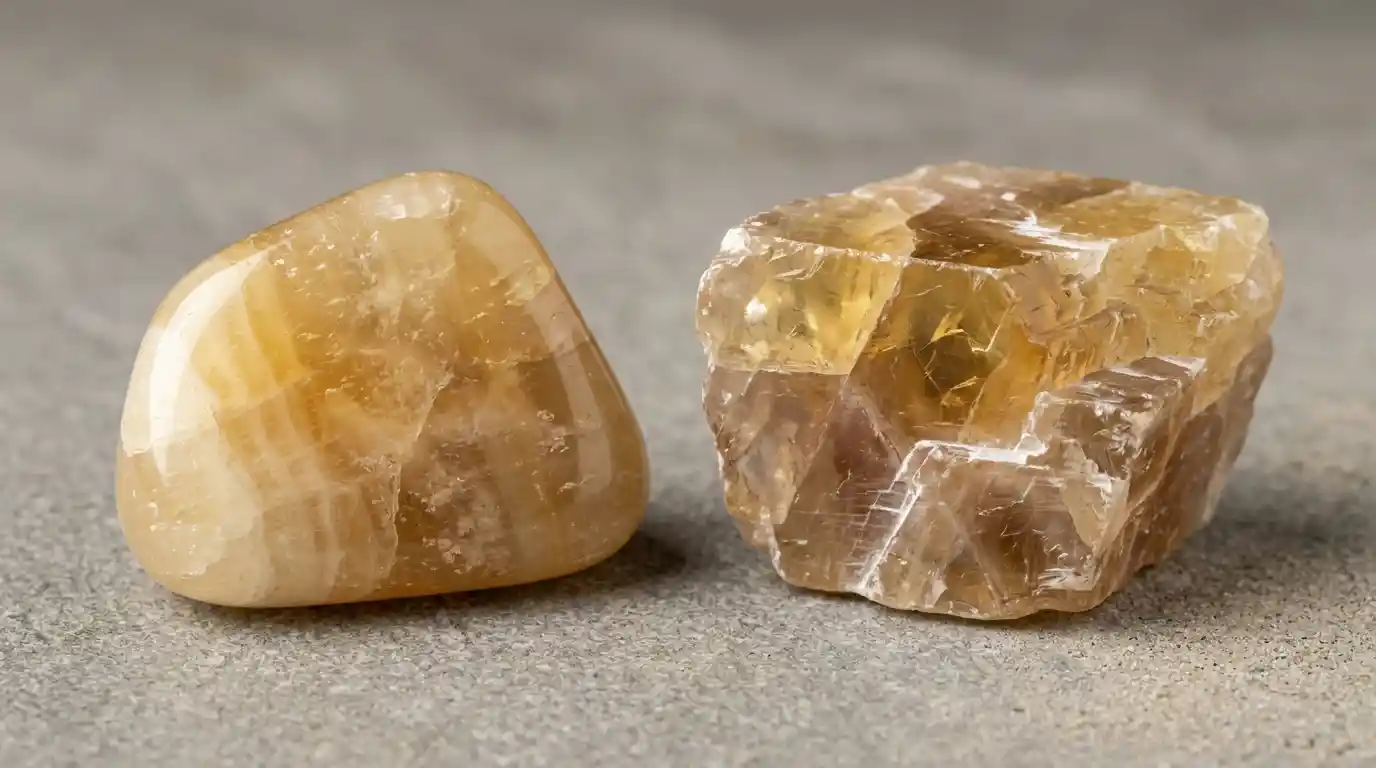
9 Honey Calcite Healing Properties: Popular Claims, Verified Facts & Safe Use
Honey calcite healing properties are commonly described through themes of confidence, motivation, concentration, optimism, emotional steadiness, decision-making, creativity, persistence, and purposeful self-reflection. Its warm yellow, amber, and honey-brown colors make associations with sunlight, confidence, and personal energy visually intuitive, but the color does not establish a therapeutic mechanism. Honey calcite has not been demonstrated to treat fatigue, depression, anxiety, digestive disorders, hormonal conditions, blood-sugar problems, cardiovascular disease, inflammation, or any other illness, and holding calcium carbonate does not supply metabolic energy or alter neurotransmitters. Scientifically, honey calcite is simply a honey-colored variety of calcite with the formula CaCO₃. It crystallizes in the trigonal system, has Mohs hardness 3, perfect rhombohedral cleavage, brittle tenacity, and luster that can range from vitreous to resinous or waxy depending on the specimen. Those verified properties explain how the stone behaves physically, while its healing reputation belongs to contemporary symbolic and reflective practice.
9 Honey Calcite Claims Built Around Warm Color, Confidence, and Forward Momentum
- Confidence and stronger self-belief
- Motivation to begin difficult tasks
- Concentration and organized thinking
- Optimism during uncertain periods
- Emotional steadiness under pressure
- More deliberate decision-making
- Creativity and idea development
- Persistence toward long-term goals
- Purposeful spiritual reflection
These nine themes are meaningfully different as personal routines without becoming nine scientifically proven effects. The honey calcite benefits often described in crystal culture become more useful when translated into actions the reader can control, such as preparing for a challenge, starting a delayed task, reducing distractions, reviewing a decision, or defining the next practical step.
Honey Calcite Mineral Science: CaCO₃ Chemistry, Honey Color, Softness, and Perfect Cleavage
Honey calcite is a color variety of calcite rather than an independent mineral species. Its chemical formula is CaCO₃, meaning each ideal formula unit contains calcium, carbon, and oxygen. Honey-colored specimens range from pale golden yellow through amber and orange-brown tones, and the coloration reflects trace impurities, defects, inclusions, or combinations of these rather than a separate chemical identity.
Calcite belongs to the trigonal crystal system and is famous for the large number of crystal habits it can form. Rhombohedral and scalenohedral crystals are especially familiar, although calcite also occurs as massive, fibrous, granular, stalactitic, and other aggregates. Honey calcite sold for decoration is often coarsely crystalline or cut from massive material, while well-formed honey-colored crystals also occur.
Luster may appear vitreous, sub-vitreous, resinous, waxy, or pearly depending on crystal face, cleavage surface, texture, and polishing. Transparent calcite displays strong birefringence, commonly called double refraction, so a line viewed through a clear crystal may appear doubled. That optical behavior is a real physical property and should not be confused with claims about energetic amplification.
Calcite defines Mohs hardness 3, making honey calcite much softer than quartz, feldspar, topaz, sapphire, ruby, and diamond. Even ordinary dust containing quartz grains can scratch a polished surface if rubbed aggressively. Its perfect cleavage in three directions is an even greater durability concern. Calcite readily splits into rhombohedral fragments along those structural planes when struck.
Tenacity is brittle, and fracture can be conchoidal outside the dominant cleavage directions. Honey calcite is therefore attractive for specimens, carvings, spheres, and protected decorative pieces, but it is less suitable for exposed everyday rings than harder gemstones.
Calcite is not a hydrated mineral. Water is not an essential component of its CaCO₃ formula. It is, however, chemically reactive with acids. Even weak acidic liquids can etch the surface and release carbon dioxide, which is why vinegar should never be used to clean a valued specimen.
Honey Calcite Formation, Naming, Geological Settings, and Lookalikes
“Honey calcite” is a descriptive variety name based on color. There is no separate type locality because the stone remains calcite mineralogically. Honey-colored calcite occurs in many limestone districts, hydrothermal veins, caves, sedimentary environments, and mineral deposits around the world.
Calcite is one of Earth’s most widespread minerals. It is the primary component of limestone and marble and forms in sedimentary, metamorphic, hydrothermal, and biological environments. Honey-colored specimens can develop wherever chemical conditions introduce the right trace impurities or structural effects during crystal growth.
Because the trade name is based mainly on appearance, honey calcite can be confused with yellow calcite, orange calcite, aragonite, gypsum, fluorite, barite, yellow quartz, amber-colored glass, and other translucent golden stones. Its low hardness, perfect rhombohedral cleavage, strong reaction with weak acids, and double refraction in sufficiently clear specimens provide more useful identification clues than color alone.
The workbook-verified honey calcite meaning can discuss symbolic interpretations around confidence and warmth, but those meanings do not change the stone’s identity as calcium carbonate.
Confidence, Motivation, and Concentration Claims
1. Confidence Through Preparation
Honey calcite is often described as a confidence stone because its golden color suggests warmth and personal strength. The stone does not biologically increase self-esteem. A practical ritual is to use it before an interview, presentation, examination, or difficult conversation and identify what has already been prepared, what still needs work, and the first action to take. Confidence then grows from evidence of preparation rather than from expecting the mineral to alter emotion.
2. Motivation to Start Difficult Tasks
Another common claim says honey calcite stimulates motivation or personal energy. Calcium carbonate does not increase metabolic energy, dopamine, or stamina through skin contact. A better use is to connect the stone with a start ritual: place it beside the task, remove unrelated distractions, and work for a short predetermined period before deciding whether to continue. The routine reduces resistance to beginning.
3. Concentration and Organized Thinking
Honey calcite is sometimes promoted for concentration and mental organization. There is no established mechanism by which the mineral improves memory or executive function. It can instead serve as a visual cue to list priorities, choose one objective, and keep unrelated tasks out of the current work period. The organization comes from the routine.
Optimism, Emotional Steadiness, and Decision-Making Claims
4. Optimism During Uncertainty
Golden stones frequently acquire symbolism involving hope and positive expectation. Honey calcite cannot make events turn out favorably. A more grounded practice is to identify one genuine difficulty, one reason progress remains possible, and one action that would improve the odds of a better outcome. This preserves optimism without turning it into magical thinking.
5. Emotional Steadiness Under Pressure
Some practitioners describe honey calcite as emotionally stabilizing. The stone does not regulate stress hormones, heart rate, or neurotransmitters. A person can instead use it as a signal to delay an immediate reaction, slow the breathing, and distinguish the facts of the situation from assumptions or predictions. The structured pause can support a more measured response.
6. More Deliberate Decision-Making
Honey calcite is also linked with decisiveness and personal direction. It cannot reveal the objectively correct choice. Used symbolically, it can prompt a practical decision review: list the options, evidence, risks, uncertainties, and consequences that matter most. If a choice is reversible, the next move may be a small test rather than a permanent commitment.
Creativity, Persistence, and Purposeful Reflection Claims
7. Creativity and Idea Development
The warm translucent appearance of honey calcite can make it an appealing object in a creative workspace. It has not been shown to enhance creative cognition. Someone can still use it as a cue for a brainstorming interval in which ideas are generated freely before being criticized. Separating creation from evaluation can make the ritual useful without assigning neurological effects to the stone.
8. Persistence Toward Long-Term Goals
Honey calcite is sometimes associated with endurance and follow-through. It cannot create discipline biologically. A practical interpretation is to place the stone near a tracker or planner and use it during scheduled reviews of a long-term goal. Instead of asking whether progress feels fast enough, identify what was completed, what is blocking the next stage, and what action should happen next.
9. Purposeful Spiritual Reflection
Modern crystal practice may use honey calcite during meditation on identity, responsibility, confidence, and personal direction. A practitioner might find its golden color meaningful while thinking about priorities or commitments. This is best treated as a spiritual or reflective framework rather than evidence that calcite activates consciousness through an energetic mechanism.
Honey Calcite Chakra Associations and Solar Plexus Symbolism
Honey calcite is most commonly associated with the solar plexus chakra in modern crystal systems because of its yellow, gold, and amber colors. Symbolic themes often include confidence, motivation, personal identity, responsibility, decisiveness, and purposeful action. Some practitioners also connect warmer orange specimens with sacral-chakra themes involving creativity and enjoyment.
Chakras are a spiritual framework rather than anatomical structures. Honey calcite has not been demonstrated to alter digestion, the pancreas, adrenal glands, metabolism, reproductive organs, or other physiological systems through chakra placement. A person who values chakra meditation can still use color as a way to organize reflection around confidence and creativity without presenting the practice as biology.
Honey Calcite Physical Care: Mohs 3 Softness, Acid Sensitivity, Water, Heat, and Ultrasonics
Honey calcite requires careful handling because it is soft and perfectly cleavable. At Mohs 3, it can be scratched by fluorite, quartz, steel, glass, and many ordinary objects. Store it separately from harder gemstones rather than allowing polished pieces to rub against one another.
Impact creates an equally important risk. Perfect rhombohedral cleavage means a drop onto a hard floor can break the stone along smooth structural planes. Carved points, pyramids, thin edges, and exposed crystals are particularly vulnerable.
Brief contact with plain water is generally acceptable for a sound untreated specimen. Calcite is not a hydrated mineral, and short gentle washing in neutral water does not normally cause immediate structural damage. Long soaking is unnecessary, especially when coatings, adhesives, fractures, matrix minerals, or jewelry settings are involved.
Acids are the major chemical danger. Vinegar, lemon juice, descaling liquids, acid-based cleaners, and many household products can visibly etch calcite. The familiar fizz produced when acid meets calcite is carbon dioxide released during chemical reaction. That reaction may be useful in geological identification but should not be performed on a polished specimen you want to preserve.
Steam cleaning should be avoided because temperature changes add unnecessary stress to a brittle, cleavable mineral. Ultrasonic cleaning is also unsuitable because vibration can exploit cleavage planes and internal fractures. A soft cloth, soft brush, and brief lukewarm water with mild non-acidic soap provide much safer physical cleaning.
Ritual Cleansing Honey Calcite Without Acid, Salt, or Aggressive Soaking
Ritual cleansing does not require chemically or physically changing honey calcite. There is no scientifically verified negative energy that needs to be washed from the mineral.
Sound, intentional breathing, quiet reflection, or dry placement on a clean cloth are low-risk options. Someone can also use a simple reset ritual by physically dusting the stone gently, deciding what previous intention has ended, and choosing one new behavior or value for the stone to represent.
Avoid vinegar, citrus, saltwater, chemical sprays, abrasive salt contact, steam, direct flame, and prolonged damp burial. Calcite’s softness and chemical reactivity make aggressive cleansing especially unnecessary.
Conclusion
Honey calcite’s golden color makes confidence and motivation understandable symbolic themes, but its verified identity is much simpler: it is honey-colored CaCO₃ with Mohs 3 hardness, perfect rhombohedral cleavage, strong acid sensitivity, and the optical properties of calcite. Its nine healing themes can still serve as prompts for preparation, focus, persistence, and reflection when those practices remain clearly separate from medical claims.
Frequently Asked Questions About Honey Calcite Healing Properties
What are the main honey calcite healing properties people claim?
Common claims include confidence, motivation, concentration, optimism, emotional steadiness, decision-making, creativity, persistence, and purposeful spiritual reflection. These are wellness or symbolic beliefs rather than proven therapeutic effects.
What is honey calcite made of?
Honey calcite is calcium carbonate with the chemical formula CaCO₃. It is a color variety of calcite rather than a separate mineral species.
How hard is honey calcite?
Calcite defines Mohs hardness 3. Honey calcite therefore scratches easily compared with quartz and most familiar jewelry gemstones.
Does honey calcite really increase energy or motivation?
No. Honey calcite has not been shown to increase metabolism, stamina, dopamine, or motivation through a mineral-specific mechanism. It can instead be used as a visual cue for starting a planned action.
Is honey calcite the same as citrine?
No. Honey calcite is calcium carbonate, while citrine is yellow quartz with the formula SiO₂. Citrine is also much harder at Mohs 7.
Which chakra is honey calcite associated with?
Modern crystal systems most commonly associate honey calcite with the solar plexus chakra and themes involving confidence, identity, motivation, and personal direction. These are spiritual associations rather than anatomical relationships.
Can honey calcite go in water?
Brief contact with plain water is generally acceptable for an untreated specimen, but prolonged soaking is unnecessary. Avoid acidic liquids because calcite reacts readily with acids.
Can honey calcite be cleaned with vinegar?
No. Vinegar reacts with calcium carbonate and can etch the surface. Lemon juice and other acidic cleaners should also be avoided.
Is honey calcite suitable for everyday jewelry?
Its Mohs 3 hardness and perfect cleavage make it poorly suited to exposed everyday rings. Protected pendants, earrings, or occasional-wear pieces are safer.
Where can honey calcite be purchased safely?
Look for accurate calcite identification, natural-looking color, condition disclosure, and careful packaging because calcite scratches and cleaves easily. The workbook-verified where to buy honey calcite topic focuses specifically on sourcing and buying risks.
Crystal healing claims are traditional or personal beliefs and should not replace qualified medical or mental health care.