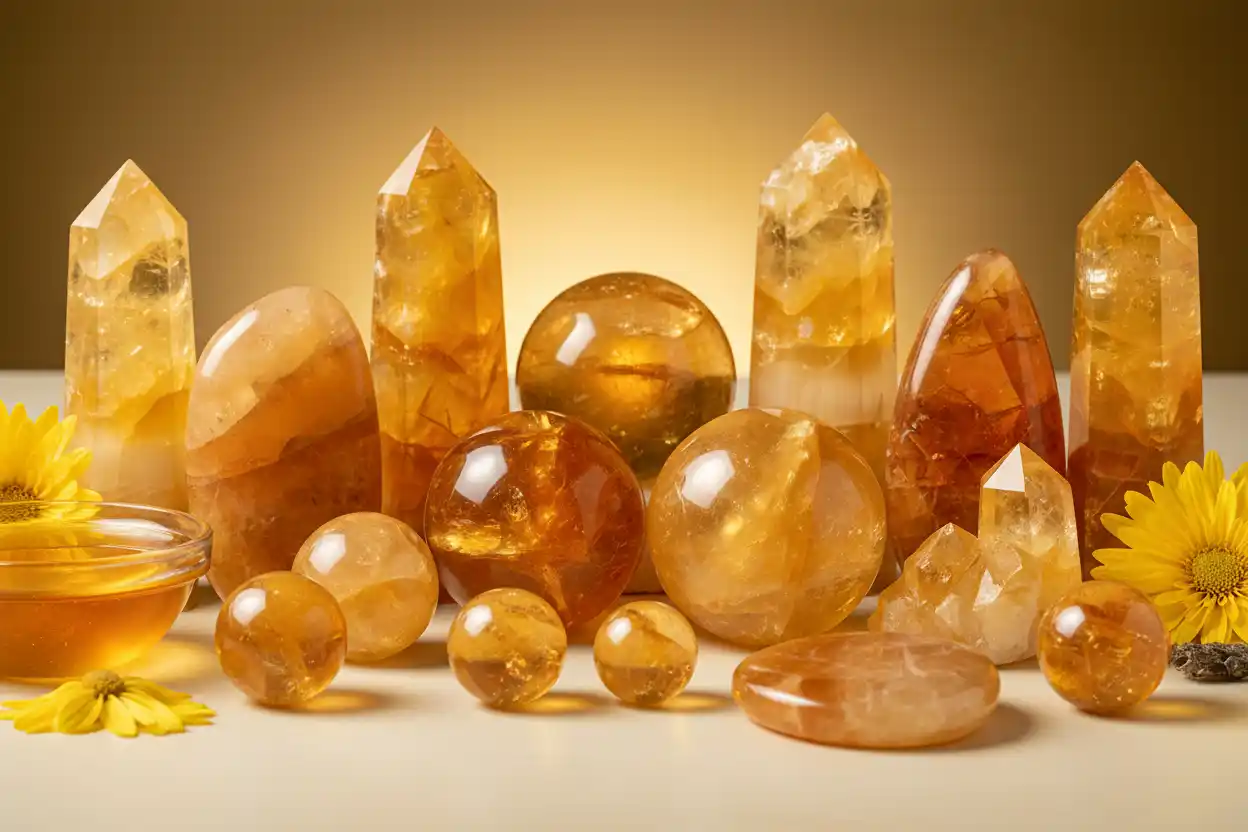
Honey Calcite Meaning: Properties, Uses & Symbolism
Honey calcite meaning begins with calcite, CaCO₃. “Honey calcite” describes calcite whose yellow, golden, amber, or brownish-yellow appearance resembles honey; it is not a separate mineral species with a different chemical formula. Mindat catalogs honey calcite under calcite, while the parent mineral is a trigonal calcium carbonate with Mohs hardness 3, measured density close to 2.71 g/cm³, perfect rhombohedral cleavage, white streak, and an exceptionally large birefringence.
That strong birefringence is one of calcite’s most recognizable physical characteristics. A transparent crystal placed over a line or small printed mark can show two images because light entering calcite divides into ordinary and extraordinary rays. GIA’s documented orangy-yellow calcite specimen measured refractive indices of 1.486 and 1.658, producing birefringence of 0.172; it also showed fluid-inclusion planes and visible optical effects related to twinning and double refraction. Honey-colored material inherits those calcite properties regardless of whether a seller calls it honey calcite, golden calcite, amber calcite, or simply yellow calcite.
Color requires more restraint. Older retail explanations often reduce yellow calcite to “iron makes it yellow,” but current analytical evidence shows that yellow coloration can be more complicated. A spectroscopic study of yellow calcite found weak, broad impurity- and defect-related absorption rather than one dominant Fe transition and documented differences in rare-earth and trace-element chemistry between yellow and pink material. Other calcite deposits can involve organic matter, inclusions, surface staining, or different trace-element systems. Therefore, honey calcite meaning should not be built on an unsupported universal color mechanism.
The symbolic layer comes later. Contemporary crystal traditions often associate honey calcite with confidence, motivation, persistence, optimism, mental organization, warmth, or purposeful action. Those interpretations can function as personal symbolism, but they are not established physiological consequences of calcium carbonate, trace elements, or birefringence. Readers exploring the broader mineral reference collection can browse Gemstone Guides. This page focuses on material identity, formation, color, recognizable traits, documented history, symbolism boundaries, and safe ownership.
Honey Calcite Meaning at a Glance
| Property or question | Evidence-aware summary |
|---|---|
| Mineral species | Calcite |
| Formula | CaCO₃ |
| Status of “honey calcite” | Descriptive color/trade name, not a separate mineral species |
| Crystal system | Trigonal |
| Typical color | Pale yellow, golden yellow, honey, amber, orange-yellow, yellow-brown |
| Mohs hardness | 3 |
| Specific gravity | About 2.71 |
| Typical calcite RI | Approximately 1.486 and 1.658 |
| Birefringence | Exceptionally high, about 0.172 |
| Optical character | Uniaxial negative |
| Cleavage | Perfect rhombohedral cleavage in three directions |
| Streak | White |
| Luster | Vitreous; cleavage surfaces can appear pearly |
| Transparency | Transparent to translucent, sometimes opaque |
| Typical formation | Sedimentary carbonate, hydrothermal veins and cavities, metamorphic carbonate rocks, caves and other carbonate-forming systems |
| Yellow-color mechanism | Specimen-specific; impurities, defects, organic material, inclusions or staining can contribute |
| Important diagnostic feature | Strong double refraction in suitable transparent material |
| Main look-alikes | Citrine/quartz, yellow fluorite, amber, aragonite, yellow glass |
| Modern symbolism | Confidence, persistence, optimism, organization, practical momentum |
| Scientific status of symbolism | Interpretive rather than demonstrated medical or psychological effect |
| Main ownership issue | Very soft and strongly cleavage-prone |
The first ownership lesson follows directly from the table: honey calcite may look gem-like, but it should never be handled according to quartz durability assumptions. GIA notes that calcite’s low hardness and easy cleavage make it uncommon as a faceted gemstone even though exceptional transparent material can be cut.
What Is Honey Calcite?
Honey calcite is calcite whose visual appearance falls somewhere in the warm yellow-to-amber range. The label is descriptive. It does not designate a chemically distinct CaCO₃ species, a fixed geographic source, a required inclusion population, or one formal saturation boundary separating “honey” from “yellow” or “golden” calcite.
Mindat’s honey calcite entry retains the calcite formula CaCO₃ and recognizes honey-colored crystal material. That is the appropriate mineralogical framework: identify the stone as calcite first, then use honey as a color description where useful.
Retail terminology is less disciplined. A pale straw-yellow specimen may be called yellow calcite by one seller and honey calcite by another. A deeper orange-yellow piece may be sold as golden calcite, amber calcite, honey calcite, or even “orange honey calcite.” These names overlap because there is no laboratory line at which yellow calcite suddenly becomes honey calcite.
When precision matters, describe what can actually be observed: transparent golden-yellow calcite, translucent amber-yellow calcite, yellow-brown calcite, or honey-colored calcite.
Honey Calcite Identity Table
| Characteristic | Honey calcite |
|---|---|
| Host mineral | Calcite |
| Ideal composition | CaCO₃ |
| Mineral group | Calcite group |
| Crystal system | Trigonal |
| Common forms | Rhombohedra, scalenohedra, tabular crystals, massive material, cleavage blocks |
| Typical color | Yellow to honey-gold and amber-brown |
| Hardness | Mohs 3 |
| Density | About 2.710 |
| Cleavage | Perfect rhombohedral |
| Fracture | Conchoidal where cleavage does not dominate |
| Tenacity | Brittle |
| Streak | White |
| Luster | Vitreous to pearly |
| Optical character | Uniaxial negative |
| RI | Approximately 1.486 / 1.658 |
| Birefringence | Approximately 0.172 |
| Pleochroism | None in normal calcite |
| Acid response | Reacts readily with dilute acid |
| Common internal features | Fluid inclusions, twinning, cleavage-related structures, growth zoning, mineral inclusions |
| Naming boundary | “Honey” describes appearance, not a separate species |
| Best identification principle | Use calcite properties rather than color alone |
Mindat identifies low hardness, strong acid reactivity, and prominent rhombohedral cleavage among the easiest recognizable calcite properties. Those traits are much more informative than whether a seller describes the color as honey, caramel, gold, lemon, or amber.
Why Calcite Has Such Strong Double Refraction
Calcite is optically anisotropic. Light traveling through the crystal can split into two rays whose refractive indices differ dramatically.
For gem-quality calcite, this difference can be around 0.172—extraordinarily large compared with most familiar transparent gemstones. GIA measured RI values of 1.486 and 1.658 in an orangy-yellow calcite from Mexico and documented conspicuous optical effects caused by double refraction and twinning.
A transparent cleavage rhombohedron placed over a printed line can therefore show two lines.
This is a physical optical effect.
It is not evidence that the stone “duplicates energy,” creates two spiritual fields, or divides negative from positive vibrations.
The deeper relationship among birefringence, twinning, fluorescence, dispersion, inclusions, and apparent honey color belongs in the Honey Calcite Optical Properties and Color Behavior.
Does Every Piece of Honey Calcite Show Obvious Doubling?
No.
The optical property belongs to calcite, but whether a person can easily see doubling depends on transparency, thickness, orientation, surface quality, internal cloudiness, fractures, and what object is being viewed through the stone.
Opaque honey calcite can be genuine calcite even though no text can be seen through it.
A translucent carving may reveal little obvious double refraction.
A transparent cleavage block with favorable orientation can show spectacular doubling.
Failure to see two images through an opaque specimen therefore does not prove that it is not calcite.
What Causes Honey Calcite’s Yellow or Golden Color?
There is no responsible universal answer for every honey-colored calcite deposit.
A recent multi-method study of yellow calcite used electron-probe analysis, LA-ICP-MS, X-ray diffraction, infrared spectroscopy, Raman spectroscopy, UV-Vis spectroscopy, and photoluminescence. The analyzed yellow specimens showed only weak broad visible absorption and were interpreted as being colored by combined minor impurity and defect centers rather than one dominant iron chromophore. They were comparatively enriched in Y, Ce, and total rare-earth elements.
Other calcite environments can produce yellow through different processes. Research on carbonate coloration notes that yellow cave calcite may be associated with organic substances such as humic material, while colored calcites more broadly can reflect transition-metal substitution, defects, inclusions, or coatings.
GIA’s documented orangy-yellow calcite showed a broad absorption below 420 nm but does not justify extrapolating one exact chromophore to every honey-colored specimen.
The safest general statement is:
Honey color in calcite is specimen- and deposit-specific and can reflect impurities, structural defects, organic material, microscopic included phases, staining, or combinations of those factors.
Why “Iron Always Makes Honey Calcite Yellow” Is Too Simple
Iron can occur in calcite and can contribute to color in particular specimens or deposits.
The problem is the word always.
Current analytical work demonstrates that at least some yellow calcite is not controlled by one dominant iron absorption. Yellow coloration can also arise from organic matter in some carbonate environments, and superficial iron-oxide staining can make an otherwise pale specimen look yellow or orange without being responsible for its internal body color.
A seller should therefore distinguish:
“yellow coloration may involve iron,”
from
“this specific specimen is colored by Fe³⁺.”
The second is an analytical claim.
Surface Staining Versus Body Color
Yellow iron-bearing coatings can develop on crystal faces, fractures, or weathered surfaces.
A coated specimen may look golden externally while a fresh chip reveals nearly colorless calcite beneath the surface. Conversely, a truly body-colored crystal remains yellow through substantial internal thickness.
This distinction is useful during examination.
Look for color concentrated along fractures, pits, crystal surfaces, or weathered zones. Compare those regions with transparent internal areas.
Do not chip an important crystal merely to investigate color.
Microscopy, spectroscopy, and existing natural damage can provide safer evidence.
Fluorescence Is Not a Universal Honey Calcite Test
Calcite can fluoresce dramatically, but fluorescence depends on trace activators, defects, impurities, and locality.
GIA’s orangy-yellow calcite showed strong yellow fluorescence under long-wave UV and moderate orangy-yellow fluorescence under short-wave UV, followed by several seconds of yellow phosphorescence.
That is one documented specimen.
Another yellow calcite may fluoresce differently, weakly, or not obviously at all.
Therefore, “glows yellow under UV” can be useful specimen information but is not the definition of honey calcite.
How Honey Calcite Forms
Calcite is one of Earth’s most widespread minerals and forms in numerous geological environments. It precipitates directly from water, crystallizes in hydrothermal veins, develops in cavities, forms limestone and other sedimentary carbonate rocks, recrystallizes during metamorphism into marble and calc-silicate assemblages, and grows in caves as stalactites, stalagmites, flowstone, and related speleothems.
The core chemistry involves dissolved calcium and carbonate reaching conditions under which CaCO₃ becomes supersaturated and precipitates. Temperature, pressure, carbon dioxide concentration, pH, water chemistry, evaporation, biological activity, and interaction with surrounding rocks influence where and how crystallization occurs.
Honey-colored calcite can therefore come from very different geological systems.
Two similarly colored stones do not need to share the same formation mechanism or trace-element chemistry.
Readers who want the broader mineral-formation framework can use How Are Gemstones Formed?, while the deposit-specific carbonate and hydrothermal context belongs in Honey Calcite Formation and Deposit Geology.
Hydrothermal Honey-Colored Calcite
Hydrothermal fluids can transport calcium, carbonate species, metals, organic compounds, and other dissolved components through fractures and cavities.
As pressure, temperature, chemistry, or gas content changes, calcite can precipitate on cavity walls or earlier minerals. Repeated fluid pulses may create zoning, inclusions, overgrowths, color variation, or several generations of calcite.
This type of growth can produce well-formed crystals rather than only massive carbonate.
Honey coloration may record aspects of those changing fluids, but the color by itself does not reconstruct fluid chemistry.
A yellow crystal is evidence of appearance.
Chemical interpretation requires analysis.
Sedimentary Calcite
Calcite is also central to limestones and many biologically influenced carbonate sediments.
Shells, skeletal debris, carbonate mud, chemically precipitated calcium carbonate, and later cementation can all contribute to limestone formation. Burial can dissolve and reprecipitate calcite, fill pores with crystals, or reorganize earlier carbonate.
Honey-colored massive calcite can therefore occur as veins, cavity fillings, recrystallized zones, or localized mineralization inside carbonate-rich rocks.
A polished yellow calcite slab may have a completely different geological history from a transparent rhombohedral crystal even though both are CaCO₃.
Metamorphic Calcite
During metamorphism, limestone can recrystallize into marble.
The calcite grains become larger and reorganized as temperature and pressure increase. Impurities in the original rock can produce bands, colors, associated silicates, or other mineral assemblages.
Some decorative honey-colored carbonate material may therefore come from recrystallized geological environments rather than open hydrothermal cavities.
Once again, the trade name does not identify the genesis.
Fluid Inclusions
Transparent calcite commonly contains fluid inclusions, healed fractures, growth zones, twin-related features, and mineral inclusions.
GIA’s analyzed orangy-yellow calcite displayed several planes of fluid inclusions, providing a direct example of how much internal history can remain inside a seemingly clean golden crystal.
The presence of fluid inclusions can support natural crystal growth and provide geological information, but a photograph of one bubble does not establish the fluid composition, age, pressure, or temperature.
The detailed specimen-scale interpretation belongs in the Honey Calcite Microscope Inclusion Notebook.
Calcite Twinning
Calcite twins readily.
Twin planes can create visible internal lines, changes in optical behavior, repeated lamellae, and spectacular image multiplication when combined with calcite’s large birefringence.
GIA’s famous faceted calcite study explained how an entering ray can repeatedly split while crossing a twin plane, producing multiple colored images of pavilion facets.
Twinning is a crystallographic relationship.
It is not evidence that the crystal contains “two souls,” duplicated metaphysical power, or any other spiritual mechanism.
Rhombohedral Cleavage
Calcite has perfect cleavage in three equivalent directions that do not meet at right angles.
A broken calcite specimen therefore often forms rhombohedral fragments with sloping faces rather than cubes.
This is one of the most useful identification clues and one of the largest practical weaknesses.
A honey calcite carving may chip into flat cleavage-controlled fragments when struck.
A polished surface may scratch long before quartz would.
A crystal point can split despite looking substantial.
The same property that aids identification creates the need for careful ownership.
Diagnostic Characteristics of Honey Calcite
Color should be the lowest-weight diagnostic clue.
The strongest ordinary calcite evidence includes:
| Observation or test | Calcite-compatible result | Reliability |
|---|---|---|
| Mohs hardness | About 3 | High, but scratch testing can damage objects |
| Cleavage | Three perfect rhombohedral directions | High |
| Double refraction | Very strong in transparent favorable orientations | High supporting clue |
| RI | About 1.486 / 1.658 | Very high for polished material |
| Birefringence | About 0.172 | Highly diagnostic |
| SG | About 2.71 | Useful |
| Acid reaction | Strong carbonate reaction | Diagnostic but destructive |
| Streak | White | Supporting |
| Crystal system/habit | Trigonal rhombohedral or scalenohedral forms | Supporting |
| Color | Yellow to honey | Very low specificity |
| Fluorescence | Variable | Supporting only |
The combination matters.
A yellow object that is Mohs 7 and gives quartz RI cannot be turned into calcite by calling it “honey calcite.”
Acid Testing: Scientifically Useful, Poor for Valuable Specimens
Calcite reacts readily with dilute acids because carbonate releases carbon dioxide during the reaction.
In geological fieldwork, dilute hydrochloric acid is a classic calcite test.
For a polished carving, jewelry item, collector crystal, historic specimen, or unknown treated object, deliberately applying acid is generally a poor first choice because it can etch and damage the surface.
If destructive testing is justified, use an expendable fragment and appropriate laboratory procedure.
Do not pour household acids over a valuable honey calcite crystal merely to watch it fizz.
Honey Calcite Versus Citrine
This is a common confusion because both can be yellow, golden, transparent, and polished.
Citrine is quartz, SiO₂.
Quartz is Mohs 7 rather than 3, has no calcite-like perfect rhombohedral cleavage, and has much smaller birefringence. A transparent calcite’s strong double refraction can be particularly helpful in separating the two.
A honey calcite sphere or palm stone may look similar to yellow quartz in a photograph.
Physical properties separate them immediately.
Honey Calcite Versus Amber
Honey and amber colors naturally invite comparison with fossil resin.
Amber is an organic gem material rather than a mineral and has dramatically lower density and hardness than calcite. It also behaves differently under heat, static electricity, spectroscopy, and surface examination.
Polished opaque material can be difficult to judge from photographs.
A honey color is not evidence that the material is amber.
Honey Calcite Versus Yellow Fluorite
Yellow fluorite can overlap with honey calcite in transparency and color.
Fluorite is harder at Mohs 4, denser at roughly 3.18, cubic rather than trigonal, and has perfect octahedral cleavage. Calcite is softer, less dense, strongly birefringent, and rhombohedrally cleavage-prone.
A clear yellow specimen showing obvious double refraction strongly favors calcite over fluorite.
Crystal habit can provide another clue when natural faces are preserved.
Honey Calcite Versus Aragonite
Aragonite is another CaCO₃ polymorph.
That means calcite and aragonite share the same chemical formula while having different crystal structures and physical properties.
Aragonite is orthorhombic and generally denser and somewhat harder than calcite. Crystal habit can also differ strongly.
A chemical test that only detects calcium carbonate cannot always distinguish the polymorph.
Structure matters.
Honey Calcite Versus Hollandite Quartz
Hollandite Quartz Meaning concerns quartz containing dark manganese-oxide inclusions.
The quartz host is far harder than calcite and lacks calcite’s dramatic rhombohedral cleavage and enormous birefringence.
A pale honey-colored quartz might superficially resemble calcite when its black inclusions are absent or cropped from a photograph, but the mineral behavior is fundamentally different.
This comparison reinforces why the host species must be established before interpreting a trade name.
Honey Calcite Versus Hyalite Opal
Hyalite Opal Meaning concerns a transparent to translucent variety of opal rather than crystalline calcite.
Opal is hydrated amorphous silica, lacks calcite’s rhombohedral cleavage, and commonly shows different optical and fluorescence behavior.
A pale yellow or near-colorless translucent piece can be visually ambiguous in poor photographs.
The internal structure and measurable properties resolve the difference.
Honey Calcite Versus Hiddenite
Hiddenite Meaning concerns green chromium-bearing spodumene under strict usage.
Hiddenite is substantially harder and denser, strongly cleavage-prone in a different crystallographic system, and has higher refractive indices than calcite.
Yellow-green spodumene and pale honey calcite can overlap somewhat under warm lighting.
The resemblance disappears under proper gemological testing.
Original Information Gain: Honey Calcite Name and Claim Audit
| Name or claim | Evidence-aware interpretation | What should not automatically be assumed | Stronger evidence when needed |
|---|---|---|---|
| Honey calcite | Honey-yellow to golden calcite | Separate mineral species | Establish calcite |
| Yellow calcite | Broad yellow color category | Different mineral from honey calcite | Usually overlapping terminology |
| Golden calcite | Descriptive/trade term | One standardized hue range | Describe actual color |
| Amber calcite | Warm amber-colored calcite terminology | Fossil amber content | Identify calcite |
| Orange honey calcite | Retail color description | Separate variety | Material remains calcite |
| Honeycomb calcite | Can describe patterned commercial calcite | Same as every honey calcite | Examine actual material and texture |
| Optical calcite | Very transparent high-quality calcite | Honey color required | Optical quality is separate |
| Iceland spar | Historically important clear optical calcite | Generic name for all calcite | Locality/trade context matters |
| “Iron-colored honey calcite” | Possible for some specimens | Universal Fe³⁺ mechanism | Spectroscopy/chemistry |
| “Rare-earth-colored calcite” | Some studied yellow material is REE-enriched | REEs alone universally produce yellow | Specimen-specific analysis |
| “Natural honey color” | May be correct | No staining, dye, coating, irradiation or treatment | Examine/treat analytically where important |
| “Solar crystal” | Modern symbolism | Stored solar radiation transferred to body | No established mechanism |
| “Confidence stone” | Modern reflective interpretation | Biological increase in confidence | Remains symbolic |
| “Digestive healing calcite” | Wellness claim | Treatment of digestive disease | Clinical evidence required |
| “Calcium crystal for bones” | Chemistry-to-health inference | Transdermal calcium supplementation | Mineral contact is not nutrition |
| “Detox calcite” | Unsupported wellness terminology | Removal of toxins | Clinical evidence required |
The most important correction is the calcium claim. Honey calcite is calcium carbonate, but a polished CaCO₃ specimen is not a calcium supplement.
Original Specimen and Photo Checklist
| Observation | Photograph can often support | Photograph cannot reliably prove |
|---|---|---|
| Honey-yellow body color | Hue and zoning | Exact chromophore |
| Transparent rhombohedron | Calcite-compatible habit | Species identity conclusively |
| Doubling of printed line | Strong calcite clue | Full treatment history |
| Cleavage faces | Rhombohedral geometry | Geographic origin |
| Fluid-inclusion planes | Internal structures | Fluid chemistry |
| Twin lamellae | Visible crystallographic structure | Formation temperature |
| Surface yellow coating | Distribution of staining | Chemical composition |
| Clear chip beneath coating | Body/surface color contrast | Full color mechanism |
| Fluorescence | Presence and color of luminescence | Universal locality or variety |
| Matrix | Geological association | Exact mine |
| Seller “Mexico” label | Provenance claim | Geographic proof |
| Seller “honey calcite” label | Trade description | Formal variety status |
| Seller “untreated” label | Disclosure claim | Independent verification |
| “Healing energy” | Nothing objectively measurable | Medical effect |
For transparent specimens, one of the most informative documentary photographs places a small high-contrast grid or printed line beneath the crystal. If the orientation is favorable, calcite’s double refraction can be captured without physically damaging the specimen.
That photograph should be treated as supporting optical evidence, not as proof of every property or locality.
Photo Workflow for Honey Calcite
Use neutral daylight or a daylight-balanced source first.
Warm bulbs can make pale yellow calcite look much more orange and encourage incorrect “deep honey” descriptions. A second transmitted-light image can reveal zoning and inclusions. A third side-lit image can emphasize cleavage planes and crystal surfaces.
If the specimen is transparent enough, photograph it over a simple printed line to document doubling.
Do not use excessive saturation.
Honey calcite should look like a natural carbonate mineral, not fluorescent orange glass.
Original Source-Comparison Framework
| Source type | Best question it answers | Main limitation |
|---|---|---|
| Mineralogical database | Formula, hardness, cleavage, SG, crystal system | Does not establish one specimen’s color cause |
| GIA gem record | Measured optical properties of analyzed yellow calcite | Applies directly to studied specimen |
| Spectroscopic calcite research | Trace elements, defects, absorption and luminescence | Color mechanism can be locality-specific |
| Geological survey | Carbonate geology and calcite occurrence | Does not validate metaphysical claims |
| Dealer listing | Current trade names and visual terminology | Weak evidence for chemistry |
| Photograph | Color, habit, zoning and visible damage | Cannot establish exact chromophore |
| Personal crystal practice | Documents symbolic use | Cannot establish mineralogical or medical effects |
| Medical source | Appropriate for genuine health questions | Does not determine spiritual meaning |
Matching the source to the claim prevents a common error: citing a seller’s spiritual description as evidence for mineral chemistry or using calcite chemistry as evidence for a medical effect.
Documented History of Calcite
Calcite has been recognized since antiquity because carbonate minerals, limestone, marble, lime, and transparent crystals were practically and scientifically important long before modern mineralogical nomenclature.
Mindat traces the calcite name to the Latin calx, meaning lime, and notes the long historical association of the word with calcium-bearing carbonate material.
Clear calcite later became especially important in optics because its unusually strong double refraction made the behavior of polarized light dramatically visible.
That history belongs to calcite broadly.
There is little justification for projecting today’s specific “honey calcite” metaphysical meanings unchanged into antiquity without primary historical evidence.
Iceland Spar and the Science of Double Refraction
Clear optical calcite historically called Iceland spar played an important role in the investigation of birefringence and polarization.
Looking through such crystals makes the splitting of light visible without sophisticated electronic equipment.
Honey calcite may not have the optical perfection required for classic optical-grade material, but it inherits the same underlying anisotropic calcite structure.
This is a genuine scientific property more interesting than many invented “energy amplification” claims.
Modern Honey Calcite Meaning
Modern honey calcite meaning commonly emphasizes confidence, optimism, motivation, persistence, decision-making, organization, creativity, warmth, and constructive action.
The color makes these associations intuitive. Golden and honey tones commonly evoke sunlight, warmth, harvest, productivity, sweetness, and value across modern visual culture.
The mineral itself adds another potential metaphor: calcite can appear optically complex because one object viewed through it becomes two.
That can symbolize considering more than one perspective.
These meanings can remain useful without being described as invisible physical forces.
Honey Calcite and Confidence
Confidence is one of the most common modern associations.
A practical use would connect the stone to preparation rather than to passive expectation. Before a presentation, interview, difficult conversation, or creative task, a person could use the honey-colored stone as a visual reminder to review the necessary information and define the next action.
The behavior can influence performance.
Calcite itself has not been shown to biologically increase confidence.
Honey Calcite and Motivation
Honey and golden colors naturally support motivational symbolism.
A grounded approach can pair the stone with a measurable action: work for twenty focused minutes, send one application, finish one section, or complete one overdue task.
The crystal acts as a cue.
It does not generate metabolic energy, dopamine, productivity, or guaranteed success.
Honey Calcite and Perspective
Double refraction provides one of the strongest material-based metaphors available for honey calcite meaning.
Looking through a transparent calcite crystal can produce two images of one object.
A reflective practice could therefore ask:
What is the first interpretation of this situation?
What is a plausible second interpretation?
What evidence would distinguish them?
The symbolism derives directly from a measurable optical property without pretending the property causes psychological change.
Honey Calcite and Decision-Making
Some crystal descriptions claim that honey calcite automatically strengthens judgment or intuition.
A stronger interpretation uses the stone to structure the decision itself.
Write down the decision, the evidence in favor, the evidence against, what remains unknown, the cost of delaying, and one reversible next step.
That can improve reasoning because it changes the decision process.
Calcite does not reveal hidden answers.
Honey Calcite and Optimism
Golden calcite can provide a warm visual object associated personally with optimism.
Responsible optimism does not mean assuming everything will work out. It means recognizing risks while continuing to identify constructive options.
The stone can symbolize that attitude.
It cannot guarantee a favorable outcome or remove external problems.
Honey Calcite and Creativity
Transparent honey calcite can show extraordinary internal visual effects from cleavage, inclusions, zoning, twinning, birefringence, and reflections.
Those features can directly inspire artists, photographers, lapidaries, and collectors.
That is a genuine creative value.
There is no need to claim that calcium carbonate chemically increases creativity in the brain.
Honey Calcite and Prosperity
Golden stones frequently receive prosperity symbolism.
Honey calcite cannot alter investment returns, increase business revenue, win lotteries, guarantee employment, attract customers, or change the probability of financial events.
A practical prosperity ritual can use the stone as a prompt to perform financially relevant behavior: reconcile accounts, send invoices, develop a skill, save regularly, or compare expenses.
The action has the mechanism.
The mineral has the symbolism.
Honey Calcite Healing Claims
There is no established scientific evidence that carrying or wearing honey calcite treats digestive illness, bone disease, calcium deficiency, hormonal problems, cardiovascular disease, anxiety, depression, neurological conditions, infertility, immune dysfunction, chronic pain, or other medical problems.
Calcite is calcium carbonate.
That fact does not mean calcium passes therapeutically through intact skin from a crystal.
Nor does the presence of CaCO₃ make a collector specimen an appropriate nutritional or antacid product.
The wider health and wellness boundary used by Gems Lore is stated in the Gems Lore Disclaimer.
Calcium Carbonate Mineral Versus Calcium Supplement
The distinction is fundamental.
Calcium carbonate is used in some manufactured food, pharmaceutical, and industrial products after it has been processed and controlled for its intended purpose.
A natural mineral specimen is not one of those products automatically.
Natural calcite can contain trace elements, fluid inclusions, other minerals, surface contaminants, cleaning residues, adhesives, coatings, and environmental material.
“Contains calcium” is chemistry.
“Safe calcium supplement” is a regulated-use claim requiring an entirely different evidence standard.
Do Not Ingest Honey Calcite or Make Elixirs
Do not powder honey calcite, swallow mineral fragments, add rough crystals to supplements, or deliberately soak collector material in drinking water for metaphysical consumption.
Even aside from contaminants, dissolving calcite alters and damages the specimen.
If calcium or medication is required, use products formulated for that purpose rather than geological display material.
Symbolic use does not require ingestion.
Safe Ownership: Calcite Is Very Soft
Mohs hardness 3 means calcite scratches readily.
Quartz in ordinary household dust can scratch polished calcite. Steel tools, many gemstone beads, countertop grit, jewelry boxes containing harder stones, and abrasive cloths can damage the surface.
A polished honey calcite palm stone that initially looks glossy can become matte or scratched after repeated contact with harder minerals.
This is predictable mineral behavior.
It is not evidence that the stone has “absorbed negative energy.”
Cleavage Is the Larger Structural Risk
Hardness concerns scratching.
Cleavage concerns splitting.
Calcite’s three directions of perfect rhombohedral cleavage mean a blow can create a flat break even when the object is not deeply scratched.
A thick piece can therefore break surprisingly cleanly.
That mechanical behavior is central to safe jewelry design, carving, transport, and storage.
The specialized mounting and impact questions belong in Honey Calcite Setting and Wear Engineering.
Jewelry Suitability
Honey calcite can be used in pendants, brooches, beads, cabochons, collector jewelry, or protected ornamental designs.
It is poorly suited to highly exposed everyday rings because hand wear subjects a stone to impacts and abrasion against objects far harder than Mohs 3.
A person’s willingness to accept scratches and occasional repolishing also matters.
Jewelry symbolism cannot improve the mineral’s durability.
Cutting and Polishing
Calcite can take a polish and can be faceted spectacularly, but the combination of low hardness and perfect cleavage makes cutting technically demanding.
Orientation matters because a cutter must avoid initiating cleavage while also considering transparency, internal fractures, zoning, twinning, optical effects, and yield.
GIA’s extraordinary faceted calcite demonstrates that successful cutting is possible, but also emphasizes why calcite is rarely chosen for conventional faceted jewelry.
The detailed lapidary workflow belongs in Honey Calcite Cutting, Orientation and Polish.
Intact Calcite Versus Processing Dust
Ordinary handling of intact honey calcite differs from sawing, grinding, drilling, sanding, crushing, or polishing mineral material.
Mechanical processing creates fine dust from calcite and any associated phases.
Professional or serious hobby lapidary work should use appropriate eye protection, equipment guarding, controlled cleanup, ventilation or local extraction, and wet processing where suitable.
Do not deliberately generate mineral powder for spiritual use.
Buying Honey Calcite
Because the name is broad, the first buying question should be whether the specimen is genuinely calcite.
The next questions concern color, transparency, crystal form, chips, cleavage damage, treatment, coatings, locality documentation, and whether “honey” is being used merely as a color label.
An unusually vivid transparent orange specimen deserves more scrutiny than a seller title alone provides.
Purchase-level seller evaluation belongs in Where to Buy Honey Calcite.
Treatment and Enhancement Questions
Calcite is soft and porous enough in some textures that commercial objects may be dyed, coated, waxed, resin-filled, repaired, or otherwise modified.
Treatment does not automatically make an object worthless.
The important issue is disclosure when treatment affects identity, value, durability, or care.
Color concentrated strongly in cracks or pores can raise a dye question.
Plastic-like surface luster can raise a coating or stabilization question.
A natural golden color should not be declared treated merely because it is strong.
Testing must follow evidence.
Specimen Conservation
A good honey calcite specimen may preserve natural crystal faces, cleavage, twinning, color zoning, fluid inclusions, fluorescence, matrix association, locality, and historic labels.
Aggressive polishing, acid cleaning, repeated soaking, or removing the matrix can destroy that evidence.
Before alteration, photograph all sides and record dimensions, weight where useful, crystal form, color zones, damaged edges, repairs, labels, locality claims, associated minerals, and any analytical information.
The Honey Calcite Specimen Conservation Record provides the mapped structure for maintaining that information.
Preserve Natural Cleavage and Crystal Faces
A broken cleavage surface is not necessarily “damage” in the scientific sense.
It can demonstrate calcite’s structure and preserve useful crystallographic information.
Likewise, natural rhombohedral or scalenohedral faces can have greater collector value than a polished surface.
Whether to cut, repair, polish, or leave a specimen untouched depends on the object’s purpose.
Aesthetic improvement and specimen conservation are not always the same goal.
Honey Calcite Is Not Citrine With a Softer Energy
Trade language sometimes places yellow minerals into one spiritual category and then differentiates them through supposed energetic intensity.
Mineralogically, honey calcite and citrine are profoundly different.
Calcite is CaCO₃, Mohs 3, strongly birefringent, and perfectly cleavage-prone.
Citrine is SiO₂ quartz, Mohs 7, much less birefringent, and mechanically more suitable for routine jewelry.
A consumer choosing between them should prioritize actual material behavior before metaphysical comparison.
Evidence and Technical Limits
This article does not claim first-hand mine visits, unpublished spectroscopy, private chemical analysis, controlled treatment experiments, or direct authentication of a reader’s specimen. Gems Lore’s broader sourcing approach is described on About Gems Lore.
Exact yellow-color cause can require UV-Vis spectroscopy, Raman analysis, X-ray diffraction, electron-probe or trace-element chemistry, fluorescence studies, microscopy, or other appropriate methods. A yellow hue alone cannot establish whether iron, rare-earth elements, organic matter, defects, inclusions, staining, or several mechanisms contributed.
Likewise, photographs cannot conclusively establish treatment, geographic origin, or every difficult calcite-versus-aragonite case.
Readers with documented corrections, laboratory data, deposit records, or stronger technical evidence can submit them through Contact Gems Lore.
Frequently Asked Questions About Honey Calcite Meaning
What is honey calcite meaning?
Honey calcite meaning combines the mineral identity of golden-yellow calcite with modern symbolic themes such as confidence, optimism, motivation, perspective, persistence, and purposeful action. Those meanings are interpretations rather than scientifically demonstrated medical effects.
What is honey calcite?
Honey calcite is yellow-to-golden or amber-colored calcite, CaCO₃. It is best treated as a descriptive color or trade name rather than a separate mineral species.
Is honey calcite the same as yellow calcite?
The terms overlap strongly. Yellow calcite is the broader color description, while honey calcite usually implies warmer golden, amber, or brownish-yellow material. There is no formal mineralogical boundary separating them.
Is golden calcite the same as honey calcite?
Often in trade usage, yes. Golden calcite and honey calcite are overlapping descriptive names rather than separate mineral species.
What is honey calcite made of?
Its host mineral is calcium carbonate, CaCO₃.
How hard is honey calcite?
Calcite has Mohs hardness 3. It scratches far more easily than quartz, beryl, garnet, sapphire, or diamond.
Does honey calcite have cleavage?
Yes. Calcite has perfect rhombohedral cleavage in three directions.
Why does calcite show double images?
Its strong birefringence splits light into ordinary and extraordinary rays. GIA measured birefringence of 0.172 in a transparent orangy-yellow calcite.
What is the refractive index of honey calcite?
Typical calcite values are approximately 1.486 and 1.658, reflecting its exceptionally high birefringence.
What causes honey calcite’s yellow color?
The cause can vary. Recent research on yellow calcite found weak impurity- and defect-related absorption rather than one dominant Fe chromophore, while other carbonate environments can involve organic matter, trace elements, inclusions, or staining.
Is iron always what makes honey calcite yellow?
No. Iron can contribute in some material, but current analytical evidence does not support one universal iron-only explanation for every yellow or honey-colored calcite specimen.
Does honey calcite fluoresce?
Some does. A GIA orangy-yellow calcite fluoresced strongly yellow under long-wave UV and moderately orangy yellow under short-wave UV. Fluorescence varies by specimen and locality.
Where does honey calcite form?
Calcite forms in hydrothermal veins and cavities, sedimentary carbonate environments, caves, metamorphic carbonate rocks, and many other geological systems. Honey-colored specimens can therefore have very different formation histories.
Is honey calcite rare?
Calcite itself is extremely common. Attractive transparent, strongly colored, unusually large, exceptionally formed, optically interesting, or well-provenanced honey-colored specimens can be more collectible than ordinary calcite, but the trade name alone does not establish rarity.
Can honey calcite be mistaken for citrine?
Yes. Golden transparent pieces can resemble citrine visually, but calcite is far softer and has extreme birefringence and rhombohedral cleavage, while citrine is quartz.
Can honey calcite be used in jewelry?
Yes, especially in protected or occasional-wear designs. Mohs hardness 3 and perfect cleavage make it a poor choice for heavily exposed everyday jewelry.
Does honey calcite have healing properties?
There is no established scientific evidence that wearing or carrying honey calcite treats disease or creates specific physiological healing effects.
Does honey calcite provide calcium to the body?
No demonstrated therapeutic calcium delivery occurs through wearing a calcite stone. Mineral calcium carbonate is not equivalent to a regulated calcium supplement.
Does honey calcite increase confidence or motivation?
A person can use it as a symbolic reminder to prepare, act, or maintain a goal, but the mineral has not been shown to biologically generate confidence or motivation.
Can honey calcite go in drinking water?
Collector honey calcite should not be powdered, ingested, or deliberately used to prepare gemstone drinking-water elixirs. Natural specimens can contain impurities, associated minerals, treatments, coatings, and contaminants not represented by the ideal CaCO₃ formula.
Final Perspective
Honey calcite meaning becomes more informative when the warm color is placed on top of the correct mineral identity. Honey calcite is calcite, CaCO₃—a trigonal mineral with Mohs hardness 3, specific gravity near 2.71, perfect rhombohedral cleavage, and one of the strongest birefringence values encountered in common transparent minerals. A documented GIA orangy-yellow calcite measured RI 1.486 and 1.658 and displayed fluid-inclusion planes, fluorescence, and striking optical effects related to double refraction.
Its color is also more scientifically interesting than the familiar one-line explanation suggests. Current research shows that yellow calcite can involve weak combined impurity and defect absorption rather than a single dominant iron chromophore, while other carbonate environments demonstrate roles for organic matter, trace elements, inclusions, and staining. The responsible description is therefore specimen-specific: identify the calcite first, document where the color occurs, and avoid assigning one coloring agent without evidence.
Modern associations with confidence, motivation, optimism, perspective, persistence, creativity, and purposeful action can still form a responsible honey calcite meaning. The mineral even supplies useful metaphors of its own. Its strong double refraction can represent examining a situation from more than one perspective, while its softness and cleavage provide a reminder that apparent solidity does not remove structural vulnerability.
The evidence boundary remains straightforward: honey is a color description, not a new mineral species; calcium carbonate chemistry does not make a collector specimen a supplement; yellow color does not reveal one universal chromophore; fluorescence is variable; hardness and cleavage must govern ownership; and metaphysical symbolism should remain distinct from medical or guaranteed behavioral claims.