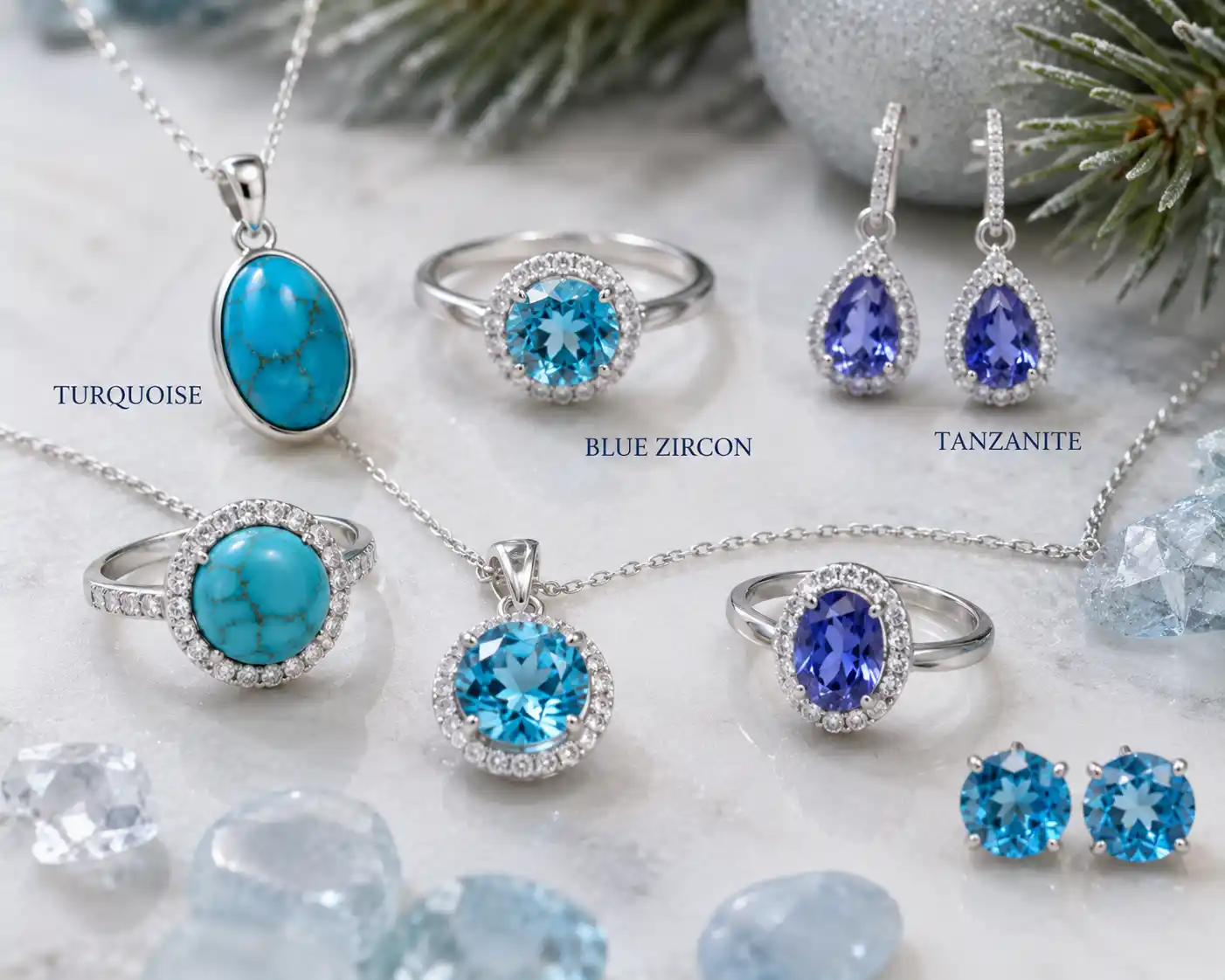
December Birthstone Jewelry: Turquoise, Tanzanite and Zircon Gifts
December birthstone jewelry offers three distinct choices: turquoise for opaque color and historic character, tanzanite for rare blue-violet elegance, and zircon for brilliant sparkle. The best gift depends on the recipient’s style, daily routine and willingness to care for a more delicate gem.
Pendants and earrings are the safest all-purpose gifts because they receive fewer impacts than rings and bracelets. Turquoise beads and cabochons suit relaxed or artistic styles, while faceted tanzanite and zircon work especially well in refined evening and formal designs.
December Birthstone Jewelry at a Glance
| Gemstone | Best jewelry formats | Style impression | Everyday practicality | Main buying concern |
|---|---|---|---|---|
| Turquoise | Pendants, earrings, beads and protected rings | Organic, bold and distinctive | Moderate | Treatment and porosity |
| Tanzanite | Studs, drops, pendants and special-occasion rings | Elegant and blue-violet | Moderate to delicate | Cleavage and color quality |
| Zircon | Earrings, pendants and protected rings | Brilliant and classic | Moderate | Facet abrasion and treatment |
| Mixed December design | Pendants, charms and coordinated sets | Personalized and colorful | Depends on the most delicate gem | Compatible care requirements |
Begin with the Recipient’s Lifestyle
Jewelry should fit how the recipient actually dresses and works.
Someone who regularly uses their hands, works around tools or cares for young children may find a pendant or stud earrings more practical than a raised ring or delicate bracelet.
A recipient who wears minimal jewelry may prefer one small birthstone accent. Another person may enjoy a large turquoise cabochon or a richly colored tanzanite centerpiece.
Observe metal color, jewelry scale and preferred formats before buying. Birth month alone does not determine personal taste.
Turquoise Jewelry Gifts
Turquoise jewelry ranges from small polished beads to bold cabochon designs with visible matrix.
The completed guide to turquoise bracelets explains bead quality, fit and construction. For earrings, the turquoise earring guide covers studs, drops and statement formats.
A turquoise necklace or pendant works well when ring sizing is unknown, while the dedicated turquoise ring guide addresses protective settings and daily-wear limitations.
Ask whether the material is untreated, stabilized, dyed, reconstructed or an imitation. Stabilization may improve practicality, but disclosure still matters.
Tanzanite Jewelry Gifts
Tanzanite’s blue-to-violet color gives it a more formal and luxurious appearance.
The completed tanzanite bracelet guide explains why flexible jewelry requires careful stone protection. Tanzanite bracelets work best for occasional wear rather than rough daily use.
Tanzanite earrings are among the safest gifts because the stones receive fewer impacts. A tanzanite necklace provides a visible centerpiece without exposing the gem like a ring.
When choosing a tanzanite ring, prioritize protective settings and make clear that it may be better suited to special occasions than constant wear.
Zircon Jewelry Gifts
Natural zircon offers high brilliance and colorful fire. Blue zircon is especially associated with December, although colorless and warm-colored varieties provide alternatives.
The completed zircon bracelet guide explains how to reduce impact and abrasion in flexible designs. Zircon earrings display strong sparkle while reducing contact with hard surfaces.
A zircon necklace or pendant suits recipients who enjoy brilliant jewelry without wanting a ring. The completed zircon ring guide covers protective settings and care for facet edges.
Confirm that the stone is natural zircon rather than cubic zirconia. The names sound similar, but the materials are unrelated.
The Best December Birthstone Jewelry by Recipient
| Recipient preference | Strongest choice | Why it works |
|---|---|---|
| Loves organic or artisan jewelry | Turquoise pendant or earrings | Opaque color and unique matrix patterns |
| Prefers elegant blue-violet gems | Tanzanite studs or pendant | Saturated color with a refined appearance |
| Wants maximum sparkle | Blue zircon earrings or pendant | High brilliance and fire |
| Rarely wears rings | Pendant or stud earrings | No sizing issue and lower impact risk |
| Enjoys bold jewelry | Large turquoise cabochon | Strong visual presence |
| Prefers delicate jewelry | Small tanzanite or zircon studs | Refined scale and color |
| Has an active lifestyle | Low-profile earrings or pendant | Reduced exposure to blows |
| Collects gemstones | Documented tanzanite, turquoise or unusual zircon | Strong mineral and provenance interest |
| Wants a personalized gift | Mixed December birthstone pendant | Represents several December traditions |
| Needs an accessible price point | Small zircon or stabilized turquoise design | Broad style and price availability |
Necklaces and Pendants
Necklaces are among the easiest December birthstone gifts because they do not require exact finger or wrist sizing.
Turquoise cabochon pendants create a strong focal point, while tanzanite works beautifully in smaller faceted drops. Zircon pendants provide diamond-like sparkle without being diamond substitutes in mineralogical terms.
Check chain length, clasp style and metal sensitivity. A delicate chain may not be suitable for a large stone.
For valuable pendants, inspect the bail and connecting ring because failure in those areas can cause the entire piece to be lost.
Earrings
Stud earrings provide a practical balance between visibility and protection.
Tanzanite and zircon studs work well because the stones remain close to the ear and receive fewer blows. Turquoise studs may be round, oval, geometric or inlaid.
Drop earrings create more movement and visual impact but may catch on scarves, hair or clothing. Consider weight and closure security.
People with sensitive ears may need verified metal composition rather than only a description such as hypoallergenic.
Rings
Rings expose gemstones to the greatest level of impact, abrasion, cosmetics and household chemicals.
A turquoise ring needs enough protection around the cabochon and should be removed before washing, applying products or doing manual work. Tanzanite rings benefit from bezels, partial bezels or supportive halos.
Zircon rings should protect facet edges and projecting corners. Very high settings may look dramatic but increase exposure.
When ring size is uncertain, choose another format or obtain an exchange option. Guessing can turn a meaningful gift into a resizing problem.
Bracelets
Bracelets move against desks, doors, clothing and other jewelry, making them challenging for December’s comparatively delicate stones.
Turquoise bead bracelets may be practical when the beads are well polished, securely strung and protected from chemicals. Tanzanite and zircon bracelets should use secure settings and remain occasional-wear pieces.
Inspect clasps, connecting links and stringing material. A valuable gemstone does not compensate for weak construction.
A bracelet should fit closely enough to avoid catching but not so tightly that it restricts movement or circulation.
Choosing the Metal
White gold, platinum and silver emphasize cool blue tones. Yellow gold creates stronger contrast and can add warmth to turquoise, tanzanite and zircon.
Rose gold may complement violet tanzanite and greenish turquoise, although the exact effect depends on saturation and skin tone.
Metal choice also affects price, weight, maintenance and allergy risk. Sterling silver may tarnish, while plated jewelry can wear through over time.
Ask for the exact metal and fineness rather than accepting broad labels such as gold tone or silver color.
Choosing a Setting
Prong settings allow more light into faceted tanzanite and zircon, but exposed corners and girdles need careful protection.
Bezels and partial bezels offer stronger edge protection, although they may change the visual openness of the design.
Turquoise cabochons are commonly bezel-set because the smooth shape and surrounding metal work naturally together.
Check that prongs are even and secure. The stone should not click, rotate or move when the piece is handled gently.
Color Matching
A matching set does not require identical color.
Turquoise naturally varies from blue to green, while tanzanite shifts between blue and violet. Zircon can appear bright blue, colorless or in warm hues.
For earrings, the stones should be reasonably balanced in tone, saturation and size. Perfect matches may cost more, especially in natural turquoise or deeply colored tanzanite.
When combining stones, consider visual harmony rather than forcing exact uniformity.
Treatment Disclosure
December birthstones commonly involve treatment considerations.
Turquoise may be stabilized, dyed or reconstructed. Most tanzanite is heat-treated, while zircon frequently receives heat treatment to produce desirable blue or colorless appearances.
Treatment does not automatically make a gemstone poor quality. However, it can affect value, care and future appearance.
Request written disclosure and keep documentation with the gift, especially for significant purchases.
Natural, Synthetic and Imitation Materials
Tanzanite has no common synthetic counterpart in the ordinary retail market, but glass and other stones may imitate its appearance. Turquoise may be imitated by dyed howlite, magnesite, plastic and reconstructed products.
Natural zircon is sometimes confused with cubic zirconia because of the name. Cubic zirconia is manufactured and should be sold under its correct identity.
The completed guides to identifying genuine turquoise and spotting imitation tanzanite provide more detailed buying checks.
For an expensive gift, independent laboratory documentation may be appropriate.
Birthstone Meaning as Part of the Gift
A short note can explain why the gemstone was chosen without making supernatural promises.
Turquoise may represent friendship and travel, tanzanite can symbolize transformation and new perspective, while zircon is associated with wisdom, prosperity and rest in different traditions.
Keep the wording personal: “I chose turquoise because its travel symbolism reminded me of our trips” is more meaningful than claiming the stone will guarantee protection.
The complete December birthstone guide covers the history, properties and traditional meanings of all three stones.
Buying December Birthstone Jewelry Online
Read the complete description and enlarge photographs. Confirm gemstone identity, dimensions, treatment, metal, total weight and return policy.
Product images may use strong lighting and magnification, so compare stone measurements with a ruler rather than judging size from the photograph alone.
Ask whether the exact item or a representative sample is shown. This matters especially for turquoise because matrix and color vary from piece to piece.
The completed buying guides for turquoise, tanzanite and zircon provide stone-specific quality checks.
Gift Presentation and Documentation
Include the receipt or exchange information discreetly. Jewelry size and style preferences can be difficult to predict, and an exchange option does not reduce the meaning of the gift.
Place the piece in a box that keeps it stationary. Turquoise should not rub against harder gemstones, while tanzanite and zircon need protection from impact.
Include treatment and care information. A recipient who understands the gemstone is more likely to preserve it correctly.
Avoid describing the jewelry as an investment unless independent evidence supports that claim.
Cleaning and Maintenance
Turquoise, tanzanite and zircon should all be cleaned gently.
Warm, mild soapy water and a soft tool may be appropriate when the complete construction and treatment are understood. Steam and ultrasonic systems are inappropriate for turquoise and tanzanite and are also generally avoided for zircon.
Apply cosmetics before wearing the jewelry. Remove pieces before bathing, swimming, cleaning, sports and manual work.
Store each item separately and have valuable settings inspected periodically.
Choosing by Budget Without Sacrificing Disclosure
A smaller well-cut zircon or tanzanite may provide more beauty than a larger weakly colored stone. Likewise, an honestly disclosed stabilized turquoise piece may be preferable to a suspiciously inexpensive item sold as rare untreated material.
Prioritize secure construction, accurate identity and return rights before carat weight or an inflated retail comparison.
Avoid vague grades such as AAA unless the seller explains the criteria. There is no universal grading scale behind many commercial quality labels.
A thoughtful gift does not need to be the most expensive option.
Conclusion
December birthstone jewelry can suit very different recipients. Turquoise offers bold opaque color and historic character, tanzanite provides rare blue-violet elegance and zircon delivers exceptional brilliance.
Pendants and earrings are the safest general gifts, while rings and bracelets need more careful lifestyle matching. Treatment disclosure, secure settings and realistic care instructions make the gift more valuable than size or marketing language alone.
Frequently Asked Questions
1. What is the best December birthstone jewelry gift?
A pendant or pair of stud earrings is the safest general choice because sizing is simple and the stones receive fewer impacts.
2. Which December birthstone is best for someone who loves sparkle?
Blue zircon usually offers the strongest brilliance and fire.
3. Which December birthstone is best for a bold artistic style?
Turquoise works especially well in large cabochons, beads and distinctive metalwork.
4. Which December birthstone looks most luxurious?
Strongly saturated tanzanite often creates the most conventionally luxurious blue-violet appearance.
5. Are tanzanite rings suitable for everyday wear?
Tanzanite rings are better for careful or occasional wear because the stone has cleavage and can be damaged by hard blows.
6. Is turquoise jewelry always untreated?
No. Turquoise may be stabilized, dyed, reconstructed or imitated, so disclosure matters.
7. Is blue zircon the same as cubic zirconia?
No. Blue zircon is a natural mineral, while cubic zirconia is manufactured.
8. Which metal looks best with December birthstones?
White metals emphasize cool blue tones, while yellow and rose gold create warmer contrast. Personal preference should guide the choice.
9. Can the three December birthstones be combined in one piece?
Yes, provided the design protects each gem and the owner follows the care needs of the most delicate material.
10. How should December birthstone jewelry be cleaned?
Use gentle, material-appropriate cleaning. Avoid steam and ultrasonic systems for turquoise and tanzanite and generally avoid them for zircon.
11. Should a birthstone gift include a laboratory report?
A report may be appropriate for a valuable stone or when origin, treatment or identity materially affects the purchase.
12. What should be included with a December birthstone gift?
Include care instructions, treatment disclosure, metal information and an exchange or return option where possible.