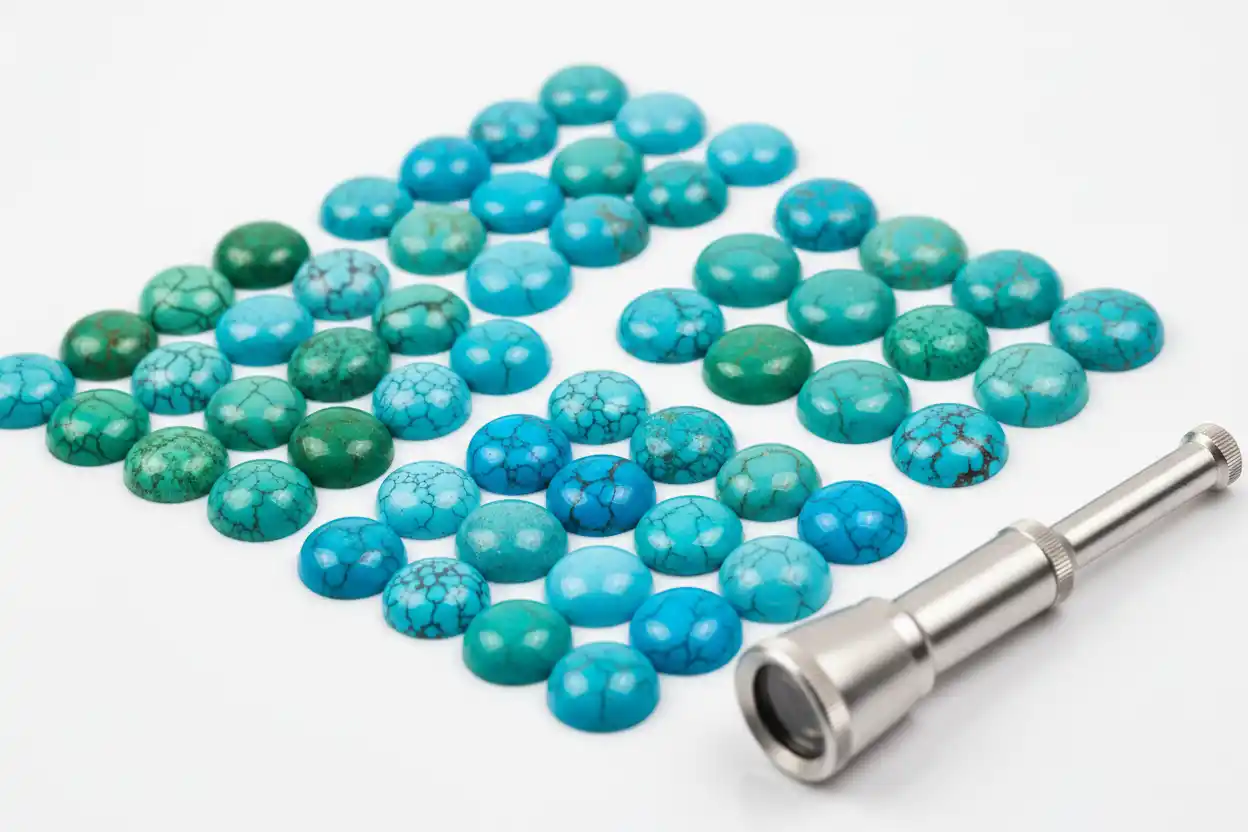
Turquoise Price Guide: Value and Cost in 2026
Turquoise prices in 2026 commonly range from approximately $1 to $150 per carat. Dyed, reconstructed and low-grade stabilized material usually sits near the bottom of that range, while fine untreated Persian, Sleeping Beauty and American mine Turquoise can reach $50 to $300 per carat.
Exceptional untreated Nevada spiderweb material, rare old-stock mine production and historically important jewelry can exceed $300 per carat. Unlike transparent gems, Turquoise is valued mainly through color, density, matrix pattern, treatment, mine provenance and cutting quality.
Turquoise Price per Carat in 2026
| Turquoise category | Typical characteristics | Approximate 2026 retail price |
|---|---|---|
| Dyed imitation or reconstructed material | Dyed Howlite, Magnesite, pressed chips, resin-rich composite or imitation | $0.50–$5 per carat |
| Stabilized commercial Turquoise | Pale or porous natural material impregnated with resin | $2–$20 per carat |
| Good natural or lightly treated Turquoise | Attractive blue or green, reasonable density and competent cutting | $10–$60 per carat |
| Fine untreated Turquoise | Even saturated color, strong polish, desirable matrix or clean face | $50–$150 per carat |
| Premium mine-grade material | Sleeping Beauty, Persian or collectible American mine material with provenance | $100–$300 per carat |
| Exceptional collector quality | Rare untreated spiderweb, old-stock deposit or historically important provenance | $300–$500+ per carat |
Turquoise is also sold by gram, cabochon, bead strand, rough slab, carving or completed jewelry piece. Five carats equal one gram, but price per carat becomes less meaningful for large carvings and specimen rough.
The broader principles behind treatment, rarity and provenance appear in How Gemstone Prices Are Determined.
What Is Turquoise?
Turquoise is a hydrated copper-aluminum phosphate that forms in dry regions where copper-bearing groundwater reacts with aluminum- and phosphorus-containing minerals.
It is generally opaque, though fine thin edges may show slight translucency. Its color ranges from sky blue and blue-green to green, yellow-green and gray-green.
Because the material can be naturally porous, hardness and durability vary considerably among deposits and even within one rough specimen.
The completed Turquoise guide owns its geology, physical properties, history and traditional symbolism.
This page remains focused on price, treatment and commercial value.
Color Is the Primary Turquoise Value Factor
Fine Turquoise commonly displays saturated sky blue, robin’s-egg blue or medium blue.
Historically, evenly colored blue material with little visible matrix has received strong international demand. That appearance is often associated with Persian Turquoise and the closed Sleeping Beauty deposit in Arizona.
However, green and blue-green Turquoise can also be valuable. Collectors may pay premiums for characteristic colors from deposits such as Carico Lake, Royston, Damele or certain Chinese mines.
The color should appear natural rather than artificially bright or plastic-like. Gray, chalky and weakly saturated material generally belongs to lower tiers unless it has exceptional historical or mine provenance.
Evenness matters for clean blue cabochons, while patterned stones are judged through the interaction between color and matrix.
The broader visual context appears in Blue Gemstones and Green Gemstones.
Matrix-Free vs Matrix Turquoise
Matrix consists of remnants of the host rock running through the Turquoise.
Some buyers prefer clean, matrix-free blue. Others collect spiderweb patterns, dark veining and deposit-specific matrix structures.
Matrix does not automatically reduce value. Fine black or brown spiderweb can create substantial premiums when the pattern is natural, evenly distributed and associated with a desirable mine.
Random gray patches, weak host rock and unstable fractures usually reduce value.
A matrix pattern should look integrated with the stone rather than painted, printed or artificially filled. Repeated identical webbing across many cabochons can indicate reconstructed or manufactured material.
The market therefore contains two premium aesthetics: clean saturated color and distinctive natural matrix.
Spiderweb Turquoise Prices
Spiderweb Turquoise contains fine intersecting matrix lines that resemble a web.
Commercial webbed material may cost approximately $10 to $50 per carat. Fine natural spiderweb commonly ranges from $50 to $200 per carat.
Exceptional material from collectible Nevada, Chinese or historic Persian sources can reach $200 to $500 per carat or more.
The highest prices require more than visible lines. The stone should combine attractive body color, dense structure, strong polish and a balanced web.
Large black areas, crumbly matrix and open fractures reduce durability. A delicate web is normally preferred to coarse host-rock patches unless the design has unusual artistic value.
Sleeping Beauty Turquoise Prices
Sleeping Beauty Turquoise comes from a mine near Globe, Arizona, that became famous for bright, relatively even blue material with little matrix.
Commercial pieces represented as Sleeping Beauty may cost approximately $20 to $80 per carat.
Fine untreated or old-stock material commonly ranges from $80 to $200 per carat. Exceptional clean blue cabochons with dependable provenance may cost more.
The mine’s closure increased demand for remaining stock. However, the name is widely misused.
A seller should provide credible supply history when the deposit name creates a premium. Color alone cannot prove Sleeping Beauty origin because Persian, Chinese and treated material may look similar.
Persian Turquoise Prices
Persian Turquoise refers to material historically mined in Iran, particularly around Nishapur.
Fine stones are valued for saturated sky-blue to medium-blue color, strong polish and limited unwanted matrix.
Commercial material may cost approximately $10 to $50 per carat. Fine clean blue Persian Turquoise commonly ranges from $50 to $150 per carat.
Rare old-stock stones, historically documented pieces and exceptional spiderweb material may cost more.
The label Persian should indicate credible geographic provenance. It should not be used as a generic quality term for every clean blue cabochon.
Historic jewelry may derive substantial additional value from age, metalwork, inscriptions and cultural provenance.
Chinese Turquoise Prices
China produces a broad range of blue, green and spiderweb Turquoise.
Low-grade stabilized or dyed material can be inexpensive. Fine natural Chinese Turquoise with dense structure and attractive webbing can command collector prices.
Commercial cabochons may cost approximately $5 to $40 per carat. Fine natural spiderweb material commonly reaches $50 to $200 per carat.
Exceptional pieces with vivid color and fine black webbing may rise higher.
Chinese origin should not be treated as an automatic discount. Quality spans reconstructed commercial products through exceptional natural material.
Disclosure of stabilization and dye remains more important than country alone.
Nevada and Other American Mine Turquoise
Nevada contains numerous Turquoise deposits with distinctive colors and matrix patterns.
Collectors recognize names such as Lander Blue, Number Eight, Lone Mountain, Royston, Carico Lake, Damele, Blue Gem and Pilot Mountain.
Fine material from an exhausted or limited deposit can command substantial premiums. Exceptional Lander Blue and other rare spiderweb material may cost several hundred dollars per carat.
Mine names are commercially powerful but difficult to verify after rough has entered secondary trading.
A handwritten dealer note is useful provenance but not equivalent to scientific origin determination. Old collection records, miner documentation and a consistent chain of ownership provide stronger support.
Arizona, New Mexico and other western states also produce collectible Turquoise with distinct commercial histories.
Natural Turquoise
Natural Turquoise usually means material cut and polished without resin stabilization, dye or reconstruction.
Some sellers still apply wax or light surface treatments while describing a stone as natural. Therefore, the term should be accompanied by a specific treatment statement.
Fine untreated material normally receives a premium because dense rough suitable for cutting is less common than porous material.
The stone should take a good polish and remain structurally sound without plastic impregnation.
Natural does not automatically mean high quality. Chalky, pale or fractured untreated material may be less valuable than attractive stabilized Turquoise intended for durable everyday jewelry.
Stabilized Turquoise
Stabilization introduces resin or polymer into porous Turquoise to improve hardness, polish and durability.
The process makes otherwise unsuitable rough usable in jewelry. It can be practical and visually attractive when disclosed.
Stabilized material should cost less than comparable untreated Turquoise because its strength depends partly on manufactured resin.
Commercial stabilized cabochons commonly range from approximately $2 to $20 per carat.
High-quality stabilized material may cost more when the underlying color and matrix are attractive, but sellers should not price it as rare untreated mine grade.
Stabilization is not the same as reconstruction. A stabilized stone still begins as a continuous piece of natural Turquoise.
Dyed Turquoise
Dye can intensify blue or green color in pale Turquoise.
It may be combined with stabilization, making disclosure particularly important.
Dye can collect in pores, drill holes, fractures and matrix areas. However, modern treatment may be difficult to detect without laboratory testing.
Dyed Turquoise generally belongs to a lower market than comparable natural-color material.
The color may also fade, bleed or change after exposure to solvents, cosmetics and heat.
A retailer should state both stabilization and dye when both processes were used.
Reconstructed and Block Turquoise
Reconstructed Turquoise is made from small Turquoise particles or fragments combined with resin and compressed into blocks.
Some products contain meaningful Turquoise content. Others use mostly resin, dye and mineral powder.
Block Turquoise may be manufactured to imitate clean blue material or natural spiderweb patterns.
It is suitable for inexpensive fashion jewelry when identified accurately. However, it should not be priced as a single natural cabochon.
Repeated web patterns, unusually consistent color and a plastic-like polish can indicate manufactured material.
The full distinction among natural, stabilized, reconstructed and imitation products belongs to the Turquoise Buying Guide.
Common Turquoise Imitations
Dyed Howlite and Magnesite are among the most common Turquoise imitations.
Howlite often contains gray veining that resembles matrix after dyeing. Magnesite can also absorb bright blue color.
Plastic, glass, ceramic, dyed Calcite, pressed powder and composite products may imitate Turquoise.
Amazonite can overlap in blue-green color, although it is usually more translucent and has a different structure. The detailed comparison belongs to Amazonite vs Turquoise.
Larimar can also overlap visually in pale blue material. Its distinction belongs to Larimar vs Turquoise.
Cut, Polish and Carat Weight
Turquoise is normally cut into cabochons, beads, inlays, carvings and flat-backed freeforms.
A fine cabochon should have a smooth polish, balanced dome and enough thickness for durability.
Excessively thick backs add weight without improving the visible face. Conversely, a very thin cabochon may crack during setting.
The highest-value cut often follows the color and matrix rather than a standardized oval shape.
Calibrated stones can be easier to mount, while freeforms preserve rare webbing or deposit-specific patterns.
Large pieces do not automatically command higher per-carat prices. Color, density, treatment and provenance remain more important.
Turquoise Jewelry Prices in 2026
| Jewelry type | Broad U.S. retail range |
|---|---|
| Silver jewelry with reconstructed or stabilized Turquoise | $30–$300 |
| Silver ring or pendant with good natural Turquoise | $150–$1,000 |
| Native American silver jewel with documented artist | $300–$5,000+ |
| Gold jewelry with fine untreated Turquoise | $800–$10,000+ |
| Historic, signed or rare-mine collector jewel | Individually evaluated |
Metalwork and authorship can contribute more value than the stone.
A signed Native American jewel may be collected for silversmithing tradition, tribal affiliation, artist reputation and design. Those factors should not be reduced to a loose-stone price calculation.
Style-specific guidance belongs to the Turquoise Ring Guide, Turquoise Earrings Guide, Turquoise Necklace Guide and Turquoise Bracelet Guide.
Turquoise’s birthstone context belongs to the December Birthstone Guide.
Certification and Provenance
Most inexpensive stabilized Turquoise does not require a costly laboratory report.
Testing becomes useful when:
- Untreated status creates a premium
- Dye or impregnation is uncertain
- Natural versus reconstructed structure matters
- A rare mine name substantially increases price
- Historic jewelry requires authentication
- The stone is represented as Persian or Sleeping Beauty material
A laboratory can identify Turquoise and detect many forms of dye, polymer impregnation and reconstruction.
Mine origin is more difficult. Provenance documents and chain of ownership often matter more than a laboratory locality opinion.
The Gemstone Certification Labs comparison explains report scope and limitations.
Durability and Care
Turquoise is relatively soft and may be porous.
Cosmetics, skin oils, perfume, household chemicals and prolonged moisture can alter its color or polish.
Stabilized material may tolerate wear better than untreated porous Turquoise, though heat and solvents can damage resin.
Steam and ultrasonic cleaning should be avoided. Warm water should also be used sparingly because soaking can affect porous stones and adhesives.
Complete maintenance guidance belongs to How to Clean Turquoise Jewelry Safely.
Does Turquoise Hold Its Value?
Commercial stabilized and reconstructed Turquoise normally resells below retail.
Fine untreated mine-grade material can retain collector demand, especially when the deposit is depleted and provenance is credible.
Signed Native American jewelry, antique Persian pieces and historically important designs follow additional collector markets.
Resale value weakens when the treatment is unknown or a famous mine name cannot be supported.
The broader secondary-market framework appears in Do Gemstones Hold Their Value?.
Online shoppers should verify treatment, dimensions, artist marks and return terms through How to Buy Gemstones Online Without Getting Scammed.
The Buying & Value hub connects Turquoise pricing with certification, treatment and resale guidance.
Frequently Asked Questions
1. How much is Turquoise worth per carat in 2026?
Most Turquoise costs approximately $1 to $150 per carat. Fine untreated and rare mine-grade material may reach $150 to $500 per carat.
2. What Turquoise color is most valuable?
Even saturated sky blue and medium blue receive strong international demand, while fine green and spiderweb material can also be highly valuable.
3. Does matrix lower Turquoise value?
Not automatically. Random weak matrix can reduce value, while fine natural spiderweb patterns may create substantial premiums.
4. How much is Sleeping Beauty Turquoise?
Commercial material may cost $20 to $80 per carat. Fine untreated old-stock cabochons commonly reach $80 to $200 per carat or more.
5. How much is Persian Turquoise?
Good Persian Turquoise commonly ranges from approximately $20 to $100 per carat. Exceptional documented material can cost more.
6. Is Chinese Turquoise valuable?
Yes. Fine natural Chinese spiderweb Turquoise can reach $50 to $200 per carat or higher.
7. Is stabilized Turquoise real?
Yes. It begins as natural Turquoise, but resin is introduced to improve its strength and polish.
8. Is reconstructed Turquoise natural?
It contains Turquoise particles or fragments combined with resin. It is a manufactured composite rather than one continuous natural stone.
9. How can Turquoise treatment affect value?
Untreated dense material receives the strongest premium. Stabilization, dye and reconstruction progressively reduce geological rarity and resale value.
10. Does Turquoise need a laboratory report?
Commercial material usually does not. Testing is useful for expensive untreated, rare-mine, natural-versus-composite and historic pieces.
11. Does Turquoise hold its value?
Fine untreated material and important signed jewelry can retain collector demand. Commercial stabilized products generally resell below retail.
12. Is Turquoise a good investment?
Rare mine-grade stones and important historic jewelry may appreciate, but treatment uncertainty and weak provenance create significant risk.
Turquoise Value Depends on What Supports the Color
Two cabochons can show similar blue faces while belonging to very different markets. One may be dense untreated Turquoise from a depleted deposit; the other may be dyed powder held together with resin.
In 2026, most attractive stabilized and natural commercial Turquoise falls between $5 and $60 per carat. Prices above that range should correspond to exceptional color, natural structure, desirable matrix, credible treatment disclosure and provenance that can survive expert scrutiny.