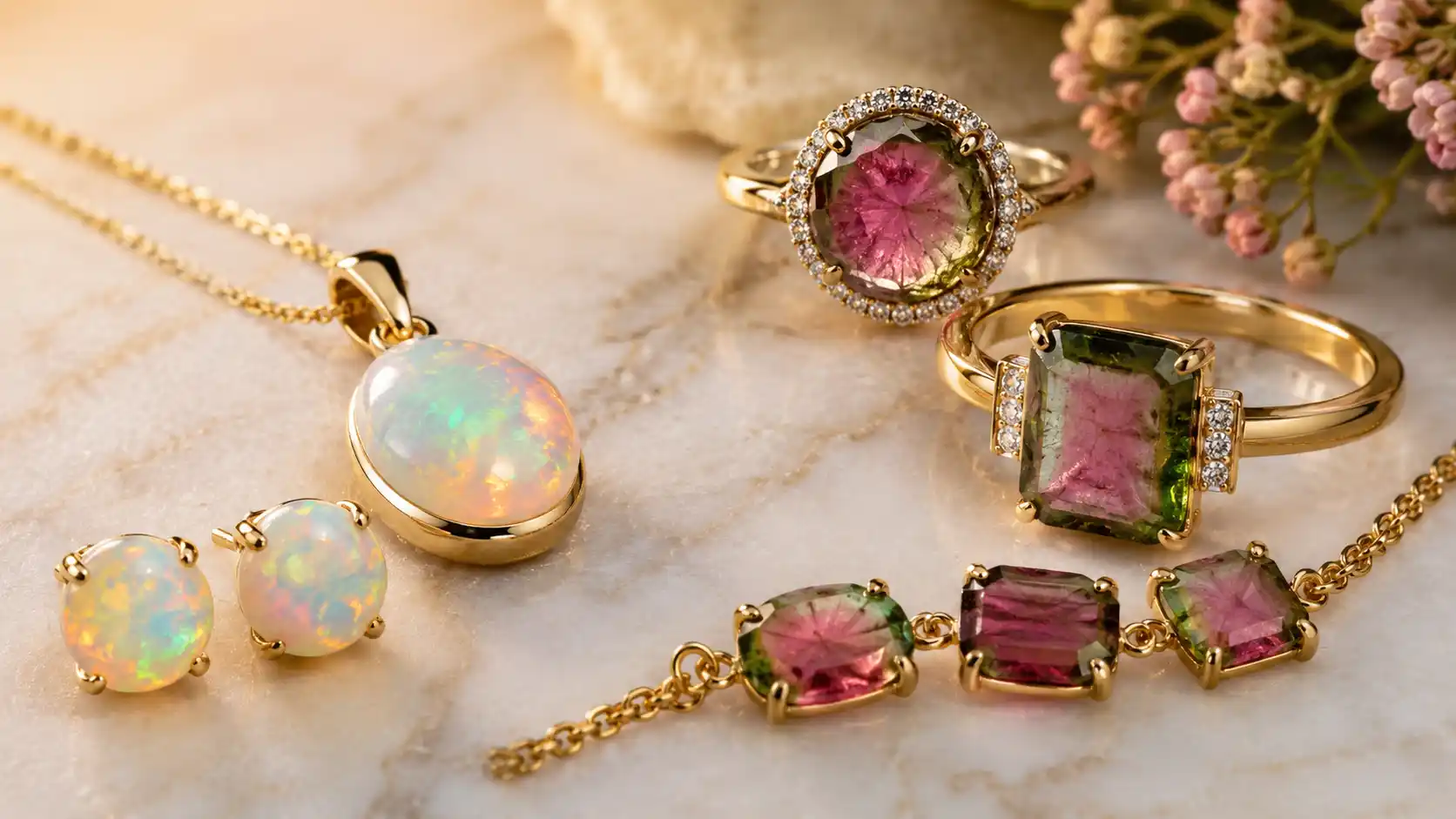
October Birthstone Jewelry: Gift Guide
October birthstone jewelry offers two dramatically different gemstone experiences. Opal can display several spectral colors inside one stone, while Tourmaline provides an unusually broad selection of pink, red, green, blue, yellow and multicolored gems.
Their jewelry requirements also differ. Opal is relatively soft, brittle and sometimes porous, so it performs best in protected settings and lower-impact formats. Tourmaline ranks higher in hardness and generally tolerates regular wear more effectively, although heat, fractures and weak settings can still cause damage.
The right gift should therefore reflect more than birth month. Color preference, lifestyle, jewelry habits, metal sensitivity, treatment disclosure and realistic maintenance all influence whether the piece will be worn regularly.
The broader October birthstone guide owns the history, properties and symbolism of the two stones. This article focuses on selecting finished jewelry for a birthday, anniversary, family milestone or personal purchase.
October Birthstone Jewelry at a Glance
| Gift format | Opal choice | Tourmaline choice | Main consideration |
|---|---|---|---|
| Stud earrings | White, Crystal or Black Opal cabochons | Pink or green Tourmaline solitaires | Pair matching and backs |
| Drop earrings | Opal cabochons or doublets | Pear, oval or elongated Tourmaline | Weight and articulation |
| Solitaire pendant | Protected solid Opal | Pink, green or blue Tourmaline | Bail and chain strength |
| Statement necklace | Boulder or Fire Opal focal piece | Large Rubellite or multicolored Tourmaline | Total weight |
| Everyday ring | Low bezel with careful wear | Protected Tourmaline setting | Impact and setting height |
| Cocktail ring | Large Opal cabochon | Large Rubellite or green Tourmaline | Rotation and comfort |
| Tennis bracelet | Protected matched Opals | Matched faceted Tourmalines | Links and clasp |
| Bead bracelet | Common or pink Opal beads | Multicolored Tourmaline beads | Drill holes and stringing |
| Luxury gift | Fine Black Opal | Paraíba-type or fine Rubellite | Documentation and treatment |
| Budget gift | Opal doublet or common Opal | Commercial pink or green Tourmaline | Clear disclosure |
| Family jewelry | Opal mixed with other birthstones | Tourmaline in several colors | Material compatibility |
| Personalized piece | Opal charm or initial pendant | Tourmaline station or charm | Construction and scale |
Choosing Opal or Tourmaline
Start with the recipient’s preferred visual effect.
Opal suits someone who enjoys irregular, one-of-a-kind color patterns. No two natural stones show precisely the same arrangement of flashes, background tone and transparency.
Tourmaline is more appropriate when the recipient has a clear favorite color. Pink, red, green, blue and multicolored crystals allow the gift to match an established wardrobe or jewelry collection.
The complete Opal gemstone guide explains precious and common Opal, while the Tourmaline gemstone guide covers the mineral group’s chemistry and color range.
Lifestyle provides the next distinction. A careful wearer may enjoy an Opal ring, while someone who rarely removes jewelry may receive more use from Tourmaline earrings, a pendant or another durable format.
Opal Jewelry Character
Precious Opal’s play-of-color can include red, orange, yellow, green, blue and violet. The colors may appear as pinfire points, broad flashes, ribbons or irregular patches.
The stone’s body may be white, dark, transparent, orange or attached naturally to host rock. Common Opal lacks play-of-color but can provide attractive pink, blue, green or orange bodycolor.
Opal is usually cut as a cabochon because a smooth dome shows the optical effect effectively. Transparent Fire Opal may also be faceted.
A gift listing should state whether the stone is solid Opal, a doublet or a triplet. Assembled pieces can offer excellent visible color at a lower price, but glue and layered construction require stricter care.
Tourmaline Jewelry Character
Tourmaline is a mineral group capable of showing nearly every color.
Pink and green are widely available. Rubellite offers stronger red or purplish-red color, Indicolite describes blue material, and Watermelon Tourmaline combines pink and green zones.
Copper-bearing Paraíba Tourmaline can display vivid turquoise, blue, green or violet and occupies a much higher market than ordinary blue-green Tourmaline.
Color zoning is common and may be part of the design rather than a flaw. A crystal slice can display several growth zones, while a faceted stone may be oriented to present one dominant color.
Tourmaline’s stronger hardness gives it wider jewelry flexibility, but heavily included stones still need protection.
Opal Earrings
Earrings are among the safest Opal gifts because they receive little contact with desks, tools and hard surfaces.
The Opal earrings guide owns detailed style and pair-matching decisions.
Studs can use small round or oval cabochons, while drops allow larger stones and greater movement. A well-matched pair should coordinate in body tone, play-of-color brightness, pattern scale and directional behavior.
Exact mirror matching is unlikely in natural Opal. The pair should look balanced rather than identical.
Broad backs help large studs remain upright. Leverbacks or locking posts are appropriate for valuable drops.
Tourmaline Earrings
The Tourmaline earrings guide covers cut, matching, closures and comfort.
Pink Tourmaline studs make a recognizable October gift, while green, blue or multicolored drops offer a less conventional alternative.
Pairs should match in hue, tone, saturation, cut dimensions and visible inclusion level. Pleochroism can make two stones appear differently colored if their crystal orientations do not coordinate.
Large Tourmaline drops may become heavy. Request the weight per earring rather than the combined weight.
A low bezel or substantial basket provides security without preventing the gemstone from showing color.
Opal Necklaces and Pendants
A pendant allows a visually important Opal to be worn with less mechanical risk than a ring.
The Opal necklaces and pendants guide owns bail, chain and setting construction.
White, Crystal and Black Opal cabochons work well as solitaires. Boulder Opal can retain natural ironstone matrix, producing an irregular shape that suits custom settings.
A bezel protects the perimeter and is generally safer than fine isolated prongs.
The chain must support the complete pendant, particularly when a substantial backing or decorative halo adds weight.
Long chains should be evaluated carefully because the pendant may strike desks or furniture when the wearer leans forward.
Tourmaline Necklaces and Pendants
The Tourmaline necklaces guide covers solitaires, stations, bead strands and multicolored designs.
Larger pink or green Tourmalines can provide stronger saturation than small accents. Elongated crystals and slices may also be used in artistic pendants.
Station necklaces can combine several colors without the weight of a continuous line. Two-point connections help flat stones remain face-up.
A multicolored bead necklace should progress deliberately rather than appearing assembled from unrelated leftovers.
The bail opening, chain gauge and clasp should all match the pendant’s weight.
Opal Rings
An Opal ring can make a memorable birthday gift, but the recipient must understand its care requirements.
The Opal rings guide owns ring settings and daily-wear limitations.
A low full bezel provides the strongest general protection. A halo can shield part of the perimeter, although harder accent stones must not touch the Opal.
High exposed cabochons are vulnerable to impact. A ring intended for frequent use should be modest in height and removed during exercise, cleaning, gardening and manual work.
Solid Opal, doublet and triplet rings belong to different care categories. The seller should identify the construction explicitly.
Tourmaline Rings
The Tourmaline rings guide covers general ring styles and buying decisions.
Tourmaline can serve in solitaires, halos, three-stone rings, signets and cocktail designs. Its color range also makes it useful for nontraditional engagement or anniversary jewelry.
A bezel protects included stones, while prongs show more of a clean faceted center.
Long crystal cuts and large rectangular stones need sufficient metal beneath them. A narrow shank can bend and allow a top-heavy ring to rotate.
Very dark green or blue stones should be viewed in ordinary indoor light because concentrated showroom lighting can make them appear brighter than they will during daily wear.
Opal Bracelets
Bracelets expose Opal to greater impact than earrings or necklaces.
The Opal bracelets guide owns line, bead and station construction.
A bezel-link bracelet provides better protection than exposed shared prongs. Each link should articulate freely without allowing neighboring stones to collide.
Opal bead bracelets require smooth drill holes and careful stringing. Hydrophane material, glue and assembled stones should not be soaked.
A close but comfortable fit reduces rotation beneath the wrist and limits contact with desks.
Tourmaline Bracelets
The Tourmaline bracelets guide covers tennis, station, bead and bangle formats.
Tourmaline provides greater durability for wrist jewelry but can still chip at exposed corners or fractures.
Multicolored bead bracelets are common and may include pink, green, blue, yellow and colorless material. The color sequence should appear deliberate.
A tennis bracelet needs a secure box clasp and flexible links. A station bracelet requires a chain strong enough to support its stones without stretching.
Hard Diamond or Sapphire bracelets should not rub continuously against Tourmaline.
Choosing Opal Quality
The complete purchase workflow belongs to the Opal buying guide.
For precious Opal, evaluate play-of-color brightness, visible colors, pattern, body tone, transparency and how much of the face displays color.
A large stone with weak, directional flashes may be less impressive than a smaller bright Opal whose color remains visible through movement.
Check the surface for scratches, pits, crazing and polishing marks. Side and back views help reveal doublet or triplet construction.
Ethiopian hydrophane material can be beautiful but requires protection from oils, perfume and prolonged liquid exposure.
Choosing Tourmaline Quality
The Tourmaline buying guide owns color, clarity, cut and variety evaluation.
Color usually drives value. Strong attractive pink, red, blue or green receives greater demand than weak grayish or overly dark material.
Clarity expectations vary by color. Red and pink stones commonly contain more inclusions than many green examples, while Paraíba-type material may remain valuable despite visible internal features.
Cut should control pleochroism and avoid windows or large black areas. Elongated rough may encourage deep narrow gems, so millimeter dimensions matter alongside carat weight.
Treatments and Assembled Opal
Opal can be smoked, dyed, sugar-acid treated, filled, coated or assembled.
The treated Opal guide explains how these processes affect appearance and care.
A doublet normally contains a thin Opal layer attached to a dark backing. A triplet adds a transparent cap. These are legitimate products when disclosed accurately.
Treatment can improve affordability, but the gift card or receipt should identify the construction. Avoid generic descriptions such as genuine rainbow stone when the material is assembled.
Tourmaline may be heated, irradiated or fracture filled. Known treatment should also be disclosed, particularly in expensive or heavily included stones.
Metal Choices
Yellow gold creates warm contrast with Opal and strengthens orange, red and green flashes. It also complements pink and green Tourmaline.
Rose gold pairs naturally with pink Tourmaline and can soften white Opal settings.
White gold, platinum and silver create cooler contrast and may emphasize blue or green colors.
The gemstone does not determine whether a piece is suitable for sensitive skin. Posts, backs, solder, plating and alloy composition matter. The guide to gemstones and metals for sensitive skin explains those concerns.
Budget Planning
Opal and Tourmaline both occupy wide price ranges.
The Opal price guide separates common Opal, solid precious Opal, Black Opal, Boulder Opal and assembled products.
The Tourmaline price guide explains why ordinary pink or green material differs dramatically from fine Rubellite, Indicolite and Paraíba-type stones.
A modest budget can purchase attractive common Opal, a disclosed doublet or commercial pink Tourmaline.
More money should improve color, construction and durability before it merely increases carat weight. A well-made pendant with a moderate center usually provides better value than an oversized stone attached to a weak chain.
Buying an October Birthstone Gift Online
Request video of the exact piece under neutral light.
Opal should be shown through movement so play-of-color brightness and direction can be evaluated. Tourmaline should be viewed in several lighting environments to reveal darkness, zoning and pleochroism.
The listing should state gemstone identity, treatment, whether Opal is solid or assembled, stone dimensions, metal alloy, total weight, closure type and return terms.
A laboratory report may be useful for a high-value Black Opal, natural-origin dispute or expensive Paraíba-type Tourmaline. Routine commercial pieces may not justify individual testing.
Cleaning and Care
Opal should follow How to Clean Opal Jewelry Safely.
Use lukewarm water, mild soap and a soft cloth. Avoid steam, ultrasonic equipment, high heat and prolonged soaking.
Tourmaline should follow How to Clean Tourmaline Jewelry Safely.
Warm soapy water remains the safest method. Steam and ultrasonic cleaning are not recommended because heat, liquid inclusions, fractures and fillings may create risks.
Store the two stones separately. Tourmaline is hard enough to scratch Opal during contact.
Frequently Asked Questions
1. What are the two October birthstones?
Opal and Tourmaline are the recognized October birthstones.
2. Which makes the safest everyday gift?
Tourmaline generally tolerates frequent wear better. Opal is safest in earrings, pendants and protective settings.
3. Is Opal jewelry always expensive?
No. Common Opal, commercial white Opal and disclosed doublets or triplets offer accessible options.
4. Which Tourmaline color is traditional for October?
Pink Tourmaline is especially familiar, but every natural Tourmaline color can represent the month.
5. Are Opal doublets and triplets fake?
No. They are assembled Opal products and are legitimate when their layered construction is disclosed.
6. Can Opal be worn in a ring?
Yes, with a low protective setting and careful removal habits.
7. Is Tourmaline suitable for an engagement ring?
Many Tourmalines are suitable with sound settings, although highly included stones need additional protection.
8. Which metal looks best with Opal?
Yellow gold creates warmth, while white metal emphasizes cooler flashes. The best choice depends on the stone and recipient.
9. Which metal suits pink Tourmaline?
Rose gold reinforces warmth, while white metal produces clearer contrast.
10. Does October birthstone jewelry need certification?
Most commercial gifts do not. Reports become more useful for valuable Black Opal, Paraíba-type Tourmaline or disputed treatment and origin claims.
11. Can Opal and Tourmaline be placed together?
Yes, provided metal separates them so the harder Tourmaline cannot scratch the Opal.
12. What information should accompany the gift?
Include gemstone identity, treatment, Opal construction, metal alloy, care instructions, receipt and return or warranty information.
October birthstone jewelry can be intensely individual without becoming impractical. Opal rewards careful wear with shifting color that cannot be duplicated exactly, while Tourmaline offers nearly any preferred hue with greater everyday flexibility. The strongest gift matches that material difference to the recipient rather than selecting by color alone.