October Birthstone Jewelry: 19 Meanings of Opal & Tourmaline Energy
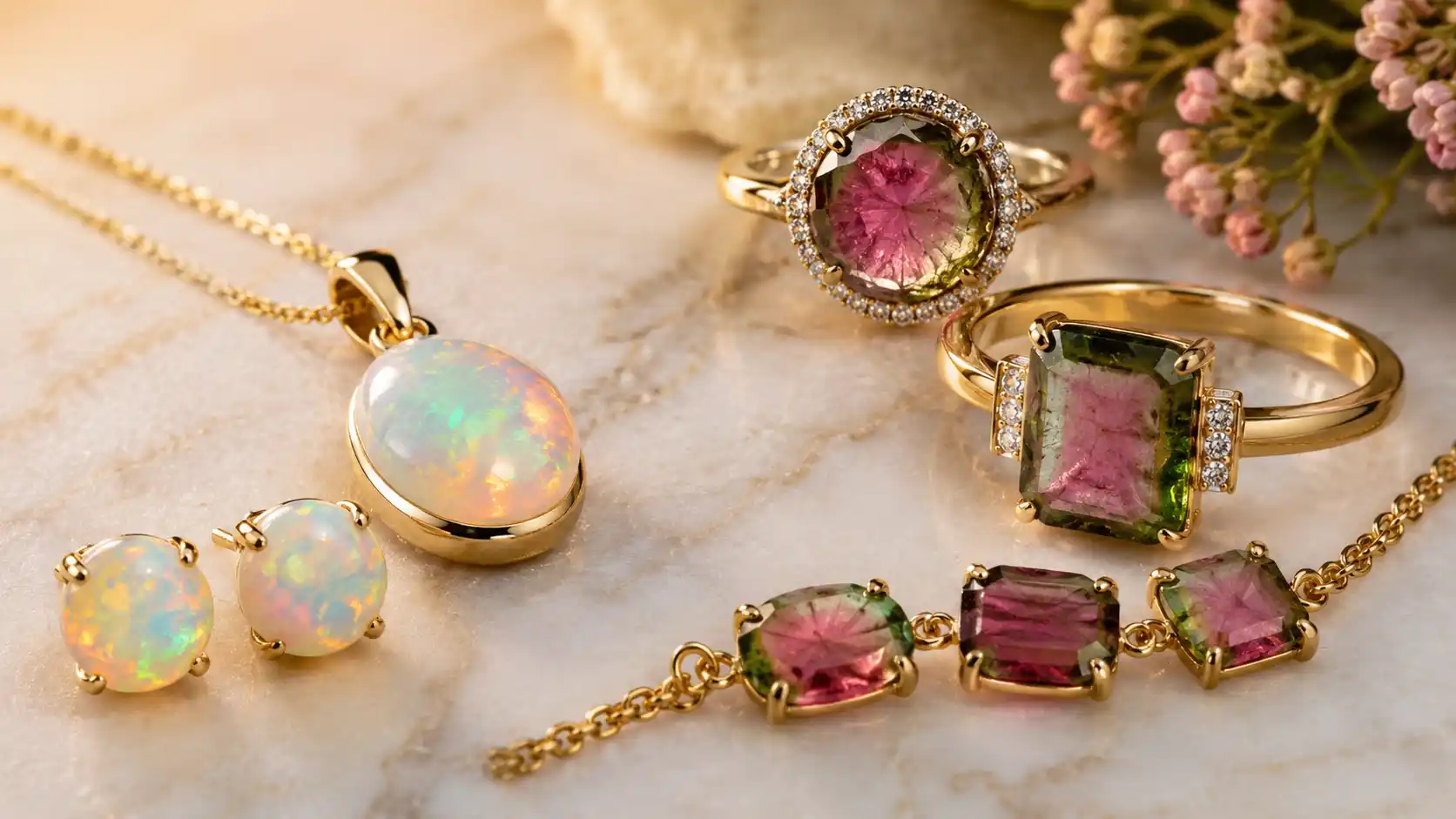
October birthstone jewelry gives wearers two extraordinarily colorful choices: opal and tourmaline. Opal is a hydrated silica gemstone famous for play-of-color, the shifting spectral flashes produced when light interacts with regularly arranged microscopic silica spheres. Tourmaline is a family of crystalline boron silicate minerals with one of the widest natural color ranges in the gem world, including pink, red, green, blue, yellow, brown, black and multicolored combinations. GIA recognizes both as October birthstones, while tourmaline is also associated with the eighth wedding anniversary.
Their physical behavior differs significantly. Opal ranges approximately 5 to 6.5 on the Mohs scale and has very poor to fair toughness, which means it can scratch or break more easily than many transparent faceted gemstones. Tourmaline is harder at about 7 to 7.5, although its toughness is considered fair and sudden temperature change can cause fracturing. Warm soapy water is the safest routine cleaning choice for both.
Spiritually, October birthstone jewelry is often described in terms of creativity, individuality, emotional expression, protection and energetic balance. Opal’s constantly changing colors and tourmaline’s enormous palette make these interpretations visually compelling, but gemstone “energy” should remain symbolic language. Neither opal nor tourmaline has been scientifically demonstrated to heal emotional conditions, protect against harmful forces or alter chakras.
19 Meanings of October Birthstone Jewelry
- Opal play-of-color can symbolize creativity.
- Shifting colors can represent change and adaptability.
- Unique patterns can symbolize individuality.
- Opal can represent imagination and emotional expression.
- Light flashes can symbolize hope emerging unexpectedly.
- White opal can represent openness and possibility.
- Black opal can symbolize mystery and depth.
- Tourmaline’s color range can represent personal freedom.
- Pink tourmaline can symbolize affection.
- Rubellite can symbolize passion and emotional intensity.
- Green tourmaline can represent growth and renewal.
- Blue tourmaline can symbolize reflection and communication.
- Black tourmaline has modern protective symbolism.
- Watermelon tourmaline can represent emotional balance.
- Tourmaline durability can symbolize resilience.
- Multicolored crystals can represent complexity within one identity.
- October birthstone jewelry can mark personal belonging.
- Jewelry can preserve memories and chosen intentions.
- Energetic meanings remain symbolic rather than scientifically measurable.
Opal Makes October Birthstone Jewelry Visually Unpredictable
Opal is unlike most familiar transparent gemstones because its most important visual feature is not ordinary faceted brilliance. Precious opal displays play-of-color, in which spectral colors appear to move or change as the stone, viewer or light source shifts position.
GIA explains that the effect is created by diffraction of light through tiny silica spheres arranged in an orderly structure. Variations in sphere arrangement produce the remarkable range of patterns and colors seen in natural opal.
This physical effect makes transformation and creativity natural symbolic themes. A single opal can look blue and green from one angle, then reveal orange or red from another.
That change does not mean the gemstone’s “energy” has shifted. It is an optical phenomenon, but the phenomenon provides a beautiful metaphor for changing perspective and discovering qualities that are not immediately visible.
Opal Individuality Comes From Patterns That Rarely Repeat
GIA compares opals to fingerprints or snowflakes because individual stones can differ dramatically in background color, play-of-color, transparency and pattern.
This makes October birthstone jewelry particularly suitable for someone who values uniqueness.
Two round diamonds of similar grading can appear extremely alike, but two natural precious opals can show completely different distributions of color. One may display broad red flashes, while another produces small green and blue pinfire.
That individuality supports symbolism involving personal identity more naturally than claims about supernatural power.
A wearer may choose an opal because the stone’s appearance feels impossible to duplicate, creating a close relationship between the gemstone and a specific birthday or personal milestone.
Play-of-Color Is the Most Important Opal Quality Factor
For precious opal, play-of-color is central to beauty and value. GIA evaluates opal through background color and play-of-color, pattern and clarity, with vivid color flashes generally preferred over weak effects. Red play-of-color has traditionally been particularly prized, although overall brightness, pattern and coverage matter strongly.
The gemstone should therefore be viewed while moving under controlled lighting.
A photograph can capture only a fraction of what an opal does in motion. Video is more useful, while in-person examination is better still.
When you buy opal, examine how much of the face shows play-of-color, how bright it remains through different angles and whether distracting dead areas interrupt the design.
Opal Is Beautiful but Requires Deliberate Care
Opal’s Mohs hardness varies from about 5 to 6.5, and GIA rates its toughness from very poor to fair. High heat, sudden temperature change or prolonged intense heat from lighting can lead to cracking or crazing in some stones.
This does not make opal unsuitable for jewelry. It simply means the jewelry style should respect the gemstone.
Pendants, earrings and protected rings are practical. A high-set opal ring worn during heavy manual work is much more vulnerable.
Warm soapy water is the only universally safe cleaning recommendation from GIA. Steam and ultrasonic cleaning should be avoided, especially because treatments, fractures and structural sensitivity may not always be obvious.
Opal Treatment Can Change Both Appearance and Care
Natural opals can receive treatments intended to alter color, apparent clarity or durability. GIA lists impregnation with oil, wax or plastic as well as sugar and smoke treatments among recognized enhancement methods.
Composite opals also exist, including doublets and triplets that combine thin opal layers with backing or protective caps.
None of these products is automatically unsuitable for jewelry, but accurate disclosure matters because natural solid opal, treated opal and assembled opal have different market positions.
The factors influencing opal price should therefore be considered alongside whether the stone is solid, composite, treated, synthetic or natural.
Opal’s Changing Light Can Symbolize Creativity Without Mysticism
Modern spiritual writing often connects opal with creativity, inspiration, emotional expression and intensified feelings.
Its visual behavior makes those associations understandable. A gemstone that continually produces unexpected colors can easily become a symbol of imagination.
The ideas found in opal benefits can therefore be meaningful when treated as personal interpretations, but opal has not been scientifically shown to stimulate creativity, heal trauma or intensify emotions biologically.
A writer, designer or artist may still choose October birthstone jewelry because the shifting colors remind them to remain open to new ideas. The psychological association belongs to the wearer, not to an experimentally demonstrated energy emitted by the silica.
Tourmaline Offers One of Gemology’s Widest Color Palettes
Tourmaline is almost the opposite of opal in structure and appearance, yet it shares October’s emphasis on color.
GIA describes tourmaline as having one of the widest color ranges of any gemstone. Iron and possibly titanium contribute to blue and green colors, manganese can produce red and pink hues, and radiation-related color centers may influence some yellow and pink stones.
This makes tourmaline exceptionally flexible in October birthstone jewelry.
Someone who prefers soft pink can choose one type, while another October-born wearer may want dark green, electric blue or a dramatic watermelon crystal containing both pink and green zones.
Birthstone identity therefore does not force the wearer into one traditional color.
Color Is the Most Important Tourmaline Quality Factor
Tourmaline value varies enormously because different colors and varieties occupy very different market positions.
GIA emphasizes that color is the dominant quality factor, with bright pure reds, greens and blues generally highly prized. Copper-bearing Paraíba-type tourmalines can occupy an exceptional category because of their vivid electric blue-to-green hues and rarity.
Clarity expectations also depend on color. Pink and red tourmalines often contain more eye-visible inclusions, while green and blue stones are generally expected to be cleaner.
When you buy tourmaline, identify the variety first and judge color, clarity, cut and treatment within that specific market rather than comparing every tourmaline through one standard.
Pink and Red Tourmaline Naturally Carry Romantic Symbolism
Pink tourmaline and rubellite are among the most popular October jewelry choices because their colors fit naturally with themes of affection, romance and emotional warmth.
Rubellite refers to red, purplish-red or strongly pink tourmaline whose color remains attractive under different lighting conditions.
These stones can symbolize passion without making claims about heart-chakra activation or emotional healing.
A pink tourmaline ring given to a partner can communicate affection because of cultural color associations and the meaning of the gift itself.
The gemstone does not need to modify emotional physiology to carry that message.
Green Tourmaline Can Represent Growth and Renewal
Green tourmaline ranges from yellowish or olive green to bluish green, with some exceptionally vivid varieties commanding substantial premiums.
The color naturally suggests vegetation and renewal, making it suitable for someone who wants October birthstone jewelry with symbolism around growth rather than romance.
GIA notes that green tourmaline is often expected to be clean and brilliant, and strong pleochroism can influence how cutters orient the finished stone.
This orientation matters because one crystal direction may look much darker than another.
The finished beauty of a green tourmaline therefore depends not only on rough color but also on skilled cutting that prevents the face-up gem from becoming overly dark.
Watermelon Tourmaline Symbolizes Complexity Within One Crystal
Watermelon tourmaline is famous for crystals with a pink interior surrounded by a green outer zone. GIA recognizes this striking multicolored variety as one of tourmaline’s distinctive natural appearances.
Its layered color naturally lends itself to symbolism involving balance, contrast and the coexistence of different qualities within one person.
This interpretation can be especially appropriate for October birthstone jewelry because it celebrates complexity rather than trying to reduce personality to one trait.
The colors result from changing chemistry during crystal growth, not from separate spiritual energies inside the gem.
Black Tourmaline Protection Is Spiritual Symbolism, Not Physical Shielding
Black tourmaline is widely marketed in modern crystal traditions as a protective or grounding stone. It may be worn in pendants, bracelets or rings because people associate its dark appearance with boundaries, stability and security.
There is no scientific evidence that black tourmaline blocks harmful spiritual energy, electromagnetic fields or negative emotions.
The broader symbolism discussed through tourmaline benefits can still be used personally. A black tourmaline pendant may remind someone to maintain healthy boundaries or remain calm during stressful interactions.
The useful effect in that situation comes from intention and behavior rather than a protective radiation shield produced by the gemstone.
Tourmaline Is More Durable Than Opal but Still Needs Care
Tourmaline ranks about 7 to 7.5 on the Mohs scale and has fair toughness. It is generally stable to light and ordinary chemicals, but high heat or sudden temperature change can damage the gem. GIA recommends warm soapy water and advises against steam and ultrasonic cleaning.
This makes tourmaline easier than opal for frequently worn rings, although setting design still matters.
Tourmalines commonly contain liquid inclusions and growth tubes. Heavy impact or thermal shock can exploit existing internal weaknesses.
A bezel, halo or lower setting can provide additional protection for a large center stone, while earrings and pendants remain lower-risk options.
Heat and Irradiation Treatments Occur in Tourmaline
Some tourmalines receive heating or irradiation to improve color. GIA notes that heat-induced changes are stable, while some irradiation-related colors can fade with heat or intense light.
Treatment does not automatically make a tourmaline undesirable, but it should be disclosed when relevant.
The highest-value varieties deserve additional verification because claims such as Paraíba-type copper-bearing color and geographic origin can materially affect price.
GIA can issue identification reports and, for qualifying Paraíba tourmaline, opinions on geographic origin when possible.
Opal and Tourmaline Express Two Different Forms of Individuality
Opal expresses individuality through pattern. Every stone can distribute its play-of-color differently.
Tourmaline expresses individuality through extraordinary variety of hue, saturation, zoning and crystal growth.
This makes October birthstone jewelry especially suited to buyers who dislike standardized designs.
A person may prefer a freeform opal pendant because its color pattern cannot easily be duplicated, while another may choose a bicolor tourmaline because two distinct colors share one crystal.
Neither choice needs a supernatural explanation. Their natural visual diversity is already enough to make the jewelry personal.
October Jewelry Should Be Chosen Around Lifestyle as Well as Symbolism
For someone who wants a ring worn every day, tourmaline is generally easier to maintain because of its greater hardness. Opal can still work when protected by a thoughtful setting and worn with greater awareness.
For earrings or pendants, both gemstones are excellent choices because they experience much less impact.
A buyer who wants maximum color movement may prefer opal, while someone who values transparency, faceting and a specific hue may prefer tourmaline.
The right October birthstone jewelry is therefore the piece that balances visual preference, durability, treatment disclosure and the wearer’s habits.
Opal and Tourmaline Energy Should Remain Personal Symbolism
Modern metaphysical practice gives these gemstones extensive energetic meanings. Opal may be described as emotionally amplifying or creatively activating, while tourmaline may be presented as grounding, balancing or protective.
There is no established clinical evidence that either gemstone treats anxiety, depression, hormonal conditions, trauma or other medical concerns.
There is also no scientific evidence that wearing tourmaline creates an energetic shield or that opal amplifies psychic ability.
Someone can still wear either stone during meditation, prayer or personal reflection. Meaningful objects often help people focus on intentions because of learned associations and memory.
That human experience is real without requiring unsupported claims about measurable gemstone energy.
Conclusion
October birthstone jewelry offers two of the most visually diverse choices in the birthstone calendar. Opal creates shifting play-of-color through the interaction of light with microscopic silica structures, while tourmaline appears across an extraordinary spectrum of natural colors and combinations. Opal requires greater physical care because of its Mohs hardness of about 5 to 6.5 and limited toughness, whereas tourmaline’s Mohs 7 to 7.5 hardness makes it better suited to frequent wear when protected from heat and impact. Their symbolism can include creativity, individuality, emotional expression, renewal and protection, but energetic interpretations should remain cultural and personal rather than medical or scientific claims.
FAQs About October Birthstone Jewelry
What are the October birthstones?
Opal and tourmaline are both recognized October birthstones. Opal is known for play-of-color, while tourmaline offers one of the widest natural color ranges among gemstones.
Which October birthstone is more durable?
Tourmaline is generally more durable for frequent wear. It ranks about 7 to 7.5 on the Mohs scale, while opal ranges about 5 to 6.5 and has lower toughness.
What causes opal’s rainbow colors?
Precious opal’s play-of-color is caused by diffraction of light through ordered arrays of microscopic silica spheres. Different arrangements create changing spectral colors and patterns.
What opal quality factor matters most?
Play-of-color is central to precious opal value. Brightness, color range, pattern, background color and how much of the stone shows color all contribute to quality.
What tourmaline color is most valuable?
Value varies by variety, but bright saturated reds, greens and blues are generally highly prized. Fine copper-bearing Paraíba-type tourmalines can command exceptional premiums because of their vivid electric colors and rarity.
How should opal jewelry be cleaned?
Warm soapy water is the safest method. GIA advises against heat, steam and ultrasonic cleaning because opal can crack, craze or react badly depending on its structure and treatments.
How should tourmaline jewelry be cleaned?
Warm soapy water is recommended. GIA advises against steam and ultrasonic cleaning because heat and thermal shock can damage tourmaline, particularly stones with liquid inclusions.
Does opal or tourmaline have healing energy?
There is no established scientific evidence that either gemstone emits therapeutic energy, treats disease or alters psychological conditions. Creativity, protection and balancing associations belong to spiritual symbolism and personal practice.
Disclaimer:
Spiritual, protective, creative, healing, grounding and energetic meanings associated with opal and tourmaline reflect folklore, cultural history and personal spiritual practice rather than established medical or psychological effects. October birthstone jewelry does not replace professional healthcare, and perceived gemstone energy cannot establish authenticity, treatment, origin or quality.