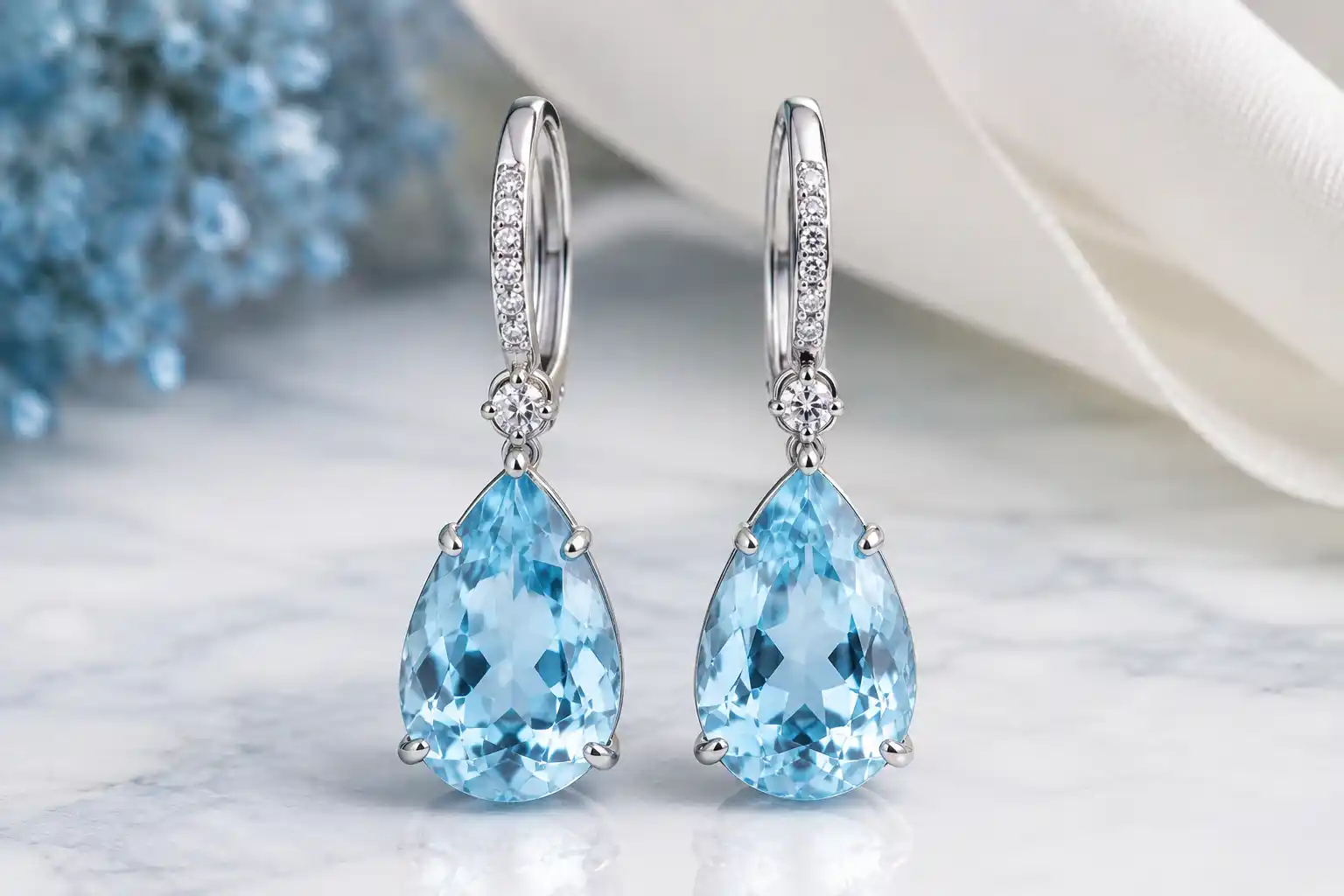
Aquamarine Earrings: Styles, Quality & Buying Guide
Aquamarine earrings place beryl’s clear blue to greenish-blue color close to the face, where the gemstones receive abundant light without facing the repeated knocks and surface contact that make rings and bracelets more demanding forms of jewelry. That lower-impact position makes aquamarine earrings well suited to frequent wear, but a successful pair still depends on much more than choosing two blue stones with the same advertised carat weight.
Pair matching, face-up dimensions, color, cut depth, setting height, complete earring weight, post alignment, back security, hinge construction, treatment disclosure, and lobe comfort all affect how aquamarine earrings look and perform once they are actually worn. A beautifully matched pair can still be frustrating if heavy settings tip forward, undersized backs fail to support the stones, or an articulated drop contains a weak connecting ring that places one irreplaceable matched earring at risk.
Aquamarine itself is the blue to greenish-blue variety of beryl, with Mohs hardness around 7.5–8 and generally good jewelry durability. The broader aquamarine meaning guide covers the gemstone’s mineral identity and symbolism, while this guide concentrates specifically on the decisions that matter when aquamarine is used as a matched pair of earrings.
Aquamarine Earrings at a Glance
| Feature | What Matters in Aquamarine Earrings |
|---|---|
| Gemstone | Blue to greenish-blue beryl |
| Mohs hardness | About 7.5–8 |
| Typical appearance | Pale blue, greenish blue, blue or stronger saturated blue |
| Common forms | Studs, bezels, halos, drops, dangles, huggies and briolettes |
| Main quality issue | Matching two gemstones visually |
| Pair weight | Confirm total pair weight versus weight per earring |
| Stud hardware | Post position, thickness and backing security |
| Drop hardware | Hooks, leverbacks, hinges, links and articulation |
| Main comfort concern | Complete earring weight and balance on the lobe |
| Common treatment | Heating to reduce green or yellow components |
| Main care concern | Cosmetics, residue, loose hardware and hard impacts |
| Safest cleaning | Lukewarm water, mild soap and a soft brush |
| Main buying risk | Focusing on gemstone size while ignoring pair construction |
Aquamarine earrings are therefore a form-specific purchase. The gemstone may be identical to one used in a pendant or ring, but matching two stones and keeping both secure introduces considerations that do not exist in a single-stone jewel.
Why Aquamarine Works Especially Well in Earrings
Aquamarine has enough scratch resistance for conventional fine jewelry, yet earrings provide an unusually forgiving environment because the stones rarely contact desks, tools, doorframes, countertops, or other hard surfaces.
This allows aquamarine earrings to use larger gems than many wearers would comfortably choose for a ring. Transparent aquamarine can also form in substantial crystals, so cutters have access to clean rough capable of producing matched ovals, rounds, cushions, pears, and emerald cuts without relying exclusively on tiny calibrated material.
The earring position also helps pale aquamarine.
Light can enter open-backed settings from several directions as the head moves, giving transparent stones opportunities to flash even when their body color is delicate. A pale aquamarine that might look subdued in a closed or heavily shadowed setting can appear much brighter beside the face.
However, this visual advantage does not eliminate the need for construction quality. Aquamarine earrings move with the wearer, and the security of posts, backs, hooks, hinges, solder joints, and jump rings matters every time the pair is put on.
Matching Aquamarine Earrings Properly
Matching is one of the most important differences between aquamarine earrings and other aquamarine jewelry.
Two stones do not need to be microscopically identical, but they should look intentionally paired when viewed from normal conversational distance. For traditional studs, matching is especially visible because each gemstone is isolated against opposite sides of the face.
Compare hue first. One aquamarine should not look noticeably greener while the other appears distinctly bluer unless the design intentionally uses contrast.
Tone and saturation come next. A darker stone beside a very pale partner can make the pair look assembled from leftovers even when both are genuine aquamarine.
Face-up dimensions matter just as much as carat weight. Two aquamarines can weigh the same while appearing different in diameter because one has a deeper pavilion or thicker girdle.
Cutting pattern should also coordinate. A lively oval with strong reflections rarely pairs convincingly with another oval showing a large transparent window through the center.
Clarity does not have to be identical, but obvious differences are distracting in formal solitaire aquamarine earrings. One eye-clean stone beside a visibly fractured or cloudy partner can make the mismatch apparent immediately.
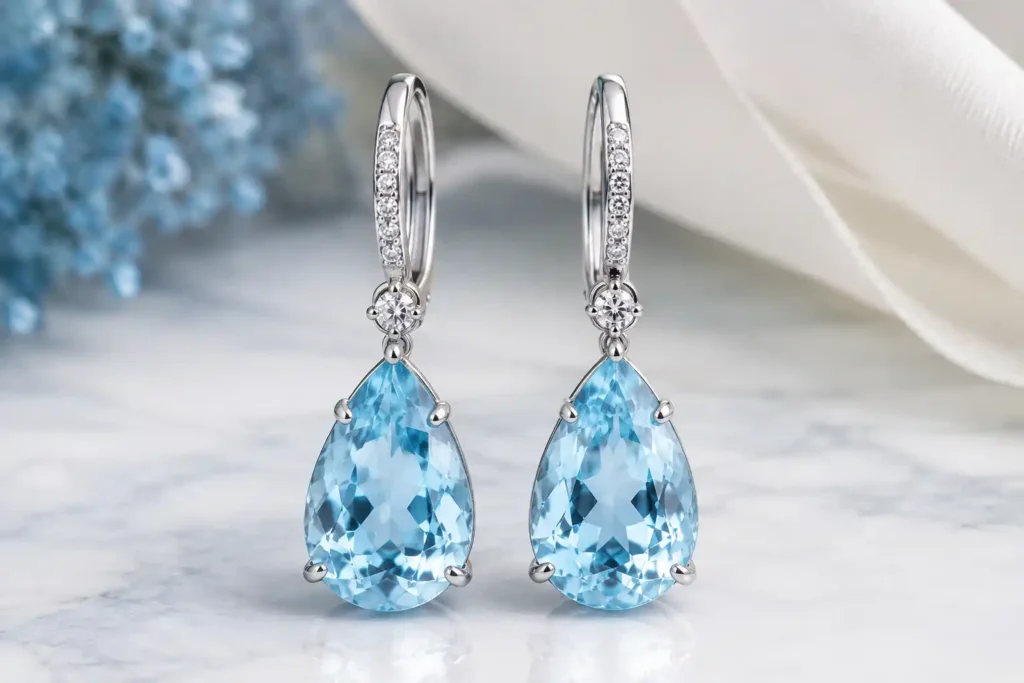
Total Carat Weight vs. Per-Earring Weight
Earring listings frequently describe gemstone weight as total carat weight for the pair.
This can create a major misunderstanding.
If aquamarine earrings are advertised at two carats total, the pair may contain approximately one carat in each earring rather than two carats on each side. Accent gemstones may also be included in the total depending on how a seller presents the specification.
Ask for the individual aquamarine weights when they materially affect the purchase, but also request millimeter dimensions because visible size is often more useful than weight alone.
Complete earring weight is a separate measurement.
Aquamarine carat weight tells you how much the gemstones weigh. It does not include gold, platinum, silver, halos, backs, hinges, decorative frames, or other components pressing on the ear.
For substantial aquamarine earrings, knowing the complete weight of each finished earring can be more useful for comfort than knowing the gemstone weight to two decimal places.
Aquamarine Stud Earrings
Studs are the most direct form of aquamarine earrings and place almost all visual attention on the matched gemstones.
Round studs give a balanced, compact appearance, while ovals can look larger vertically for their weight. Cushions provide softer corners, and emerald cuts emphasize transparency and broad flashes rather than intense scintillation.
The post should be positioned carefully behind the setting.
A centrally placed post generally helps the earring sit evenly. An off-center post can cause a large stud to rotate or tilt, particularly when the gemstone and setting extend beyond the central portion of the lobe.
Setting depth matters as well. A very tall basket places the stone farther from the ear and creates greater leverage on the post, which can make substantial aquamarine earrings droop even when the backing itself remains tight.
Lower profiles usually feel more stable.
Four-Prong, Six-Prong, and Bezel Studs
Four-prong aquamarine earrings expose more of the gemstone and create a relatively open appearance.
The trade-off is that fewer contact points secure the stone. The prongs need to remain correctly positioned and substantial enough to withstand ordinary handling.
Six-prong designs provide additional retention around round gemstones, although they add more visible metal.
Bezels surround much of the gemstone’s perimeter and can be especially practical for aquamarine earrings intended for frequent wear. The smooth edge reduces snagging on hair and clothing while providing protection around the girdle.
Because aquamarine is often light in tone, the bezel should remain proportionate. Excessive metal can visually shrink a small pale stone.
An open back can provide cleaning access and keep the overall design lighter, provided the construction still supports the gemstone securely.
Earring Posts
The post is easy to overlook because it is mostly hidden during wear, but it is one of the most important components of aquamarine earrings.
A post that is too thin can bend.
A post that is unnecessarily thick may be uncomfortable for the wearer’s piercing.
The post should also be smooth, properly finished, and free from burrs or sharp solder residues.
For valuable aquamarine earrings, inspect the connection between the post and the setting. A strong backing cannot prevent loss if the post itself separates from the earring.
If metal sensitivity is a concern, ask specifically what alloy passes through the piercing. The decorative face may be one metal while the post or backing uses another.
Friction Backs
Friction backs are common because they are simple, compact, and convenient.
For small to medium aquamarine earrings, a well-fitted friction back can provide excellent security when the post groove and clutch remain in good condition.
Large studs often benefit from wider stabilizing backs.
A tiny backing may grip the post securely yet allow the setting to lean forward because it does not distribute enough pressure across the back of the lobe.
Friction backs should resist removal without requiring excessive force. If a formerly secure back begins sliding unusually easily, replace it rather than waiting for an earring to disappear.
Matched aquamarine earrings can be difficult to recreate precisely after one is lost.
Screw Backs
Screw-back aquamarine earrings use threaded posts and backs that rotate into position.
They provide deliberate fastening and can be appealing when the gemstones are valuable or emotionally important.
The threads should turn smoothly. Rough or damaged threads can irritate a piercing, make the earring difficult to remove, or encourage the wearer to leave it on during activities when removal would be preferable.
Screw backs also require more time to put on and take off.
That inconvenience is not necessarily a problem, but the recipient should actually like the mechanism rather than receiving it solely because it sounds more secure.
Locking and Stabilizing Backs
Mechanical locking backs can provide strong security while avoiding the full threading of a screw system.
They are particularly useful for substantial aquamarine earrings when the wearer wants convenient removal but does not trust a basic friction clutch.
The mechanism needs to remain clean.
Cosmetics, skin oils, hairspray residue, and fine debris can accumulate around moving parts and interfere with the lock.
Wide stabilizing backs are valuable when the main issue is not accidental opening but forward tilt. By supporting a larger area of the lobe, they help a heavy stud sit more upright.
Comfort and security are related but not identical.
Aquamarine Bezel Earrings
Bezel-set aquamarine earrings create a smooth silhouette that works particularly well for people whose hair regularly catches on prongs.
The surrounding metal protects the gemstone edge while reducing sharp projections around the ear.
A bezel should follow the stone evenly.
Uneven metal pressure around a thin girdle, surface-reaching fracture, or vulnerable corner may create a localized stress point.
Very pale aquamarine also needs enough visible surface area to remain distinct from the metal. White settings can blend with an icy stone, while yellow or rose gold can provide stronger contrast.
Judge the finished aquamarine earrings rather than assuming one metal color will automatically make every stone look better.
Aquamarine Halo Earrings
Halo aquamarine earrings surround the blue center with smaller accent stones, frequently diamonds or another colorless gem.
The design can increase apparent scale and create strong contrast around a medium-blue center.
Matching extends beyond the aquamarines.
Both halos should have comparable diameter, spacing, setting height, and accent-stone appearance. A slightly crooked halo can make the center aquamarine appear misaligned even when the gemstone itself is positioned correctly.
Low integrated halos are generally easier to wear than excessively tall settings because they place less leverage on the post and catch less readily in hair.
A halo also creates more tiny settings to inspect and more spaces where cosmetics can accumulate.
Aquamarine Drop Earrings
Drop aquamarine earrings introduce movement, which can make the gemstone’s transparency especially attractive.
Pears, elongated ovals, emerald cuts, and briolettes respond well because their shapes naturally follow the vertical direction of the earring.
Movement also introduces hardware risk.
Every articulated connection should move freely without showing a gap. Hinges need to open and close smoothly, while jump rings should not spread under the weight of the lower section.
Long aquamarine earrings should hang at similar lengths on both sides.
Even minor differences in hook position, gemstone dimensions, hinge placement, or connector length can become obvious when the pair moves beside the jawline.
Leverback Aquamarine Earrings
Leverbacks are particularly suitable for aquamarine drops because the closure locks behind the ear and does not depend on a removable backing.
The hinge should move smoothly without side-to-side looseness.
When closed, the wire and latch should meet securely rather than requiring the wearer to force them into alignment.
Check the distance between the gemstone and the leverback.
A drop hanging too close to the mechanism can strike the metal repeatedly, while an excessively long connector may allow the stone to swing more aggressively than necessary.
For valuable aquamarine earrings, leverbacks provide a useful combination of movement and retention when they are well built.
French Hooks and Open Ear Wires
Open hooks produce a light, simple look and suit informal drop aquamarine earrings.
Their weakness is obvious: there is no mechanical closure behind the ear.
A small silicone or metal stopper can reduce the chance of the hook sliding out during clothing changes or abrupt movement.
Hook thickness and curve affect comfort.
A very short hook may feel insecure, while an excessively long wire can extend awkwardly behind the lobe.
The point where the decorative aquamarine section connects with the ear wire should also be inspected because one open connecting loop can release the entire drop.
Huggie Aquamarine Earrings
Huggies sit close to the earlobe and usually create less movement than traditional drops.
Small aquamarines may be set along the front of the hoop or suspended as short charms.
Because calibrated stones are small, their blue can appear quite pale. This is normal for many genuine aquamarines and should not automatically be interpreted as poor authenticity.
The hinge and closure deserve careful examination.
A huggie that no longer clicks or aligns precisely can open during wear even when every gemstone remains secure.
Check the interior for rough edges as well, since a small mechanical imperfection becomes irritating when the earring sits closely against the ear.
Briolette Aquamarine Earrings
Briolettes are faceted drops drilled close to their narrow ends rather than held in conventional baskets.
This construction displays aquamarine with very little surrounding metal and can produce graceful movement.
The drill hole is the critical weakness.
Inspect both aquamarines for cracks radiating from the hole, chips around the opening, and uneven drilling that leaves one side unusually thin.
Wire wrapping should support the stone without pinching it.
Once a fracture begins around a briolette hole, repeated movement can gradually make the damage worse.
Matched briolette aquamarine earrings should coordinate in length, width, drill placement, color, and hanging orientation rather than merely being approximately the same weight.
Choosing the Best Aquamarine Color for Earrings
Aquamarine ranges from pale greenish blue to clearer blue and stronger blue-green.
Commercial preference often favors a cleaner blue appearance, but greenish-blue aquamarine is genuine and can be visually beautiful.
Small aquamarine earrings frequently appear lighter than large pendants or rings because the color becomes easier to perceive through a greater volume of material.
Therefore, vivid saturated small studs sold at an unusually low price deserve careful scrutiny.
Photography complicates the problem. Cool lighting, darker backgrounds, white-balance changes, and saturation editing can make pale aquamarine look much stronger online.
Ask to see the actual pair together under neutral lighting.
The types of aquamarine guide explains the broader range of color and trade terminology without treating every shade as a separate gemstone species.
Cut Quality in Aquamarine Earrings
Aquamarine’s transparency makes poor cutting relatively easy to see.
A shallow stone may show a large window through the center, while excessive depth can concentrate weight underneath the setting and reduce face-up size.
In aquamarine earrings, both stones should behave similarly.
One lively gemstone beside another with obvious extinction or a transparent center will make the pair look uneven even when their color matches well.
Emerald cuts emphasize clarity and broad flashes, while rounds, cushions, and ovals can provide more scintillation.
Pear-shaped aquamarine earrings require particular attention to the tips. A protective V-prong or appropriate bezel treatment reduces exposure at the point.
Clarity and Inclusions
Transparent aquamarine is often available with high apparent clarity, so fine faceted aquamarine earrings commonly look eye-clean.
That does not mean every inclusion is unacceptable.
Small tubes, tiny crystals, veils, or other internal features may have little effect when they remain unobtrusive and do not weaken the gemstone.
Surface-reaching fractures deserve more concern, especially when they lie beneath a prong or close to a drilled area.
A matched pair should also have similar overall transparency.
One clean stone next to a visibly cloudy partner can look mismatched even if both are natural.
Heat Treatment
Heating is commonly used to reduce greenish or yellowish components in aquamarine and produce a purer-looking blue.
A heated gemstone remains genuine aquamarine.
The more useful question is whether known treatment has been disclosed accurately rather than whether every treated gemstone should automatically be rejected.
The general framework for understanding enhancement is covered in gemstone treatments.
Fracture filling is considerably less routine and has greater care implications because filling substances may react differently to heat, chemicals, ultrasonic vibration, or repair procedures.
For aquamarine earrings with significant value, ask specifically whether any clarity enhancement has been detected or disclosed.
Natural, Laboratory-Grown, and Imitation Aquamarine Earrings
Natural aquamarine formed through geological processes.
Laboratory-grown beryl can reproduce the relevant aquamarine material in a controlled environment and should be sold with its manufactured origin clearly stated.
Imitations are different materials.
Blue glass, synthetic spinel, topaz, apatite, and other blue stones can resemble aquamarine visually, particularly when they are small and already mounted.
The real vs fake aquamarine guide explains why appearance alone cannot prove identity and why destructive scratch, heat, and chemical tests should not be used on finished jewelry.
A low price does not prove an imitation, and a high price does not prove genuine natural aquamarine.
Documentation and seller disclosure matter more.
Metal Choice
White gold, platinum, and silver create a cool background that blends naturally with pale aquamarine.
Yellow gold gives the blue stronger warm contrast and may help lightly saturated stones stand out visually.
Rose gold creates a softer pink-blue combination.
For aquamarine earrings, however, appearance is only one part of metal selection.
Posts and backs contact the skin directly, so someone with known metal sensitivity should confirm the alloy of those components rather than checking only the visible setting.
A white-looking earring may use rhodium-plated white gold, platinum, silver, or another alloy, and the post is not automatically identical to every decorative component.
Earring Weight and Lobe Comfort
Complete weight can determine whether beautiful aquamarine earrings remain in regular use.
Aquamarine itself has moderate density, but substantial gold or platinum settings, halos, accent diamonds, articulated frames, and large backs can create unexpectedly heavy earrings.
A heavy stud may pull downward.
A long drop can swing and tug during movement.
An earring that feels comfortable for a few minutes may become irritating after extended wear.
For larger pieces, request complete weight per earring rather than relying on gemstone carat weight.
If substantial studs lean forward, a wider back may solve the problem more effectively than replacing the gemstone setting.
Cosmetics, Hairspray, and Aquamarine Earrings
Aquamarine earrings sit close to several products that can gradually make them look dull.
Hairspray, conditioner, styling products, foundation, sunscreen, perfume, and skin oils can accumulate on gemstone pavilions, metal galleries, posts, and backs.
The aquamarine itself is generally more resistant than many softer gems, but residue reduces transparency and brilliance.
Put earrings on after applying sprays and cosmetics whenever practical.
This also helps keep locking backs and hinges cleaner.
If aquamarine earrings begin looking gray or strangely muted without visible scratches, accumulated residue may be responsible rather than gemstone deterioration.
The Risk of Losing One Matched Earring
Loss is a uniquely important issue with earrings because losing one stone can destroy the usefulness and value of an otherwise excellent matched pair.
Replacing a common small aquamarine may be possible.
Replacing one side of a large, strongly colored, precisely matched pair can be much harder because color, cut, dimensions, depth, and setting must all coordinate closely enough with the surviving earring.
Check backs and hooks before wear.
Inspect solder joints and articulated connections periodically.
Do not continue using a loose friction back simply because it has not yet failed.
For an expensive or sentimental pair, keep clear photographs and purchase documentation so the surviving earring can be matched more accurately if replacement is ever necessary.
Coordinating Aquamarine Earrings With Other Jewelry
Aquamarine earrings do not need to match every aquamarine piece exactly.
A coordinated set often looks more natural when the pieces share metal tone and a similar general blue range rather than identical saturation.
An aquamarine necklace can repeat the cool color close to the neckline, while an aquamarine bracelet introduces smaller stones whose color may naturally appear lighter.
For bridal or commitment jewelry, an aquamarine engagement ring has very different impact and setting considerations from earrings, so the most durable design does not need to mimic the earring construction.
Avoid allowing hard diamond-heavy earrings or metal components to strike aquamarine repeatedly during storage simply because the pieces belong to one set.
Buying Aquamarine Earrings Online
Ask to see the actual pair together.
Separate glamour photographs can conceal color mismatch, different face-up size, uneven settings, or different stone depths.
Request millimeter dimensions for both gemstones, total and per-stone weight where available, complete earring weight, metal fineness, post type, backing mechanism, and known treatment.
For drops, ask about the leverback, hook, hinge, and connecting-ring construction.
For briolettes, request clear photographs around the drill holes.
For studs, examine post alignment from the side and back rather than looking only at the gemstone face.
Price should also reflect the complete object rather than the stone alone. The aquamarine price guide explains how color, size, treatment, cut, and market context influence gemstone value, while earring cost also includes matching, metal, labor, accent stones, hardware, and brand positioning.
Seller Claims to Treat Carefully
Terms such as “AAA aquamarine” may be useful within one seller’s inventory but do not represent a universal aquamarine grading system.
Likewise, prestigious color or locality terminology should not substitute for visible quality and supporting evidence.
A seller should be able to state whether the aquamarine earrings contain natural or laboratory-grown material, known treatments, gemstone dimensions, metal fineness, and whether advertised carat weight applies to each stone or the entire pair.
For pre-owned aquamarine earrings, ask about replacement stones, repaired posts, rebuilt prongs, altered backs, and solder work.
A mismatched replacement is easier to notice in earrings than in many other forms of jewelry.
How to Clean Aquamarine Earrings
Warm or lukewarm water, mild soap, and a soft brush are appropriate for routine cleaning of most stable aquamarine earrings.
Inspect the pair first.
A loose stone, bent post, weakened hinge, damaged backing, open connecting ring, or visibly fractured gem should be repaired before cleaning.
Brush gently around the pavilion and beneath the setting, where cosmetics and skin oils collect.
Clean posts and backs as well because residue can affect both comfort and mechanical function.
The complete procedure is covered in how to clean aquamarine jewelry.
Ultrasonic and steam methods should not be treated as automatic choices. Unknown fillings, liquid inclusions, damaged settings, adhesives, antique construction, or accompanying sensitive gems make conservative hand cleaning preferable.
Storing Aquamarine Earrings
Store aquamarine earrings as a pair but keep the gemstones from rubbing against one another.
Separate padded slots or a lined earring box work well.
Do not throw them loose into a jewelry pouch with diamonds, sapphires, or rough metal components that can scratch exposed aquamarine surfaces.
Long drop earrings should be laid or suspended so chains and articulated links do not tangle.
Close leverbacks and secure removable backs during storage so small components do not disappear.
For valuable matched aquamarine earrings, keeping the pair consistently stored together also reduces the surprisingly common problem of one earring becoming separated from the other.
Frequently Asked Questions
Are aquamarine earrings suitable for frequent wear?
Yes. Aquamarine has useful scratch resistance at about 7.5–8 on the Mohs scale, and earrings generally receive less impact than rings or bracelets. Secure settings, posts, backs, and moving hardware still need regular inspection.
What is the best style of aquamarine earrings for easy wear?
Low-profile studs and bezel earrings are among the easiest options because they limit movement and snagging. Well-built huggies can also work well when their hinges and closures remain secure.
How closely should aquamarine earrings match?
Traditional solitaire aquamarine earrings should coordinate closely in hue, tone, dimensions, cutting, transparency, and visible brightness. Drops and asymmetrical designs allow somewhat more variation when the difference looks intentional.
Why do small aquamarine earrings look pale?
Aquamarine frequently has light tone, and color becomes more visible through larger volumes of material. Small calibrated stones can therefore look delicate or icy blue while still being genuine aquamarine.
Is greenish-blue aquamarine lower quality?
Not automatically. A purer blue often receives stronger commercial preference, but natural greenish-blue aquamarine can be attractive. Personal color preference remains legitimate as long as the stone is represented accurately.
Is heated aquamarine still real?
Yes. Heating commonly modifies greenish or yellowish components while leaving the gemstone aquamarine. Known treatment should still be disclosed.
Which earring backs are best for aquamarine studs?
Small and medium studs can work well with secure friction backs, while larger settings often benefit from wide stabilizing backs, locking systems, or screw backs depending on wearer preference.
Are screw backs always safer?
They provide deliberate fastening, but they are not automatically the best choice for everyone. Thread condition, comfort, ease of use, and post construction still matter.
Are leverbacks good for aquamarine drop earrings?
Yes. A well-made leverback gives articulated aquamarine earrings a closed mechanical attachment behind the ear, reducing dependence on a removable stopper or open hook.
What should I check on briolette aquamarine earrings?
Inspect the drilled area for chips or radiating fractures, confirm that wrapping does not pinch the stone, and compare the two drops for matching length, width, color, and drill position.
Why do large aquamarine studs droop?
The complete earring may extend too far forward or use a small backing that does not distribute enough support across the lobe. A broader stabilizing back or lower-profile setting can improve balance.
Can aquamarine earrings be heavy?
Yes. The aquamarine may not be unusually dense, but metal, accent stones, halos, frames, and articulated components can produce substantial finished weight. Ask for complete weight per earring when comfort is important.
Can hairspray damage aquamarine earrings?
Routine exposure is more likely to leave residue than immediately damage stable aquamarine, but repeated buildup reduces brilliance and can interfere with backs and hinges. Apply sprays before putting the earrings on whenever practical.
How can I tell if aquamarine earrings are genuine?
Color alone is insufficient. Natural aquamarine, laboratory-grown beryl, blue topaz, apatite, synthetic spinel, and glass can overlap visually. Seller disclosure and appropriate gemological testing are more reliable than destructive home tests.
Do aquamarine earrings need laboratory reports?
Most ordinary pairs do not need individual reports. Independent documentation becomes more useful when unusually valuable stones, strong natural-origin claims, rare treatment claims, or significant premiums are involved.
Which metal looks best with aquamarine earrings?
White metals create a cool visual combination, while yellow and rose gold provide stronger warm contrast. The best option depends on the particular stones, skin tone, wearer preference, and any metal-sensitivity considerations.
What should I do if one aquamarine earring is lost?
Keep the surviving earring and any original specifications, photographs, grading documents, or invoices. A jeweler may be able to source and cut a replacement, but closely matching color, dimensions, depth, and setting becomes increasingly difficult with unusual stones.
How should aquamarine earrings be cleaned?
Use mild soap, lukewarm water, and a soft brush for most stable pieces, paying attention to the gemstone pavilion, posts, backs, and spaces beneath settings. Filled stones and delicate or damaged construction need more conservative care.
What matters most when buying aquamarine earrings?
Evaluate the pair as finished jewelry. Matching color and dimensions matter, but so do post alignment, backing security, total earring weight, lobe comfort, setting height, hinges, hooks, treatment disclosure, metal quality, and the risk of losing one matched side.
Aquamarine earrings take advantage of one of beryl’s strongest jewelry characteristics: transparent blue color in a position that allows generous light while avoiding much of the abrasion faced by hand jewelry. The best pair is not simply two aquamarines sold together, but two gemstones intentionally matched in color, dimensions, cut, and brightness, supported by posts, backs, hooks, hinges, settings, and metalwork that remain comfortable and secure. When those details are evaluated together, aquamarine earrings can provide substantial visual presence without turning a beautiful matched pair into a constant maintenance problem.