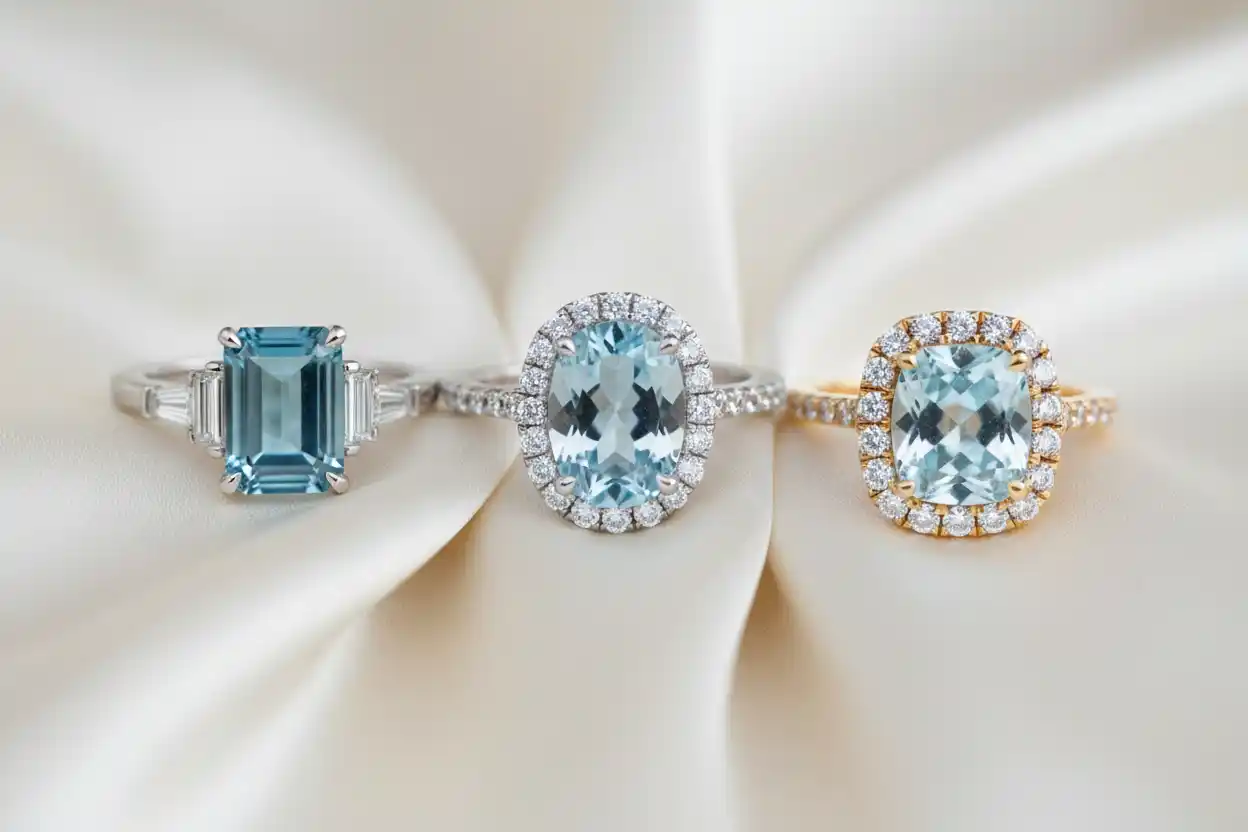
Aquamarine Engagement Ring: Styles, Quality & Buying Tips
An aquamarine engagement ring combines transparent blue-to-greenish-blue beryl with enough hardness and toughness for regular jewelry wear, making it a realistic colored-stone alternative to the traditional diamond or sapphire center. Aquamarine ranks about 7.5–8 on the Mohs scale and generally has good toughness, but an engagement ring receives thousands of small impacts, abrasions, pressure events, and encounters with harder materials over years of wear, so the setting and ring profile matter almost as much as the stone itself.
The best aquamarine engagement ring is therefore not simply the largest or bluest stone within a budget. Color should remain attractive in ordinary lighting, cutting should avoid obvious windowing or excessive hidden depth, fractures near the girdle or setting points deserve attention, and the mounting should protect vulnerable edges without making the ring impractical to clean, resize, repair, or wear beside a wedding band.
Aquamarine is also commonly heat treated to reduce greenish or yellowish components and create a cleaner blue appearance. That established treatment can produce attractive, stable jewelry material, but buyers should still expect accurate disclosure. Likewise, prestigious color names, origin claims, seller-created grades, and unusually low prices should never substitute for clear information about what the gemstone actually is.
Aquamarine Engagement Ring at a Glance
| Feature | What to Know |
|---|---|
| Gemstone | Aquamarine, blue to greenish-blue beryl |
| Composition | Be₃Al₂Si₆O₁₈ |
| Mohs hardness | About 7.5–8 |
| Toughness | Generally good |
| Cleavage | Poor to indistinct |
| Typical center colors | Pale blue, greenish blue, blue, stronger medium blue |
| Common center cuts | Oval, cushion, emerald, round, pear |
| Practical settings | Bezel, semi-bezel, six-prong, low halo, protected three-stone |
| Main daily-wear risks | Abrasion, edge chipping, hard knocks, worn prongs |
| Common treatment | Heat treatment |
| Typical clarity | Often eye-clean in fine faceted material |
| Main fit concern | Ring spinning, knuckle fit, band width and setting weight |
| Main maintenance need | Periodic setting inspection and gentle cleaning |
| Best buying focus | Color, cut, condition, setting engineering and disclosure |
The broader aquamarine meaning guide covers the gemstone’s mineral identity, history, symbolism, and geological background. Here, the focus stays specifically on how to choose and maintain an aquamarine engagement ring intended for long-term wear.
Is Aquamarine Good for an Engagement Ring?
Yes, aquamarine can be a good engagement-ring gemstone when the wearer understands the difference between “durable enough for jewelry” and “indestructible.”
Its hardness of about 7.5–8 gives an aquamarine engagement ring considerably better resistance to scratching than softer stones such as opal, turquoise, pearl, apatite, or fluorite. Aquamarine is also generally considered to have good toughness, and its cleavage is poor rather than perfect.
Those are genuine advantages.
However, sapphire and diamond still offer greater scratch resistance, and a ring is the jewelry form most exposed to repeated contact. A wearer who works with tools, lifts heavy equipment, handles abrasive materials, gardens regularly, or rarely removes jewelry for physical tasks should choose a particularly protective aquamarine engagement ring or consider a harder center gemstone.
The best gemstones for engagement rings comparison helps place aquamarine’s durability beside other practical center-stone options.
Aquamarine Engagement Ring vs. Diamond
Aquamarine and diamond create very different engagement-ring aesthetics.
Diamond emphasizes brilliance, scintillation, and spectral fire, while aquamarine emphasizes transparent blue color and broad flashes of reflected light. Because fine aquamarine crystals can occur in substantial sizes, a larger-looking colored center may be attainable without entering the same pricing structure as a comparable high-quality natural diamond.
Diamond still has a major durability advantage.
Its Mohs hardness of 10 gives it exceptional scratch resistance, while an aquamarine engagement ring will accumulate wear more readily if exposed to grit, harder gemstones, and repeated surface contact.
Aquamarine can nevertheless be an excellent choice for someone who specifically wants blue color rather than a colorless stone.
A diamond halo or diamond side stones can also combine the two appearances without requiring aquamarine to imitate diamond. The diamond engagement ring guide covers the different quality and setting considerations that apply when diamond is the primary center stone.
Aquamarine Engagement Ring vs. Sapphire
Sapphire is another important blue engagement-ring alternative and is harder than aquamarine at Mohs 9.
Sapphire commonly offers stronger saturation and greater resistance to long-term abrasion, while aquamarine tends to produce lighter, clearer, more open blue tones. A large aquamarine may also provide greater visual spread for a given budget than a fine intensely colored sapphire.
The choice is therefore not only about durability.
Someone who prefers pale ocean blue, transparency, and a lighter visual character may prefer an aquamarine engagement ring even while accepting that it requires somewhat more careful wear.
For a person who wants to leave the ring on during nearly every activity, sapphire generally provides a larger durability margin.
Choosing Aquamarine Color
Color is usually the first feature noticed in an aquamarine engagement ring.
Natural aquamarine ranges from pale greenish blue through blue-green to cleaner blue, with most commercial material remaining relatively light in tone compared with sapphire.
A highly desirable center should look recognizably blue in the lighting conditions where the ring will actually be worn. Studio photographs can exaggerate saturation through cool lighting, dark backgrounds, careful exposure, or editing.
Ask to see the aquamarine engagement ring or loose center stone under neutral indoor lighting as well as brighter illumination.
A stone that looks richly blue only against a black background but nearly colorless on the hand may disappoint after purchase.
Does Darker Aquamarine Mean Better Quality?
Not automatically.
Aquamarine often becomes more desirable as blue saturation strengthens, but darkness and saturation are not the same property.
A stone can be strongly colored yet remain bright, while another can become gray or excessively dark in portions of the face-up view.
For an aquamarine engagement ring, medium or moderately strong blue with good transparency often creates a more attractive long-term appearance than a stone chosen solely because it is described as “dark.”
Personal preference also matters.
Some buyers genuinely prefer the greenish component of less-altered material, while others want a cleaner blue. Neither choice is wrong when the gemstone and treatment are represented accurately.
The types of aquamarine guide explains the color range and common commercial terminology more fully.
Heat Treatment and Aquamarine Color
Heat treatment is common in aquamarine and is usually performed to reduce greenish or yellowish components, leaving a purer blue appearance.
A heated stone remains genuine aquamarine.
For an aquamarine engagement ring, routine heating is generally less important than whether the seller has disclosed known treatment honestly and priced the stone appropriately.
The treatment is normally stable during ordinary wear, although that does not make high-temperature jewelry repair around the stone automatically harmless. A jeweler should know what gemstone and treatments are present before using heat near the setting.
Rare fracture-filled aquamarine requires greater caution because filling materials can respond differently to heat and cleaning.
Choosing the Cut
Aquamarine’s frequently high clarity makes cutting quality especially visible.
A poorly proportioned stone can show a large transparent window through the center, while excessive depth can hide substantial carat weight below the girdle without adding useful face-up size.
An aquamarine engagement ring should therefore be judged from the top and side.
The center should return enough light to look lively while maintaining its blue color. Some extinction is normal in many faceted gemstones, but large dead dark zones or a broad transparent center weaken the visual performance.
Millimeter dimensions are extremely useful when comparing stones because carat weight alone does not tell you how much finger coverage the center provides.
Oval Aquamarine Engagement Ring
Oval aquamarine is popular because the elongated outline can provide substantial visual spread while maintaining a familiar brilliant-style appearance.
An oval aquamarine engagement ring can also lengthen the visual line of the finger and fit well into solitaire, halo, three-stone, and bezel designs.
Look for a balanced outline.
An oval that is excessively narrow can appear pinched, while one that is overly broad may lose the elegant elongated effect.
Bow-tie darkness through the center can occur in elongated cuts. Some bow-tie effect is acceptable when the stone remains lively as it moves, but a broad permanently dark band can dominate the face-up appearance.
Emerald-Cut Aquamarine Engagement Ring
Emerald cuts suit aquamarine particularly well because long step facets emphasize transparency, calm blue color, and broad flashes rather than intense scintillation.
The same openness makes poor cutting and inclusions easy to see.
An emerald-cut aquamarine engagement ring should have visually balanced steps and enough depth to return light without creating a large central window.
Corner protection deserves special attention.
The clipped corners reduce some vulnerability compared with a sharp rectangular point, but the gemstone still needs correctly positioned prongs or a bezel that protects the girdle without placing excessive pressure on it.
Cushion-Cut Aquamarine Engagement Ring
Cushions combine a roughly square or rectangular outline with rounded corners.
Those softer corners make a cushion aquamarine engagement ring mechanically attractive because there are fewer sharp points to protect than in a pear or marquise.
Cushion faceting varies considerably.
Some stones produce broad chunky flashes, while others use more fragmented brilliant-style patterns. Neither is automatically superior.
Look for even light return, attractive face-up dimensions, and a shape that looks intentional rather than uneven.
Pear-Shaped Aquamarine Engagement Ring
Pear-shaped aquamarine creates a strong directional design and can make the center look large for its weight.
The point is the main durability concern.
A pear aquamarine engagement ring should protect that end with a V-prong, bezel, or another purpose-designed setting feature.
Leaving the tip unsupported merely because an open setting looks delicate creates unnecessary risk.
Also check symmetry along the long axis. One shoulder should not appear noticeably fuller than the other unless the cut is intentionally asymmetrical.
Round Aquamarine Engagement Ring
Round aquamarine offers familiar proportions and works easily with six-prong solitaires, bezels, halos, and many wedding-band combinations.
The round outline has no vulnerable corner or point, which makes it mechanically convenient for daily wear.
Because round cutting can remove more rough than elongated shapes, it may provide less visual spread for the same starting crystal or price.
For an aquamarine engagement ring, a well-cut round stone can still be an excellent choice when durability, symmetry, and straightforward setting options matter more than maximizing apparent size.
Carat Weight vs. Visible Size
Carat measures weight, not visible dimensions.
Aquamarine’s density means a stone can present a substantial face-up size at a relatively moderate carat weight compared with some denser gems, but cut proportions strongly influence the result.
A deeply cut aquamarine engagement ring center can hide weight underneath the setting while appearing disappointingly small from above.
Always ask for length, width, and depth measurements.
Two aquamarines with the same carat weight can differ significantly in finger coverage.
A slightly lighter stone with better spread and stronger light return can be a much better purchase than a heavier stone selected for the carat number.
Aquamarine Clarity
Fine faceted aquamarine is commonly expected to be eye-clean because transparent crystals can form with relatively few visible inclusions.
That makes clarity easier to evaluate visually than it is in heavily included gemstones such as emerald.
A tiny internal feature does not automatically reduce the suitability of an aquamarine engagement ring.
Location is more important.
A surface-reaching fracture at a corner, directly under a prong, or close to the girdle deserves more attention than a small enclosed crystal deep inside the stone.
Inspect the aquamarine from multiple angles before mounting whenever possible.
Once the center is placed inside a basket or halo, metal may conceal fractures that later become relevant during repair or resetting.
Best Settings for an Aquamarine Engagement Ring
Setting design should reflect how frequently the ring will be worn and how physically active the wearer is.
| Setting | Protection | Best Use |
|---|---|---|
| Full bezel | High | Active wear, low-profile designs |
| Semi-bezel | High to moderate | Protection with more visible stone |
| Six-prong solitaire | Moderate to high | Round and oval centers |
| Four-prong solitaire | Moderate | More exposed visual style |
| Low halo | Moderate to high | Added visual size and edge protection |
| Three-stone | Moderate | Symbolic designs and side protection |
| Flush setting | High for smaller stones | Minimalist, low-profile rings |
| Tall cathedral | Variable | Traditional look with greater exposure |
| Tension style | Highly design-dependent | Requires specialist engineering |
There is no single universally best setting for an aquamarine engagement ring. The practical goal is to protect the gemstone’s vulnerable geometry while keeping the finished ring comfortable, serviceable, and proportionate.
Bezel Settings
A full bezel surrounds the center gemstone with metal.
For an aquamarine engagement ring intended for frequent wear, that perimeter protection can significantly reduce direct blows to the girdle and exposed corners.
Bezels also produce a smoother profile that catches less on clothing, hair, and gloves.
The trade-off is visual.
A thick bezel can make a pale aquamarine appear smaller, particularly when the metal covers too much of the face-up edge. Well-designed open-backed construction can preserve access for cleaning while allowing the stone to remain bright.
The bezel should follow the gemstone evenly rather than pressing heavily against one weak area.
Six-Prong Settings
Six prongs provide multiple contact points around a round or suitable oval center.
If one prong becomes slightly damaged, several others still contribute to retention.
A six-prong aquamarine engagement ring can therefore offer a useful balance between openness and security.
The individual prongs should not be excessively thin.
More prongs do not improve security when all of them are underbuilt, badly positioned, or already worn.
Inspect the ring periodically and have looseness corrected before the center begins moving visibly.
Four-Prong Settings
Four-prong settings expose more of the gemstone and can make an aquamarine engagement ring look visually lighter.
They also leave more girdle between the supports.
This style can work well for careful wear, especially when the center has a strong girdle and rounded outline, but it offers less redundancy than a six-prong arrangement.
For square or rectangular stones, prong placement should protect vulnerable corners rather than simply contact convenient flat surfaces.
Halo Settings
A halo surrounds the aquamarine with smaller stones, commonly diamonds.
This can make a modest center appear substantially larger and create bright white contrast against blue aquamarine.
A low integrated halo can also shield portions of the center’s perimeter from side impacts.
However, an aquamarine engagement ring with a halo contains many more tiny settings than a solitaire.
Each accent stone introduces another prong or bead that can wear, and residue can accumulate in the spaces between the halo and center.
The design should therefore add protection without becoming unnecessarily difficult to maintain.
Three-Stone Aquamarine Engagement Ring
A three-stone design can use diamond side stones, smaller aquamarines, or another complementary gemstone.
Diamond sides create greater brightness and hardness contrast, while aquamarine sides create a unified blue appearance.
Matching smaller aquamarines to a larger center can be difficult because color often looks paler in reduced sizes.
The side stones should also be positioned so the finished aquamarine engagement ring remains comfortable between neighboring fingers.
Very wide three-stone designs can press against adjacent fingers or interfere with a wedding band even when they look balanced from above.
Setting Height
Setting height has a major effect on how an aquamarine engagement ring behaves during ordinary wear.
A high center can look dramatic and may allow a wedding band to sit flush beneath the gallery, but the gemstone also becomes a lever that catches on pockets, sweaters, gloves, bags, and furniture.
A low setting reduces snagging and impact exposure.
This is particularly useful for aquamarine because the gemstone is durable but does not have sapphire or diamond’s level of scratch resistance.
Low does not mean cramped.
There should still be enough access beneath the center for cleaning and enough structure to support the gemstone correctly.
Cathedral Settings
A cathedral-style aquamarine engagement ring uses rising shoulders that frame or support the center setting.
These arches can create an elegant transition from the shank toward the gemstone and add useful structural support.
The term does not automatically indicate whether the center itself sits high or low.
Some cathedral rings elevate the gemstone substantially, while others use the shoulders around a relatively protected basket.
Judge the actual profile rather than the style name.
Ring Shank and Band Width
The shank must support the center stone without becoming unnecessarily bulky.
A very thin band beneath a large aquamarine engagement ring can twist, deform, or make the top feel disproportionately heavy.
This imbalance can also contribute to spinning.
A slightly wider shank often improves stability, particularly with a large center, halo, or three-stone arrangement.
Tapered designs can provide visual delicacy near the gemstone while retaining more metal around the lower portion of the finger where wear and future resizing occur.
Aquamarine Engagement Ring Spinning
Large colored-stone rings can rotate on the finger because the setting is heavier than the shank.
Spinning becomes more noticeable when the finger narrows significantly below the knuckle or when the ring is intentionally sized loosely to pass over a larger knuckle.
A very top-heavy aquamarine engagement ring may rotate until the center repeatedly strikes the palm side or neighboring fingers.
Possible solutions include adjusting size, increasing shank width, adding sizing beads, using an alternative shank profile, or redesigning an extremely high setting.
The correct solution depends on finger anatomy and ring construction.
Do not solve persistent spinning merely by making the ring painfully tight.
Ring Sizing
An aquamarine engagement ring should fit securely without restricting normal circulation or becoming difficult to remove.
Finger size changes with temperature and ordinary swelling, so one measurement taken when the hands are unusually cold can produce an inaccurate result.
Band width also matters.
Wide shanks can feel tighter than thin bands at the same nominal size.
When the wearer has a large knuckle and a narrower finger base, the jeweler may need to balance ease of passage over the knuckle against rotation after the ring is in position.
Proper fit becomes especially important with a large aquamarine center because extra weight magnifies instability.
Resizing an Aquamarine Engagement Ring
Not every aquamarine engagement ring resizes equally well.
Plain solitaire shanks often provide the greatest flexibility.
Pavé extending far around the band, full-eternity designs, intricate engraving, tension-style construction, unusual alloys, and complex multi-stone settings can make resizing more difficult.
Aquamarine itself should also be protected from unnecessary heat during jewelry work.
Before buying, ask how many sizes the design can reasonably be altered and whether the center must be removed for major repair or resizing.
A ring intended to last for decades should be serviceable rather than designed only for its initial presentation.
Wedding Band Compatibility
An engagement ring does not exist in isolation if it will eventually be worn beside a wedding band.
Check whether the basket, halo, prongs, or side stones extend into the space where another band would sit.
Some aquamarine engagement ring designs allow a straight wedding band to fit flush.
Others require a curved, contoured, or custom band.
Neither approach is inherently wrong, but the buyer should know before selecting the engagement ring.
Repeated rubbing between two poorly matched rings can also wear metal and settings over time.
Aquamarine Engagement Ring Metals
Platinum
Platinum is naturally white, dense, and suitable for substantial prongs and fine jewelry construction.
It can provide an excellent neutral background for blue aquamarine, although the complete ring feels heavier than a comparable gold design.
Platinum also develops a characteristic surface patina with wear.
White Gold
White gold creates a cool visual setting that works naturally with aquamarine.
Many white-gold pieces are rhodium plated, and the bright surface can require periodic replating depending on wear and preference.
Alloy composition matters for anyone with known metal sensitivity.
Yellow Gold
Yellow gold provides warm contrast against blue aquamarine.
That contrast can help a pale center remain visually distinct, although reflections from yellow metal can influence the perceived warmth of an extremely light stone.
Rose Gold
Rose gold creates a stronger pink-blue contrast.
The combination can look especially distinctive with pale or medium aquamarine, although copper-rich alloys should still be considered in relation to skin sensitivity and maintenance.
Metal choice should support the wearer’s existing jewelry and lifestyle rather than being selected from gemstone color alone.
Natural vs. Lab-Grown Aquamarine
Natural aquamarine formed through geological processes.
Laboratory-grown aquamarine is manufactured beryl with the relevant gemological identity but a different origin.
Both can produce attractive engagement-ring stones when accurately represented.
Origin affects rarity, market value, collectability, and the story attached to the gemstone, so natural and laboratory-grown material should never be presented interchangeably without disclosure.
Imitations are different again.
Blue topaz, synthetic spinel, glass, and other stones can resemble an aquamarine engagement ring without being aquamarine.
The real vs fake aquamarine guide covers nondestructive identification and the limitations of home testing.
Aquamarine vs. Blue Topaz for an Engagement Ring
Blue topaz can visually resemble aquamarine, especially in strongly colored commercial material.
Topaz has Mohs hardness 8, but it also has perfect cleavage, which creates its own impact vulnerability.
Commercial blue topaz is commonly produced through irradiation followed by heating, whereas aquamarine frequently receives heat treatment to reduce greenish color.
The two stones also differ in density, refractive properties, typical color ranges, market pricing, and mineral identity.
The direct aquamarine vs blue topaz comparison explains these measurable distinctions without relying on color alone.
For an engagement ring, either stone requires an appropriate setting, but they should not be sold as though they are interchangeable materials.
Seller-Created Aquamarine Grades
Descriptions such as “AAA,” “AAAA,” or “premium grade” are not universal aquamarine quality standards.
A seller may use these terms internally to separate merchandise, but another company can use the same letters for a completely different quality range.
For an aquamarine engagement ring, evaluate measurable and visible characteristics instead:
color, tone, saturation, dimensions, clarity, cutting, treatment, gemstone identity, condition, setting construction, and documentation.
A prestigious-sounding grade should never replace photographs, measurements, and clear disclosure.
Origin Claims and Trade Names
Some aquamarine trade names are associated with highly saturated color or famous sources.
These names can be useful historically or commercially, but they should not automatically be interpreted as laboratory grades or guaranteed geographic origins.
A finished aquamarine engagement ring cannot normally be assigned to a particular mine merely because the color resembles material from that location.
Meaningful provenance requires documentation.
Likewise, a famous locality does not make an unattractive or poorly cut gemstone fine quality simply because the name appears in the listing.
Aquamarine Engagement Ring Price and Value
Aquamarine value changes with color, size, clarity, cut, treatment, origin evidence where relevant, and overall desirability.
An aquamarine engagement ring adds additional costs for metal, design, accent stones, craftsmanship, setting labor, brand, and retail service.
This is why a finished ring should not be evaluated using one generalized per-carat number.
Larger aquamarine crystals occur more readily than fine large crystals of many other colored gems, so price does not necessarily rise in the same way as it does for extremely scarce stones.
Fine saturated color becomes increasingly important as size grows.
The separate aquamarine price guide focuses on gemstone-specific value factors, while engagement-ring pricing must also account for the quality and serviceability of the mounting.
How to Buy an Aquamarine Engagement Ring Online
Request enough information to judge both gemstone and ring.
Useful details include:
- center-stone dimensions
- center-stone weight
- color under neutral lighting
- treatment disclosure
- natural or laboratory-grown origin
- full side-profile photographs
- setting height
- metal fineness
- band width
- ring size
- resizing limitations
- accent-stone details
- return policy
Video is particularly useful because it shows whether the aquamarine remains blue as the ring moves and whether windowing or extinction dominates certain angles.
Avoid listings that provide only a highly saturated face-up photograph against a dramatic dark background.
Certification and Laboratory Reports
Most ordinary aquamarine engagement ring purchases do not require the same grading infrastructure used for diamonds.
However, independent gemstone identification can become useful when the center is unusually valuable, represented as natural untreated material at a substantial premium, claimed to have a rare origin, or difficult to distinguish from another gem.
A reputable laboratory can determine whether a stone is natural or laboratory-grown and report detectable treatments where its testing permits.
Aquamarine does not have one universally accepted consumer quality-grading system equivalent to the diamond Four Cs.
A seller-issued “certificate” therefore should not automatically be treated as independent gemological verification.
Daily Wear Habits
An aquamarine engagement ring can be worn regularly, but regular wear does not mean keeping it on during every activity.
Remove the ring before weight training, gardening, construction work, heavy cleaning, contact sports, and other tasks that expose the stone or setting to concentrated impact.
Take particular care around diamond and sapphire jewelry because those harder gemstones can scratch aquamarine if they rub together.
Desk work can also produce gradual wear when the ring repeatedly contacts a hard surface.
These precautions are not evidence that aquamarine is unsuitable for engagement jewelry. They are normal risk management for a colored gemstone expected to remain attractive for many years.
Cleaning an Aquamarine Engagement Ring
Warm water, mild soap, and a soft brush are appropriate for most stable aquamarine jewelry.
Inspect the ring before cleaning.
If the center moves, a prong is lifted, an accent stone is loose, or the shank is visibly damaged, repair should come first.
Brush gently beneath the center where lotion, soap, and skin oils collect. Transparent aquamarine can lose much of its apparent brightness when residue coats the pavilion.
Ultrasonic and steam cleaning may be suitable for some uncomplicated aquamarines, but fractures, liquid inclusions, rare fracture filling, damaged settings, or sensitive accompanying stones make hand cleaning the safer default.
The aquamarine jewelry cleaning guide covers the procedure and important exceptions in more detail.
Professional Maintenance
Have the setting inspected periodically, especially when an aquamarine engagement ring is worn most days.
Prongs can thin gradually without suddenly looking broken.
Pavé beads can wear.
A shank can become thin at the bottom.
A halo can shift after an impact.
A ring that begins catching clothing more frequently may have a lifted prong or distorted setting even if the center still feels secure.
Early repair is generally easier and less expensive than replacing a lost aquamarine that must match the original dimensions and color.
Aquamarine Engagement Ring Symbolism
Aquamarine has accumulated symbolic associations with calm communication, courage, loyalty, clarity, and safe passage, partly through its sea-colored appearance and historical connection with sailors.
Those themes can fit an engagement ring naturally because long-term relationships depend on communication, boundaries, trust, adaptation, and deliberate choices.
An aquamarine engagement ring can therefore represent the kind of partnership a couple intends to build.
It cannot guarantee that partnership.
The gemstone does not ensure fidelity, reconciliation, marriage success, emotional compatibility, or another person’s behavior.
At Gems Lore, the symbolism of an aquamarine engagement ring is most meaningful when the couple chooses what the blue stone represents for them while treating the gemstone itself according to its real physical properties.
Frequently Asked Questions
Is an aquamarine engagement ring durable enough for everyday wear?
Yes. Aquamarine ranks about 7.5–8 on the Mohs scale and generally has good toughness, making an aquamarine engagement ring practical for regular wear when the stone is protected from hard knocks and the setting is maintained.
Is aquamarine as durable as sapphire?
No. Sapphire is harder at Mohs 9 and offers greater resistance to surface abrasion. Aquamarine remains a practical engagement-ring stone but requires somewhat more deliberate care.
Is aquamarine harder than quartz?
Yes. Quartz ranks 7, while aquamarine is about 7.5–8. Harder gems such as sapphire and diamond can still scratch aquamarine.
What is the best setting for an aquamarine engagement ring?
A full or semi-bezel offers strong edge protection, while six-prong solitaires and low halos can also provide a good balance between security and visibility. The best setting depends on stone shape and wearer activity.
Is a four-prong aquamarine ring safe?
It can be when the stone, girdle, prongs, and wearer’s habits are suitable. Four prongs expose more of the center than six prongs, so maintenance and setting quality become especially important.
Which aquamarine cuts are best for engagement rings?
Oval, cushion, emerald, round, and pear cuts can all work well. Rounded shapes reduce exposed corners, while pear points and step-cut corners need deliberate setting protection.
Why does my aquamarine engagement ring look pale?
Aquamarine naturally tends toward lighter tones, and its appearance changes with lighting, stone size, background, metal, and cut. A genuine stone does not need intense blue saturation.
Is greenish aquamarine lower quality?
Not necessarily. Greenish blue occurs naturally in aquamarine, although the market often favors cleaner blue. Some buyers specifically prefer the greener appearance.
Is heat-treated aquamarine genuine?
Yes. Heating commonly reduces green or yellow components while leaving the material genuine aquamarine. Known treatment should still be disclosed.
Is a lab-grown aquamarine real aquamarine?
Laboratory-grown aquamarine is manufactured beryl with aquamarine material characteristics rather than a mined natural gemstone. It should be clearly disclosed as laboratory grown.
How can I tell aquamarine from blue topaz?
Color alone is unreliable. Aquamarine and topaz differ in density, refractive properties, cleavage, treatment patterns, and chemistry. Nondestructive gemological testing provides much better evidence than home scratch tests.
Does aquamarine scratch easily?
Aquamarine has useful scratch resistance, but it is not immune to abrasion. Diamond, sapphire, topaz, and some other harder materials can scratch it.
Can an aquamarine engagement ring chip?
Yes. A sufficiently hard impact can chip an exposed girdle, facet edge, or vulnerable point even though aquamarine generally has good toughness.
Should I choose a bezel for an active lifestyle?
A low bezel can be an excellent option because it protects the perimeter and reduces snagging. The entire ring should still be removed for activities involving heavy impacts or tools.
Why does an aquamarine engagement ring spin?
A large center, high setting, thin shank, loose fit, or pronounced difference between knuckle and finger-base size can make the ring top-heavy. Sizing adjustments, a wider shank, or sizing beads may help.
Can an aquamarine engagement ring be resized?
Many can, particularly straightforward solitaire designs, but pavé, eternity bands, tension settings, and complex multi-stone construction can limit resizing. Ask about future sizing before purchase.
Will a straight wedding band fit beside an aquamarine engagement ring?
It depends on the gallery and setting profile. Low baskets, halos, or side stones may prevent a straight band from sitting flush, in which case a contoured wedding band may be needed.
Does an aquamarine engagement ring need a laboratory report?
Not every ring needs one. Independent identification becomes more valuable when the center commands a high premium for claimed natural origin, lack of treatment, unusual provenance, or exceptional quality.
How should an aquamarine engagement ring be cleaned?
Use lukewarm water, mild soap, and a soft brush for routine cleaning of a stable piece. Avoid automatically using steam or ultrasonic cleaning when the stone has fractures, liquid inclusions, filling, or the setting is damaged.
What should I prioritize when buying an aquamarine engagement ring?
Prioritize attractive color in normal lighting, competent cutting, appropriate clarity and condition, a protective setting, comfortable fit, adequate shank strength, resizing practicality, treatment disclosure, and reliable seller information. Carat weight should come after those factors.
An aquamarine engagement ring can be a practical long-term alternative to conventional colorless bridal jewelry when the choice is made around the realities of daily wear. Aquamarine provides excellent transparency, distinctive sea-blue color, useful hardness, and enough toughness for regular ring use, while a well-engineered setting protects the girdle, corners, and center without creating excessive height or maintenance difficulty. When color, cut, setting, shank, sizing, treatment disclosure, wedding-band compatibility, and realistic care are evaluated together, the result can remain both personally meaningful and physically suited to the demands placed on an engagement ring.