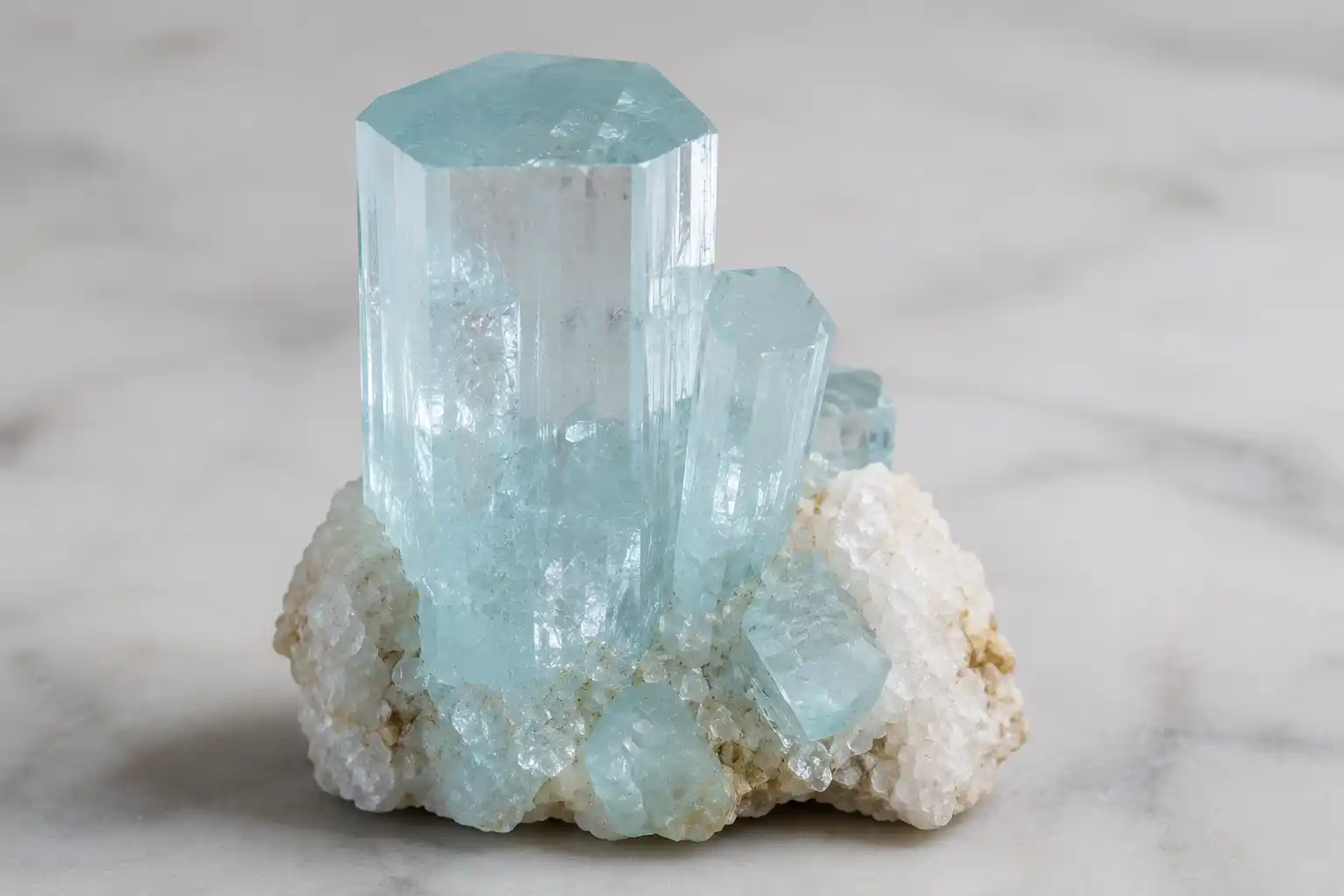
Aquamarine Meaning: Beryl Identity, History & Symbolism
Aquamarine meaning begins with beryl. Aquamarine is the blue to greenish-blue gem variety of the mineral beryl, whose ideal chemical composition is Be₃Al₂Si₆O₁₈. It shares its fundamental crystal structure with emerald, morganite, heliodor, goshenite, and other beryl varieties, but its blue appearance is associated primarily with iron-related absorption rather than the chromium- or vanadium-dominated coloration commonly associated with emerald. Gemological reference data place aquamarine around 7.5–8 on the Mohs hardness scale, with a specific gravity near 2.72 and typical refractive indices of approximately 1.577–1.583.
Those properties make aquamarine more than a poetic “water stone.” It is a relatively durable transparent beryl capable of forming large, well-developed hexagonal crystals, particularly in granitic pegmatites. Fine gem material can be remarkably clean, while natural crystals may contain growth tubes, fluid inclusions, mineral crystals, fractures, and other internal evidence of formation.
The human story surrounding aquamarine developed from its sea-like color. Its name derives from Latin-rooted language meaning “sea water,” an obvious reference to blue-green beryl rather than evidence that the stone possesses a physical connection with oceans. Modern symbolism commonly links aquamarine with calm, communication, courage, emotional clarity, travel, and protection. Those meanings can be culturally or personally significant, but they remain interpretations rather than measurable effects of beryl.
This page therefore treats aquamarine meaning in layers: first mineral identity, then geological formation and color, then diagnostic evidence and documented naming history, and finally responsible symbolism. Commercial price, treatment details, jewelry construction, cleaning, cutting, and other specialist decisions remain with their separate Aquamarine cluster pages.
Readers exploring other belief-oriented gemstone references can browse the Healing Crystal category.
Aquamarine Identity at a Glance
| Property | Aquamarine |
|---|---|
| Mineral species | Beryl |
| Gem variety | Blue to greenish-blue beryl |
| Ideal formula | Be₃Al₂Si₆O₁₈ |
| Mineral class | Cyclosilicate |
| Crystal system | Hexagonal |
| Common crystal habit | Six-sided prismatic crystals, often elongated |
| Typical color | Pale blue, greenish blue, blue-green, stronger blue in fine material |
| Principal color influence | Iron-related absorption |
| Transparency | Transparent to translucent |
| Luster | Vitreous |
| Mohs hardness | Approximately 7.5–8 |
| Typical specific gravity | About 2.72 |
| Typical refractive index | Approximately 1.577–1.583 |
| Birefringence | Approximately 0.005–0.009 |
| Optical character | Uniaxial negative |
| Pleochroism | Commonly near-colorless or weaker color in one direction and stronger blue in another |
| Cleavage | Indistinct to poor |
| Tenacity | Brittle, although generally durable enough for jewelry with sensible care |
| Important identification limit | Blue color alone cannot establish aquamarine, natural origin, treatment status, or geographic provenance |
Aquamarine is therefore not defined simply as “a light blue gemstone.” The name belongs to blue-to-greenish-blue beryl. A blue manufactured glass, blue topaz, blue apatite, synthetic beryl, or another transparent blue gem does not become aquamarine because its color resembles seawater.
That species-level definition is the foundation for every other interpretation on this page.
Aquamarine Is Beryl First
Beryl has a ring-silicate structure built from beryllium, aluminium, silicon, and oxygen. Different trace constituents and structural effects can produce different recognized gem varieties within the same mineral species.
Aquamarine occupies the blue-to-greenish-blue region of that family.
This relationship explains why aquamarine and emerald can share fundamental physical properties while looking dramatically different. Both are beryl, yet their color-producing chemistry differs. The distinction also shows why gemstone variety names should not be confused with mineral species names.
A laboratory can identify a transparent blue specimen as beryl using optical, spectroscopic, and physical properties. Calling that beryl aquamarine then depends on whether its color falls within the accepted blue to greenish-blue varietal range.
That is a more defensible process than beginning with a photograph and working backward from the word “blue.”
How Aquamarine Forms
Aquamarine is especially associated with granitic pegmatites. Pegmatites are very coarse-grained igneous bodies that develop from chemically evolved, volatile-rich melts and fluids capable of concentrating elements that occur only sparsely in more ordinary rocks.
Beryllium is one of those elements.
When sufficient beryllium, aluminium, silicon, oxygen, and appropriate trace constituents are available, beryl can crystallize. Open pockets within pegmatites can provide enough space for exceptional hexagonal crystals to grow with well-developed faces rather than being restricted to interlocking grains.
Quartz, feldspar, muscovite, tourmaline, and other pegmatitic minerals commonly occur in the same broader geological environments. Aquamarine may also occur in additional hydrothermal or metamorphic settings, so pegmatite should be understood as the characteristic gem-producing environment rather than an exclusive rule.
Detailed questions about crystallization sequence, pegmatite zoning, host rocks, alpine-type occurrences, secondary deposits, and locality interpretation belong in Aquamarine formation and deposit geology.
For aquamarine meaning, the useful geological conclusion is simpler: the stone’s clarity and watery color developed through specific beryl crystal chemistry inside real geological systems, not through an association with literal seawater.
Why Aquamarine Is Blue
Iron is central to aquamarine color. Different iron oxidation states and their positions or interactions within the beryl structure affect absorption of visible light, producing blue and greenish-blue appearances. Spectroscopic work on aquamarine has documented Fe²⁺-related absorption and Fe²⁺–Fe³⁺ interactions associated with blue coloration.
That statement does not mean every aquamarine has identical trace chemistry.
Some crystals are very pale. Others show more green. Some material is strongly blue. Differences can reflect iron concentration, oxidation state, structural position, optical orientation, and treatment history.
This is why statements such as “all aquamarine is colored only by Fe²⁺” are too simple. Aquamarine color is an iron-related optical system rather than one universal atom-to-color formula that can be inferred from a photograph.
The dedicated Aquamarine optical properties and color behavior guide owns the deeper discussion of absorption, pleochroism, refractive data, spectra, directional color, and unusual blue beryl.
Aquamarine Can Look Greener Before Treatment
Natural aquamarine frequently contains a noticeable green component. Controlled heating is commonly used to reduce that greenish contribution and leave a bluer appearance. GIA describes heating as a standard aquamarine color treatment and notes that much untreated material is naturally blue-green.
That does not mean every pure-blue aquamarine is heated.
It also does not mean heated aquamarine is synthetic.
The beryl itself remains naturally formed when natural material is subjected to heat. Treatment status is a separate disclosure question concerning what happened after mining.
Because treatment has its own evidence requirements and commercial implications, this page does not attempt to duplicate the detailed analysis maintained in treated aquamarine.
The useful meaning-page boundary is simply this: color can be natural or modified, and blue intensity alone cannot establish the history of a stone.
Aquamarine Is Dichroic
Aquamarine’s hexagonal structure makes it optically uniaxial, and its color can vary with viewing direction. Gemological references commonly describe aquamarine as showing a stronger blue direction and a weaker or nearly colorless direction.
This directional behavior is called dichroism.
A cutter can use it when deciding how to orient rough because the final face-up appearance depends partly on which crystallographic directions dominate through the finished facet arrangement. Orientation therefore affects more than weight retention.
That does not mean every aquamarine visibly flashes between two dramatic colors when moved.
In pale stones, dichroism may be subtle. In more strongly colored material, directional differences can become more obvious.
The phenomenon is a measurable optical property, not evidence that the gem changes emotional or spiritual “frequency” when turned.
Why Aquamarine Can Be So Clear
Fine aquamarine is often notable for excellent transparency. Large beryl crystals can contain unusually clean areas suitable for faceting, making eye-clean aquamarines available in dimensions that would be exceptional for many other colored gems.
Natural clarity does not mean internal features are absent.
Aquamarine can contain growth tubes, fluid inclusions, healed fractures, mineral crystals, thin films, and other microscopic structures. GIA microscopy studies document fluid-related tubes, multiphase inclusions, solid minerals, and stress-related internal features in aquamarine from several geological sources.
Those inclusions can be useful for understanding natural growth and, in appropriate cases, distinguishing natural from synthetic material.
They should not be generalized into a rule such as “all natural aquamarine must have tubes.” A clean stone is not automatically synthetic.
The detailed internal world belongs in the Aquamarine microscope inclusion notebook.
Diagnostic Traits of Aquamarine
Aquamarine identification becomes strong when several independent properties converge.
A transparent blue to greenish-blue gemstone with a hexagonal beryl crystal habit may be visually compatible with aquamarine. Refractive indices around 1.577–1.583, specific gravity near 2.72, uniaxial negative optical character, modest birefringence, hardness around 7.5–8, and appropriate dichroism make the identification much stronger.
These measurements separate aquamarine effectively from several common look-alikes.
Blue apatite, for example, has a substantially lower hardness but higher refractive index and density. Blue topaz has different optical data and cleavage. Glass lacks beryl’s crystalline optical behavior. Synthetic aquamarine can match many basic physical properties closely because it is laboratory-grown beryl, making growth features and more advanced analysis important when natural origin is the question.
This illustrates an important evidence principle: species identification and natural-origin determination are not always the same problem.
Aquamarine Versus Blue Apatite
Aquamarine and blue apatite can overlap visually, especially in online photographs. Their physical properties are much less similar.
Aquamarine is much harder, with Mohs hardness around 7.5–8 compared with about 5 for apatite. Aquamarine also has a lower refractive index and lower density than typical gem fluorapatite.
Those differences are large enough that normal gemological testing can separate the materials efficiently.
For readers making an actual side-by-side decision rather than researching aquamarine meaning, the complete comparison belongs in Apatite vs Aquamarine.
Original Aquamarine Specimen and Photo Evaluation Checklist
The following checklist separates what can legitimately be observed from a photograph or specimen from claims that require stronger evidence.
| Observation | What it can reasonably support | What it cannot prove alone |
|---|---|---|
| Transparent blue to greenish-blue color | Appearance compatible with aquamarine | Beryl identity |
| Six-sided elongated crystal | Habit compatible with beryl | Aquamarine variety identification |
| Flat or modified crystal termination | Plausible beryl morphology | Geographic origin |
| Vitreous luster | Consistent with aquamarine | Natural origin |
| Excellent transparency | Common in fine aquamarine | Absence of treatment |
| Long internal tubes | Known natural aquamarine feature | Natural origin by themselves |
| Fluid or mineral inclusions | Potential natural-growth evidence | Specific mine |
| Stronger blue in one viewing direction | Compatible with dichroic aquamarine | Treatment status |
| Greenish-blue body color | Common natural appearance | Unheated status |
| Pure blue appearance | Possible aquamarine appearance | Proof of heating |
| Seller says “natural” | Natural-origin claim | Untreated status |
| Seller says “unheated” | Treatment claim | Independent laboratory confirmation |
| Seller names a country or mine | Provenance statement | Geographic proof |
| RI around 1.577–1.583 | Strong beryl-compatible gemological evidence | Natural versus synthetic beryl |
| Spectroscopy consistent with iron-colored beryl | Strong aquamarine evidence | Geographic origin |
| Laboratory evidence of natural growth | Strong natural-origin evidence | Commercial value |
The checklist is intentionally designed to prevent several claims from being collapsed into one.
A gem can be natural aquamarine and heated.
A gem can be natural and untreated while having undocumented origin.
A gem can be aquamarine but laboratory-grown beryl.
A stone can be genuine natural aquamarine while a seller’s famous-mine claim remains unsupported.
Each conclusion requires its own evidence.
Aquamarine Claims That Need Reconciliation
| Claim | Evidence status | More accurate interpretation |
|---|---|---|
| “Aquamarine is blue beryl” | Supported | Aquamarine is the blue to greenish-blue variety of beryl |
| “Aquamarine is a separate mineral from beryl” | Incorrect | Beryl is the mineral species |
| “Every aquamarine is naturally pure blue” | Incorrect | Natural material commonly contains a green component |
| “Every pure-blue aquamarine is heated” | Unsupported | Color alone cannot prove treatment |
| “Heated aquamarine is fake” | Incorrect | Natural aquamarine can be heat treated and remain natural beryl |
| “Aquamarine is naturally flawless” | Too absolute | Fine material is often very clean but inclusions occur |
| “Dark blue automatically means highest quality” | Oversimplified | Tone, saturation, clarity, cutting, and overall appearance matter |
| “A famous mine automatically makes a stone valuable” | Incorrect | Individual gem quality still controls commercial desirability |
| “Aquamarine protects sailors scientifically” | Unsupported | Maritime protection is historical or symbolic belief |
| “Aquamarine treats throat disease because it is blue” | Unsupported | Color symbolism is not medical evidence |
| “Aquamarine water heals the body” | Unsupported | No established therapeutic mechanism |
| “Aquamarine guarantees calmness” | Unsupported | Calm symbolism is personal or cultural, not a predictable mineral effect |
This reconciliation table satisfies a more useful purpose than repeating a standard list of metaphysical meanings. It shows precisely where a true observation ends and an unsupported extension begins.
Where the Name Aquamarine Comes From
The name aquamarine derives from Latin-rooted terminology meaning “sea water.” Historical mineral references connect the name with blue-green beryl whose color resembled the sea.
That etymology is materially appropriate.
A pale greenish-blue crystal can resemble clear coastal water, while more saturated gems evoke deeper blue water. The association between color and sea is therefore straightforward without requiring a supernatural explanation.
The name does not indicate that aquamarine forms from seawater. Gem-quality aquamarine is strongly associated with pegmatitic and related geological environments rather than ocean precipitation.
Nor does the name prove that the stone physically controls water, weather, tides, or maritime safety.
Those later symbolic ideas belong to cultural interpretation.
Aquamarine and Historical Sea Symbolism
Aquamarine has long been surrounded by maritime imagery. Historical and later lapidary traditions associated sea-colored gems with sailors, voyages, protection, calm water, and safe passage.
The important evidence boundary is that documented belief proves people held an idea; it does not prove the gemstone caused the predicted outcome.
A sailor carrying aquamarine for protection is evidence of symbolism.
A controlled physical mechanism by which beryl prevents shipwrecks would be a scientific claim, and no such mechanism has been established.
This distinction allows historical traditions to be discussed respectfully without converting them into factual safety guarantees.
Aquamarine Meaning and Calm
Modern aquamarine symbolism often emphasizes calmness, composure, and emotional steadiness.
The association is understandable. Pale blue and blue-green colors are widely used in modern design and cultural symbolism to evoke water, open space, coolness, and quietness. Aquamarine’s high transparency can reinforce that visual impression.
A person may therefore use an aquamarine ring, pendant, loose stone, or crystal as a reminder to pause before responding, communicate gently, or approach a stressful situation deliberately.
That use involves human interpretation and behavior.
There is no established evidence that the crystal directly lowers stress hormones, treats anxiety disorders, changes nervous-system function, or guarantees emotional calm.
Aquamarine can symbolize calm without being a medical sedative.
Aquamarine Meaning and Communication
Aquamarine is also commonly associated with communication, truthful speech, confidence in conversation, and self-expression.
Much of this symbolism overlaps with modern blue-color and chakra traditions.
Someone may choose to wear aquamarine before a presentation or difficult conversation because the stone reminds them to speak clearly. That is a coherent symbolic practice.
The mineral does not physically improve vocabulary, alter vocal anatomy, compel honesty, or cause another person to interpret a message favorably.
Communication remains a human skill.
The gemstone can be an intentional cue, but not a substitute for preparation, listening, empathy, or clear language.
Aquamarine and “Throat Chakra” Claims
Contemporary metaphysical practices often associate aquamarine with the throat chakra because of its blue color.
This is a spiritual framework rather than a gemological finding.
Standard mineralogical and medical methods do not establish a measurable anatomical throat-chakra structure that can be activated by beryl. Placing aquamarine near the throat therefore should not be presented as treatment for thyroid disease, respiratory illness, vocal problems, swallowing difficulty, infection, or other medical conditions.
A person can still incorporate the gemstone into spiritual practice if that symbolism is meaningful.
The responsible distinction is between personal ritual and medical evidence.
Does Aquamarine Have Healing Properties?
There is no established scientific evidence that wearing, holding, meditating with, or sleeping near aquamarine treats disease.
Claims involving the throat, lungs, immune system, hormones, allergies, eyesight, dental health, anxiety, digestion, or other bodily systems require clinical evidence. The chemical presence of beryllium, aluminium, silicon, oxygen, iron, or other constituents in a crystal does not create a therapeutic delivery mechanism through skin.
Aquamarine should therefore not replace medical assessment or treatment.
This does not prohibit personal symbolic use.
A stone can be meaningful during recovery, meditation, grief, goal setting, or other life experiences without being represented as the cause of a medical outcome.
Aquamarine Should Not Be Ingested
Aquamarine is a beryllium-containing silicate mineral. The elements are bound within the beryl crystal structure, but that does not make powdered aquamarine a nutritional or medicinal ingredient.
Do not grind aquamarine for ingestion.
Do not place fragments into drinking water with the intention of creating a therapeutic mineral elixir.
Do not infer biological benefit simply because a naturally occurring crystal contains elements that also exist elsewhere in chemistry.
External ownership of a polished gem is a completely different exposure context from intentionally ingesting mineral powder.
There is no useful reason to create that unnecessary risk.
Aquamarine and Courage Symbolism
Aquamarine is sometimes described as a stone of courage.
That interpretation can be framed responsibly.
Someone might wear it while doing something personally difficult and use the stone as a reminder of a commitment they have already made. The object can become associated with the experience and later function as a memory cue.
What the stone cannot guarantee is bravery.
It cannot remove all fear, force someone to take a particular action, or prevent the consequences of risky behavior.
A symbolic courage stone should never replace practical preparation or risk assessment.
Aquamarine and Relationship Symbolism
Aquamarine is also connected in modern gemstone traditions with loyalty, honesty, partnership, harmony, and clear communication in relationships.
These ideas may make the stone attractive for meaningful jewelry.
A couple can choose aquamarine because its symbolism reflects the qualities they value. That intentional meaning is genuine at the human level.
The gemstone does not guarantee fidelity, repair damaged trust, make another person communicate, prevent conflict, or determine whether a relationship succeeds.
Jewelry can represent a commitment.
It cannot enforce one.
Aquamarine Is Durable but Not Indestructible
Aquamarine’s hardness of roughly 7.5–8 gives it good resistance to ordinary scratching and makes it much more practical for jewelry than softer stones such as apatite. GIA considers aquamarine durable and suitable for rings when worn with appropriate care.
Hardness is still only one part of durability.
Aquamarine is brittle. A sufficiently hard impact can chip a girdle, damage a corner, or extend an existing fracture. Large stones may also contain fluid inclusions or other internal features that affect how aggressively they should be cleaned.
This is why physical jewelry design deserves a separate discussion in Aquamarine setting and wear engineering.
The meaning page only needs to establish the correct ownership principle: aquamarine is suitable for jewelry, but “hard” does not mean damage-proof.
Aquamarine Jewelry Formats Serve Different Needs
Aquamarine is used in rings, earrings, necklaces, bracelets, and other jewelry because its clarity, hardness, attractive blue color, and availability in relatively large stones make it versatile.
Each format creates different mechanical demands.
An aquamarine ring receives more direct impacts and abrasion than many other jewelry formats.
An aquamarine necklace introduces pendant balance, chain strength, stone orientation, and neckline considerations.
Aquamarine earrings usually experience less impact but raise questions about pair matching, weight, post or hook construction, and security.
An aquamarine bracelet encounters repeated surface contact and, in bead designs, stress around drill holes and stringing components.
Those pages own the construction decisions. This one does not attempt to turn symbolic meaning into a jewelry buying guide.
Safe Cleaning Depends on Condition and Treatment
Warm soapy water is a conservative cleaning method for aquamarine. GIA notes that ultrasonic and steam cleaning can often be used on sound material but should be avoided or reconsidered when liquid inclusions, fractures, or filling are present; fracture-filled stones require particularly conservative cleaning.
The practical implication is that a generic instruction such as “all aquamarine is safe in an ultrasonic” is too broad.
Gem condition matters.
Treatment matters.
Jewelry construction matters.
For a complete care workflow rather than a brief ownership boundary, use how to clean aquamarine jewelry.
Faceting Aquamarine Is an Optical Decision
Aquamarine is commonly cut into emerald cuts, ovals, cushions, rounds, pears, and a wide range of designer forms.
The cutter is balancing weight retention, transparency, pleochroism, color concentration, inclusions, crystal orientation, and final dimensions.
Pale material can benefit from designs that increase optical path length and face-up color. Deeper rough may permit stronger-looking finished stones, while excessively deep cutting can hide weight without improving visible size.
Those choices affect gem appearance but belong to lapidary analysis rather than aquamarine meaning.
Readers interested in those technical tradeoffs should use Aquamarine cutting, orientation and polish.
Value Is Not Part of the Mineral Definition
Aquamarine can range from modest commercial material to exceptionally fine gems and collector crystals.
That price difference does not change the mineral’s identity.
Color, saturation, clarity, size, cut, treatment, provenance claims, retail context, and specimen quality can all affect commercial value. A famous locality name does not automatically make an ordinary stone valuable, and a visually exceptional gem does not become inferior because a buyer is unfamiliar with its source.
Those variables require a commercial methodology rather than a meaning article.
The dedicated aquamarine price page owns that analysis.
For purchase decisions involving seller disclosure, return policies, reports, and comparison methods, use buy aquamarine.
Original Evidence Ladder for Aquamarine Claims
A useful way to evaluate aquamarine information is to ask what level of evidence actually supports the statement.
Level 1 — Direct observation: blue or greenish-blue color, transparency, cut, crystal habit, visible inclusions, surface condition, matrix, and apparent zoning.
Level 2 — Routine gemological measurements: refractive index, birefringence, optic character, specific gravity, pleochroism, and fluorescence.
Level 3 — Microscopy: growth tubes, multiphase inclusions, mineral crystals, healed fractures, filling, synthetic-growth features, and other internal structures.
Level 4 — Species identification: spectroscopy or other appropriate testing confirming beryl and supporting aquamarine identification.
Level 5 — Natural versus synthetic origin: growth structures, inclusion evidence, spectroscopy, chemistry, and laboratory methods appropriate to beryl origin determination.
Level 6 — Treatment determination: evidence relevant to heat, filling, or other modifications rather than assumptions based on color alone.
Level 7 — Geographic provenance: traceable records, original labels, geological context, laboratory evidence where applicable, and chain-of-custody information.
Level 8 — Historical symbolism: documentary evidence showing that people actually associated aquamarine or sea-colored beryl with a particular belief.
Level 9 — Metaphysical effect: a historical record can demonstrate that a belief existed, but it cannot establish that the supernatural or healing claim is physically true.
This evidence ladder is the central analytical framework for this page.
A blue photograph is Level 1 evidence.
It should never be asked to prove species, treatment, natural origin, mine, historical use, and healing power simultaneously.
Natural, Untreated, and Provenance Are Three Different Claims
Aquamarine commerce frequently compresses several different ideas into one phrase.
“Natural aquamarine” addresses whether the beryl formed naturally rather than being laboratory grown.
“Untreated aquamarine” addresses whether its appearance has been intentionally altered after mining.
“Brazilian,” “Pakistani,” or another geographic description addresses provenance.
A stone can be natural but heated.
A stone can be natural and unheated but lack reliable mine documentation.
A stone can have documented geographic origin while containing a repair or filling.
The distinction matters because each claim changes the evidence required.
Do not let the word “natural” silently answer questions it was never designed to answer.
Provenance Matters for Collector Crystals
Aquamarine occurs in many important gem-producing regions, and individual localities can develop recognizable reputations for crystal size, habit, matrix associations, or color.
Appearance still cannot prove locality.
A large pale-blue crystal on muscovite might resemble famous material from a well-known pegmatite district, but mineral specimens from different regions can converge visually.
Original labels, collection history, mine records, invoices, geological associations, and credible source documentation therefore matter.
For a gem cut completely away from its matrix, origin can be even harder to establish from appearance.
Preserving documentation is consequently part of responsible ownership, especially for collector specimens.
Keep Important Aquamarine Specimens in Context
A well-formed aquamarine crystal may carry scientific or collecting value beyond its transparent interior.
Matrix can document how the crystal grew.
Associated quartz, feldspar, mica, tourmaline, or other minerals can help characterize its geological setting.
A weathered contact point can reveal how it was attached inside a pocket.
An old specimen label may preserve a collecting locality that cannot be reconstructed later.
Removing a crystal from matrix purely to make it look cleaner can therefore reduce information.
Likewise, repairing a broken crystal without recording the repair may compromise later interpretation.
Detailed specimen preservation belongs in the Aquamarine specimen conservation record.
What Aquamarine Meaning Can Responsibly Represent
Aquamarine offers several natural features that lend themselves to metaphor without requiring supernatural claims.
Its transparent blue color can symbolize clarity.
Its sea-derived name can symbolize calmness or movement.
Its large, well-formed crystals can represent structure and persistence.
Its dichroism can serve as a metaphor for perspective: the same material presents different color intensity from different directions.
Its geological formation can symbolize the idea that unusually clear structures can develop within chemically complex environments.
None of those metaphors is a physical power.
That distinction is what keeps symbolic interpretation useful.
Aquamarine Does Not Need Invented Powers to Be Meaningful
Aquamarine is already an unusually rich material.
It is a blue variety of one of gemology’s most important mineral species.
Its color records iron-related optical processes.
Its crystals can grow to impressive sizes in evolved geological environments.
Its internal features preserve fluids and minerals associated with crystal growth.
Its name connects its appearance with seawater.
Its durability allows it to become jewelry that can remain in families and collections for long periods when cared for properly.
Those facts offer more genuine information than vague claims that the crystal “raises vibrations” or automatically changes a person’s life.
Modern symbolism can remain as a separate layer without replacing this material history.
Frequently Asked Questions
What is aquamarine?
Aquamarine is the blue to greenish-blue gem variety of beryl, a beryllium aluminium silicate mineral with the ideal formula Be₃Al₂Si₆O₁₈.
Is aquamarine a mineral?
Aquamarine is a variety name. The underlying mineral species is beryl.
Is aquamarine the same mineral as emerald?
Yes at the species level: both are varieties of beryl. Their characteristic colors and trace-element chemistry differ.
What color is natural aquamarine?
Natural aquamarine ranges from greenish blue through blue-green to blue. Much material is relatively light in tone, although stronger colors occur.
What makes aquamarine blue?
Iron-related absorption within the beryl structure produces aquamarine’s blue and greenish-blue colors. Different iron states and structural interactions influence the final appearance.
Is greenish aquamarine natural?
Yes. A green component is common in natural aquamarine.
Is pure-blue aquamarine always heat treated?
No. Heating is commonly used to reduce greenish color, but appearance alone cannot prove whether an individual gem has been heated.
Does heating make aquamarine fake?
No. A naturally formed aquamarine remains natural beryl after heat treatment. Treatment and natural-versus-synthetic origin are separate classifications.
How hard is aquamarine?
Aquamarine has a Mohs hardness of approximately 7.5–8, giving it good resistance to scratching compared with many colored gemstones.
Is aquamarine suitable for jewelry?
Yes. It is generally durable enough for rings and other jewelry when protected from severe impacts and cared for appropriately.
Is aquamarine transparent?
Fine gem-quality aquamarine can be exceptionally transparent. Natural inclusions, tubes, fractures, and other internal features can still occur.
Is aquamarine pleochroic?
Yes. Aquamarine can show directional color, commonly with a stronger blue direction and a weaker or near-colorless direction.
Where does aquamarine form?
Gem aquamarine is especially associated with granitic pegmatites, although beryl can occur in additional geological environments.
Why is it called aquamarine?
The name derives from language meaning sea water, referring to the gem’s characteristic blue-green color.
Does aquamarine come from the sea?
No. The name refers to color. Aquamarine is a geological beryl mineral, commonly associated with pegmatites rather than ocean water.
Does aquamarine protect sailors?
Aquamarine has maritime protective symbolism in historical and later traditions, but there is no scientific evidence that carrying the gem prevents accidents at sea.
What does aquamarine symbolize?
Modern symbolism commonly associates aquamarine with calmness, clarity, courage, communication, honesty, travel, and emotional balance.
Does aquamarine have healing properties?
There is no established scientific evidence that aquamarine treats disease or produces medical healing.
Does aquamarine help with anxiety?
Someone may use aquamarine as a personal calming symbol, but the mineral has not been scientifically demonstrated to treat anxiety disorders or directly regulate the nervous system.
Does aquamarine improve communication?
It can serve as a personal reminder to communicate clearly, but there is no established evidence that beryl directly changes speech, communication ability, or another person’s response.
Is aquamarine associated with the throat chakra?
Aquamarine is commonly linked with the throat chakra in modern metaphysical practice because of its blue color. Chakra associations are spiritual interpretations rather than established anatomy or gemological properties.
Can aquamarine be put in drinking water for healing?
Aquamarine should not be used to prepare ingestible gemstone remedies. There is no established therapeutic benefit, and intentional ingestion of gemstone material is unnecessary.
Is aquamarine more durable than apatite?
Yes. Aquamarine is substantially harder than apatite and is generally more suitable for frequent jewelry wear.
Can aquamarine be synthetic?
Laboratory-grown beryl can be produced, including material resembling aquamarine. Basic species identification alone therefore does not always establish natural geological origin.
Can a photograph prove that aquamarine is natural?
No. A photograph can document appearance but cannot reliably establish natural versus synthetic origin, treatment status, or geographic provenance.
How can aquamarine be identified?
Gemologists use a combination of refractive index, specific gravity, optic character, pleochroism, microscopy, spectroscopy, and other tests rather than relying on blue color alone.
What should I check before buying aquamarine?
Identity, natural or laboratory-grown origin, treatment disclosure, dimensions, color, clarity, cut, condition, and seller documentation are all relevant. The transaction-specific process belongs in buy aquamarine.
How should aquamarine be cleaned?
Warm soapy water is a conservative option. More detailed methods and treatment-related restrictions are covered in how to clean aquamarine jewelry.
Is aquamarine valuable?
Value varies widely according to color, size, clarity, cut, treatment, provenance context, and retail market. Commercial valuation methodology belongs in the dedicated aquamarine price guide.
Aquamarine meaning is strongest when the sea-colored symbolism rests on an accurate material foundation. Aquamarine is beryl first: a hexagonal beryllium aluminium silicate whose iron-related absorption creates blue to greenish-blue color, whose crystals can grow exceptionally clear in pegmatitic environments, and whose optical and physical properties make it identifiable without relying on marketing descriptions.
Its name connects that color with seawater, and people have built additional meanings around calm, courage, communication, travel, loyalty, and emotional clarity. Those interpretations can remain personally significant without becoming medical or supernatural facts.
Keeping the categories separate produces a fuller picture of aquamarine: geological material, identifiable gem, historical name, wearable object, and human symbol—each understood according to the evidence appropriate to it.