Aquamarine Bracelet: Styles, Fit & Buying Guide
An aquamarine bracelet places a transparent blue-to-greenish-blue beryl gemstone in one of the most mechanically demanding jewelry positions, because the wrist repeatedly moves across desks, clothing, bags, doorways, watch cases, and other hard surfaces. Aquamarine is durable enough for regular jewelry use at about 7.5–8 on the Mohs scale and generally has good toughness, yet a successful bracelet still depends on stone depth, girdle protection, drill-hole condition, link articulation, clasp security, fit, and the quality of the metalwork rather than hardness alone.
That distinction is especially important with an aquamarine bracelet because bracelet construction varies enormously. A stretch strand of polished beads has completely different failure points from a prong-set tennis bracelet, while a station bracelet depends on individual links and connecting rings, and a rigid cuff must fit the wrist closely enough to avoid rotating its gemstones into repeated impacts.
Aquamarine itself also deserves careful selection. Fine material is generally transparent, pale to moderately saturated blue or greenish blue, and commonly heat treated to reduce greenish or yellowish components. Small bracelet stones often look paler than large aquamarines because the gemstone naturally tends toward lighter tone, so buyers should evaluate matching and brightness rather than expecting every genuine aquamarine bracelet to display an intense electric blue.
Aquamarine Bracelet at a Glance
| Feature | What to Check |
|---|---|
| Gemstone | Blue to greenish-blue beryl |
| Mohs hardness | About 7.5–8 |
| Toughness | Generally good |
| Cleavage | Poor to indistinct |
| Common bracelet forms | Beaded, knotted, station, tennis, bezel-set, chain and cuff |
| Main stone quality factors | Color, clarity, cut, matching and condition |
| Common treatment | Heat to reduce green or yellow components |
| Main mechanical risk | Repeated wrist-level impact |
| Critical hardware | Clasp, jump rings, hinges, links and settings |
| Bead-specific concern | Drill-hole wear and cord or elastic fatigue |
| Faceted-stone concern | Girdle chips, prongs and exposed corners |
| Safest routine cleaning | Lukewarm water, mild soap and a soft brush |
| Best fit | Secure without constriction or excessive rotation |
| Buying priority | Complete bracelet construction, not carat weight alone |
The broader aquamarine meaning guide covers the gemstone’s mineral identity, formation, history and symbolism. Here, the focus stays on how aquamarine behaves specifically when it is worn around a moving wrist.
Why Aquamarine Works in Bracelets
Aquamarine belongs to the beryl family and has the composition Be₃Al₂Si₆O₁₈. It shares its mineral species with emerald, morganite, heliodor and colorless goshenite, although iron gives aquamarine its characteristic greenish-blue to blue appearance.
Its Mohs hardness of about 7.5–8 gives an aquamarine bracelet useful resistance to routine scratching. Aquamarine is harder than quartz, feldspar, apatite and many ornamental stones, making it considerably more practical for bracelets than soft materials such as turquoise, opal, pearl or fluorite.
However, hardness does not describe every way jewelry can fail.
An aquamarine bracelet can still develop chipped facet junctions after repeated knocks, bent prongs can release a gemstone, bead holes can enlarge from friction, and bracelet links can wear until the entire piece becomes insecure. Aquamarine may also contain liquid inclusions, fractures or other internal features that make an individual stone less tolerant of impact or inappropriate cleaning.
The gemstone hardness chart provides useful scratch-resistance context, but bracelet design must account for the whole object rather than relying on the gemstone’s hardness number.
Aquamarine Bracelet Styles and Their Real Trade-Offs
The best aquamarine bracelet style depends less on fashion terminology than on how the gemstones are supported and how the construction behaves during wrist movement.
Beaded Aquamarine Bracelet
A beaded aquamarine bracelet uses drilled stones rather than individual metal settings.
This construction can show natural variations in blue, greenish blue, translucency, inclusions and internal texture that would be less desirable in fine faceted gems but attractive in a bead strand.
The primary weakness is the drill hole.
Inspect each hole for chips, crescent-shaped fractures and sharp edges that could cut elastic or cord. The area around a hole removes material from the bead and concentrates stress, so an otherwise durable aquamarine bead can break there after repeated movement.
A strand should also prevent adjacent beads from striking one another excessively. Small knots or spacer components can reduce direct contact, although any metal spacer touching aquamarine should have smooth edges.
Stretch Aquamarine Bracelet
Stretch bracelets are convenient because they require no clasp, but elastic is a consumable component rather than permanent hardware.
Repeated stretching, skin oils, cosmetics, heat and age eventually reduce elasticity. If an aquamarine bracelet begins to hang loosely, shows visible elastic fibers, or requires unusually far stretching over the hand, restringing is safer than continuing to wear it.
A stretch design should roll over the hand rather than being pulled aggressively from one section of cord.
Large heavy beads accelerate elastic fatigue because every movement adds more load.
Knotted Aquamarine Bracelet
A knotted aquamarine bracelet uses thread or cord with knots between individual beads or small groups.
The construction provides an important practical advantage: if the cord breaks, fewer stones are likely to scatter.
Knots also reduce bead-to-bead contact.
Inspect for fraying near drill holes, discoloration, stretched sections, or knots that have moved away from the beads. Cord should be replaced before visible damage becomes severe.
Knotted construction can be especially sensible for higher-quality aquamarine beads because restringing is inexpensive compared with losing several matched stones.
Aquamarine Tennis Bracelet
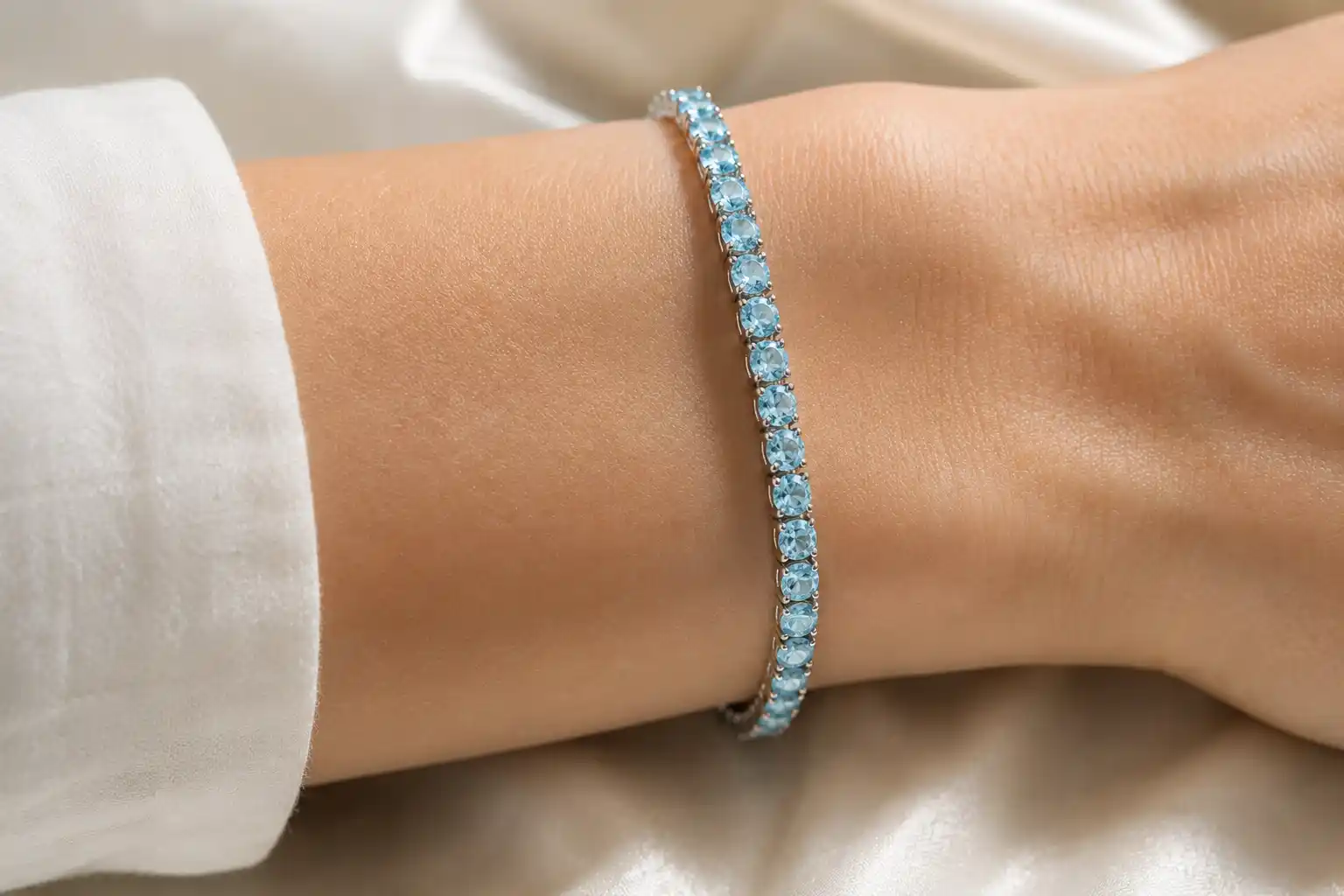
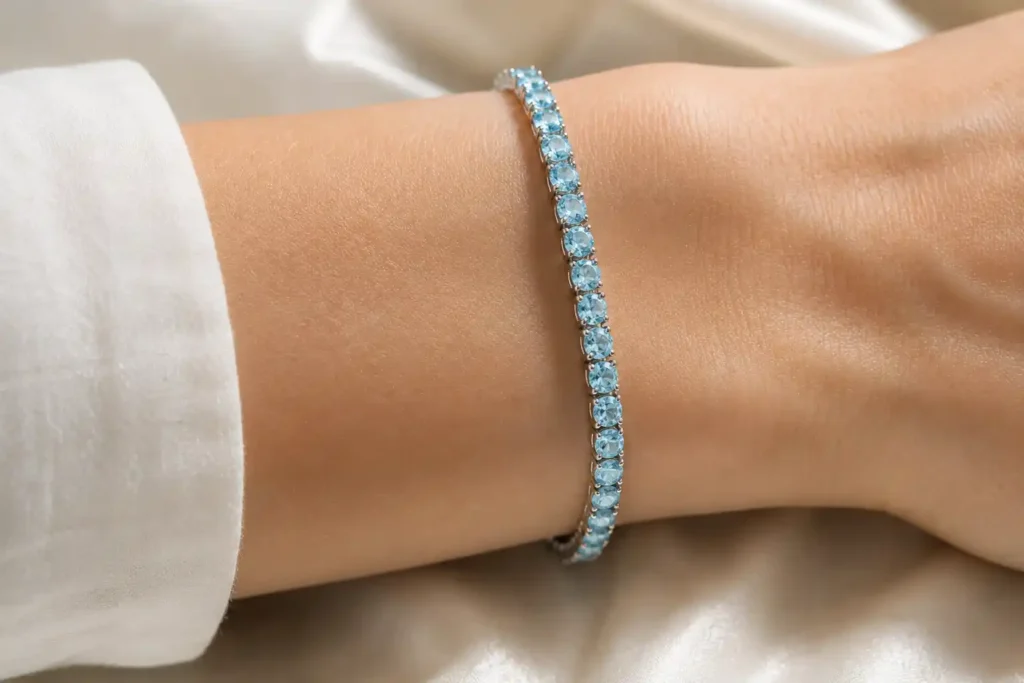
A tennis-style aquamarine bracelet presents one of the most demanding construction challenges because numerous faceted stones are set individually in a flexible line.
Every stone should remain aligned as the bracelet bends around the wrist.
A well-built piece articulates smoothly without producing sharp kinks, twisting settings face-down, or allowing adjacent gemstone girdles to strike each other repeatedly.
Matching is particularly visible in this format. Since many aquamarines appear side by side, differences in hue, tone, saturation, dimensions, cut depth and brightness become much more noticeable than they would in a mixed design.
Small aquamarine can naturally look pale, so a tennis bracelet made from modest calibrated stones may display a subtle icy or watery blue rather than the deeper appearance of a large center gem.
That is not evidence that the gemstones are fake.
Matching Stones in an Aquamarine Bracelet
Matching deserves more attention in an aquamarine bracelet than in a solitaire ring or pendant because several stones are viewed simultaneously.
Good matching involves more than identical carat weights.
Compare:
- face-up dimensions
- blue versus greenish-blue hue
- depth of tone
- saturation
- transparency
- cutting pattern
- brilliance
- visible inclusions
Two stones can weigh the same but look different in size if one is cut much deeper.
Likewise, two equally blue stones may look mismatched if one is heavily included or noticeably darker.
For an aquamarine bracelet containing many small gemstones, slight natural variation can look harmonious. The problem arises when one or two stones are conspicuously gray, green, dark, shallow or poorly cut relative to the rest.
Prong-Set Aquamarine Bracelet
Prongs minimize the amount of metal covering each gemstone and allow substantial light access, making them common in tennis and station designs.
The trade-off is exposure.
Prongs can catch on clothing or bend after impact, particularly on an aquamarine bracelet that regularly brushes against desks and bags.
Check every prong, not only those around the largest stone. A missing or lifted prong on a small aquamarine can still allow the gemstone to escape.
Each prong should contact the gemstone securely without appearing twisted, excessively thin or positioned far above the crown.
The girdle also deserves attention. Extremely thin girdles or sharp corners are more vulnerable than thicker rounded areas.
Bezel-Set Aquamarine Bracelet
A bezel surrounds most or all of the gemstone’s perimeter with metal, creating a smoother and more protected edge.
For an aquamarine bracelet, that protection can be valuable because the bezel reduces direct contact with the girdle and catches less easily than tall prongs.
However, aquamarine is often light in tone.
A very heavy bezel or completely closed construction can make a small pale gemstone appear visually smaller or less lively. Open-backed bezels can provide a useful compromise by protecting the edge while allowing access for light and cleaning.
Inspect the bezel rim for dents, gaps and uneven pressure. Metal should hold the stone securely rather than appearing to bite into one side of the girdle.
Station Aquamarine Bracelet
A station aquamarine bracelet spaces gemstones along a chain rather than placing them continuously around the wrist.
This reduces total gemstone weight and can create a lighter piece for regular wear.
The connecting hardware becomes especially important.
Each station may be joined through jump rings, soldered loops or short chain sections, which means numerous small components must carry repeated movement. Inspect connections for gaps, thinning and distortion.
Station bracelets also tend to rotate more than a continuous tennis design, so settings should look finished from multiple angles and should not have sharp galleries that rub the skin.
Rigid Aquamarine Cuffs and Bangles
A cuff or bangle changes the mechanical problem because the bracelet itself does not articulate through dozens of small links.
Instead, fit determines how much the piece rotates.
A loose aquamarine bangle can swing around the wrist and repeatedly strike the gemstones against hard objects. A fitted cuff reduces movement but should never pinch or require damaging bending every time it is worn.
Aquamarine set into a rigid piece should sit low enough that the setting does not become the first point of impact.
Before buying an open cuff, ask whether the design is intended to be adjusted repeatedly. Some metal constructions tolerate modest fitting, while repeated bending can weaken the structure or alter stone settings.
Aquamarine Bracelet Fit
Fit is not merely a comfort issue.
It directly affects durability.
An aquamarine bracelet that is excessively loose moves farther before every impact and can rotate until gemstone faces strike the underside of a desk or table. One that is too tight places constant tension on links, settings and the clasp while restricting comfortable wrist movement.
A practical fit allows some movement while keeping the bracelet under control.
Tennis and station bracelets should drape naturally without forming tight corners.
A beaded bracelet should not leave deep indentations in the skin or require extreme stretching to pass over the hand.
When buying online, measure an existing bracelet that already fits rather than relying only on wrist circumference.
Finished bracelet length, bead diameter, clasp dimensions and inner circumference can all affect actual fit.
Why Large Beads Need Extra Length
Bead diameter changes the usable interior size of an aquamarine bracelet.
Large round beads occupy more space toward the inside of the bracelet than a thin chain, so two bracelets with the same measured exterior length may fit differently.
This is particularly important with 8 mm, 10 mm or larger beads.
A heavier large-bead strand also needs stronger stringing material and creates more load around the wrist.
When comparing sizes, ask whether the seller provides finished inner circumference or only total strand length.
Aquamarine Bracelet Clasps
The clasp deserves the same level of scrutiny as the gemstones.
A secure aquamarine bracelet with excellent stones can still be lost if the closure fails.
Lobster Clasp
A lobster clasp is practical for lightweight and medium-weight chain or station bracelets.
The spring mechanism should close completely without leaving a gap.
Check the ring receiving the clasp as well. A strong clasp attached to an unsoldered or thin jump ring still creates a weak point.
Box Clasp
Box clasps are common on tennis bracelets.
The tongue should enter fully and lock firmly without excessive looseness. Higher-value designs may include one or two additional safety catches.
If the clasp opens when the bracelet twists slightly, it needs adjustment.
Toggle Clasp
Toggle clasps can be attractive and easy to operate, but security depends on proportion.
The bar must be long enough that ordinary wrist movement cannot pull it back through the receiving ring.
A loose bracelet combined with an undersized toggle increases the risk of accidental opening.
Magnetic Clasp
Magnetic closures are convenient for people who have difficulty operating small clasps, but they deserve caution on valuable aquamarine bracelets.
The magnet must be strong enough to resist accidental separation, and a secondary safety mechanism is preferable when the bracelet contains costly stones.
Convenience should not replace security.
Bracelet Articulation
Articulation describes how freely the individual sections of a bracelet move in relation to one another.
A well-articulated aquamarine bracelet follows the wrist smoothly.
Links should not bind, kink or turn gemstones sharply into adjacent settings.
Pick up the bracelet and allow it to drape naturally. A rigid section in an otherwise flexible chain may indicate a damaged hinge, bent link, debris accumulation or previous repair.
On a tennis bracelet, check whether the settings can flip completely upside down. Excessive flipping creates additional contact between gemstone crowns and hard surfaces.
Aquamarine Color in Bracelets
Aquamarine ranges naturally from pale greenish blue through blue-green to stronger blue.
The market often favors relatively pure blue with useful saturation, but personal preference still matters. Some buyers deliberately prefer the greener character of untreated-looking material.
Small gemstones create a special challenge.
Aquamarine commonly shows stronger visible color in larger sizes, so tiny calibrated bracelet stones can appear nearly colorless under weak lighting even when they are genuine.
A seller should not artificially increase photographic saturation to make a pale aquamarine bracelet look dramatically blue.
Ask for photographs in neutral lighting and, for an expensive piece, request video showing the bracelet moving.
The types of aquamarine guide explains color ranges and commercial terminology without treating every blue shade as a separate mineral variety.
Heat Treatment in Aquamarine Bracelets
Heating is common in aquamarine and is generally used to reduce greenish or yellowish components, leaving a purer blue appearance.
A heated aquamarine remains genuine aquamarine.
Treatment should nevertheless be disclosed when known because buyers may care about natural color history, value and documentation.
Heat-treated color is generally stable under ordinary wear, but that does not mean finished jewelry should be exposed casually to extreme temperatures.
Rare fracture-filled aquamarine requires more conservative cleaning because the filling material can react differently from the host gemstone.
The wider gemstone treatments guide explains the difference between heating, filling, coating, irradiation and other enhancement processes.
Natural, Lab-Grown and Imitation Aquamarine
An aquamarine bracelet can contain natural beryl, laboratory-grown beryl, another blue gemstone or manufactured imitation material.
Laboratory-grown aquamarine has the basic beryl material identity but was grown through a controlled process rather than natural geology.
Blue topaz is a different mineral.
Apatite is a different mineral.
Glass and synthetic spinel can imitate color without being aquamarine at all.
Visual appearance alone cannot always settle these distinctions, especially in small mounted stones.
The dedicated real vs fake aquamarine guide explains nondestructive identification and why scratch tests, heat tests and other damaging methods should be avoided.
For a costly aquamarine bracelet, clear seller disclosure may be more practical than trying to individually laboratory-test dozens of small stones.
Aquamarine vs. Blue Topaz in Bracelets
Blue topaz is one of the most common materials that can visually resemble aquamarine.
The difference matters because commercial blue topaz is widely available in strong saturated colors and is usually created through irradiation followed by heating, while aquamarine’s commercial appearance is typically lighter.
Topaz is harder at Mohs 8 but has perfect cleavage, whereas aquamarine has poorer cleavage and different density and refractive properties.
A vivid inexpensive blue bracelet should not automatically be called aquamarine merely because its color looks ocean-like.
For a direct gemological comparison, see aquamarine vs blue topaz.
Choosing Aquamarine Clarity
Fine faceted aquamarine is commonly expected to be relatively clean because the mineral can form large transparent crystals.
That does not mean every aquamarine bracelet needs flawless stones.
Very small inclusions may be invisible at normal wrist distance.
More important bracelet-specific concerns are inclusions or fractures that reach the surface, sit near exposed corners, pass through drill holes, or affect a stone’s structural stability.
For bead bracelets, translucent material can be attractive in its own right, and natural internal features may give the strand character.
Clarity should therefore be judged according to the type of aquamarine bracelet rather than one universal standard.
Cut Quality in Faceted Aquamarine Bracelets
Faceted stones should return light evenly enough to appear lively when the wrist moves.
A very shallow aquamarine may develop a large window through the center, making it look washed out.
A very deep stone can hide weight below the setting and appear darker or smaller from above.
In an aquamarine bracelet, consistency across multiple stones matters more than maximizing each individual carat weight.
Mixed depths can cause neighboring stones to sit at different heights, changing both appearance and snag risk.
A well-matched set of slightly smaller, evenly cut stones can produce a more refined bracelet than a heavier set selected only by weight.
Metal Choices
The metal in an aquamarine bracelet affects appearance, maintenance and mechanical strength.
White Gold
White gold creates a cool background that blends naturally with aquamarine’s blue.
Many white-gold pieces receive rhodium plating, which can gradually wear and reveal a slightly warmer underlying alloy.
Yellow Gold
Yellow gold creates stronger contrast.
Pale aquamarine can become more visible against warm metal, although yellow reflections may subtly influence the appearance of very light stones.
Rose Gold
Rose gold produces a warmer pink contrast and can make a delicate blue aquamarine bracelet look more distinctive.
Platinum
Platinum is dense, naturally white and useful in fine jewelry, although its additional weight is noticeable in substantial bracelet designs.
Sterling Silver
Sterling silver can provide a lower-cost setting for aquamarine.
Tarnish is normal and should be removed with methods compatible with both the metal and gemstone.
Whatever the metal, inspect construction rather than assuming a precious-metal stamp guarantees strong links or secure settings.
Aquamarine Bracelet and Watch Stacking
An aquamarine bracelet worn beside a watch deserves extra spacing.
A watch case, bracelet edge or metal clasp can strike the gemstones repeatedly as the wrist moves.
Even though aquamarine has good hardness, metal impacts can chip exposed edges or bend prongs.
If stacking, place enough separation between the pieces that the hardest parts do not constantly collide.
A rigid metal watch bracelet beside a delicate aquamarine tennis bracelet is a particularly poor combination for unrestricted movement.
Layering With Other Bracelets
Stacking an aquamarine bracelet beside other gemstone bracelets introduces another concern: relative hardness.
Diamond, sapphire and ruby can scratch aquamarine.
Aquamarine itself can scratch softer materials.
Large faceted stones can also hit neighboring beads even when both gemstones have similar hardness.
Use spacers or wear bracelets on different wrists when direct gemstone-to-gemstone contact is frequent.
A layered look is not worth slowly abrading polished surfaces.
Aquamarine Bracelet as March Birthstone Jewelry
Aquamarine is a principal modern March birthstone and is commonly selected for birthday jewelry because of its blue color and long association with the sea.
An aquamarine bracelet works particularly well as a birthstone gift when the recipient already wears wrist jewelry and the giver knows the approximate fit.
The broader March birthstone jewelry guide compares bracelets with earrings, rings and necklaces for recipients who may prefer another jewelry format.
Birthstone status does not determine gemstone quality.
Color, treatment, matching, construction, fit and seller disclosure still need normal scrutiny.
Buying an Aquamarine Bracelet Online
Online photographs should help you evaluate the complete bracelet, not only provide an attractive close-up of one gemstone.
Look for:
- full front and back views
- clasp photographs
- side views of settings
- video showing articulation
- close-ups of bead drill holes
- measurements
- finished bracelet length
- metal fineness
- total gemstone weight if provided
- natural or laboratory-grown disclosure
- known treatment disclosure
For a beaded aquamarine bracelet, ask whether the beads are natural aquamarine, dyed material, reconstructed material or another blue mineral.
For a faceted bracelet, ask whether total gemstone weight refers to all stones combined.
Commercial descriptions such as “AAA aquamarine” are seller-created quality language rather than a universal gemological grading system, so the physical characteristics matter more than the label.
Seller Disclosure That Actually Matters
A trustworthy listing should distinguish facts from sales language.
Useful disclosure includes whether the aquamarine is natural or laboratory-grown, whether heating or other treatment is known, metal fineness, stone dimensions, total weight, bracelet length, clasp type, and whether repairs or replacement stones are present in a pre-owned piece.
Geographic origin claims deserve evidence.
A bracelet should not receive a premium merely because a seller attaches a famous source name without documentation.
Likewise, “Santa Maria” and similar aquamarine trade descriptions should not automatically be interpreted as a laboratory grade or proof of geographic origin.
The aquamarine price guide explains why saturation, tone, cut, clarity and actual quality matter more than a prestigious trade label.
How Much Should Matching Affect Value?
Matching can materially influence the desirability of a multi-stone aquamarine bracelet because assembling many comparable gems requires additional sorting.
A bracelet containing evenly matched blue stones can therefore deserve a premium over a visually inconsistent piece even when total carat weight is similar.
That premium should come from the actual result.
If the aquamarines are merely pale and identical because they were cut from abundant commercial material, a seller should not treat matching alone as evidence of extraordinary rarity.
For beads, some buyers deliberately prefer natural variation.
The appropriate standard depends on the design.
New vs. Pre-Owned Aquamarine Bracelets
A pre-owned aquamarine bracelet can be an excellent purchase when condition and previous repairs are understood.
Inspect clasp wear, stretched links, missing safety catches, replacement gemstones, bent prongs, solder repairs, worn plating, enlarged drill holes and previous restringing.
Replacement aquamarines may differ subtly in hue or cutting from the original set.
That does not automatically make the bracelet undesirable, but it should be reflected in the description and price.
Antique pieces also require conservative cleaning because older solder, foiling, closed-back settings or accompanying gemstones may respond poorly to methods that are safe for modern uncomplicated aquamarine jewelry.
How to Clean an Aquamarine Bracelet
For most stable aquamarine bracelets, lukewarm water, mild soap and a soft brush provide the safest routine cleaning method.
Inspect the bracelet before it touches water.
Check every clasp, setting, link, hinge and stone for looseness. On bead strands, inspect cord or elastic and look for damaged drill holes.
Clean one section at a time rather than allowing a heavy bracelet to hang unsupported from one end.
Focus particularly beneath transparent stones, where skin oil, lotion and soap residue can reduce brightness.
The complete procedure appears in how to clean aquamarine jewelry.
Ultrasonic and Steam Cleaning
Ultrasonic and steam cleaning are not necessary for routine aquamarine bracelet care.
Professional guidance generally considers these methods acceptable only for suitable aquamarine without problematic fractures, liquid inclusions or filling, but an entire bracelet introduces additional components that may be less tolerant than the gemstone.
Vibration can expose loose settings.
Steam can affect repairs, fillers, adhesives, coatings or accompanying materials.
Warm soapy water is the lower-risk default when treatment and internal features are unknown.
Cosmetics, Lotion and Sunscreen
Bracelets receive substantial exposure to skincare products because they sit close to the hands and forearms.
Lotion and sunscreen can collect beneath gemstones and around links, making pale aquamarine look dull or gray.
Allow products to absorb or dry before putting on an aquamarine bracelet when practical.
Perfume should also be allowed to dry rather than sprayed directly onto jewelry.
Residue usually affects appearance before it damages the aquamarine itself, but repeated contamination also makes clasps and articulated links harder to inspect.
When to Remove an Aquamarine Bracelet
Remove an aquamarine bracelet before activities that create repeated impact, heavy abrasion or unnecessary chemical exposure.
That includes household cleaning, gardening, strength training, contact sports, swimming and manual work involving tools.
Desk work can also be surprisingly abrasive when a tennis bracelet sits exactly where the wrist rests on a hard surface.
A durable gemstone does not benefit from unnecessary impacts.
Removing a bracelet for high-risk tasks preserves settings and hardware as much as the aquamarine.
Storage
Store an aquamarine bracelet in its own soft compartment rather than loose with other jewelry.
A tennis bracelet should lie naturally rather than being folded sharply at one point.
Beaded strands should not be stretched around objects for storage.
Keep harder gemstones from rubbing against exposed aquamarine surfaces, and prevent chains or prongs from tangling through articulated links.
If the bracelet contains a safety chain, fasten it loosely so it does not knot around the settings.
Aquamarine Bracelet Symbolism
Aquamarine traditionally carries associations with calm communication, courage, clarity, fidelity and safe passage, largely influenced by its sea-blue color and historical connection with sailors.
An aquamarine bracelet can make those themes personally meaningful because the jewelry remains visible during ordinary movement.
Someone might treat it as a reminder to respond deliberately during a difficult conversation, to ask for clarification instead of assuming intent, or to maintain a chosen boundary.
These are symbolic uses.
Aquamarine does not scientifically calm the nervous system, guarantee fidelity, prevent accidents or control another person’s behavior.
The bracelet can represent an intention; actions determine whether that intention is practiced.
Frequently Asked Questions
Is an aquamarine bracelet suitable for everyday wear?
Yes, a well-built aquamarine bracelet can handle regular wear because aquamarine has Mohs hardness around 7.5–8 and generally good toughness. Bracelets still receive frequent impact, so settings, drill holes, links and clasps require sensible care.
What is the best aquamarine bracelet style for durability?
Low-profile bezel or well-constructed station designs can provide useful edge protection. Beaded bracelets can also be practical when drill holes are clean and stringing material is maintained. Construction quality matters more than the style name alone.
Is a tennis aquamarine bracelet durable?
It can be, provided the links articulate smoothly, gemstones are securely set, and the clasp is robust. The large number of individual settings means routine inspection is particularly important.
How should an aquamarine bracelet fit?
It should allow comfortable movement without sliding excessively over the hand or rotating constantly around the wrist. A very tight bracelet stresses links, while an excessively loose one receives more impact.
Why do small aquamarines look pale in bracelets?
Aquamarine commonly has light tone, and stronger visible saturation often becomes easier to appreciate in larger stones. Small calibrated bracelet gems can therefore appear delicate or icy blue while still being genuine.
Is greenish-blue aquamarine natural?
Yes. Natural aquamarine commonly ranges from greenish blue to blue. Heating is often used to reduce green or yellow components and create a purer blue appearance.
Is heated aquamarine still genuine?
Yes. Heating changes the color appearance but does not change aquamarine into another mineral. Known treatment should still be disclosed.
What should I inspect on an aquamarine bead bracelet?
Check drill holes, chips, fractures, stringing material, knots or elastic, bead-to-bead contact and the overall fit. Damage around drill holes is especially important because that area experiences concentrated stress.
What should I inspect on a faceted aquamarine bracelet?
Examine prongs or bezel rims, girdle condition, stone matching, link articulation, clasp security, safety catches and whether any setting sits unusually high or crooked.
Are magnetic clasps safe for an aquamarine bracelet?
They can be convenient, but a valuable bracelet benefits from a secondary safety feature because accidental separation is possible. Closure strength should match the bracelet’s weight.
Can I wear an aquamarine bracelet beside a watch?
Yes, but leave enough separation to prevent the watch case or metal bracelet from repeatedly striking the aquamarines. Constant contact can damage settings or chip exposed edges.
Can aquamarine be worn with harder gemstone bracelets?
It can, but direct rubbing against diamond, sapphire or ruby should be minimized because those harder gemstones can scratch aquamarine.
Is aquamarine or blue topaz better for a bracelet?
Both can work, but they are different minerals with different treatment histories and physical properties. Aquamarine has good jewelry durability, while topaz is slightly harder but has pronounced cleavage that requires its own care considerations.
Can I clean an aquamarine bracelet with soap and water?
Yes. Lukewarm water, mild soap and a soft brush are the safest routine method for most stable pieces. Inspect settings, links, cord and clasp first.
Can an aquamarine bracelet go in an ultrasonic cleaner?
Only suitable stones and sound settings should be exposed to ultrasonic cleaning. Fractures, liquid inclusions, filling, weakened links or unknown treatment make warm soapy water the safer choice.
How can I tell whether an aquamarine bracelet is real?
Color alone cannot establish identity. Natural aquamarine, laboratory-grown beryl, blue topaz, apatite, synthetic spinel and glass can overlap visually. Seller disclosure and professional gemological testing are more reliable than destructive home tests.
Does an aquamarine bracelet need a laboratory report?
Most inexpensive multi-stone bracelets do not require individual gemstone reports. Documentation becomes more useful when the bracelet contains unusually valuable stones, strong natural-origin claims, significant untreated-color premiums or other characteristics that materially affect price.
What makes an aquamarine bracelet valuable?
Color, transparency, cutting, matching, stone size, treatment, metal, construction, clasp quality, condition and craftsmanship all contribute. Total carat weight alone does not establish quality.
Is aquamarine a March birthstone?
Yes. Aquamarine is a principal modern March birthstone and is frequently chosen for birthday jewelry, although birthstone status does not prove natural origin or gemstone quality.
What is the main mistake to avoid when buying an aquamarine bracelet?
Do not evaluate only the gemstones. A beautiful aquamarine bracelet can still be a poor purchase if its clasp is weak, links bind, drill holes are damaged, fit is wrong, settings are insecure or treatment and material identity are unclear.
An aquamarine bracelet succeeds when gemstone quality and bracelet engineering support each other. Aquamarine’s 7.5–8 Mohs hardness and generally good toughness make it practical for wrist jewelry, but repeated movement places unusual demands on drill holes, prongs, bezels, hinges, links, articulation and clasps. Choosing balanced color, properly matched stones, an appropriate fit, secure hardware and clearly disclosed material creates a bracelet that can display aquamarine’s clean sea-blue appearance without relying on hardness alone to compensate for weak construction.