Andalusite Price: Quality & Value, What Raises or Lowers Cost
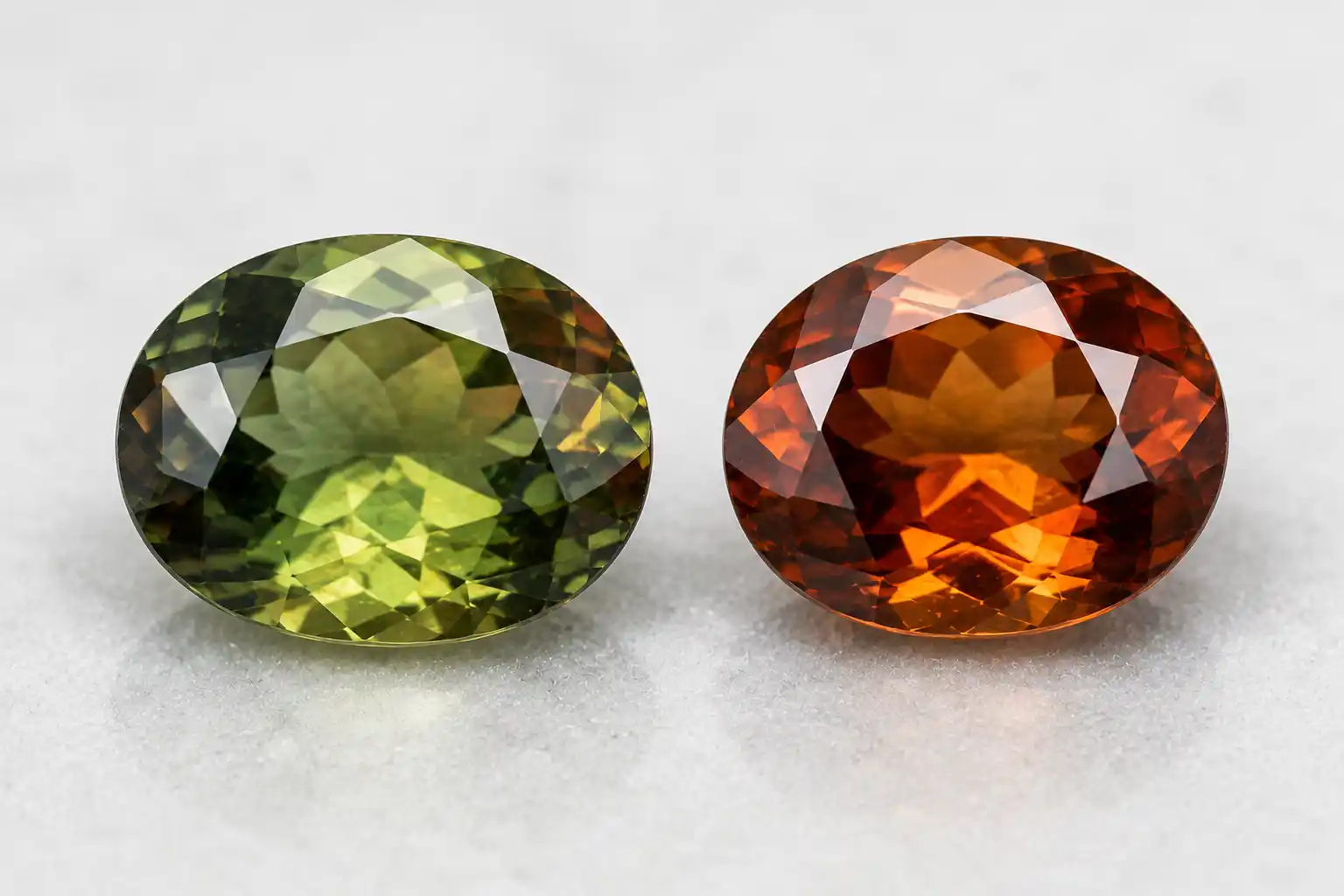
Andalusite price is determined less by one standardized grade and more by the way color, pleochroism, clarity, cutting orientation, size, treatment, provenance, and overall face-up beauty interact in an individual stone. Andalusite is an aluminum silicate mineral with the formula Al₂SiO₅, and transparent gem-quality material can display yellowish green, olive green, orange, reddish brown, pinkish brown, and related hues. Its strongest visual distinction is pleochroism: because andalusite is an optically biaxial gemstone, different crystallographic directions can display different colors, and several of those colors may appear through the crown of one faceted stone.
That optical complexity makes simplistic andalusite price charts unreliable. Two stones with the same carat weight can look dramatically different if one displays lively green, gold, and reddish flashes while the other faces up predominantly dark brown. GIA specifically notes that strong pleochroism can affect colored-stone value positively or negatively depending on cutting orientation, because poor orientation can introduce weak or unattractive colors into the face-up appearance. Carat weight therefore becomes meaningful only after the visible quality of the stone has been established.
Andalusite Price at a Glance
| Value Factor | Typical Effect on Andalusite Price |
|---|---|
| Face-up color | Attractive green, yellow-green, orange, reddish, and mixed pleochroic combinations generally increase desirability |
| Pleochroism | Strong, visually pleasing directional colors can add value |
| Cut orientation | A cut that presents the best colors through the crown can command more than poorly oriented material |
| Tone | Medium to moderately dark stones that retain brightness generally outperform stones that become nearly black |
| Saturation | Distinct, lively colors are generally more appealing than grayish or muddy appearances |
| Clarity | Transparent material with limited distracting inclusions usually commands stronger interest |
| Cut quality | Good brilliance, symmetry, polish, and minimal windowing or extinction improve value |
| Carat weight | Larger clean gems can command premiums, but size cannot compensate for weak color or poor cut |
| Treatment | Fracture filling or other enhancement can influence value and buyer preference |
| Origin | Provenance may interest collectors, but visible quality usually matters more than country name alone |
| Chiastolite | Valued by cross pattern and specimen quality rather than transparent-faceted standards |
| Jewelry setting | Gold, platinum, side stones, workmanship, and brand can exceed the value of the loose andalusite |
| Documentation | Independent identification can reduce uncertainty for significant purchases |
| Market liquidity | Andalusite has a smaller specialist market than mainstream colored gems, affecting resale and price comparisons |
There is no universal andalusite price per carat that can be applied responsibly across every quality level. A useful valuation compares stones with genuinely similar color, pleochroism, clarity, cutting, dimensions, treatment status, and market context rather than multiplying weight by one generic online number.
Why Andalusite Price Varies So Much
Andalusite is common enough as a mineral that geologists encounter it regularly in metamorphic rocks, yet transparent material suitable for attractive faceted gemstones is much less commonly encountered. GIA’s gemological research describes gem-quality andalusite as relatively uncommon in the jewelry trade and documents colors ranging from yellowish green and green to brownish pink, including bicolored material with strong pleochroism. GIA’s collection also contains faceted andalusites well above ten carats, confirming that substantial stones exist even though attractive transparent material remains a specialist gem category.
The market is therefore not governed by simple scarcity alone. An ordinary transparent stone with dark brown color may remain affordable, while a large, clean, beautifully oriented gem showing vivid green and warm reddish or golden flashes can attract a much stronger premium. Precision cutting, unusual provenance, matched pairs, designer jewelry, or collector interest can push prices higher still.
Color Is One of the Strongest Value Drivers
Andalusite does not have one universally preferred bodycolor in the way fine ruby is associated with red or fine emerald with green. CIBJO describes transparent andalusite as ranging from brownish or yellowish green to orangy brown and notes that green and orange can often be visible together because of strong pleochroism. Mindat records additional natural colors including pink to reddish brown, yellow, green, gray, and more unusual hues.
Value therefore depends on the attractiveness of the complete face-up combination rather than whether one particular color is present. A lively olive-green stone with warm red-brown flashes may be more desirable than a nominally greener stone that looks gray or excessively dark. Similarly, a bright reddish-orange andalusite can be highly attractive even if green plays a smaller role in its appearance.
Pleochroism Can Raise Andalusite Value
Pleochroism means a gemstone displays different apparent colors in different crystal directions. GIA explains that biaxial gemstones such as andalusite can potentially display three directional color components, and those colors can influence the overall appearance of a faceted gem even when viewed face-up.
Strong pleochroism is one of andalusite’s defining attractions because different crown and pavilion facets can return green, yellow, orange, red, or brownish colors simultaneously. A well-cut gem may therefore appear almost mosaic-like without being color-zoned in the ordinary sense.
Market value increases when that effect looks intentional and beautiful. Strong pleochroism does not automatically mean high quality, however, because unattractive directional colors can reduce value just as effectively as attractive ones can raise it.
Pleochroism Can Also Lower Value
The same optical property that makes andalusite distinctive can create problems when the rough is poorly oriented. GIA’s colored-stone value guidance specifically identifies andalusite as a strongly pleochroic gem and warns that a cutter can lower potential value by introducing weak or undesirable colors into the face-up appearance.
This means the buyer should not ask only whether a stone is strongly pleochroic. The more useful question is whether its pleochroic colors work together attractively.
A gemstone that flashes rich green, amber, and reddish brown while remaining bright can be visually compelling. Another gem may technically show several colors yet face up mostly muddy brown or nearly black. Both may have strong pleochroism, but their market desirability will differ substantially.
Cutting Orientation Has an Unusually Strong Effect on Price
Cutting orientation matters in every colored stone, but it is especially important in andalusite. GIA’s research on Brazilian material found that cutters deliberately oriented green rough so that green appeared through the table, while other pleochroic colors could remain visible around the corners. Bicolored rough was oriented specifically to preserve color zoning in the face-up stone.
That work illustrates why two pieces of rough with similar size and chemistry can produce finished gemstones of very different value. The cutter must choose between weight retention, inclusion placement, brilliance, and the most attractive directional color.
A stone that sacrifices some carat weight to present better green-orange or green-red interplay may ultimately be more valuable than a heavier gem cut mainly to maximize yield.
Face-Up Beauty Matters More Than Hidden Potential
A rough crystal may contain an attractive green direction that becomes largely invisible after faceting if the cutter prioritizes yield over orientation. Buyers pay for the finished face-up appearance rather than the theoretical colors that exist inside the crystal.
This principle is especially important when sellers emphasize rough origin or mineral chemistry as evidence of value. Those facts can be interesting, but they do not guarantee that the finished stone displays desirable color.
Rotate the gemstone under diffused light. A strong stone should reveal changing pleochroic colors while retaining an attractive overall look through normal viewing angles.
Medium Tone Often Performs Better Than Excessive Darkness
Andalusite frequently contains naturally earthy tones, and rich brown or olive components can be beautiful. The problem arises when tone becomes so dark that pleochroic color is lost inside nearly black areas.
GIA’s broader colored-stone guidance emphasizes that tone, saturation, orientation, and cut interact in determining appearance and value. A darker stone is therefore not automatically better merely because its color appears intense.
A medium or moderately dark andalusite that remains bright and clearly shows multiple colors can have stronger visual appeal than a deeper stone whose facets remain largely inactive.
Green Andalusite Can Command Strong Interest
Green and yellow-green andalusite often attracts buyers because those colors contrast strongly with the gem’s red, pinkish, or brown pleochroic directions. GIA documented Brazilian rough and cut stones displaying yellowish green, green, and brownish-pink colors, with some examples deliberately oriented to strengthen green face-up appearance.
The word green should not be treated as an automatic premium. A vivid or bright green appearance generally has more market appeal than murky olive-brown material, but a beautifully cut orange-red stone can still be more desirable than a weak green example.
Price should follow the actual saturation, brightness, and color interaction rather than a simple color name.
Warm Reddish and Orange Stones Can Also Be Valuable
GIA’s Gübelin collection includes Sri Lankan andalusite with reddish-orange bodycolor and yellowish-gray to orangy-red pleochroism, demonstrating that attractive andalusite is not limited to green-dominant material.
Warm-toned stones can look particularly rich when orange and red components remain bright rather than becoming muddy brown. Pleochroic flashes of yellow or green may add additional complexity.
A buyer should therefore avoid price charts that imply one fixed hierarchy such as green always being superior to orange or reddish stones. The overall face-up result matters more.
Gray and Muddy Brown Modifiers Can Reduce Appeal
Brown is a normal part of andalusite’s natural color range, so the presence of brown does not automatically indicate low quality. Problems arise when grayness, excessive darkness, or dull brown dominates enough of the crown that the stone loses liveliness.
The market generally rewards distinctive pleochroism, and weak gray-brown color can make that phenomenon harder to appreciate. Poor cut orientation can further increase dark areas.
A strong valuation therefore considers whether brown contributes warmth and contrast or simply suppresses the gemstone’s brighter colors.
Clarity Influences Value but Should Be Judged Face-Up
Natural andalusite can contain fractures, mineral inclusions, tubes, and growth-related features. GIA’s Brazilian research documented numerous inclusion types, while specimens in the Gübelin collection include both large fractures and colorless mineral inclusions.
The effect on value depends on visibility and location. A small inclusion near the girdle may have almost no influence during ordinary wear, while a large central fracture can interrupt color and brilliance.
Buyers should begin with unaided face-up inspection before reaching for magnification. A tiny inclusion visible only under a loupe is generally less important than weak cutting, poor orientation, or an unattractive color combination.
Eye-Clean Transparent Material Is More Desirable
Transparent gem-quality andalusite already occupies a narrower market than common opaque or heavily included andalusite. Within that transparent market, stones that look clean to the unaided eye usually attract stronger interest when their color and cut are also good.
Clarity should not be evaluated in isolation. A perfectly clean stone that faces up muddy and dark can still be less desirable than a slightly included gem with exceptional pleochroism.
The highest-value stones tend to combine several favorable characteristics rather than achieving perfection in only one.
Fractures Can Affect Both Beauty and Durability
Andalusite has distinct cleavage and only fair-to-good toughness according to GIA’s durability guidance, while Mindat similarly describes distinct-to-good cleavage and brittle tenacity. A substantial surface-reaching fracture therefore deserves more attention than a harmless internal crystal.
Such a fracture may reduce transparency, create a potential impact point, complicate setting, or indicate filling if the apparent clarity seems unusually improved.
The effect on value depends on severity. A small stable feature near the edge may be acceptable, while a large fracture crossing the central face should normally reduce price unless another rare characteristic compensates.
Cut Quality Can Raise Andalusite Price Considerably
A well-cut andalusite should manage three tasks simultaneously: display attractive pleochroic colors, return enough light for brilliance, and preserve a sensible amount of weight from the rough. Poor cutting can fail at all three.
GIA’s value-factor research emphasizes that cutting choices interact directly with pleochroism and overall value in strongly directional gemstones such as andalusite. A cutter who places the table poorly can expose weak color, while inappropriate pavilion proportions can create windowing or excessive extinction.
Precision-cut stones may therefore command a premium beyond ordinary material cost because the buyer is paying for orientation skill, symmetry, polish, optical performance, and potentially substantial rough loss.
Windowing Can Lower Value
Windowing occurs when a portion of the pavilion is too shallow to return light effectively, allowing the viewer to see through the center of the stone. The effect can make color appear pale or washed out.
In andalusite, a large window is especially damaging because the gem’s primary appeal comes from complex directional color. If the center looks transparent while the best pleochroic flashes remain only near the edge, the face-up presentation loses impact.
A small window may be tolerable in unusually rare material, but a premium-priced commercial stone should generally provide good light return across most of its crown.
Excessive Extinction Can Also Lower Cost
Extinction produces dark areas where little light returns to the viewer. Some dark facets are normal in most faceted gems as they move, but excessive extinction can turn andalusite’s green or red-brown directions nearly black.
The effect may be caused by cut geometry, optical orientation, strong tone, or a combination of these factors. A still photograph can hide the problem by showing the stone at its brightest angle.
Slow video is therefore particularly valuable when assessing andalusite. A better stone should remain visually active during movement rather than appearing attractive only in one carefully selected position.
Symmetry and Polish Matter
Uneven facets, poor junctions, an off-center culet, rough polish, or a noticeably distorted outline can lower the visual quality of a faceted andalusite even when its color is good.
Because gem-quality andalusite is a specialist product rather than a high-volume calibrated commodity, cutting quality can vary considerably. Some cutters maximize weight, while others prioritize optical performance and color orientation.
A carefully executed cut deserves a premium when the additional craftsmanship is visible in brilliance, balance, and efficient use of pleochroic color.
Size Raises Price When Quality Remains Strong
Larger transparent andalusite can command stronger prices because obtaining enough clean rough while preserving attractive color becomes progressively more difficult. GIA’s Gübelin project documents Brazilian faceted andalusites above 10, 13, 14, and 16 carats, showing that large stones exist but are notable enough to form part of an important gemological collection.
Size should still remain subordinate to quality. A 12-carat stone that is dark, windowed, or heavily fractured may be less desirable than a 3-carat gem with excellent pleochroism and precision cutting.
Larger size creates a premium most effectively when the gem remains bright, clean, well oriented, and visually balanced.
Bigger Stones Do Not Follow a Simple Linear Formula
If quality were identical, a five-carat andalusite would generally cost more in total than a one-carat stone. The increase does not have to be a simple five-times multiplication because larger clean stones may be harder to replace.
The challenge is that quality is rarely identical. A large gem may sacrifice color orientation or clarity, while a smaller stone may represent the best section of the rough.
Price-per-carat calculations should therefore be made only after the stones have been aligned for color, clarity, cut, treatment, and overall visual quality.
Face-Up Dimensions Help Explain Value
Carat weight measures mass rather than visible size. A deep-cut andalusite may retain considerable weight below the girdle without appearing proportionally larger from the top.
Buyers should compare length, width, and depth alongside carat weight. A lighter but efficiently cut stone may create greater visible presence than a heavier deep stone.
Depth can sometimes be justified when it improves pleochroism or brilliance, so a deep cut is not automatically poor. The additional weight should simply contribute something visible or optically useful.
Large Matched Pairs Can Carry a Premium
Matching andalusite is challenging because two stones must coordinate not only in weight and dimensions but also in pleochroic balance, dominant color, brightness, cut, and clarity.
Earring pairs that look similar in one photograph may diverge substantially as they rotate. A genuinely well-matched pair can therefore require considerable rough selection and cutting effort.
The premium makes sense when the match remains convincing under normal movement rather than simply when the carat weights are identical.
Brazil Is an Important Source
Brazil has supplied significant transparent andalusite to the gem trade. GIA’s research documented material from Brazilian sources displaying yellowish-green, green, brownish-pink, bicolored, and chiastolite appearances, and the Gübelin collection includes several sizeable Brazilian faceted stones.
Brazilian provenance can therefore provide useful geological context, but it should not automatically command a premium independent of quality.
A beautifully oriented Brazilian gem deserves value because of what it actually shows. A weakly colored or poorly cut stone does not become fine simply because the country name is desirable.
Sri Lanka Is Also a Documented Gem Source
GIA’s Gübelin collection includes andalusite recorded from Sri Lanka, including a 2.25-carat transparent reddish-orange stone displaying yellowish-gray and orangy-red pleochroism.
This confirms that fine andalusite can emerge from multiple geological sources and in color combinations that differ from the better-known Brazilian green-brown material.
For ordinary jewelry valuation, the individual stone’s color, clarity, cut, and size generally provide more useful information than origin alone.
Other Localities Add Collector Interest
Gem-quality andalusite has also been reported from the United States, Madagascar, Russia, Myanmar, China, and additional localities. The species itself occurs much more widely because it is an important metamorphic mineral.
Collectors may value unusual provenance, especially when the locality is documented and no longer produces much transparent material. That niche premium belongs to the mineral-collector or provenance market rather than representing a universal rule for jewelry andalusite.
A stone from an unusual locality should still be attractive if it is being priced primarily as a gemstone.
Geographic Origin Usually Matters Less Than Appearance
Andalusite does not have the same established origin-premium structure seen in markets such as fine ruby, sapphire, emerald, or alexandrite. Published gemological information emphasizes the optical quality and rarity of facetable material rather than a formal hierarchy of localities.
This means sellers should not use a country name as a substitute for describing color, clarity, and cut.
Origin can add provenance and collector interest, but face-up beauty remains the more practical value driver for most jewelry buyers.
Andalusite Is Not Usually Sold Through a Universal Grade
Commercial descriptions may use A, AA, AAA, AAAA, premium, top color, museum grade, collector grade, or investment grade. These labels should be treated as seller-specific unless the seller explains a defined methodology.
There is no widely adopted andalusite grading system comparable with GIA’s standardized diamond grading scales. Colored-stone valuation instead requires direct analysis of color, clarity, cut, size, treatment, and market factors.
A buyer comparing three websites should therefore compare the stones themselves rather than assuming one retailer’s AAA stone is equivalent to another seller’s AAA inventory.
“AAA Andalusite” Is Only as Useful as Its Definition
If a seller defines AAA as strong green-red pleochroism, eye-clean clarity, precision cutting, and excellent polish, the label can summarize an internal inventory standard. Another seller might use AAA merely to describe stones it considers above average.
Without transparent criteria, the grade cannot establish fair value.
Ask for high-resolution images, neutral-light video, dimensions, weight, treatment disclosure, and an explanation of what the grade measures. Those details allow meaningful comparison even if sellers use different terminology.
Transparent Faceted Andalusite and Chiastolite Have Different Value Structures
Chiastolite is a variety of andalusite containing dark carbonaceous inclusions arranged in a characteristic cross-like pattern. GIA documents chiastolite as usually opaque or strongly included and commonly fashioned to display that internal cross rather than maximize transparency.
A high-quality chiastolite slice may therefore be valuable because the cross is centered, sharp, symmetrical, and visually distinct. Those same inclusions would dramatically reduce the desirability of a transparent faceted andalusite.
Price comparisons should separate these two categories. A faceted green-brown andalusite and a polished chiastolite cabochon may share the same mineral species while appealing to different buyers for entirely different reasons.
Chiastolite Size Alone Does Not Determine Value
A large chiastolite cabochon with a weak or distorted cross may be less collectible than a smaller slice showing a crisp, centered pattern.
Color contrast between the dark cross and lighter host material, polish, thickness, symmetry, integrity, and provenance can all contribute to value.
Collectors should therefore evaluate chiastolite like a patterned ornamental gem rather than by applying the same clarity and brilliance rules used for transparent andalusite.
Treatment Can Affect Andalusite Value
Andalusite is not known for the extensive routine treatment seen in some major gem markets, but buyers should avoid absolute claims that the stone can never be enhanced. Gemological research has documented fracture filling with resin as capable of improving apparent clarity in andalusite, while experimental heating produced little significant color improvement in the material studied.
A filled stone can still be attractive, but the treatment changes its market category and care considerations.
Treatment disclosure matters most when the stone is expensive enough that untreated condition forms part of the seller’s value argument.
Fracture Filling Can Lower Collector Preference
Filling a surface-reaching fracture reduces its visibility without removing the fracture itself. The treatment can improve appearance, but some buyers prefer stones whose apparent clarity is entirely natural.
The effect on price depends on the extent of treatment. A small filled fracture near the girdle is different from extensive filling through the central portion of a gem.
When comparing two otherwise similar stones, an untreated example generally provides a cleaner basis for collector value, while the treated gem may still offer good jewelry value if priced and disclosed appropriately.
Heat Treatment Does Not Define the Andalusite Market
Experimental GIA research on Brazilian andalusite found only subtle color changes, if any, after heating. This distinguishes the species from markets where heat treatment routinely transforms color and commercial availability.
A buyer should therefore avoid assuming that every strong-colored andalusite has been heated or, conversely, that treatment is impossible.
Written disclosure and appropriate gemological examination remain more reliable than assumptions based only on color.
Durability Influences Jewelry Value
Andalusite has a Mohs hardness of about 6.5 to 7.5, fair-to-good toughness, and distinct cleavage. This makes it wearable in many jewelry types but less forgiving of hard impact than its hardness number alone might suggest.
A well-protected ring can therefore have more practical value than a highly exposed design using the same gemstone. Pendants and earrings generally expose andalusite to fewer impacts, which can help preserve polish and edges.
When comparing finished jewelry prices, part of the difference may reflect setting quality rather than gemstone quality alone.
Condition Matters in Secondhand Andalusite
Used jewelry should be examined for facet-edge abrasion, scratches, chips, loose prongs, setting damage, and surface-reaching fractures.
A lightly worn stone may need only cleaning and setting maintenance. A chipped gem may require repolishing or recutting, which removes weight and can change the carefully oriented pleochroism.
Condition can therefore have a greater effect on value than buyers expect, particularly when replacing the exact color balance of a damaged andalusite would be difficult.
Finished Jewelry Price Is Not the Same as Loose-Gem Price
Historical auction records include andalusite in necklaces, cufflinks, mixed gemstone jewelry, and designer objects, but the prices of those pieces include precious metal, other gemstones, workmanship, design, age, and sometimes maker attribution. Christie’s, for example, has catalogued jewelry combining andalusite with jadeite, coral, diamonds, tourmaline, emerald, and other materials.
Such sales cannot be converted directly into an andalusite price per carat.
A loose-stone valuation should compare loose stones whenever possible. Finished-jewelry valuation should assess the entire object.
Designer Jewelry Can Cost Far More Than the Andalusite Alone
A recognized maker, custom setting, high-karat gold, platinum, diamonds, or complex fabrication can turn a moderately priced gemstone into an expensive finished jewel.
The premium does not mean the center andalusite suddenly acquired a higher intrinsic price per carat. It means the buyer is purchasing craftsmanship, design, materials, and brand value alongside the gem.
This distinction becomes especially important for insurance and resale because replacing the complete jewel may cost much more than replacing only the loose stone.
Market Demand Is More Specialized Than for Mainstream Gems
Andalusite has a smaller consumer market than sapphire, ruby, emerald, aquamarine, or amethyst. Many buyers have never encountered a faceted andalusite, while collectors and gem enthusiasts may actively seek it because of its strong pleochroism.
This narrower audience can influence resale liquidity. A beautiful stone may be genuinely rare yet take longer to sell because fewer consumers recognize the gem or actively search for it.
Rarity and liquidity are therefore separate concepts. A scarce gem is not automatically easy to resell at a high price.
Specialized Demand Can Create Strong Premiums for Exceptional Stones
The smaller market does not prevent fine andalusite from attracting collectors. Large transparent gems, unusually green material, vivid red-orange stones, attractive bicolor specimens, precision cuts, and unusually strong pleochroic combinations can be difficult to replace.
Collectors often pay for replacement difficulty rather than broad popularity. An exceptional stone may therefore command a significant premium within the specialist market even if ordinary commercial andalusite remains modestly priced.
Quality needs to be genuinely exceptional, however. The word rare should not be used to justify a premium for every dark brown stone merely because the species is less familiar.
Why Generic Online Andalusite Price Charts Disagree
Online price charts often use different assumptions about color, clarity, cut, carat size, retail markup, origin, and market level. Some may describe commercial brown-green material, while others focus on vivid collector-quality stones.
A table that lists “AAA andalusite” at one rate and “AA andalusite” at another becomes especially difficult to compare when the grade itself lacks a universal definition.
The most defensible approach is to treat those charts as rough orientation and compare actual stones with similar visible quality.
Price per Carat Becomes More Useful After Quality Is Matched
Once two stones have similar face-up color, pleochroism, clarity, cutting quality, treatment status, and size range, a price-per-carat comparison can help identify whether one seller is substantially higher or lower.
Before that alignment, price per carat can be misleading.
A one-carat precision-cut vivid green-red andalusite and a one-carat dark commercial stone may occupy entirely different market tiers despite identical weight.
Retail Price and Resale Value Can Differ Significantly
Retail price includes dealer sourcing, inventory risk, cutting costs, photography, marketing, payment fees, overhead, customer service, and profit. A dealer buying back a used stone needs room for verification, remarketing, holding time, and another margin.
A consumer should therefore not expect an ordinary retail andalusite to be immediately resalable for the original purchase price.
Exceptional stones, signed jewelry, or historically important pieces may perform differently, but future resale still depends on finding the right buyer.
Andalusite Should Not Be Sold as a Guaranteed Investment
Gem-quality andalusite can be collectible, but rarity does not guarantee appreciation. Future price depends on supply, demand, quality, documentation, fashion, specialist interest, transaction costs, and resale venue.
The market is also less liquid than markets for widely recognized gems, which can make valuation more subjective.
A buyer is on firmer ground purchasing andalusite for its unusual pleochroism, beauty, mineralogical interest, or jewelry design potential rather than because a seller promises financial returns.
Independent Identification Can Support Higher-Value Purchases
Most modestly priced andalusite does not require extensive laboratory documentation, but independent identification becomes increasingly reasonable as the purchase price and claims rise.
A report can help confirm that the material is actually andalusite and may investigate detectable treatment. It does not automatically determine whether the stone has attractive pleochroism or whether the seller’s price is competitive.
Identification and valuation should therefore remain separate steps.
Seller Certificates Have Limited Value Without Clear Methodology
A retailer may provide an authenticity card listing material, weight, measurements, and origin. Such documentation is useful as a written record of the seller’s representation but is not automatically equivalent to an independent laboratory report.
A certificate stating “AAA natural Brazilian andalusite” does not explain what AAA means, how Brazil was established, or whether treatment was tested unless the document explicitly addresses those questions.
The stronger the premium attached to the claims, the stronger the supporting evidence should be.
Appraisal and Gemological Identification Serve Different Purposes
A gemological report investigates material identity and treatment. An appraisal estimates economic value for a defined purpose such as insurance replacement, estate valuation, or fair-market sale.
A high-value andalusite ring may benefit from both because the laboratory verifies the center stone while the appraiser evaluates the complete jewel.
A laboratory report should not be interpreted as a price certificate, and an appraisal should not be assumed to prove species identity unless adequate gemological examination was included.
How to Compare Two Andalusites Properly
Begin with face-up appearance under similar neutral lighting. Compare dominant color, pleochroic colors, brightness, tone, saturation, and whether one stone becomes significantly darker as it moves.
Then compare clarity, cut, windowing, extinction, polish, weight, and dimensions. Review treatment, provenance, documentation, and setting only after the visual quality is understood.
This approach prevents a country name, carat number, or seller-created grade from overwhelming the characteristics that actually determine beauty.
A Practical Andalusite Value Checklist
Before accepting an andalusite price, review the complete quality picture:
Confirm that the gemstone is actually natural andalusite.
Evaluate the dominant face-up color rather than relying on the seller’s color name.
Rotate the gemstone and judge whether its pleochroic colors remain attractive.
Check whether green, yellow, orange, reddish, or brown components create pleasing contrast.
Avoid assuming that stronger darkness means stronger quality.
Inspect for eye-visible fractures, clouds, or distracting mineral inclusions.
Look for excessive windowing through the center.
Check whether large areas remain permanently dark because of extinction.
Compare symmetry, facet alignment, and polish.
Compare face-up dimensions with carat weight.
Ask whether fracture filling or any other treatment has been disclosed.
Treat geographic origin as supporting context rather than proof of quality.
Ignore unsupported AAA, premium, or investment-grade labels.
Separate loose-gem value from metal, side stones, and designer value in jewelry.
Consider independent identification when the purchase is financially significant.
Compare prices only after aligning quality and market category.
The previous Gems Lore guide to buy andalusite provides a complementary purchase-focused framework for authenticity, seller questions, treatment, durability, and inspection.
What Raises Andalusite Cost the Most?
The strongest premium usually appears when several favorable factors occur together rather than when one attribute is exceptional. An attractive stone might combine vivid green-yellow-orange or green-red pleochroism, good brightness, transparency, limited distracting inclusions, excellent orientation, efficient proportions, good polish, and larger size.
A precision cut can add another premium because skilled orientation may sacrifice rough weight to improve face-up color.
Documented provenance, a matched pair, custom jewelry, or an established designer can increase value further, but those factors build on the gemstone’s visual quality rather than replacing it.
What Lowers Andalusite Cost?
Weak gray-brown appearance, excessive darkness, poor orientation, strong windowing, heavy extinction, visible fractures, poor polish, chips, or awkward proportions can all reduce value.
A large gemstone can still be inexpensive if those problems are substantial.
Treatment may also affect collector preference, while a finished piece with a damaged setting or badly worn facet edges can receive a lower resale price despite a respectable original stone.
Is Andalusite Expensive?
Andalusite occupies a broad specialist market rather than one universally expensive category. Commercial stones can be relatively accessible, while large, clean, vividly pleochroic, precision-cut examples can command substantially more.
Its relative unfamiliarity also means retail markups and quality descriptions can vary from seller to seller.
The question is therefore better phrased as whether a particular andalusite is worth its asking price, which depends on the combination of characteristics visible in that exact stone.
Why Some Small Andalusites Cost More Than Larger Ones
A smaller stone can be more valuable if the cutter sacrificed weight to achieve better orientation, brighter face-up color, stronger pleochroic contrast, and improved brilliance.
The larger stone may retain additional weight through an overly deep pavilion or less favorable orientation.
Quality and replacement difficulty determine value more effectively than weight alone.
Why Exceptional Large Andalusite Can Be Valuable
Large transparent material provides more space for dramatic pleochroism and can be much harder to match or replace when clarity and cutting remain excellent. GIA’s Gübelin collection demonstrates that important andalusites can exceed ten carats, including Brazilian examples above 13 and 16 carats.
A large gem should not receive a rarity premium merely because of its weight. The premium becomes meaningful when desirable color, transparency, and competent cutting survive at that size.
Does Origin Raise Andalusite Cost?
Origin can add collector interest, especially when a stone comes from an unusual or historically significant locality with reliable documentation. For the general jewelry market, however, andalusite does not have a universally established country premium comparable with certain sapphires, rubies, or alexandrites.
Brazilian or Sri Lankan origin may provide context but should not outweigh face-up quality.
Paying primarily for geography makes less sense when the stone itself is dark, included, or poorly cut.
Does Untreated Status Raise Value?
Untreated status can appeal to collectors, particularly when the stone is high quality and treatment could otherwise explain clarity or appearance. Andalusite is not a treatment-dominated market, so untreated status is not necessarily an extraordinary rarity by itself.
A fine untreated gem can still command a premium because the buyer knows its visible characteristics come from the natural stone and cutting rather than clarity enhancement.
Quality remains essential. Untreated but unattractive material is not automatically valuable.
Does a Laboratory Report Raise Value?
A report can improve market confidence when natural identity or treatment is uncertain, but it does not directly improve the gemstone.
For modestly priced material, report cost may not be justified. For an exceptional large stone, unusual provenance claim, or expensive piece of jewelry, independent documentation can become more useful.
The financial benefit comes from reducing uncertainty rather than from creating a new physical quality.
Conclusion
Andalusite price is driven primarily by the quality of its face-up appearance, especially the relationship among color, pleochroism, cutting orientation, clarity, brilliance, and size. Andalusite is naturally capable of displaying several directional colors because it is an optically biaxial gemstone, and GIA emphasizes that pleochroism can materially affect colored-stone value depending on how the cutter orients the rough.
Transparent gem-quality material is less commonly encountered than ordinary andalusite, but large faceted stones do exist, including significant Brazilian examples in GIA’s Gübelin collection. Size therefore deserves a premium only when attractive color, transparency, and competent cutting remain strong. Geographic origin, untreated status, and documentation can support value, but none replaces visible quality.
The most reliable andalusite valuation avoids unsupported AAA grades and generic price-per-carat charts. Compare the exact stone under neutral lighting, examine how its pleochroic colors behave as it moves, assess clarity and cut, review treatment and provenance, and then compare it with genuinely similar material. That approach explains what raises or lowers cost far more accurately than carat weight alone.
Frequently Asked Questions About Andalusite Price
How much is andalusite worth?
Andalusite does not have one authoritative universal price because quality varies substantially with color, pleochroism, clarity, cutting orientation, size, treatment, provenance, and market venue. Commercial stones and exceptional collector-quality gems belong to different tiers. A meaningful valuation requires comparison with stones showing similar face-up color and optical quality rather than applying one generic per-carat figure.
What is the biggest factor affecting andalusite price?
Face-up color and pleochroism are among the most important factors because andalusite’s directional colors define its visual identity. GIA notes that cutting orientation can either improve or reduce value by controlling which pleochroic colors appear through the crown. Clarity, cut, size, and treatment then modify that basic quality level.
What color of andalusite is most valuable?
There is no single standardized best color. Attractive green, yellow-green, orange, reddish, and warm brown combinations can all be desirable when they are bright and well balanced. Green material often attracts particular interest, but a vivid reddish-orange gem can be more valuable than a weak or muddy green one. Overall face-up beauty matters more than the color name.
Is green andalusite expensive?
Fine transparent green or yellow-green andalusite can command a premium when the color remains bright and is complemented by attractive reddish, orange, or golden pleochroism. GIA has documented Brazilian stones deliberately oriented to display green through the table. A dark olive stone should not receive the same premium merely because it is labeled green.
Is reddish andalusite valuable?
Yes. GIA’s Gübelin collection includes transparent reddish-orange andalusite from Sri Lanka with distinctive warm pleochroism. Rich warm colors can be highly attractive when they retain sufficient brightness and do not become muddy or overly brown.
Does strong pleochroism increase andalusite value?
It can. Strong pleochroism is highly characteristic of andalusite and can create beautiful multicolor effects. The premium depends on whether the directional colors are attractive. GIA notes that poor orientation can actually lower value by introducing weak or undesirable colors into the face-up appearance.
Is trichroic andalusite more expensive?
Andalusite is biaxial and can show three directional color components, although a viewer does not necessarily see three equally strong colors in every finished stone. A visibly attractive multicolor effect can support value, but the term trichroic alone does not establish quality.
Why do two andalusites of the same weight have different prices?
Their dominant color, pleochroism, clarity, cut orientation, brilliance, dimensions, treatment, and condition may differ significantly. One stone might display vivid green and red flashes while another of equal weight looks mostly dark brown. Carat weight becomes meaningful only after these quality factors are aligned.
Does clarity matter for andalusite value?
Yes. Transparent material with fewer distracting inclusions generally commands stronger interest when color and cut are comparable. GIA has documented andalusites containing fractures and mineral inclusions, demonstrating that clarity can vary substantially.
Is eye-clean andalusite rare?
Transparent gem-quality andalusite is less commonly encountered than ordinary opaque or included mineral material, so an eye-clean stone with attractive color can be desirable. The final value still depends heavily on pleochroism and cutting because clarity alone cannot compensate for weak face-up appearance.
Does cut affect andalusite price?
Very strongly. Cut orientation determines which pleochroic colors dominate the finished gemstone, while pavilion proportions influence brilliance, windowing, and extinction. GIA specifically identifies strong pleochroism as a factor cutters must manage to preserve value.
Why is precision-cut andalusite more expensive?
Precision cutting requires additional planning, labor, symmetry, polish, and often greater loss of rough weight. With andalusite, the cutter must also orient the crystal to display attractive directional colors. A well-executed stone may therefore command a craftsmanship premium beyond the value of the rough material.
What is windowing in andalusite?
Windowing is a transparent-looking central region caused by pavilion angles that fail to return enough light toward the viewer. It can make the stone look washed out and weaken the visible pleochroic colors. A large window generally lowers value unless an unusually rare feature compensates.
What is extinction in andalusite?
Extinction refers to dark face-up areas where little light returns to the observer. Andalusite’s natural directional colors can make extinction particularly noticeable when the stone is dark or poorly oriented. Excessive permanent darkness generally reduces visual appeal and value.
Does carat weight strongly affect andalusite price?
Larger clean stones can command stronger premiums because they are harder to replace, but weight is not the dominant factor when color or cutting is weak. GIA’s collection includes Brazilian andalusites above ten carats, showing that large faceted material exists. Quality should be evaluated before size.
Is a 10-carat andalusite rare?
A transparent, attractive ten-carat stone is notable, particularly when it combines fine pleochroism, clarity, and cutting. GIA’s Gübelin collection contains several Brazilian stones above ten carats, so such sizes are possible rather than unprecedented. The rarity premium depends on quality.
Can a smaller andalusite be worth more than a larger one?
Yes. A smaller gem may have substantially better color, pleochroic balance, clarity, brilliance, precision cutting, and face-up proportions. A larger gem may retain extra weight through depth or possess weaker color. Size should not override quality.
Does Brazilian origin increase andalusite value?
Brazil is an important source of gem-quality material, but origin alone does not make every Brazilian stone superior. GIA has documented Brazilian stones in numerous colors and quality levels. Visible beauty generally matters more for jewelry pricing than the country name alone.
Is Sri Lankan andalusite valuable?
It can be. GIA’s collection includes transparent Sri Lankan material with attractive reddish-orange color and documented pleochroism. As with Brazilian stones, actual quality determines value more directly than geographic label.
Does andalusite have an official AAA grade?
There is no widely adopted universal AAA grading system for andalusite comparable with standardized diamond grading. Seller labels such as AAA, premium, or museum grade should therefore be interpreted through the criteria the seller actually uses rather than assumed to have universal meaning.
What does AAA andalusite mean?
It usually means the seller considers the stone high quality within its own inventory. One business might base AAA on color, clarity, and cut, while another may emphasize size or green coloration. Buyers should request the actual quality criteria before comparing grades across sellers.
Is chiastolite worth the same as transparent andalusite?
No direct comparison is appropriate because the two are valued differently. Transparent andalusite is judged mainly by pleochroic color, clarity, cut, and brilliance, while chiastolite is prized for its cross-like inclusion pattern, contrast, centering, polish, size, and specimen character.
Does treatment lower andalusite value?
Treatment can affect collector preference and price, particularly when fracture filling improves apparent clarity. GIA research has documented resin filling as capable of producing obvious clarity improvement in andalusite. The effect on value depends on treatment extent, disclosure, and the overall quality of the stone.
Is andalusite normally heated?
Heat treatment does not define the commercial andalusite market in the way it does for some other gemstones. GIA research on Brazilian material found only subtle color changes, if any, after heating. Buyers should ask for disclosure rather than assuming treatment from color alone.
Is untreated andalusite more valuable?
Untreated status can support collector interest when two stones are otherwise similar, particularly if treatment might explain apparent clarity. Quality remains more important overall. An unattractive untreated stone can still be worth less than a beautiful treated example sold with full disclosure.
How hard is andalusite?
Mindat reports Mohs hardness around 6.5 to 7.5, while GIA gives the same general range. This provides reasonable scratch resistance, although cleavage and only fair-to-good toughness mean hard impacts still require caution.
Does durability affect andalusite value?
Yes, especially in finished jewelry. A securely mounted stone without major fractures may be more practical than an equally beautiful gemstone with vulnerable cleavage-oriented damage. Protective settings can add manufacturing cost but may preserve the stone more effectively during wear.
Is andalusite suitable for an engagement ring?
It can be used in rings, but the buyer should understand its distinct cleavage and fair-to-good toughness. A protective setting and reasonable wear habits are advisable, particularly for a valuable stone.
Can andalusite be confused with tourmaline?
Yes. Certain brown-green tourmalines can resemble andalusite visually, especially because both may show directional color effects. Professional gemological testing is more reliable than color alone when natural andalusite identity materially affects value.
Does a laboratory report increase andalusite value?
A report can increase buyer confidence by reducing uncertainty about species and treatment, particularly for an expensive or unusual gemstone. It does not automatically improve color or cut, so documentation should be viewed as supporting evidence rather than a quality premium by itself.
Do I need a certificate for an inexpensive andalusite?
Usually not if the stone comes from a reputable seller, the price is modest, and the description is clear. Independent testing makes more economic sense when the transaction is substantial or when treatment and identity materially affect value.
Why is andalusite less expensive than some rarer colored gems?
Although transparent facetable andalusite is uncommon, the market is smaller and less internationally established than those for ruby, sapphire, emerald, or alexandrite. Value reflects both scarcity and demand, so a relatively rare gem does not automatically command the same prices as a more widely collected gemstone.
Does rarity guarantee a high andalusite price?
No. A rare stone can remain modestly priced if consumer demand is limited, its color is unattractive, or the cut is poor. Market value depends on scarcity interacting with beauty, quality, recognition, and buyer demand.
Does andalusite hold its resale value?
Resale depends on quality, documentation, setting, dealer margin, market demand, and the buyer pool available at the time of sale. Because andalusite has a specialized market, finding the right buyer may take longer than selling a widely recognized mainstream gemstone.
Is andalusite a good investment?
It can be collectible, particularly in exceptional size or color, but no reliable guarantee exists that ordinary andalusite will appreciate financially. Buy it primarily for its unusual pleochroism, mineralogical interest, jewelry appeal, or collectibility rather than promises of guaranteed returns.
How can I tell if an andalusite price is fair?
Confirm identity, compare the exact face-up colors and pleochroism, inspect clarity and cutting, review dimensions and weight, ask about treatment, and compare the stone with similarly sized and similarly colored material from reputable sellers. The previous Gems Lore guide to buy andalusite can help structure that comparison.
What raises andalusite price the most?
The strongest premiums generally come from an attractive combination of vivid pleochroic colors, good brightness, transparent clarity, excellent cutting orientation, useful size, minimal treatment, and strong overall face-up beauty. Precision cutting, matched pairs, and unusual provenance can add further value.
What lowers andalusite price the most?
Muddy or excessively dark color, poor pleochroic orientation, strong windowing, heavy extinction, obvious fractures, weak polish, chips, treatment concerns, inefficient cutting, and poor condition can all reduce value even when the stone has substantial carat weight.
What is the biggest mistake when estimating andalusite price?
The biggest mistake is starting with carat weight or an online AAA grade before evaluating how the exact stone actually looks. Andalusite’s value depends heavily on the way pleochroic colors interact through the cut, so a smaller, brighter, better-oriented gemstone can be worth considerably more than a larger stone with unattractive directional color.