Apatite Meaning: What the Mineral Evidence Really Shows
Apatite meaning begins with an important mineralogical correction: “apatite” is commonly used as a convenient name for a group of closely related calcium phosphate minerals rather than one chemically uniform mineral species. Gem material sold simply as apatite is commonly fluorapatite, whose ideal composition is Ca₅(PO₄)₃F, while related apatite-group species include chlorapatite and hydroxylapatite, in which chlorine or hydroxyl occupies the corresponding structural site. The familiar shorthand Ca₅(PO₄)₃(F,Cl,OH) therefore describes a family relationship rather than proving the exact species of every specimen called apatite.
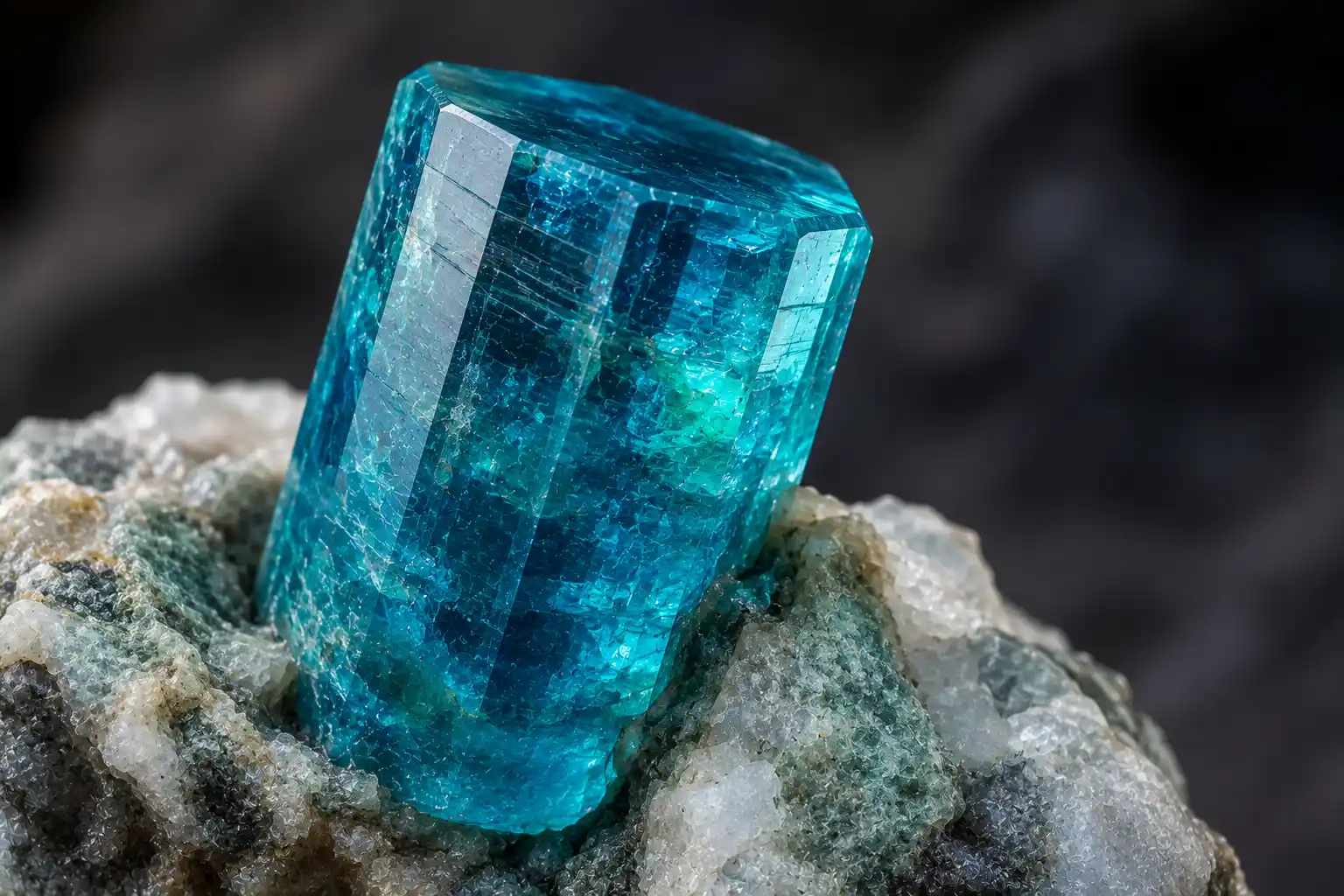
This distinction matters because apatite is extraordinarily variable in appearance. Natural material can be colorless, yellow, green, blue, blue-green, violet, purple, pink, brown, or combinations of these colors. Transparent crystals may be faceted, translucent material may be cut into cabochons, and well-formed crystals are important mineral specimens. Yet color alone cannot identify the exact apatite-group species, reveal geographic origin, or prove whether a gem’s appearance is untreated.
Apatite is also famous for another reason: it defines hardness 5 on the Mohs scale. That makes it scientifically familiar but comparatively vulnerable as a jewelry stone. Its brilliance and vivid colors can resemble harder gems, while its modest hardness and brittle behavior require more careful ownership than its visual appearance might suggest.
Modern crystal traditions add another layer to apatite meaning, commonly linking the stone with motivation, communication, creativity, personal growth, manifestation, or emotional clarity. Those ideas belong to symbolic practice. They are not measurable properties of calcium phosphate, and apatite has not been scientifically demonstrated to treat disease, suppress appetite, control metabolism, alter another person’s behavior, or guarantee desired outcomes.
The wider Healing Crystal collection follows the same boundary: first establish what a material is, then separate measurable evidence from cultural interpretation and modern belief.
Apatite Identity at a Glance
| Property | Apatite |
|---|---|
| Mineral status | Common group or generic name covering related apatite-group species |
| Common gem species | Fluorapatite |
| Generalized formula | Ca₅(PO₄)₃(F,Cl,OH) |
| Fluorapatite formula | Ca₅(PO₄)₃F |
| Chlorapatite formula | Ca₅(PO₄)₃Cl |
| Hydroxylapatite formula | Ca₅(PO₄)₃OH |
| Mineral class | Phosphate |
| Common crystal system | Hexagonal |
| Typical crystal habit | Hexagonal prisms, tabular crystals, granular or massive material |
| Common colors | Colorless, yellow, green, blue, blue-green, violet, purple, pink, brown, white |
| Transparency | Transparent to translucent |
| Luster | Vitreous to subresinous |
| Mohs hardness | 5 |
| Typical specific gravity | Roughly 3.1–3.25 for fluorapatite |
| Cleavage | Poor |
| Fracture | Conchoidal to uneven |
| Tenacity | Brittle |
| Optical character | Commonly uniaxial negative in fluorapatite |
| Gemological refractive index | Commonly around the low-to-mid 1.63–1.65 range, depending on composition |
| Important limitation | “Apatite” on a label does not always identify the exact apatite-group species |
The identity table also explains why terminology deserves attention. Gem dealers can reasonably use “apatite” as a familiar commercial name, particularly when fluorapatite is strongly suspected or established, but a scientifically precise species assignment may require chemical or structural analysis.
Apatite Is a Group Name Before It Is a Color Name
Apatite is sometimes marketed almost as if “blue apatite,” “green apatite,” and “yellow apatite” were three distinct mineral species. They are not.
Color is an appearance property. Species identity depends on crystal chemistry and structure.
Most transparent gem apatite encountered in the trade is fluorine-rich material, but the visible color does not by itself reveal whether fluorine, chlorine, hydroxyl, or another substitution dominates the relevant structural sites. Mineralogical nomenclature therefore distinguishes exact apatite-group species when suitable analysis is available while allowing “apatite” to remain useful as a broader descriptive term when the chemistry has not been resolved.
This distinction is especially useful for collectors buying crystals rather than finished gems. A specimen labeled simply “apatite” may be correctly identified at the group level while lacking the chemical data necessary for a more exact species name.
How Apatite Forms
Apatite is geologically widespread. Fluorapatite is an important accessory phosphate mineral in many igneous rocks and can occur in granitic pegmatites, alkaline rocks, syenitic systems, carbonatites, hydrothermal environments, metamorphic rocks, skarns, marbles, and sedimentary phosphate deposits. The mineral can therefore form through several very different geological processes rather than one universal “apatite formation” pathway.
In an igneous system, apatite may crystallize directly from magma as phosphorus, calcium, fluorine, chlorine, hydroxyl, rare-earth elements, and other components are partitioned among growing minerals and residual melt. Small apatite grains occur as accessory minerals in many rocks, while favorable pegmatitic or hydrothermal conditions can permit substantially larger crystals.
In metamorphic rocks, apatite may survive from earlier material, recrystallize, or participate in reactions associated with changing temperature, pressure, and fluid chemistry. In sedimentary systems, calcium phosphate can become concentrated into economically important phosphatic deposits.
These geological pathways are too different to collapse into one short origin story. The detailed relationship among pegmatites, carbonatites, hydrothermal veins, metamorphic hosts, sedimentary phosphorites, and locality evidence belongs in Apatite formation and deposit geology.
For this page, the key point is that apatite meaning begins with a widespread phosphate system whose geological role is much broader than its use as a blue gemstone.
Why Apatite Comes in So Many Colors
Apatite’s generalized calcium-phosphate structure can accommodate a surprising range of substitutions and defects, allowing natural specimens to develop markedly different colors. Transition elements, rare-earth elements, charge-transfer processes, structural defects, color centers, and substitutions affecting phosphate or channel sites may all influence absorption of visible light.
This means there is no single “apatite color element.”
Blue apatite provides a useful example. Research has associated blue coloration in some apatite with manganese-related species substituting within the structure, while other optical and defect-related mechanisms have also been investigated in natural and treated material. The correct mechanism for one specimen should not automatically be assigned to every blue crystal merely because the colors look similar.
Green, yellow, violet, purple, and pink material likewise require specimen-specific caution. A color observed in a photograph is evidence of appearance, not a laboratory analysis of the chromophore.
For a dedicated treatment of natural hues, color mechanisms, unusual colors, lighting, symbolism attached to individual colors, and the limits of visual diagnosis, use Apatite color meaning.
Apatite Can Be Strongly Pleochroic
Some colored apatite shows visible pleochroism, meaning different colors or intensities appear when light travels through different crystallographic directions. The effect varies with color, composition, orientation, and saturation.
Gemological examinations of blue apatite, for example, can record directional blue and nearly colorless appearances. Faceting mixes these optical directions through the stone’s pavilion and crown, so the finished face-up appearance may be more complicated than simply seeing one color from one side and another from a second direction.
Pleochroism can help with identification but cannot prove apatite by itself. Other colored gemstones also show directional absorption.
Detailed refractive indices, birefringence, pleochroism, fluorescence, absorption, chatoyancy, and other optical properties belong in Apatite optical properties and color behavior.
Apatite’s Hardness Is Famous for a Reason
Apatite defines hardness 5 on the Mohs scale, placing it between fluorite and orthoclase feldspar in that comparative system.
That scientific role sometimes creates a misleading impression that a hardness number fully describes durability. It does not.
Hardness measures resistance to scratching. Apatite is also brittle, can contain fractures and inclusions, and may abrade along exposed facet junctions during wear. Quartz dust and many common jewelry materials are harder than apatite, meaning an apatite surface can accumulate scratches more readily than sapphire, spinel, topaz, beryl, or quartz.
The practical result is that a beautifully faceted apatite can be entirely genuine and still require cautious use.
Specific decisions about girdle protection, exposed corners, prongs, bezels, impact direction, and jewelry suitability are handled in Apatite setting and wear engineering.
Diagnostic Traits of Apatite
Apatite identification works best through converging evidence. Common fluorapatite characteristics include hardness 5, specific gravity around 3.1–3.25, vitreous luster, typically hexagonal crystal morphology, poor cleavage, brittle fracture, and refractive indices around the 1.63–1.65 region. Transparent gem material is commonly uniaxial negative.
These values are useful because apatite is frequently mistaken for other gems. That tendency is not a modern accident; confusion with other minerals is embedded in the history of the name itself.
A green transparent crystal can resemble beryl, tourmaline, or other green gems. Bright blue-green faceted material may visually recall copper-bearing tourmaline. Yellow stones can overlap with several other gem species at first glance.
Hardness can narrow possibilities but should not be tested destructively on a finished gem or valuable specimen. Refractive index, optic character, density, spectroscopy, microscopy, Raman analysis, and chemistry offer stronger approaches when an exact determination matters.
Apatite Is Not Aquamarine
Blue apatite and aquamarine can be confused in photographs because both can present attractive blue to blue-green color. The resemblance ends quickly under gemological testing.
Aquamarine is beryl, a beryllium aluminium silicate with substantially greater hardness and a different refractive-index range, density, crystal chemistry, and durability profile.
A buyer should therefore be cautious when brilliant blue color becomes the only basis for identification.
This is one reason the ancient origin of the name apatite remains so appropriate: appearance can deceive.
Apatite Is Not Paraíba Tourmaline
Intensely saturated blue-green apatite is sometimes promoted with words such as “Paraíba-colored” or even informal trade expressions that borrow the famous tourmaline name.
Color similarity does not create mineral equivalence.
Paraíba-type tourmaline belongs to the tourmaline group and owes its characteristic coloration to a different chemical system. Apatite remains a calcium phosphate. Basic gemological properties can separate them, while spectroscopy and chemical analysis can provide additional evidence.
The comparison is especially important when a bright blue-green apatite is photographed under lighting that emphasizes saturation. A visual resemblance should never justify representing apatite as tourmaline.
Original Apatite Specimen and Photo Evaluation Checklist
When assessing an apatite crystal, faceted stone, cabochon, or seller photograph, record observable facts before accepting larger claims.
| Observation | What it may support | What it cannot prove alone |
|---|---|---|
| Hexagonal prismatic crystal | Habit compatible with apatite-group material | Exact apatite species |
| Vitreous transparent crystal | Compatible with gem apatite | Geographic origin |
| Hardness near 5 from appropriate existing data | Supports apatite interpretation | Fluorapatite versus chlorapatite |
| Blue-green color | Common gem apatite appearance | Natural color or treatment status |
| Yellow-green color | Common apatite appearance | Specific chromophore |
| Purple or violet color | Documented apatite color range | Exact trace-element chemistry |
| Needle or tube inclusions | Useful microscopic observations | Species identity by themselves |
| Cat’s-eye effect | Known in apatite | Exact locality |
| Seller uses “Paraíba apatite” | Trade comparison to color | Tourmaline identity |
| Seller uses “natural apatite” | Geological-origin claim | Untreated status |
| Seller uses “fluorapatite” | Specific species claim | Proof without analytical support |
| Seller names a mine | Provenance statement | Independent origin verification |
| Raman spectrum compatible with apatite | Strong species/group evidence | Complete chemistry or provenance |
| Chemical analysis identifying dominant F, Cl, or OH | Stronger species-level evidence | Whether color was treated afterward |
The purpose of this checklist is not to make ordinary buying impossible. It is to stop one visible feature from answering five unrelated questions.
A blue stone can be apatite without proving where it formed. A natural crystal can still have been treated. A correct group identification can still be too broad to establish a specific apatite-group species.
Microscopic observations deserve their own disciplined record, which is why inclusions, tubes, crystals, fractures, growth structures, and surface features are developed separately in the Apatite microscope inclusion notebook.
Apatite Names and Claims That Need Qualification
The name itself is unusually useful for identifying misleading claims.
| Name or claim | Evidence assessment | More accurate interpretation |
|---|---|---|
| Apatite | Valid generic/group-level usage | Common term for related apatite-group minerals |
| Fluorapatite | Specific mineral species | Ca₅(PO₄)₃F |
| Chlorapatite | Specific mineral species | Ca₅(PO₄)₃Cl |
| Hydroxylapatite | Specific mineral species | Ca₅(PO₄)₃OH |
| “Blue apatite” | Descriptive gem term | Color description, not separate species |
| “Neon apatite” | Commercial appearance term | No standardized mineral species or grade |
| “Paraíba apatite” | Informal trade comparison | Apatite resembling some blue-green tourmaline colors, not Paraíba tourmaline |
| “Apatite suppresses appetite” | Unsupported wordplay | The mineral name is unrelated to appetite control |
| “Apatite is always fluorapatite” | Too absolute | Fluorapatite is common, especially in gems, but exact species requires evidence |
| “Apatite contains fluoride, so it strengthens teeth when worn” | Unsupported biological inference | Mineral chemistry does not establish therapeutic delivery |
| “Blue apatite opens communication scientifically” | Unsupported | Communication symbolism is interpretive |
| “Apatite is a manifestation stone” | Metaphysical language | No demonstrated mechanism linking apatite to external outcomes |
The table highlights a recurring problem: a true mineral fact can become the starting point for an unsupported conclusion. Fluorapatite really can contain fluorine, but that does not mean wearing it provides dental treatment. Apatite really does sound similar to “appetite” in English, but the names have unrelated origins.
Why Apatite Was Named for Deception
The name apatite derives from a Greek root meaning to deceive or mislead. The reference reflects how easily apatite specimens were historically confused with other minerals because their crystal habits and colors can resemble several better-known species.
That naming history is unusually appropriate for a modern gemological guide.
Green apatite can resemble other green transparent gems. Blue-green material can invite comparison with tourmaline. Yellow crystals can visually overlap with other species. A clean hexagonal crystal may be mistaken for beryl by someone relying only on shape and color.
The name is not connected to appetite, eating, hunger, weight control, or metabolism.
This distinction matters because some metaphysical marketing has built appetite-suppression claims around the English similarity between “apatite” and “appetite.” That is word association, not mineralogical history or medical evidence.
Apatite and Appetite Are Unrelated Words
Apatite should not be used as a weight-loss tool.
There is no established scientific evidence that carrying, wearing, meditating with, or placing apatite near the body suppresses hunger, alters metabolic rate, changes fat absorption, regulates blood sugar, or causes weight loss.
The linguistic resemblance is coincidental.
Presenting apatite as an appetite-control treatment is particularly problematic because eating behavior, metabolism, nutrition, and weight management can involve significant health considerations. A gemstone should not replace qualified medical or nutritional support.
This is one of the clearest examples of why responsible apatite meaning requires an evidence boundary rather than an unfiltered list of crystal claims.
Apatite and the Minerals in Teeth and Bone
Hydroxylapatite is closely related to mineral material in human and animal hard tissues, which has encouraged another set of misleading gemstone claims.
The connection is real but easy to misuse.
Biological apatite is an important component of bones and teeth, but natural biological material is chemically complex and commonly substituted rather than a perfect crystal of ideal laboratory composition. The fact that apatite-group chemistry appears in skeletal tissue does not mean wearing a fluorapatite gemstone transfers useful calcium, phosphorus, or fluoride into bones or teeth.
Mineral composition does not automatically create a delivery mechanism.
A crystal worn around the neck is therefore not a treatment for osteoporosis, dental decay, fractures, calcium deficiency, phosphate imbalance, or other medical conditions.
The chemical relationship is scientifically interesting without being medical proof.
Is Apatite Usually Fluorapatite?
Much gem-quality apatite is fluorine-rich fluorapatite, and fluorapatite is a common natural member of the apatite group. GIA gemological literature commonly describes faceted gem material simply as apatite while noting fluorapatite as the typical or common gem member.
However, exact species terminology should remain proportional to the evidence.
A seller who has analytical documentation supporting fluorapatite can reasonably use the specific name. A dealer who knows only that the material is apatite should not be forced to invent a more exact species assignment.
This is a useful example of transparent uncertainty rather than a defect in identification.
Treatment Claims Need Caution
Natural apatite already occurs in a wide range of attractive colors, but heating can modify the appearance of some material. Experimental work has demonstrated changes in color and luminescence in natural apatite under controlled heating, showing why a blanket statement that apatite can never be heat treated is too strong.
The opposite assumption is also wrong: vivid blue or green color does not prove treatment.
Treatment detection can depend on the material, starting color, heating conditions, defects, luminescence behavior, spectroscopy, and other evidence. A seller’s disclosure remains important when appearance has been intentionally modified.
Transaction-specific questions—what to ask a seller, how to interpret treatment statements, and when independent testing may be justified—belong in where to buy apatite rather than turning this page into a buying guide.
Provenance Cannot Be Determined From Color Alone
Gem and specimen apatite occurs in many parts of the world. Well-known material comes from pegmatites, metamorphic environments, carbonatites, and other deposits across several continents.
A neon blue-green stone therefore cannot be assigned to a country merely because it resembles material commonly sold from that country. Likewise, a purple crystal cannot be given a locality based solely on hue.
Origin claims require documentary or geological evidence.
Original labels, invoices, collection histories, mine statements, host-rock relationships, and laboratory or specialist observations can each contribute different levels of provenance support. The appropriate framework is provided in the Apatite provenance and disclosure checklist.
A precise locality should never be invented to make a specimen sound more desirable.
Apatite as a Geological Indicator
Apatite is more important to geoscience than its jewelry-market visibility might suggest. Because it incorporates phosphorus and can accommodate numerous trace constituents, apatite grains can preserve information about the melts, fluids, rocks, and alteration processes in which they formed.
Accessory apatite can survive within igneous and metamorphic rocks even when it makes up only a small proportion of the whole rock. Its chemistry may therefore provide evidence that would be invisible from the rock’s major minerals alone.
That scientific role gives apatite meaning in a very literal sense: a tiny grain can record geological conditions.
This geochemical importance should not be confused with the metaphysical idea that apatite “stores emotional information.” One claim concerns measurable chemistry inside a geological material; the other is symbolic language.
Apatite as a Gemstone
Transparent apatite can produce beautiful faceted gems with bright color, respectable brilliance, and, in some material, strong pleochroism or chatoyancy. Blue-green stones receive considerable attention because of their saturated appearance, while yellow, green, purple, and other colors provide a much broader gem palette.
The weakness is durability.
Hardness 5 means apatite can be scratched by common dust containing quartz. Brittle material may also chip after impact, and heavily included gems can be more vulnerable than clean stones of equivalent dimensions.
This does not make apatite unsuitable for jewelry; it makes design and use important. Pendants and earrings generally expose a stone to different mechanical risks than an unprotected ring.
The decisions involved in rough orientation, facet design, polishing, and managing fractures are addressed in Apatite cutting, orientation, and polish.
Safe Ownership of Apatite
Apatite should be treated as a relatively soft, brittle gemstone and mineral specimen. Store faceted stones away from harder gems capable of scratching them, avoid unnecessary impacts, and be particularly careful with exposed facet junctions or existing fractures.
Heat and rapid temperature changes are poor default choices for a material whose exact treatment history and internal condition may not be known. Aggressive mechanical cleaning is likewise unnecessary.
Questions specifically about physical cleaning and symbolic cleansing belong on how to cleanse apatite so that this page does not duplicate a dedicated care topic.
Collector specimens have another concern: geological context. Removing a crystal from matrix, polishing a natural surface, discarding an old label, or repairing a broken crystal without documenting the repair can destroy information even when the specimen looks cleaner afterward.
Long-term storage, labels, repairs, matrix stability, and documentation are handled in the Apatite specimen conservation record.
Cutting Apatite Requires More Caution Than Its Beauty Suggests
Apatite’s modest hardness and brittle nature make lapidary work less forgiving than cutting quartz or corundum. Internal fractures, tubes, cleavage-related weaknesses, crystal orientation, and heat generated during polishing can all influence the outcome.
A large piece of transparent rough may therefore yield a smaller finished stone than its initial dimensions suggest if the cutter must remove fractures or choose an orientation that improves appearance.
This is another reason finished gem size alone should not be interpreted as evidence of geological rarity or value.
For this meaning reference, the relevant conclusion is simple: apatite is genuinely gemmable, but it is not mechanically equivalent to harder transparent gemstones.
Original Evidence Ladder for Apatite Claims
Apatite demonstrates why the evidence required should match the claim being made.
Level 1 — Visual observation: color, apparent transparency, crystal shape, polish, zoning, visible fractures, and matrix.
Level 2 — Basic gemological measurements: refractive index, specific gravity, optic character, pleochroism, fluorescence, and hardness information obtained without damaging the stone.
Level 3 — Microscopic evidence: inclusions, tubes, growth structures, fracture fillings, surface coatings, polishing features, and internal zoning.
Level 4 — Mineral identification: Raman spectroscopy or other appropriate methods confirming apatite-group material.
Level 5 — Species-level chemistry: analytical evidence capable of distinguishing fluorapatite, chlorapatite, hydroxylapatite, or related compositional complexity.
Level 6 — Color-mechanism evidence: spectroscopy, chemistry, luminescence, defect studies, and treatment experiments relevant to the individual material.
Level 7 — Provenance: original labels, geological matrix, traceable collection history, source documentation, and other evidence supporting geographic claims.
Level 8 — Historical or cultural claim: traceable historical texts, museum documentation, archaeological evidence, or scholarship showing that a particular interpretation genuinely existed.
A product photograph operates mainly at Level 1. It cannot establish an exact species, treatment history, mine, ancient symbolic use, or healing effect.
That distinction provides the original analytical framework required for this page rather than simply repeating the same list of apatite properties found in generic crystal descriptions.
Documented History Versus Invented Ancient Lore
Apatite has a well-documented scientific naming history centered on its tendency to be confused with other minerals. That documented story is more defensible than attaching an untraceable ancient civilization to the stone.
Modern websites sometimes claim that apatite was universally used by ancient healers, warriors, priests, or unnamed civilizations for motivation, prophecy, weight control, or spiritual communication. Such claims should not be repeated without primary or specialist historical evidence.
A mineral can be culturally interesting without an invented ancient pedigree.
The genuinely documented history includes mineral classification, confusion with visually similar species, phosphate chemistry, geological research, gemological study, biological apatite research, and the mineral’s growing use as a colorful gem.
That is already a substantial story.
Responsible Apatite Symbolism
Modern apatite symbolism commonly includes motivation, learning, creativity, communication, self-expression, reflection, ambition, and personal development. Blue stones are often connected with communication themes, green stones with growth, yellow material with confidence, and purple examples with intuition.
These associations largely reflect modern crystal traditions and broader human color symbolism.
A person may use apatite as a physical reminder to finish a project, communicate more clearly, study consistently, or examine a long-term goal. In that context, the stone functions as a chosen symbol.
There is no established evidence that apatite itself produces motivation, increases intelligence, makes someone more creative, alters another person’s communication, or causes external opportunities to appear.
Symbolism is strongest when it inspires deliberate human action rather than replacing it.
The general evidence boundary for metaphysical and health claims is described in the Gems Lore disclaimer.
Apatite and Manifestation Claims
Apatite is frequently described as a manifestation stone, particularly in modern crystal communities.
“Manifestation” can mean several different things. If it refers to identifying a goal, writing it down, reviewing priorities, and taking consistent action, a stone can certainly be used as a symbolic reminder within that process.
If manifestation means that apatite directly causes money, relationships, jobs, physical changes, or other external outcomes through an invisible energetic mechanism, there is no established scientific evidence supporting the claim.
That distinction preserves personal ritual while avoiding guarantees.
An apatite necklace cannot make an employer offer a job. A crystal on a desk cannot guarantee business growth. A meditation stone cannot compel another person to begin or repair a relationship.
Personal meaning does not require causal claims.
Apatite and Communication Symbolism
Blue apatite is commonly associated with communication and self-expression. The symbolism is understandable because blue is widely connected with voice, openness, and calm in contemporary color systems.
Someone might therefore keep a blue apatite on a desk while preparing a difficult conversation or use it as a reminder to listen before responding.
There is no demonstrated mineralogical mechanism by which blue fluorapatite improves speech, changes vocal anatomy, treats throat disorders, or makes another person understand a message.
The useful distinction is behavioral: a person can attach an intention to an object and then act on that intention.
The stone provides the reminder, not the communication skill.
Apatite and Chakra Claims
Modern metaphysical sources frequently assign apatite colors to different chakras. Blue material is commonly linked with the throat chakra, while other colors are mapped to different symbolic energy centers.
These systems belong to spiritual practice rather than established anatomy.
Gemological instruments can measure refractive index, absorption, fluorescence, density, and chemical composition. They do not measure chakra activation.
Someone may still use apatite within a chakra-based meditation tradition if that practice is personally meaningful. The responsible boundary is simply to avoid converting the belief into a medical claim.
Apatite Does Not Scientifically Detoxify the Body
“Detox” is another term commonly attached to crystals without defining what is supposedly being removed or how the mechanism would work.
Apatite has not been established as a treatment that removes toxins from blood, liver, kidneys, skin, lungs, or other tissues. Wearing or carrying a phosphate mineral does not substitute for the body’s physiological processes or appropriate medical treatment.
The same applies to claims that apatite balances hormones, treats arthritis, heals fractures, improves dental health, or changes metabolism.
These claims may appear alongside genuine statements about apatite chemistry, which can make them sound more credible than they are. Chemical composition is not clinical evidence.
What “Healing Crystal” Means Here
Apatite sits in the Healing Crystal category because that is how many readers search for and encounter the material, not because Gems Lore treats metaphysical healing as established science.
The category allows the site to address those claims directly rather than ignore them.
Within that context, “healing crystal” describes a cultural and commercial usage category. Mineralogical facts remain mineralogical facts; spiritual practices remain beliefs; medical claims require medical evidence.
This separation is part of the editorial approach described on About Gems Lore.
Why a Laboratory Name Can Be More Precise Than a Shop Label
A commercial label may say simply “apatite.” That can be perfectly useful for ordinary gem trading.
A mineralogical analysis may instead identify fluorapatite because fluorine dominates the relevant structural site. Another specimen might prove to be hydroxylapatite or chlorapatite.
Neither type of label is automatically dishonest. They answer different levels of precision.
Problems arise when a broad commercial identification is presented as though it included chemical information that was never measured. A seller should not claim a precise species, treatment status, or mine origin merely because a stone visually resembles another documented specimen.
This evidence-centered approach also protects sellers from unnecessary overstatement.
Apatite Specimens Can Be More Valuable Scientifically Than Polished
A well-formed apatite crystal in original matrix can preserve evidence about crystal growth, mineral associations, zoning, geological environment, and collection provenance. Removing it from the matrix to create a polished object may destroy much of that information.
Conversely, damaged or fragmentary material with little specimen significance may be perfectly suitable for lapidary use.
The right decision therefore depends on the object.
A collector-grade crystal with old documentation should not automatically be cut merely because transparent areas exist. A broken gem-quality crystal with no meaningful matrix context may have more value as a fashioned stone.
There is no universal rule that “natural crystal is always better” or “polished gem is always better.”
Treatment, Natural Origin, and Locality Are Separate Claims
Apatite provides a useful example of why commercial disclosures should be unpacked.
“Natural apatite” means the base material formed naturally rather than being manufactured.
“Untreated apatite” addresses whether its appearance has been intentionally modified.
“Fluorapatite” is a species-level mineralogical statement.
“Apatite from a named country or mine” is a provenance claim.
A single stone could satisfy one statement while the others remain unknown.
That is why the Apatite provenance and disclosure checklist treats these claims separately instead of allowing the word “natural” to stand in for everything.
Safe Ownership Without Alarmism
Apatite is not a material that requires fear during ordinary ownership. An intact polished gem or mineral specimen can be handled normally with sensible protection from scratching and impact.
The precautions become more important during cutting, sanding, drilling, or crushing, because those activities create mineral and matrix dust. Standard lapidary dust controls, wet methods where appropriate, eye protection, ventilation, and clean work practices are more sensible than breathing fine particulate from any mineral-working operation.
Ingestion is unnecessary. Do not grind apatite into powders, add mineral fragments to drinks, or consume preparations based on claims about phosphorus, calcium, fluoride, detoxification, weight control, or healing.
The fact that apatite-related chemistry occurs naturally in biological tissues does not make arbitrary mineral specimens food or medicine.
Frequently Asked Questions
What is apatite?
Apatite is a common generic or group-level name for related calcium phosphate minerals. Gem-quality material is often fluorapatite, Ca₅(PO₄)₃F.
Is apatite a single mineral species?
Not in the most precise modern mineralogical usage. The familiar name covers related apatite-group species differentiated by chemistry, including fluorapatite, chlorapatite, and hydroxylapatite.
Why is it still called apatite in jewelry?
“Apatite” remains a practical and widely recognized gem-trade name. Exact species chemistry is not determined for every commercial stone, and much gem material is fluorine-rich.
What does apatite look like?
Natural apatite can be colorless, yellow, green, blue, blue-green, violet, purple, pink, brown, or white. Transparent crystals commonly have hexagonal prismatic habits.
What is the hardness of apatite?
Apatite defines hardness 5 on the Mohs scale. It can therefore be scratched more readily than quartz, beryl, topaz, spinel, sapphire, and many other popular jewelry stones.
Is apatite fragile?
It is brittle and relatively soft for a faceted gemstone. Scratching, edge abrasion, fractures, and impacts deserve more attention than with harder gems.
Why was apatite named “apatite”?
Its name comes from a Greek root associated with deception because the mineral was easily confused with other species.
Does the name apatite come from appetite?
No. The resemblance between “apatite” and the English word “appetite” is coincidental.
Does apatite reduce appetite?
There is no established scientific evidence that apatite jewelry, crystals, or meditation practices suppress hunger or cause weight loss.
Is apatite good for bones or teeth?
Apatite-group minerals are chemically related to mineral material found in bones and teeth, but wearing a gemstone does not deliver a therapeutic dose or treat skeletal or dental conditions.
What causes blue apatite?
Blue color can involve manganese-related substitutions and other structural or defect-related absorption mechanisms. The precise cause should not be assigned to an individual specimen solely from appearance.
Can apatite be heat treated?
Heat can alter color and luminescence in some natural apatite, so treatment is possible. Vivid color alone does not prove that a stone has been heated.
Is blue apatite the same as Paraíba tourmaline?
No. They are different materials with different chemistry and physical properties. Bright blue-green apatite may resemble certain tourmalines visually, but it remains apatite.
Is apatite the same as aquamarine?
No. Aquamarine is blue to blue-green beryl and is significantly harder. Similar color does not make the two gems mineralogically related.
Is apatite always fluorapatite?
No. Fluorapatite is very common and accounts for much gem material, but the broader name apatite can include related compositions. Exact species identification requires appropriate evidence.
Where does apatite form?
Apatite occurs in igneous rocks, pegmatites, carbonatites, metamorphic rocks, hydrothermal systems, and sedimentary phosphate deposits. Different specimens can therefore have very different geological histories.
Can apatite show a cat’s-eye effect?
Yes. Some apatite contains suitably oriented inclusions that produce chatoyancy when cut as cabochons.
How can real apatite be identified?
Color and crystal shape are preliminary clues. Refractive index, specific gravity, optic character, microscopy, spectroscopy, Raman analysis, and chemical methods provide progressively stronger evidence.
Can a photograph prove that a gem is apatite?
No. A photograph can document color, apparent transparency, cut, crystal shape, and visible inclusions, but it cannot reliably prove species, treatment, exact chemistry, or provenance.
What does apatite symbolize?
Modern symbolism commonly associates apatite with motivation, communication, learning, creativity, personal growth, and goal setting. These meanings are interpretive rather than scientifically measured mineral properties.
Does apatite have healing properties?
There is no established scientific evidence that apatite treats disease, alters metabolism, repairs bones, balances hormones, detoxifies organs, or produces medical healing.
Does blue apatite improve communication?
Blue apatite can be used as a personal symbol or reminder for clearer communication, but there is no scientific evidence that the mineral directly changes speech, communication ability, or another person’s response.
Does apatite help with manifestation?
A person can use apatite as a reminder to define goals and take action. There is no demonstrated evidence that the stone itself causes money, relationships, career outcomes, or other external events.
Is apatite safe to own?
Yes, with sensible mineral and gemstone handling. Protect it from scratching and impact, avoid ingesting mineral material, and use standard dust controls during lapidary work.
How should apatite be cleaned or spiritually cleansed?
Because apatite is comparatively soft and brittle, conservative methods are preferable. Detailed physical and symbolic methods are covered separately in how to cleanse apatite.
How should important apatite specimens be preserved?
Protect crystal edges, preserve original matrix and labels when they provide context, document repairs, and avoid unnecessary destructive testing. More detailed collection guidance is available in the Apatite specimen conservation record.
Where can I ask about an unusual apatite specimen?
For a specific specimen question, provide clear photographs, existing labels, dimensions, and the exact claim you are trying to evaluate through Contact Gems Lore. Information submitted through the site is handled according to the Privacy Policy.
Apatite meaning becomes substantially more useful when the material is allowed to be complex. “Apatite” can refer to a family of closely related calcium phosphate minerals rather than one chemically identical species. Its crystals occur across numerous geological environments, carry a broad natural color range, define hardness 5, and can produce striking transparent gemstones despite relatively modest durability.
Its documented name reflects deception because apatite was so easily confused with other minerals. That history provides an appropriate warning for modern interpretation as well: attractive color does not prove species, a familiar trade label does not prove exact chemistry, and a genuine mineral fact does not automatically support a healing claim.
Modern symbolism can still give apatite personal meaning. Motivation, communication, creativity, reflection, or goal setting can all be useful themes when a person consciously chooses them. They simply remain human interpretations rather than physical powers demonstrated in calcium phosphate.
That separation satisfies the strongest form of apatite meaning: mineral identity first, evidence where evidence exists, uncertainty where testing stops, and symbolism without turning belief into science.