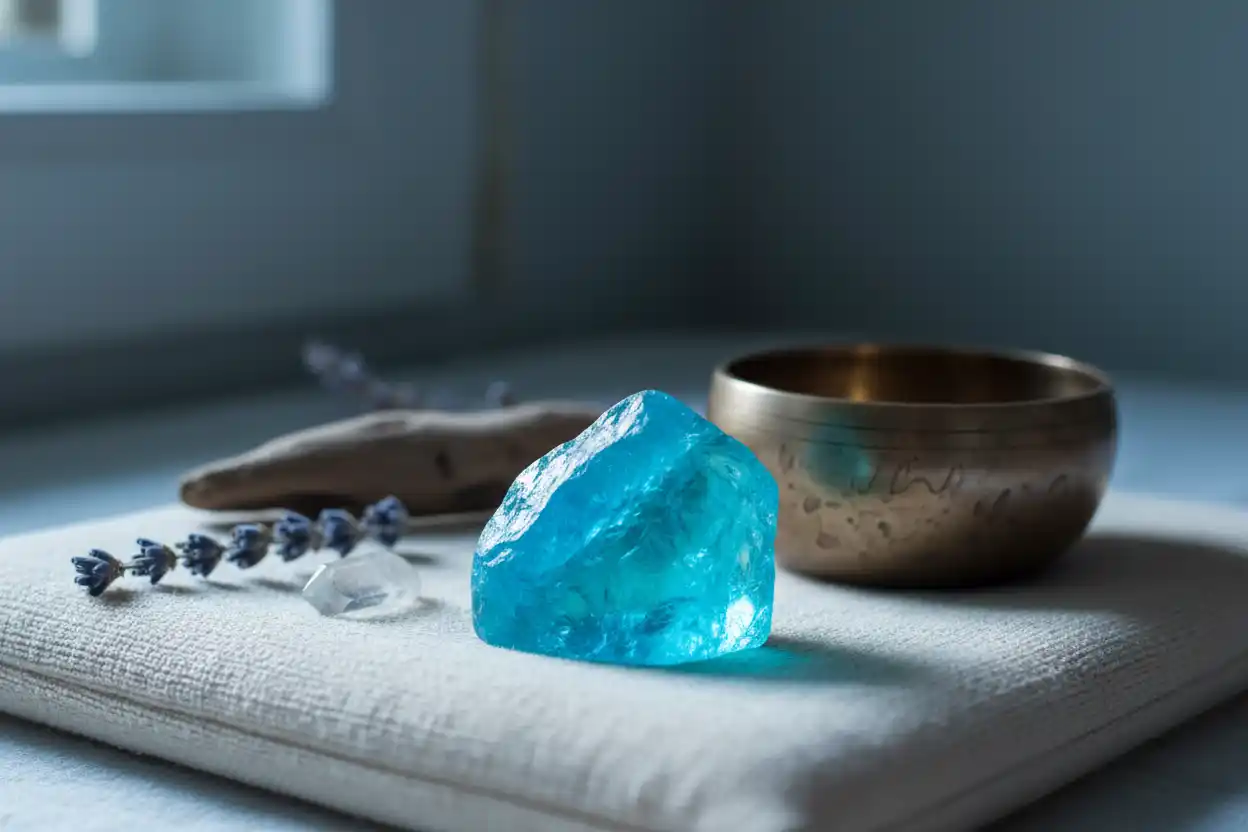
How to Cleanse and Charge Apatite
The safest ways to cleanse and charge Apatite are sound, intention, visualization, breath, indirect moonlight, and a gentle dry-cloth ritual. A brief lukewarm-water rinse may be used for a sound untreated specimen, but soaking is unnecessary and acids, salt, steam, ultrasound, and abrasive contact should be avoided.
Apatite is the defining mineral at Mohs hardness 5 and is brittle. Faceted gemstones, crystal points, beads, and specimens can scratch or chip more easily than Quartz, Tourmaline, Garnet, Spinel, Ruby, or Sapphire.
What Cleansing and Charging Mean
Cleansing is commonly used in modern crystal practice to mark a fresh beginning or release an object’s previous associations.
Charging generally means dedicating the stone to an intention, meditation practice, personal reminder, or symbolic purpose.
These rituals do not change Apatite’s chemistry, crystal structure, color, hardness, or measurable energy.
The material’s geology, colors, localities, and spiritual associations belong to the broader Apatite guide.
Color-specific symbolism is covered separately in Apatite Color Meaning.
Apatite Is a Mineral Group
Apatite is a group name applied to related calcium-phosphate minerals. Fluorapatite is the most common gem and rock-forming member, while hydroxylapatite and chlorapatite contain different dominant anions.
Gem-quality material may appear blue, blue green, green, yellow, violet, pink, colorless, or brown.
The full material range belongs to Types of Apatite.
| Property | Ritual implication |
|---|---|
| Mineral group | Apatite |
| Common gem member | Fluorapatite |
| Typical colors | Blue, green, yellow, pink, violet, brown, or colorless |
| Mohs hardness | 5 |
| Tenacity | Brittle |
| Cleavage | Poor |
| Safest ritual methods | Sound, intention, visualization, breath, and indirect moonlight |
| Water exposure | Brief contact only for sound untreated material |
| Acid exposure | Avoid |
| Main risks | Scratching, chipping, fractures, acids, treatments, settings, and hard surfaces |
The gemstone hardness chart places Apatite at the midpoint of the Mohs reference scale.
That number does not make it suitable for rough handling. Its brittleness and limited scratch resistance are addressed in Gemstone Toughness vs Hardness and Gemstone Cleavage Explained.
Inspect the Apatite First
Examine the stone under bright, indirect light.
Look for chipped facet junctions, bruised crystal points, open fractures, cloudy glue, damaged drill holes, loose prongs, peeling coatings, and color concentrated in fissures.
Transparent blue Apatite can contain needles, tubes, veils, crystals, liquid-related features, and internal fractures.
These inclusions are not surface dirt. Do not push a brush, pin, or salt crystal into them.
When a point is thin, a stone is heavily included, or a setting is unstable, use a non-contact cleansing method.
Separate Physical Cleaning from Symbolic Cleansing
Physical dirt should be removed only when necessary.
Wipe a smooth Apatite gently with a dry microfiber cloth. When deeper cleaning is required, a sound untreated stone can receive a brief lukewarm wash with mild soap and a very soft brush.
Avoid ultrasonic and steam cleaners because vibration and heat may damage fractures, brittle edges, filler, glue, and settings.
The broader equipment boundaries appear in Which Gemstones Can Go in an Ultrasonic Cleaner?.
Allow the stone to dry fully before beginning a spiritual ritual.
Method 1: Cleanse Apatite with Sound
Place the Apatite on a thick folded cloth.
Ring a bell, chime, tuning fork, or singing bowl nearby. You may also hum, chant, clap softly, or play calm music.
Do not place a faceted stone or crystal point inside a hard bowl while striking it. Apatite’s facet edges and terminations can chip.
Sound volume does not determine the ritual’s effectiveness. Several gentle tones are enough.
This method works for loose gems, mounted jewelry, specimens, beads, and treated material.
Method 2: Use Intention
Keep the Apatite resting on a padded surface or hold it loosely above a cloth.
Choose one clear purpose. The stone might remind you to communicate directly, complete a learning goal, organize creative ideas, or pause before making an impulsive choice.
State the intention once or several times.
This method is physically safe because it adds no moisture, acid, abrasive material, or environmental exposure.
The intention can remain practical even when the object’s meaning is spiritual.
Method 3: Use Visualization
Place the Apatite where it cannot roll or fall.
Imagine the object becoming free from old associations and connected with a new purpose.
Some practitioners visualize blue, green, yellow, or neutral light based on the stone’s color. The visualization is symbolic and does not imply that the mineral emits measurable energy.
Continue for several breaths or a few minutes.
This method is particularly suitable for fractured, faceted, coated, glued, or valuable Apatite.
Method 4: Use Breath Carefully
Leave the stone on a soft cloth.
Take several slow breaths and exhale gently toward it once or twice.
Avoid creating visible condensation. Moisture trapped in a fracture or setting provides no ritual benefit.
State the intention afterward.
This method should remain brief, especially for a specimen with fragile crystal terminations.
Method 5: Use Indirect Moonlight Indoors
Place Apatite indoors near a window on a padded tray or in an open jewelry box.
An hour, an evening, or overnight indoor placement may be used according to personal preference.
Outdoor exposure is unnecessary. Dew, rain, rapid cooling, animals, theft, and falling debris create practical risks.
Indirect moonlight avoids the heat associated with prolonged direct sun.
The broader light-exposure framework appears in Which Crystals Can and Can’t Go in the Sun.
Method 6: Use a Brief Water Ritual
A sound, untreated Apatite can be rinsed briefly with clean lukewarm water.
Hold it over a bowl rather than a sink drain. Dry it immediately with a soft cloth.
Do not soak it for hours or overnight.
Avoid water for fracture-filled, dyed, coated, glued, strung, matrix-supported, heavily fractured, or unidentified material.
The general water framework belongs to Which Crystals Can and Can’t Go in Water.
Water is optional rather than necessary. Sound and intention provide lower-risk alternatives.
Method 7: Use a Written Intention
Write one concise statement and place it beside the padded Apatite.
The statement may relate to learning, planning, communication, creative work, or another personally meaningful action.
Leave the arrangement for several minutes or an evening.
Keep pens, clips, metal objects, and rough paper edges away from the polished stone.
A cloth layer provides extra scratch protection.
Method 8: Use a Mindful Cloth Ritual
Place the gemstone on a padded work surface.
Use a soft microfiber cloth to remove fingerprints with minimal pressure.
Avoid rubbing repeatedly across facet junctions or crystal points.
As you wipe, focus on the purpose associated with the object.
This ritual combines light maintenance with symbolic preparation without requiring immersion or another mineral.
Do Not Use Vinegar or Lemon Juice
Apatite is a calcium-phosphate mineral, and acids can attack calcium apatites.
Vinegar, lemon juice, acidic sprays, descaling products, and chemical dips should not be used for either physical cleaning or spiritual cleansing.
Acids may dull or etch a polished surface and can also damage metal, glue, coatings, and companion stones.
A stronger reaction does not indicate that a ritual is more effective. It indicates material alteration.
Avoid Direct Salt Contact
Dry salt can scratch Apatite, lodge in fissures, and collect around prongs or drill holes.
Saltwater adds prolonged moisture and may affect metal, elastic, thread, filler, and glue.
Do not bury a faceted stone or crystal point in coarse salt.
When salt is symbolically important, place it in a separate bowl while the Apatite remains on a lined dish nearby.
Avoid Soil Burial
Soil contains Quartz grains and other mineral debris that can scratch Apatite.
It may also contain moisture, fertilizer, organic acids, microorganisms, and staining materials.
Outdoor burial creates risks of loss, rain, pressure, and broken crystal points.
A nature-based alternative places the Apatite near a plant while keeping it dry on a separate padded surface.
Avoid Steam, Flame, and Heat
Do not use candles, flame, heated bowls, steam, saunas, radiators, or boiling water.
Heat may stress fractures, damage filling, soften glue, and affect coatings or settings.
Apatite’s brittle structure provides no reason to combine cleansing with temperature extremes.
Cool, dispersed smoke may be used briefly by people who already follow that tradition, but sound and visualization leave no residue.
Can Apatite Touch Clear Quartz or Selenite?
Clear Quartz is harder than Apatite and can scratch it.
Selenite is softer, but grit trapped between the two materials can still damage polished surfaces.
Use a cloth barrier whenever Apatite is placed near another stone.
The ritual does not require direct mineral contact.
The same principle applies when placing Apatite beside the softer blue mineral discussed in How to Cleanse and Charge Angelite.
Blue Apatite and Similar Gemstones
Blue Apatite can resemble Aquamarine, Paraíba-colored Tourmaline, blue Topaz, glass, and other vivid blue materials.
The complete comparison with blue beryl belongs to Apatite vs Aquamarine.
The broader color family appears in Blue Gemstones.
Apatite is usually too brittle for an exposed everyday engagement-ring setting. The wider suitability discussion belongs to Blue Gemstones for Engagement Rings.
Cleaning response, scratching, acids, and heat should never be used as home identification tests.
Treatments and Safety
Apatite may be heated, irradiated, coated, filled, dyed, or imitated, although treatment frequency varies by material and market.
The general enhancement framework appears in Gemstone Treatments Explained.
Treatment does not prevent personal symbolic use, but it can make water, light, solvents, and abrasion less predictable.
Do not grind Apatite, create mineral dust, burn it, or place it in drinking water. Ordinary intact handling differs from ingestion or destructive testing.
The wider handling distinction belongs to the Toxic Crystals safety list.
Buying and Authenticity Context
The Where to Buy Real Apatite guide covers color, transparency, inclusions, scratches, cut, treatment, imitation, and seller disclosure.
Inspect secondhand Apatite for rounded facet junctions and surface abrasion. Its vivid color can remain attractive even when the polish has deteriorated.
Cleansing cannot restore worn facets. Repolishing requires an experienced lapidary and removes some gemstone weight.
Frequently Asked Questions
1. What is the safest way to cleanse Apatite?
Sound, intention, visualization, breath, a soft cloth, and indirect indoor moonlight are the lowest-risk methods.
2. Can Apatite be cleansed in water?
A sound untreated stone can be rinsed briefly, but prolonged soaking is unnecessary and unsuitable for filled, dyed, glued, coated, or fractured material.
3. Can Apatite be left in moonlight overnight?
Yes, when kept indoors on a padded surface away from condensation and temperature changes.
4. Can Apatite be charged in sunlight?
Indirect light is safer. Prolonged direct sun adds heat and may create uncertainty when treatment is unknown.
5. Can Apatite be cleansed with salt?
Direct salt contact is not recommended because salt can scratch the stone and lodge in fractures or settings.
6. Can vinegar clean or cleanse Apatite?
No. Acids can attack calcium apatites and may dull the polished surface.
7. Can Apatite be cleansed with smoke?
A brief cool-smoke ritual is possible, but sound or intention avoids soot, heat, and fragrance residue.
8. Can Clear Quartz charge Apatite?
Some practitioners use it symbolically, but Quartz is harder and should be separated from Apatite by a soft cloth.
9. Is Blue Apatite safe for daily handling?
Gentle handling is acceptable, but its Mohs hardness of 5 and brittle tenacity make scratches and chips possible.
10. How long should Apatite charge?
A few minutes or an evening can serve the ritual. There is no scientifically required duration.
11. How often should Apatite be cleansed?
Use a schedule that fits your practice while minimizing repeated handling of fragile points and faceted stones.
12. Does cleansing change Apatite scientifically?
No established scientific evidence shows that cleansing alters its chemistry, health effects, or measurable physical energy.
Conclusion
Apatite’s vivid colors can suggest a more durable gem than its Mohs hardness and brittle structure provide. Sound, intention, visualization, and protected moonlight preserve the polish while avoiding acids, salt, hard crystals, and unnecessary soaking. A meaningful ritual should clarify the purpose attached to the object without physically altering the Apatite.
Crystal cleansing and charging are spiritual or personal practices, not scientifically established methods for changing health, energy, or the physical properties of Apatite.