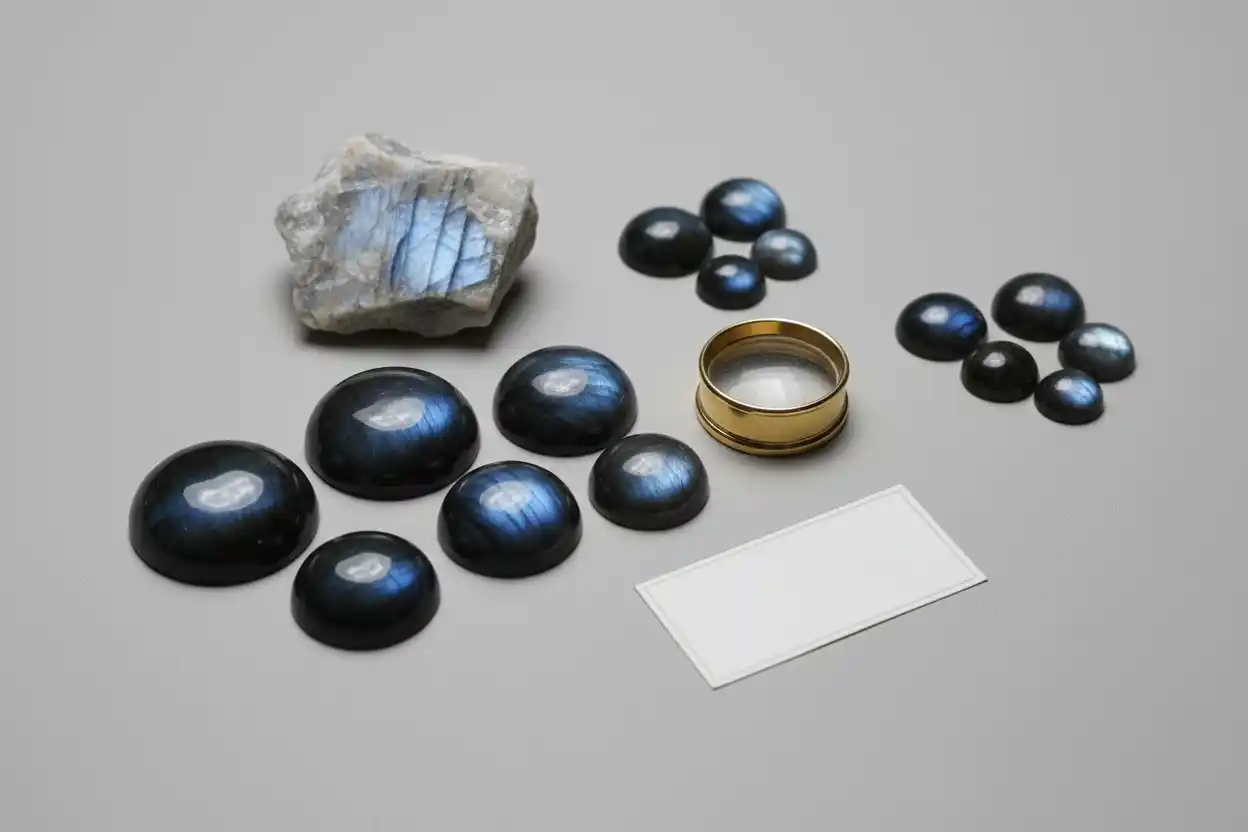
Where to Buy Real Black Moonstone: Trusted Sellers and Fake-Spotting Tips
Real black moonstone should show more than a dark body color. The material is bought for a mobile internal sheen—usually white, silver, gray, blue or occasionally warmer in tone—that appears to float beneath the surface as the stone moves. A black cabochon without a convincing feldspar-related optical effect may be another dark stone carrying a commercial moonstone label.
The term “black moonstone” is used more loosely than classic white moonstone. Sellers may apply it to dark gray orthoclase moonstone, dark feldspar with adularescence, included feldspar, dark labradorite or other phenomenal feldspar products. Therefore, a careful buyer should ask what mineral species the seller believes the stone to be rather than accepting the trade name as a complete identification.
The black moonstone meaning guide covers the variety’s appearance and symbolic associations. This page focuses on choosing sellers, judging optical quality, checking treatments and distinguishing genuine phenomenal feldspar from glass, coatings and mislabeled stones.
What Black Moonstone Should Be
Classic moonstone belongs to the feldspar family and shows adularescence caused by light interacting with microscopic internal structures. The term moonstone may also be used in the trade for other feldspars that display a moonstone-like sheen.
Black moonstone typically has a dark gray, charcoal, brownish gray or nearly black body. Its sheen should move across or within the stone when the viewing angle changes. The effect may be broad and billowy, narrow and directional, or concentrated around part of the dome.
A seller should be able to describe three separate qualities:
| Quality | What to evaluate |
|---|---|
| Body color | Gray, charcoal, brown-gray or near black without excessive artificial saturation |
| Optical effect | Mobile internal sheen rather than fixed surface reflection |
| Mineral identity | Feldspar identification, not simply a trade name copied from a wholesaler |
The feldspar family guide provides the mineralogical context without duplicating the buying checks on this page.
Where to Buy Genuine Black Moonstone
Specialist colored-stone dealers
A gemstone dealer who routinely handles phenomenal feldspars is the best source for calibrated cabochons and higher-quality jewelry stones. The dealer should show each cabochon under moving light and state whether the stone is orthoclase, labradorite or another feldspar when that information is known.
For premium stones, ask whether the identification comes from a laboratory report, supplier declaration or visual assessment. A careful dealer may describe the piece as “black moonstone, trade name; feldspar species not independently confirmed.” That level of caution is more credible than unsupported certainty.
Lapidary artists
Lapidaries often buy rough directly and understand how orientation affects the sheen. Because adularescence depends on the relationship between internal structures and the polished surface, cutting quality can determine whether the effect appears centered, weak or visible only at an extreme angle.
Ask the cutter whether the rough was stabilized, backed or filled and whether the photographs show the stone dry under neutral light. A skilled lapidary should also provide a video that rotates the cabochon through the full range of its flash.
Gem and mineral shows
Shows make it possible to compare black moonstone with labradorite, rainbow moonstone, black opal, obsidian and glass. Hold the tray still while the seller moves the light, then move the stone yourself. A genuine internal effect should shift in a way that relates to the stone’s orientation.
Inspect the sides and back. A dark backing or coating can strengthen apparent body color and make a pale or translucent stone look black face-up.
Established online shops
Online buying is viable when the listing provides a realistic moving-light video, neutral still photographs, dimensions, weight, treatment disclosure and return rights. The online gemstone buying guide explains the general seller checks.
Avoid listings that show only one still image with a bright white streak. A fixed ring-light reflection on the polish can resemble sheen in a photograph but will not move through the stone like adularescence.
Jewelry retailers
For finished jewelry, choose a retailer who names the stone, metal, setting method and treatment. Black moonstone should be protected from sharp impact because feldspar has cleavage and moderate hardness.
Pendants and earrings are generally safer than exposed rings. If buying a ring, a low bezel or halo can protect the perimeter better than tall prongs.
How Adularescence Should Behave
Adularescence appears to glow from within the feldspar rather than sitting on top of it. As the stone moves, the luminous area should travel, expand, contract or shift across the cabochon.
Surface glare behaves differently. It remains tied to the polished surface and often appears as a crisp reflection of the light source. A white ring or rectangular phone reflection that stays sharply defined is not proof of moonstone.
The phenomenon’s strength depends on cut orientation, dome height, transparency and internal structure. Some genuine black moonstone has a subtle silver glow rather than an electric flash. Therefore, intensity alone does not determine authenticity.
The broader moonstone guide explains adularescence and traditional use, while the moonstone buying guide covers the full color range. This article remains focused on dark-body material.
Black Moonstone Versus Labradorite
Moonstone and labradorite belong to the feldspar group, and trade terminology can overlap. Labradorite usually shows labradorescence, which may produce blue, green, yellow, orange or multicolored flashes. Traditional moonstone more often shows a softer billowing white or blue sheen.
However, some labradorite is sold under moonstone names, and other feldspars can display adularescence. Consequently, buyers should not rely on a simplified statement that all multicolored stones are fake moonstone.
The labradorite versus moonstone guide addresses the species and optical distinctions in detail. The labradorite profile is also useful when a black stone produces broad colored flash rather than a soft moonstone glow.
Black Moonstone Versus Rainbow Moonstone
Rainbow moonstone is commonly accepted in the trade even though much material is transparent to translucent labradorite rather than classic orthoclase moonstone. It usually has a pale body and multicolored sheen.
Black moonstone should have a genuinely dark body. A pale rainbow moonstone mounted over a black backing is not the same product, although the appearance can be similar from the front.
The rainbow moonstone guide covers that variety separately. Sellers should not alternate between “black moonstone” and “black rainbow moonstone” without explaining the feldspar identity and construction.
Black Moonstone Versus Peach and White Moonstone
Peach moonstone has peach, beige or warm orange body color, while white moonstone is pale, white or colorless. Dark inclusions can appear in either variety, but inclusions alone do not convert them into black moonstone.
The types of moonstone guide helps separate color categories. Nevertheless, commercial names can overlap, so the seller’s photographs and mineral disclosure remain more useful than the label alone.
Black Moonstone Versus Black Opal
Black opal can display play-of-color—distinct spectral patches that shift as the stone moves. Moonstone shows adularescence, a smoother floating sheen. The two phenomena arise from different structures and should not look identical.
Some dark glass imitates both by using iridescent films or glitter. The moonstone versus opal guide explains the distinction without duplicating the seller evaluation here.
Common Imitations and Misrepresentation
Coated glass
Glass can be coated with iridescent material to create blue, silver or rainbow reflections. The color may appear strongest at the surface, especially around scratches or edges. Bubbles, flow lines and mold seams provide additional clues.
Fiber-optic glass
Manufactured fiber-optic material can show a bright moving band. The effect is usually narrow and cat’s-eye-like rather than broad, billowy adularescence. Parallel fibers may be visible under magnification.
Assembled stones
A transparent or pale upper layer may be combined with a dark backing and iridescent film. The join can sometimes be seen around the girdle or beneath the dome.
GIA has documented assembled imitation moonstone products in which coatings and layered construction created a convincing face-up effect. Therefore, checking the side profile is essential.
Coated gypsum or soft mineral
A softer pale mineral can be coated to produce luster and iridescence. Such products may scratch or abrade more easily than feldspar, although destructive testing is not recommended.
Labradorite sold without disclosure
Labradorite is a natural feldspar, not a cheap fake. The problem arises when a seller represents one feldspar variety as another while charging a premium based on the name.
Dark backing beneath pale moonstone
A backing may improve contrast and protect a thin cabochon. However, the seller should disclose it because the stone may appear much lighter when removed from the setting.
The real versus fake moonstone guide covers imitations, doublets and surface effects in greater depth.
Treatments and Filling
Moonstone can be fracture-filled or polymer-impregnated to improve apparent clarity or stability. Clear filler may reduce the visibility of fractures, while colored backing can deepen the apparent body color.
Wax, oil and surface coating may also change luster or contrast. Although treatments are not always easy to detect at home, bubbles, flash effects along fractures, differences in surface luster and coating wear may provide clues.
The gemstone treatment guide explains why “natural” does not necessarily mean untreated. Ask the seller to state both origin and enhancement separately.
How to Judge Quality
Strength of sheen
A desirable stone should show a noticeable optical effect under ordinary directional light. The sheen does not need to cover the entire stone at once, but it should be visible without extreme positioning.
Movement
The glow should travel as the cabochon rotates. A stationary white patch may be a reflection, pale mineral inclusion or cutting artifact.
Body color
Black moonstone ranges through gray, charcoal and brownish black. Even color can be attractive, although natural zoning and inclusions are common.
Cut orientation
The cutter should orient the internal structure so the effect appears face-up. A high dome may strengthen movement, while an incorrectly oriented cabochon can hide most of the phenomenon.
Surface finish
Look for a smooth polish without deep scratches, flat areas or extensive undercutting. Fine surface wear is easier to see when the stone is tilted away from the flash.
Fractures
Moonstone commonly contains internal features, including tension cracks. However, fractures reaching the surface can weaken the stone and may have been filled.
Size and shape
Large stones with strong centered sheen are less common than ordinary commercial cabochons. Still, size alone should not outweigh optical performance and condition.
The moonstone price guide keeps specific pricing factors separate from this seller-focused page.
Buying Rough Black Moonstone
Rough requires more expertise because the final optical effect depends on orientation. Ask the seller to wet only a small area for demonstration or provide both dry and wet photographs. Wet images can reveal potential but may exaggerate final appearance.
Look for cleavage, open fractures and weathered surfaces. A dark exterior does not guarantee a black interior, while a plain-looking surface may hide good sheen once cut in the correct direction.
Request the mine region or country of origin, but do not treat locality as a substitute for quality. A rough dealer should explain whether the material was tested as feldspar and whether sample stones from the batch produced adularescence.
Buying Cabochons
Cabochons are the easiest form to evaluate because the optical effect is already exposed. Ask for a video under one small moving light rather than several diffuse studio lights.
View the front, back and girdle. A natural unbacked stone should show continuous material around the edge. A straight seam, resin layer or separate black base indicates assembly or backing.
Calibrated cabochons should have accurate dimensions and a level girdle. Uneven backs and very thin edges can complicate setting.
Buying Beads and Bracelets
Black moonstone beads may show weaker sheen than cabochons because round beads cannot all be oriented face-up. Therefore, expect the flash to appear on different sides as the strand moves.
Check drill holes for fractures and filler. Beads should have consistent size and secure polish without white chalky edges.
The moonstone bracelet guide covers design and wear considerations. For authenticity, the seller should clarify whether the entire strand is natural feldspar or a mix of coated beads.
Buying Pendants, Earrings and Rings
Pendants show adularescence well because broad cabochons can face the viewer. The moonstone necklace guide addresses chain length, setting style and proportions.
Earrings should be matched for body color, size and optical strength. Perfectly identical flash patterns are unrealistic, but the pair should appear balanced. The moonstone earrings guide provides more style-specific guidance.
Rings face the greatest impact risk. The moonstone ring guide explains protective settings, while the gemstone hardness chart places feldspar around 6 to 6.5 on the Mohs scale.
That hardness does not prevent cleavage damage. The toughness-versus-hardness guide explains why a hard knock can chip moonstone even when ordinary dust does not immediately scratch it.
Seller Questions Before Purchase
Ask the seller what mineral species the stone is believed to be and whether “black moonstone” is being used as a trade name. Request confirmation of any backing, filling, coating, stabilization or assembly.
Then ask whether the video shows the exact stone, what type of light was used and whether color saturation was edited. For jewelry, determine whether the stone can be inspected from the back and how it is secured.
A reputable seller should also provide the stone’s dimensions, weight, country of origin, return period and written treatment disclosure.
Professional Identification
A gemologist can examine refractive index, birefringence, specific gravity, optical character and microscopic inclusions. Raman spectroscopy can identify feldspar phases, while infrared spectroscopy may help detect polymer impregnation.
Because several feldspars can show moonstone-like phenomena, a laboratory report may describe both the mineral identity and trade name. That distinction is useful rather than contradictory.
Testing is most worthwhile for expensive jewelry, large premium cabochons, alleged untreated material and stones whose value depends on a specific feldspar identity.
Shipping and Returns
Moonstone should be wrapped separately from harder gems and metal components. Cabochons need rigid containers, while rings and pendants should be immobilized so chains or prongs cannot strike the stone.
A fair return policy should allow inspection in daylight and directional indoor light. The buyer should not need to scratch, heat or chemically test the gem to qualify for a return.
Photograph the stone and packaging when it arrives, particularly if the optical effect appears significantly weaker than the listing video.
Ethical and Origin Claims
Black moonstone may be marketed with country-level claims such as Madagascar, India or another feldspar-producing region. Those claims should come from the supply chain rather than visual appearance.
The ethical crystal sourcing guide explains how to assess origin, labor and environmental statements. Full mine-to-market documentation may not exist for low-cost cabochons, but sellers should avoid inventing precise locality stories.
Cleaning and Storage
Use lukewarm water, mild soap and a soft cloth only when the stone is known to be structurally sound and untreated. Rinse briefly and dry thoroughly.
Avoid steam and ultrasonic cleaning because heat, vibration, cleavage and filled fractures can create damage. The dedicated moonstone jewelry-cleaning guide provides setting-specific instructions.
For traditional cleansing practices, the moonstone cleansing guide offers non-destructive methods while keeping symbolism separate from gemological care.
Store black moonstone in a padded compartment away from harder jewelry. Remove rings before sports, cleaning, gardening and other impact-prone activities.
Buy the Moving Light, Not the Color Label
A dark feldspar becomes desirable black moonstone when its internal optical effect is attractive, mobile and honestly represented. The word “black” alone does not establish species, quality or value.
Use the B crystal directory, B gemstone directory and visual gemstone guide for broader comparison. Most importantly, choose a seller who shows the stone in motion, identifies the material cautiously and discloses every layer, filling and treatment.
Frequently Asked Questions
1. Is black moonstone a recognized mineral species?
No. It is a commercial color or variety term used for dark feldspar material showing a moonstone-like optical effect.
2. What color is genuine black moonstone?
Body color can range from gray and charcoal to brownish gray or nearly black. The sheen may be white, silver, blue or another lighter tone.
3. Does real black moonstone have to flash blue?
No. Genuine material may show white, silver or softer gray adularescence. Blue sheen can be desirable, but it is not required.
4. Is black moonstone the same as labradorite?
Not always. Some trade material may be labradorite or another feldspar, while other stones may be orthoclase moonstone. Ask for the seller’s mineral identification.
5. How can I separate adularescence from surface glare?
Adularescence appears to move within the stone and changes shape as the cabochon rotates. Surface glare remains a sharp reflection tied to the polish.
6. Is black moonstone commonly coated?
Coated and assembled imitations exist, although not every dark moonstone is treated. Check edges, girdles and the back for films, seams and wear.
7. Can black moonstone be fracture-filled?
Yes. Polymer filling or impregnation can reduce fracture visibility or improve stability. Such treatment should be disclosed.
8. Is black moonstone safe for everyday rings?
It can be worn with care, but feldspar is vulnerable to scratching, chipping and cleavage. Protective settings and removal during physical tasks are advisable.
9. Why does the flash disappear at some angles?
The optical effect depends on how light reaches the feldspar’s internal structures. A genuine stone can appear plain when viewed outside the correct angle.
10. Should every bead in a strand show the same flash?
No. Round beads have different orientations, so the sheen will appear on different sides. Perfectly identical effects may suggest manufactured material.
11. Do I need a laboratory report?
Most inexpensive pieces do not require one. A report is more useful for premium jewelry, disputed feldspar identity, filling concerns or unusually valuable cabochons.
12. What is the clearest warning sign in a listing?
Avoid sellers who show only one heavily edited flash photograph and refuse to provide a rotating video, side view, treatment statement or return option.