Black Obsidian Benefits: 9 Real Uses, Gentle Symbolism, Evidence, Safe Use & Clear Limits
Black obsidian benefits begin with qualities that can be observed directly. Obsidian is natural volcanic glass created when silica-rich lava cools rapidly enough that extensive crystal growth does not occur. Its glossy surface, deep black appearance, conchoidal fracture, extremely sharp broken edges, archaeological significance, ornamental use, and geological value make it far more interesting than a list of unverified healing claims.
Humans have worked obsidian for thousands of years because it fractures predictably into sharp edges. Archaeological finds show its use for cutting implements and projectile points, while chemical analysis can often connect an artifact with a specific volcanic source. This ability has made obsidian valuable not only as an ancient tool stone but also as evidence for studying trade, travel, and relationships between communities.
Modern crystal culture adds symbolic black obsidian benefits such as grounding, truth, protection, self-reflection, and releasing unwanted patterns. These interpretations can serve as personal themes, but they should remain separate from measurable properties of volcanic glass. Obsidian does not medically detoxify the body, remove disease, absorb harmful forces, or guarantee emotional change. Its real geology and cultural history already provide substantial reasons to value the stone.
9 Black Obsidian Benefits at a Glance
- Sharp conchoidal fracture made obsidian highly useful for traditional cutting implements.
- Archaeological sourcing can reveal ancient movement, exchange, and trade routes.
- Volcanic glass provides an accessible way to study rapid lava cooling and glass formation.
- High polish and deep color make black obsidian useful for jewelry and ornamental objects.
- Controlled flaking gives modern knappers insight into ancient stone-working techniques.
- Distinctive glassy texture makes obsidian useful for learning basic rock identification.
- Natural variations give collectors choices ranging from uniform black to patterned obsidians.
- Modern symbolism can support reflection, boundaries, or personal intention without medical claims.
- Responsible handling teaches why sharp edges, brittleness, and truthful identification matter.
Black Obsidian Benefits Start with Extraordinary Volcanic Geology
One of the most important black obsidian benefits is educational. Obsidian forms when suitable volcanic lava cools so rapidly that atoms cannot organize into the large crystal structures found in many other igneous rocks. The result is a natural glass rather than a rock dominated by visible mineral grains. Silica-rich volcanic systems are especially associated with obsidian formation.
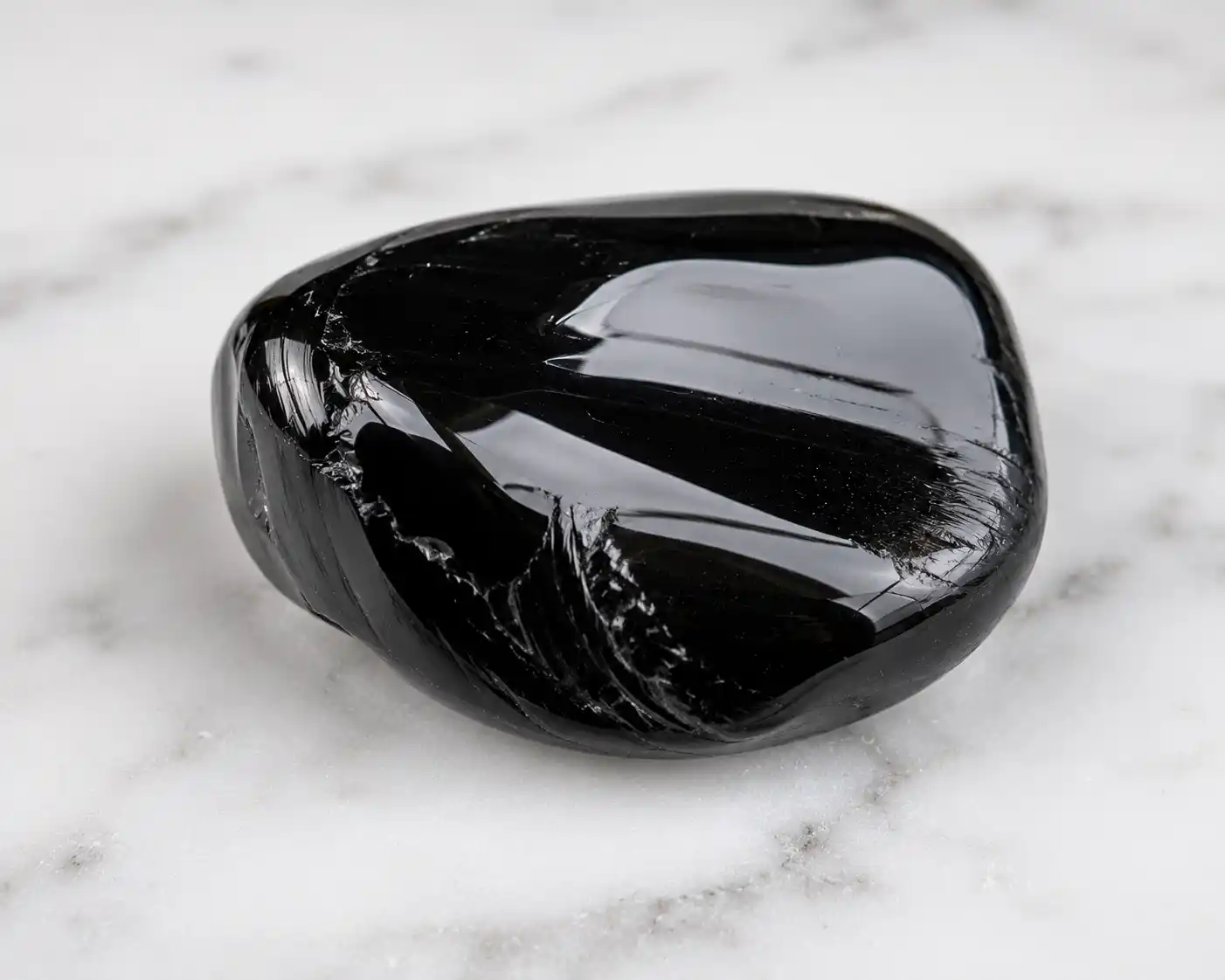
Freshly broken black obsidian commonly displays a smooth, curved conchoidal fracture. This fracture pattern resembles the curved surfaces produced when manufactured glass breaks. Because no regular crystal cleavage controls the break, force can propagate through the glass in ways that create thin, sharp edges.
Its black color does not mean the glass is necessarily completely opaque in every thin section. Some obsidian reveals brownish, smoky, or translucent edges when held against strong light. Other varieties contain bubbles, crystallites, or mineral inclusions that produce snowflake, mahogany, golden-sheen, silver-sheen, or rainbow effects.
These differences make obsidian useful for comparing volcanic textures and learning why outward color alone cannot define every rock. Black obsidian benefits collectors and students because a seemingly simple dark stone can introduce concepts involving magma composition, cooling rate, glass formation, fracture behavior, inclusions, and volcanic history.
Sharp Fracture Made Obsidian an Important Human Tool Stone
Few black obsidian benefits have stronger historical evidence than its usefulness for cutting. Conchoidal fracture allows experienced knappers to remove flakes in controlled ways, producing edges much sharper than those typically found on ordinary broken rocks. Archaeological evidence from many regions documents obsidian knives, scrapers, projectile points, blades, and other implements.
At Yellowstone, for example, geological obsidian sources supplied stone that people used for tools over long periods. Research on archaeological obsidian also demonstrates how artifacts can travel far from the volcanic source where the stone originated.
That history makes black obsidian valuable for understanding technological skill. Producing an effective tool required far more than simply breaking glass. Knappers selected suitable pieces, understood fracture behavior, controlled striking angles, and shaped edges according to intended use.
Modern flintknappers still study obsidian because its predictable fracture clearly reveals how force travels through brittle stone. This practice should be approached cautiously. Fresh obsidian flakes can cause serious cuts, and tiny fragments may be difficult to see. Eye protection, controlled work areas, appropriate gloves when handling waste, and safe disposal of flakes are more important than treating knapping as a casual craft.
The historical significance of obsidian comes from human knowledge applied to the stone, not from mystical properties hidden inside it.
Archaeology Turns Obsidian into a Record of Ancient Movement
Another remarkable black obsidian benefit comes from geochemistry. Obsidian from different volcanic sources can carry distinctive chemical signatures. Archaeologists can compare those signatures with artifacts recovered from archaeological sites and determine where the volcanic glass originally came from.
This process helps researchers investigate movement and exchange. Obsidian artifacts found far from their geological source may indicate trade, travel, social connections, or repeated use of particular landscapes. Research in Southeast Alaska, for example, has connected archaeological obsidian tools with identifiable source areas and long-distance transport.
This scientific value gives a small archaeological flake significance far beyond its appearance. Its chemistry may contribute evidence about how people interacted with landscapes and with one another.
Collectors should also recognize the ethical implications. Archaeological artifacts lose important context when removed illegally or without documentation. An artifact is not simply an attractive piece of black glass. Its location, surrounding objects, layer, and relationship with a site can carry information that disappears when the object is disturbed.
For modern collectors, commercially obtained geological specimens provide a much more responsible way to appreciate black obsidian benefits without damaging archaeological sites or cultural heritage.
Jewelry, Carving, and Polishing Reveal Obsidian’s Decorative Side
Black obsidian can take a glossy polish that gives jewelry and carvings a sleek, almost mirror-like appearance. Cabochons, beads, pendants, earrings, small carvings, decorative spheres, and display pieces make use of this smooth finish. The neutral black color also pairs easily with silver-colored metals, gold tones, wood, leather, and brightly colored gems.
Decorative use is one of the most accessible black obsidian benefits because it depends on observable craftsmanship. A carefully polished cabochon may show an even glassy surface, clean curves, and subtle translucency at thin edges. A carving may take advantage of the contrast between polished and matte areas to create depth.
Obsidian is not ideal for every jewelry situation. Its glassy structure means that it can chip or fracture when struck. Hardness alone does not describe this vulnerability. A ring worn during heavy work can hit a countertop, doorframe, or tool and develop a chip, while pendants and earrings generally receive less impact.
Broken jewelry deserves caution because a chipped edge can become extremely sharp. Owners should stop wearing damaged pieces until they can be inspected or repaired. These practical limitations are part of understanding black obsidian benefits responsibly rather than treating the stone as indestructible because of its dramatic appearance.
Black Obsidian Helps Explain the Difference Between Rock and Crystal
Marketing language frequently calls black obsidian a crystal, but geologically it is volcanic glass rather than a crystalline mineral. That distinction gives the stone educational value. Obsidian forms without the extensive ordered crystal structure that defines minerals such as quartz, tourmaline, garnet, or feldspar.
For beginners, this makes black obsidian an excellent comparison specimen. Its smooth glassy luster can be contrasted with the crystal faces of quartz, the cleavage of feldspar, or the granular textures of many rocks. Fresh fracture surfaces are particularly informative because their curved, shell-like shape differs from crystal cleavage planes.
Confusion becomes more likely when black glass manufactured by people is sold as natural obsidian. Color alone cannot reliably establish origin. Bubbles, flow structures, inclusions, fracture texture, density, optical behavior, provenance, and professional gemological examination may all become relevant depending on the specimen.
A person deciding where to buy black obsidian should therefore prioritize accurate identification, clear disclosure, natural-looking variation where appropriate, and realistic claims rather than assuming every glossy black object is volcanic glass.
Comparing Black Obsidian with Other Dark Stones Prevents Identification Mistakes
Black gemstones can look surprisingly similar in photographs. Obsidian, black tourmaline, onyx, dyed glass, jet, and other dark stones may all appear nearly black under ordinary lighting, yet they differ significantly in formation, structure, hardness, fracture, density, and surface character.
Obsidian’s glassy luster and conchoidal fracture are particularly useful clues. Black tourmaline, by contrast, is a crystalline mineral and often shows lengthwise striations on natural crystal surfaces. Those distinctions become especially important when rough specimens are sold without reliable labels.
Understanding black tourmaline vs obsidian involves looking beyond color to crystal structure, texture, hardness behavior, fracture, and geological origin. A polished cabochon can make identification more difficult because cutting removes many natural surface features, which is why seller provenance and gemological testing sometimes matter.
Identification itself is one of the practical black obsidian benefits for collectors. Learning to distinguish volcanic glass from crystalline dark stones builds observation skills that transfer to many other gemstones and rocks.
It also protects buyers from exaggerated pricing. A compelling spiritual story cannot establish whether a piece is natural obsidian, manufactured glass, or another black gem. Physical evidence must do that work.
Modern Black Obsidian Benefits Include Symbolic Reflection, Not Proven Healing
Modern spiritual practice frequently describes black obsidian as a stone of grounding, protection, truth, shadow work, energetic cleansing, and emotional release. These ideas form an important part of contemporary crystal culture, but they should not be confused with the stone’s geological or archaeological properties.
Symbolism can still have personal value. A highly reflective polished surface may represent honest self-examination. Black color can symbolize privacy, boundaries, seriousness, or steadiness. Volcanic origin may suggest change, heat, transformation, or the idea that difficult conditions can produce something visually striking.
Someone might place black obsidian on a desk as a reminder to address uncomfortable facts, carry a polished stone while practicing clearer boundaries, or use it during journaling about habits they want to change. The actions come from the individual. The stone serves as a cue.
Claims surrounding black obsidian healing properties may discuss emotional or energetic themes, but there is no established evidence that obsidian treats illness, removes toxins, cures psychological disorders, improves circulation, or extracts harmful substances from the body.
Keeping that boundary clear allows symbolism to remain meaningful without asking volcanic glass to perform medical functions.
Collecting Black Obsidian Encourages Attention to Geological Variation
Not all obsidian looks the same, which makes collecting another practical source of black obsidian benefits. Pure-looking dark pieces may appeal to collectors interested in classic volcanic glass, while other varieties contain patterns created by inclusions, bubbles, flow structures, oxidation, or crystallization.
Snowflake obsidian contains pale crystal aggregates that produce its familiar spotted appearance. Mahogany obsidian combines dark glass with reddish-brown regions. Sheen obsidians can display metallic-looking or colorful optical effects caused by microscopic structures or inclusions.
Even apparently simple black specimens can vary in transparency, luster, fracture, flow banding, and associated volcanic rock. Locality information makes these differences more informative because it connects an individual specimen with a geological setting.
Collectors should favor legal, well-documented sources and avoid removing specimens from protected areas. Obsidian deposits can also have cultural significance, so collecting rules may involve more than ordinary property ownership.
A labeled geological specimen with reliable locality information can provide more long-term educational value than an anonymous polished piece marketed primarily through spiritual claims. Both can be attractive, but documentation adds another layer of meaning.
Safe Handling Is an Essential Part of Enjoying Black Obsidian
Safety belongs among real black obsidian benefits because the stone teaches a useful lesson about the difference between beauty and toughness. A polished surface may feel smooth and harmless, while a fresh fracture can produce edges sharp enough to cause deep cuts.
Rough specimens should be handled carefully, especially when they already contain thin flakes or damaged margins. Loose chips should not be left where children or pets can encounter them. Knapping waste deserves the same caution as broken glass and should be contained before disposal.
Jewelry requires gentler treatment than many owners expect. Avoid dropping obsidian pieces onto tile, concrete, stone countertops, or other hard surfaces. Store them separately from harder jewelry that can scratch polished surfaces. Mild soap, lukewarm water, and a soft cloth are generally sufficient for routine cleaning of stable pieces, while aggressive impact cleaning methods offer little advantage.
Black obsidian should never be ground, drilled, or cut without appropriate equipment, ventilation, eye protection, and control of airborne dust and fragments. Finished jewelry does not present the same handling concern as active lapidary work, but fabrication requires proper workshop practices.
Responsible care preserves both appearance and physical safety, making it a more meaningful black obsidian benefit than any claim of invisible protection.
Conclusion
Black obsidian benefits include far more than modern spiritual associations. Natural volcanic glass records rapid cooling, fractures into exceptionally sharp edges, preserves evidence of ancient technology, allows archaeological sourcing, accepts a high polish, supports jewelry and decorative work, teaches rock identification, rewards collecting, and provides a striking object for personal symbolism.
Its cultural importance comes from how people learned to work, exchange, value, and interpret the stone across different places and periods. Modern ideas about protection, grounding, and self-reflection can remain part of black obsidian benefits when they are treated as symbolic beliefs rather than medical facts. Understanding what obsidian actually is makes the stone more interesting, not less mysterious.
FAQs
What are the main black obsidian benefits?
The most verifiable black obsidian benefits include geological education, sharp controlled fracture, archaeological importance, source analysis, jewelry and carving use, collecting, identification practice, and personal symbolism.
Is black obsidian a crystal?
No. Obsidian is natural volcanic glass rather than a crystalline mineral, although it is often called a crystal in commercial and spiritual contexts.
Why does black obsidian break into such sharp edges?
Its glassy structure produces conchoidal fracture, allowing curved fracture surfaces and extremely sharp edges to form when the stone breaks.
Was black obsidian really used for ancient tools?
Yes. Archaeological evidence from many regions documents obsidian blades, projectile points, scrapers, and other implements. Its sharp fracture made it highly useful for skilled stone workers.
Can archaeologists identify where obsidian came from?
Often, yes. Chemical signatures can distinguish many geological obsidian sources, allowing researchers to compare artifacts with source deposits and study ancient movement and exchange.
Is black obsidian good for jewelry?
Yes, especially for pendants, earrings, beads, and protected designs. It can take a glossy polish, but it is brittle enough to chip or fracture under hard impact.
Does black obsidian protect against negative energy?
Protection is a modern spiritual association rather than a scientifically demonstrated property of volcanic glass. Some people use the stone symbolically to represent boundaries, caution, or self-possession.
Can black obsidian heal the body?
There is no established medical evidence that black obsidian treats disease, detoxifies the body, improves circulation, relieves pain, or cures mental-health conditions.
How can I use black obsidian safely?
Handle rough or broken pieces carefully, keep sharp chips contained, protect jewelry from hard impacts, and use proper safety equipment during cutting, drilling, or knapping.
Black obsidian benefits associated with healing, energy, or emotional effects belong to spiritual and personal belief and should not replace qualified medical or mental-health care.