Black Tourmaline Benefits: 7 Real Uses, Gentle Symbolism & Verified Facts
Black tourmaline benefits extend well beyond the protection claims commonly associated with the stone. Most black tourmaline encountered by collectors is iron-rich schorl, a member of the complex tourmaline mineral group. Its dark color, strongly striated crystals, trigonal structure, hardness, geological usefulness, electrical properties, and ability to occur in striking mineral specimens make it valuable for collecting, jewelry, mineral identification, geology, and education.
Tourmaline is unusual because it can become electrically charged when heated or subjected to pressure. These pyroelectric and piezoelectric behaviors are genuine physical properties, although they do not mean a black tourmaline crystal creates a healing field around a person. The difference matters because interesting science is sometimes repackaged into claims about electromagnetic protection, detoxification, or invisible energy that the evidence does not support.
Modern spiritual traditions add themes of grounding, protection, boundaries, and steadiness to black tourmaline benefits. Those ideas can serve as personal symbolism, but the strongest reasons to appreciate the stone remain observable. A well-formed schorl crystal can reveal crystal growth, geological conditions, chemistry, fracture, surface texture, and natural associations with minerals such as quartz, feldspar, or mica.
7 Black Tourmaline Benefits at a Glance
- Distinctive crystal form makes black tourmaline valuable for mineral collecting and identification.
- Hardness around 7 to 7.5 makes many polished pieces suitable for jewelry with sensible care.
- Schorl can preserve useful geological information about the environment in which it formed.
- Pyroelectric and piezoelectric behavior provides a memorable introduction to real mineral physics.
- Strong natural striations and dark color help students distinguish tourmaline from several other black stones.
- Rough crystals, polished pieces, carvings, and jewelry provide versatile decorative and lapidary uses.
- Modern protection and grounding symbolism can support personal intention when kept separate from medical claims.
Black Tourmaline Benefits Begin with the Complex Tourmaline Mineral Group
Tourmaline is not a single simple mineral with one fixed chemical formula. It is a group containing multiple recognized mineral species whose chemistry can vary substantially. Elements can substitute into different positions within the crystal structure, contributing to the remarkable range of tourmaline colors and geological associations.
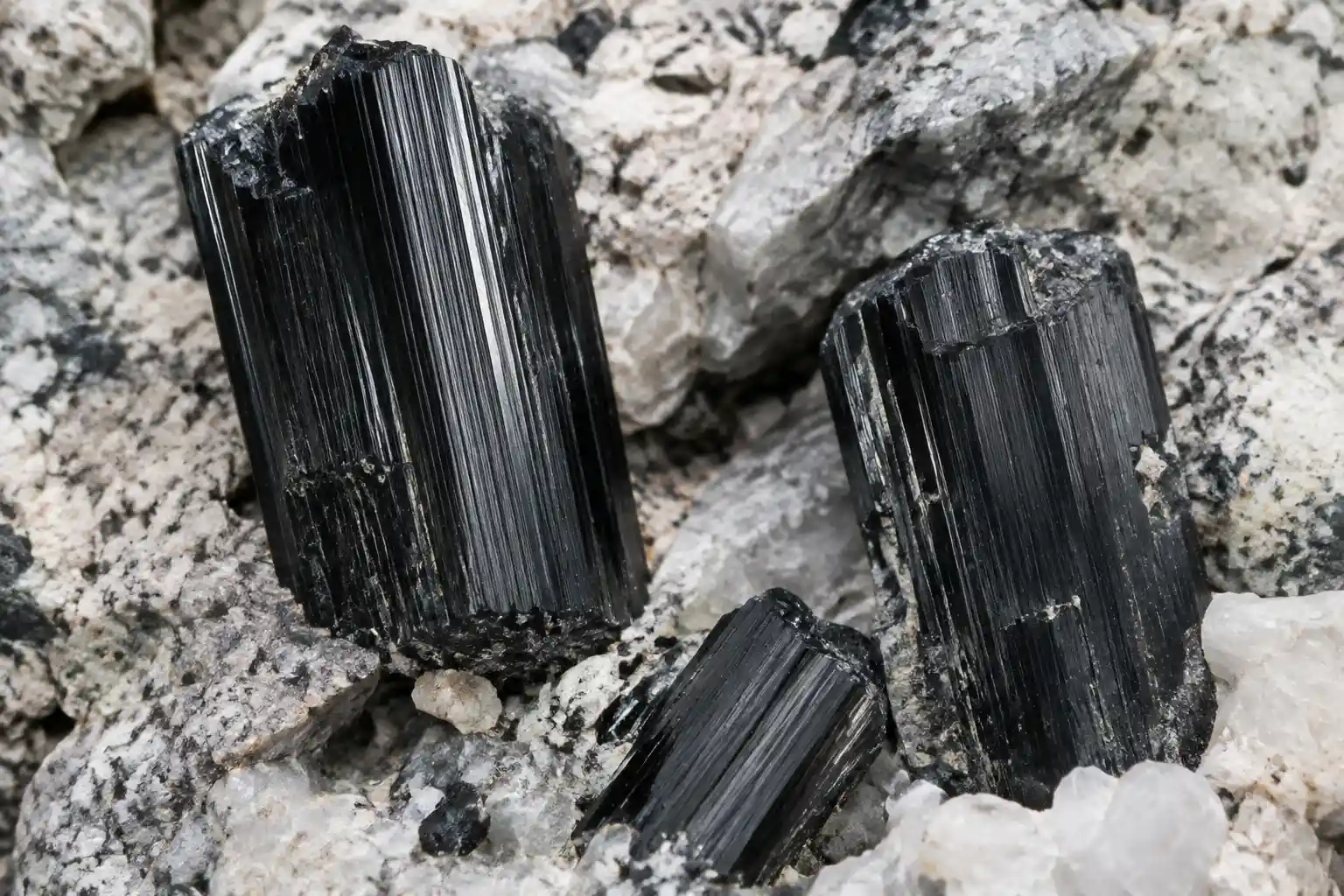
Black tourmaline sold in mineral shops is commonly schorl, an iron-rich tourmaline species. Schorl is typically black to bluish-black or brownish-black and belongs to the trigonal crystal system. Natural crystals often grow as elongated prisms marked by prominent lengthwise striations, giving rough pieces a recognizable ridged appearance.
These features create several practical black tourmaline benefits for students and collectors. A beginner can learn to examine crystal habit, luster, surface texture, hardness, fracture, and host rock instead of identifying a stone by color alone. A more experienced collector may study how schorl occurs in granitic pegmatites, metamorphic rocks, or other geological environments.
The chemistry can also provide information about geological processes. Tourmaline is unusually resistant to chemical alteration, and its composition can preserve clues about the fluids and conditions present while it formed. That makes tourmaline useful in geological research as well as attractive in a display case.
Durability Makes Black Tourmaline Practical for Jewelry and Everyday Objects
Tourmaline generally ranks around 7 to 7.5 on the Mohs hardness scale, giving many black tourmaline pieces better scratch resistance than softer gems such as opal, calcite, or fluorite. This durability is one of the clearest black tourmaline benefits for jewelry, beads, polished stones, and small carvings.
Hardness does not mean the stone cannot break. Tourmaline has only fair toughness, and long crystals can fracture if dropped or struck sharply. Rough schorl may also contain natural fractures or areas attached to softer host rock. Rings and bracelets therefore deserve more care than pendants or earrings because hands and wrists receive more frequent impacts.
Black tourmaline works especially well in designs that preserve some of the natural crystal shape. Wire-wrapped pendants, crystal-point jewelry, polished cabochons, beads, and carved forms can all emphasize different qualities. Rough pieces highlight natural striations and growth, while polished surfaces reveal the dense black appearance and vitreous luster.
Warm, soapy water is the safest general cleaning method. High heat and sudden temperature changes should be avoided, and ultrasonic or steam cleaning is not the best default, particularly when the stone contains fractures or inclusions.
Practical black tourmaline benefits therefore include durability, visual versatility, and an appearance that works in both natural-specimen and finished-jewelry designs.
Schorl Gives Collectors a Window into Pegmatites and Metamorphic Rocks
Collecting is one of the most lasting black tourmaline benefits because schorl can form impressive crystals in a variety of geological settings. It is common in granitic pegmatites, where crystals may occur with quartz, feldspar, mica, and other minerals. Tourmaline can also occur in metamorphic rocks, making its geological associations diverse enough to support substantial mineral study.
Pegmatites are especially interesting because slow crystallization and volatile-rich fluids can allow unusually large crystals to develop. A black tourmaline crystal emerging from pale feldspar or quartz creates strong visual contrast and can preserve relationships between several minerals within the same specimen.
Collectors often value complete terminations, strong luster, clear striations, unusual crystal groups, interesting host-rock associations, and reliable locality information. Size alone does not determine quality. A smaller crystal with excellent form and an intact termination may be more attractive than a much larger specimen with heavy damage or repairs.
This geological context adds substance to black tourmaline benefits. The stone becomes more than a dark crystal sold for metaphysical use. It becomes evidence of crystal growth, changing fluid chemistry, pressure, temperature, and the development of the rock around it.
A labeled specimen with trustworthy locality information can therefore provide educational value for decades, especially when its geological associations remain intact.
Real Electrical Properties Make Tourmaline Scientifically Interesting
Tourmaline’s electrical behavior is one of the most fascinating black tourmaline benefits because it is both real and frequently misunderstood. Tourmaline can develop electrical charges when heated, a property known as pyroelectricity. Mechanical stress can also produce electrical polarization through piezoelectric behavior.
Historically, these properties attracted attention because heated tourmaline could attract small particles such as dust. The effect is still noticeable in practical settings, where tourmaline can acquire a slight surface charge under certain conditions.
These scientific facts sometimes become exaggerated in gemstone marketing. Pyroelectric and piezoelectric properties do not demonstrate that wearing black tourmaline shields the human body from electronics, removes harmful radiation, neutralizes Wi-Fi, or treats health problems. A measurable mineral property cannot simply be transferred into a medical claim without supporting evidence.
The distinction actually makes black tourmaline benefits more interesting. A small crystal can introduce concepts from crystallography, electricity, pressure, temperature, and atomic structure. Students can see how symmetry and crystal structure influence physical behavior while also learning why scientific terminology needs careful interpretation.
Tourmaline does not need an invented protective mechanism to be remarkable. Its real electrical characteristics already place it among the more memorable minerals encountered in gemology and mineralogy.
Identification Skills Help Separate Black Tourmaline from Similar Dark Stones
Black stones can look deceptively alike in photographs. Schorl, obsidian, onyx, black spinel, jet, dark glass, and other gems may appear almost identical under weak lighting, which makes identification another practical source of black tourmaline benefits.
Rough schorl commonly shows long prismatic crystals and strong parallel striations running along the crystal. Obsidian is natural volcanic glass and lacks the same crystal structure, while polished onyx has different optical and structural characteristics. Glass imitations may copy the color but do not reproduce the natural crystal habit of a well-formed tourmaline specimen.
The differences between black tourmaline and obsidian become especially clear when crystal structure, fracture, hardness, luster, natural surface features, and geological origin are considered together. This is far more reliable than deciding that every glossy black stone belongs to the same category.
Exact species identification within the tourmaline group can be more difficult. A black crystal may look like schorl while precise chemical classification requires advanced analytical testing. Buyers should therefore be cautious when ordinary appearance is used to support highly specific chemical claims.
Developing these identification habits is one of the most transferable black tourmaline benefits because the same observational discipline applies to many gemstones.
Responsible Buying Protects the Geological and Collecting Value
Commercial popularity has made black tourmaline widely available, but quality and representation vary. Some sellers offer natural terminated crystals, others sell broken rough, polished pieces, beads, carvings, repaired specimens, or tourmaline still attached to host rock. None of these forms is automatically superior. Their suitability depends on what the buyer wants.
A collector deciding where to buy black tourmaline should examine crystal form, damage, repairs, locality claims, host-rock relationships, seller disclosure, and whether photographs show the actual specimen. A jewelry buyer may care more about polish, secure setting, durability, dimensions, and comfort.
Claims of exceptional rarity deserve scrutiny because ordinary black schorl is widely distributed. Particular localities, crystal habits, associations, sizes, or specimen qualities can certainly be scarce, but black color alone does not make a tourmaline rare.
Heavy spiritual marketing should not replace identification. A seller describing a crystal as highly protective, cleansing, electromagnetic, or detoxifying has not provided evidence of mineral identity or specimen quality.
Black tourmaline benefits are easier to appreciate when the stone is represented honestly. A common but beautifully formed crystal can provide more collecting satisfaction than an aggressively marketed specimen carrying unsupported claims.
Jewelry, Display, and Lapidary Uses Give Black Tourmaline Practical Versatility
Another advantage among black tourmaline benefits is the variety of ways the mineral can be enjoyed. Natural crystals can be displayed without cutting, especially when the termination and striations are attractive. Broken rough may be polished, drilled, carved, or incorporated into decorative objects, while suitable pieces can become cabochons, beads, pendants, or other jewelry.
The deep neutral color gives black tourmaline strong design flexibility. It pairs easily with silver-colored metals, yellow gold, copper tones, leather, quartz, and brightly colored gems. Rough surfaces can create an organic look, while polished forms appear more formal and understated.
Lapidary work still requires care. Tourmaline may contain fractures, inclusions, or structural weaknesses that become important during sawing, grinding, drilling, or setting. Professional dust control, eye protection, and appropriate workshop procedures should be used whenever stone is cut or ground.
For display specimens, gentle handling preserves natural crystal surfaces better than repeated rubbing or aggressive cleaning. Dust can usually be removed with soft tools and mild cleaning appropriate to the specimen and its associated minerals.
These practical uses make black tourmaline benefits relevant even for people with no interest in metaphysical traditions.
Modern Protection and Grounding Symbolism Should Remain Symbolic
Protection is probably the best-known spiritual association attached to black tourmaline benefits. Modern crystal practice often describes the stone as grounding, protective, cleansing, stabilizing, or capable of absorbing negative energy. These themes may have personal meaning, but they are not established medical or physical effects.
Protection can be interpreted more realistically as a symbol of boundaries. A person may keep black tourmaline near a workspace as a reminder to protect focused time, wear a pendant while practicing clearer limits in relationships, or use a polished stone during reflection about responsibilities that have become excessive.
Grounding can likewise describe practical attention rather than invisible energy. Someone might use a stone as a tactile cue to notice immediate surroundings, slow down before reacting, identify what can actually be controlled, or return attention to one task.
Claims about black tourmaline healing properties often go further by discussing energy, emotional wellness, or bodily effects. Those ideas belong to spiritual belief and should not be presented as evidence that the mineral treats anxiety disorders, pain, circulation problems, neurological conditions, infections, hormonal concerns, or other medical issues.
Symbolism remains useful when agency stays with the person rather than the stone.
Important Cautions Keep Black Tourmaline Benefits Realistic
Black tourmaline’s popularity has encouraged several claims that go beyond available evidence. The stone’s electrical properties do not prove that it protects people from household electromagnetic fields. Its iron content does not make it a nutritional source of iron. Holding or wearing schorl does not detoxify the body, improve organ function, or remove harmful substances from the bloodstream.
Physical handling is generally straightforward, but rough crystals can have pointed terminations or sharp broken edges. Large specimens should be placed securely, especially around children or pets. Jewelry with fractured stones should be inspected because damaged sections can loosen or chip further.
Owners should also remember that natural crystals vary. Some schorl is dense and solid, while other pieces contain fractures, weathered surfaces, mica attachments, or host-rock sections that require gentler handling. One care rule cannot describe every complex specimen.
These cautions do not reduce black tourmaline benefits. They separate what is demonstrable from what is promotional. Schorl remains an attractive, geologically informative, electrically interesting, durable, and versatile member of the tourmaline group without needing exaggerated claims.
Conclusion
Black tourmaline benefits include distinctive crystal form, useful hardness, geological importance, genuine pyroelectric and piezoelectric behavior, identification value, collecting interest, jewelry versatility, and meaningful personal symbolism. Most black tourmaline sold to collectors is iron-rich schorl, a scientifically interesting member of one of gemology’s most chemically complex mineral groups.
Modern beliefs about grounding and protection can remain part of the experience when they are treated as symbolism rather than health effects or invisible shielding. Understanding the mineral’s actual chemistry, crystal habit, durability, electrical behavior, geological setting, and care requirements gives black tourmaline benefits a much stronger foundation than unsupported claims ever could.
FAQs
What are the main black tourmaline benefits?
The most verifiable black tourmaline benefits include mineral collecting, jewelry use, geological education, mineral identification, real electrical properties, durable polished forms, and personal symbolism.
Is black tourmaline the same as schorl?
Much of the black tourmaline sold commercially is schorl, an iron-rich species in the tourmaline group. Precise species identification can require chemical analysis because appearance alone does not always provide certainty.
Is black tourmaline durable?
Tourmaline generally ranks about 7 to 7.5 on the Mohs scale, offering useful scratch resistance. Its toughness is only fair, so hard impacts and sudden temperature changes can still cause damage.
Does black tourmaline really become electrically charged?
Tourmaline can develop electrical polarization when heated or mechanically stressed. These pyroelectric and piezoelectric properties are genuine mineral physics.
Does black tourmaline block electromagnetic radiation?
Its electrical properties do not establish that wearing or placing black tourmaline near electronics protects the human body from electromagnetic fields. Claims of this kind require evidence beyond the mineral’s pyroelectric or piezoelectric behavior.
How can I identify rough black tourmaline?
Natural schorl often forms elongated prismatic crystals with strong lengthwise striations and a vitreous luster. Exact identification should consider structure, hardness, fracture, associated minerals, and professional testing when necessary.
Can black tourmaline be worn every day?
Many black tourmaline jewelry pieces are suitable for regular wear with reasonable care. Avoid hard impacts, high heat, steam cleaning, ultrasonic cleaning, and activities likely to chip or fracture the stone.
What does black tourmaline symbolize?
Modern symbolism commonly emphasizes grounding, protection, boundaries, steadiness, and self-possession. These are personal or spiritual interpretations rather than scientifically demonstrated effects.
Does black tourmaline have medical benefits?
There is no established evidence that black tourmaline treats disease, pain, anxiety disorders, circulation problems, hormonal conditions, neurological disorders, infections, or other medical concerns.
Black tourmaline benefits associated with healing, energy, or protection remain spiritual and personal beliefs and should not replace qualified medical or mental-health care.