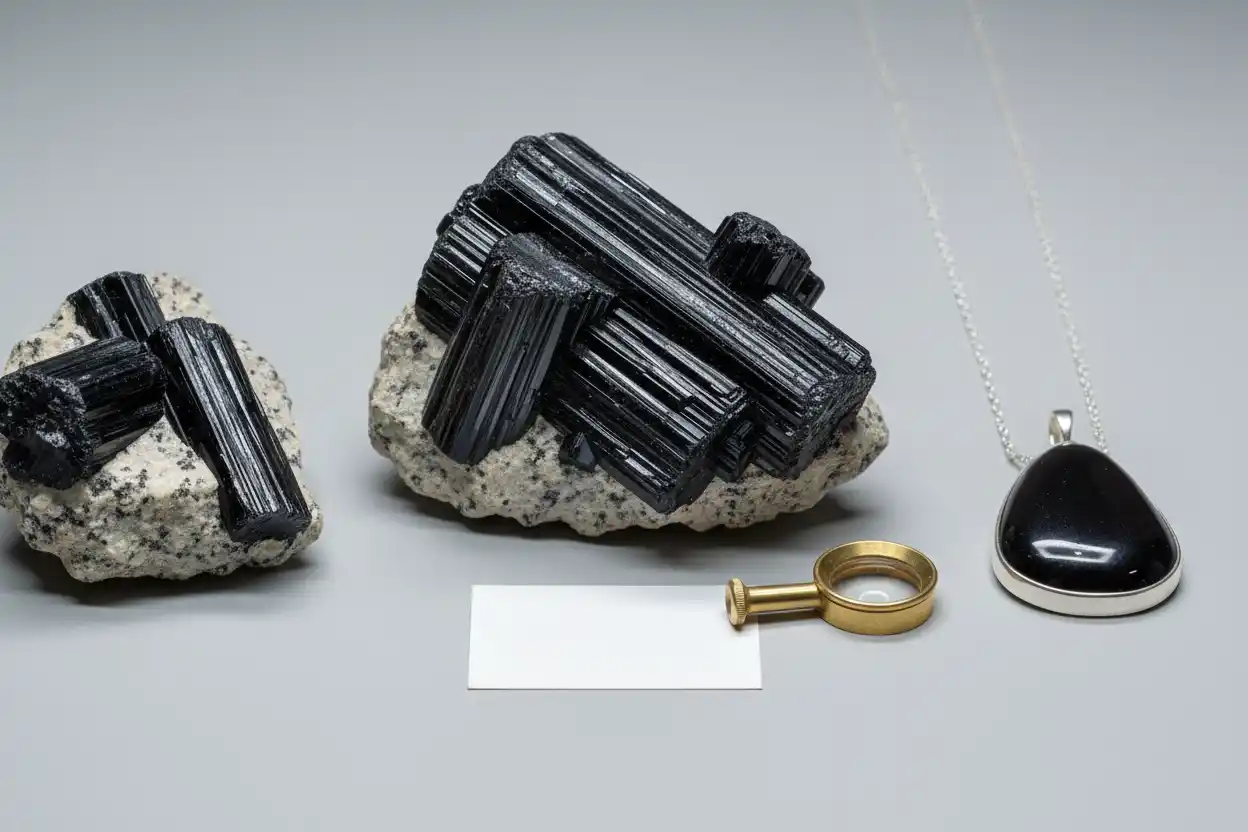
Where to Buy Real Black Tourmaline and Avoid Fakes
Black tourmaline is abundant in many mineral markets, yet the commercial label can hide several different realities. A listing may contain genuine schorl, another dark tourmaline-group mineral, a tourmaline-bearing rock, black amphibole, dyed quartz, glass, resin or a reconstructed cluster.
Most retail black tourmaline is called schorl because schorl is the common iron-rich black member of the tourmaline group. However, color does not establish species. Dravite, foitite and other tourmalines can appear dark, and precise species identification may require chemical analysis rather than visual inspection.
The planned black tourmaline meaning guide owns the variety’s symbolism and traditional uses. This buying guide instead concentrates on mineral identity, crystal form, seller disclosure, repairs, jewelry quality and the limits of home testing.
Know What You Are Buying
Tourmaline is a group of related boron-bearing silicate minerals rather than one chemically uniform species. Members share a trigonal crystal structure but differ in composition.
Schorl is typically iron-rich and black. It commonly forms elongated prisms with strong longitudinal striations and a triangular or rounded-triangular cross-section. Crystals may occur singly, in parallel groups, in radiating aggregates or within quartz and feldspar-rich pegmatite.
Not every dark tourmaline is schorl. Therefore, a responsible seller should distinguish among a confirmed species, a likely field identification and a general trade label.
| Listing term | Reasonable interpretation |
|---|---|
| Schorl | The seller has mineralogical evidence or credible locality-based identification |
| Black tourmaline | A dark tourmaline-group material sold under the accepted trade term |
| Black tourmaline in matrix | Tourmaline crystals occur within quartz, feldspar or another host |
| Tourmaline-bearing rock | The object contains tourmaline but is not a single solid crystal |
| Black crystal | Too vague to establish mineral identity |
The tourmaline family guide explains the group’s broader mineralogy, while the types of tourmaline guide separates major varieties.
Choose the Right Product Form
| Product | Best seller | Main buying risk |
|---|---|---|
| Individual crystal | Mineral dealer | Broken termination, repair, incorrect species and weak locality data |
| Cluster or matrix specimen | Specialist dealer or mineral show | Glued crystals, unstable matrix and reconstructed display |
| Rough chunk | Lapidary or mineral supplier | Mixed host rock, hidden fractures and misidentified amphibole |
| Polished tower or sphere | Lapidary retailer | Resin, filled fractures and low tourmaline content |
| Beads | Reputable bead supplier | Dyed quartz, glass, resin and drill-hole fractures |
| Pendant or cabochon | Jeweler or lapidary | Backing, glue, surface coating and durability |
| Large display piece | Mineral dealer with shipping experience | Structural fractures and concealed restoration |
Crystal collectors need precise condition and locality information. Jewelry buyers should place greater emphasis on stability and setting construction.
Where to Buy Genuine Black Tourmaline
Specialist mineral dealers
A mineral dealer is the most reliable source for well-formed schorl crystals, matrix specimens and documented localities. Good listings state the dimensions of the whole specimen and the largest visible crystal rather than quoting only weight.
Ask whether the termination is complete, whether crystals have been reattached and whether the matrix has been stabilized. A black crystal glued upright onto a decorative base may still be genuine, but it should not be represented as naturally freestanding.
Gem and mineral shows
At a show, examine the cross-section and striations. Tourmaline prisms commonly have three-sided symmetry, although weathering, breakage and intergrowth can obscure the form.
Turn the specimen over. Reconstructed clusters often reveal excess adhesive or filler at the base. Meanwhile, natural matrix specimens should show crystals entering the host rock rather than merely resting on it.
Established online sellers
The seller should show the exact specimen from several angles, including the termination and base. Highly cropped front photographs can hide repairs and broken backs.
The online gemstone buying guide explains seller verification and payment protection. For black tourmaline, require a realistic condition report because dark surfaces can conceal cracks in photographs.
Lapidary suppliers
Lapidary suppliers may offer massive black tourmaline, slabs and tourmaline-bearing rock. Ask how much of the object is tourmaline and which minerals form the matrix.
A tower carved from quartz and black tourmaline inclusions is not the same as a tower cut from one solid tourmaline crystal. Both can be natural, but the description and price should reflect the construction.
Jewelry retailers
Black tourmaline jewelry is usually made from rough prisms, polished cabochons, beads or included rock. The retailer should identify whether the piece is solid tourmaline, tourmaline in quartz or an assembled product.
The general tourmaline buying guide covers colored gem-quality tourmaline. Black opaque material has a different market, so colored-stone grading terms should not be applied mechanically.
What Genuine Black Tourmaline Looks Like
Natural black tourmaline commonly appears vitreous to resinous, with parallel striations running along elongated crystals. Freshly broken surfaces can show conchoidal to uneven fracture, while the exterior may be dull from weathering.
Many crystals are not perfectly smooth. Growth interruptions, matrix contacts, corrosion, chips and natural surface textures can occur. Completely flawless prisms with identical grooves deserve closer inspection, especially when numerous pieces share exactly the same shape.
Thin edges can appear brown, reddish brown or greenish under intense transmitted light, depending on species and composition. Thick schorl usually remains opaque.
Some black tourmaline is strongly fractured. This is particularly relevant for large crystals from pegmatites, where internal stress and extraction damage can leave seemingly solid pieces vulnerable to splitting.
Schorl Versus Other Dark Tourmalines
Schorl is the most common name attached to black tourmaline, but dark dravite, foitite and compositionally intermediate tourmalines also exist. Visual features often identify the tourmaline group more easily than an exact species.
Locality and host rock can support an identification. For example, an iron-rich black crystal in granitic pegmatite may reasonably be called schorl based on established occurrence. Nevertheless, laboratory confirmation may still be required for scientifically important specimens.
A retailer should not invent a rare species name to increase value. Conversely, describing an untested dark crystal simply as black tourmaline can be appropriately honest.
Black Tourmaline Versus Obsidian
Obsidian is volcanic glass without a natural prismatic crystal form. Black tourmaline is crystalline and commonly displays longitudinal striations and three-sided symmetry.
Polished objects can obscure those distinctions. The planned black tourmaline versus obsidian guide will own the detailed comparison, while the black obsidian guide provides context for the glassy alternative.
A glossy black surface alone cannot establish either material.
Black Tourmaline Versus Amphibole
Hornblende and other dark amphiboles can form elongated black crystals. They may occur in metamorphic or igneous rocks and can look similar to tourmaline in low-resolution photographs.
Tourmaline commonly shows triangular cross-sections and strong lengthwise striations. Amphiboles tend to display different cleavage angles and cross-sections, but broken or weathered pieces can remain ambiguous.
Do not perform destructive cleavage tests. Raman spectroscopy, X-ray diffraction or expert microscopy offers a safer route when identity affects price.
Black Tourmaline Versus Aegirine
Aegirine can form dark green to black elongated crystals, often in alkaline rocks. Its crystal shape, luster and host associations differ from schorl, yet polished or damaged pieces may be mislabeled.
Aegirine crystals can appear more sharply bladed, while tourmaline typically forms striated prisms. However, photographs alone are not always enough.
Glass, Resin and Molded Imitations
Black glass can imitate polished tourmaline beads and smooth towers. Round gas bubbles, flow lines, mold seams and uniform glassy surfaces support a manufactured origin.
Resin casts may copy a striated prism but often have rounded grooves, repeated surface details and a molded base. Embedded glitter or chips may be used to create a “natural” texture.
Some molded products contain crushed real tourmaline mixed with resin. Such composites should be sold as reconstituted or tourmaline-containing material rather than solid natural crystals.
Glued and Reconstructed Clusters
Natural crystals are sometimes glued together to create fuller clusters. A collector specimen may also have a termination reattached after extraction.
Repairs are not automatically unacceptable. Many important mineral specimens have professional restoration. Nevertheless, a reconstructed decorative cluster differs significantly from one naturally grown in that arrangement.
Look for glossy adhesive, filler bridging unrelated crystals, repeated vertical orientation and a base that conceals every contact point. Ultraviolet light may reveal some adhesives, although fluorescence is not a definitive test.
Treatments and Enhancement
Opaque schorl is not commonly color-enhanced in the same manner as many transparent gems because its black color is already stable and abundant. The more relevant treatments are oiling, waxing, coating, resin stabilization, fracture filling and repair.
Oil can deepen surface luster and disguise pale abrasions. Resin may stabilize a heavily cracked carving or fill pits in a bead. Black pigment can conceal pale filler around repaired crystals.
The gemstone treatment guide explains how treatment disclosure affects care and value.
Do not use heating or pyroelectric behavior as an authenticity test. Tourmaline can develop electrical charge with temperature change, but deliberately heating an unknown specimen can damage coatings, adhesive or the crystal itself.
How to Judge a Crystal
Crystal form
Look for a credible prismatic shape, longitudinal striations and natural variation. A triangular or rounded-triangular cross-section supports tourmaline-group identification, although breakage may obscure it.
Termination
A complete termination adds collector appeal. However, many natural crystals are broken at one end or grew against another mineral. The seller should show the top clearly and distinguish a natural contact from fresh damage.
Surface condition
Natural surfaces may be striated, etched or partly coated by matrix minerals. Heavy artificial polish on a specimen crystal should be disclosed because it changes the natural surface.
Internal fractures
Strong lighting can reveal fractures near thin edges. Ask whether the crystal makes clicking sounds, moves in its matrix or has been stabilized.
Matrix
Quartz, feldspar, mica and other pegmatite minerals may create attractive associations. Matrix should support the crystal rather than conceal extensive glue.
Locality
A precise label can add scientific interest. Still, a country name alone does not prove species or quality.
Evaluating Polished Towers and Spheres
A carved tower may contain solid massive tourmaline, multiple crystals cemented by host rock or a mixed quartz-tourmaline material. Inspect the base and sides for changes in grain and mineral composition.
Polishing can expose pits where softer material pulls away. Minor texture may be natural, but thick resin coating should be stated.
Large spheres require particular scrutiny because hidden fractures may open after a temperature change or impact. Request a rotating video and photographs under ordinary room light.
Buying Beads and Bracelets
Beads should have smooth holes and no radiating cracks. Because black tourmaline is often fractured, poor drilling can create chips that spread during stringing.
A bead strand may include tourmaline-bearing quartz rather than uniformly solid tourmaline. The seller should explain whether variation comes from natural matrix or mixed materials.
The tourmaline bracelet guide discusses strand construction and wear. For black beads, elastic cord should not be pulled so tightly that adjacent beads strike each other continuously.
Buying Pendants, Earrings and Necklaces
Natural crystal pendants should be supported near a stable end. A cap glued onto a fractured termination can detach, especially when the pendant swings against hard surfaces.
Cabochons benefit from bezels that protect their edges. The tourmaline necklace guide and tourmaline earrings guide cover proportions, settings and matching considerations.
For earrings, perfect crystal matching is uncommon. A balanced pair can differ slightly in striation and shape while remaining visually compatible.
Buying Black Tourmaline Rings
Tourmaline has good scratch resistance, but black crystals may contain substantial fractures and remain brittle. An exposed rough prism can catch on clothing or split after a knock.
The tourmaline ring guide addresses setting styles. For black tourmaline, choose a low protected design instead of a tall crystal point.
The gemstone hardness chart places tourmaline near 7 to 7.5, while gemstone toughness versus hardness explains why hardness does not eliminate fracture risk.
Localities and Provenance
Black tourmaline occurs in many regions, including Brazil, the United States, Namibia, Madagascar, Pakistan, Afghanistan and parts of Europe. It forms in pegmatites, granitic rocks and some metamorphic environments.
No single shape proves Brazilian or Namibian origin. An exact locality should come from the supplier, collection label or mine documentation.
Be cautious when ordinary commercial crystals receive a famous-mine label without supporting history. A credible locality statement should be specific enough to be useful but cautious enough to reflect the evidence.
Price and Value
Black tourmaline is generally less valuable per carat than transparent saturated gem tourmaline. However, specimens are not priced primarily by carat.
Value factors include crystal size, form, termination, luster, condition, matrix association, locality, documentation and repair history. A smaller undamaged crystal with an attractive natural termination may be more desirable than a large fractured prism.
Polished objects are priced for usable rough, cutting loss and workmanship. Jewelry cost may depend more on metal and design than on the black tourmaline.
The tourmaline price guide covers the wider family’s value structure. Buyers should not apply Paraíba or fine-color tourmaline pricing logic to opaque schorl.
Seller Questions
Ask whether the seller has identified the material as tourmaline-group, schorl or another species. Determine whether that conclusion comes from analysis, locality or supplier labeling.
Request exact dimensions, photographs of the termination and base, locality information and repair disclosure. Ask whether wax, oil, resin, coating, filler or glue is present.
For polished products, confirm whether the piece is solid tourmaline or tourmaline-bearing rock. For beads, request hole size and information about fractures.
Finally, verify the inspection period and return policy before paying.
Professional Identification
A gemologist may use crystal morphology, refractive index where accessible, specific gravity, microscopy and spectroscopy to establish tourmaline-group identity.
Exact species assignment can require chemical analysis because tourmaline composition is complex. Raman spectroscopy can identify tourmaline, while X-ray diffraction and compositional methods may help distinguish schorl from related members.
Opaque rough crystals may not suit every standard gemological test. Therefore, a mineralogical laboratory is preferable when species accuracy or locality is scientifically important.
Shipping
Large tourmaline crystals should be supported along their length rather than packed with pressure on the termination. Matrix specimens need immobilization inside a rigid inner box.
Beads and polished stones should be wrapped separately because fractures can spread when objects strike one another. Crystal pendants should not travel loose with chains.
Insurance and tracking are sensible for large, well-formed or locality-documented specimens.
Responsible Sourcing
Tourmaline supply chains can pass through miners, local traders, exporters, cutting centers and retailers. A small seller may not possess mine-level documentation, but they should avoid unsupported claims about direct partnerships.
The ethical crystal sourcing guide explains how to assess traceability and labor claims. For specimen purchases, legal collection and accurate locality labeling are especially important.
Cleaning and Storage
A sound untreated tourmaline object can usually be cleaned with lukewarm water, mild soap and a soft brush. Rinse briefly and dry thoroughly.
Avoid ultrasonic and steam cleaning when the crystal is heavily fractured, repaired, filled or attached with adhesive. The completed guide to cleaning tourmaline jewelry provides setting-specific care.
Store crystal specimens so they cannot roll or strike harder objects. Wrapped jewelry should rest in a separate compartment away from diamonds and corundum.
The October birthstone guide offers broader tourmaline context without changing the practical care limits of opaque black material.
Frequently Asked Questions
1. Is black tourmaline always schorl?
No. Schorl is the most common iron-rich black tourmaline, but other tourmaline species can be dark. Exact species identification may require chemical analysis.
2. What shape should real black tourmaline have?
Many natural crystals are elongated and striated with triangular or rounded-triangular cross-sections. Massive or broken material may not preserve an obvious crystal shape.
3. Can black tourmaline be made from glass?
Glass can imitate polished black beads and carvings, but it is not tourmaline. Bubbles, flow lines and mold seams may support a glass identification.
4. Are perfectly smooth black tourmaline points natural?
A naturally terminated crystal can be attractive, but a perfectly smooth geometric point is often polished or carved. The seller should disclose shaping.
5. Is black tourmaline commonly dyed?
Color treatment is not the main concern because natural material is already black. Coating, wax, resin, filler and incorrect identification are more relevant.
6. Does a magnet prove that black tourmaline is real?
No. Magnetic response varies with composition and inclusions, while other iron-bearing minerals may also react. A magnet is not a definitive identification test.
7. Can I heat tourmaline to test its electrical charge?
Do not use heat as a home authenticity test. Heating can damage a fractured crystal, adhesive, coating or jewelry setting and does not confirm species reliably.
8. Is black tourmaline suitable for daily jewelry?
Polished tourmaline can be wearable, but fractured rough crystals and exposed points remain vulnerable to impact. Protected pendants and low settings are safer.
9. Are glued tourmaline specimens worthless?
No. A disclosed repair can preserve an important or attractive specimen. The price should reflect the repair’s extent, stability and visibility.
10. Why does my black tourmaline contain white material?
White areas may be quartz, feldspar or another natural matrix mineral. The seller should describe the piece as tourmaline in matrix rather than solid tourmaline.
11. Do I need a laboratory certificate?
Usually not for inexpensive crystals or beads. Testing is more useful for costly specimens, disputed species, important localities or large wholesale orders.
12. What is the largest warning sign in a listing?
Be cautious when an allegedly rare schorl crystal has no base photographs, no locality history, no repair disclosure and a seller who cannot explain how it was identified.
Buy the Crystal, Matrix and Disclosure as One Package
Black tourmaline is not difficult to find, but a well-bought piece should make sense mineralogically. The form, striations, matrix, locality and condition should support one another rather than relying on the word “schorl.”
The B crystal directory, B gemstone directory and gemstone types guide provide broader comparisons. Choose the specimen whose repairs and limitations are visible, not the one made perfect by vague marketing.