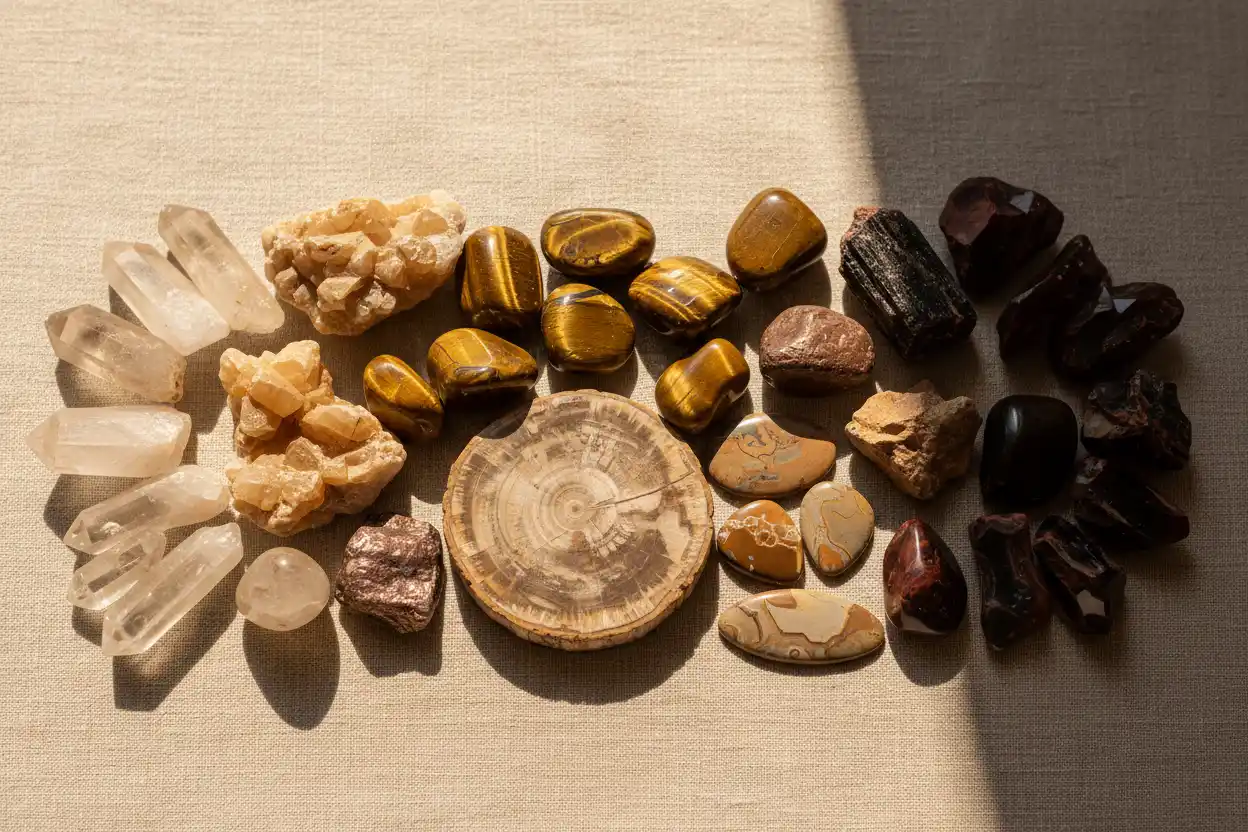
Brown Crystals: Benefits, Uses & Practical Guidance
Brown crystals are commonly associated with grounding, patience, practical judgment, stability, responsibility, and the ordinary routines that make larger goals possible. Their colors range from pale beige, tan, honey, bronze, and caramel through reddish brown, chocolate, coffee, smoky gray-brown, and shades so dark they can look almost black.
Yet brown crystals do not belong to one mineral family, and some materials routinely grouped with crystals are not minerals at all. Smoky quartz is crystalline quartz, dravite is a tourmaline species, bronzite is iron-bearing orthopyroxene, mahogany obsidian is natural volcanic glass, petrified wood is mineralized fossil material, septarian is a multicomponent concretionary rock, and desert rose may consist primarily of gypsum or barite.
Those differences matter because stones that share a brown appearance can have completely different hardness, cleavage, toughness, water tolerance, light stability, fracture behavior, dust hazards, and appropriate uses. A quartz-family palm stone can tolerate handling that would damage a fragile gypsum rosette, while a polished obsidian piece can break into far sharper edges than its smooth surface suggests.
At Gems Lore, brown crystals are approached as visually and materially diverse objects whose traditional symbolism can support reflection or deliberate habits, while their physical identity determines how they should actually be handled, cleaned, stored, displayed, or worn.
Brown Crystals at a Glance
| Brown crystal or material | What it actually is | Typical appearance | Practical physical concern | Traditional symbolic theme |
|---|---|---|---|---|
| Smoky quartz | Brown quartz | Transparent gray-brown to deep smoky black | Hard but can chip; color may be treatment-related | Perspective, grounding, release |
| Tiger’s eye | Chatoyant quartz-rich material | Golden-brown with moving silky eye | Fairly durable; impact can still chip it | Observation, practical courage |
| Bronzite | Iron-bearing orthopyroxene | Brown with bronze or coppery schiller | Moderate hardness and cleavage | Boundaries, composure |
| Petrified wood | Mineralized fossil wood | Brown, tan, red, cream wood patterns | Usually durable when silicified; provenance can matter | Patience, continuity |
| Picture jasper | Opaque silica-rich material | Tan and brown landscape-like pattern | Generally durable; mixed zones can vary | Perspective, connection with place |
| Mahogany obsidian | Natural volcanic glass | Black with reddish-brown patches | Brittle; broken edges can be extremely sharp | Grounded change |
| Dravite | Magnesium-rich tourmaline | Brown to brown-black crystals | Hard surface but brittle | Responsibility, steadiness |
| Andalusite | Aluminum silicate | Brown, green, gold, red through pleochroism | Brittle with cleavage | Perspective, adaptability |
| Axinite | Borosilicate mineral group | Brown, violet-brown, honey-brown | Thin crystals and cleavage can be fragile | Adjustment, flexibility |
| Enstatite | Orthopyroxene mineral | Brown, bronze, gray, green-brown | Cleavage and brittleness | Quiet endurance |
| Brown aragonite | Calcium carbonate | Tan, honey, reddish clusters | Soft and cleavage-prone | Structure, gradual progress |
| Desert rose | Usually gypsum or barite rosettes | Beige to sandy brown flower-like clusters | Gypsum varieties are very soft and water-sensitive | Adaptation |
| Septarian | Mineral-filled concretionary rock | Brown matrix with pale or yellow veins | Mixed minerals require conservative care | Integration |
| Mookaite | Jasper/radiolarite trade material | Brown, mustard, cream, burgundy | Generally practical when well silicified | Choice, practical movement |
| Boulder opal | Natural opal in brown ironstone | Brown matrix with colorful opal | Opal can scratch, crack, or craze | Creativity within constraints |
| Brown calcite | Calcium carbonate | Caramel, coffee, honey translucent masses | Soft, cleavage-prone, acid-sensitive | Reflection, patience |
| Brown agate | Banded chalcedony | Tan, gray, caramel, brown bands | Good practical durability | Incremental progress |
| Brown jasper | Opaque silica-rich material | Earth brown to red-brown | Generally durable | Endurance, routine |
The table deliberately mixes minerals, rocks, volcanic glass, fossil material, and aggregates because that is how brown crystals appear in real collections. The important step is recognizing what each object actually is before choosing a cleaning method or assigning it a practical use.
What Counts as a Brown Crystal?
The phrase brown crystals is a collecting and spiritual-practice category rather than a mineralogical classification.
A mineralogist would not group smoky quartz, obsidian, petrified wood, septarian, and tiger’s eye together simply because they share an earthy color. Their compositions and structures are too different.
However, color-based groups can still be useful when the distinctions are made explicit.
True Crystalline Minerals
Smoky quartz, dravite, andalusite, axinite, enstatite, aragonite, and calcite are mineral materials with defined crystal structures.
Their physical properties can therefore be described through concepts such as crystal system, hardness, cleavage, density, and optical behavior.
Rocks and Mineral Aggregates
Septarian and many jasper materials contain several minerals or microscopic components rather than one large uniform crystal.
Calling them brown crystals is convenient in a collection, but it should not imply that the entire object consists of one crystal species.
Natural Glass
Mahogany obsidian is volcanic glass.
It forms when silica-rich lava cools too quickly for an orderly crystal lattice to develop. It belongs comfortably in a crystal-shop collection, but mineralogically it is not a crystal.
Mineralized Fossil Material
Petrified wood preserves the structure of ancient wood after mineral-rich fluids replace or fill the original tissues.
It may become dominated by silica, but the object remains a fossilized biological structure rather than simply a brown quartz crystal.
Understanding these categories makes brown crystals more interesting because their shared appearance is only the beginning of the story.
What Makes Brown Crystals Brown?
Brown can develop through several unrelated mechanisms.
Iron is one of the most important contributors. Iron-bearing minerals and iron oxides produce brown, bronze, yellow-brown, and reddish-brown colors in many natural materials.
In dravite, iron and other compositional factors contribute the dark brown appearance common to this magnesium-rich tourmaline species.
Bronzite gains much of its earthy color from iron-bearing orthopyroxene chemistry, while its brighter metallic-looking areas come from directional internal reflection rather than from metallic bronze.
Jasper and petrified wood can contain iron oxides that create ochre, yellow-brown, rust, red-brown, or darker zones.
Smoky quartz develops differently.
The brown-to-gray color of smoky quartz is associated with irradiation-related color centers involving aluminum defects within quartz. Natural geological radiation can create the smoky appearance, while artificial irradiation can also produce or intensify similar color commercially.
Patterned brown crystals may combine several mechanisms at once.
Septarian can contain dark concretion material with calcite, aragonite, or other vein fillings. Boulder opal places hydrated silica within brown ironstone. Mahogany obsidian combines dark glass with iron-related reddish-brown patches.
Because the mechanisms differ, brown color is never enough to identify an unknown stone.
What Do Brown Crystals Symbolize?
Brown crystals are most commonly associated with soil, wood, shelter, continuity, work, resources, physical reality, and the slower processes that support stability.
This gives brown crystals a different symbolic tone from highly saturated red, orange, or bright yellow materials.
Their traditional themes often concern maintenance rather than dramatic beginnings.
Keeping a budget.
Finishing routine work.
Repairing something instead of replacing it immediately.
Maintaining a boundary after it has been stated.
Continuing a worthwhile plan after the initial excitement has disappeared.
Brown crystals do not create these behaviors independently.
They can instead become tangible reminders of a behavior someone has already chosen to practice.
That distinction is central to using brown crystals responsibly.
Brown Crystals for Grounding
Grounding is one of the most common reasons people seek brown crystals.
In spiritual language, grounding may mean feeling connected with the body, Earth, home, or immediate environment. In a practical reflective context, it can mean returning attention from speculation toward what is actually happening and what can be done next.
Several brown crystals fit that symbolism particularly well.
Smoky quartz can represent sorting manageable problems from repetitive worry.
Bronzite can represent making a clear decision and maintaining a boundary.
Petrified wood can symbolize patience with processes that develop gradually.
Dravite can represent responsibility without treating every problem as a personal failure.
Picture jasper can represent seeing one concern within a wider landscape.
A simple grounding practice does not require believing that the stone changes the nervous system.
Hold or observe one stable specimen and ask:
What is a fact right now?
What is an assumption?
What can I actually do next?
The stone supplies a sensory cue. Attention and action supply the practical benefit.
The spiritual framework most often associated with these themes is explored separately in the root chakra meaning guide.
Smoky Quartz
Smoky quartz is one of the most recognizable transparent brown crystals.
Its color can range from barely smoky gray through warm brown, dark chocolate, and nearly black morion.
Because it is quartz, it ranks around 7 on the Mohs scale and lacks the easy cleavage found in several softer brown minerals. That makes polished smoky quartz practical for frequent handling.
The symbolism most commonly centers on perspective, grounding, release, and distinguishing a current problem from imagined future problems.
A useful practice is to divide concerns into three categories:
Act now.
Schedule later.
Outside my control.
Smoky quartz cannot remove a problem, but it can represent the decision to stop treating all three categories as though they require immediate action.
Artificial irradiation can create or deepen smoky color, so strong darkness does not automatically prove untreated origin.
Tiger’s Eye
Tiger’s eye is another important member of brown crystals collections, although its structure differs significantly from ordinary quartz crystal.
The stone is a quartz-rich chatoyant material containing aligned fibrous structures that create its characteristic moving eye.
Golden-brown tiger’s eye commonly symbolizes observation, practical confidence, and checking a situation before reacting.
That association fits the optical effect unusually well.
When the stone rotates, a bright line moves across its surface. Symbolically, this can represent changing viewpoint before assuming the first interpretation is complete.
Tiger’s eye is generally practical for beads, cabochons, pendants, and carefully worn rings.
Its relative durability does not justify careless cutting, however. Lapidary work on silica-rich material requires proper dust control.
Bronzite
Bronzite is an iron-bearing orthopyroxene material known for broad bronze, coppery, or golden reflections across a brown body.
The effect is schiller rather than the narrow cat’s-eye band of tiger’s eye.
Bronzite traditionally symbolizes composure, boundaries, practical confidence, and making decisions without unnecessary aggression.
A useful symbolic application involves saying no.
Before declining something, identify the actual decision first. State it clearly, then explain only as much as the situation genuinely requires.
The stone does not make another person respect a boundary.
Brown crystals work best as reminders of chosen behavior rather than tools expected to control someone else’s response.
Bronzite has moderate hardness and cleavage, so pendants and polished palm stones are generally safer than highly exposed rings.
Petrified Wood
Petrified wood is not one crystal species, yet it belongs naturally among brown crystals because its earth tones and preserved wood structure make it one of the strongest visual symbols of time and continuity.
Mineral-rich fluids gradually replace or fill the original wood structure, often with silica.
Growth rings, cell structures, bark textures, knots, and grain may remain visible even after the material becomes mineralized.
Petrified wood is traditionally associated with patience and long-term development.
A grounded use is to connect it with work whose result cannot reasonably appear immediately.
Someone learning a difficult skill might use the material to represent repeated practice rather than instant mastery.
Collecting rules matter.
Material from protected public lands, parks, or regulated fossil sites can be subject to restrictions, so provenance should be considered when acquiring large natural specimens.
Picture Jasper
Picture jasper is valued for brown, tan, cream, and reddish patterns that can resemble deserts, mountains, horizons, or landscapes.
Those scenes are geological patterns rather than actual preserved photographs.
Its symbolism frequently centers on perspective and connection with place.
One practical reflection is to ask:
How important will this problem look after I have more distance from it?
That question does not minimize real problems.
It encourages proportion.
Picture jasper is generally durable enough for palm stones, carvings, cabochons, and beads, although mixed veins, cavities, or poorly consolidated areas can polish or wear differently.
Mahogany Obsidian
Mahogany obsidian combines black volcanic glass with reddish-brown patches.
Because obsidian is glass rather than a crystalline mineral, it is one of the clearest reminders that the term brown crystals is broader than strict mineralogy.
Its traditional symbolism includes grounded change and integrating earlier experiences without allowing them to dictate every later decision.
A practical exercise might ask:
What should I keep from this experience, and what no longer needs to guide my next decision?
Physical safety is important.
Obsidian breaks with conchoidal fracture and can form extremely sharp edges. A chipped specimen should not continue to be handled casually as a palm stone.
Dravite
Dravite is a magnesium-rich tourmaline species commonly appearing brown, dark brown, yellow-brown, or brown-black.
Unlike many soft decorative brown crystals, dravite ranks around 7 on the Mohs scale.
Its traditional symbolism centers on responsibility, stability, and accepting ordinary human limits.
A useful question is:
Which part of this situation actually belongs to me?
This can help distinguish accountability from taking responsibility for another person’s choices.
Dravite’s hardness supports jewelry, but like other tourmalines it remains brittle enough that hard impacts and existing fractures deserve attention.
Andalusite
Andalusite is especially interesting among brown crystals because a transparent stone can show brown, green, yellow, orange, or reddish directions at the same time through strong pleochroism.
The mineral is Al₂SiO₅ and belongs to the same polymorphic family as kyanite and sillimanite.
Its symbolism naturally centers on perspective.
One gemstone can present several legitimate colors depending on orientation, offering an intuitive metaphor for examining a situation from more than one informed viewpoint.
That does not imply that all viewpoints are equally accurate.
The useful practice is to compare them with evidence.
Andalusite can be worn as jewelry, although brittle behavior and cleavage still matter.
Axinite
Axinite refers to a group of borosilicate minerals often recognized by thin wedge-shaped crystals and strong pleochroism.
Brown, violet-brown, honey, reddish-brown, and olive tones are common.
Axinite symbolism usually centers on adaptability and revising a plan when new information changes the problem.
A person might use it as a reminder to ask:
Which part of my plan was based on an assumption that is no longer true?
Transparent axinite can be faceted, but its thin crystal habit, cleavage, and brittle edges make natural specimens and occasional jewelry more realistic than unrestricted everyday wear.
Enstatite
Enstatite is a magnesium-rich orthopyroxene that occurs in brown, green-brown, gray, yellowish, and nearly black material.
Some varieties display subtle sheen or schiller.
Among brown crystals, enstatite works particularly well as a symbol of quiet endurance.
The practical interpretation is not to continue every plan indefinitely.
It is to distinguish an uncomfortable but worthwhile process from one that evidence shows is failing.
Ask:
Is this difficult because it takes time, or because the approach is wrong?
The stone does not answer the question. It provides the prompt.
Brown Aragonite
Brown aragonite is calcium carbonate with the same basic chemistry as calcite but a different crystal structure.
It may appear as tan, honey, brown, reddish, radiating, clustered, or branching specimens.
Traditional symbolism often emphasizes structure, repetition, and gradual progress.
Physically, aragonite requires substantially more care than quartz-family brown crystals.
It is relatively soft and has cleavage, so display specimens should be protected from hard contact.
Prolonged water exposure and acidic cleaners are poor choices.
This is a good example of why one universal “brown crystal cleansing method” cannot be safe for every material.
Desert Rose
Desert rose is a descriptive name for flower-like mineral rosettes, commonly formed from gypsum and sometimes barite.
Sand becomes incorporated between or around crystal blades, producing beige, cream, tan, or brown clusters that resemble petals.
Symbolically, desert rose is often associated with adapting to difficult environments.
Physically, gypsum desert roses are extremely soft.
Their thin blades can break under ordinary handling, and water can damage the specimen.
They should remain dry, supported, and protected from abrasion.
A desert rose should not be stored loose in a pouch with quartz, tiger’s eye, or other hard brown crystals.
Septarian
Septarian is not a single crystal.
It is a concretionary rock or mineral aggregate characterized by internal fractures filled with minerals that may include calcite, aragonite, and other components.
Polished pieces commonly show brown matrix crossed by yellow, cream, white, or darker veins.
Its symbolism frequently centers on integration: several visibly different components forming one coherent structure.
This can represent cooperation without requiring uniformity.
Because septarian contains mixed materials, conservative care is best.
Acids are especially inappropriate where calcite or aragonite is present.
Prolonged soaking is unnecessary.
Mookaite
Mookaite is an Australian lapidary trade material associated with silica-rich sedimentary material, commonly described through jasper or radiolarite terminology.
Its palette can include mustard yellow, burgundy, cream, white, red, purple-brown, and earthy brown.
Traditional symbolism focuses on choice and practical movement.
A grounded practice is to use the stone while comparing realistic options rather than waiting for perfect certainty.
Ask:
Which option is good enough to test?
Brown crystals do not need to symbolize permanent stability. Some can represent moving carefully once sufficient evidence exists.
Boulder Opal
Boulder opal combines natural opal with the brown ironstone in which it formed.
The ironstone is not merely a decorative backing attached after cutting.
In genuine boulder material, the opal and host are naturally associated.
Bright play-of-color against dark brown matrix has encouraged symbolism involving creativity within constraints.
A practical interpretation asks:
What can I build with the conditions I actually have?
The ironstone can provide physical support, but the exposed opal remains softer and more vulnerable than quartz-family materials.
Avoid impact, abrasive storage, strong heat, and aggressive cleaning.
Brown Calcite
Brown calcite may appear honey-colored, caramel, coffee-brown, amber-brown, or translucent beige.
Calcite is calcium carbonate and ranks only around 3 on the Mohs scale.
It also has excellent cleavage and reacts with acids.
Those properties make it far less durable than its polished appearance can suggest.
Brown calcite is often associated symbolically with rest, reflection, patience, or allowing a problem to settle before responding.
It works best as a display or meditation object rather than an everyday ring material.
Water-heavy cleansing routines and acidic household products should be avoided.
Brown Agate and Brown Jasper
Brown agate and brown jasper are among the more physically practical brown crystals because both are silica-rich chalcedony-family materials.
Brown agate typically shows bands in caramel, tan, gray, cream, and deeper brown.
Brown jasper is more opaque and may contain mottling, veins, spots, and iron-rich patterns.
Both commonly symbolize incremental progress, endurance, and dependable routines.
Dye can occur in commercial agate and some porous silica materials, so unusually uniform or highly artificial-looking color deserves scrutiny.
Treatment does not automatically make the stone unusable.
It simply changes the correct description.
Brown Crystals for Work and Routine
Brown crystals are particularly well suited to symbolic practices based on routine because brown is culturally associated with work, earth, shelter, and material resources.
Choose one action rather than a vague outcome.
For example, place smoky quartz beside financial paperwork as a reminder to open and review it.
Keep bronzite beside a work calendar as a reminder to protect capacity before agreeing to another commitment.
Use petrified wood near a long-term project to represent consistency.
Place picture jasper near a desk to represent reviewing a problem in context.
The practical principle is simple:
Pair one object with one behavior.
This avoids expecting brown crystals to create discipline automatically.
Brown Crystals for Boundaries
Bronzite, dravite, tiger’s eye, and dark jasper are commonly used in traditions involving boundaries.
A grounded boundary practice can separate three different issues:
What am I willing to do?
What am I not willing to do?
What action will I take if the boundary is ignored?
Brown crystals may symbolize the decision, but they cannot enforce it.
Nor can any stone guarantee protection from another person’s actions.
Practical safety, legal assistance, support networks, and clear communication remain more important when real risk exists.
Brown Crystals for Perspective
Smoky quartz, picture jasper, andalusite, and tiger’s eye work particularly well for perspective-centered symbolism because each offers a different visual metaphor.
Smoky quartz alters transparency through its smoky color.
Picture jasper resembles a landscape viewed from a distance.
Andalusite reveals several directional colors.
Tiger’s eye changes dramatically as its bright band moves.
A useful exercise is:
What would I conclude if I had to argue the strongest reasonable case against my current interpretation?
Brown crystals do not make that alternative conclusion correct.
They simply provide memorable prompts for examining assumptions.
Brown Crystals and the Root Chakra
Brown crystals are frequently associated with the root chakra because contemporary chakra traditions connect that center with stability, survival, shelter, resources, boundaries, physical presence, and the Earth element.
Brown is not the only root-chakra color. Red and black are also widely used.
The dedicated root chakra crystals guide compares the wider stone selection and spiritual framework.
Chakras are subtle-body concepts rather than anatomical organs.
Using brown crystals in a root-chakra practice should therefore remain symbolic.
A person might meditate with a brown stone and then complete one practical action related to the same theme: preparing food, reviewing expenses, organizing essential documents, improving a work routine, or addressing a household repair.
The ritual represents stability.
The action helps create it.
Brown Crystals Are Not All Safe in Water
One of the most important practical differences among brown crystals is water tolerance.
Quartz-family materials such as smoky quartz, tiger’s eye, agate, and many jaspers can generally tolerate brief ordinary washing when untreated and structurally sound.
That does not create a reason for prolonged soaking.
Calcite and aragonite are softer carbonate minerals whose surfaces can be affected by acidic conditions.
Gypsum desert rose is soft and water-sensitive.
Septarian may combine several materials with different tolerances.
Boulder opal requires more conservative handling than ordinary quartz.
Coatings, dye, resin, glue, bead cord, metal findings, and fracture fillings introduce additional variables.
When identity or treatment is uncertain, dry or minimally damp cleaning is safer than immersion.
Sunlight and Brown Crystals
Sunlight should not be treated as universally safe simply because brown is a dark color.
Smoky quartz color centers can be affected by sufficient light and heat exposure, and artificially treated material may behave differently from untreated specimens.
Organic adhesives, dyes, coatings, resin, and display materials may also change during prolonged intense exposure.
There is no practical benefit to leaving brown crystals in harsh direct sunlight for extended periods.
Ordinary indoor display is enough for most collections.
Symbolic charging does not require risking color or treatment stability.
Physical Safety Matters More Than Color
Brown crystals can present very different physical hazards.
Obsidian can break into razor-like edges.
Gypsum desert rose can shed delicate blades.
Calcite and aragonite can chip easily.
Quartz-family material creates silica-containing dust when mechanically cut.
Mixed rocks may contain minerals that cannot be recognized from the polished surface alone.
Unknown specimens should never be ground into powder, placed in drinking water, or used in cosmetics.
Cutting, drilling, and grinding require appropriate dust control.
Normal handling of a stable polished stone is very different from breathing dust created during lapidary work.
How to Clean a Mixed Brown Crystal Collection
A collection containing several brown crystals should be cleaned according to its most fragile individual materials rather than with one universal ritual.
Begin by identifying each object.
Quartz, tourmaline, carbonate minerals, gypsum, opal, volcanic glass, fossil material, and mixed rocks should not automatically receive identical treatment.
For most stable polished pieces, a soft dry cloth is a safe first step.
A slightly damp cloth may be appropriate where the material tolerates moisture.
Delicate rosettes and fragile matrix specimens are better dusted gently.
Avoid abrasive powders, harsh acids, bleach, steam, and ultrasonic cleaning unless the exact stone, treatments, fractures, and settings make the method appropriate.
Symbolic cleansing is addressed separately in how to cleanse crystals because spiritual ritual and physical cleaning solve different problems.
How to Store Brown Crystals
Do not store every brown stone loose in the same pouch.
Hard materials can scratch softer ones.
Quartz-family stones may abrade calcite, aragonite, gypsum, or softer polished pieces.
Obsidian may chip and create sharp edges.
Delicate desert roses can be crushed.
Natural crystal terminations can strike one another.
Use individual pouches, divided boxes, padded trays, or stable specimen stands according to the material.
Large spheres should be prevented from rolling.
Fragile matrix specimens should be supported from beneath rather than by projecting crystals.
Proper storage protects the physical object regardless of the symbolic meaning attached to it.
Brown Crystals vs Brown Gemstones
Brown crystals and brown gemstones overlap, but the pages answer different practical questions.
This brown crystals directory includes specimens, volcanic glass, fossil material, rocks, mineral aggregates, and spiritual-practice objects. The emphasis is identity, physical safety, traditional symbolism, and practical reflective use.
The brown gemstones directory focuses instead on materials selected as gems: durability, faceting, treatment, setting suitability, value, buying, and jewelry performance.
A smoky quartz crystal point can belong comfortably here as a specimen or symbolic object.
A precision-cut smoky quartz intended for a ring belongs equally comfortably in gemstone evaluation.
The material may be the same, but the decision being made is different.
Choosing Brown Crystals by Practical Purpose
The best choice depends less on finding a universally “strongest” brown stone and more on matching symbolism and physical properties to the intended use.
For a frequently handled palm stone, smoky quartz, tiger’s eye, jasper, or agate is more forgiving than gypsum or calcite.
For a display collection, delicate aragonite or desert rose can be appropriate when protected.
For a desk reminder about boundaries, bronzite provides a particularly clear symbolic association.
For perspective, picture jasper, andalusite, or tiger’s eye offers a material-specific visual metaphor.
For patience and long-term projects, petrified wood fits naturally.
For creative work within practical constraints, boulder opal creates a particularly distinctive image.
Choose one stone because its identity and symbolism fit the actual purpose rather than because a generic list promises that several brown crystals all produce the same effect.
Frequently Asked Questions
What do brown crystals symbolize?
Brown crystals commonly symbolize grounding, patience, responsibility, stability, boundaries, practical judgment, and steady progress. These associations come from cultural and spiritual interpretation rather than demonstrated physiological effects.
Which brown crystals are most commonly used for grounding?
Smoky quartz, bronzite, tiger’s eye, dravite, petrified wood, picture jasper, and brown jasper are common symbolic choices. Their physical properties and specific traditional themes differ substantially.
Are all brown crystals actual crystals?
No. Mahogany obsidian is natural volcanic glass, petrified wood is mineralized fossil material, and septarian is a multicomponent concretionary rock. They are commonly grouped with crystals in collecting and spiritual practice without being single mineral crystals.
What is the most durable brown crystal for handling?
Quartz-family materials such as smoky quartz, tiger’s eye, agate, and many jaspers provide good practical scratch resistance. Dravite is also relatively hard, although brittleness and fractures still matter.
Which brown crystals are fragile?
Gypsum desert rose, brown calcite, aragonite, opal-bearing material, and thin natural crystal specimens require more care than quartz-family palm stones.
Is smoky quartz naturally brown?
Yes. Natural smoky quartz forms when irradiation interacts with aluminum-related defects in quartz. Artificial irradiation can also create or intensify smoky coloration commercially.
Is mahogany obsidian really a crystal?
No. Mahogany obsidian is volcanic glass without the long-range ordered lattice required for a crystalline mineral.
Is petrified wood a crystal?
No. Petrified wood is fossil material whose original wood structure has been replaced or filled by minerals, commonly silica. It may be strongly mineralized without becoming one individual crystal.
Can brown crystals go in water?
Some stable quartz-family materials tolerate brief washing, while gypsum, calcite, aragonite, opal, mixed rocks, repaired specimens, dyed material, and coated pieces require more caution. One water rule cannot safely cover the whole category.
Can brown crystals go in sunlight?
Ordinary indirect light is generally easier on a collection than prolonged intense exposure. Smoky quartz and some treated, dyed, coated, or resin-bearing materials may change under strong light or heat.
Which brown crystals are associated with the root chakra?
Smoky quartz, tiger’s eye, brown jasper, bronzite, petrified wood, and dravite are commonly used in contemporary root-chakra practices. Chakra associations are spiritual rather than anatomical.
Do brown crystals scientifically improve grounding?
No reliable evidence shows that brown crystals directly change neurological or emotional grounding. A stone can function as a tactile or visual reminder within a deliberate grounding routine.
Do brown crystals protect against negative energy?
Protection symbolism appears in several traditions, but a brown stone cannot guarantee supernatural or physical protection. Practical boundaries, risk assessment, safety planning, and appropriate assistance remain essential.
Can brown crystals treat anxiety or stress?
Brown crystals are not medical treatments for anxiety, stress disorders, depression, trauma, or other mental-health conditions. Someone may still find a quiet ritual or tactile object personally calming.
Are brown crystals naturally colored?
Many are naturally brown, but treatment can alter some commercial materials. Irradiation, heating, dye, coatings, resin, or other processes may affect color depending on the stone.
How do I identify an unknown brown crystal?
Do not rely on color. Examine luster, transparency, crystal habit, banding, optical effects, hardness where appropriate, cleavage, density, inclusions, fracture, and geological context. Valuable or ambiguous pieces may require professional mineralogical or gemological testing.
Can I use several brown crystals together?
Yes, if the combination is personally meaningful. For physical care, however, clean and store each stone according to its own mineral identity rather than treating the collection as one material.
Practical Stability Comes From What You Do With the Symbol
Brown crystals form one of the most materially diverse color groups found in crystal collections. The category can include quartz, tourmaline, pyroxene, carbonate minerals, volcanic glass, mineralized fossils, concretions, opal in ironstone, and patterned silica-rich rocks, all sharing an earthy palette while behaving very differently when scratched, dropped, washed, heated, cut, or stored.
That diversity is precisely why material identity matters.
Smoky quartz is not cared for like gypsum desert rose. Obsidian is not structurally equivalent to jasper. Petrified wood is not simply a brown crystal point, and septarian should not be treated as one homogeneous mineral.
Symbolically, brown crystals most often represent grounding, patience, responsibility, stability, boundaries, perspective, and work that accumulates through repetition.
Those ideas become more useful when they lead to a concrete action.
A stone cannot create a budget, maintain a boundary, finish a project, remove uncertainty, repair a home, or force emotional stability. It can mark the decision to do the next relevant thing.
That is the most practical way to use brown crystals: understand what each material actually is, handle it according to its real physical properties, choose symbolism that fits a specific intention, and let repeated action—not the object alone—build the stability the brown color represents.