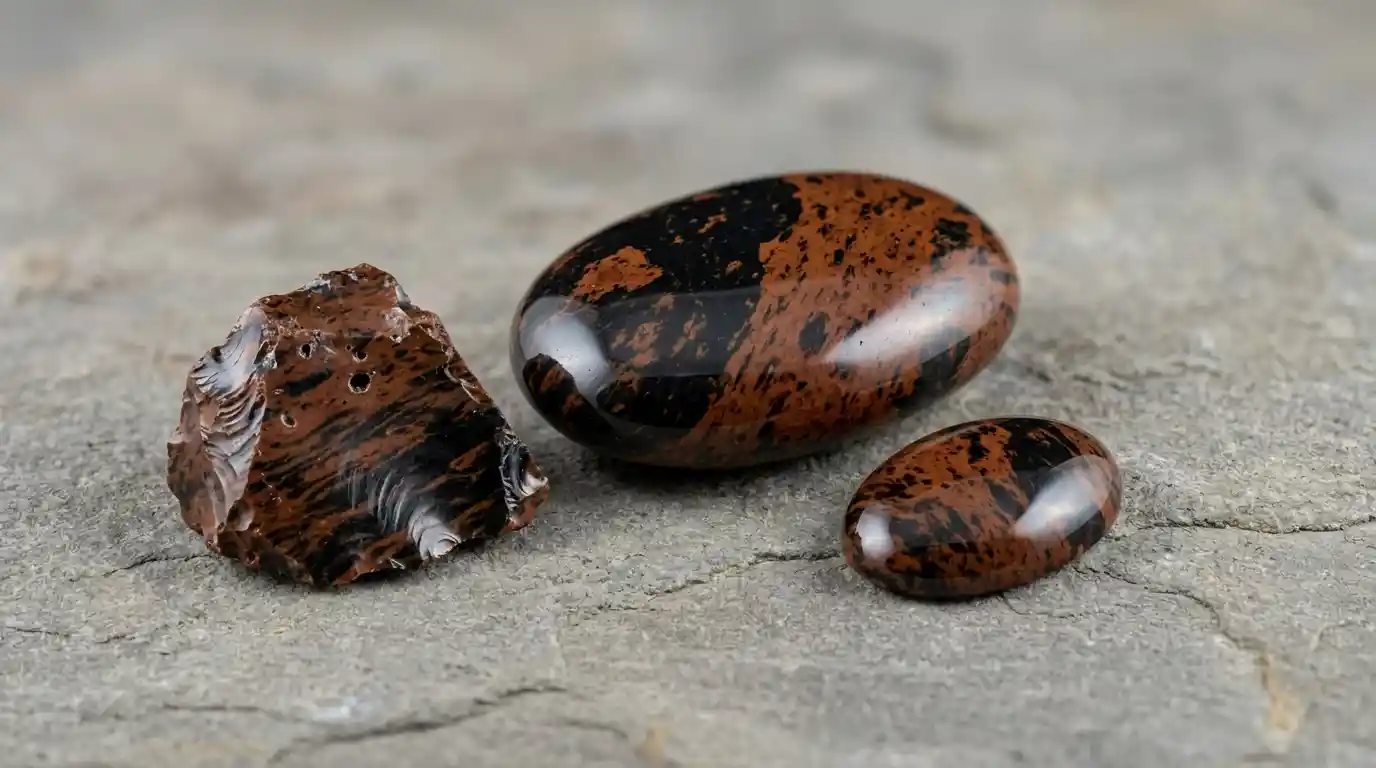
Mahogany Obsidian Healing Properties: 11 Claims, Evidence & Safe Use
Mahogany obsidian healing properties are commonly associated with grounding, emotional steadiness, courage, confidence, boundaries, motivation, resilience, practical thinking, release, self-reflection, and spiritual protection. Its black volcanic-glass base crossed by reddish-brown patches gives the stone a visually strong connection with earth, fire, and stability, but those associations do not establish a therapeutic mechanism. Mahogany obsidian has not been demonstrated to treat anxiety, depression, trauma, pain, circulation problems, inflammation, fatigue, hormonal disorders, or another medical condition, and its iron-rich coloration does not transfer strength or iron into the body. Scientifically, mahogany obsidian is a naturally colored variety of obsidian, an amorphous volcanic glass created when silica-rich lava cools too rapidly for large crystals to develop. It has no crystal system, commonly falls near Mohs 5 to 5.5, lacks cleavage, breaks with extremely sharp conchoidal fracture, and is brittle despite its solid appearance.
11 Mahogany Obsidian Healing Claims
- Grounding and present-moment awareness
- Emotional steadiness during stress
- Courage in difficult situations
- Confidence and purposeful action
- Stronger personal boundaries
- Motivation and follow-through
- Resilience after setbacks
- Practical thinking and clearer priorities
- Release of unhelpful patterns
- Self-reflection and perspective
- Spiritual protection and symbolic stability
These eleven themes can support distinct reflective routines without becoming eleven scientifically verified healing effects. Many mahogany obsidian benefits become more useful when translated into actions such as slowing down before reacting, defining a boundary, starting one delayed task, reviewing a setback, or writing down what needs to change.
Mahogany Obsidian Mineral Facts
Mahogany obsidian is volcanic glass rather than a crystalline mineral. Obsidian forms when silica-rich lava cools so quickly that atoms do not organize into the repeating lattice required for a true crystal. Its structure is therefore amorphous, and it has no mineralogical crystal system.
The dominant chemistry of most obsidian is silica-rich, but natural volcanic glass also contains aluminum, sodium, potassium, iron, magnesium, calcium, and other elements in varying proportions. Mahogany obsidian develops its characteristic black and reddish-brown patterning from iron-rich and other natural impurities distributed through the glass. The result may appear as patches, streaks, clouds, bands, or irregular fields rather than one uniform color.
The surface normally has vitreous luster and can polish to a mirror-like finish. Thin edges may appear slightly translucent even when thicker sections look fully opaque. Natural flow banding, tiny bubbles, crystallites, mineral inclusions, or color zoning can occur depending on the volcanic source and cooling history.
Obsidian generally measures around Mohs 5 to 5.5. That makes it softer than quartz and most common dust containing quartz grains, so polished surfaces can develop scratches. It has no cleavage, but it is brittle and fractures conchoidally, producing curved break surfaces and potentially razor-sharp edges.
That fracture property explains why obsidian became so important to early toolmakers. A carefully struck piece can produce an edge much sharper than most ordinary stone tools. The same property also means broken mahogany obsidian should be handled cautiously because fresh fragments can cut skin easily.
Volcanic Origin and Obsidian History
Obsidian forms in volcanic environments where silica-rich lava cools rapidly, especially along lava-flow margins, domes, and other settings where cooling prevents extensive crystallization. Natural obsidian occurs in many volcanic regions, including Mexico, the western United States, Armenia, Iceland, Italy, Japan, and parts of Central and South America.
Mahogany-patterned obsidian is known from several deposits, including Glass Buttes in Oregon and Armenian occurrences where reddish-brown areas contrast strongly with black glass. Trade appearance varies considerably, so locality cannot be established reliably from color pattern alone.
Obsidian itself has a genuine archaeological history stretching back thousands of years. Neolithic and later societies used it for cutting tools, projectile points, knives, mirrors, ornaments, and trade. Archaeologists can sometimes identify the geological source of ancient obsidian through chemical analysis, revealing remarkably extensive trade networks.
That historical evidence applies to obsidian as a volcanic glass. It does not prove that ancient cultures recognized modern “mahogany obsidian healing properties” as a separate wellness system. The mahogany obsidian meaning used today is largely a contemporary interpretation of its color, volcanic origin, and dark protective appearance.
Grounding and Emotional Stability
Grounding Through Sensory Focus
Mahogany obsidian is strongly associated with grounding because its black and reddish-brown colors resemble dark rock and earth. The stone does not electrically ground the nervous system or attach the body to the Earth through an invisible field. It can still serve as a useful tactile anchor. Notice its cool surface, weight, polished texture, color boundaries, breathing rhythm, and the physical surroundings. The grounding effect comes from directing attention toward immediate sensory information.
Emotional Steadiness Under Stress
Another common claim says mahogany obsidian stabilizes intense emotions. Volcanic glass does not regulate neurotransmitters, cortisol, or heart rate through touch. A practical ritual is to use the stone as a reminder to delay an immediate response, slow the breathing, separate what actually happened from assumptions, and decide whether anything needs to be done immediately.
Courage, Confidence, and Boundaries
Courage During Difficult Moments
Dark obsidian varieties are often associated with strength and courage. Mahogany obsidian cannot eliminate fear or make a dangerous situation safe. Before an uncomfortable but necessary action, use it as a cue to identify what preparation can reduce risk, what remains outside personal control, and what first step can still be taken despite uncertainty.
Confidence Through Preparation
The reddish-brown and black patterning also inspires themes of inner strength. A gemstone does not biologically increase self-esteem. Before a presentation, meeting, conversation, or decision, use it as a reminder to review what has been prepared and define the first action clearly. Repeated evidence of capability is a stronger source of confidence than expecting a stone to create it.
Boundaries as Practical Protection
Mahogany obsidian is frequently marketed as protective or as absorbing negative energy. There is no evidence that volcanic glass creates an energetic barrier around the wearer. Protection becomes more useful when translated into boundaries: decide what requests you will decline, what behavior you will not accept, and when leaving a situation or seeking support is the appropriate response.
Motivation, Resilience, and Practical Thinking
Motivation Through Immediate Action
Some practitioners describe mahogany obsidian as energizing or motivating. It does not increase metabolic energy or dopamine through skin contact. A simple ritual is to place the stone beside the task that has been delayed and begin for a predetermined period before deciding whether to continue. Starting converts symbolic motivation into behavior.
Resilience After Setbacks
Obsidian begins as molten rock and rapidly becomes glass, making transformation an understandable metaphor for resilience. The stone cannot make someone psychologically tougher. After a setback, use it to identify what failed, what remains intact, what can be learned, and what next attempt is still possible.
Practical Thinking and Priorities
Grounding symbolism often leads to claims that mahogany obsidian supports practical thinking. It does not improve cognition biologically. A useful exercise is to list what is known, what is assumed, what can be controlled, and which task matters most now. The structure reduces mental clutter more plausibly than the stone itself.
Release, Self-Reflection, and Protection Symbolism
Releasing Unhelpful Patterns
Mahogany obsidian is often described as helping people release habits, resentment, or emotional baggage. It cannot remove memories or trauma. A more realistic practice is to identify one repeated behavior that is no longer useful, name the trigger that usually starts it, and choose a replacement response. Release becomes a change in behavior rather than something extracted from the body.
Self-Reflection and Perspective
The contrasting black and brown areas can serve as a visual metaphor for complexity. During journaling, write down the first interpretation of a difficult event and then deliberately consider another interpretation that fits the same facts. This can expose assumptions without treating the stone as a source of hidden information.
Spiritual Protection and Stability
Modern spiritual practice often uses mahogany obsidian in protection rituals focused on stability, security, and clearing unwanted influence. Such rituals can be personally meaningful, but no measurable protective field has been demonstrated. The stone can instead symbolize commitments to safer environments, clear limits, deliberate choices, and consistent routines.
Mahogany Obsidian Chakra Meaning
Mahogany obsidian is most commonly associated with the root chakra because of its dark black and earthy reddish-brown colors. Modern practitioners connect it with themes of stability, security, grounding, courage, physical presence, and personal boundaries. Some also associate the red-brown areas with sacral or lower-body symbolism.
Chakras are a spiritual framework rather than anatomical structures. Mahogany obsidian has not been demonstrated to affect the spine, adrenal glands, reproductive organs, nervous system, circulation, or another physiological system through chakra placement.
Its color can still help structure a meditation around security, responsibility, and boundaries without turning spiritual symbolism into a medical claim.
Mahogany Obsidian Care and Safety
Mahogany obsidian’s Mohs hardness of about 5 to 5.5 makes it moderately resistant to scratching but noticeably softer than quartz. Store polished pieces separately from quartz, topaz, sapphire, ruby, diamond, and other harder stones that could mark the surface.
The greater physical risk is fracture. Obsidian is brittle and breaks conchoidally. Drops onto tile, concrete, or stone countertops can produce sharp chips or splinters. Broken pieces should be handled as cautiously as broken glass.
Brief cleaning with lukewarm water is generally safe for natural untreated mahogany obsidian. Mild soap and a soft cloth are usually sufficient. Prolonged soaking is unnecessary, particularly when a piece contains open fractures, glued components, coatings, metal settings, or unknown treatments.
Rapid temperature changes should be avoided because glass can develop stress from sudden heating or cooling. Steam cleaning is unnecessary. Ultrasonic cleaning is also best avoided for fractured, carved, repaired, or heavily included pieces.
Strong chemicals, abrasive powders, and hydrofluoric acid should never be used. Hydrofluoric acid attacks silica-rich glass and is extremely hazardous.
Cutting and grinding obsidian creates sharp fragments and fine silicate dust. Lapidary work requires wet methods, eye protection, effective extraction, and suitable respiratory protection.
Safe Ritual Cleansing
Mahogany obsidian does not need aggressive physical treatment for ritual cleansing. There is no scientifically demonstrated negative energy that must be removed from the volcanic glass.
Sound, quiet reflection, intentional breathing, dry placement, or gently wiping the stone are low-risk choices. A grounding ritual can be as simple as identifying one concern that is outside your control and one practical action that remains available.
Avoid flame, extreme heat, abrasive salt, chemical sprays, rough burial, and any method that could chip the glass. A simple symbolic reset preserves both the polish and the sharp-edge safety of the stone.
Conclusion
Mahogany obsidian combines a genuine volcanic origin, glassy structure, sharp conchoidal fracture, and distinctive iron-rich reddish-brown patterning. Its eleven healing themes can still support grounding, courage, boundaries, resilience, reflection, and practical action, but the useful effect comes from the routines built around the stone rather than from an unproven therapeutic mechanism.
FAQs
What are the main mahogany obsidian healing properties?
Common claims include grounding, emotional steadiness, courage, confidence, boundaries, motivation, resilience, practical thinking, release, self-reflection, and spiritual protection. These are wellness or spiritual beliefs rather than scientifically proven effects.
Is mahogany obsidian a crystal?
No. It is natural volcanic glass with an amorphous structure rather than a crystalline mineral lattice.
What makes mahogany obsidian brown and black?
Iron-rich and other natural impurities within the volcanic glass create reddish-brown areas against a darker black base.
How hard is mahogany obsidian?
Obsidian generally falls around Mohs 5 to 5.5. It can be scratched by quartz and harder gemstones.
Why is broken obsidian so sharp?
Obsidian fractures conchoidally. The curved fracture can create extremely thin, sharp edges, which is why ancient people used obsidian extensively for cutting tools.
Does mahogany obsidian scientifically reduce anxiety?
No. Mahogany obsidian has not been shown to treat anxiety or regulate the nervous system through a gemstone-specific mechanism. It can serve as a tactile cue for breathing or sensory grounding exercises.
Which chakra is mahogany obsidian associated with?
Modern crystal systems most commonly associate it with the root chakra and themes involving grounding, stability, boundaries, and security. These associations are spiritual rather than anatomical.
Can mahogany obsidian go in water?
Brief washing with lukewarm water is generally safe for untreated natural obsidian. Mild soap and a soft cloth are sufficient for routine cleaning.
Is mahogany obsidian safe to wear every day?
It can be worn regularly, but polished surfaces can scratch and the glass can chip after hard impact. Rings and bracelets need more protection than pendants or earrings.
Does mahogany obsidian have ancient healing traditions?
Obsidian itself has an extensive archaeological history as a tool, trade object, ornament, and ritual stone. That does not establish a specific ancient healing system for the modern mahogany obsidian trade variety.
Crystal healing claims are traditional or personal beliefs and should not replace qualified medical or mental health care.