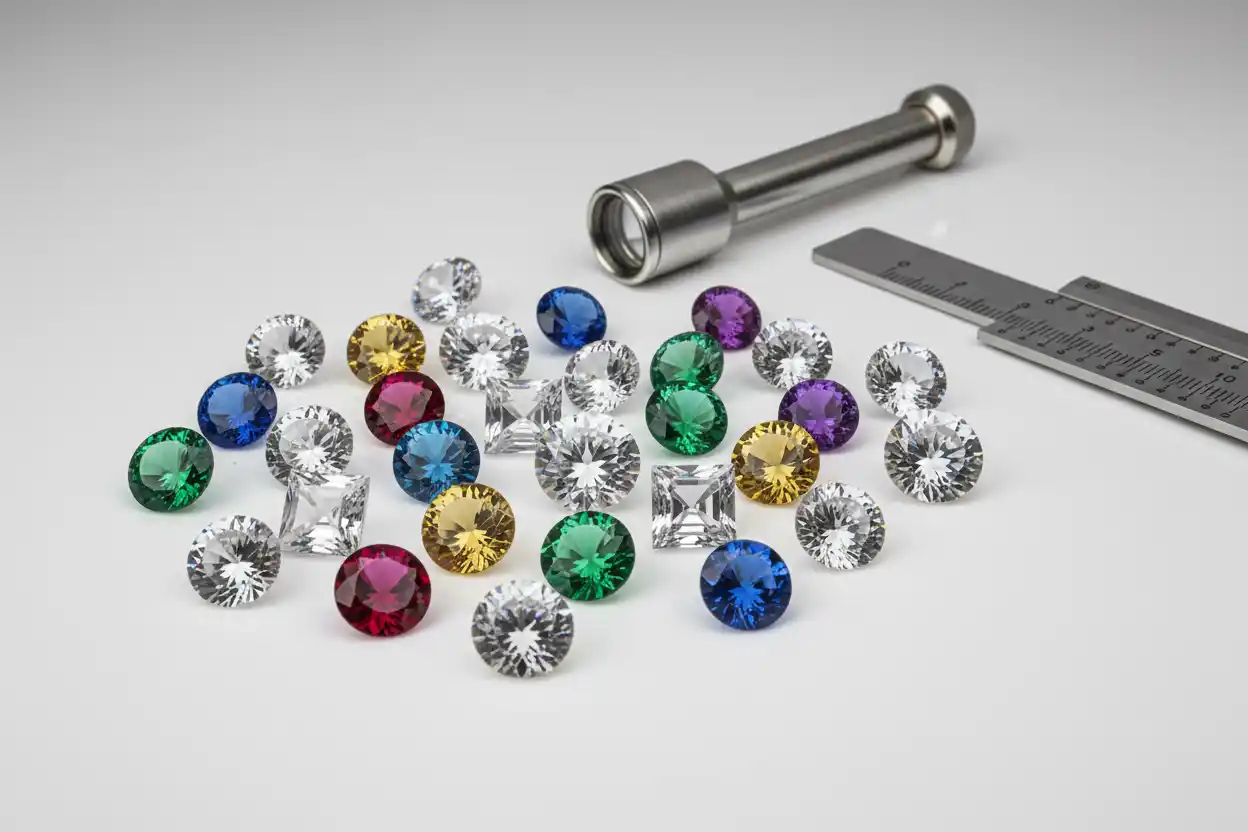
Buy Cubic Zirconia: Buyer Checks, Treatments & Value
To buy cubic zirconia intelligently, begin with the correct identity: cubic zirconia, usually abbreviated CZ, is a laboratory-created zirconium-oxide material widely used as a diamond simulant. It is not diamond, laboratory-grown diamond, or natural zircon. GIA defines a simulant as a material that resembles another gem while having different chemical composition, crystal structure, and optical and physical properties, and identifies synthetic cubic zirconia as one of the most common man-made diamond simulants in the jewellery market.
That distinction is central to value. CZ is manufactured in large quantities, can be grown in substantial sizes, and can be produced in many colors, so its price is driven less by geological rarity than by cutting, polish, setting quality, design, brand, metal, coatings, craftsmanship, and retail service. GIA notes that most CZ has very high clarity, a Mohs hardness of about 8.5, slightly more fire but less brilliance than diamond, and broad availability in both colorless and colored forms. Buyers therefore gain little from paying a large premium solely for exaggerated rarity language or a huge carat number.
Buy Cubic Zirconia At a Glance
| Buying Factor | What to Check | Why It Matters |
|---|---|---|
| Identity | Cubic zirconia rather than diamond, lab-grown diamond, moissanite, glass, or zircon | These are different materials with different properties and values |
| Cut | Proportions, symmetry, windowing, pattern, polish | Cutting strongly influences sparkle and overall appearance |
| Color | Colorless appearance or intended fancy color | CZ can be manufactured in many colors, so color does not imply rarity by itself |
| Clarity | Chips, polish marks, bubbles, inclusions, surface defects | High clarity is normal in CZ; obvious defects should generally reduce desirability |
| Size | Millimeter dimensions and weight | Large CZ can be manufactured readily, so large size does not automatically create scarcity |
| Durability | Scratches, chips, facet-edge wear | CZ is hard but softer than diamond and can show wear over time |
| Coatings | Diamond-like, colored, or other surface coating | Coatings may change appearance and can have different durability from the underlying CZ |
| Setting Metal | Sterling silver, gold, platinum, plated base metal | Metal value and construction can exceed the value of the CZ itself |
| Mounting Quality | Prongs, alignment, finishing, security | Good workmanship can justify more of the retail price than the loose stone |
| Retail Grade | AAA, 5A, 6A, “premium,” or similar labels | Usually seller-defined rather than universal laboratory grades |
| Brand/Design | Designer name, custom cut, fashion positioning | Can create substantial retail premiums independent of raw material rarity |
| Condition | Scratches, abrasion, cloudiness, looseness, coating wear | Important for pre-owned CZ jewellery and long-term appearance |
| Seller Disclosure | Clear description as CZ and any coating/treatment | Prevents confusion with diamond or laboratory-grown diamond |
Cubic Zirconia Is a Diamond Simulant, Not a Type of Diamond
Natural diamond and laboratory-grown diamond are both crystalline carbon and share essentially the same fundamental crystal structure and many physical properties, while cubic zirconia is zirconium oxide with very different physical and optical characteristics. GIA explicitly identifies CZ as an imitation or simulant rather than a laboratory-grown diamond.
This distinction matters whenever a seller uses ambiguous phrases such as “lab diamond alternative,” “created diamond,” “diamond CZ,” or “diamond-like stone.” A product can legitimately be marketed for its diamond-like appearance, but the material itself should be described accurately. Laboratory-grown diamond is not a simulant, while CZ is. A buyer should therefore look for clear material disclosure on the product page, invoice, and jewellery description rather than relying on photographs.
The Gems Lore guide to the most expensive gemstones provides broader context for why visual similarity does not create equivalent gem identity or market value. Two colorless faceted materials can look related in jewellery photographs while differing radically in rarity, physical properties, durability, and resale market.
Do Not Confuse Cubic Zirconia With Natural Zircon
The similar names create persistent confusion. Cubic zirconia is manufactured zirconium oxide, whereas zircon is a naturally occurring zirconium silicate mineral with its own crystal structure and gemological properties. The two materials are not varieties of one another.
A retailer should use the full term cubic zirconia or the accepted abbreviation CZ when describing this simulant rather than shortening it to “zircon.” Mislabeling can cause a buyer to believe they are purchasing a natural gemstone when the product is actually manufactured CZ.
The same naming discipline applies across gem buying generally. Terms such as natural, synthetic, imitation, simulant, treated, and coated describe different attributes and should not be used interchangeably.
High Clarity Is Normal, Not an Exceptional Rarity Grade
GIA notes that most cubic zirconia is colorless or near colorless and has high clarity with minute, if any, imperfections. This means that claims such as “flawless CZ” or “internally flawless simulated diamond” should not automatically command a major premium. Very clean material is normal for a manufactured product produced under controlled conditions.
Buyers should instead inspect for defects created during cutting, polishing, setting, coating, or wear. Scratches across the table, chipped facet edges, uneven polish, misaligned facets, or damaged girdles can matter more than tiny internal features.
Colored CZ follows the same basic principle. An attractive pink, blue, yellow, green, red, or purple stone can be visually desirable, but unusual color does not automatically establish natural rarity because manufacturers can produce CZ across a wide color range. GIA documents CZ in numerous colors and very large sizes.
Cut Quality Is One of the Most Important Reasons to Pay More
Because the underlying material is inexpensive and abundant, cutting quality can become one of the strongest differences between ordinary and premium-looking CZ. A poorly proportioned stone can appear glassy, flat, overly fiery, or visually unbalanced, while careful faceting can create attractive symmetry and a convincing overall pattern.
GIA notes that CZ has slightly greater fire than diamond but lower brilliance. The cutter can influence how those optical properties appear by selecting facet angles, pattern, depth, and polish appropriate to the material. A well-designed round brilliant may balance fire and white-light return more effectively than an inexpensive mass-cut stone whose facets mainly preserve weight or speed production.
Check face-up symmetry, centered culet or pavilion pattern where applicable, even facet junctions, clean polish, and whether the stone looks lively across ordinary lighting conditions. For fancy shapes, examine outline symmetry and whether corners or points have been protected adequately by the setting.
More Fire Does Not Mean Cubic Zirconia Is Optically Superior to Diamond
CZ disperses white light strongly and can display broad rainbow flashes, which some buyers enjoy precisely because the effect is dramatic. GIA states that CZ has slightly more fire but less brilliance than diamond and notes that its broad flashes can look artificial to some observers.
Neither appearance is objectively “better” for every buyer. Someone who wants maximum colorful sparkle may prefer CZ, while someone seeking the optical balance associated with diamond may prefer diamond or another material. The important point is that fire, brilliance, and scintillation are different aspects of appearance, so one property should not be used as proof that two materials are equivalent.
Retailers that advertise CZ as visually identical to diamond under all conditions are oversimplifying meaningful optical differences.
Large CZ Is Easy to Produce, So Size Alone Should Not Command a Scarcity Premium
GIA illustrates cubic zirconia pieces weighing dozens or even hundreds of carats and notes that the material can be produced in large sizes. Unlike naturally rare gems whose price per carat can rise dramatically once clean crystals exceed certain sizes, CZ manufacturing is not constrained by geological crystal occurrence in the same way.
A ten-carat CZ can still cost more than a one-carat CZ because it uses more material and may require more cutting labor, but buyers should not accept claims that large CZ is inherently rare or investment-grade. The quality of the faceting, polish, design, and mounting may justify a higher price; mere mass generally does not.
Dimensions are often more useful than carat weight for comparing CZ with diamond-like alternatives because materials have different densities. A stone with the same millimeter diameter as a diamond does not necessarily have the same weight.
CZ and Diamond of the Same Carat Weight Do Not Have the Same Size
Cubic zirconia is denser than diamond, so an equal-weight CZ generally faces up smaller than a diamond of comparable proportions. GIA’s classic research on diamond simulants notes that CZ is substantially denser than diamond and that diameter-versus-weight relationships can help separate the two materials.
This is an important shopping detail because sellers may describe a CZ in either actual carat weight or “diamond-equivalent” dimensions. A buyer should look for millimeter measurements rather than assuming that a one-carat CZ will visually match a one-carat diamond.
For earrings, rings, and pendants, face-up diameter usually matters more to appearance than the number of carats printed in the listing.
Cubic Zirconia Is Hard but Not as Scratch-Resistant as Diamond
GIA gives cubic zirconia a Mohs hardness of about 8.5, which makes it suitable for jewellery but less resistant to scratching than diamond. Hardness should not be confused with toughness, and a CZ can also chip if struck sharply at a vulnerable edge or point.
Daily wear can gradually soften facet junctions and reduce the crisp appearance that makes a new CZ attractive. Rings generally experience more abrasion than earrings or pendants because hands encounter desks, tools, doors, bags, and other surfaces continuously.
For someone purchasing an inexpensive everyday ring, replacement after substantial wear may be more economical than repolishing. For an important custom piece with an exceptional cut, condition and maintenance deserve greater consideration.
Colorless CZ Can Change in Appearance Over Time
GIA notes that colorless CZ may develop a yellowish appearance over time. Buyers should therefore treat claims of permanent D-color diamond equivalence cautiously, particularly when a seller presents the material as requiring no long-term maintenance or replacement.
Changes in appearance can also come from ordinary surface contamination. Oils, lotions, soap film, and dust reduce sparkle on any transparent faceted stone, and CZ’s attractive appearance can improve substantially after proper cleaning.
Condition should be evaluated before assuming that an older stone has fundamentally changed. A dirty CZ, scratched CZ, coated CZ, and genuinely color-shifted CZ present different issues.
Coated Cubic Zirconia Requires Specific Disclosure
Some manufacturers have applied thin surface coatings to cubic zirconia in an attempt to alter its color, improve its diamond-like appearance, or claim improved physical characteristics. GIA studied colorless coated CZ marketed with a thin diamond-like or nanocrystalline-carbon-containing layer and found that the coating did not completely withstand typical gemstone cleaning and handling procedures.
A coated CZ is still fundamentally CZ. The coating may add a visual effect, but it should not be marketed as converting the material into diamond or giving it diamond’s bulk properties. Buyers should ask what coating is present, whether it covers the whole stone, how durable it is, and which cleaning methods the seller recommends.
Pre-owned coated CZ deserves particularly close inspection around facet junctions, girdles, and exposed areas where wear can reveal differences between the coating and underlying material.
Fancy-Color CZ Is Usually Created During Manufacture
Cubic zirconia can be produced in a wide range of colors, and GIA documents pink, yellow, blue, green, red, purple, and black appearances among manufactured CZ. Color can result from additives incorporated during production, meaning a vivid blue or pink CZ is not automatically a surface-treated colorless stone.
This distinction matters because color-through-the-material and surface coating can have different durability. If the listing uses words such as coated, plated, film, aura, mystic, diamond-coated, or color-enhanced, ask how the color was created rather than assuming every fancy-color CZ behaves identically.
A stable manufactured color may be an excellent choice for inexpensive jewellery because the buyer can obtain saturated hues without paying for natural gemstone rarity.
Setting Quality Often Matters More Than Loose CZ Value
The retail price of a CZ ring may depend much more on the metal and workmanship than on the center stone. A well-made 14K or 18K gold mounting, platinum setting, custom design, or labor-intensive pavé piece can cost substantially more than the loose CZ it contains.
Inspect prong alignment, stone security, metal thickness, finishing beneath the setting, solder joins, symmetry, plating quality, and whether accent stones are identified correctly. A high-quality setting can justify a higher total price even when the CZ itself is inexpensive.
The opposite is also true. A large attractive CZ in thin plated base metal may have limited long-term durability despite impressive photographs. Buyers should ask what they are paying for: the loose stone, precious metal, craftsmanship, designer brand, or all of these together.
Sterling Silver and Gold-Plated Settings Need Different Expectations
CZ is commonly set in sterling silver because the combination provides substantial sparkle at an accessible price. Silver can tarnish but can also be polished and maintained. Gold-plated or rhodium-plated base-metal jewellery may show plating wear over time, especially on rings and bracelets that experience frequent friction.
A seller should state the metal clearly. Phrases such as “gold finish,” “gold tone,” or “18K look” do not necessarily mean solid gold. Hallmarks can help but should be interpreted with local standards and seller documentation.
When comparing two otherwise similar CZ pieces, differences in metal construction may explain more of the price gap than differences in the stones.
Retail CZ Grades Such as 5A or AAAAA Are Usually Seller-Specific
CZ is commonly marketed with labels such as AAA, 5A, AAAAA, 6A, premium, Russian cut, diamond cut, or highest grade. These terms can be useful within a retailer’s own inventory, but they should not be mistaken for a universal gemological grading framework.
GIA explains that simulants are identifiable materials distinct from diamond and states that GIA does not issue diamond grading reports for simulants. A seller’s “5A” CZ therefore is not equivalent to a standardized GIA diamond color, clarity, or cut grade.
Ask what the grade measures. If it simply refers to the seller’s preferred combination of colorlessness, clarity, polish, and cut, compare those characteristics directly rather than paying for the letter or number itself.
“Russian CZ” Is Not Automatically a Different Gem Species
Commercial listings sometimes use geographic or manufacturing labels that imply superior quality. Cubic zirconia remains cubic zirconia regardless of where the crystal was manufactured or cut. A factory, cutter, or brand can certainly produce better workmanship, but the geographic phrase itself does not create a different mineral identity.
If a seller charges a premium for a named origin or production method, ask what measurable quality difference supports the premium. Better faceting, polish, consistency, coating technology, metalwork, warranty, or design can all be legitimate reasons. A vague origin story without those characteristics deserves less weight.
CZ Is Not Automatically a Better or Worse Choice Than Moissanite
Synthetic moissanite and CZ are both commonly used as diamond alternatives, but they are different materials. GIA lists synthetic moissanite at a higher Mohs hardness than CZ and describes it as having strong brilliance and intense fire, while CZ remains highly affordable and easy to produce in many colors and sizes.
The appropriate choice depends on priorities. Buyers focused on the lowest cost and easy replacement may prefer CZ, while those seeking greater scratch resistance may consider moissanite or another material. Someone seeking the identity and market characteristics of diamond should recognize that neither simulant becomes diamond merely because it resembles one.
This is another reason that terms such as synthetic, laboratory-grown, and imitation must remain distinct throughout the buying process.
Do Not Pay Diamond-Level Prices for an Unbranded Loose CZ
Cubic zirconia’s manufacturing abundance is central to its affordability. GIA describes it as very affordable and widely available. An unusually high loose-stone price should therefore be explained by exceptional cutting, recognized artistry, proprietary treatment, documented craftsmanship, or another identifiable feature rather than by unsupported claims of geological rarity.
Finished jewellery is different because gold, platinum, designer status, diamonds in the setting, workmanship, and retail service may legitimately create a high total price. Separate those components mentally when deciding whether the item represents value.
The Gems Lore citrine price guide provides a useful conceptual comparison: even a natural gemstone can remain relatively affordable when supply is abundant, and size does not necessarily produce rarity premiums. CZ takes that principle further because the material itself is manufactured.
Evaluate Pre-Owned CZ by Condition Rather Than Original Grade
A previously worn cubic zirconia can develop scratches, chipped edges, dulled facet junctions, coating wear, or accumulated surface film. A stone originally marketed as “5A” does not retain premium appearance merely because the invoice still uses that grade.
Inspect the table, crown facets, girdle, points, and areas near prongs under magnification. Determine whether cloudiness disappears after cleaning or represents actual abrasion. For coated material, look for uneven surface appearance or areas where the film may have worn.
Because loose CZ replacement is often inexpensive, heavily worn stones in otherwise valuable settings may be worth replacing rather than restoring.
Cleaning and Care Should Match the Actual Product
GIA lists warm soapy water as safe for common diamond simulants and identifies ultrasonic and steam cleaning as generally safe for uncoated CZ in its consumer comparison. Coated CZ deserves more caution because GIA’s durability research found that thin coatings did not completely withstand typical cleaning and handling procedures.
The safest practical approach is to follow the manufacturer’s instructions when a coating or specialty treatment is present. The metal setting may impose additional restrictions; pearls, coral, glued components, enamel, or other gems mounted alongside CZ can require gentler methods than the CZ itself.
Cleaning recommendations should therefore apply to the entire piece of jewellery rather than the center stone in isolation.
Laboratory Reports Usually Add Little Value to Ordinary CZ
Professional gemologists can distinguish CZ from diamond using its optical and physical properties, and GIA describes simulants as much easier to separate from diamond than laboratory-grown diamonds because simulants have fundamentally different composition and physical characteristics.
Ordinary inexpensive CZ normally does not justify the cost of a sophisticated independent laboratory report. The purchase price, setting quality, seller disclosure, and return policy are generally more commercially relevant.
Testing becomes more useful when an expensive piece is represented ambiguously as diamond, when the jewellery contains multiple unknown stones, or when appraisal of a valuable precious-metal or designer piece requires confirmation of every component.
Common Red Flags When You Buy Cubic Zirconia
A buyer should investigate further when:
The seller calls CZ a laboratory-grown diamond.
“Synthetic diamond” is used for CZ without clarifying that it is a simulant.
A huge carat weight is presented as inherently rare.
A 5A, 6A, or AAAAA grade is treated as an international laboratory standard.
A coating is advertised but its composition and care requirements are not disclosed.
Solid gold is implied through vague wording such as gold tone or gold finish.
A product price approaches fine-diamond territory without exceptional setting or design value.
The seller refuses millimeter dimensions or metal specifications.
Pre-owned CZ shows heavy abrasion but is described as flawless.
Guaranteed resale or investment appreciation is promised.
These warnings do not mean CZ itself is a poor material. They indicate that the seller’s representation may deserve closer examination.
How to Compare Cubic Zirconia Listings Fairly
A useful CZ comparison should include:
Exact material disclosure as cubic zirconia.
Millimeter dimensions and actual weight if provided.
Shape and facet design.
Face-up symmetry and polish.
Colorless or fancy-color appearance.
Presence and type of any coating.
Visible chips, scratches, or abrasion.
Metal type and purity.
Setting construction and stone security.
Designer or custom-cut provenance if claimed.
Warranty and replacement policy.
Return and inspection terms.
Whether the listed grade is seller-defined.
Once those variables are aligned, price differences become much easier to understand.
Conclusion
To buy cubic zirconia well, treat it as its own manufactured gem material rather than as a cheaper grade of diamond. CZ is a synthetic zirconium-oxide simulant with a Mohs hardness around 8.5, high clarity, broad color availability, strong fire, and lower brilliance than diamond. Its abundance means raw size and clarity usually create less value than cutting, polishing, coating, metal quality, jewellery workmanship, design, and seller service.
Accurate disclosure matters more than grand grading terminology. A 5A label is not a universal laboratory grade, a coated CZ is still CZ, and a lab-grown diamond is a different material entirely. Buyers who compare millimeter dimensions, cut quality, condition, coatings, metal construction, and total jewellery workmanship can obtain excellent visual value without paying premiums based on misleading rarity or diamond-equivalence claims.
Frequently Asked Questions
Is cubic zirconia a laboratory-grown diamond?
No. Cubic zirconia is laboratory-created zirconium oxide and is used as a diamond simulant. Laboratory-grown diamond is crystalline carbon with essentially the same fundamental crystal structure and physical properties as natural diamond. GIA clearly separates CZ simulants from laboratory-grown diamonds.
Is cubic zirconia the same as zircon?
No. Cubic zirconia is a manufactured zirconium-oxide material, while zircon is a natural zirconium-silicate mineral. Their similar names do not indicate that they are the same gem species.
How hard is cubic zirconia?
GIA gives CZ a Mohs hardness of approximately 8.5. It is hard enough for jewellery but scratches more readily than diamond and can show abrasion through prolonged wear.
Does cubic zirconia have more fire than diamond?
GIA notes that CZ has slightly more fire than diamond but less brilliance. Its rainbow flashes can appear broader, which some buyers enjoy and others find less diamond-like.
Does CZ turn yellow?
GIA states that colorless cubic zirconia may yellow over time. Surface dirt, abrasion, or coating wear can also change appearance, so an older stone should be cleaned and inspected before the cause is assumed.
Is coated cubic zirconia more durable?
Not necessarily. GIA studied thin diamond-like coatings on CZ and found that the coating did not completely withstand typical gemstone cleaning and handling. A coating may change appearance without giving the entire stone diamond-like durability.
What does 5A cubic zirconia mean?
5A is generally a seller or manufacturer quality category rather than a universal laboratory grade. GIA does not issue diamond grading reports for simulants such as CZ. Buyers should ask what the retailer’s grade actually measures.
Are large cubic zirconias rare?
No in the geological sense. CZ can be manufactured in very large sizes, and GIA documents examples weighing dozens to hundreds of carats. Large size can increase cutting cost or total material used, but it should not be marketed as natural scarcity.
Is cubic zirconia good for an engagement ring?
It can be a practical low-cost choice for buyers comfortable with the possibility of scratches, abrasion, or eventual stone replacement. A secure setting and realistic durability expectations matter more than an exaggerated quality grade.
Is cubic zirconia a good investment?
CZ is generally purchased for appearance, affordability, fashion, and jewellery design rather than scarcity-driven investment value. Its manufactured abundance means buyers should not expect guaranteed appreciation or strong resale value from the loose stone alone.