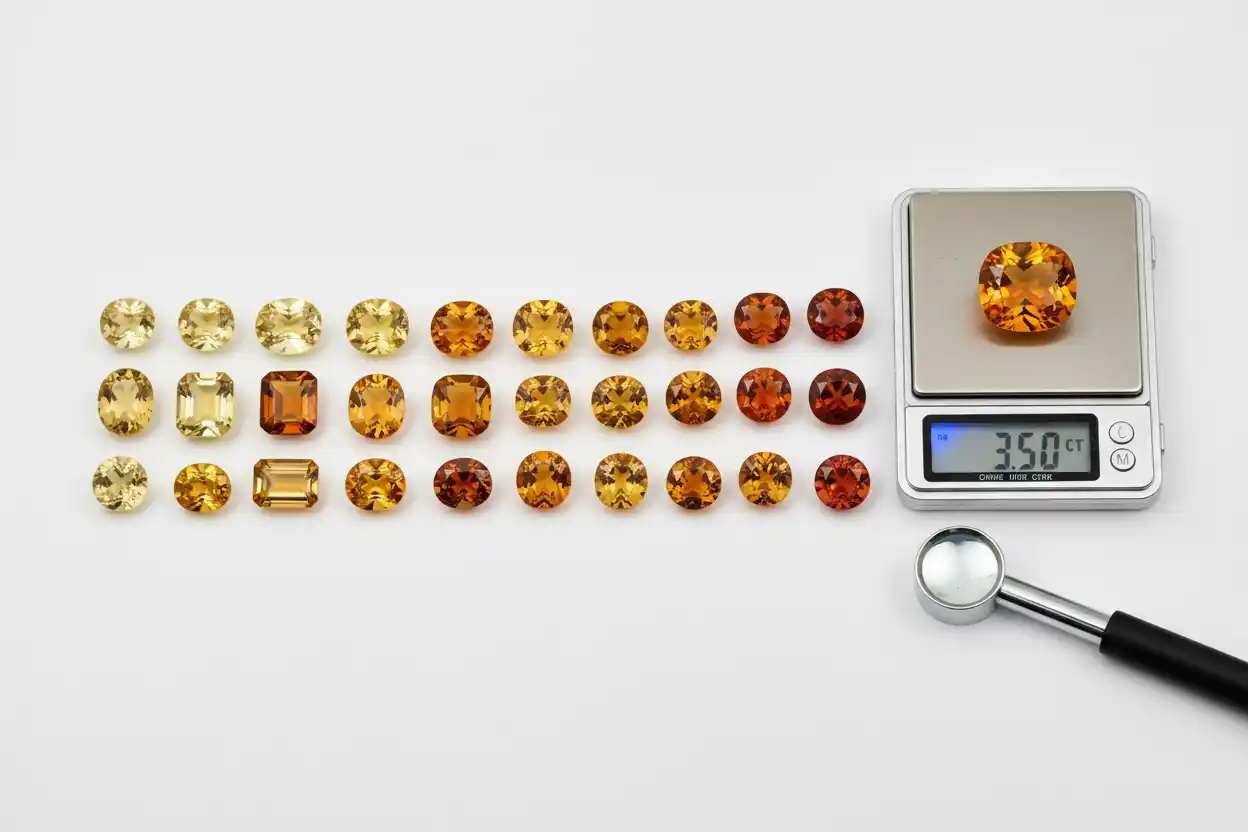
Citrine Price: How Value Is Judged, Market Demand, Grade & Origin
Citrine price is generally more accessible than the price of many other transparent colored gemstones because quartz is widely available, large clean citrine can be produced in substantial sizes, and most market citrine receives its color through heat treatment of amethyst. GIA describes citrine as one of the most popular yellow-to-orange gems and notes that even fine material remains comparatively affordable, with price per carat not rising dramatically merely because the stone becomes larger. This market structure means color, cutting, treatment representation, clarity, craftsmanship, and seller context often matter more than an impressive carat number.
There is still no responsible universal citrine price per carat that applies to every listing. A pale commercial stone cut for mass-market jewelry belongs to a different quality category from a saturated reddish-orange, eye-clean, precision-cut gemstone with excellent proportions. Natural unheated color may also carry different collector interest from ordinary heat-treated material when the representation is credible. Buyers who are actively shopping should first review the Gems Lore guide on how to buy citrine, because accurate value comparison begins with identity, treatment, quality, and disclosure.
Citrine Price At a Glance
| Value Factor | What to Examine | Typical Influence on Citrine Price |
|---|---|---|
| Color | Hue, saturation, brown component and evenness | Rich attractive yellow to reddish orange usually commands stronger demand |
| Clarity | Eye-visible inclusions and transparency | Eye-clean faceted material is common and normally preferred |
| Cut | Brilliance, symmetry, polish and windowing | Better cutting can create a meaningful premium even in inexpensive rough |
| Carat Weight | Total weight plus millimeter dimensions | Larger size raises total value but usually does not create dramatic per-carat jumps by itself |
| Treatment | Heated versus credibly represented natural-color material | Treatment status changes the appropriate comparison group |
| Natural/Synthetic Status | Natural quartz versus laboratory-grown citrine | Origin category affects market position and disclosure |
| Condition | Chips, abrasion, scratches and fractures | Damage can reduce desirability, particularly in pre-owned jewelry |
| Design | Precision cutting, carving or notable jewelry workmanship | Craftsmanship can add value beyond raw gem material |
| Origin | Documented provenance versus seller locality claim | Geographic source usually matters less than visible quality in ordinary citrine |
| Documentation | Laboratory identification when justified | Reduces uncertainty but does not assign market value |
| Retail Grade | Seller-defined labels such as AAA | Useful only if the seller explains the criteria; not a universal laboratory standard |
| Market Channel | Specialist retail, jewelry brand, auction, private resale | Different transaction settings can produce different prices |
Why Citrine Is Usually More Affordable Than Its Natural Rarity Suggests
Natural-color citrine is rare, but the commercial market does not depend solely on naturally yellow quartz. GIA states that most citrine available today is produced by heating amethyst, creating a large supply of attractive yellow, orange, and reddish-orange quartz. This is an important example of why geological rarity and market price are not identical concepts.
A material can be rare in one natural form while the commercial market remains well supplied through accepted treatment. Heat-treated citrine is not a different mineral species; it remains quartz. As a result, consumers can purchase large, clean, brightly colored stones without facing the extreme scarcity premiums associated with gemstones whose desirable color and size cannot be produced from abundant natural rough through routine treatment.
The distinction is useful when reading the Gems Lore guide to the rarest gemstones in the world. Natural rarity must always be evaluated together with treatment, supply, demand, size distribution, and the availability of substitutes before predicting monetary value.
Color Is the Leading Citrine Value Factor
GIA describes desirable citrine colors as saturated yellow through reddish orange and orangy red, particularly when brownish components do not overwhelm the appearance. It also notes that earthy deep brownish or reddish-orange shades remain popular with consumers.
This means citrine price can vary significantly within the same carat weight. A pale yellow stone may be inexpensive even when large, while a strongly saturated, lively gemstone with attractive orange or reddish-orange color can command a premium. Color zoning can reduce desirability when it is visually distracting, particularly because clean, evenly colored material is widely available.
Photography can complicate price comparison. Warm lights can make a modest yellow stone appear much richer, while digital saturation can intensify orange or red. Higher-priced listings should provide enough imagery to judge color under neutral conditions rather than relying on one heavily optimized photograph.
More Saturation Does Not Always Mean Better Color
Color quality is not a simple race toward the darkest possible stone. A very dark citrine can become brown, dull, or heavily extinct in certain areas, reducing brilliance. A medium-toned stone with excellent saturation and light return may therefore appear more valuable than a darker but visually closed stone.
Hue preferences also differ across markets and buyers. Some consumers prefer golden yellow, others favor orange, and some actively seek reddish-orange material. GIA’s quality guidance recognizes both saturated yellow-to-reddish-orange colors and contemporary popularity for deeper earthy shades.
The fairest valuation considers how pleasing the individual stone appears rather than assuming a trade description automatically represents a superior grade.
Clarity Usually Has a Straightforward Effect on Citrine Price
Much faceted citrine is eye-clean, meaning visible inclusions are uncommon enough that buyers generally expect a clear-looking stone. GIA states that dealers look for citrines without obvious inclusions and that visible inclusions can materially reduce value, especially in pale-colored gems where internal features are easy to see.
Because eye-clean citrine is readily available, a visibly included ordinary faceted stone generally needs another compelling attribute to justify a premium. Exceptional cutting, unusual natural-color provenance, artistic carving, or an attractive included aesthetic can change the evaluation, but those are specific cases rather than the baseline market.
Clarity should also be separated from condition. Internal inclusions formed during crystal growth are different from external scratches, chips, worn facet junctions, or later fractures created through use.
Cut Quality Can Create More Value Than Additional Weight
Citrine rough is sufficiently available that a skilled cutter can often prioritize beauty rather than saving every possible fraction of carat weight. GIA documents citrine in calibrated commercial cuts, custom designs, fantasy cuts, and large carvings.
A well-cut citrine can show brighter light return, better symmetry, more attractive proportions, and stronger face-up presence than a heavier stone with a large window or excessive depth. This makes cutting one of the most practical areas in which buyers can see a direct connection between quality and price.
Precision or designer cutting can also create a premium that belongs partly to craftsmanship rather than to citrine rough itself. A thirty-carat award-winning custom cut should not be compared directly with a thirty-carat mass-produced stone solely through a per-carat formula because the labor, design, optical performance, and market audience differ substantially.
Larger Citrine Does Not Automatically Command a Large Per-Carat Premium
GIA specifically notes that citrine occurs in large sizes and that price per carat does not increase dramatically for larger stones in the way it can for gemstones where large clean crystals are scarce.
This makes citrine particularly attractive for statement jewelry, cocktail rings, pendants, carvings, and large designer pieces. Buyers can obtain substantial face-up size without necessarily entering an extreme rarity tier.
Total price can still rise as weight increases because the buyer is receiving more gemstone material and potentially more complex cutting. The important distinction is that a twenty-carat citrine should not be assumed automatically to have a much higher value per carat than a five-carat stone of the same quality.
Natural Unheated Citrine Can Occupy a Different Collector Category
Natural-color citrine is comparatively rare, and GIA has documented natural citrine from sources such as Zambia and Bolivia. A credibly documented unheated stone may appeal to collectors who value natural color formation and scarcity.
That does not create a universal untreated premium. Natural color alone cannot compensate for unattractive hue, poor clarity, weak cutting, damage, or questionable provenance. An exceptional heat-treated citrine can still be more beautiful and commercially desirable than a mediocre natural-color stone.
Buyers should also distinguish “natural gemstone” from “natural color.” A heat-treated citrine can begin as natural amethyst and remain natural quartz even though its present color was created through treatment. Sellers should describe these concepts clearly rather than using the word “natural” ambiguously.
Treatment Is Normal but Still Relevant to Value
Heat treatment dominates commercial citrine supply, so heated status should not automatically be treated as a defect. GIA describes most market citrine as heat-treated amethyst and presents the process as a common source of commercial yellow-to-orange material.
Value becomes more complicated when a seller charges a substantial premium for alleged untreated material. In that situation, the representation needs evidence proportional to the premium. Unsupported verbal claims should not be treated as equivalent to an independent gemological conclusion.
The relationship with amethyst is also commercially important. The Gems Lore amethyst price guide provides useful context because the starting material for much citrine belongs to the same quartz species, while buy amethyst explains the quality and documentation considerations for the purple variety before treatment.
Synthetic Citrine Belongs in a Separate Price Category
Laboratory-grown quartz exists, and GIA states that some synthetic quartz is produced as laboratory-grown citrine. Synthetic citrine shares essential mineral characteristics with natural quartz but has an artificial growth origin.
The commercial value of synthetic material should therefore not be compared automatically with natural quartz, even when appearance is excellent. Proper disclosure allows buyers to make an informed decision according to their priorities.
An imitation is different again. Glass or another gemstone can resemble citrine without being quartz. Natural, treated natural, synthetic, and imitation materials should remain separate categories throughout any price comparison.
Geographic Origin Usually Has Limited Direct Effect on Ordinary Citrine Price
Citrine occurs in multiple countries, and GIA identifies sources including Bolivia, Spain, Madagascar, Mexico, Uruguay, and other regions, while noting that Brazil supplies much amethyst used to produce heat-treated citrine.
Unlike certain rubies, sapphires, or emeralds, ordinary citrine is generally not valued primarily through prestigious mine origin. Color, clarity, cut, treatment, size, and craftsmanship tend to matter more in routine retail transactions.
A documented natural-color deposit can still interest collectors, but seller-stated origin and independently supported provenance should be distinguished. GIA’s current origin-report service does not list citrine among the stones eligible for its standard geographic-origin report. Buyers should therefore be cautious when a listing claims that a standard identification certificate proves a specific citrine mine or country without the report actually saying so.
Retail Grades Such as AAA Do Not Establish Universal Citrine Value
Sellers may organize citrine inventory into categories such as A, AA, AAA, premium, Madeira grade, collector grade, or other proprietary labels. These descriptions can be useful within one retailer’s system but do not create a universal laboratory grading scale.
GIA’s Colored Stone Identification Report identifies gemstone type, natural or synthetic status, detectable treatments, and descriptive characteristics rather than assigning a standardized retail quality grade to citrine.
A buyer comparing two AAA citrines from different sellers should therefore look past the label and compare actual color, clarity, dimensions, cutting, treatment, condition, and seller protections.
Market Demand Helps Keep Fine Citrine Commercially Important
GIA describes citrine as one of the most popular and frequently purchased yellow gemstones and as a leading yellow-to-orange gem in the market. Its combination of attractive warm colors, jewelry durability, broad size availability, and accessible pricing gives it a large consumer market.
High demand does not necessarily translate into scarcity-driven price escalation because supply is also substantial. Heat treatment expands the available color supply, quartz crystals occur in large sizes, and eye-clean material is common. Market price therefore reflects the balance between strong consumer interest and abundant commercial availability.
The most noticeable premiums tend to concentrate in exceptional color, custom cutting, natural-color collector material, notable design, or documented provenance rather than ordinary calibrated stones.
Jewelry Design Can Add More Value Than the Loose Citrine Itself
A finished citrine jewel can cost much more than a loose stone of similar weight because its retail price may include gold or platinum, diamonds, setting labor, custom design, maker reputation, and brand positioning. Dividing the final ring or necklace price by the citrine’s carat weight would therefore create a misleading gemstone price.
Designer-cut citrine creates a similar distinction even before setting. Precision faceting, carving, or an award-winning design can command additional money because the buyer is paying for artistic labor and intellectual design as well as quartz.
When comparing citrine price, determine whether the figure represents rough material, a commercially cut loose gemstone, precision cutting, or a finished branded jewel.
Condition Influences Pre-Owned Citrine Value
Citrine has a Mohs hardness of 7 and good toughness, but it remains vulnerable to wear and thermal shock. GIA cautions that abrupt temperature changes can fracture citrine and that prolonged intense light can fade color in some material.
Pre-owned stones can show abraded facet junctions, scratches, chipped girdles, damaged points, or setting-related wear. These issues can reduce resale appeal even when the stone retains good color.
A repolish may restore some surface condition but can reduce weight or alter proportions. Appraisers and buyers should therefore distinguish an undamaged original cut from a stone requiring corrective work.
Laboratory Reports Usually Make Sense Only When the Stakes Justify Them
GIA offers Colored Stone Identification Reports for citrine but notes that they are not commonly requested because ordinary citrine value is often modest relative to laboratory-report cost.
A report becomes more logical when the seller claims unusual natural-color status, the stone is a high-value designer piece, identity is uncertain, or the transaction price is high enough that independent verification materially reduces risk.
The report still does not determine citrine price. It can establish facts about identity and detectable treatment, but an appraisal or market comparison must address monetary value separately.
Retail Price, Appraisal and Resale Value Are Different
Retail citrine price includes seller overhead, inventory risk, jewelry craftsmanship, marketing, return privileges, and profit margin. An insurance appraisal may estimate replacement cost in an appropriate retail market, while a dealer purchase offer must leave room for testing, inventory holding, resale risk, and future margin.
The three numbers can therefore differ substantially without necessarily contradicting one another. A consumer who buys a citrine ring at full retail should not assume the center stone alone could immediately be resold for the same amount.
Citrine’s broad availability can make this distinction particularly important because buyers have many substitute stones from which to choose.
How to Compare Citrine Prices Fairly
The most meaningful comparison uses stones with similar color intensity, hue, treatment, clarity, cut quality, weight, dimensions, condition, and level of craftsmanship. A mass-market heated citrine and a documented natural-color precision-cut specimen are not equivalent simply because both are ten carats.
Seller service also matters. Reliable photographs, clear treatment disclosure, return rights, laboratory evidence when appropriate, and professional after-sale support can justify some retail premium.
Price comparison becomes strongest when you can explain the difference between two listings in physical or transactional terms rather than relying on seller grades.
What Usually Raises Citrine Price?
Citrine tends to command stronger prices when it combines attractive saturated color, even appearance, eye-clean clarity, excellent proportions, lively brilliance, strong polish, desirable dimensions, and sound condition. Precision cutting, notable carving, high-end jewelry design, or credibly documented natural-color status can create additional premiums.
The most expensive-looking listing is not necessarily the highest-quality gemstone, however. Fine citrine remains a relatively accessible gem precisely because large clean quartz is available and commercial treatment supplies attractive colors efficiently.
What Usually Lowers Citrine Price?
Very pale or muddy color, distracting brownness, strong zoning, visible inclusions, large windows, poor symmetry, surface damage, uncertain identity, undisclosed treatment, weak photography, or misleading rarity claims can all reduce what an informed buyer is willing to pay.
Large size can fail to add much value when the stone is poorly cut or unattractive. Similarly, a natural-color claim adds little if the seller cannot support it or if the stone itself lacks appealing color.
Conclusion
Citrine price reflects an unusual balance between natural rarity and commercial abundance. Natural-color citrine is rare, yet heat treatment of amethyst supplies most of the market with attractive yellow-to-orange quartz, while large clean crystals remain readily available. GIA consequently describes citrine as both highly popular and relatively affordable, with limited dramatic per-carat escalation as size increases.
The strongest valuation method concentrates on color, clarity, cut, treatment, natural versus synthetic status, dimensions, condition, craftsmanship, documentation, and sales context. Origin should not be confused with quality, retailer grades should not be mistaken for universal laboratory grades, and laboratory identification should remain separate from appraisal or resale value. Those distinctions provide a much more reliable understanding of citrine price than a generic chart claiming one fixed rate for every stone.
Frequently Asked Questions
How much does citrine cost per carat?
There is no single citrine price per carat that applies to every stone. Color, clarity, cutting, treatment, natural or synthetic status, craftsmanship, condition, and seller context can change value. Because large citrine is comparatively available, size alone usually does not produce the dramatic per-carat premiums seen in gemstones where large clean rough is exceptionally scarce.
What citrine color is usually most valuable?
GIA describes saturated yellow to reddish orange and orangy red with little or no brownish component as prized colors, while deeper earthy reddish-orange shades also have substantial consumer popularity. Attractive brightness, even color, and good cutting still matter alongside hue.
Is natural unheated citrine more expensive?
Credibly documented natural-color citrine can attract collector interest because natural citrine is rare, but there is no universal premium that applies to every stone. Quality, color, clarity, cutting, documentation, and demand remain important, and an unsupported “unheated” claim should not justify a large premium by itself.
Why is citrine relatively affordable if natural citrine is rare?
Most commercial citrine is produced by heating amethyst, which creates a large supply of attractive yellow-to-orange quartz. Large clean quartz is also widely available, so market supply is much greater than the supply of naturally yellow unheated citrine alone would suggest.
Do large citrines cost much more per carat?
Not necessarily. GIA states that large citrines remain relatively affordable and that price per carat does not rise dramatically solely with larger size. A large stone still needs attractive color, clarity, cutting, and condition to justify a substantial premium.
Does AAA citrine have an official meaning?
AAA is generally a seller-defined commercial description rather than a universal laboratory grade. GIA’s colored-stone reports focus on identification, natural or synthetic status, detectable treatments, and descriptive characteristics rather than assigning standardized AAA-style citrine grades.
Does country of origin determine citrine value?
Usually not by itself. Citrine occurs in multiple countries, and ordinary market value depends more heavily on color, clarity, cut, treatment, and craftsmanship. GIA’s current standard geographic-origin report service also does not list citrine among eligible gemstones.
Is heat-treated citrine worth less than natural citrine?
Heat-treated citrine belongs to the normal commercial market and can be attractive and valuable, while credibly documented natural-color material may attract a separate collector premium. The exact difference depends on quality and demand rather than one fixed discount or multiplier.
Does a GIA report give a citrine value?
No. GIA can identify citrine and report relevant gemological characteristics and detectable treatments, but its identification report is not an appraisal. Market value requires a separate valuation using comparable stones and the intended transaction type.
Is citrine a guaranteed investment?
No. Citrine can be collectible and beautifully cut, but its broad commercial availability limits the logic of guaranteed appreciation claims. Future value depends on demand, quality, craftsmanship, condition, documentation, and resale market conditions rather than a promise attached to the stone.