
Buy Padparadscha Sapphire: Smart Buying Tips & Red Flags
If you want to buy padparadscha sapphire intelligently, begin with laboratory-supported color qualification before carat weight, country of origin, clarity, or a romantic lotus-blossom description. Padparadscha is not a separate mineral species from sapphire; it is a narrowly defined pink-orange to orange-pink color designation within natural corundum, and the premium can be substantial precisely because relatively few sapphires fall convincingly inside that balanced color range.
That narrow definition creates unusual buying risks. A natural sapphire can be beautiful peach, salmon, pink, orange, coral, or sunset-colored without qualifying as padparadscha. A stone can look like padparadscha under one lamp but become ordinary pink under another. Color zoning can create a face-up blend from separate pink and yellow areas. Heat can modify color legitimately, beryllium diffusion can create padparadscha-like orange-pink appearances, and some sapphires contain unstable color centers that temporarily alter the orange component under different illumination conditions. GIA specifically notes that the definition has long been debated and states that it applies the padparadscha description on its colored-stone reports when a sapphire meets its criteria.
The strongest methodology when you buy padparadscha sapphire is therefore natural sapphire identity first, independent padparadscha designation second, stable face-up color third, pink-orange balance fourth, treatment status fifth, cut and color distribution sixth, transparency and clarity seventh, dimensions eighth, structural condition ninth, origin tenth, and price last. Following that order prevents a seller-created “lotus pink,” “sunset,” “AAA,” “Ceylon,” or “investment grade” label from replacing the evidence that actually supports the premium.
The broader Padparadscha Sapphire guide explains the gemstone’s corundum identity, color, properties, formation, sources, and traditional symbolism. This page focuses specifically on how to buy padparadscha sapphire as a loose stone or finished jewel without paying padparadscha prices for ordinary peach sapphire, heat-and-diffusion material, unstable color, synthetic corundum, poor cutting, or a stone whose report does not support the trade designation.
What to Judge First When You Buy Padparadscha Sapphire
Padparadscha belongs to the corundum mineral species, with the same basic aluminum-oxide composition and exceptional hardness as other sapphires. What separates it commercially is not a different crystal species but a narrowly accepted face-up mixture of pink and orange.
When you buy padparadscha sapphire, use this hierarchy:
| Priority | What to evaluate | Why it matters |
|---|---|---|
| 1 | Natural sapphire identity | Synthetic corundum and other pink-orange gems can imitate the appearance |
| 2 | Laboratory padparadscha designation | Borderline peach, pink, and orange sapphires may not qualify |
| 3 | Color stability | Temporary orange components can create a misleading showroom appearance |
| 4 | Pink-orange balance | Both color components should contribute meaningfully face-up |
| 5 | Tone | Light-to-medium appearance is central to the traditional color range |
| 6 | Saturation | Attractive delicacy generally matters more than extreme vividness |
| 7 | Treatment | Heat, diffusion, irradiation-related effects, filling, and coating change value |
| 8 | Color distribution | Zoning should not create a false blended appearance from separate color blocks |
| 9 | Cut | Windowing, extinction, depth, and orientation directly affect color |
| 10 | Transparency and clarity | Fine stones should remain transparent enough for the subtle color to read clearly |
| 11 | Dimensions and weight | Deep cutting can preserve expensive weight without useful face-up spread |
| 12 | Origin and price | Provenance adds value only after identity, color, and treatment are secure |
When you buy padparadscha sapphire through this sequence, the rare name has to be earned by the stone rather than assigned by the product description.
Understand How Narrow the Padparadscha Color Range Is
The most important concept when you buy padparadscha sapphire is that not every peach sapphire is padparadscha.
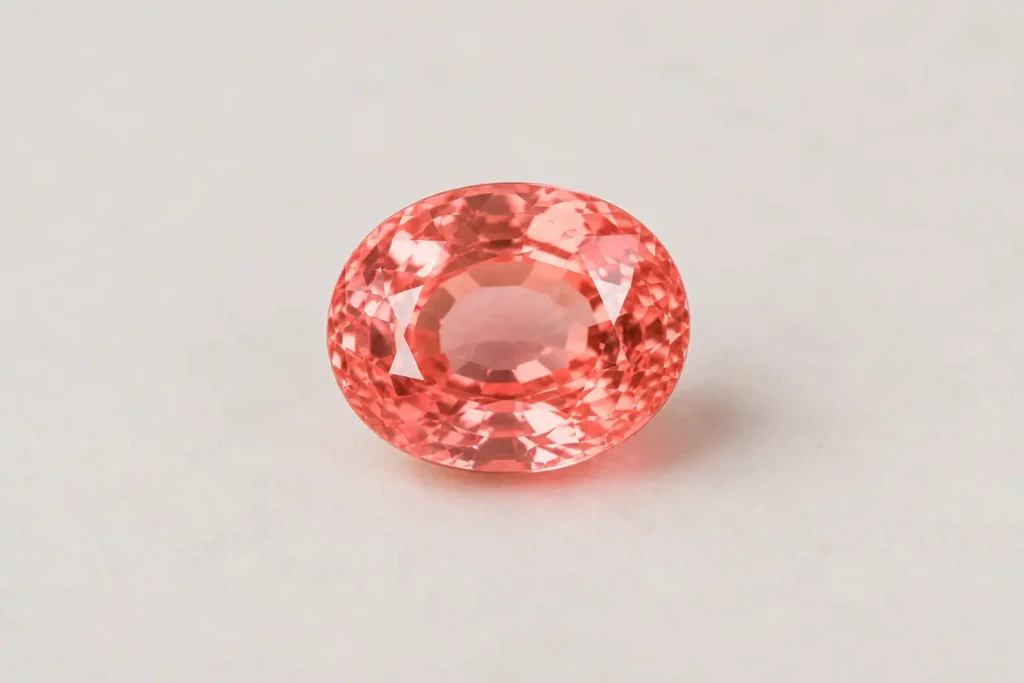
The accepted color sits between pink and orange, generally within light-to-medium tone rather than extremely dark or strongly saturated material. GIA describes the broadly accepted range as light-to-medium pinkish orange to orange-pink, while also emphasizing that the definition remains debated within the trade.
That means several attractive sapphires can fall outside the category:
pure pink sapphire, pure orange sapphire, yellowish orange sapphire, strongly reddish orange sapphire, brownish peach sapphire, heavily purple-modified sapphire, very dark salmon material, or strongly zoned corundum whose apparent blend exists only from one angle.
When you buy padparadscha sapphire, beauty and qualification need to be evaluated separately.
A stone can fail a laboratory’s padparadscha criteria and still be a beautiful natural sapphire.
It simply should not carry the same designation premium.
Both Pink and Orange Should Be Visible Face-Up
When you buy padparadscha sapphire, inspect whether both components are present simultaneously from the normal viewing direction.
The gemstone should not appear purely pink face-up while revealing orange only through the pavilion.
It should not look orange from one end and pink from the other.
It should not require warm lighting to create orange that disappears under neutral illumination.
The strongest stones show an integrated warm pink-orange balance across the face rather than two disconnected colors being averaged by the eye.
Do Not Confuse Peach Sapphire With Automatically Qualifying Padparadscha
Peach is a broad commercial color description.
Some peach sapphires can fall within a laboratory’s padparadscha criteria.
Many do not.
When you buy padparadscha sapphire, avoid sellers who use peach, salmon, lotus, coral, sunset, sunrise, and padparadscha as interchangeable labels.
Those words describe impressions.
Padparadscha should be supported by an appropriate laboratory conclusion when the designation materially affects price.
The wider Types of Sapphire guide helps separate padparadscha from pink, orange, yellow, purple, parti-colored, color-change, and other sapphire categories.
Light-to-Medium Tone Is Usually the Sweet Spot
Padparadscha’s appeal comes partly from delicacy.
When you buy padparadscha sapphire, a stone should generally remain light enough for the pink and orange components to be visible distinctly, yet deep enough that the gemstone does not wash out under ordinary light.
Excessive darkness can push the appearance toward brownish orange, red-orange, or overly saturated salmon.
Excessive paleness can make the stone look almost colorless.
The strongest stone is often neither the darkest nor the most vivid.
It is the one whose color remains luminous.
Strong Saturation Is Not Automatically Better
This differs from many colored-stone categories where buyers often chase maximum saturation.
When you buy padparadscha sapphire, an extremely vivid neon orange-pink stone should trigger closer evaluation rather than automatic excitement.
Very high saturation can move a sapphire away from the traditional pastel padparadscha appearance.
It can also raise treatment questions if the color looks unusually intense for the size and tone.
A delicate but unmistakable mixed hue can be much more convincing.
Judge Color Under Neutral Light Before Warm Jewelry Lighting
Rose gold and yellow gold can change the apparent balance dramatically.
Rose gold can strengthen pink.
Yellow gold can add warmth and apparent orange.
Skin tone, wooden surfaces, warm lamps, and beige backgrounds can produce similar effects.
When you buy padparadscha sapphire, ask to see the loose stone against both white and neutral gray before relying on jewelry photographs.
A gemstone should qualify through its own body color rather than through reflections supplied by its setting.
Compare the Stone in More Than One Ordinary Lighting Environment
Padparadscha is subtle enough that illumination matters greatly.
When you buy padparadscha sapphire, compare the stone under:
neutral diffused light, ordinary indoor illumination, directional white light, and the intended jewelry environment.
The purpose is not to demand identical color everywhere.
Every colored gemstone changes somewhat with illumination.
The purpose is to confirm that the stone remains recognizably pink-orange rather than changing categories completely.
Color Stability Deserves Unusually High Attention
Some sapphires contain color-center behavior that can temporarily strengthen or weaken yellow-orange coloration.
This matters greatly when you buy padparadscha sapphire because a stone could appear to fall inside the prized range during a sales presentation but later settle into a more ordinary pink appearance.
GIA uses a color-stability procedure on relevant sapphires and bases the reported color on the result after standardized testing; temporary padparadscha-like color that falls outside the accepted range after the stability procedure does not qualify.
A meaningful purchase should therefore rely on laboratory evaluation rather than home experimentation with ultraviolet lamps or intense light.
Do Not Attempt Color-Stability Experiments Yourself
When you buy padparadscha sapphire, do not deliberately expose the stone to intense ultraviolet light, concentrated heat, or prolonged experimental illumination to see whether the color changes.
Such testing can alter the temporary color state and complicate return rights.
A professional laboratory can evaluate stability under controlled conditions and record its conclusion consistently.
You should receive the gemstone in a representative state rather than turning the return period into an experiment.
Ask Whether the Report Explicitly Uses the Word Padparadscha
This is one of the simplest and strongest safeguards when you buy padparadscha sapphire.
A report that says:
Natural Sapphire — Orangy Pink
is not necessarily the same as a report that specifically applies a padparadscha designation.
A report that says:
Natural Corundum — Pinkish Orange
may describe a beautiful color without establishing that the laboratory treats the stone as padparadscha under its naming policy.
Read the actual conclusion.
Do not allow a seller to translate laboratory wording into a stronger trade designation than the laboratory itself used.
Laboratory Policies Can Differ
Padparadscha has never had one perfectly universal boundary shared identically by every laboratory and dealer.
When you buy padparadscha sapphire, two respected laboratories can occasionally treat a borderline color differently, particularly where saturation, tone, modifiers, zoning, treatment, or color stability complicate the stone.
That does not automatically make either laboratory dishonest.
It reflects the reality that the trade designation occupies a narrow color region with some judgment involved.
For a particularly expensive borderline stone, a second respected opinion can be sensible.
GIA Does Not Give Sapphire a Universal Quality Grade
When you buy padparadscha sapphire with a GIA report, understand what the report does and does not mean.
GIA states that it does not provide universal quality grading for sapphire and other colored stones. Its colored-stone reports can describe weight, measurements, shape, cutting style, color, natural versus laboratory-grown status, detectable treatments, and—when requested and possible—geographic-origin opinion.
That means a GIA report supporting the padparadscha description is highly useful for identity and classification, but you must still judge beauty, cut, transparency, and price yourself.
The broader Gemstone Certification guide explains these report boundaries in practical detail.
Heat Treatment Is Common and Accepted in Sapphire
When you buy padparadscha sapphire, do not confuse natural sapphire with unheated sapphire.
Heating is a widely accepted sapphire treatment and can improve color or clarity. GIA notes that heat is an accepted treatment, while a fine sapphire confirmed by an independent laboratory as showing no evidence of heat can carry greater rarity and value.
A heated natural sapphire can still be a beautiful high-quality gemstone.
The important issues are:
what treatment occurred, whether the laboratory still applies the padparadscha designation, whether the color is stable, and whether the asking price reflects heated rather than no-heat status.
No-Heat Padparadscha Needs Strong Documentation
When you buy padparadscha sapphire with a major no-heat premium, insist on a respected laboratory report stating that no evidence or indications of heating were detected according to that laboratory’s terminology.
A seller saying:
“untouched,”
“earth mined,”
“natural,”
“mine direct,”
or “never enhanced”
does not provide equivalent evidence.
Natural geological origin and heat-treatment history are separate questions.
A natural sapphire can have been heated.
Beryllium Diffusion Is a Major Padparadscha Risk
Beryllium diffusion is particularly relevant because it can create or modify yellow, orange, and orangy-pink colors in corundum.
The treatment became commercially significant precisely because less valuable starting material could be altered into highly attractive padparadscha-like colors. GIA research found that beryllium diffusion can penetrate deeply, and in difficult cases advanced chemical analysis may be needed for detection.
When you buy padparadscha sapphire, do not accept vague treatment wording such as “enhanced” or “heated” if the report’s complete treatment section has not been reviewed.
Diffusion Is Not Equivalent to Conventional Heat
This distinction has direct value consequences.
Traditional heating alters existing defects and inclusions within the sapphire without intentionally adding a color-causing element into the lattice.
Lattice diffusion uses heat and chemicals to introduce an element that changes color. GIA explains that diffusion-treated sapphires generally command less value than sapphires treated only by conventional heat or stones that have not been treated.
When you buy padparadscha sapphire, a diffusion-treated stone should therefore not be priced like an equivalent conventionally heated or no-heat specimen.
Beryllium-Diffused Sapphire Should Not Be Marketed as Equivalent Padparadscha
GIA’s color-stability discussion specifically notes that its padparadscha characterization does not apply to beryllium-diffused sapphire.
That makes diffusion disclosure one of the most important report checks when you buy padparadscha sapphire.
A seller may still offer an attractive pink-orange diffusion-treated sapphire.
The problem is not that the stone lacks beauty.
The problem is paying a rare-padparadscha price for color that was materially manufactured through diffusion treatment.
Irradiation and Unstable Color Centers Need Separation
Irradiation-related and light-activated color effects can produce temporary orange or yellow components in some sapphire.
When you buy padparadscha sapphire, ask whether the laboratory evaluated color stability and relevant treatment behavior rather than assuming every peach appearance is permanent.
A gemstone photographed immediately after exposure to conditions that strengthen orange color may not represent how it will look during ordinary ownership.
Stable representative color should form the basis of the transaction.
Fracture Filling Changes the Quality Category
Corundum is durable, but lower-quality material can contain surface-reaching fractures that are filled with glass or another material.
When you buy padparadscha sapphire, inspect fractures carefully and read the report’s enhancement comments.
A filled gemstone can still be natural sapphire at its core.
Its clarity, durability, value, and repair requirements differ from an unfilled stone.
A significant padparadscha premium should not be paid without understanding whether foreign material contributes to the apparent color or transparency.
Colored Residue Inside Fractures Can Distort Face-Up Hue
This is particularly relevant in a gemstone defined by a subtle color balance.
When you buy padparadscha sapphire, inspect whether orange, yellow, or reddish material appears concentrated inside surface-reaching fissures rather than distributed naturally through the sapphire body.
Colored residue, staining, glass, or other foreign material can influence the apparent face-up blend.
The desired pink-orange color should belong primarily to the corundum itself.
Coatings Need Disclosure
A surface film can modify color without changing the underlying sapphire species.
When you buy padparadscha sapphire with unusually strong or surface-concentrated color, inspect facet junctions, girdle areas, chips, and scratches for abrupt changes.
Do not scrape the gemstone yourself.
Professional testing is safer.
A natural sapphire with a coating remains natural corundum, but its visible color belongs to a treated category.
Synthetic Padparadscha-Like Sapphire Exists
Laboratory-grown corundum can be produced in attractive pink, orange, and intermediate colors.
When you buy padparadscha sapphire, exceptionally clean appearance does not prove synthetic origin because natural sapphire can also be very clean.
Likewise, inclusions do not automatically prove natural origin because some synthetic growth methods produce inclusions and growth structures.
The Real vs Fake Sapphire guide explains the broader distinction among natural sapphire, synthetic corundum, glass, assembled products, and treated material.
For a meaningful padparadscha premium, rely on professional natural-versus-laboratory-grown identification.
Color Zoning Can Make a Stone Look Better Than It Really Is
Natural sapphire frequently grows with color zoning.
A cutter can sometimes orient those zones intelligently to create an attractive face-up blend.
When you buy padparadscha sapphire, inspect whether the gemstone’s apparent pink-orange color comes from a coherent integrated hue or from:
one pink end plus one yellow end, a yellow center with pink edges, separate orange and colorless zones, or a narrow peach band positioned beneath the table.
Minor zoning can be acceptable.
The designation should not depend on an optical trick that disappears as soon as the gemstone turns.
Request Pavilion and Side Views
Color zoning can hide extremely well in one face-up photograph.
When you buy padparadscha sapphire online, request slow video plus clear side and pavilion images.
These views can reveal:
separate color bands, uneven depth, concentrated orange areas, colorless zones, inclusions, fractures, and whether a colored setting is influencing the appearance.
The How to Buy Gemstones Online guide provides the broader transaction framework, but padparadscha requires unusually disciplined color documentation.
Pleochroism Can Change the Pink-Orange Balance
Sapphire is pleochroic, meaning color can vary with crystallographic direction.
When you buy padparadscha sapphire, one direction can appear pinker while another appears more orange or yellow.
A skilled cutter should orient the rough so the most attractive and qualifying blend dominates face-up.
Poor orientation may create a gemstone that looks convincingly padparadscha only when tilted.
Cut Orientation Is More Important Than Perfect Symmetry
Rare material encourages cutters to preserve weight.
When you buy padparadscha sapphire, some asymmetry may be acceptable if it preserves a superior color zone and avoids unnecessary loss of rare rough.
However, the trade-off should improve the stone visibly.
A crooked outline that preserves weight but leaves severe zoning or windowing is not automatically justified.
Windowing Can Destroy Delicate Color
A shallow pavilion allows light to pass through instead of returning strongly to the viewer.
When you buy padparadscha sapphire, windowing is particularly damaging because the color is already relatively delicate.
A broad transparent central window can make the middle look nearly colorless.
Place the stone over a neutral surface and view it face-up.
If the background remains clearly visible through a large central region, the cut deserves a discount.
Deep Cutting Can Hide Valuable Weight
The opposite problem is excessive depth.
A cutter may retain a deep pavilion because every fraction of a carat matters in valuable rough.
When you buy padparadscha sapphire, compare:
carat weight, length, width, depth, and face-up presence.
A heavier stone is not necessarily a larger-looking stone.
You may still accept a deeper cut if it strengthens color significantly.
Know what the hidden weight is accomplishing.
Compare Millimeters Alongside Carats
A gemstone’s dimensions show how much visible area you actually receive.
When you buy padparadscha sapphire, ask for exact measurements rather than choosing solely from carat thresholds.
A well-spread 1.40-carat stone can look larger than a deep 1.70-carat stone.
Likewise, an elongated oval can appear visually larger than a compact cushion of similar weight.
Carat is mass.
It is not face-up size.
Ovals Are Common for Good Reasons
Oval cutting often preserves sapphire rough efficiently while allowing a cutter to manage color zoning and create useful face-up spread.
When you buy padparadscha sapphire in an oval, inspect:
bow-tie darkness, shoulder symmetry, color concentration at the ends, windowing, pavilion depth, and whether one end appears much pinker or more orange than the other.
A mild moving bow tie can provide contrast.
A permanent dark band through the center weakens the stone.
Cushions Can Present Color Beautifully
Cushion cuts can preserve rough effectively while creating broad enough facets for the subtle mixed color to remain visible.
When you buy padparadscha sapphire in a cushion, evaluate whether the stone is:
square or elongated, brilliant or mixed cut, deep enough for color but not excessively heavy, and free from a central window.
The outline should serve the color.
Pear Shapes Need Color Balance and Tip Protection
A pear can show a stronger color concentration near the point because of the greater depth and narrowing geometry.
When you buy padparadscha sapphire in a pear, make sure one end does not become orange while the broad end appears almost pink or colorless.
Also inspect the tip for chips and thin girdle sections.
For ring use, a protective V-prong can be sensible.
Rounds Can Carry a Cutting Premium
Round brilliants require more removal from many natural sapphire rough shapes.
When you buy padparadscha sapphire in a round, a strong example can show excellent symmetry and brilliance, but the shape alone does not justify poor color.
Color remains the defining factor.
Step Cuts Expose Color and Clarity Honestly
Emerald and other step cuts contain broad facets that reveal the interior clearly.
When you buy padparadscha sapphire in a step cut, inspect:
zoning, windowing, inclusions, extinction, and color balance very carefully.
There are fewer small brilliant facets available to disguise weaknesses.
A strong step-cut stone can look elegant and unusually transparent.
A weak one can appear empty.
Clarity Matters, but Padparadscha Does Not Need to Be Flawless
Fine transparent material is desirable because the subtle color needs enough openness to remain luminous.
When you buy padparadscha sapphire, common natural inclusions can include:
rutile silk, crystals, fingerprints, healed fractures, growth structures, zoning, and small cavities.
A minor inclusion can be completely acceptable.
It may even support natural-origin interpretation.
The important question is whether it distracts from the face-up color or weakens the structure.
Do Not Pay Excessively for Microscopic Perfection
Once a stone is comfortably eye-clean, additional clarity improvement may contribute less visual value than better color or cutting.
When you buy padparadscha sapphire, a tiny enclosed crystal near the girdle can be a rational compromise if it allows you to obtain stronger pink-orange balance.
Spend first on what you can actually see.
Colored Inclusions Need More Scrutiny Than Colorless Ones
An orange-stained fracture or yellow inclusion can affect the face-up color classification more than an equivalent transparent inclusion.
When you buy padparadscha sapphire, inspect whether any inclusion materially contributes to the pink-orange appearance.
The qualifying color should come from the sapphire body rather than foreign colored material.
Surface-Reaching Fractures Matter Structurally
Corundum has excellent toughness and no cleavage, but it can still chip or fracture.
When you buy padparadscha sapphire, inspect the girdle, pavilion, tips, corners, and future setting points.
A surface-reaching fracture near a prong deserves more attention than a small enclosed crystal in the center.
The Gemstone Toughness vs Hardness guide explains why resistance to scratching and resistance to breakage are separate properties.
Padparadscha Sapphire Is Highly Durable for Jewelry
Corundum ranks 9 on the Mohs scale.
The Gemstone Hardness Chart places sapphire among the most scratch-resistant mainstream jewelry gemstones.
When you buy padparadscha sapphire for a ring, pendant, earrings, or bracelet, normal durability is a major advantage over softer peach-colored alternatives such as morganite.
Durability does not excuse weak setting construction.
Prongs can bend even when the sapphire remains intact.
Rings Are an Excellent Use When the Stone Is Sound
The Sapphire Ring guide covers setting styles and construction in depth.
When you buy padparadscha sapphire for a ring, inspect:
girdle thickness, corner protection, prong security, gallery construction, shank thickness, setting height, and whether the gemstone can be removed for future testing without unnecessary damage.
A rare high-value center deserves a setting designed for long-term servicing.
Color of the Metal Changes the Finished Look
Rose gold strengthens pink.
Yellow gold strengthens warmth and orange.
White gold and platinum provide a more neutral contrast.
When you buy padparadscha sapphire jewelry, choose the metal according to the finished aesthetic you want, but evaluate the loose gemstone separately first.
The setting should complement a qualifying color rather than manufacture one.
Halo Stones Can Change Perceived Saturation
White diamonds surrounding a pastel sapphire can make the center appear stronger through contrast.
Pink sapphires can increase the perceived pink component.
Orange or yellow accents can strengthen warmth.
When you buy padparadscha sapphire in a complex jewel, judge the center stone by itself whenever its rare designation creates a substantial part of the price.
Ask What Every Accent Stone Is
A padparadscha center may be surrounded by natural diamonds, laboratory-grown diamonds, white sapphire, spinel, or cubic zirconia.
When you buy padparadscha sapphire jewelry at meaningful value, the invoice should identify significant accents accurately.
Do not infer diamond identity from sparkle alone.
Sri Lanka Has the Strongest Historical Association
Padparadscha’s lotus-blossom name and trade history are strongly associated with Sri Lanka, traditionally called Ceylon.
When you buy padparadscha sapphire represented as Sri Lankan, that origin can add collector interest, particularly in a fine no-heat stone.
However, geographic origin does not create the designation by itself.
A Sri Lankan sapphire can still be too pink, too orange, too yellow, too brown, too dark, too zoned, or otherwise outside a laboratory’s padparadscha criteria.
Padparadscha Is Not Restricted to Sri Lanka
Fine qualifying pink-orange sapphires can come from other sapphire-producing regions, including Madagascar and Tanzania.
When you buy padparadscha sapphire, do not reject a well-documented Madagascar stone simply because another seller claims that “real padparadscha only comes from Ceylon.”
The name’s history and the modern laboratory color designation are related but not identical concepts.
Buy the stone’s verified color first.
Origin Is a Separate Laboratory Question
GIA states that sapphire origin opinions may be available when the evidence supports a conclusion and also notes that every mine produces a range of quality.
When you buy padparadscha sapphire with an origin premium, make sure the report actually contains an origin opinion rather than assuming that a sapphire identification report automatically includes one.
“Ceylon type” is not the same as “origin: Sri Lanka.”
“Madagascar color” is not the same as a laboratory origin conclusion.
No-Heat Plus Fine Origin Can Create a Significant Premium
A beautifully balanced padparadscha with no evidence of heat and credible Sri Lankan or another desirable origin can occupy a much rarer category than ordinary heated material.
When you buy padparadscha sapphire at this level, documentation quality should rise with the premium.
One old dealer card is not enough for a major transaction.
A respected independent report should address the points that matter financially.
Origin Should Never Rescue Weak Color
A famous country name cannot turn ordinary peach sapphire into fine padparadscha.
When you buy padparadscha sapphire, prioritize:
designation, stable color, treatment, transparency, cut, and condition before provenance.
Origin is an additional value factor.
It is not a replacement for quality.
Compare Price Only After the Laboratory Category Is Clear
The Padparadscha Sapphire price guide provides the broader value framework, but price comparison becomes meaningful only after you know what category the stone actually occupies.
When you buy padparadscha sapphire, compare:
no-heat with no-heat, conventionally heated with conventionally heated, similarly colored stones with similar laboratory designations, and similar size ranges with comparable cutting.
Do not compare a beryllium-diffused pink-orange sapphire directly with an unheated natural padparadscha.
They can look superficially similar while belonging to different economic categories.
Color Can Matter More Than Carat Weight
A 1.2-carat gemstone with exceptional stable pink-orange balance can be substantially more desirable than a 2-carat stone that looks mostly pink, mostly orange, or heavily zoned.
When you buy padparadscha sapphire, additional weight adds value only when the defining color quality continues.
Size should amplify excellence.
It should not replace it.
Large Fine Stones Deserve a Higher Evidence Threshold
A large transparent stone combining:
balanced padparadscha color, excellent cutting, no obvious treatment concerns, and premium provenance
can be genuinely important.
When you buy padparadscha sapphire fitting that description, independent documentation becomes non-negotiable.
Exceptional rarity should increase scrutiny rather than reduce it.
Very Low Prices Need Context
A small heated padparadscha, a pale stone, an included gem, or material with less prestigious origin can cost less than elite examples.
Low price by itself does not prove fraud.
When you buy padparadscha sapphire at a surprisingly low price, however, investigate whether the explanation is:
borderline color, heat treatment, diffusion, synthetic origin, poor cutting, heavy zoning, weak clarity, missing report, or a seller using the trade name loosely.
A bargain should have a reason.
Very High Prices Need Context Too
High price does not prove qualification.
When you buy padparadscha sapphire at a major premium, ask exactly what you are paying for:
balanced stable color, no-heat status, size, transparency, precise cutting, Sri Lankan provenance, prestigious laboratory wording, or exceptional rarity.
If the answer is simply “padparadscha is rare,” the price methodology is incomplete.
Seller Grades Such as AAAA Are Not Universal
Padparadscha listings can include:
AAA, AAAA, 5A, royal padparadscha, lotus grade, sunset grade, investment grade, collector grade, or museum quality.
These are not one universally accepted independent grading framework.
When you buy padparadscha sapphire, translate every grade into factual questions.
Does a respected laboratory use the padparadscha designation?
Is the color stable?
Is the stone heated?
Is diffusion absent?
What is the color balance?
How transparent is it?
Is it windowed?
What are the dimensions?
What supports the origin?
Those answers matter.
The number of A’s does not.
A Seller’s Color Name Should Not Override the Report
Imagine a report describing a gemstone as natural pink sapphire while the seller lists it as “rare lotus padparadscha.”
When you buy padparadscha sapphire, treat that discrepancy as material.
Ask why the laboratory did not apply the same designation.
A retailer is free to describe appearance.
It should not use a commercially stronger color designation to bypass laboratory wording when the name materially changes price.
Report Verification Is Essential
When you buy padparadscha sapphire with laboratory documentation, use the issuing laboratory’s official verification system where available.
Then compare the archive with the physical report.
After that, compare the report with the gemstone.
Check:
weight, measurements, shape, cutting style, color description, photograph, treatment, origin where present, and identification conclusion.
A real report number copied from another stone does not authenticate your gemstone.
Match Distinctive Inclusions
Natural sapphires often contain individual internal features that function almost like fingerprints.
When you buy padparadscha sapphire, compare visible crystals, fingerprints, silk, zoning, or cavities with the report photograph and seller’s magnified images.
This is especially useful when the stone has been removed from a sealed parcel or passed through several dealers.
Recutting Can Invalidate Report Matching
A padparadscha sapphire may be recut to improve windowing, remove a chip, or strengthen face-up color.
When you buy padparadscha sapphire that has been recut after its report was issued, the old weight and dimensions will no longer match.
A fresh laboratory submission can restore documentary continuity.
Do not assume an old report remains an adequate match after substantial cutting.
Mounted Stones Are Harder to Evaluate Fully
Metal can obscure:
the girdle, pavilion, exact weight, color zoning, treatment clues, and some inclusions.
When you buy padparadscha sapphire already set, ask whether the report was issued when the stone was loose.
If the financial stakes are high, determine whether the laboratory can examine the mounted piece adequately or whether the setting limits conclusions.
Do not remove an important gemstone from valuable signed or antique jewelry casually.
Online Photography Can Shift Padparadscha Color Dramatically
Padparadscha sits between two colors that cameras and screens reproduce inconsistently.
A slight change in white balance can push the gemstone toward:
pink, coral, orange, yellow, or brown.
When you buy padparadscha sapphire online, actual-stone video matters enormously.
The seller should not rely on one highly edited macro photograph.
Request a Neutral White Reference in the Frame
A white or gray reference helps you judge whether color balance has been manipulated.
When you buy padparadscha sapphire, inspect the reference object as closely as the gemstone.
If white paper looks cream, the orange may be exaggerated.
If gray looks blue, pink may appear artificially stronger.
A natural-looking background increases confidence in the presentation.
Do Not Judge From Skin Alone
Skin tone can reflect warm color into a pastel sapphire.
When you buy padparadscha sapphire, hand photographs are useful for scale and jewelry appearance but weak as the only color evidence.
Ask for the loose stone over neutral surfaces too.
Request Slow Rotation Rather Than Fast Sparkle Video
Fast spinning under point lights can make every sapphire look exciting while hiding zoning and windowing.
When you buy padparadscha sapphire, a slow rotation under broad neutral illumination is more useful.
Watch:
whether pink and orange remain balanced, whether one end becomes yellow, whether a window appears, whether extinction dominates, and whether the stone changes classification from different angles.
Ask for Side and Pavilion Media
Face-up color is the buying target, but side views explain how the cutter achieved it.
When you buy padparadscha sapphire, inspect whether:
strong orange exists only along the girdle, the pavilion is excessively deep, one zone dominates from the side, fractures reach the surface, or colored metal reflects through the stone.
The face tells you what you see.
The side often tells you why.
Return Terms Should Allow Independent Verification
A high-value padparadscha purchase should provide enough protection for reasonable non-destructive verification.
When you buy padparadscha sapphire online, confirm whether laboratory or gemologist inspection is permitted before the return period ends.
Do not:
heat the stone, irradiate it, recut it, scratch it, reset it, expose it to chemicals, or conduct amateur color-stability experiments.
Verification should preserve the gemstone.
The Invoice Should Preserve Every Premium-Bearing Claim
When you buy padparadscha sapphire, useful invoice wording can include:
natural sapphire, padparadscha designation, carat weight, dimensions, treatment status, laboratory name, report number, geographic origin where represented, and metal or accent-stone information for finished jewelry.
If you paid a no-heat Sri Lankan padparadscha premium, the invoice should not merely say:
“pink sapphire ring.”
Specific documentation protects resale, insurance, and future identification.
Appraisal and Gemological Report Serve Different Purposes
A gemological report can address:
material identity, natural versus synthetic origin, treatment, color description, and possibly geographic origin.
An appraisal estimates monetary value for a defined purpose.
When you buy padparadscha sapphire, do not allow a large appraisal number to substitute for a report supporting the rare color designation.
The rare name should be established first.
Value comes afterward.
Ethical and Mine-Origin Claims Need Separate Evidence
A gemological origin report does not automatically prove that a stone was ethically mined, directly sourced, or traceable to one individual miner.
When you buy padparadscha sapphire because sourcing matters to you, ask for documentation supporting:
supplier chain, mine or region, labor practices, dealer relationships, and transaction history where available.
A laboratory country opinion and an ethical-source statement answer different questions.
Do Not Use Destructive Home Tests
Corundum is very hard, but scratch testing is unnecessary.
Acids do not establish padparadscha color qualification.
Heat can alter treatment evidence or damage a filled stone.
When you buy padparadscha sapphire, the important questions are sophisticated enough that destructive home tests add little value.
Use the laboratory report and professional examination.
Routine Care Is Straightforward for Sound Corundum
A structurally sound unfilled sapphire is highly suitable for frequent wear.
Warm water, mild soap, and a soft brush are generally appropriate for routine cleaning.
When you buy padparadscha sapphire with filling, coating, unusual treatment, or significant fractures, use more conservative care.
Tell a jeweler about the report findings before repair or high-temperature work.
Major Red Flags When You Buy Padparadscha Sapphire
| Red flag | Why it matters |
|---|---|
| Seller applies padparadscha without an appropriate laboratory report | Borderline peach, pink, and orange stones may not qualify |
| Report describes only pink sapphire | Retailer may be upgrading the color name beyond the laboratory conclusion |
| Report describes only orange sapphire | Meaningful pink component may be missing |
| Color looks perfect only in warm lighting | Setting or illumination may be creating the desired blend |
| Rose-gold photographs are the only color evidence | Pink reflection can materially change appearance |
| Stone turns pure pink under neutral light | Orange component may be weak or unstable |
| One end is pink and the other orange | Zoning may be creating an artificial blended impression |
| Strong yellow or brown modifier is ignored | Stone may fall outside strict padparadscha criteria |
| Dark highly saturated color is marketed as automatically superior | Traditional padparadscha is generally light to medium |
| “Natural” is used to imply unheated | Natural origin and heat status are separate |
| No-heat premium has no laboratory support | Rarity claim remains unverified |
| Treatment section says only “enhanced” | Exact treatment is unclear |
| Beryllium diffusion is not addressed | Diffusion can create padparadscha-like color |
| Diffusion-treated stone is priced like no-heat material | Value categories differ substantially |
| Color-stability question is ignored | Temporary orange can affect classification |
| Seller recommends UV exposure to “restore” orange | Temporary color manipulation may be involved |
| Colored fissures materially influence face-up appearance | Foreign material may be contributing to the color |
| Large window is hidden beneath strong background color | Cut quality and natural saturation may be weaker than presented |
| Very deep pavilion accompanies small face-up dimensions | Rare weight may be hidden below the girdle |
| AAAA is presented as a universal padparadscha grade | Seller grades are not standardized |
| “Ceylon” is used as proof of padparadscha | Geographic origin does not itself qualify the color |
| Madagascar origin is used to dismiss an otherwise qualifying stone | Padparadscha is not restricted to Sri Lanka |
| Seller certificate is presented as independent gemological analysis | Retailer documentation may simply repeat sales claims |
| Report number is valid but measurements do not match | The report may belong to another sapphire |
| Stock images are used for an expensive individual stone | Actual color, zoning, cut, and inclusions remain unknown |
| Appraisal value is used as proof of color designation | Valuation and identification are different |
| Guaranteed appreciation is promised | Rare colored-stone resale remains uncertain |
| Return terms prevent independent inspection | Buyer assumes too much classification risk |
Several of these warning signs together are a strong reason not to buy padparadscha sapphire until the seller provides stronger evidence.
A Practical Buy Padparadscha Sapphire Decision Matrix
Strong premium purchase: A respected laboratory explicitly supports the padparadscha designation, color remains stable and balanced between pink and orange, the stone has attractive light-to-medium tone, treatment is fully disclosed, cutting preserves brightness, transparency is good, and the price matches comparable documented material.
Strong no-heat purchase: The gemstone combines convincing padparadscha color with a respected report stating that no evidence of heating was detected, while transparency, cut, condition, and dimensions justify the no-heat premium.
Strong heated purchase: The natural sapphire is conventionally heated, still receives an appropriate padparadscha designation, has stable attractive color, and costs meaningfully less than comparable no-heat material.
Strong value purchase: The stone gives up famous origin, perfect clarity, exact round shape, or a carat threshold while retaining excellent qualifying color, good transparency, limited windowing, and sound documentation.
Color-priority purchase: A smaller stone shows a far more convincing pink-orange balance than larger candidates. You accept lower weight because color is the defining scarcity.
Origin-priority purchase: Sri Lankan or another desirable provenance is supported by an appropriate laboratory opinion, but the gemstone also stands on its own for color, treatment, clarity, and cut.
Jewelry purchase: The padparadscha designation is secure before mounting, the setting complements rather than manufactures the color, the sapphire is structurally sound, and the complete jewel is built strongly enough for regular wear.
Borderline purchase: The color is beautiful but one respected laboratory calls it peach, pink, or orange sapphire rather than padparadscha. You buy it only if the price reflects the broader sapphire category rather than the premium name.
Documentation-dependent purchase: The stone is unusually large, supposedly no-heat, strongly saturated, disputed between laboratories, or offered with an important origin premium. Additional independent verification is proportionate to the financial risk.
Poor purchase: The gemstone is natural sapphire but heavily windowed, poorly oriented, severely zoned, overly brown or yellow, structurally damaged, or priced mainly through seller-created grade terminology.
Walk away: The seller refuses a respected laboratory report, conceals diffusion, changes treatment claims, uses unstable color as permanent evidence, or provides paperwork that does not match the stone.
Where the Best Value Often Appears
The strongest value when you buy padparadscha sapphire often lies in beautiful conventionally heated stones with stable qualifying color, rather than chasing a no-heat premium automatically.
A heated stone can give you the same durable corundum species, a compelling lotus-like color, and excellent transparency at a lower cost. If natural unheated status is not central to why you want the gemstone, that trade-off can be rational.
Another strong value area can be stones slightly below familiar carat thresholds.
A 0.93-carat gem with exceptional color and efficient spread can be a better purchase than a poorly cut 1.05-carat stone carrying a psychological size premium.
Buy Padparadscha Sapphire for the Laboratory Designation Before the Seller’s Adjective
Words such as lotus, sunrise, sunset, salmon, peach, and coral are useful visual descriptions.
They do not establish the rare trade designation.
When you buy padparadscha sapphire, the report should anchor the name.
Buy Padparadscha Sapphire for Color Before Origin
A superb Madagascar or Tanzanian stone with a convincing laboratory designation can be a stronger gemstone than a mediocre Sri Lankan stone.
When you buy padparadscha sapphire, origin should refine an already excellent stone rather than rescue weak color.
Buy Padparadscha Sapphire for Stable Color Before One Perfect Photograph
Temporary or illumination-dependent orange can make a stone look more valuable than it behaves during normal ownership.
When you buy padparadscha sapphire, stable representative color is more important than dramatic photography.
Buy Padparadscha Sapphire for Treatment Clarity Before a Low Price
A suspiciously inexpensive padparadscha may be:
heated, diffusion treated, synthetic, poorly cut, borderline in color, heavily included, or unsupported by a respected laboratory.
When you buy padparadscha sapphire, find the reason for the discount before celebrating it.
Buy Padparadscha Sapphire for Cut Before Maximum Weight
A smaller well-cut gemstone can appear larger, brighter, and more saturated than a heavier deep stone.
When you buy padparadscha sapphire, carat weight should follow visible quality.
Buy Padparadscha Sapphire for Structural Condition Before Microscopic Clarity
A tiny enclosed crystal can be harmless.
A surface-reaching fracture near a prong can create long-term risk.
When you buy padparadscha sapphire for jewelry, prioritize structural soundness over a flawless label.
Final Buying Method
The smartest way to buy padparadscha sapphire is to treat color qualification, color stability, treatment, and gemstone quality as separate decisions.
First confirm that the stone is natural sapphire rather than laboratory-grown corundum or another pink-orange material. Then require an appropriate independent report supporting the padparadscha designation itself if that name creates a meaningful part of the asking price.
Next, evaluate color under neutral light. Both pink and orange should contribute visibly face-up, usually within a delicate light-to-medium range rather than an extremely dark or aggressively saturated appearance. Inspect the stone through movement to make sure the apparent blend does not depend mainly on separate color zones.
Then establish color stability. A temporary orange component can move a sapphire into or out of the padparadscha range depending on how it behaves under standardized laboratory evaluation. Do not attempt to manipulate the color yourself.
After that, investigate treatment. Conventional heat is accepted and can produce excellent jewelry, while no-heat material may carry a rarity premium when laboratory-supported. Beryllium diffusion belongs to a materially different value category and should not be treated as equivalent to ordinary heat. Review any filling, coating, irradiation-related effects, and colored fissure material as well.
Next, examine cut, transparency, inclusions, structural condition, millimeter dimensions, and face-up spread. A rare stone still needs to be attractive. Windowing, excessive depth, poor orientation, and strong zoning can undermine the value of an otherwise impressive report.
Then consider origin. Sri Lanka has the strongest historical relationship with the name, but qualifying stones can come from other sapphire-producing regions. Pay a provenance premium only when the origin is supported and the gemstone already has excellent color and treatment status.
Finally, verify the report against the exact gemstone, review return protection, preserve every premium-bearing claim on the invoice, and compare the price only with stones in the same treatment and documentation category.
When you buy padparadscha sapphire through this hierarchy, the strongest purchase is not simply the peachiest, pinkest, most expensive, or most famous-origin stone. It is the sapphire whose natural identity, laboratory designation, stable pink-orange balance, treatment status, cut, transparency, condition, dimensions, provenance, documentation, and price all support the same credible premium.
The broader Sapphire Buying Guide provides the family-wide decision framework, while the Treated Sapphire guide explains heating, diffusion, filling, and other enhancements in greater depth. The wider Buying & Value section connects these principles with additional gemstone identification, pricing, certification, and purchase guidance.
Frequently Asked Questions
What should I check first when I buy padparadscha sapphire?
Confirm that the stone is natural sapphire and that an appropriate independent laboratory actually supports the padparadscha designation. Color beauty alone is not enough when the trade name creates a substantial premium.
What color is real padparadscha sapphire?
The accepted range generally sits between light-to-medium pinkish orange and orange-pink. Both pink and orange should contribute meaningfully to the face-up appearance.
Is every peach sapphire padparadscha?
No. Peach sapphire is a broader commercial description. Some peach stones may qualify, while many are too pink, orange, yellow, brown, red, pale, dark, or otherwise outside a laboratory’s criteria.
Is salmon sapphire the same as padparadscha?
Not automatically. Salmon is an informal color description and can cover stones inside or outside the padparadscha range.
Is coral-colored sapphire padparadscha?
Possibly, but the word coral alone does not establish qualification. An appropriate laboratory should evaluate the actual hue, tone, saturation, stability, and treatment.
Is dark padparadscha more valuable?
Not necessarily. Padparadscha is generally associated with a light-to-medium tone, and excessive darkness can push the stone toward brownish, reddish, or overly saturated appearances.
Is vivid padparadscha better?
Not automatically. Strong saturation can be attractive, but excessively vivid or neon color may fall outside more traditional padparadscha definitions.
Should padparadscha look pink and orange at the same time?
Ideally, yes. A convincing gemstone should present an integrated pink-orange appearance rather than looking purely pink from one direction and orange from another.
Can lighting change padparadscha color?
Yes. Warm, cool, directional, and diffused lighting can alter the perceived balance between pink and orange, which is why neutral-light evaluation is important.
Can rose gold make padparadscha look pinker?
Yes. Rose gold can reflect warm pink tones into a transparent sapphire and strengthen the apparent pink component.
Can yellow gold make padparadscha look more orange?
Yes. Yellow gold can add warmth and make an orange component look stronger.
What is color stability in padparadscha sapphire?
Some sapphires contain color centers that can change the yellow or orange component after exposure to different lighting conditions. Laboratories may test whether the representative color remains inside the padparadscha range.
Can a sapphire temporarily look like padparadscha?
Yes. Certain unstable color effects can temporarily strengthen orange or yellow, making an otherwise pink sapphire look more padparadscha-like.
Should I test padparadscha color stability at home?
No. Professional laboratories use controlled procedures. Home ultraviolet, heat, or prolonged-light experiments can alter the temporary color state and complicate return rights.
Does GIA identify padparadscha sapphire?
GIA can indicate on an appropriate colored-stone report when, in its opinion, a sapphire meets its criteria for the padparadscha description.
Does GIA grade padparadscha sapphire?
GIA does not issue a universal colored-stone quality grade comparable with its diamond grading system. It identifies and describes the gemstone and reports detectable treatments and eligible origin opinions.
Is a report saying “orangy pink sapphire” enough?
Not necessarily if you are paying specifically for the padparadscha designation. Check whether the laboratory itself applies the padparadscha name.
Can laboratories disagree about padparadscha?
Yes. Borderline stones can occasionally receive different terminology because laboratories may use somewhat different policies for hue, tone, saturation, modifiers, stability, and treatment.
Should an expensive padparadscha have two reports?
Not every stone requires two reports, but a second respected opinion can be rational for an unusually valuable, borderline, no-heat, or disputed gemstone.
Is heated padparadscha real?
Yes. Heating does not make natural corundum synthetic. A conventionally heated natural sapphire can still be a beautiful padparadscha when the relevant laboratory accepts the designation.
Is unheated padparadscha more valuable?
Comparable fine stones showing no evidence of heat can command a premium because they are rarer. The no-heat claim should be supported by a respected laboratory.
Does natural padparadscha mean unheated?
No. Natural refers to geological origin. A natural sapphire can still have been heated or otherwise treated.
What is beryllium-diffused sapphire?
Beryllium diffusion uses high heat and an introduced element to alter sapphire color, including orange and pink-orange appearances.
Can beryllium diffusion create padparadscha-like color?
Yes. Beryllium diffusion has been used to create or modify orange and orangy-pink colors that can resemble valuable padparadscha.
Is diffusion the same as heat treatment?
No. Conventional heat alters the sapphire without intentionally introducing a color-causing element into the crystal lattice, while diffusion does.
Is diffusion-treated sapphire worth less?
It generally occupies a lower value category than comparable conventionally heated or unheated natural sapphire because the color was modified through a more extensive treatment process.
Can a beryllium-diffused sapphire receive the same padparadscha status?
GIA’s padparadscha characterization does not apply to beryllium-diffused sapphire, making diffusion disclosure especially important.
Can padparadscha be irradiated?
Color-center and irradiation-related effects can influence orange or yellow components in sapphire, so appropriate treatment and stability analysis matters for valuable stones.
Can padparadscha be fracture filled?
Yes. Surface-reaching fractures can potentially contain glass or another filler. Filling should be disclosed because it affects value, durability, and care.
Can colored material inside a fracture make sapphire look padparadscha?
Foreign orange or yellow material inside fissures can influence face-up appearance, which is why colored fractures deserve careful examination.
Can padparadscha sapphire be synthetic?
Laboratory-grown corundum can be produced in pink-orange colors. A report should distinguish natural from laboratory-grown origin when you buy padparadscha sapphire at a meaningful premium.
Does perfect clarity mean a padparadscha is synthetic?
No. Natural sapphire can be very clean. Origin should be established gemologically rather than inferred from clarity.
What inclusions occur in natural padparadscha?
Possible inclusions include rutile silk, crystals, fingerprints, healed fractures, growth structures, zoning, and cavities.
Should padparadscha be eye-clean?
Fine stones generally benefit from high transparency and limited distracting inclusions, but microscopic perfection is not required.
Are inclusions bad in padparadscha?
Not automatically. Small enclosed inclusions can be acceptable. Surface-reaching fractures or colored inclusions that influence the face-up hue deserve greater concern.
What is windowing in padparadscha sapphire?
Windowing is a broad transparent region caused by weak pavilion proportions, allowing the background to show through and reducing color concentration and brilliance.
Is deep cutting bad?
Some depth can strengthen color and preserve rare rough, but excessive depth hides weight beneath the girdle and reduces face-up spread.
What cut is best for padparadscha sapphire?
Oval and cushion cuts are common because they preserve rough and manage color effectively, but round, pear, radiant, and step cuts can also be excellent when proportions and color orientation are strong.
Is an oval padparadscha a good choice?
Yes. Inspect bow tie, symmetry, zoning, depth, and whether both ends maintain the desired pink-orange balance.
Is a cushion padparadscha valuable?
It can be. Cushion cutting can preserve weight and present color attractively when the stone is not excessively deep or windowed.
Is Sri Lankan padparadscha the best?
Sri Lanka has the strongest historical association with the name and fine stones can receive collector interest, but origin alone does not determine quality.
Does real padparadscha have to come from Sri Lanka?
No. Qualifying pink-orange sapphires can come from other sapphire-producing regions, including Madagascar and Tanzania.
Is Madagascar padparadscha genuine?
It can be. A natural Madagascar sapphire that meets a respected laboratory’s padparadscha criteria can legitimately occupy the category.
Can origin be determined from color alone?
No. Geographic-origin opinions depend on gemological and chemical evidence, not simply whether the stone has a Ceylon-like or Madagascar-like appearance.
Should I pay extra for Ceylon origin?
A documented Sri Lankan origin can add value to an exceptional stone, especially with fine color and no-heat status, but the premium should come after the gemstone’s quality and treatment are established.
What does AAA padparadscha mean?
AAA and similar labels are seller-created grades rather than one universal independent standard. Ask for actual color, treatment, cut, dimensions, laboratory designation, and origin evidence.
What is lotus padparadscha?
Lotus terminology refers to the traditional flower-color association behind the name. It is not a separate mineral species or universally standardized commercial grade.
What is sunset sapphire?
Sunset is a descriptive marketing term for warm pink-orange or orange-pink sapphire. It does not automatically mean the stone qualifies as padparadscha.
Why should I compare millimeter dimensions?
Carat measures weight, while millimeters show visible size. Deep cutting can produce a heavier gemstone without a correspondingly larger face-up appearance.
Does a larger padparadscha always cost more?
Large fine stones can command strong premiums, but size adds meaningful value only when qualifying color, transparency, treatment status, cut, and condition remain strong.
Is padparadscha sapphire good for an engagement ring?
Yes. Sapphire’s Mohs hardness of 9, excellent toughness, and lack of cleavage make it highly suitable for frequently worn jewelry when the gemstone and setting are structurally sound.
Is padparadscha harder than morganite?
Yes. Sapphire is substantially harder and generally more scratch resistant than morganite, making it especially practical for regular ring wear.
Should padparadscha be set in rose gold?
Rose gold is aesthetically popular because it complements pink-orange color, but the stone should be evaluated loose first because the metal can increase perceived pinkness.
Is white gold good for padparadscha?
Yes. White gold or platinum creates a relatively neutral frame that can help the gemstone’s inherent pink-orange balance remain visually distinct.
Does padparadscha need a laboratory report?
For a meaningful premium, yes. The narrow color designation and treatment risks make independent reporting unusually important.
Is a seller certificate enough?
A seller certificate records the retailer’s claim but is not automatically equivalent to independent gemological testing.
Is an appraisal enough?
No. An appraisal estimates monetary value. It does not replace independent identification, treatment analysis, or padparadscha classification.
How do I verify a padparadscha report?
Use the issuing laboratory’s official report-verification system where available, then compare weight, dimensions, shape, color, treatment, origin, photograph, and identifying features with the actual gemstone.
What if the report and stone dimensions do not match?
Resolve the discrepancy before purchase. The stone may have been recut, switched, measured incorrectly, or paired with the wrong report.
What should I request when I buy padparadscha sapphire online?
Request the exact laboratory report, report verification, neutral-background photographs, slow rotation video, side and pavilion views, dimensions, treatment disclosure, origin documentation where relevant, written invoice claims, and return terms allowing reasonable verification.
How should padparadscha sapphire be cleaned?
A sound unfilled sapphire can generally be cleaned with warm water, mild soap, and a soft brush. Filled, coated, fractured, or unusually treated stones require more conservative care.
Does padparadscha hold its value?
Exceptional documented stones with strong color, desirable treatment status, fine condition, and credible provenance may attract specialist demand, but resale and appreciation are never guaranteed.
What is the biggest mistake when you buy padparadscha sapphire?
The biggest mistake is paying for the name before proving that the gemstone qualifies for it. When you buy padparadscha sapphire, confirm natural sapphire identity, obtain a respected laboratory padparadscha designation, verify stable pink-orange color, understand heat and diffusion, inspect zoning and cut, match the report to the stone, and only then decide whether the price is justified.