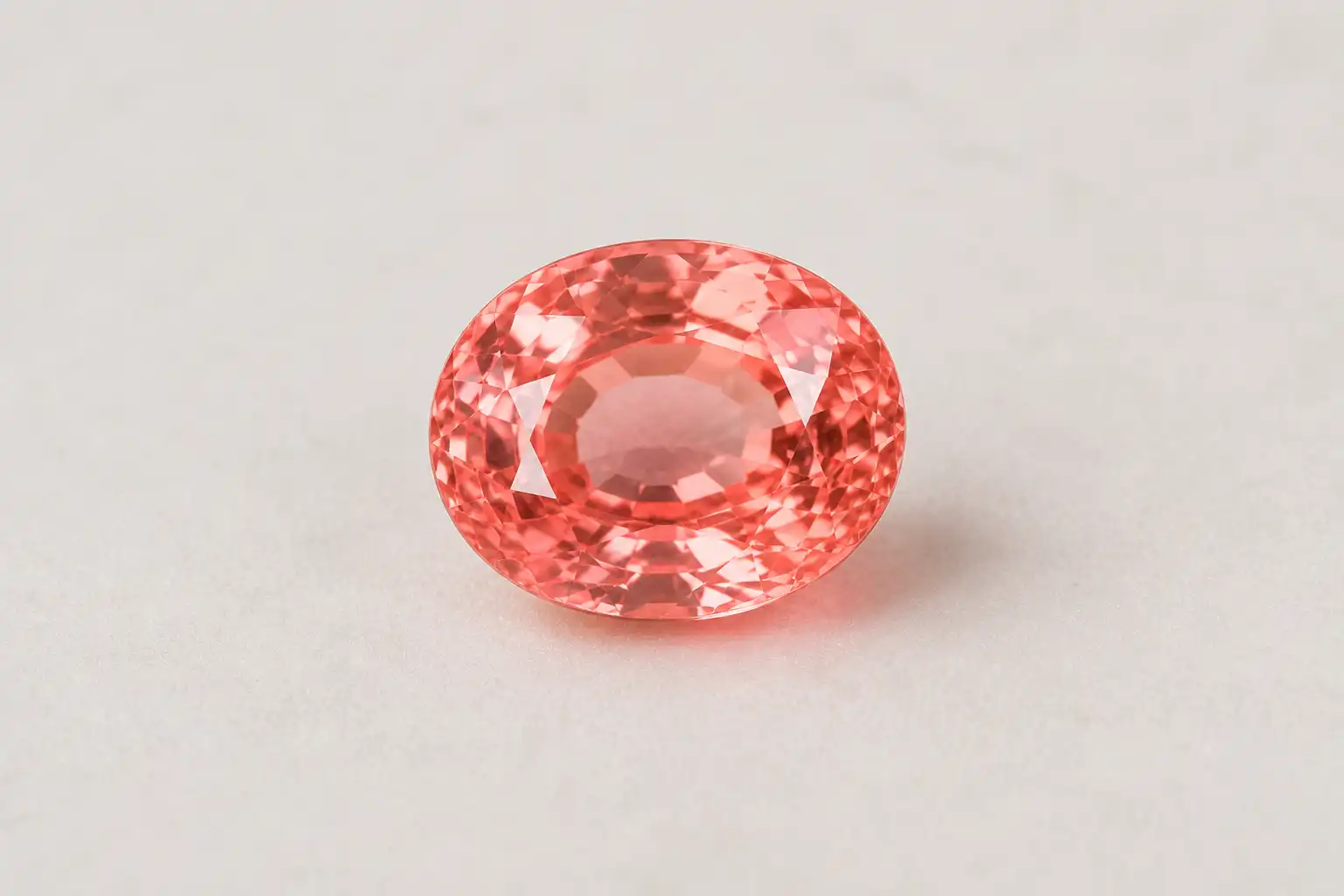
Padparadscha Sapphire: Meaning, Properties and Symbolism
Padparadscha Sapphire is a rare pink-orange to orange-pink variety of corundum. Its color occupies a narrow transition between pink Sapphire and orange Sapphire, creating tones often described as lotus, salmon, peach, coral, sunrise or sunset.
The name is associated with a Sinhalese expression for lotus blossom, linking the gemstone closely with Sri Lankan language and gem history. Although pink-orange Sapphires now come from several countries, Sri Lanka remains central to the name’s cultural and market identity.
Gemologically, Padparadscha is Sapphire. It shares corundum’s hardness, toughness, crystal structure and general chemical composition. What distinguishes it is the accepted face-up color, together with treatment, stability and laboratory reporting standards.
Modern symbolism blends pink themes of love and compassion with orange associations involving creativity, confidence and action. These interpretations are cultural and personal rather than scientifically demonstrated forces.
Padparadscha Sapphire at a Glance
| Property | Padparadscha Sapphire |
|---|---|
| Mineral species | Corundum |
| Chemical formula | Al₂O₃ |
| Crystal system | Trigonal |
| Defining color | Pinkish orange to orangy pink |
| Typical tone | Light to medium |
| Transparency | Transparent to translucent |
| Luster | Vitreous |
| Refractive index | Approximately 1.762–1.770 |
| Specific gravity | Approximately 4.00 |
| Mohs hardness | 9 |
| Cleavage | None |
| Toughness | Excellent |
| Common inclusions | Rutile silk, crystals, fingerprints, zoning and healed fractures |
| Common treatments | Heat; diffusion and filling also occur |
| Main identification concern | Color qualification, treatment and color stability |
| Historical association | Sri Lanka and the lotus-blossom color |
What Is Padparadscha Sapphire?
Padparadscha is a fancy-color Sapphire within the corundum mineral species.
The Sapphire gemstone guide owns the complete family profile, while Types of Sapphire places Padparadscha among blue, pink, yellow, orange, white, green, purple, parti-colored and color-change varieties.
The defining feature is not one separate chemical species. It is the balanced pink-orange color accepted by the trade and gemological laboratories.
A stone can be natural Sapphire without qualifying as Padparadscha. Conversely, an attractive peach Sapphire may be beautiful and valuable while falling outside the narrower designation.
The Meaning of the Name
Padparadscha is commonly connected with Sinhalese words for lotus blossom.
The name reflects the warm pink-orange color associated with selected lotus flowers rather than the gemstone’s mineral composition.
This linguistic and cultural connection explains why the term is historically linked with Sri Lanka.
Modern market use has expanded beyond one geographic source, but the lotus reference remains central to its identity.
The detailed emotional and color symbolism belongs to Padparadscha Sapphire Color Meaning and Symbolism.
Padparadscha Color
Padparadscha lies between pink and orange.
Some gems are predominantly pink with a visible orange component. Others appear more orange but retain clear pink warmth.
Light-to-medium tone is generally expected. Excessively dark, brown, gray, yellow, red or purple stones may not qualify.
Color should be assessed face-up under controlled and ordinary lighting rather than judged from one strongly edited image.
The broader Sapphire Color Meaning guide covers the entire corundum palette without replacing Padparadscha’s narrower definition.
What Causes the Color?
Sapphire color develops through trace elements and structural color centers within corundum.
Pink commonly involves chromium. Orange and yellow components can involve combinations of iron, chromium and color-center effects, and the exact cause may vary among stones.
Treatment can alter these features, making visual color alone insufficient for determining whether the appearance is natural.
Pleochroism and color zoning further influence the face-up result.
Advanced spectroscopy and trace-element analysis may be needed to understand treatment and color origin fully.
Crystal Structure and Composition
Padparadscha consists principally of aluminum oxide.
Corundum crystallizes in the trigonal system and forms barrels, bipyramids, tabular crystals and waterworn alluvial pebbles.
Pure corundum would be colorless. Trace elements and lattice-related effects create the pink-orange color.
The crystal structure gives Sapphire its exceptional hardness and resistance to ordinary wear.
However, laboratory-grown corundum has the same fundamental structure, so composition alone does not establish natural origin.
Formation
Corundum forms in geological environments poor in silica but rich in aluminum.
It can develop in metamorphic rocks, marble-related settings, high-grade gneisses and selected igneous or pegmatitic environments.
Weathering releases durable Sapphire crystals from host rock. Rivers then transport and concentrate them in alluvial gravels.
Many Sri Lankan Sapphires are recovered from secondary deposits where waterworn crystals occur among gravel, clay and other heavy minerals.
Formation environment affects inclusions and trace chemistry, which can help laboratories evaluate origin.
Sri Lankan Padparadscha
Sri Lanka has the strongest historical association with Padparadscha.
The island’s gem gravels have produced pink, orange, yellow, blue and other Sapphires for centuries.
Sri Lankan Padparadscha is often valued for light-to-medium tone, transparency and a delicate balance between pink and orange.
However, origin does not guarantee qualification. A Sri Lankan Sapphire may be too pink, orange, yellow, brown or pale to receive the name.
A significant Ceylon or Sri Lankan origin claim should be supported by an independent laboratory.
Madagascar and Other Sources
Pink-orange Sapphires also occur in Madagascar, Tanzania and other corundum-producing regions.
Madagascar became an important modern source of fancy-color Sapphire and can produce material resembling Sri Lankan stones.
Geographic origin may influence rarity, collector preference and price, but it remains secondary to individual color, treatment, clarity and cut.
A stone should not be rejected solely because it comes from outside Sri Lanka if its color and laboratory characteristics qualify.
Likewise, a prestigious locality cannot compensate for weak color or extensive treatment.
Physical Properties and Durability
Padparadscha ranks 9 on the Gemstone Hardness Chart.
Only Diamond and a few exceptional materials exceed corundum’s scratch resistance in standard gem use.
Sapphire also has excellent toughness and no cleavage. The Gemstone Toughness vs Hardness guide explains why those features make it suitable for frequently worn jewelry.
A hard blow can still chip a girdle, damage a pointed cut or bend the setting.
Filled stones, surface-reaching fractures and thin sections require additional caution despite the species-level durability.
Pleochroism
Padparadscha can show different color strengths according to viewing direction.
One direction may appear pinker, while another carries stronger orange or yellow.
A cutter must orient the rough so the most balanced mixed color faces upward.
Poor orientation can create a gemstone that qualifies only from a narrow direction or shows strong zoning face-up.
Pleochroism contributes visual life, but the stone should still retain a coherent pink-orange identity.
Color Zoning
Natural Sapphire often grows with uneven color.
Padparadscha may contain bands or regions of pink, orange, yellow and nearly colorless material.
A skilled cut blends these zones into an attractive face-up appearance. Poor cutting may create an obvious split or pale window.
Color zoning can support natural growth interpretation, but laboratory-grown and treated stones can also show zoning.
The stone should be evaluated through movement rather than one carefully selected photograph.
Clarity and Inclusions
Natural Padparadscha may contain rutile silk, mineral crystals, healed fractures, fingerprints, cavities and growth structures.
Fine stones are generally expected to remain transparent enough for their delicate color to be visible.
Small inclusions can be acceptable and may help establish natural origin.
Surface-reaching fractures near the girdle or a setting point create greater durability concern.
An unusually flawless gemstone is not automatically synthetic, but its origin and treatment deserve careful verification.
Cutting Styles
Oval and cushion cuts are common because they retain weight and distribute color effectively.
Round brilliants remove more rough but provide symmetrical sparkle. Pears, radiants and emerald cuts create different proportions and visual effects.
The cut should prevent a broad central window and excessive extinction.
Deep pavilions may retain carat weight without creating corresponding face-up size.
The complete quality workflow belongs to the Padparadscha Sapphire Buying Guide.
Heat Treatment
Heating is common in Sapphire.
It can improve color, transparency or both by changing inclusions and color-producing defects.
Heated Padparadscha remains natural corundum, but comparable unheated stones generally command a premium because they are rarer.
The Treated Sapphire guide owns the complete treatment framework.
A seller should state treatment in writing rather than relying on the buyer to assume it from price or appearance.
Beryllium Diffusion and Other Treatment
Beryllium diffusion can create or modify orange, yellow and pink-orange colors in corundum.
Depending on treatment conditions, color may penetrate deeply enough that ordinary visual examination cannot reveal it.
Advanced chemical analysis may be required for detection.
Fracture filling and dye can also occur in lower-quality material.
Diffusion-treated or filled stones can be attractive, but they do not occupy the same market as untreated or conventionally heated natural Padparadscha.
Color Stability
Some pink, yellow and orange Sapphires contain unstable color centers.
A stone may become more orange after exposure to ultraviolet-rich light and return toward pink after darkness or controlled illumination.
Laboratories use color-stability procedures when evaluating Padparadscha submissions.
The stable or standardized color—not a temporary showroom state—should determine the description.
A significant purchase should include a report that addresses this issue according to the laboratory’s current policy.
Natural vs Laboratory-Grown Padparadscha
Laboratory-grown pink-orange Sapphire has the same fundamental corundum structure as natural material.
Flux, flame-fusion and other growth methods can produce attractive colors and high clarity.
The Lab Sapphire guide explains synthetic corundum and its growth features.
Manufactured origin must be disclosed.
The Real vs Fake Sapphire guide owns the full distinction among natural Sapphire, laboratory-grown corundum, glass and other imitations.
Padparadscha vs Pink Sapphire
Pink Sapphire lacks enough orange to fit the Padparadscha balance.
A faint warm modifier does not necessarily move a pink stone into the rarer category.
Pink Sapphire can be highly valuable without carrying the Padparadscha name.
The Pink Gemstones guide compares corundum with Spinel, Tourmaline, Morganite and other pink materials.
Independent laboratory language matters when the trade-name difference substantially affects price.
Padparadscha vs Orange Sapphire
Orange Sapphire may be yellowish orange, pure orange or reddish orange.
Padparadscha requires a meaningful pink component.
The Orange Gemstones guide places orange Sapphire among Spessartite Garnet, Fire Opal, Topaz, Spinel and other materials.
A vivid orange Sapphire may be more saturated than a Padparadscha but still belong to a different market category.
Accuracy benefits both stones rather than treating one name as automatically superior.
Padparadscha vs Peach Sapphire
Peach Sapphire is a broad descriptive category.
It can include pinkish beige, salmon, pale orange, brownish pink and colors that overlap Padparadscha.
Some peach stones qualify; many do not.
The term peach usually describes appearance without carrying the same laboratory-defined rarity expectations.
A seller should not convert every marketable peach Sapphire into Padparadscha solely to increase price.
Padparadscha vs Morganite
Morganite is pink-to-orange-pink beryl.
Its pale peach and salmon colors can resemble Padparadscha, especially in rose gold.
Morganite ranks 7.5–8 rather than 9 and has different density, refractive behavior and inclusions.
Large Morganite is more available, while fine natural Padparadscha generally commands a much stronger rarity premium.
A professional gemologist can separate them through standard testing.
Value Factors
Current market ranges belong to the Padparadscha Sapphire Price Guide.
Color qualification is central, followed by treatment, size, clarity, cut, origin evidence and stability.
Unheated stones with credible laboratory designation generally receive a premium.
A large gem with brown, yellow or uneven color may be worth less per carat than a smaller balanced example.
Market value should not be estimated from carat weight alone.
Padparadscha Jewelry
A Padparadscha Sapphire bracelet requires careful matching across several stones.
Padparadscha Sapphire earrings need pair coordination, while a Padparadscha Sapphire necklace can present a larger focal gem.
A Padparadscha Sapphire ring uses corundum’s durability for hand-level wear.
Each format should preserve the color without allowing rose or yellow metal to create an appearance the stone does not possess independently.
Padparadscha Meaning and Symbolism
Padparadscha symbolizes a meeting between compassion and action.
Pink traditions emphasize affection, tenderness and emotional openness. Orange traditions add creativity, confidence and visible movement.
The lotus connection contributes meanings involving renewal, beauty, spiritual development and emergence from difficult circumstances.
Sunrise and sunset imagery adds transition, hope and the completion of one stage before another begins.
These meanings come from culture and color interpretation rather than measurable gemological energy.
Love and Partnership
Padparadscha is increasingly used in engagement and anniversary jewelry.
Its mixed color can symbolize affection joined with passion, or a relationship that remains warm while continuing to grow.
The gemstone cannot guarantee fidelity, attract a specific partner or repair an unsafe relationship.
Its value as a relationship stone comes from the commitment and memory attached to the jewel.
Sapphire’s broader symbolism of loyalty adds another traditional layer without creating a supernatural promise.
Creativity and Confidence
The orange component connects Padparadscha with creativity and personal expression.
A wearer may use the gemstone as a reminder to begin a project, speak clearly or pursue an idea with both enthusiasm and judgment.
The stone cannot create skill, remove every fear or guarantee recognition.
Confidence grows through preparation and repeated action.
The symbolism becomes meaningful when it accompanies behavior rather than replacing it.
September Birthstone Context
Sapphire is the traditional September Birthstone.
Blue remains the most familiar September color, but Padparadscha is equally part of the Sapphire species.
A September-born person can choose pink-orange Sapphire without losing the birthstone connection.
Birthstone tradition is separate from the gem’s geological properties and does not make one color more durable or therapeutic.
Buying and Documentation
A major Padparadscha purchase should include an independent identification report.
The Gemstone Certification guide explains natural or laboratory origin, detectable treatment, color description and geographic-origin opinions.
GIA does not provide one universal colored-stone quality grade, so the buyer must still evaluate color, cut, clarity and price.
For remote purchases, follow How to Buy Gemstones Online Without Getting Scammed.
Verify the report number and compare the listed dimensions with the actual gemstone.
Cleaning and Care
Follow How to Clean Padparadscha Sapphire Jewelry Safely.
Warm water, mild soap and a soft brush are suitable for untreated and conventionally heated Sapphire.
Filled or dyed stones require more conservative care, commonly a damp cloth.
Avoid uncontrolled repair heat and store the gem away from Diamond, which can scratch corundum.
The Crystals That Start With P and Gemstones That Start With P directories provide alphabetical context without defining the stone’s mineral family.
Frequently Asked Questions
1. What is Padparadscha Sapphire?
It is a rare pink-orange to orange-pink variety of gem corundum.
2. What does Padparadscha mean?
The name is associated with Sinhalese words for lotus blossom and its characteristic color.
3. Is Padparadscha a separate mineral?
No. It is Sapphire, which belongs to the corundum mineral species.
4. What is the best Padparadscha color?
Fine stones show a balanced pink-orange appearance, commonly in light-to-medium tones without strong brown, gray, yellow or purple modifiers.
5. Where does Padparadscha come from?
Sri Lanka has the strongest historical association, while Madagascar, Tanzania and other regions also produce pink-orange Sapphire.
6. Is Padparadscha always unheated?
No. Heat treatment is common in Sapphire. Treatment should be disclosed and documented.
7. Can diffusion create Padparadscha-like color?
Yes. Beryllium diffusion and other processes can produce or alter orange and pink-orange color.
8. Can its color change after light exposure?
Some stones have unstable color centers, so laboratories may perform standardized stability testing.
9. Is peach Sapphire the same as Padparadscha?
Not necessarily. Peach is a broad commercial term, while Padparadscha follows narrower color criteria.
10. Is laboratory-grown Padparadscha Sapphire available?
Laboratory-grown pink-orange corundum exists and must be disclosed as manufactured.
11. Does Padparadscha have proven healing properties?
No. Love, creativity, confidence and lotus-related meanings are cultural or personal symbolism rather than established medical effects.
12. How should Padparadscha Sapphire be cleaned?
Use warm soapy water for untreated or heat-treated stones. Filled or dyed material requires gentler care.
Padparadscha is unusual because its identity depends on balance. Too little orange and it becomes pink Sapphire; too little pink and it enters the orange range. That narrow meeting point gives the gemstone its lotus name, market rarity and symbolism of compassion joined with action.
Padparadscha Sapphire meanings involving love, creativity, chakra balance, confidence, healing and spiritual transformation are cultural or personal interpretations rather than scientifically established effects.