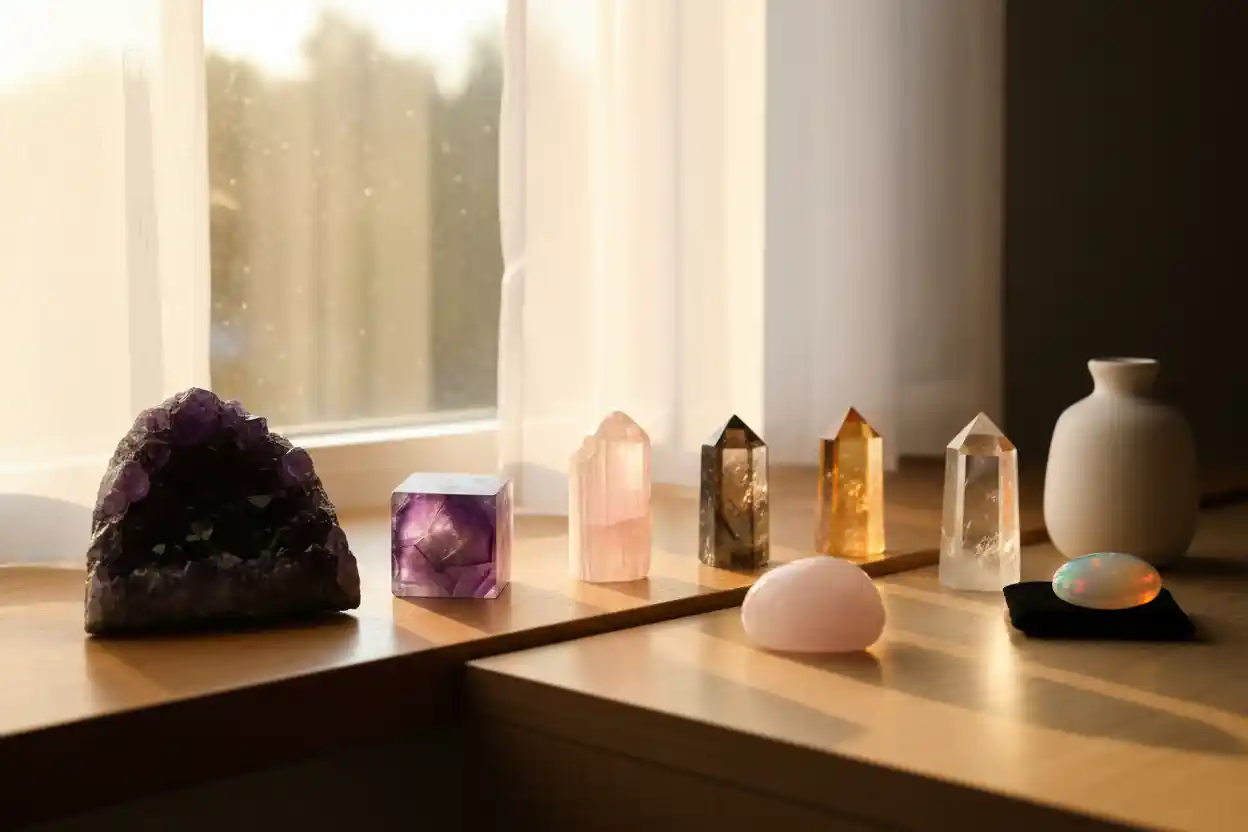
Can Crystals Go in the Sun? 7 Practical Answers About Fading, Heat & Safe Display
Can crystals go in the sun? Some crystals tolerate normal daylight well, while others can fade, change color, heat up, fracture from temperature changes, or suffer damage to treatments after prolonged exposure. Sunlight safety therefore depends on the actual mineral, color mechanism, treatment history, specimen shape, surrounding temperature, and length of exposure rather than a universal rule that all crystals either love or hate sunlight.
Short periods of ordinary daylight are very different from leaving a gemstone on a sunny windowsill for weeks or months. Amethyst can lose color after prolonged intense light, kunzite is notably vulnerable to fading from bright light and heat, and certain yellow-to-brown topaz colors may also fade with prolonged sunlight. A clear quartz specimen may remain physically stable while a polished sphere or transparent ornament creates another problem entirely by concentrating sunlight onto nearby combustible objects.
The useful answer to can crystals go in the sun is therefore conservative: identify the stone, understand its stability, and avoid prolonged direct exposure when there is no practical reason for it.
7 Answers to “Can Crystals Go in the Sun?”
- Some durable crystals tolerate ordinary indirect daylight with little concern.
- Amethyst can fade after prolonged exposure to intense light.
- Kunzite can lose color under prolonged bright light or heat.
- Some yellow, brown, and reddish-brown topaz can fade with prolonged heat or sunlight.
- Sudden heating and cooling can fracture stones that are vulnerable to thermal shock.
- Transparent spheres and crystal objects can concentrate sunlight and create a fire risk.
- Spiritual sun charging does not require hours of direct exposure to preserve personal meaning.
Can Crystals Go in the Sun Without Fading?
Can crystals go in the sun without changing color? Some can, but color stability varies widely. The visible color of a gemstone may come from trace elements, structural defects, radiation-related color centers, inclusions, or human treatments, and those mechanisms do not all respond to light in the same way.
Colorless quartz is generally much less concerning than light-sensitive colored varieties, yet even within one mineral family the answer can change. Amethyst is purple quartz, but prolonged intense light can fade some specimens. Citrine can also experience color changes under excessive light and heat depending on the stone and its history.
Normal indoor lighting is different from storing a specimen in strong direct sun every day. If a crystal is valuable because of its color, there is little benefit in testing how much ultraviolet exposure it can survive.
When deciding can crystals go in the sun, protect color first unless reliable gemological information says prolonged exposure is suitable.
Amethyst Can Fade Under Prolonged Intense Light
Amethyst provides one of the clearest reasons not to treat sunlight as universally harmless. The gemstone is quartz at Mohs 7, so its scratch resistance is good, but hardness says nothing about color stability.
Some amethyst can fade after prolonged exposure to intense light. Heat can also alter amethyst color, and sufficiently high temperatures may lighten the purple or produce other changes. This means a specimen can remain physically hard while its most valued visual feature gradually weakens.
Can crystals go in the sun if the crystal is amethyst? Brief ordinary daylight during wear or photography is not the same as permanent placement in a sunny window. Long-term direct exposure is unnecessary if preserving rich purple color matters.
The crystal hardness chart is useful for understanding scratch resistance, but it cannot predict fading because hardness and light stability describe different properties.
Kunzite Needs Stronger Protection From Bright Light
Kunzite is particularly important when answering can crystals go in the sun because its pink-to-violet color can fade under prolonged bright light or heat. Gem collectors sometimes describe kunzite as an “evening stone” because limiting strong daytime exposure helps preserve color.
Kunzite belongs to the spodumene family and has a Mohs hardness around 6.5 to 7, but it also has perfect cleavage in two directions. That combination means the gem can face two separate risks: color fading from prolonged light and physical breakage from impact or temperature stress.
Natural and color-enhanced kunzite can both lose intensity. A sunny windowsill is therefore a poor permanent display location for an attractive pink or violet specimen.
Can crystals go in the sun when their color is known to be light-sensitive? A shaded display case, indirect daylight, or controlled artificial lighting gives the collector more control without sacrificing visibility.
Topaz Shows Why Color Variety Matters
Topaz complicates the question can crystals go in the sun because not every color behaves exactly the same way. Topaz is hard at Mohs 8, yet its perfect basal cleavage gives it relatively poor toughness compared with what that hardness number may suggest.
Many topaz colors are reasonably stable under normal conditions. However, prolonged heat or sunlight can fade some yellow-to-brown, reddish-brown, or dark brown stones. Coated topaz introduces another care issue because its appearance depends on a thin surface layer that needs protection from abrasion.
Strong heat and sudden temperature changes can also create internal breaks. A sunny location may expose a stone to both light and rising temperature, especially behind glass.
Can crystals go in the sun if they are topaz? Occasional normal exposure is very different from deliberately leaving a valuable colored topaz in direct sunlight for prolonged periods. Shade is the safer long-term display choice when exact stability is uncertain.
Heat and Thermal Shock Can Damage Crystals Even When Color Stays Stable
Fading is only one part of can crystals go in the sun. Direct sunlight can heat stone, metal settings, display stands, and enclosed glass cases. If a hot specimen is then moved quickly into cold air or placed against a cool surface, temperature differences can create stress.
Topaz and kunzite are particularly vulnerable to abrupt temperature changes because cleavage or poor toughness increases the chance of fracture. Opal requires thoughtful temperature care as well, especially when structural water and existing cracks are involved.
If you are asking why did my crystal break after window display, heat cycling, an old internal fracture, impact, cleavage, or a combination of stresses may be more realistic explanations than spiritual overload.
Can crystals go in the sun for a few minutes? Many can. The real problem usually arises when prolonged exposure creates unnecessary heat, fading, or repeated daily temperature cycling.
Clear Crystal Spheres Can Create a Fire Risk Near Windows
One of the least discussed answers to can crystals go in the sun concerns concentrated light. A transparent or highly refractive spherical object can focus sunlight onto a small area. Fire services have documented fires involving crystal or glass ornaments positioned where direct sunlight passed through or reflected from them onto towels, curtains, clothing, and other combustible objects.
This is especially relevant to clear quartz spheres, crystal balls, glass spheres, faceted glass ornaments, and similar objects placed on sunny windowsills. The exact optical behavior depends on shape, transparency, angle, and sun position, but the safest rule is simple: do not leave transparent or reflective spheres where they can focus direct sunlight onto nearby surfaces.
A stone does not need to be light-sensitive itself to create this hazard. Clear quartz may remain unchanged while the concentrated beam damages something around it.
Can crystals go in the sun on a windowsill? Large clear spheres and similar optical objects are better kept out of direct beams entirely.
Does Sunlight Recharge Crystal Energy?
Some people ask can crystals go in the sun because sunlight appears in spiritual charging rituals. There is no established scientific evidence that crystals contain a finite reserve of healing energy that sunlight replenishes.
The distinction behind do crystals run out of energy is important here. Minerals exchange heat, light, electrical charge, and mechanical energy through real physical mechanisms, but these processes do not establish that sunlight restores metaphysical healing power.
A sunlight ritual can still carry personal meaning. Brief morning light, placing a stone near but not directly inside a sunbeam, or simply visualizing warmth can preserve the symbolic association without risking prolonged fading.
Can crystals go in the sun for spiritual practice? Physical care should still take priority over ritual rules.
Indirect Daylight Is Usually Better for Long-Term Display
For most collections, bright indirect daylight offers a good compromise between visibility and preservation. It allows color and crystal form to remain visible without subjecting specimens to the strongest direct solar exposure.
Keep light-sensitive stones away from sunny windows. Display valuable gems in cases where temperature remains reasonably stable. Rotate specimens if needed rather than leaving the same colored stone under strong illumination indefinitely.
Window glass also does not eliminate every wavelength or prevent heating. A room can become hot even when direct outdoor conditions are absent.
Can crystals go in the sun if you do not know what they are? Avoid prolonged exposure until identification and treatment history are clearer. Conservative storage is easier than reversing fading.
Sunlight Can Affect Treatments as Well as Natural Color
Gemstone treatments create another reason the answer to can crystals go in the sun varies. Irradiation, heat treatment, coatings, fillers, dyes, resins, and other enhancements can have different stability profiles.
Kunzite may receive irradiation followed by heating, yet both treated and natural color can fade under strong light. Coated stones depend on a surface layer whose care requirements differ from the underlying mineral. Filled or assembled gems can also have adhesives or substances that respond poorly to excessive heat.
Treatment is not automatically a defect. Many established gemstone treatments remain stable during normal use. The important point is disclosure and appropriate care.
When treatment history is uncertain, prolonged direct sunlight is an unnecessary experiment.
A Safer Rule for Sun Charging and Crystal Display
If sunlight is part of your personal ritual, keep the exposure short and use indirect light for stones with uncertain stability. Avoid leaving crystals unattended in direct sun, particularly transparent spheres, light-sensitive colored gems, or specimens inside closed glass containers where temperatures can rise.
You can also choose symbolic alternatives. Sound, meditation, a spoken intention, or ordinary placement in a bright room can replace direct sun exposure. None requires the mineral to survive repeated heating.
Can crystals go in the sun safely? The best answer is mineral-specific rather than spiritual: use direct sunlight only when the stone’s light and heat stability are understood and the physical setting is safe.
Conclusion
Can crystals go in the sun? Many crystals tolerate ordinary daylight, but prolonged direct sunlight can fade amethyst, kunzite, and some topaz colors, while heat and thermal shock can damage vulnerable stones. Transparent spheres and reflective crystal objects can also focus sunlight strongly enough to create a fire hazard.
Indirect daylight is the safer long-term display choice for most collections. Sun charging remains a personal ritual and does not justify risking a valuable or light-sensitive specimen.
FAQs
Can Crystals Go in the Sun Every Day?
Some stable minerals tolerate regular daylight, but daily direct sunlight is unnecessary and can fade or heat sensitive stones over time.
Can Amethyst Go in the Sun?
Brief normal exposure is different from prolonged direct sunlight. Some amethyst can fade with extended intense light, so long-term sunny-window display is best avoided.
Can Kunzite Go in the Sun?
Kunzite should be protected from prolonged bright light and heat because its pink-to-violet color can fade.
Can Clear Quartz Go in the Sun?
Clear quartz is generally light-stable, but transparent spheres can focus sunlight strongly enough to create a fire hazard near combustible objects.
Can Topaz Go in the Sun?
Many topaz colors are reasonably stable, but prolonged heat or sunlight can fade some yellow-to-brown and reddish-brown stones. Strong heat and temperature changes can also cause damage.
Does Sunlight Charge Crystals?
Sun charging is a spiritual practice. There is no established evidence that sunlight replenishes a measurable reserve of crystal healing energy.
How Long Should Crystals Stay in Sunlight?
There is no scientifically required charging duration. For ritual use, short or indirect exposure reduces unnecessary fading and heat risk.
Can Sunlight Break a Crystal?
Heat and rapid temperature changes can contribute to fractures in vulnerable stones, particularly gems with cleavage, internal fractures, or poor toughness.
Where Should I Display Light-Sensitive Crystals?
Use a location with indirect daylight, stable temperature, and no strong direct sunbeam. This protects both color and the surrounding room.
Sun-charging practices are personal spiritual rituals rather than scientifically demonstrated methods of restoring therapeutic crystal energy.