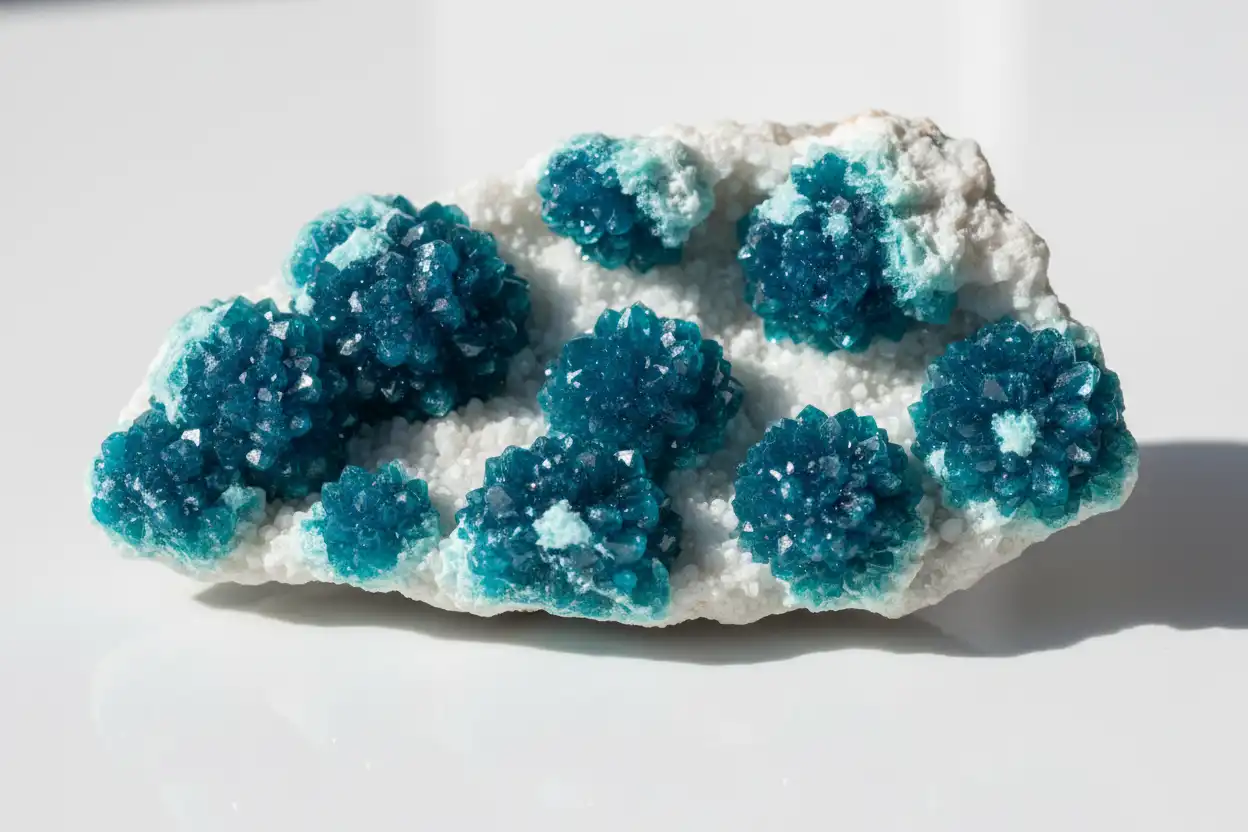
Cavansite Meaning: Mineral Facts, History & Symbolism
Cavansite meaning is commonly associated in modern crystal practice with communication, perspective, self-expression, reflection, insight, and adapting thoughtfully to change. Those themes belong to symbolism rather than measurable mineral effects. Materially, cavansite is a hydrated calcium vanadium silicate with the ideal formula CaV⁴⁺OSi₄O₁₀·4H₂O. It crystallizes in the orthorhombic system and is best known for vivid blue to greenish-blue prismatic crystals that frequently form delicate radiating rosettes or spherical aggregates.
Its intense color and intricate habit make cavansite visually distinctive, but neither feature alone guarantees identification. Several blue minerals can occur as sprays or crusts, and photographs often exaggerate saturation while suppressing the subtle greenish component that can be visible in genuine cavansite. Cavansite is also a dimorph of pentagonite: the two minerals share the same ideal chemical formula while having different crystal structures.
A material-first approach therefore begins with chemistry, crystallography, habit, density, hardness, cleavage, geological setting, and analytical evidence before turning to modern symbolic interpretations. Other mineral references using the same approach are available in Gemstone Guides.
What Is Cavansite?
Cavansite is a valid mineral species composed principally of calcium, vanadium, silicon, oxygen, and structural water. Its name was constructed from the chemical elements calcium, vanadium, and silicon, making the name itself a concise reference to its composition.
Its ideal formula can be written as:
CaV⁴⁺OSi₄O₁₀·4H₂O
The vanadium is present principally in the +4 oxidation state in the ideal structure. Cavansite is classified among hydrated silicate minerals and forms orthorhombic crystals rather than cubic, hexagonal, or tetragonal ones.
| Property | Typical cavansite characteristics |
|---|---|
| Mineral species | Cavansite |
| Ideal formula | CaV⁴⁺OSi₄O₁₀·4H₂O |
| Mineral class | Hydrated vanadium silicate |
| Crystal system | Orthorhombic |
| Typical habit | Prismatic crystals, radiating sprays and spherulitic rosettes |
| Typical color | Greenish blue to strong blue |
| Transparency | Transparent in fine crystals to translucent in aggregates |
| Luster | Vitreous |
| Mohs hardness | About 3–4 |
| Specific gravity | About 2.21–2.31 measured |
| Cleavage | Good in one principal direction |
| Tenacity | Brittle |
| Optical character | Biaxial positive |
| Approximate RI range | About 1.542–1.551 |
| Common collector form | Blue rosettes on pale zeolite-rich matrix |
| Closely related mineral | Pentagonite |
| Separate mineral species? | Yes |
These values are consistent across mineralogical references describing cavansite’s physical and optical properties.
Why Cavansite Looks So Unusually Blue
Cavansite contains vanadium as an essential structural component rather than merely as an incidental contaminant. Vanadium in particular oxidation and coordination environments can interact with visible light strongly, contributing to the mineral’s characteristic blue-to-greenish-blue appearance.
The exact face-up color of a specimen can still vary because of several additional factors:
crystal thickness;
transparency;
orientation;
illumination;
internal defects;
associated minerals;
surface condition;
and camera white balance.
A thin transparent crystal may look bright sky blue, while a dense rosette appears deeper royal blue. Under illumination rich in blue wavelengths, subtle differences between cavansite and related pentagonite can become easier to observe.
The important boundary is that color is evidence, not proof.
A vivid blue mineral is not automatically cavansite simply because its hue resembles photographs of famous collector specimens.
Cavansite Can Have a Greenish-Blue Component
Commercial photographs frequently portray cavansite as pure saturated blue.
Natural mineral descriptions are more nuanced.
Greenish-blue to blue is the established range, and mineralogical observations note that cavansite can look slightly greener or more teal than pentagonite under suitable illumination. That difference may disappear in photographs because digital processing, white balance, saturation, and display characteristics can suppress subtle green components.
This makes color comparison most useful when two specimens are viewed:
under the same light source;
against the same background;
without separate photo editing;
and preferably beside a verified reference specimen.
Color should still be combined with morphology and analytical evidence.
What Does Natural Cavansite Look Like?
The most recognizable cavansite specimens consist of intensely blue radiating aggregates attached to pale matrix minerals.
Individual crystals can be prismatic, but they often grow outward from a common center and form rounded rosettes or spherulitic groups. When the crystals are sufficiently transparent, individual surfaces reflect light sharply and give the aggregate a vitreous sparkle.
Natural specimens can show:
compact spherical rosettes;
partial hemispherical sprays;
scattered individual crystals;
clustered radiating groups;
small broken needles or prisms;
uneven crystal sizes;
attached pale zeolites;
calcite;
dark basalt matrix;
and irregular cavity surfaces.
A perfectly symmetrical blue ball should not be treated as the only acceptable cavansite form.
Growth depends on available space, fluid pathways, competing minerals, nucleation sites, and whether part of the aggregate was interrupted by the cavity wall.
Why Cavansite Forms Rosettes
A radiating rosette develops when many crystals grow outward from a limited nucleation region.
If several crystals begin close together and continue extending into open cavity space, their long axes can diverge in multiple directions. The final aggregate becomes approximately spherical or fan-like even though each constituent crystal follows ordinary crystallographic growth rules.
The result resembles a flower, burst, or pom-pom when viewed macroscopically.
That appearance is one reason cavansite attracts collectors. It combines a highly saturated color with a three-dimensional architecture that remains visually distinctive even in small specimens.
The rosette is morphology.
It is not evidence that the mineral emits energy outward from a central point.
How Cavansite Forms
Cavansite is especially associated with secondary mineralization in cavities within basaltic volcanic rocks. Silica-rich and calcium-bearing fluids moving through fractures and open spaces can react with vanadium-bearing components in the host system and eventually precipitate hydrated silicate minerals under favorable chemical and temperature conditions.
Well-known cavansite occurrences in western India are associated with basalt cavities containing stilbite, heulandite, calcite, mordenite, and other secondary minerals. Mineral occurrence records repeatedly document cavansite alongside stilbite and heulandite in these cavity assemblages.
This association fits a broader pattern in basalt-hosted cavity mineralization: after the lava solidifies, later fluids move through fractures and vesicles and deposit successive generations of secondary minerals.
The full sequence can be complicated. Mineral order, fluid composition, temperature, alteration of volcanic glass and primary silicates, available vanadium, and interactions with previously formed zeolites all matter.
Those deposit-scale relationships are addressed separately in cavansite formation and deposit geology.
Why Cavansite Commonly Occurs With Stilbite
Stilbite is one of the most familiar companions of collector-grade cavansite.
The visual contrast is striking: pale cream, white, or peach-toned stilbite crystals create a light background against which saturated blue cavansite rosettes stand out strongly.
The association is not merely aesthetic. Both minerals can develop as secondary phases in open basalt cavities during fluid-driven alteration and mineral deposition.
Mindat’s occurrence and specimen data from the important Pune-region deposits repeatedly show cavansite with stilbite and heulandite, as well as calcite, mordenite, and other cavity minerals.
Association still does not prove identity.
A blue mineral attached to stilbite is geologically plausible as cavansite, but laboratory confirmation may be needed when the species claim materially affects value.
Cavansite and Heulandite
Heulandite-group minerals are another frequent companion.
They may form pale tabular or sparkling crystals beneath, beside, or partly surrounding the blue cavansite aggregates. In some specimens, the visual sequence suggests different episodes of mineral growth within the same cavity.
That type of relationship can contain geological information.
A collector should therefore resist removing cavansite from matrix simply to isolate the blue crystal. The attached zeolites and basalt can help preserve:
mineral sequence;
cavity context;
original contact relationships;
locality characteristics;
and specimen aesthetics.
A complete matrix specimen can therefore be scientifically more informative than an isolated blue rosette.
Cavansite Versus Pentagonite
Pentagonite is the most technically important comparison because it has the same ideal chemical formula as cavansite:
CaV⁴⁺OSi₄O₁₀·4H₂O
The two are dimorphs.
That means identical overall chemistry can be arranged into different crystal structures, producing separate mineral species.
Both are orthorhombic, so simply learning the crystal system does not settle the distinction. Morphology, detailed structural relationships, optical appearance, and instrumental analysis become important.
Pentagonite is famous for distinctive pseudo-fivefold-looking twinned aggregates, although the apparent symmetry should not be interpreted as a true fivefold crystallographic axis. Recent mineralogical summaries also note that pentagonite may appear purer blue, while cavansite can show a greener or teal component under appropriate light.
For a valuable specimen, Raman spectroscopy or X-ray diffraction is much more reliable than deciding from color alone.
Same Chemistry Does Not Mean Same Mineral
The cavansite-pentagonite relationship is a useful mineralogical lesson.
A mineral is defined by more than its elemental ingredients.
Atomic arrangement matters.
Two materials can contain calcium, vanadium, silicon, oxygen, and water in the same overall proportions yet be different species because those components occupy different structural positions.
This is similar in principle to other mineral polymorph relationships such as:
diamond and graphite;
calcite and aragonite;
rutile, anatase, and brookite.
The shared formula establishes a chemical relationship.
The different structure establishes mineralogical individuality.
Original Cavansite Specimen and Photo Checklist
The following checklist provides a practical way to evaluate a purported cavansite specimen without pretending that photographs can replace analytical mineralogy.
Look for a true radiating aggregate
Determine whether individual blue crystals actually diverge from a shared center rather than merely forming a painted or granular blue patch.
Examine individual crystal surfaces
Fine cavansite should show genuine vitreous crystal faces where preservation is good.
A completely matte powdery surface deserves additional investigation.
Check color under neutral light
Record the ordinary face-up color before using strong blue-rich illumination.
Natural cavansite can be greenish blue as well as saturated blue.
Reduce digital saturation
If evaluating seller images, imagine how the specimen might appear with less saturation.
Extremely electric-blue images can hide useful color nuances.
Inspect the matrix
Stilbite, heulandite, calcite, mordenite, and basalt are plausible companions in important cavity deposits.
Matrix supports geological context but is not an independent identification test.
Examine the crystal-to-matrix contact
Natural rosettes should show plausible attachment points and growth relationships.
A blue aggregate sitting on a glossy adhesive layer should be disclosed as repaired or assembled.
Look for broken radial crystals
Cavansite is relatively soft and brittle. Small chips and missing crystal ends are plausible on handled specimens.
Inspect the rosette center
A natural aggregate generally contains irregular crystal crowding where individual prisms nucleated close together.
Compare transparent edges
Thin crystal tips can transmit light more readily than the dense center of the aggregate.
Check whether the blue material is actually a coating
A uniform film following every cavity contour may represent another mineral or treatment rather than prismatic cavansite.
Use magnification before physical testing
A loupe can reveal crystal habit, cleavage, fractures, repairs, coatings, secondary growth, and associated minerals. The dedicated cavansite microscope inclusion notebook develops these observations further.
Avoid destructive hardness testing
Cavansite is only around Mohs 3–4 and can be damaged easily. Scratching a collector specimen provides poor value when morphology and instrumental testing are available.
Do not prove locality from color
Bright blue rosettes may resemble famous Indian material, but visual consistency is not documentary provenance.
Compare with pentagonite carefully
Pure-blue versus greener-blue appearance can be a useful clue under controlled lighting, but it is not a substitute for structural evidence.
Separate metaphysical language entirely
Descriptions such as communication stone, psychic mineral, third-eye crystal, truth activator, or high-vibration cavansite contribute nothing to species identification.
A Source-Comparison Guide to Common Cavansite Claims
Cavansite attracts both accurate mineral information and exaggerated commercial narratives. Separating them makes the mineral easier to evaluate.
| Claim | Evidence status | More accurate interpretation |
|---|---|---|
| Cavansite is a calcium vanadium silicate | Supported | Its ideal formula includes calcium, V⁴⁺, silica and structural water |
| Cavansite is orthorhombic | Supported | It crystallizes in the orthorhombic system |
| Cavansite commonly forms blue rosettes | Supported | Spherulitic radiating aggregates are characteristic |
| Cavansite is extremely hard | Incorrect | Its hardness is only about Mohs 3–4 |
| Cavansite is a durable everyday gemstone | Misleading | Softness, cleavage and brittleness limit wear |
| Cavansite and pentagonite have the same formula | Supported | They are dimorphs |
| Cavansite and pentagonite are the same mineral | Incorrect | Their different structures make them separate species |
| Every vivid blue rosette on stilbite is cavansite | Unsupported | Association and appearance need confirmation |
| Cavansite is always pure royal blue | Incorrect | Greenish-blue to blue is documented |
| Pure color alone separates cavansite from pentagonite | Too absolute | Color is only one supporting clue |
| The name comes from “cave stone” | Incorrect | The name combines calcium, vanadium and silicon |
| Every cavansite specimen comes from India | Incorrect | The mineral has other documented localities |
| Cavansite scientifically improves communication | Unsupported | Communication is a modern symbolic theme |
| Cavansite activates psychic perception | Metaphysical belief | No mineralogical measurement establishes this |
| Cavansite heals the throat or nervous system | Unsupported medical claim | Mineral identity does not demonstrate therapeutic efficacy |
The strongest descriptions are those that specify which claims come from measurable properties and which are interpretations.
The Name Cavansite Comes From Chemistry
Cavansite has one of the more straightforward mineral names.
Its name is formed from parts of the words calcium, vanadium, and silicon—the principal elements that characterize its composition.
This is worth emphasizing because modern crystal lore sometimes invents linguistic origins after the fact.
The name does not come from:
caves;
Sanskrit;
an ancient healing tradition;
a spiritual teacher;
a chakra term;
or a word meaning communication.
Its origin is mineralogical.
That gives cavansite a documented naming story without requiring fictional ancient mythology.
Cavansite’s Documented Geographic Story
The mineral was formally described from material associated with the Owyhee Dam area in Oregon, which remains its type locality. The specimens most familiar to modern collectors, however, are strongly associated with basalt quarries in the Pune region of Maharashtra, India, where highly aesthetic blue rosettes occur with zeolite-group minerals and calcite.
The distinction between type locality and famous commercial source matters.
A mineral’s type locality is the reference occurrence tied to its original formal description.
The locality that produces the most widely recognized collector specimens can be somewhere else entirely.
This is common in mineral collecting.
Locality Should Not Be Guessed From Matrix Alone
A bright blue cavansite rosette perched on pale stilbite may strongly resemble material from the Pune region.
That is useful contextual evidence, but resemblance is not provenance.
Similar-looking associations can potentially occur elsewhere, and specimens can lose labels as they pass through collections.
Reliable locality evidence can include:
original mine labels;
quarry information;
dealer records;
acquisition records;
field photographs;
collection cards;
specimen numbers;
or an otherwise traceable chain of custody.
The cavansite provenance disclosure checklist provides a structured way to distinguish documented source information from an appearance-based attribution.
Cavansite Hardness and Fragility
Cavansite is much softer than quartz.
With Mohs hardness around 3–4, it can be scratched by many materials encountered in ordinary jewelry and specimen handling. Its crystals are also brittle and possess good cleavage in one direction.
Those properties explain why cavansite is principally a collector mineral rather than a mainstream faceted gemstone.
A sharp blue rosette may survive geologically for a long time inside a protected cavity, yet become damaged quickly when:
rubbed against another specimen;
brushed aggressively;
dropped;
squeezed in packaging;
or handled repeatedly by the crystals.
Hardness, cleavage and brittleness all matter.
Can Cavansite Be Faceted?
Transparent crystals exist, but faceting cavansite presents severe practical limitations.
Individual crystals are usually small. Their relatively low hardness, brittleness and cleavage make them vulnerable during preforming, faceting, polishing, setting and later wear.
A rare sharp crystal may also have more scientific or collector value intact than as a tiny cut gem.
Any cutting decision should therefore begin with preservation:
Is the crystal complete?
Does it form part of an important rosette?
Is the matrix association significant?
Is locality documented?
Would cutting destroy diagnostic morphology?
Is there enough clean transparent material to justify the risk?
The technical considerations around crystal orientation, cleavage, polishing and preservation are covered in cavansite cutting, orientation and polish.
Cavansite in Jewelry
Cavansite is not an ideal exposed everyday ring stone.
Its moderate-to-low hardness and brittle nature create substantial vulnerability to scratching and impact. A protruding rosette would be even less practical because individual radial crystals can catch on clothing or other objects.
If cavansite is used in wearable art, designs that isolate the specimen from direct impact make more sense than conventional exposed prongs.
Protective pendants or display-oriented pieces are mechanically more realistic than frequently worn rings or bracelets.
Even a protective setting must account for pressure. Tightening metal directly against a fragile aggregate can break crystals before the jewelry is ever worn.
Those design constraints are addressed in cavansite setting and wear engineering.
Cavansite Versus Cerussite
The mapped cerussite meaning reference provides a useful contrast because both minerals can form highly lustrous collector crystals but differ radically in composition and physical behavior.
Cerussite is lead carbonate, PbCO₃, and has very high density compared with cavansite. Cavansite is a hydrated calcium vanadium silicate with density only a little above 2.2.
A colorless or pale cerussite crystal therefore feels surprisingly heavy for its dimensions, whereas cavansite’s identity is dominated visually by blue color and radiating habit.
The comparison reinforces a general rule: luster alone is not mineral identification.
Cavansite Versus Candle Quartz
The preceding candle quartz meaning reference concerns quartz with distinctive secondary growth morphology.
Quartz has Mohs hardness near 7 and specific gravity near 2.65. Cavansite is substantially softer, somewhat less dense, and chemically unrelated.
Both materials can develop complex secondary crystal textures on matrix, but candle quartz remains SiO₂ while cavansite requires calcium, vanadium, silicate groups and structural water.
A dramatic growth habit is therefore a visual characteristic.
It does not establish mineral family.
Cavansite Versus Pentagonite Under Controlled Light
A useful non-destructive comparison begins by placing verified cavansite and pentagonite under identical light.
Mineralogical observations indicate that pentagonite can appear a purer blue while cavansite often shows a subtle green or teal cast under illumination containing a strong blue component.
This can be educational, but several limitations remain:
camera white balance can erase the difference;
specimen thickness changes saturation;
matrix colors affect perception;
inclusions can alter hue;
and individual samples may overlap visually.
Use the color observation as supporting evidence.
Do not turn it into a universal one-step identification test.
Laboratory Identification
Cavansite can be identified with several complementary analytical methods.
Raman spectroscopy can provide a mineral-specific vibrational pattern associated with the silicate framework, vanadyl groups and structural water.
X-ray diffraction can distinguish cavansite’s crystal structure from pentagonite despite their identical ideal chemistry.
Chemical analysis can establish calcium, vanadium and silicon as major constituents.
Optical mineralogy can examine biaxial-positive behavior, refractive indices, pleochroism and birefringence in suitable transparent material.
Microscopy can document crystal habit, cleavage, growth relationships, inclusions, repairs and associated minerals.
When the primary question is cavansite versus pentagonite, structural or spectroscopic testing generally carries more weight than bulk chemistry alone.
Why Chemistry Alone Can Be Incomplete
Suppose an elemental analysis of a tiny blue crystal detects calcium, vanadium, silicon and oxygen in proportions compatible with the cavansite-pentagonite system.
That is valuable evidence.
It may still be insufficient to decide between the two dimorphs.
Both share the same ideal formula.
The remaining distinction depends on structural arrangement.
This leads to an important identification principle:
Composition tells you which ingredients are present. Structure can determine which mineral those ingredients form.
Cavansite is therefore an excellent teaching example of why mineral identification extends beyond chemical formulas.
Treatments, Repairs and Artificial Assembly
Cavansite is generally valued for natural crystal form and matrix association rather than treatment-enhanced color, so the most relevant commercial concerns often involve repairs, assembly, coatings and incorrect identification rather than standardized gemstone enhancement.
Fragile rosettes can break during extraction or transport.
Possible interventions include:
reattaching a rosette to its original matrix;
attaching a loose aggregate to a different matrix;
stabilizing damaged rock;
applying adhesive to fractured crystals;
consolidating fragile matrix;
or modifying photographs to intensify blue color.
A repair does not automatically make a specimen undesirable.
Disclosure determines whether the buyer can evaluate it accurately.
A repaired specimen represented honestly is fundamentally different from an assembled specimen represented as untouched natural growth.
How to Inspect for Repairs
Use magnification and strong side lighting.
Examine the base of the cavansite aggregate where it meets the matrix.
Possible repair clues include:
glossy transparent adhesive;
an unusually smooth contact line;
bubbles inside glue;
adhesive extending onto adjacent crystals;
mismatch between broken surfaces;
matrix grains embedded in resin;
or a contact whose geometry does not resemble natural growth.
Some professional repairs can be difficult to detect visually.
Do not accuse a specimen of assembly solely because its composition looks aesthetically perfect.
Record the observation and escalate important purchases when necessary.
Where to Buy Cavansite
Purchase-specific questions such as seller reputation, specimen condition, repair disclosure, locality evidence, return terms and appropriate documentation belong on the dedicated where to buy cavansite guide.
For this meaning reference, the buying boundary is narrower.
A seller’s metaphysical language does not establish mineral authenticity.
Terms such as:
high-frequency cavansite;
psychic-grade crystal;
healer-selected specimen;
ascension quality;
throat-chakra cavansite;
or manifestation mineral
are not mineralogical grades.
A buyer should first establish whether the blue material is actually cavansite and whether its matrix, locality and condition are represented accurately.
Conserving Cavansite Specimens
Cavansite’s physical delicacy makes conservation particularly important.
The rosette should not be used as a handle.
Instead, support the specimen by a stable portion of matrix and avoid direct pressure on the blue crystals.
Storage should protect against:
vibration;
specimen-to-specimen contact;
abrasive packaging;
crushing;
unstable boxes;
dust accumulation requiring aggressive cleaning;
and repeated handling.
Before changing storage or attempting cleaning, photograph all sides of an important specimen.
Record:
rosette dimensions;
existing chips;
fractures;
matrix contacts;
associated minerals;
repairs;
labels;
and known provenance.
The cavansite specimen conservation record provides a structured framework for that documentation.
Cleaning Cavansite Conservatively
A delicate mineral cluster should never be cleaned merely because a generic crystal-care instruction recommends soaking or scrubbing.
Cavansite crystals are soft and brittle, while the matrix can contain zeolites, calcite and other minerals with different mechanical and chemical sensitivities.
Avoid:
stiff brushing;
abrasive powders;
aggressive ultrasonic cleaning;
steam;
scraping;
acids;
prolonged immersion without understanding the matrix;
and high-pressure air directed at fragile sprays.
Loose dust may sometimes be better tolerated than damage caused by removing it.
Collector conservation should preserve the specimen, not force it to look newly mined.
Cavansite Meaning in Modern Symbolism
Modern cavansite meaning commonly emphasizes communication, truthfulness, perspective, reflection, insight and clearer expression.
Its strong blue color provides an obvious cultural connection to communication symbolism because contemporary crystal systems often associate blue stones with voice, speech and the throat chakra.
Its radiating habit offers another metaphor.
Many small crystals emerge from one central region, which can be interpreted as one idea expanding into several perspectives or one observation leading to multiple possible explanations.
These are human interpretations inspired by appearance.
The mineral does not need to alter speech centers in the brain for the symbolism to be personally useful.
Communication as a Practical Symbol
A grounded use of communication symbolism focuses on behavior.
Someone might associate cavansite with the reminder to:
say what is actually known;
distinguish evidence from assumption;
ask a direct question;
listen before responding;
state uncertainty clearly;
or revise an explanation when better information appears.
These behaviors fit the stone’s symbolic reputation without claiming a supernatural mechanism.
The specimen can function as a cue.
The communication skill still has to be practiced by the person.
Perspective and the Cavansite Rosette
A cavansite rosette contains many crystals pointing in different directions while remaining part of one aggregate.
That structure creates a natural metaphor for perspective.
A problem can have one central subject but several legitimate viewing angles.
A useful reflective exercise might ask:
Which parts of this situation are shared facts, and which change depending on viewpoint?
The mineral’s morphology makes the question memorable.
It does not physically transmit perspective into consciousness.
Cavansite and Truth Symbolism
Some metaphysical descriptions call cavansite a stone of truth.
Truth is not a measurable mineral property.
A more useful interpretation is procedural: use the stone as a reminder to separate observation from conclusion.
For example:
“The crystal is blue” is an observation.
“The crystal is cavansite” is an identification that requires additional evidence.
“The crystal came from a particular quarry” is a provenance claim requiring documentation.
“The crystal improves communication” is a symbolic or metaphysical statement.
That evidence hierarchy is ironically well suited to a mineral whose identity can be confused with a chemically identical dimorph.
Cavansite and the Throat Chakra
Modern crystal traditions frequently associate blue cavansite with the throat chakra.
Other systems extend it to the third eye or crown chakra because the mineral is also linked symbolically with insight and spiritual awareness.
These associations belong to metaphysical practice.
A mineralogist can measure:
crystal structure;
refractive indices;
density;
cleavage;
chemical composition;
and optical absorption.
Those measurements do not establish whether a chakra is open, blocked, balanced, activated or healed.
A person may still include cavansite in a private spiritual practice while keeping the interpretation separate from mineral science.
Cavansite and Psychic Claims
Some contemporary descriptions claim that cavansite improves clairvoyance, telepathy, channeling, dream communication or access to spiritual guidance.
These statements are not supported by the mineral’s known physical properties.
Vanadium does not create psychic perception merely because it is part of the crystal structure.
Likewise, the mineral’s blue color, orthorhombic symmetry or radiating habit does not establish a biological mechanism for extrasensory ability.
Such claims should be identified as metaphysical beliefs rather than presented as gemological conclusions.
Does Cavansite Have Healing Properties?
Cavansite should not be presented as a medical treatment.
Claims that it treats throat disorders, hearing problems, respiratory illness, neurological disease, anxiety, thyroid conditions, inflammation, pain, sleep disorders or other medical conditions are not established by its mineralogical identity.
Its measurable properties include:
hydrated calcium-vanadium-silicate chemistry;
crystal structure;
hardness;
cleavage;
density;
optical behavior;
and geological formation.
Those facts describe a mineral.
They do not demonstrate therapeutic effects through ordinary contact.
A specimen can be personally meaningful during meditation, journaling or reflection without substituting it for medical or mental-health care.
Vanadium in Cavansite Is Not a Supplement
Vanadium is an essential part of cavansite’s chemistry, but that should not be turned into a nutritional or medical claim.
Chemical behavior depends on compound, oxidation state, solubility, dose and exposure route.
Vanadium structurally bound within cavansite is not equivalent to a controlled pharmaceutical or nutritional preparation.
Ordinary contact with a specimen does not provide a defined therapeutic dose through the skin.
The mineral formula explains identity.
It does not prescribe biological use.
Safe Ownership and Handling
Normal possession of an intact cavansite specimen does not require treating the crystal as an acute hazard merely because it contains vanadium.
The more immediate collector risk is mechanical damage.
Its soft, brittle crystals can chip or detach easily.
Different considerations apply if material is intentionally crushed, ground, drilled or otherwise processed. Mineral dust should not be deliberately inhaled, and natural matrix specimens can contain additional minerals whose composition differs from cavansite.
Because collector-grade crystals are small, fragile and generally more valuable intact than processed, there is little practical reason to grind them.
Do not pulverize cavansite for ingestion or use geological specimens to prepare drinking-water crystal elixirs.
An intact display mineral and generated particulate material are different exposure conditions.
An Original Cavansite Evidence Ladder
Claims about cavansite can be ranked according to the evidence needed to support them.
Direct observation can establish blue color, radiating habit, visible crystal form, matrix, fractures and specimen condition.
Magnification can document prismatic crystals, cleavage, repairs, associated minerals and natural versus suspicious contact surfaces.
Basic physical testing can assess density and hardness compatibility when an expendable or suitable loose sample is available.
Optical mineralogy can examine refractive behavior, biaxial character and pleochroism.
Chemical analysis can show calcium, vanadium and silicon consistent with the cavansite-pentagonite system.
Raman spectroscopy can provide stronger species-level vibrational evidence.
X-ray diffraction can directly separate cavansite from pentagonite through their different structures.
Geological context can establish whether the specimen association is compatible with basalt-cavity secondary mineralization.
Provenance documentation supports mine, quarry, district and collector claims.
Historical documentation supports the mineral’s scientific naming and type-locality history.
Modern symbolism includes communication, insight, truth, perspective, chakra work and psychic themes. These interpretations should remain clearly separate from mineral identity.
What Cavansite Meaning Can Reliably Include
Cavansite meaning becomes most useful when material identity, documented history and modern symbolism remain distinct.
Materially, cavansite is an orthorhombic hydrated calcium vanadium silicate with the ideal formula CaV⁴⁺OSi₄O₁₀·4H₂O. It commonly forms prismatic crystals and intensely blue-to-greenish-blue radiating rosettes, has Mohs hardness around 3–4, measured density around 2.21–2.31, vitreous luster and brittle behavior with good cleavage.
Its relationship with pentagonite is particularly informative. Both minerals share the same ideal chemistry yet retain different structures, demonstrating that mineral identity depends on atomic organization as well as elemental composition. Subtle color differences can support visual comparison, but structural or spectroscopic evidence is more reliable when the distinction matters.
Geologically, many of the most familiar collector specimens occur as vivid blue rosettes with stilbite, heulandite, calcite and other secondary minerals in basalt cavities. Those associations explain the characteristic pale-matrix-and-blue-rosette appearance without turning that appearance into a universal locality test.
Historically, cavansite’s name derives directly from calcium, vanadium and silicon. Its documented mineralogical story therefore begins with chemistry and classification rather than an ancient spiritual term.
Symbolically, modern users may interpret cavansite as representing communication, perspective, clearer expression, thoughtful questioning or insight. Its radiating crystal habit offers an intuitive metaphor for examining one subject from several directions, while its diagnostic complexity makes it an especially suitable reminder to separate observation from assumption.
Those interpretations can remain personally meaningful without claiming that cavansite treats disease, activates chakras, transfers therapeutic vanadium through the skin, or creates scientifically established psychic ability.
Purchase-specific questions are addressed separately in where to buy cavansite, while the detailed optical distinctions remain on the cavansite optical properties and color behavior reference.
Gems Lore explains its material-first approach on the About page. Health, metaphysical and informational limitations are set out in the Disclaimer, supporting mineralogical evidence or corrections can be submitted through Contact, and site data practices are described in the Privacy Policy.
Cavansite does not need exaggerated mythology to be remarkable. A delicate hydrated silicate containing vanadium can crystallize into intensely colored blue rosettes inside volcanic cavities, coexist with pale zeolite crystals, and share its exact ideal formula with another mineral whose structure remains different. Cavansite meaning is strongest when that real mineral story comes first and symbolism remains the human interpretation inspired by it.