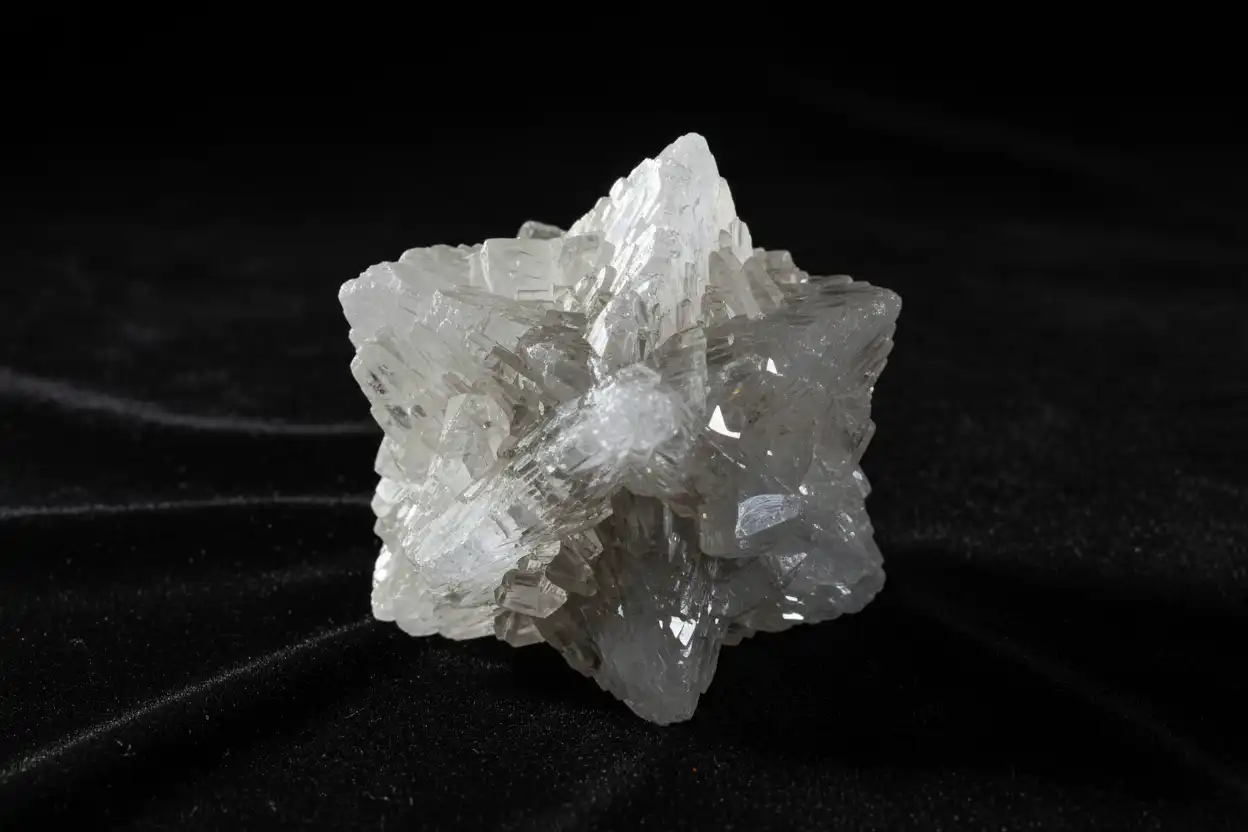
Cerussite Meaning: Mineral Facts, History & Symbolism
Cerussite meaning is commonly associated in modern crystal practice with perspective, transformation, resilience, reassessment, and recognizing value after circumstances change. Those ideas are symbolic interpretations rather than measurable effects produced by the mineral. Materially, cerussite is lead carbonate, PbCO₃, a dense orthorhombic mineral that forms principally in the oxidized portions of lead deposits. It is commonly produced when primary lead minerals such as galena are chemically altered near the surface, making cerussite both an important collector mineral and a visible record of changing geological conditions.
Cerussite has an unusually dramatic combination of properties. It is only about Mohs 3–3.5, yet its measured density is approximately 6.53–6.57 g/cm³, so even a modest crystal can feel unexpectedly heavy. Transparent crystals have very high refractive indices, extreme birefringence, strong dispersion, and commonly adamantine luster, which can give clean specimens an almost gem-like brightness despite their softness and brittleness. Cerussite belongs to the aragonite structural group and can develop complex twins, including cyclic and reticulated forms that create some of the most recognizable crystal geometries in lead-mineral collections.
For other mineral references that place composition and identification before symbolism, browse the Gemstone Guides.
What Is Cerussite?
Cerussite is a naturally occurring lead carbonate mineral with the ideal formula:
PbCO₃
Lead is an essential part of its structure, not a trace contaminant. Carbonate groups combine with Pb²⁺ in an orthorhombic crystal arrangement related structurally to aragonite. Cerussite is therefore chemically different from galena, anglesite, calcite, and other minerals that may occur in the same deposits even when they share lead, carbonate, or similar colors.
| Property | Typical cerussite characteristics |
|---|---|
| Mineral species | Cerussite |
| Chemical formula | PbCO₃ |
| Mineral class | Carbonate |
| Structural group | Aragonite group |
| Crystal system | Orthorhombic |
| Typical color | Colorless, white, gray, pale blue or green; other tints may occur |
| Transparency | Transparent to translucent |
| Mohs hardness | About 3–3.5 |
| Specific gravity | About 6.53–6.57 |
| Cleavage | Distinct to good in important crystallographic directions |
| Fracture | Conchoidal to uneven |
| Tenacity | Very brittle |
| Luster | Commonly adamantine; may also be vitreous, resinous or pearly |
| Optical character | Biaxial negative |
| Refractive indices | Approximately 1.803, 2.074 and 2.076 |
| Maximum birefringence | About 0.273 |
| Dispersion | Strong |
| Main geological setting | Oxidized zones of lead deposits |
| Common precursor | Galena and other lead-bearing ore minerals |
The combination of extreme density, modest hardness, high refractive indices, strong birefringence, and lead-carbonate chemistry provides a much stronger identification framework than color alone.
Why Cerussite Is So Heavy
Cerussite’s exceptional heft is one of its most immediately noticeable properties.
Its specific gravity is around 6.5, meaning it is more than twice as dense as quartz and substantially denser than most familiar transparent gemstones. This high density comes largely from lead, an element with a high atomic mass, occupying a major structural role in PbCO₃.
A transparent crystal can therefore create an unusual sensory contradiction. It may look like a delicate colorless gem yet feel dramatically heavier than a similarly sized quartz, feldspar, calcite, or beryl crystal.
That apparent heaviness is useful as a screening clue, but subjective heft should not replace measurement. Matrix material, internal cavities, repairs, and attached minerals can alter how a specimen feels in the hand.
For a suitable loose crystal, hydrostatic specific-gravity measurement provides much stronger evidence.
Cerussite Is Soft Despite Its Density
Density and hardness describe unrelated properties.
Cerussite is very dense but only about Mohs 3–3.5.
This means a crystal can feel extraordinarily heavy while remaining susceptible to scratching and edge damage.
The distinction is important because visual brilliance can make transparent cerussite look more durable than it actually is. A sharply terminated specimen with adamantine faces should not be handled like quartz merely because the surfaces look glassy.
Hardness measures resistance to scratching.
It does not measure weight, toughness, or resistance to fracture.
Cerussite is both relatively soft and very brittle.
Why Cerussite Can Look Diamond-Like
Well-formed transparent cerussite can display intense brightness because its refractive indices are unusually high. Its measured principal refractive indices extend from about 1.803 to above 2.07, and its birefringence is extraordinarily strong at roughly 0.273. Gemological references also describe strong dispersion.
These optical properties create:
strong surface brilliance;
high visual relief;
distinct facet-edge doubling in transparent material;
colorful dispersion under suitable illumination;
and bright adamantine reflections.
A photograph can therefore make clear cerussite resemble diamond, zircon, or another brilliant transparent gem.
The resemblance is superficial.
Diamond is much harder, structurally unrelated, dramatically more durable, and much less birefringent.
Cerussite’s optical behavior is explored in detail on the cerussite optical properties and color behavior page.
Extreme Birefringence Is a Major Diagnostic Trait
Birefringence occurs when an anisotropic crystal has different refractive indices according to light direction.
Cerussite’s birefringence is exceptionally large.
In suitable transparent material, a viewer may see strong doubling of internal features, rear facet edges, inclusions, or lines viewed through the crystal.
This is not an optical illusion produced by polishing.
It reflects the crystal’s anisotropic optical structure.
The effect can provide valuable diagnostic evidence when transparent specimens or cut stones are available, particularly when combined with high density and high refractive indices.
Birefringence should not be translated into metaphysical language about “multiple realities” as though the optical effect scientifically changed human perception. It can inspire that metaphor, but the measurable phenomenon concerns light.
Why Cerussite Forms Complex Twins
Cerussite is famous for twinning.
Single crystals can occur, but repeated twinning can produce forms that appear:
pseudohexagonal;
star-like;
V-shaped;
heart-like;
reticulated;
skeletal;
or arranged into complex interconnected frameworks.
The apparent symmetry can be deceptive.
Cerussite remains orthorhombic even when repeated twins create an outline that looks approximately sixfold.
This is an important mineralogical distinction:
External outline does not always reveal the underlying crystal system directly.
Several individuals can intergrow according to specific crystallographic twin laws and create an aggregate whose overall geometry appears more symmetrical than each individual crystal.
Pseudohexagonal Does Not Mean Hexagonal
A cyclic cerussite twin may look remarkably hexagonal.
That does not make cerussite a hexagonal mineral.
The apparent six-sided geometry results from multiple orthorhombic individuals arranged through repeated twinning.
This is comparable to other minerals whose twins create misleading apparent symmetry.
For specimen identification, examine:
repeated re-entrant angles;
boundaries between twin individuals;
changes in luster;
internal doubling;
crystallographic orientation;
and whether the apparent hexagon consists of several intergrown crystals.
A photograph that shows only the outside silhouette can hide much of this evidence.
How Cerussite Forms
Cerussite is principally a secondary mineral of oxidized lead deposits.
Primary lead ore commonly occurs as galena, PbS. When galena-bearing rock is exposed to oxygenated groundwater and near-surface weathering, sulfur and lead participate in a series of chemical reactions. Lead can be mobilized locally and recombined with carbonate to form cerussite where conditions are favorable.
Cerussite can therefore replace, coat, surround, or grow near remnants of earlier galena.
Other secondary lead minerals may occur during the same broader alteration process.
The geological sequence is not universal. Local pH, carbonate availability, groundwater chemistry, oxidation conditions, host-rock composition, sulfates, chlorides, phosphates, and other dissolved constituents can influence which lead minerals become stable.
The complete deposit-scale treatment is covered in cerussite formation and deposit geology.
Cerussite as an Alteration Product of Galena
The relationship between galena and cerussite is one of the most useful ways to understand the mineral.
Galena is lead sulfide:
PbS
Cerussite is lead carbonate:
PbCO₃
During oxidation and weathering, the sulfide mineral becomes chemically unstable under near-surface conditions. Lead can remain locally concentrated while sulfur is oxidized and redistributed. If carbonate is available, lead carbonate can crystallize.
This is why cerussite commonly occurs in the oxidized zone above or around primary lead sulfide ore.
The mineral records transformation caused by geochemistry, not a mysterious energetic conversion.
That real transformation later provides an understandable source for modern symbolic interpretations involving adaptation or change.
Cerussite and Anglesite
Anglesite is lead sulfate:
PbSO₄
It can occur alongside cerussite in oxidized lead deposits because both may develop through alteration of galena.
The two minerals share high density and lead-rich chemistry, but the anion differs:
cerussite contains carbonate;
anglesite contains sulfate.
Crystal structure, optical behavior, cleavage, and chemical response consequently differ.
A white or colorless heavy mineral from an oxidized lead deposit should therefore not be identified as cerussite solely because it feels dense.
Geological context narrows possibilities.
It does not replace mineral testing.
Cerussite and Galena
Galena is visually very different in ideal specimens.
It is metallic lead sulfide, typically gray with metallic luster and characteristic cubic cleavage. Cerussite is usually nonmetallic, commonly transparent to translucent, and can show adamantine luster and intricate crystal twins.
However, weathered specimens can contain both.
A pale cerussite coating may partly cover darker galena, while cavities left by dissolving or altered sulfide can later contain secondary lead-carbonate crystals.
Such relationships can make a matrix specimen scientifically valuable because they preserve the transition from primary ore to oxidized secondary mineralization.
What Causes Cerussite Color?
Pure cerussite can be colorless.
Natural specimens may also appear white, gray, blue, green, or otherwise lightly tinted.
Color can be influenced by:
trace substitutions;
microscopic inclusions;
surface coatings;
alteration products;
associated minerals;
structural defects;
and light scattering.
A blue or green tint should not automatically be assigned to one trace element without analytical evidence.
Likewise, a white specimen may derive its appearance partly from numerous internal fractures, microscopic inclusions, or aggregate texture rather than from an intrinsically opaque crystal lattice.
The correct distinction is between what can be seen and what has actually been chemically demonstrated.
Colorless in Transmitted Light
Mineralogical references describe cerussite as colorless in transmitted light even though hand specimens may appear white, gray, blue, or green.
This distinction illustrates how mineral color depends on observation conditions.
A thick aggregate may look gray because of inclusions and internal reflection.
A transparent thin region may lose most of that apparent color.
A surface coating can color the outside without changing the underlying crystal.
For identification, compare transmitted and reflected light rather than treating one photograph as the definitive appearance.
Original Cerussite Specimen and Photo Checklist
The following checklist provides a non-destructive first-pass framework for examining a purported cerussite specimen.
Consider density immediately
If a loose crystal is unexpectedly heavy for its size, cerussite becomes more plausible.
Do not use subjective heft as the final identification.
Examine luster
Good transparent crystals can show unusually intense adamantine reflections.
A dull earthy coating may hide that luster locally.
Look for twinning
Search for repeated intergrowths, re-entrant angles, pseudohexagonal forms, cyclic arrangements, or reticulated structures.
Complex twinning is highly characteristic but not mandatory.
Confirm the crystal is not actually hexagonal
A six-sided outline can result from cyclic twinning of orthorhombic individuals.
Inspect internal boundaries.
Look for strong optical doubling
In transparent material, internal features or rear edges can appear doubled because of extreme birefringence.
Examine existing broken surfaces
Cerussite is brittle and can show conchoidal fracture as well as cleavage-controlled breaks.
Do not break a good specimen intentionally.
Inspect the matrix
Galena remnants, iron oxides, other secondary lead minerals, carbonate gangue, or oxidized ore textures can provide plausible geological context.
Look for pseudomorph or replacement relationships
Cerussite may preserve shapes or spaces connected with earlier lead minerals.
These textures can be more informative than isolated crystals.
Compare thin and thick regions
Color may weaken substantially through thin transparent sections.
Inspect for repairs
Complex twins and reticulated crystals are delicate.
Look for adhesive at contact points, glossy seams, bubbles, or mismatched broken surfaces.
Use magnification
A loupe or microscope can reveal twin boundaries, inclusions, cleavage, alteration coatings, fractures, repairs, internal doubling, and growth textures. More detailed observations belong in the cerussite microscope inclusion notebook.
Do not scratch-test collector crystals
The hardness is low enough that destructive testing can create obvious permanent damage.
Do not taste or lick the specimen
Cerussite contains lead as an essential component and should never be identified by taste or oral contact.
Preserve labels
Lead-mineral localities can be important to collector and scientific interpretation.
Exclude metaphysical language from identification
Terms such as transformation crystal, awakening mineral, abundance stone, perspective amplifier, or high-frequency cerussite provide no species-level evidence.
Claim Versus Evidence: Common Cerussite Statements
| Claim | Evidence status | More accurate interpretation |
|---|---|---|
| Cerussite is lead carbonate | Supported | Its ideal formula is PbCO₃ |
| Cerussite is orthorhombic | Supported | Apparent hexagonal twins do not change its crystal system |
| Cerussite is extremely dense | Supported | Measured density is around 6.53–6.57 g/cm³ |
| Cerussite is very hard because it feels heavy | Incorrect | Hardness is only about 3–3.5 |
| Transparent cerussite can show strong brilliance | Supported | High RI and strong dispersion contribute to its appearance |
| Cerussite has extremely strong birefringence | Supported | Its principal refractive indices differ dramatically |
| A six-sided cerussite twin is a hexagonal crystal | Incorrect | Cyclic twinning can create pseudohexagonal outlines |
| Cerussite commonly forms through alteration of galena | Supported | It is a common secondary mineral in oxidized lead deposits |
| Every white heavy mineral in a lead deposit is cerussite | Incorrect | Anglesite and other minerals require consideration |
| Cerussite is harmless because it is natural | Incorrect | It is lead carbonate and requires lead-aware handling |
| Cerussite should be used in drinking-water elixirs | Unsafe | Lead-bearing mineral material should not be ingested |
| Cerussite releases lead as beneficial grounding energy | Unsupported and unsafe framing | Lead chemistry is a health consideration, not a therapeutic property |
| Cerussite scientifically increases resilience | Unsupported | Resilience is a modern symbolic interpretation |
| Cerussite activates spiritual transformation | Metaphysical belief | No mineralogical measurement establishes this effect |
| Cerussite treats illness | Unsupported medical claim | Lead-carbonate identity does not establish therapeutic efficacy |
This evidence boundary is particularly important for cerussite because unsupported wellness claims can obscure a genuine chemical safety issue.
Cerussite’s Name and Documented History
The name cerussite derives from the Latin cerussa, associated with white lead. Mineralogical references record the name as reflecting that historical connection with lead carbonate.
That etymology belongs to chemistry and mineral history.
Historical references to “white lead” need to be interpreted carefully because the term has also been applied to manufactured lead-carbonate pigments and related lead compounds rather than exclusively to naturally crystallized cerussite specimens.
The mineral and the pigment history overlap chemically, but they are not identical categories.
A naturally formed transparent crystal from an ore deposit is not the same object as processed white-lead pigment even when lead carbonate chemistry connects them.
Cerussite and White-Lead Pigment History
Lead carbonate compounds were historically important as white pigments because they provided strong covering power.
That use also became associated with serious lead exposure risks.
A mineral specimen should not be treated as pigment, but the chemistry explains why cerussite deserves more careful handling than quartz, calcite, or many common collector minerals.
The historical importance of lead carbonate therefore has two sides:
it demonstrates genuine material usefulness;
it also demonstrates why lead compounds require respect.
No mystical interpretation is necessary to make that history significant.
Cerussite Meaning in Modern Symbolism
Modern cerussite meaning commonly emphasizes adaptation, perspective, transformation, resilience, and recognizing new possibilities after disruption.
The geology provides an intuitive metaphor.
Cerussite commonly develops when an earlier lead sulfide mineral is altered under new environmental conditions. The lead remains part of the system, but its chemical relationships change as weathering, oxidation, carbonate availability, and groundwater create a different mineral.
Someone may use that transformation symbolically to represent reorganizing existing resources rather than assuming every major change requires starting from nothing.
That is metaphor.
Holding cerussite does not chemically transform a person’s circumstances.
Transformation as a Geological Metaphor
Cerussite provides a more defensible transformation metaphor than many crystals because its geological story genuinely involves mineral alteration.
Galena can become unstable near the surface.
New chemical conditions develop.
Lead is reorganized into secondary minerals such as cerussite.
A practical reflection inspired by that process might ask:
Which part of the situation has actually changed?
Which resources remain available?
Is an old structure unsuitable for current conditions?
What can be reorganized rather than discarded?
Which conclusion needs new evidence?
The geological transformation is measurable.
The personal interpretation is chosen.
Perspective and Twinning
Cerussite’s cyclic twins can look very different depending on viewing direction.
A complex aggregate may initially appear to be one highly symmetrical crystal. Closer examination reveals several intergrown orthorhombic individuals.
That makes perspective an especially appropriate symbolic theme.
Someone might use the specimen as a reminder that a convincing overall appearance can conceal a more complicated underlying structure.
The practical lesson is not supernatural:
Change the viewing angle before deciding that the first explanation is complete.
This is a symbolic application of crystallography rather than a claim that the mineral alters perception biologically.
Resilience Without Romanticizing Lead
Because cerussite forms through alteration, modern crystal descriptions sometimes frame it as a symbol of surviving difficult conditions.
That metaphor can be useful.
It should not be extended into the claim that exposure to a lead mineral strengthens the body or makes someone physically more resilient.
Lead is not a wellness ingredient.
Cerussite’s resilience symbolism should remain psychological or philosophical, while its actual chemistry is handled with appropriate safety precautions.
Keeping those two categories separate is especially important here.
Cerussite and Chakra Claims
Contemporary metaphysical systems may associate cerussite with the root, crown, third eye, or combinations of chakras depending on the author.
Those associations are not mineralogical classifications.
Laboratory measurements can determine:
chemical composition;
density;
crystal structure;
refractive indices;
birefringence;
and other physical properties.
They cannot determine whether a chakra is blocked, open, activated, balanced, aligned, or healed.
A person may choose to interpret a safely displayed specimen symbolically, but chakra language should not override the mineral’s lead-related handling requirements.
Does Cerussite Have Healing Properties?
Cerussite should not be presented as a medical treatment.
Claims that it treats disease, detoxifies the body, strengthens the nervous system, corrects mineral deficiencies, improves circulation, heals trauma, or provides therapeutic lead through energetic mechanisms are unsupported and potentially misleading.
Cerussite is PbCO₃.
Lead carbonate is a lead compound, and lead exposure can harm health. Exposure risks increase when lead-containing material becomes dust or is swallowed, and public-health guidance emphasizes preventing inhalation and ingestion of lead-containing particles.
The appropriate distinction is therefore stronger than for many common decorative stones:
Cerussite can be meaningful as a mineral specimen or symbolic object, but its chemical composition is not a basis for wellness use.
Lead Is Not a Therapeutic Element in Cerussite
The presence of lead must never be converted into a beneficial metaphysical claim.
Lead carbonate is identified as a hazardous lead compound, and cerussite is its natural mineral form. Safety information for lead carbonate emphasizes avoiding exposure, particularly inhalation and ingestion, and washing hands before eating after potential contact.
This directly rules out practices such as:
grinding cerussite for powders;
placing it in drinking water;
making mineral elixirs;
licking or tasting specimens;
intentionally generating dust;
or treating lead content as a nutritional benefit.
A mineral formula explains identity.
It does not describe a therapeutic ingredient.
Cerussite Is Not a Practical Everyday Jewelry Stone
Transparent cerussite can be visually spectacular and has been faceted for collectors, but routine jewelry use is problematic for several reasons.
First, Mohs hardness around 3–3.5 means surfaces and facet edges abrade easily.
Second, cerussite is very brittle.
Third, its cleavage and extreme density place additional mechanical demands on cutting and setting.
Most importantly, it is a lead carbonate mineral.
These combined limitations make collector display or controlled gemological study more appropriate than ordinary skin-contact jewelry.
The mechanical and mounting issues are addressed in cerussite setting and wear engineering without treating wearability as the defining purpose of the mineral.
Faceting Cerussite
The optical reward can be extraordinary.
High refractive indices, strong dispersion, and enormous birefringence can create a brilliant faceted stone with visible doubling and colorful flashes.
The cutting difficulty is equally substantial.
A cutter must manage:
low hardness;
brittleness;
cleavage;
high density;
fragile facet edges;
orientation;
internal fractures;
and lead-containing dust.
A fine natural crystal can also have considerably more mineralogical value intact than as faceting rough.
The technical aspects belong in cerussite cutting, orientation and polish, where lapidary decisions can be discussed without duplicating the broader meaning reference.
Safe Ownership Requires Lead-Aware Handling
Cerussite deserves more deliberate handling than inert-feeling collector minerals.
Lead exposure can occur through ingestion or inhalation of lead-containing dust, and children are particularly vulnerable to lead exposure.
For a collector specimen, conservative practice includes:
avoid unnecessary direct handling;
handle by a stable matrix when practical;
use disposable or washable gloves for repeated handling;
wash hands thoroughly after contact;
never eat, drink, or smoke while handling the specimen;
keep the mineral away from food-preparation and dining surfaces;
keep it inaccessible to children and pets;
do not lick, taste, or place it in the mouth;
do not put it into drinking water;
do not crush, grind, drill, sand, or polish it casually;
and contain any broken fragments rather than sweeping them into ordinary living areas.
Lead dust can be difficult to see, so the absence of visible particles does not establish that a dusty processing method is safe.
A Display Case Is Better Than Frequent Handling
Cerussite is particularly well suited to enclosed display.
A case reduces:
accidental touching;
crystal breakage;
dust transfer;
access by children or pets;
and repeated abrasion of fragile surfaces.
It also protects complex twins and reticulated crystals whose projecting branches can break easily.
For an important specimen, the ideal goal is to preserve its mineralogical information while minimizing both physical damage and unnecessary lead contact.
This is more useful than treating a rare collector crystal as a tactile object that needs to be handled repeatedly for symbolic practice.
What to Do if a Cerussite Specimen Breaks
Do not grind or pulverize the fragments further.
Avoid dry brushing or compressed air that could redistribute fine particles.
Keep children and pets away from the area, collect larger fragments carefully, and use lead-aware cleaning practices appropriate to the surface and amount of material involved.
Wash hands thoroughly afterward.
If significant dust has been generated through cutting, grinding, crushing, or another processing activity, treat the situation as a lead-exposure issue rather than ordinary mineral dust.
CDC guidance emphasizes that lead-containing dust can enter the body through breathing or swallowing and may not be obvious in the air.
Cerussite Versus Cavansite
The preceding cavansite meaning reference concerns a hydrated calcium vanadium silicate, often vivid blue and relatively light compared with cerussite.
Cerussite is lead carbonate and has a density above 6.5.
Cavansite is much less dense.
Both can be brittle collector minerals, but their chemistry, crystal structures, optical properties, geological environments, and safety considerations are fundamentally different.
This comparison demonstrates why similar collector status or metaphysical marketing does not imply mineralogical similarity.
Cerussite Versus Candle Quartz
Candle quartz meaning concerns SiO₂ with distinctive secondary quartz growth.
Quartz has Mohs hardness near 7 and specific gravity around 2.65. Cerussite is roughly half as hard and more than twice as dense.
A transparent crystal photograph can conceal those differences.
Cerussite’s high refractive behavior and adamantine luster can even make it appear visually more brilliant than quartz, yet basic physical measurements quickly separate them.
Cerussite Versus Chalcedony
Chalcedony meaning concerns microcrystalline silica, generally a durable, relatively lightweight quartz-family material.
Cerussite is an entirely different lead-carbonate mineral.
Chalcedony has hardness around the quartz-family range and no prominent easy cleavage. Cerussite is soft, exceptionally dense, brittle, and strongly anisotropic optically.
The contrast is particularly relevant when pale polished materials lose their original crystal form.
A light-colored appearance is never enough to establish family or species.
Color Is Even Less Useful Across Different Mineral Families
The mapped chalcedony color meaning guide illustrates how one silica material can occur in multiple colors without changing its fundamental family identity.
Cerussite creates the opposite diagnostic lesson.
A colorless cerussite and a colorless quartz can look superficially similar while differing profoundly in density, hardness, refractive index, structure, and chemistry.
Color should therefore be treated as one observation among many.
It is not a complete identification system.
Provenance Matters for Important Cerussite
Cerussite occurs in many oxidized lead deposits, but particular mining districts have produced especially distinctive twinning, transparency, crystal size, matrix associations, or historically important specimens.
A crystal’s shape can suggest a comparison with known locality material without proving origin.
Reliable provenance may include:
original mine labels;
collection cards;
dealer documentation;
acquisition records;
historic specimen numbers;
photographs;
institutional records;
or a traceable chain of custody.
The cerussite provenance disclosure checklist provides a structured way to distinguish documented source information from visual inference.
Provenance becomes especially important when locality substantially affects collector value.
Conserving Cerussite Specimens
Cerussite combines low hardness, brittleness, complex twinning, high density, and lead chemistry, making conservation more important than aggressive cleaning.
A large dense crystal on fragile matrix can place mechanical stress on its attachment point. Reticulated twins can break when wrapped too tightly. Soft crystal faces can be scratched by ordinary packing material containing harder dust.
Before changing storage or attempting treatment, document:
crystal dimensions;
twinning;
existing chips;
cleavage cracks;
matrix contacts;
repairs;
coatings;
labels;
and provenance.
The cerussite specimen conservation record provides a structured framework for recording those features before changes become irreversible.
Avoid Casual Chemical Cleaning
Cerussite is a carbonate and a lead compound.
Aggressive acids, reactive cleaning products, abrasive methods, and untested chemical baths should not be used casually.
A cleaning treatment can damage surfaces, mobilize lead-containing material, alter associated minerals, or destroy scientifically useful coatings and alteration textures.
For a valuable or historically important specimen, accepting minor surface dust can be preferable to exposing the object to an uncertain treatment.
Conservation should prioritize stability and information preservation rather than maximum brightness.
An Evidence Ladder for Cerussite Claims
Different cerussite claims require different kinds of evidence.
Direct observation can document crystal habit, twinning, color, luster, matrix, transparency, fractures, and condition.
Measured density can establish whether the extraordinary heft is compatible with lead carbonate.
Hardness observations can support the expected soft-mineral range, though destructive testing should be minimized.
Microscopy can reveal twin boundaries, inclusions, cleavage, alteration, repairs, coatings, internal doubling, and growth relationships.
Optical mineralogy can demonstrate exceptionally high refractive indices, biaxial behavior, and extreme birefringence.
Raman spectroscopy can provide a strong carbonate structural fingerprint.
X-ray diffraction can confirm the orthorhombic cerussite structure and distinguish it from other lead minerals.
Chemical analysis can establish lead and carbonate-compatible composition while identifying substitutions or associated phases.
Geological context can show whether the specimen comes from an oxidized lead-mineral assemblage consistent with secondary cerussite formation.
Provenance documentation supports mine, district, collector, and ownership claims.
Historical evidence supports the relationship between the cerussite name and white-lead terminology.
Modern symbolism includes transformation, resilience, perspective, and spiritual change. These are interpretive meanings rather than intrinsic properties of PbCO₃.
What Cerussite Meaning Can Reliably Include
Cerussite meaning becomes clearest when material identity, geological transformation, documented history, symbolism, and safety remain separate.
Materially, cerussite is PbCO₃, an orthorhombic lead carbonate in the aragonite group. It has hardness around 3–3.5 yet measured density around 6.53–6.57, making it simultaneously soft and extraordinarily heavy. Transparent material has very high refractive indices, extreme birefringence, and strong dispersion, while repeated twinning can create pseudohexagonal, cyclic, star-like, or reticulated forms.
Geologically, it is principally a secondary mineral of oxidized lead deposits, commonly developing through alteration of galena and other lead minerals. That genuine process of chemical reorganization provides an understandable basis for modern transformation symbolism without implying supernatural action.
Historically, the name comes from cerussa, associated with white lead. That documented connection is materially relevant because cerussite is genuinely lead carbonate rather than a harmless stone merely carrying the word “lead” in an old trade story.
Symbolically, someone may use cerussite to represent changing structure, reassessing assumptions, or retaining useful resources while adapting to new conditions. Its complex twinning can similarly inspire the idea that one apparent form may contain several underlying perspectives.
Those meanings should never be used to obscure safety. Lead carbonate is hazardous material, and lead exposure should be minimized, particularly through inhalation or ingestion of dust. Cerussite should not be consumed, used in drinking-water elixirs, ground for ritual powders, or handled casually by children.
Gems Lore explains its material-first approach on the About page. Health, metaphysical, identification, and safety limitations are set out in the Disclaimer, while factual corrections or supporting mineralogical evidence can be submitted through Contact.
Cerussite needs no exaggerated mythology to be extraordinary. Lead carbonate can emerge from the weathering of primary ore, grow into intricate cyclic twins, feel unexpectedly heavy in the hand, and produce optical brilliance that contrasts sharply with its softness and fragility. Cerussite meaning is strongest when those measurable facts come first, modern symbolism remains clearly interpretive, and lead-aware handling is treated as an essential part of responsible ownership.