Carnelian Meaning: Mineral Facts, History & Symbolism
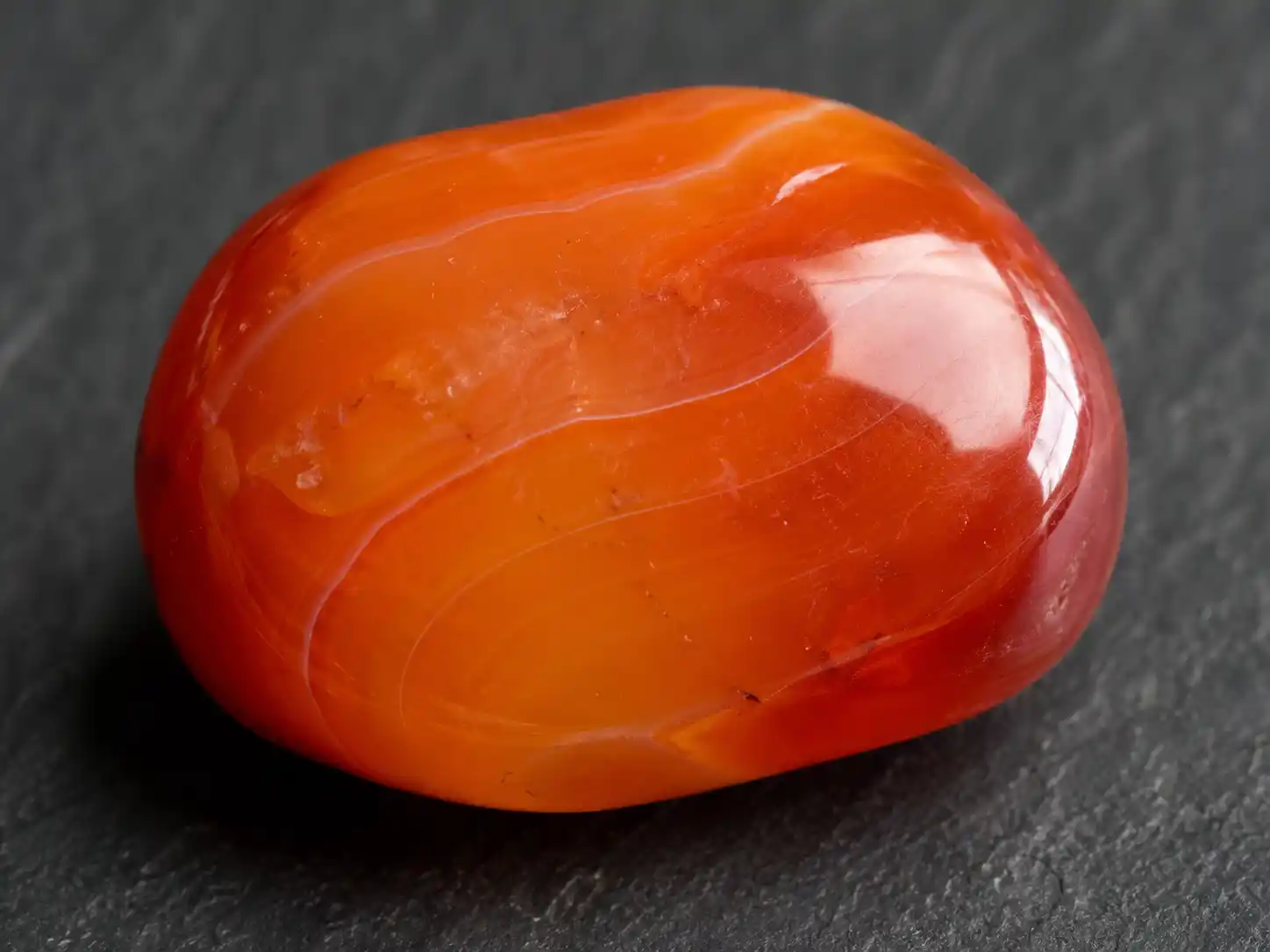
Carnelian meaning is commonly associated with confidence, vitality, initiative, creativity, courage, motivation, and purposeful action. Those ideas belong to historical and modern symbolism rather than to measurable effects produced by the stone. Materially, carnelian is a translucent orange, reddish orange, red, or brownish-red variety of chalcedony, the microcrystalline form of quartz. Its essential chemistry is silicon dioxide, SiO₂, while its characteristic warm color is produced primarily by finely dispersed iron-bearing compounds within the chalcedony.
This distinction is fundamental because carnelian is often discussed as though its orange-red appearance creates a completely separate mineral. It does not. Carnelian belongs within the quartz family and shares the characteristic hardness, lack of easy cleavage, conchoidal fracture, and general optical behavior of chalcedony. What makes it recognizable is the combination of microcrystalline texture, translucency, warm iron-related color, and geological growth as silica-rich material filling cavities, fractures, pores, or other available spaces.
Readers interested in the site’s broader symbolic crystal coverage can explore the Healing Crystal section, while this reference begins with the material itself before considering cultural or metaphysical interpretations.
What Is Carnelian?
Carnelian is chalcedony colored predominantly in shades of orange to reddish brown. Chalcedony consists of microscopic intergrowths of quartz and closely related silica structures rather than the large, easily visible crystals seen in rock crystal or amethyst.
A polished carnelian therefore usually appears smooth and relatively uniform to the unaided eye even though its internal structure is crystalline on a microscopic scale.
| Property | Typical carnelian characteristics |
|---|---|
| Material identity | Orange-to-red variety of chalcedony |
| Chemical composition | Primarily SiO₂ |
| Mineral family | Quartz / chalcedony |
| Structure | Microcrystalline silica |
| Typical color | Yellow-orange, orange, reddish orange, red to brownish red |
| Transparency | Commonly translucent; locally semi-transparent or nearly opaque |
| Mohs hardness | About 6.5–7 |
| Specific gravity | Roughly 2.60–2.65 |
| Refractive index | Approximately 1.53–1.54 |
| Cleavage | None prominent |
| Fracture | Conchoidal to uneven |
| Luster | Waxy on rough surfaces, vitreous to waxy when polished |
| Streak | White |
| Principal color influence | Finely dispersed iron-bearing compounds |
| Separate mineral species? | No; a chalcedony variety |
Carnelian grades continuously into other chalcedony colors, so there is no universal scientific color boundary at which every observer must stop using one trade name and start using another.
That is particularly important when distinguishing carnelian from sard.
Carnelian Is Chalcedony, Not Crystalline Quartz
Quartz occurs in several textural forms.
Rock crystal, amethyst, citrine, and smoky quartz are familiar macrocrystalline varieties in which the crystal structure develops as comparatively large single crystals or crystal domains.
Carnelian belongs to chalcedony, where the silica is organized as an extremely fine intergrowth. Individual crystallites are too small to create the obvious hexagonal prism habit associated with macrocrystalline quartz.
That means a natural rough carnelian does not normally occur as a transparent orange six-sided quartz point.
It is more commonly encountered as nodules, vein material, cavity fillings, irregular masses, rounded pebbles, or banded-to-unbanded chalcedony later cut into cabochons, beads, carvings, intaglios, and other polished forms.
What Gives Carnelian Its Orange and Red Color?
Carnelian’s color is principally associated with iron.
Finely dispersed ferric iron compounds, particularly iron oxides, can produce the yellow-orange, orange, red, and brownish-red tones characteristic of the material. Hematite-related particles are especially relevant to strong red coloration.
Because the color is distributed through microscopic material rather than necessarily concentrated into visible crystals, a carnelian can look relatively uniform while still showing differences in intensity from one region to another.
A thin edge may appear bright orange when backlit, whereas a thicker part of the same stone can look darker red or brown.
That difference does not automatically represent separate varieties. Light travels through different path lengths, and carnelian’s translucency strongly affects perceived color.
The detailed relationship among color centers, iron-bearing particles, transmitted light, absorption, and visual saturation is explored in carnelian optical properties and color behavior.
Natural Carnelian Color Is Often Uneven
Perfectly uniform orange-red coloration is not a requirement for natural carnelian.
Rough and polished material may show:
pale orange areas;
dark red zones;
brownish sections;
cloudy patches;
faint bands;
white or gray chalcedony;
iron-rich spots;
small fractures;
and transitions between translucent and more opaque material.
This variability is especially important in photographs. Strong backlighting can make a darker specimen look dramatically brighter, while warm studio lighting can exaggerate red saturation.
A useful assessment therefore compares the stone under neutral reflected light and transmitted light rather than relying on one heavily illuminated photograph.
Carnelian and Sard: Where Is the Boundary?
Carnelian and sard are historically related names for warm-colored chalcedony.
Carnelian is generally associated with brighter orange, reddish orange, or red chalcedony, while sard tends to describe darker brownish-red to brown chalcedony.
The transition is gradual.
There is no simple laboratory measurement that forces every borderline specimen into one trade category based solely on one color coordinate. Historical usage also varies.
A stone near the boundary is therefore better described honestly as reddish-brown chalcedony, carnelian-to-sard, or according to established trade convention rather than pretending the distinction is absolute.
Carnelian Versus Red Agate
Agate is also chalcedony, but its defining feature is visible banding or patterned growth rather than a specific color.
Carnelian is commonly relatively uniform or only subtly zoned.
Red-orange chalcedony with clearly developed agate banding can legitimately be described as agate even though parts of the material have carnelian-like coloration.
That means the categories can overlap descriptively.
“Carnelian” emphasizes color.
“Agate” emphasizes banded chalcedony structure.
A single specimen can show areas that fit both descriptions.
How Carnelian Forms
Carnelian forms when silica-bearing fluids enter cavities, fractures, pore spaces, or other openings and deposit microcrystalline silica over repeated stages.
Those environments occur in volcanic rocks, sedimentary systems, weathering profiles, hydrothermal settings, and other silica-rich geological contexts.
Silica can be mobilized in groundwater or hydrothermal fluids and later precipitate when chemical conditions change. Iron already present in the host rock or circulating fluids can become incorporated into the developing chalcedony and contribute to the final orange-red color.
Many carnelian nodules preserve evidence of more than one stage of formation. An outer rind may differ from the interior, faint banding can indicate changing growth conditions, and iron concentration may vary across the piece.
The complete geological treatment of silica transport, cavity filling, weathering, iron oxidation, host rocks, and deposit settings is covered in carnelian formation and deposit geology.
Why Carnelian Is Often Found as Nodules and Pebbles
Chalcedony frequently fills cavities in volcanic rock or develops as resistant silica-rich nodules.
Once the host rock weathers, those nodules can survive because quartz-family materials are relatively hard and chemically durable under many surface conditions.
Transport by water can then round the rough surfaces.
This is why naturally worn carnelian pebbles can occur in sediment and gravel deposits far from the rock in which the chalcedony originally formed.
A rounded carnelian pebble therefore does not necessarily represent a primary growth shape.
Its present form may reflect erosion and transport after mineralization.
Heat Can Change Carnelian Color
Heating is important in carnelian because iron-bearing chalcedony can respond visibly to temperature.
Pale, yellowish, brownish, or less saturated chalcedony may become more orange or red when heating changes the state or appearance of iron-bearing compounds. Material sold as carnelian can therefore be naturally colored, heat-enhanced, or selected from agate whose color has been intensified through controlled heating.
Heat treatment does not convert quartz into a different mineral.
The chalcedony remains silica.
What changes is the appearance of its iron-related coloration.
This is one reason color intensity alone should not be used as proof of untreated origin.
Dyeing Is Also Possible
Chalcedony is sufficiently porous at microscopic scales that some material can accept dyes, particularly when fractures, bands, or textural differences provide pathways for coloring agents.
Dyed orange or red chalcedony can therefore imitate natural carnelian appearance.
Clues can include unusual color concentrations in fractures, drill holes, porous zones, or surface-reaching structures, although sophisticated treatments are not always obvious visually.
A strong color should not automatically be treated as suspicious, because naturally vivid carnelian exists.
The appropriate approach is evidence-based rather than assuming either that all intense carnelian is treated or that treatment never occurs.
Carnelian’s Hardness and Durability
Carnelian has the durability advantages typical of chalcedony.
With Mohs hardness around 6.5–7, it resists ordinary scratching better than calcite, fluorite, apatite, and many softer ornamental materials. Its microcrystalline texture also avoids the prominent easy cleavage found in some transparent gems.
That combination makes carnelian practical for beads, cabochons, seals, carvings, rings, pendants, bracelets, and earrings.
It is not indestructible.
A sharp blow can chip an edge, a thin carving can fracture, and harder abrasives can scratch the surface. Existing fractures or weak drill holes can create local vulnerabilities.
The mechanical implications for wearable designs are covered in carnelian setting and wear engineering.
Carnelian Has No Easy Cleavage
Cleavage is a mineral’s tendency to split along structurally controlled planes.
Carnelian does not have the strong cleavage of calcite, topaz, feldspar, or some other common gems.
When chalcedony breaks, it more often develops conchoidal or irregular fracture surfaces.
That fracture style can create curved, shell-like breaks similar to those seen in glass and other quartz materials.
The absence of easy cleavage contributes to carnelian’s usefulness for carving and engraving because the stone can tolerate shaping from multiple directions more readily than a mineral with one highly vulnerable cleavage plane.
An Original Carnelian Specimen and Photo Checklist
The following checklist helps evaluate rough, polished stones, beads, carvings, and online photographs without pretending that visual inspection can resolve every treatment or origin question.
Confirm chalcedony-like texture
Look for a dense, fine-grained material without visible large crystal faces inside the body.
Natural rough surfaces may appear waxy rather than glass-clear.
Examine color in neutral reflected light
Record whether the stone appears yellow-orange, orange, reddish orange, red, or brownish red without backlighting.
This provides a more realistic everyday appearance.
Then use transmitted light
A flashlight behind a thin edge can reveal translucency, internal zoning, cloudiness, fractures, and differences in color density.
Do not interpret the resulting glow as the normal face-up color.
Look for gradual color transitions
Natural iron distribution can create irregular zones rather than perfectly uniform saturation.
Smooth transitions are generally more informative than one isolated intense patch.
Inspect drill holes in beads
Color concentrated strongly around the walls of a drill hole or inside fractures can deserve closer examination for dye.
It is not automatically proof of treatment.
Look for faint agate banding
Some carnelian retains subtle banding because the material belongs within the broader chalcedony-agate system.
Strong banding may justify describing the piece as carnelian-colored agate.
Examine fractures
Natural fractures can collect iron staining or dye and therefore appear darker than the surrounding chalcedony.
Their relationship to color matters.
Check polish
Carnelian should accept a good smooth polish.
Orange coatings sitting above a poorly polished or unusually soft substrate would be inconsistent with ordinary solid chalcedony.
Be cautious with perfect neon red
Natural vivid material exists, but extreme digital saturation can make ordinary carnelian appear unrealistically intense.
Compare several photographs if purchasing remotely.
Observe the rough rind
Natural nodules may have weathered, pale, chalky, or iron-stained exterior surfaces very different from the polished interior.
Do not rely on bubbles alone
Glass imitation can contain bubbles, but the absence of bubbles does not prove natural chalcedony.
Use magnification where needed
Microscopy can reveal fibrous texture, iron-rich inclusions, fractures, dyes, polish features, coatings, and other useful clues. The carnelian microscope inclusion notebook develops these observations further.
Do not prove hardness destructively
Scratching a finished cabochon damages the object and rarely provides enough information to justify the loss.
Keep origin claims separate
Color and pattern do not establish a specific mine or country.
Ignore metaphysical labels during identification
Descriptions such as confidence stone, fertility crystal, motivation gem, sacral chakra stone, or energy booster provide no evidence of material identity.
A Claim-versus-Evidence Guide to Carnelian
Carnelian is one of the gemstones where genuine archaeological history, mineral facts, trade practices, and metaphysical claims are frequently blended together.
| Claim | Evidence status | More accurate interpretation |
|---|---|---|
| Carnelian is chalcedony | Supported | It is orange-to-red microcrystalline quartz |
| Carnelian is primarily SiO₂ | Supported | Its essential material is silica |
| Iron contributes to its warm color | Supported | Finely dispersed iron-bearing compounds are central to orange-red coloration |
| Carnelian is a completely separate mineral species | Incorrect | It is a color variety of chalcedony |
| Every orange-red chalcedony is untreated carnelian | Unsupported | Heat or dye may modify some material |
| Every dark reddish-brown chalcedony is carnelian | Terminology-dependent | Darker material may be called sard |
| All banded red chalcedony should be called only carnelian | Too broad | Distinct banding can justify agate terminology |
| Strong red color proves high quality | Unsupported as a universal rule | Translucency, evenness, cut, treatment, condition and intended use also matter |
| Heat treatment creates a synthetic gem | Incorrect | Heated natural chalcedony remains natural chalcedony with modified color |
| Carnelian was genuinely used historically for seals and ornaments | Supported historically | Its durability and carving properties made it useful |
| Every ancient orange bead was carnelian | Unsupported | Archaeological material requires identification |
| Carnelian scientifically increases courage | Unsupported | Courage is a symbolic association |
| Carnelian improves fertility | Unsupported medical claim | No gemological property establishes this |
| Carnelian increases physical energy through contact | Unsupported | Symbolic motivation is different from measurable metabolic energy |
| Carnelian activates the sacral chakra | Spiritual interpretation | Chakra claims are not mineralogical properties |
The table keeps documented history intact while preventing the existence of ancient carnelian artifacts from being used as proof of modern healing claims.
Carnelian Versus Glass
Orange-red glass is one of the simpler visual substitutes for carnelian.
Glass can be uniformly colored, translucent, inexpensive to shape, and capable of an excellent polish.
Potential clues include:
rounded gas bubbles;
flow lines;
unusually uniform internal appearance;
molded shapes;
lower hardness;
and different optical behavior.
None is universally present.
High-quality glass can lack obvious bubbles, while natural chalcedony can appear surprisingly uniform.
When an important object needs reliable identification, gemological testing is stronger than visual guesswork.
Carnelian Versus Jasper
Jasper is an opaque or nearly opaque microcrystalline silica material commonly containing abundant mineral impurities.
Carnelian is normally valued for at least some translucency.
The boundary can become subjective where a deep red chalcedony is only weakly translucent.
A useful practical distinction is:
translucent orange-red chalcedony → typically carnelian;
opaque iron-rich red silica → typically red jasper.
Nature can still produce transitional material, so the categories should not be forced beyond the evidence.
Carnelian Versus Sard
Sard is generally darker and browner.
Carnelian is generally brighter orange to reddish orange.
Both are chalcedony.
Historical terminology has varied enough that two reputable descriptions may use different names for the same borderline reddish-brown stone.
That makes transparent disclosure more useful than insisting on an artificial universal dividing line.
Carnelian Versus Treated Agate
Agate can be heated to alter iron-related coloration, sometimes producing rich orange-red areas commercially described as carnelian.
The critical question is not whether the silica remains natural—it does—but whether the appearance has been modified and whether the seller discloses that modification when relevant.
A beautiful heated chalcedony can still be durable and useful.
Treatment disclosure matters because buyers may value untreated natural coloration differently.
Can Carnelian Be Identified With Standard Gemological Tests?
Yes, although distinguishing carnelian specifically from other chalcedony colors relies partly on appearance because they share the same underlying quartz material.
Useful evidence includes:
refractive index around the chalcedony range;
specific gravity near 2.6;
hardness compatible with quartz;
aggregate optical behavior;
microcrystalline texture;
spectroscopy where appropriate;
and microscopy.
Advanced techniques can investigate iron-bearing components or suspicious dyes.
The question should be framed precisely.
A laboratory may be able to identify the material as natural chalcedony more confidently than it can reconstruct every step of its color history from one test.
Origin Is Harder to Prove Than Identity
A stone can be conclusively identified as carnelian-colored chalcedony without revealing exactly where it formed.
Carnelian occurs in multiple geological regions and has circulated through trade networks for a very long time.
Color is especially weak as a locality indicator.
An orange-red stone that resembles material commonly associated with one country can still originate elsewhere.
Reliable provenance depends on mine information, collection labels, dealer records, parcel documentation, field notes, or other evidence connecting the actual specimen to its claimed source.
The carnelian provenance disclosure checklist provides a structured framework for assessing those claims.
Carnelian Has a Genuine Documented Human History
Carnelian has a substantial archaeological and decorative history.
Its warm color, ability to take a high polish, relative durability, and suitability for detailed engraving made it useful for beads, seals, amulets, intaglios, rings, and other carved objects across parts of the ancient Near East, North Africa, South Asia, and the Mediterranean world.
That history is materially plausible because chalcedony can preserve carved detail better than much softer stone.
Carnelian seal stones were particularly useful because engraved designs could be pressed into soft sealing materials repeatedly without rapid wear.
Trade also carried carnelian considerable distances from important production and working centers.
These documented uses are far stronger historically than generic statements that “all ancient cultures believed carnelian increased motivation.”
Ancient Use Does Not Prove Modern Metaphysical Claims
An archaeological carnelian bead proves that people selected, worked, traded, wore, or valued the stone.
A seal can demonstrate administrative, decorative, ownership, religious, or social use depending on its context.
Neither automatically proves that the wearer believed carnelian affected metabolism, fertility, chakras, motivation, or emotional health in the way modern crystal descriptions claim.
Historical interpretation requires evidence from the culture being discussed.
Modern meanings should therefore not be projected backward merely to make them sound older.
Carnelian Meaning in Modern Symbolism
Modern carnelian meaning commonly centers on motivation, confidence, courage, creativity, vitality, decisiveness, and taking practical action.
Its visual appearance makes those associations understandable.
Orange and red are culturally associated in many modern contexts with warmth, movement, energy, urgency, visibility, and activity. Carnelian’s translucent glow when illuminated can reinforce that impression.
Someone might therefore choose carnelian as a reminder to begin a delayed project, speak more deliberately in a difficult conversation, practice a skill consistently, or convert an intention into a scheduled action.
Those are practical uses of symbolism.
The mineral does not need to emit motivational energy for the reminder to function.
Courage as a Behavioral Symbol
Carnelian is frequently called a courage stone.
A grounded interpretation of that phrase focuses on behavior.
Courage can involve:
asking an uncomfortable but necessary question;
giving a clear answer;
presenting work despite uncertainty;
acknowledging an error;
beginning a task before confidence feels complete;
or setting a reasonable boundary.
A person can associate a carnelian stone with one of those behaviors and use it as a cue.
The stone does not biologically suppress fear or guarantee success.
Creativity and Carnelian
Creativity is another common association.
Carnelian’s strong warm color can make it a visually stimulating object, and an individual may choose to connect that appearance with writing, design, music, art, or another creative practice.
A useful symbolic routine might be simple: place the stone near a workspace only when actively creating, so it becomes associated with beginning the task rather than merely thinking about it.
That kind of environmental cue can have practical personal value.
It remains different from claiming that chalcedony directly changes neural creativity through skin contact.
Carnelian and Motivation
Motivation fluctuates, which makes external reminders useful for some people.
A carnelian object can become a cue for a specific action:
When I notice the stone, I begin the next defined task.
That turns broad symbolism into a repeatable behavior.
The physical properties of carnelian do not demonstrate that it increases cellular energy, hormones, neurotransmitters, or athletic performance.
A symbolic reminder and a physiological stimulant are not the same thing.
Carnelian and the Sacral Chakra
Modern chakra practices often connect orange carnelian with the sacral chakra because of its color.
Other systems extend the symbolism to the root or solar plexus chakra.
These associations belong to spiritual practice rather than mineralogy.
Gemological instruments can measure carnelian’s refractive behavior, density, silica structure, inclusions, and color-related absorption. They cannot determine whether a chakra is blocked, open, activated, healed, or balanced.
A person can still use the stone within a private chakra practice while keeping that interpretation separate from scientific claims.
Does Carnelian Have Healing Properties?
Claims about carnelian healing properties are widespread enough to deserve their own focused treatment rather than being mixed into the mineral definition.
The dedicated carnelian healing properties guide examines the difference between traditional belief, modern metaphysical practice, personal ritual, and claims that would require medical evidence.
For the material reference, the boundary is straightforward.
Carnelian should not be presented as a treatment for infertility, hormonal disorders, depression, chronic fatigue, circulation problems, digestive disease, sexual dysfunction, pain, inflammation, or other medical conditions.
Its identity as iron-colored chalcedony does not establish those effects.
Iron in Carnelian Does Not Become an Iron Supplement
Carnelian contains iron-bearing material responsible for much of its color.
That does not mean the body absorbs a useful nutritional iron dose by wearing the stone.
Iron behavior depends on chemical form, concentration, solubility, dose, exposure route, digestion, and metabolism.
Microscopic iron oxides embedded within silica are not equivalent to medically appropriate iron supplementation.
The same reasoning applies whenever a gemstone contains an element that also has a biological role.
Mineral chemistry explains the stone.
It is not a therapeutic ingredient list.
Carnelian Jewelry and Wear
Carnelian’s hardness, toughness relative to many cleavable gems, and ability to take a smooth polish make it suitable for many jewelry forms.
That practical history continues in modern pieces.
A carnelian bracelet exposes beads or cabochons to more frequent knocks and surface contact than a protected pendant, while carnelian earrings generally experience less mechanical wear.
A carnelian necklace can use larger polished pieces with relatively low impact exposure, whereas a carnelian ring receives substantially more contact with hard surfaces.
These design differences matter more to durability than symbolic meanings assigned to the jewelry form.
Cleaning Carnelian
Carnelian is relatively durable, but cleaning should still be proportionate to the actual object.
A solid untreated cabochon and an antique carved seal in a fragile setting do not necessarily deserve the same procedure.
Fractures, dyes, adhesives, metal settings, coatings, stringing materials, and historical surfaces can alter the safest method.
The dedicated guide on how to clean carnelian jewelry covers those practical considerations without assuming that every orange chalcedony object is structurally identical.
Cutting and Polishing
Carnelian’s lack of easy cleavage and fine-grained structure make it an excellent carving and cabochon material.
Cutters commonly consider:
color zoning;
translucency;
dark versus pale areas;
natural fractures;
banding;
rind thickness;
orientation;
final thickness;
and whether transmitted light improves or weakens appearance.
A very thick cabochon may become excessively dark, while a thin cut can reveal brighter orange translucency.
Carving also allows natural color variations to become part of the design.
The technical relationship among saw direction, shaping, thickness, fracture avoidance, and final polish is covered in carnelian cutting, orientation and polish.
Where to Buy Carnelian
Material identification, treatment disclosure, representative photographs, dimensions, condition, and return terms are more useful buying evidence than metaphysical labels.
The where to buy carnelian guide addresses seller evaluation and purchase-specific questions separately.
For this meaning reference, the important distinction is that terms such as “high vibration,” “healing grade,” “fertility stone,” or “manifestation carnelian” do not constitute gemological quality grades.
A buyer should first establish what the physical stone is.
Conserving Important Carnelian Objects
Carnelian has been used in archaeological objects, antique seals, beads, cameos, carved pieces, and historic jewelry, so some specimens carry cultural information beyond the value of the silica itself.
Aggressive repolishing can remove:
tool marks;
surface wear;
patina;
inscriptions;
archaeological residues;
old repairs;
and evidence of previous use.
A historic carnelian object should therefore not automatically be treated like a newly mined cabochon.
Before cleaning, repolishing, or altering an important piece, record its dimensions, surface, fractures, inscriptions, drill holes, provenance labels, repairs, and existing wear.
A structured documentation approach is available in the carnelian specimen conservation record.
Safe Ownership
Normal handling and wearing of intact carnelian is generally straightforward.
The stone should not be treated as hazardous merely because it contains silica and iron-bearing material.
The exposure context changes during cutting, grinding, drilling, sanding, or polishing.
Mechanical processing of quartz-family minerals can create respirable crystalline-silica dust. Appropriate wet methods, local extraction, eye protection, and suitable respiratory controls are important during lapidary work rather than uncontrolled dry grinding.
Do not deliberately pulverize carnelian for inhalation or ingestion.
Likewise, there is no need to place geological specimens into drinking water to obtain symbolic benefit.
The mineral may contain matrix material, polishing compounds, dyes, fracture residues, or other substances not represented by the ideal SiO₂ formula.
A Practical Evidence Ladder for Carnelian Claims
Different claims require different evidence.
Direct observation can document color, translucency, banding, rind, fractures, polish, dimensions, and surface condition.
Basic gemological testing can determine whether hardness, density, refractive behavior, fracture, and other physical properties are compatible with chalcedony.
Microscopy can reveal fibrous aggregate texture, iron-rich particles, fractures, dye concentrations, coatings, weathering, and treatment clues.
Spectroscopy can investigate absorption features associated with color and sometimes help identify treatment-related differences.
Advanced chemical analysis can characterize iron-bearing components and other impurities where necessary.
Geological evidence can determine whether the specimen’s host-rock and alteration relationships are compatible with chalcedony formation.
Provenance documentation is required for specific mine, district, collection, archaeological, or geographic claims.
Historical evidence can demonstrate the genuine use of carnelian for beads, seals, carvings, jewelry, and ornamental objects without automatically proving modern metaphysical interpretations.
Modern symbolism includes courage, creativity, motivation, confidence, vitality, fertility, manifestation, and chakra associations. These meanings should remain clearly separated from physical and medical claims.
What Carnelian Meaning Can Reliably Include
Carnelian meaning becomes more useful when three layers are kept distinct.
Materially, carnelian is orange-to-red chalcedony composed primarily of microcrystalline silica. Its characteristic appearance is strongly influenced by finely dispersed iron-bearing compounds, while its quartz-family structure gives it hardness around 6.5–7, good polishability, no prominent easy cleavage, and practical durability for carving and jewelry.
Geologically, carnelian develops when silica-rich fluids deposit chalcedony within cavities, fractures, nodules, or other spaces, often incorporating iron that later contributes to warm coloration. Natural color can vary considerably, and heating or dyeing can modify some commercial material, so unusually strong red color should be interpreted with evidence rather than assumption.
Historically, carnelian genuinely has a long record of use for beads, seals, engraved stones, jewelry, and decorative objects. Those documented uses demonstrate human appreciation of its color, workability, durability, and appearance. They do not automatically prove today’s medical, chakra, manifestation, or energy claims.
Symbolically, carnelian can reasonably represent courage, initiative, creativity, confidence, or moving from intention to action. Someone can use the stone as a personal reminder to begin a task, speak clearly, practice consistently, or act according to a chosen priority.
That symbolism does not require claiming that carnelian treats disease, increases fertility, changes metabolism, transfers iron into the body, or emits a scientifically established motivational force.
Carnelian’s genuine story is already substantial: microscopic quartz crystallites combine into durable chalcedony, iron-bearing material generates a spectrum of warm orange-red color, silica moves through geological systems to fill cavities and fractures, and humans have selected the resulting stone for carving and ornament across many different cultural contexts. Carnelian meaning is strongest when those material and historical facts come first and the symbolic layer remains clearly human.