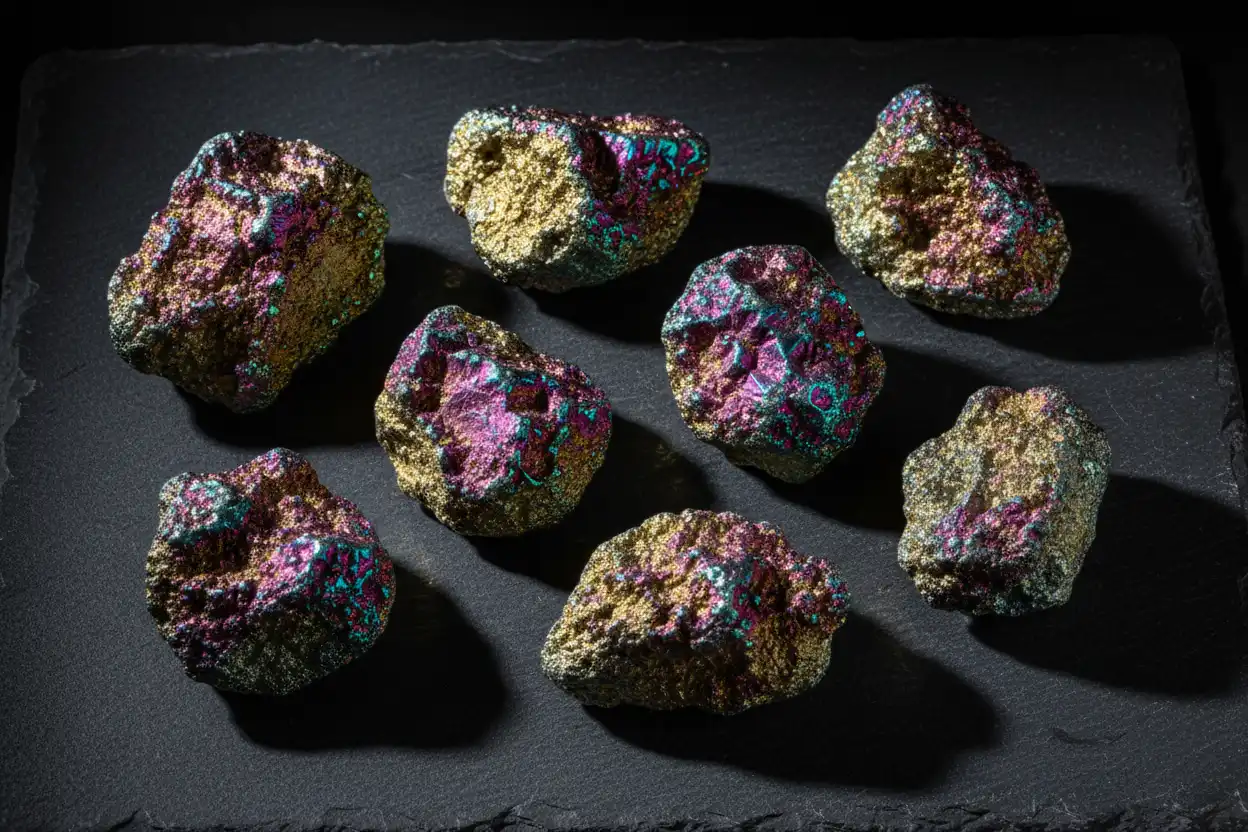
Chalcopyrite Meaning: Mineral Facts, History & Symbolism
Chalcopyrite meaning is commonly associated in modern crystal practice with confidence, resourcefulness, opportunity, perseverance, abundance, and recognizing value that may not be obvious at first glance. Those themes belong to symbolism rather than to measurable powers of the mineral. Materially, chalcopyrite is copper iron sulfide, CuFeS₂, an opaque metallic mineral and one of the world’s most important natural copper ores. Its fresh surface is typically brass yellow, which explains why it is sometimes confused with pyrite or even gold, while weathering and deliberate surface treatment can create purple, blue, bronze, green, and iridescent tarnish.
The mineral’s scientific identity is more informative than the common nickname “peacock ore.” Chalcopyrite is tetragonal, relatively soft for a metallic mineral at roughly Mohs 3.5–4, brittle rather than malleable, commonly has specific gravity around 4.1–4.3, and produces a dark greenish-black to black streak. It occurs across numerous ore-forming environments, particularly hydrothermal copper systems, porphyry deposits, volcanogenic massive sulfide deposits, skarns, veins, replacement bodies, and some magmatic sulfide assemblages.
Those properties create a useful evidence boundary. Fresh brass-yellow chalcopyrite is a physical material. Rainbow tarnish is a surface phenomenon. Its historical role as a copper ore is documented. Ideas about abundance, confidence, manifestation, or energetic activation are symbolic interpretations.
For other mineral-first references that make the same distinction, browse the Gemstone Guides.
What Is Chalcopyrite?
Chalcopyrite is a copper iron sulfide mineral with the ideal formula:
CuFeS₂
Copper and iron are essential structural components rather than incidental impurities. Sulfur completes the sulfide framework.
Chalcopyrite crystallizes in the tetragonal system, although its crystals can look deceptively cubic, tetrahedral, distorted, twinned, massive, granular, disseminated, or irregular. Many specimens occur as grains or masses within ore rather than as perfect collector crystals.
| Property | Typical chalcopyrite characteristics |
|---|---|
| Mineral species | Chalcopyrite |
| Chemical formula | CuFeS₂ |
| Mineral class | Sulfide |
| Crystal system | Tetragonal |
| Fresh color | Brass yellow to golden yellow |
| Tarnish | Bronze, purple, blue, green or multicolored |
| Transparency | Opaque |
| Luster | Metallic |
| Mohs hardness | About 3.5–4 |
| Specific gravity | Commonly about 4.1–4.3 |
| Streak | Greenish black to black |
| Cleavage | Poor or indistinct |
| Fracture | Uneven to locally conchoidal |
| Tenacity | Brittle |
| Common habit | Massive, granular, disseminated, compact or crystalline |
| Economic importance | Major copper ore |
| Frequent look-alikes | Pyrite, bornite, gold and other yellow metallic sulfides |
The formula is simple enough to remember, but natural specimens can contain trace substitutions and microscopic intergrowths with other sulfides. A bulk chemical reading may therefore reflect more than one mineral if the specimen is fine-grained.
Why Chalcopyrite Is Brass Yellow
Fresh chalcopyrite is typically a warm brass-yellow metallic color.
The appearance comes from the way its copper-iron-sulfur electronic structure reflects and absorbs visible light. Unlike transparent gemstones, where light enters the body and interacts extensively with internal crystal structure, chalcopyrite is opaque. Its metallic appearance is dominated by strong surface reflection and electronic absorption.
That is why the fresh color should be assessed on an untarnished surface when mineral identification matters.
An old specimen may look bronze, violet, blue, green, or almost black externally while a fresh chip exposes unmistakable brass-yellow material underneath.
The detailed relationship among fresh metallic color, surface alteration, reflected light, oxidation, and artificial iridescence belongs on the dedicated chalcopyrite optical properties and color behavior reference rather than being repeated throughout this meaning page.
Why Chalcopyrite Turns Purple, Blue, and Green
The rainbow colors commonly associated with chalcopyrite are usually surface tarnish.
When chalcopyrite reacts with oxygen, moisture, and other environmental agents, extremely thin alteration layers develop on the surface. Those films change how reflected light behaves and can produce bronze, violet, purple, blue, green, or multicolored appearances.
The underlying mineral has not become blue chalcopyrite in the same sense that sapphire can have blue body color.
A useful distinction is:
Fresh chalcopyrite color: brass yellow.
Tarnish color: a surface alteration effect.
This becomes particularly important in commercial specimens because vivid iridescence can be produced or intensified artificially.
Is Rainbow Chalcopyrite Natural?
Sometimes.
Natural weathering can create attractive iridescent tarnish on chalcopyrite. Similar colors can also develop on bornite and other copper sulfides.
However, extremely vivid “peacock ore” sold commercially may have been chemically treated to accelerate or exaggerate surface coloration.
The treatment can transform a plain brass-yellow specimen into a dramatic purple-blue-green display piece without changing the underlying bulk mineral.
A treated chalcopyrite remains chalcopyrite if the substrate is genuinely CuFeS₂.
Its surface appearance has been modified.
The treatment should therefore be understood as an appearance issue rather than a new mineral identity.
Chalcopyrite Is Not the Same as Peacock Ore
“Peacock ore” is a trade nickname, not a precise mineral species.
It is commonly applied to iridescent:
bornite;
chalcopyrite;
treated chalcopyrite;
mixed copper sulfides;
and occasionally specimens where the exact altered phase is not clearly established.
This makes the term unsuitable as the sole identification.
A seller can accurately describe a specimen as “peacock ore” in a decorative sense while still needing to identify whether the underlying mineral is bornite, chalcopyrite, or a mixture.
The visual nickname describes an effect.
Mineralogy identifies the material.
Chalcopyrite Versus Pyrite
Chalcopyrite is frequently called fool’s gold, but pyrite is the mineral more strongly associated with that nickname.
The two can look similar because both are opaque metallic sulfides with yellowish color.
Their diagnostic differences are substantial.
| Property | Chalcopyrite | Pyrite |
|---|---|---|
| Formula | CuFeS₂ | FeS₂ |
| Fresh color | Warm brass yellow | Paler brass to yellowish |
| Hardness | About 3.5–4 | About 6–6.5 |
| Streak | Greenish black to black | Greenish black to brownish black |
| Crystal system | Tetragonal | Cubic |
| Common crystal habit | Massive, distorted tetragonal forms, tetrahedral-looking forms | Cubes, pyritohedra, octahedral forms |
| Tenacity | Brittle | Brittle |
| Copper content | Essential | Not essential |
Hardness is especially useful.
A steel point can scratch chalcopyrite more readily than pyrite. Pyrite is hard enough to resist many ordinary metal tools.
Crystal habit also helps when well-developed forms survive.
Pyrite commonly forms true cubes.
Chalcopyrite can look approximately tetrahedral or distorted but is not a cubic mineral.
Chalcopyrite Versus Gold
The brass-yellow metallic appearance also creates occasional confusion with native gold.
Gold behaves very differently.
Gold is exceptionally dense, soft, malleable, and ductile. Under pressure it bends or deforms rather than shattering like a brittle sulfide.
Chalcopyrite is lighter, harder than gold, and brittle.
A practical comparison is:
gold can flatten or deform;
chalcopyrite tends to chip or fracture;
gold produces a yellow metallic streak;
chalcopyrite produces a much darker streak.
The distinction should still be made without damaging an important specimen.
Visual color alone is one of the weakest methods because lighting and tarnish can make chalcopyrite look impressively gold-like.
Chalcopyrite Versus Bornite
Bornite is another copper iron sulfide and one of the main reasons the term peacock ore becomes confusing.
Fresh bornite is typically more bronze to copper-brown than fresh chalcopyrite, but its surface commonly tarnishes rapidly into purple, blue, and iridescent colors.
Chalcopyrite begins more distinctly brass yellow.
Both minerals can occur together.
Weathering can further complicate the surface so that a specimen contains chalcopyrite, bornite, secondary copper minerals, and multiple alteration films in a very small area.
A strongly iridescent specimen should therefore not be classified from rainbow color alone.
When exact identity matters, microscopy, composition, and structural methods provide much stronger evidence.
Original Chalcopyrite Specimen and Photo Checklist
The following checklist provides a practical way to evaluate a suspected chalcopyrite specimen without assuming every golden or rainbow metallic mineral belongs to the species.
Find a fresh surface if one already exists
Examine a natural chip or broken edge.
Fresh chalcopyrite should generally look brass yellow beneath surface tarnish.
Do not deliberately damage a fine collector crystal simply to expose fresh material.
Examine the luster
Chalcopyrite should be opaque and metallic.
A transparent or translucent yellow crystal is not behaving like ordinary chalcopyrite.
Compare hardness cautiously
Chalcopyrite is relatively soft for a metallic sulfide at about Mohs 3.5–4.
Pyrite is significantly harder.
Avoid scratching a display-quality specimen when an expendable edge or existing damage can provide information.
Check the streak where appropriate
A dark greenish-black to black streak is compatible with chalcopyrite.
Use streak testing only on material where minor surface damage is acceptable.
Look at the crystal shape
Well-developed chalcopyrite can show distorted tetragonal, tetrahedral-looking, twinned, or irregular crystals.
A perfect striated cube strongly favors pyrite.
Examine tarnish distribution
Natural tarnish commonly follows exposed surfaces and weathered areas.
Extremely uniform intense rainbow color can deserve additional treatment investigation.
Inspect sheltered areas
Recesses, fresh chips, matrix contacts, or protected surfaces may retain more of the original brass-yellow color.
Look for multiple sulfides
Natural ore specimens frequently contain more than one metallic phase.
A specimen sold as chalcopyrite can legitimately contain pyrite, bornite, sphalerite, galena, or other minerals.
Compare the matrix
Quartz veins, sulfide-rich rock, altered volcanic material, skarn minerals, and hydrothermal assemblages can support geological plausibility.
Matrix is context, not proof.
Use magnification
Microscopy can reveal tarnish layers, crystal boundaries, intergrowths, fractures, inclusions, replacement textures, and multiple sulfide phases. The chalcopyrite microscope inclusion notebook develops those observations in more detail.
Watch for coatings
An applied chemical treatment can intensify iridescence.
Color limited to the outermost exposed surface is consistent with a surface process.
Do not identify “gold” from color alone
Test physical behavior, density, streak, hardness, and mineral context rather than trusting yellow metallic appearance.
Avoid acid experiments
Acids can alter sulfide surfaces, mobilize metal-bearing compounds, and destroy collector value.
Preserve old locality labels
Ore-deposit context can be important to mineral interpretation.
Keep symbolism outside diagnosis
Terms such as prosperity stone, abundance crystal, manifestation mineral, energy booster, or confidence stone provide no mineralogical evidence.
A Claim-versus-Evidence Guide to Chalcopyrite
| Claim | Evidence status | More accurate interpretation |
|---|---|---|
| Chalcopyrite is copper iron sulfide | Supported | Its ideal formula is CuFeS₂ |
| Chalcopyrite is a major copper ore | Supported | It is one of the most economically important copper minerals |
| Fresh chalcopyrite is brass yellow | Supported | Rainbow colors usually involve surface tarnish |
| Chalcopyrite is naturally blue throughout | Incorrect | Blue is generally a surface alteration appearance |
| Every rainbow chalcopyrite specimen is naturally tarnished | Unsupported | Artificial chemical treatment can intensify iridescence |
| Peacock ore is one precise mineral species | Incorrect | The nickname can refer to bornite, chalcopyrite, treated material or mixtures |
| Chalcopyrite is pyrite | Incorrect | Their chemistry, crystal structure and hardness differ |
| Chalcopyrite is gold | Incorrect | It is a brittle Cu-Fe sulfide rather than malleable native gold |
| Chalcopyrite commonly occurs in hydrothermal copper systems | Supported | It is widespread across numerous ore-forming environments |
| Chalcopyrite cannot tarnish | Incorrect | Surface oxidation and alteration are common |
| Chalcopyrite scientifically attracts wealth | Unsupported | Abundance is a symbolic association |
| Chalcopyrite improves confidence through mineral energy | Unsupported | Confidence is a modern interpretive theme |
| Chalcopyrite can replace financial planning | Incorrect | Symbolism cannot determine economic outcomes |
| Chalcopyrite cures disease | Unsupported medical claim | Mineral identity does not establish therapeutic efficacy |
| Copper in chalcopyrite becomes a nutritional benefit through touch | Unsupported | Structural copper sulfide is not a controlled dietary dose |
The distinction matters particularly when a commercial surface treatment is described as though it were a rare natural color variety.
How Chalcopyrite Forms
Chalcopyrite forms across an unusually broad range of ore-forming environments.
It is especially important in hydrothermal systems where hot, chemically active fluids transport copper, iron, sulfur, and other elements through fractures or permeable rock. As pressure, temperature, sulfur activity, fluid composition, oxidation state, or wall-rock chemistry changes, sulfide minerals can precipitate.
Chalcopyrite can form with:
pyrite;
bornite;
sphalerite;
galena;
molybdenite;
magnetite;
pyrrhotite;
quartz;
calcite;
chlorite;
and many other gangue or ore minerals.
The exact association depends strongly on deposit type.
The detailed relationships among porphyry systems, skarns, volcanogenic massive sulfides, hydrothermal veins, replacement deposits, and magmatic sulfide environments are covered in chalcopyrite formation and deposit geology.
Chalcopyrite in Porphyry Copper Deposits
Porphyry copper systems are among the most important geological environments for chalcopyrite.
These enormous hydrothermal systems develop around intrusive magmas and can distribute copper-bearing sulfides through very large volumes of fractured and altered rock.
Chalcopyrite may occur as:
disseminated grains;
veinlets;
fracture coatings;
grains with bornite;
grains with pyrite;
or part of broader alteration zones.
A specimen from such a system may look visually unimpressive compared with a polished collector crystal while representing economically important copper mineralization.
Mineralogical significance and specimen beauty are different value systems.
Chalcopyrite in Hydrothermal Veins
Hydrothermal veins form when mineral-bearing fluids move through fractures and precipitate minerals as conditions change.
Chalcopyrite can crystallize alongside quartz and other sulfides, producing attractive specimens where metallic brass-yellow crystals contrast against pale gangue.
Veins can record multiple mineralizing stages.
An early quartz generation may be cut by later sulfides, or chalcopyrite may itself be fractured and overgrown by younger minerals.
These relationships can provide more geological information than the isolated metallic crystal alone.
Chalcopyrite in Skarns
Skarns develop where chemically reactive fluids associated with intrusive activity interact strongly with carbonate-rich rocks.
The resulting mineral assemblages can include garnet, pyroxene, magnetite, calcite, and sulfides.
Copper-bearing skarns may contain significant chalcopyrite.
The mineral’s presence therefore does not tell you one formation environment by itself.
Chalcopyrite identity is a mineralogical question.
Deposit classification requires the larger rock and alteration context.
Chalcopyrite in Massive Sulfide Deposits
Volcanogenic massive sulfide systems can concentrate copper, zinc, lead, iron, sulfur, gold, silver, and other elements in sulfide-rich bodies associated with submarine hydrothermal activity.
Chalcopyrite may occur with pyrite, sphalerite, and other sulfides.
Fine-grained ore from such a setting can be difficult to interpret visually because individual minerals intergrow at small scales.
Bulk yellow metallic appearance may therefore conceal several sulfide phases.
Microscopy and chemical mapping become particularly valuable in those cases.
Why Chalcopyrite Is Economically Important
Chalcopyrite’s importance extends far beyond mineral collecting.
Its formula contains copper as an essential structural component, and large chalcopyrite-bearing ore deposits provide a major source of copper for industrial use.
Copper recovered from ores ultimately contributes to applications involving:
electrical conductors;
electronics;
motors;
generators;
plumbing;
construction;
heat exchange;
machinery;
and numerous alloys.
The industrial product is processed copper.
It is not equivalent to using a raw chalcopyrite crystal directly.
That distinction matters because a mineral can be economically essential without possessing a therapeutic or energetic effect in its natural specimen form.
Ore Grade Is Not the Same as Specimen Quality
A collector may value a bright, well-crystallized chalcopyrite cluster on quartz.
A mining operation evaluates something different.
Economic ore assessment can involve:
copper concentration;
tonnage;
mineral distribution;
metallurgy;
recovery characteristics;
contaminants;
deposit geometry;
and processing costs.
A visually beautiful specimen can contain little economically relevant copper in the context of an entire deposit.
Conversely, dull disseminated chalcopyrite throughout a massive ore body can be extremely important economically.
“High quality” therefore means different things in mineral collecting and mining.
What Happens When Chalcopyrite Weathers?
At or near Earth’s surface, sulfide minerals become exposed to oxygenated water and chemically different conditions from those under which they formed.
Chalcopyrite can oxidize and contribute copper, iron, sulfate, acidity, and secondary minerals to the weathering environment.
Copper released through alteration may later become incorporated into minerals such as:
malachite;
azurite;
chrysocolla;
brochantite;
covellite;
or other secondary copper phases depending on local chemistry.
The exact products vary.
A green coating on chalcopyrite is therefore not automatically one particular copper mineral.
Identification requires more than color.
Tarnish Is Not the Same as Deep Weathering
A thin iridescent tarnish layer represents relatively superficial surface alteration.
Deep weathering can chemically transform a much larger portion of the specimen.
The difference matters.
A polished or lightly oxidized chalcopyrite surface may still be overwhelmingly CuFeS₂ beneath a microscopic film.
A deeply altered specimen can contain significant secondary copper and iron minerals, porous replacement textures, and little pristine chalcopyrite near the surface.
Describing both merely as “rainbow chalcopyrite” hides meaningful geological differences.
Cutting and Polishing Chalcopyrite
Chalcopyrite can be polished for decorative objects or flat surfaces, but it is not a conventional transparent faceting gemstone.
Its metallic luster can create attractive polished sections, especially when the mineral occurs with contrasting ore phases.
Cutting decisions need to consider:
brittleness;
fractures;
multiple sulfide phases;
tarnish;
oxidation;
heat generation;
polish response;
and dust control.
A rare well-crystallized specimen may lose most of its collector value if cut merely to create a shiny surface.
The detailed lapidary boundary, including orientation, preparation, polishing behavior, and preservation decisions, belongs in chalcopyrite cutting, orientation and polish.
Chalcopyrite in Jewelry
Polished chalcopyrite occasionally appears in pendants, cabochons, beads, or novelty jewelry, but it has significant limitations for routine wear.
Its hardness around 3.5–4 means the surface scratches more readily than quartz-family gemstones.
The material is brittle.
Tarnish can change appearance.
Contact with moisture, skin products, household chemicals, and abrasion can alter the surface further.
A protective pendant or occasional-wear object is more realistic than an exposed everyday ring.
Mechanical and mounting considerations are addressed separately in chalcopyrite setting and wear engineering.
Why a Chalcopyrite Surface Changes During Wear
A polished metallic surface is highly dependent on the condition of its outermost layer.
Scratching creates fine lines that scatter light.
Oxidation changes chemistry at the surface.
Oils from handling can temporarily change apparent luster.
Cleaning products can accelerate alteration or strip some films while producing others.
A piece of jewelry can therefore become visually different without the bulk mineral having changed identity.
Anyone buying polished chalcopyrite for its specific rainbow appearance should expect surface condition to matter significantly over time.
Documented History of Chalcopyrite
Chalcopyrite has long been recognized as a copper-bearing mineral because copper can be extracted from chalcopyrite-rich ores.
Its name combines roots referring to copper and pyrite-like material, essentially identifying it as a copper-bearing pyrite-like mineral.
That name reflects visual and chemical relationships rather than spiritual symbolism.
Historical mining communities may have encountered chalcopyrite well before modern analytical mineralogy could distinguish sulfide species precisely, so older references to copper ore, yellow ore, pyrites, or related materials should not automatically be translated into the modern species name without context.
The strongest historical statement is therefore practical:
Chalcopyrite belongs to the long technological history of copper extraction.
That history is substantial without inventing a universal ancient metaphysical meaning.
Ancient Copper Use Does Not Prove Ancient Chalcopyrite Symbolism
Copper objects can demonstrate that people mined, smelted, traded, and worked copper-bearing resources.
They do not automatically prove that every source ore was chalcopyrite.
Copper can originate from multiple minerals and ore types.
Likewise, evidence that a community used copper does not prove it attributed today’s abundance, chakra, confidence, or manifestation meanings to chalcopyrite crystals.
To establish a specific ancient chalcopyrite tradition, the material itself would need to be identified and the symbolic interpretation supported by relevant archaeological or textual evidence.
Without that chain, the modern symbolism should be called modern.
Chalcopyrite Meaning in Modern Symbolism
Modern chalcopyrite meaning commonly emphasizes opportunity, abundance, confidence, persistence, creativity, and recognizing hidden value.
The visual source of that symbolism is easy to understand.
Fresh chalcopyrite resembles gold while also being a major copper ore. A comparatively ordinary-looking metallic mineral can therefore contain an element of enormous practical economic importance.
Its tarnish provides another metaphor. The same crystal can present brass yellow, bronze, violet, blue, or green appearances depending on surface condition.
Someone might interpret those properties as reminders to examine value beyond first impressions and to distinguish surface appearance from underlying structure.
The metaphor can be useful.
The mineral does not need to attract money physically.
Abundance as Symbolism, Not Financial Mechanism
Chalcopyrite is frequently marketed as an abundance or prosperity stone.
A grounded interpretation translates abundance into behavior rather than prediction.
For example, a person might use the specimen as a reminder to:
review available resources;
identify an overlooked skill;
examine unnecessary spending;
finish an income-producing task;
compare opportunities using evidence;
or improve one practical financial process.
These actions can affect outcomes.
Holding CuFeS₂ does not guarantee income, investment returns, business success, lottery winnings, or financial protection.
Symbolism and financial causation should not be confused.
Hidden Value as a Practical Metaphor
Chalcopyrite’s importance as an ore offers a particularly strong metaphor for hidden value.
A rough ore specimen may not resemble refined copper at all.
The economically useful metal is chemically bound within a sulfide mineral and requires extraction and processing before it becomes usable copper.
Applied symbolically, that can represent situations where value requires work before it becomes accessible.
A useful reflective question is:
Which resource do I possess that has value only if I actually process, practice, organize, or apply it?
That is a meaningful interpretation rooted in mineral economics.
It is not evidence of manifestation energy.
Tarnish and First Impressions
The rainbow surface of chalcopyrite also makes an effective metaphor for first impressions.
A purple-blue specimen may look like an entirely different substance until a fresh surface reveals brass-yellow chalcopyrite beneath it.
Someone can interpret that as a reminder to ask:
Am I evaluating only the surface?
What changed: the underlying structure or merely its exterior?
Which conclusion would change if I had a fresh reference point?
Is visual novelty being mistaken for fundamental difference?
The physical mineral provides the image.
The reasoning remains human.
Chalcopyrite and Confidence
Confidence symbolism is often attached to bright metallic stones.
A practical version avoids claiming that a mineral chemically changes self-esteem.
Instead, the stone can serve as a cue to perform behaviors associated with informed confidence:
verify the facts;
prepare before speaking;
acknowledge uncertainty;
make one defensible decision;
revise when evidence changes;
and avoid confusing certainty with competence.
That approach makes confidence a practice rather than an invisible energy transferred from a crystal.
Chalcopyrite and Chakra Associations
Modern metaphysical systems may connect chalcopyrite with the solar plexus chakra because of its yellow-gold appearance, while rainbow-tarnished pieces are sometimes associated with several chakras simultaneously.
These are spiritual interpretations.
Mineralogical instruments can measure:
metallic reflectance;
chemical composition;
crystal structure;
hardness;
density;
and surface alteration.
They cannot determine whether a chakra is open, blocked, activated, aligned, cleansed, or balanced.
A person can include chalcopyrite in private symbolic practice while keeping that framework distinct from mineral science.
Does Chalcopyrite Have Healing Properties?
Chalcopyrite should not be presented as a medical treatment.
Claims that it treats respiratory disease, inflammation, neurological conditions, metabolic problems, pain, infection, circulation disorders, fever, or other health concerns are not established by the mineral’s copper-iron sulfide composition.
Its measurable properties describe:
CuFeS₂ chemistry;
tetragonal structure;
metallic luster;
hardness;
density;
streak;
tarnish;
and geological formation.
Those facts do not demonstrate therapeutic effects through ordinary contact.
A specimen may still have personal or aesthetic value during reflection or meditation without replacing appropriate healthcare.
Copper and Iron in Chalcopyrite Are Not Supplements Through Touch
Copper and iron are biologically important elements in appropriate chemical forms and doses.
That does not mean chalcopyrite supplies beneficial copper or iron through ordinary skin contact.
The elements are chemically bound within a sulfide mineral.
Biological availability depends on:
chemical form;
solubility;
dose;
exposure route;
metabolism;
and individual health context.
A mineral formula explains composition.
It is not a nutritional label.
Grinding the mineral or attempting to consume it creates exposure rather than a controlled supplement.
Safe Ownership and Handling
An intact chalcopyrite specimen can generally be collected and displayed with sensible mineral-handling practices, but it should not be treated as food, medicine, or an ingredient for drinking water.
The larger safety concern appears when sulfide minerals are:
cut;
drilled;
ground;
sanded;
crushed;
heated;
or reacted with acids.
Those processes can create fine metal-bearing mineral dust, alter sulfide surfaces, or produce reactive residues.
Avoid deliberately creating dust in living spaces.
Use appropriate wet processing where technically suitable, local extraction, eye protection, and suitable respiratory controls for lapidary or mineral-processing work.
Do not lick, ingest, or intentionally inhale chalcopyrite particles.
Do Not Use Chalcopyrite in Drinking-Water Elixirs
Direct-water crystal elixirs are particularly unnecessary with a copper-iron sulfide.
The specimen may contain:
chalcopyrite;
other sulfides;
secondary copper minerals;
iron alteration products;
matrix material;
chemical treatment residues;
polishing compounds;
or adhesives.
Those components are not represented by a simplistic statement that the stone contains “beneficial copper and iron.”
If symbolic water rituals matter to someone, the mineral can remain physically separated from anything intended for consumption.
There is no mineralogical benefit to dissolving, soaking, or ingesting chalcopyrite.
Avoid Aggressive Acid Cleaning
Acid treatment can alter chalcopyrite.
It may strip tarnish, create new surface coloration, dissolve associated minerals, mobilize copper- and iron-bearing material, or permanently change specimen appearance.
This is especially important with rainbow commercial material because chemical exposure may be the reason the current color exists.
A collector should not assume that a cleaning technique suitable for quartz is suitable for sulfide ore.
Minor surface dirt can be less damaging than an uncontrolled chemical experiment.
Conserving Chalcopyrite Specimens
A significant specimen can preserve more information than metallic color alone.
Crystal form, tarnish, associated sulfides, quartz contacts, alteration rims, oxidation products, matrix, labels, and previous repairs can all contribute to its interpretation.
Before cleaning, polishing, or altering an important specimen, document:
fresh versus tarnished surfaces;
crystal dimensions;
fractures;
matrix contacts;
associated minerals;
secondary coatings;
existing repairs;
labels;
and provenance.
The chalcopyrite specimen conservation record provides a structured framework for tracking those details without destroying evidence through unnecessary restoration.
Tarnish Can Be Part of the Specimen’s History
Not every tarnished surface should be polished away.
Natural alteration may record the specimen’s environmental history.
Collector aesthetics also matter. Some people value fresh brass-yellow chalcopyrite; others prefer naturally developed iridescent surfaces.
Before mechanically polishing a specimen, ask whether the alteration is:
natural;
historically documented;
diagnostic;
aesthetically valued;
or concealing significant damage.
Once a tarnish layer has been removed, the original surface cannot simply be recreated as geological history.
Conservation and cosmetic improvement are not always the same goal.
Provenance and Locality Claims
Chalcopyrite is widespread, so geographic identification from appearance alone is particularly weak.
A brass-yellow mass on quartz can occur in many mining districts.
Even distinctive crystal habits may develop independently in more than one deposit.
Reliable locality evidence can include:
original mine labels;
dealer records;
collection cards;
field documentation;
specimen numbers;
acquisition history;
or traceable institutional records.
The chalcopyrite provenance disclosure checklist provides a structured way to separate documented origin from an appearance-based guess.
A famous mine name deserves stronger evidence when it materially increases price.
Chalcopyrite Versus Charoite
The neighboring charoite meaning reference concerns a purple silicate material with swirling fibrous textures rather than an opaque metallic sulfide.
The two are mineralogically unrelated.
Charoite is valued mainly as a polished ornamental stone.
Chalcopyrite is primarily a metallic copper ore and collector mineral.
Any superficial similarity created by purple surface tarnish disappears once luster, opacity, chemistry, hardness, structure, and formation are considered.
Purple color does not establish mineral relationship.
Chalcopyrite Versus Chalcedony
The preceding chalcedony meaning reference provides an even stronger contrast.
Chalcedony is microcrystalline silica, predominantly SiO₂, with nonmetallic waxy-to-vitreous luster and quartz-family hardness.
Chalcopyrite is CuFeS₂, opaque, metallic, significantly softer, and much denser.
The similarity lies almost entirely in the beginning of their names.
A polished gray chalcedony and a polished metallic chalcopyrite should never be classified together simply because both begin with “chalc-.”
Chalcopyrite Versus Chevron Amethyst
Chevron amethyst meaning concerns patterned purple quartz rather than metallic sulfide ore.
Amethyst transmits light, has Mohs hardness near 7, and owes its purple coloration to mechanisms within quartz.
Rainbow-tarnished chalcopyrite remains opaque and metallic.
The comparison is useful because digital crystal photography can make a purple surface look more similar across materials than it really is.
Transparency and luster separate them immediately.
Color Terminology Can Create False Similarity
The mapped chalcedony color meaning reference demonstrates how color terms can vary within a silica material while mineral identity remains rooted in structure and composition.
Chalcopyrite presents the complementary lesson.
One mineral can develop dramatically different surface colors through tarnish while its underlying CuFeS₂ identity remains unchanged.
“Purple,” “blue,” “gold,” and “green” therefore describe appearance.
They do not by themselves define species.
Laboratory Identification
Chalcopyrite is usually recognizable in ordinary ore specimens, but instrumental methods become useful when grains are microscopic, several sulfides are intergrown, or a commercially significant specimen requires confirmation.
Useful methods include:
Reflected-light microscopy. Opaque ore minerals are commonly examined in polished sections using reflected rather than transmitted light.
Raman spectroscopy. Suitable spectra can provide structural evidence distinguishing chalcopyrite from similar sulfides.
X-ray diffraction. Diffraction can confirm the tetragonal structure where sufficient material is available.
Electron-microprobe analysis. Quantitative elemental measurements can establish copper, iron, sulfur, substitutions, and fine intergrowths.
SEM-EDS. Scanning electron microscopy with elemental analysis can rapidly characterize small grains and alteration products.
X-ray fluorescence. XRF can establish bulk or localized elemental composition, though mixed minerals require careful interpretation.
The analytical technique should match the question.
Detecting copper and sulfur in a mixed ore does not automatically prove every yellow grain is chalcopyrite.
Microscopy Has a Different Role With Opaque Minerals
Transparent gemstone microscopy commonly examines inclusions inside the stone.
Chalcopyrite is opaque, so the approach changes.
Reflected-light and surface microscopy can reveal:
polishing relief;
grain boundaries;
tarnish;
replacement textures;
intergrowths;
fractures;
inclusions exposed at the surface;
and neighboring sulfides.
A polished ore section can show several minerals that look nearly identical to the unaided eye but reflect light differently under controlled microscopy.
This is why technical ore identification often relies on polished-section work rather than ordinary backlighting.
An Evidence Ladder for Chalcopyrite Claims
Different claims require different evidence.
Direct observation can document metallic luster, brass-yellow fresh color, tarnish, crystal habit, matrix, fractures, and condition.
Streak and hardness can help separate chalcopyrite from some look-alikes when non-destructive priorities allow testing.
Specific gravity can establish whether density is compatible with chalcopyrite.
Reflected-light microscopy can document ore textures, intergrowths, replacement relationships, and surface alteration.
Chemical analysis can demonstrate copper, iron, and sulfur while identifying substitutions and neighboring minerals.
Raman spectroscopy can provide stronger species-level structural evidence.
X-ray diffraction can confirm the tetragonal chalcopyrite structure.
Geological context can determine whether the occurrence fits porphyry, skarn, massive sulfide, vein, replacement, or magmatic mineralization.
Provenance documentation supports mine, district, collector, and ownership claims.
Historical evidence supports chalcopyrite’s genuine importance as copper ore without automatically validating modern metaphysical interpretations.
Modern symbolism includes abundance, opportunity, confidence, creativity, transformation, and chakra associations. These are human interpretations rather than intrinsic properties of CuFeS₂.
What Chalcopyrite Meaning Can Reliably Include
Chalcopyrite meaning becomes clearest when material facts, geological history, economic significance, and modern symbolism remain separate.
Materially, chalcopyrite is CuFeS₂, a tetragonal copper iron sulfide with opaque metallic luster, brass-yellow fresh color, hardness around 3.5–4, relatively high density, dark streak, brittle behavior, and a strong tendency to develop surface tarnish. Its rainbow appearance is commonly an alteration effect and can also be enhanced artificially, so “peacock ore” should not be treated as a precise mineral species.
Geologically, chalcopyrite is widespread in copper-bearing hydrothermal and ore-forming systems. It occurs in porphyry copper deposits, veins, skarns, massive sulfide deposits, replacement bodies, and other mineralized settings. Its importance as a major copper ore gives the mineral a substantial real-world story independent of crystal symbolism.
Historically, chalcopyrite belongs to the practical history of copper mining and metallurgy. Its name reflects its copper-bearing, pyrite-like appearance rather than an ancient spiritual classification. Evidence for copper use should not automatically be converted into evidence for a specific historical chalcopyrite ritual.
Symbolically, modern users may interpret chalcopyrite as representing abundance, resourcefulness, opportunity, confidence, or discovering value beneath an ordinary surface. Its ore role offers a particularly grounded metaphor: useful copper is present within the mineral, but extracting that value requires identification, processing, skill, and work.
That symbolism can remain personally meaningful without claiming that chalcopyrite attracts money, guarantees business success, treats illness, transfers useful copper or iron through the skin, or scientifically activates chakras.
Gems Lore explains its material-first approach on the About page. Health, metaphysical, safety, and informational limitations are set out in the Disclaimer, while factual corrections or supporting mineralogical evidence can be submitted through Contact.
Chalcopyrite does not need exaggerated promises to be remarkable. A brittle brass-yellow sulfide can concentrate economically essential copper, crystallize through complex hydrothermal systems, transform visually through microscopic surface films, intergrow with multiple ore minerals, and resemble both pyrite and gold while remaining chemically distinct from each. Chalcopyrite meaning is strongest when that real mineral and ore story comes first and symbolism remains the human interpretation inspired by it.