Coral Benefits: 9 Hidden Uses, Deep Symbolism & Verified Facts, Safe Limits
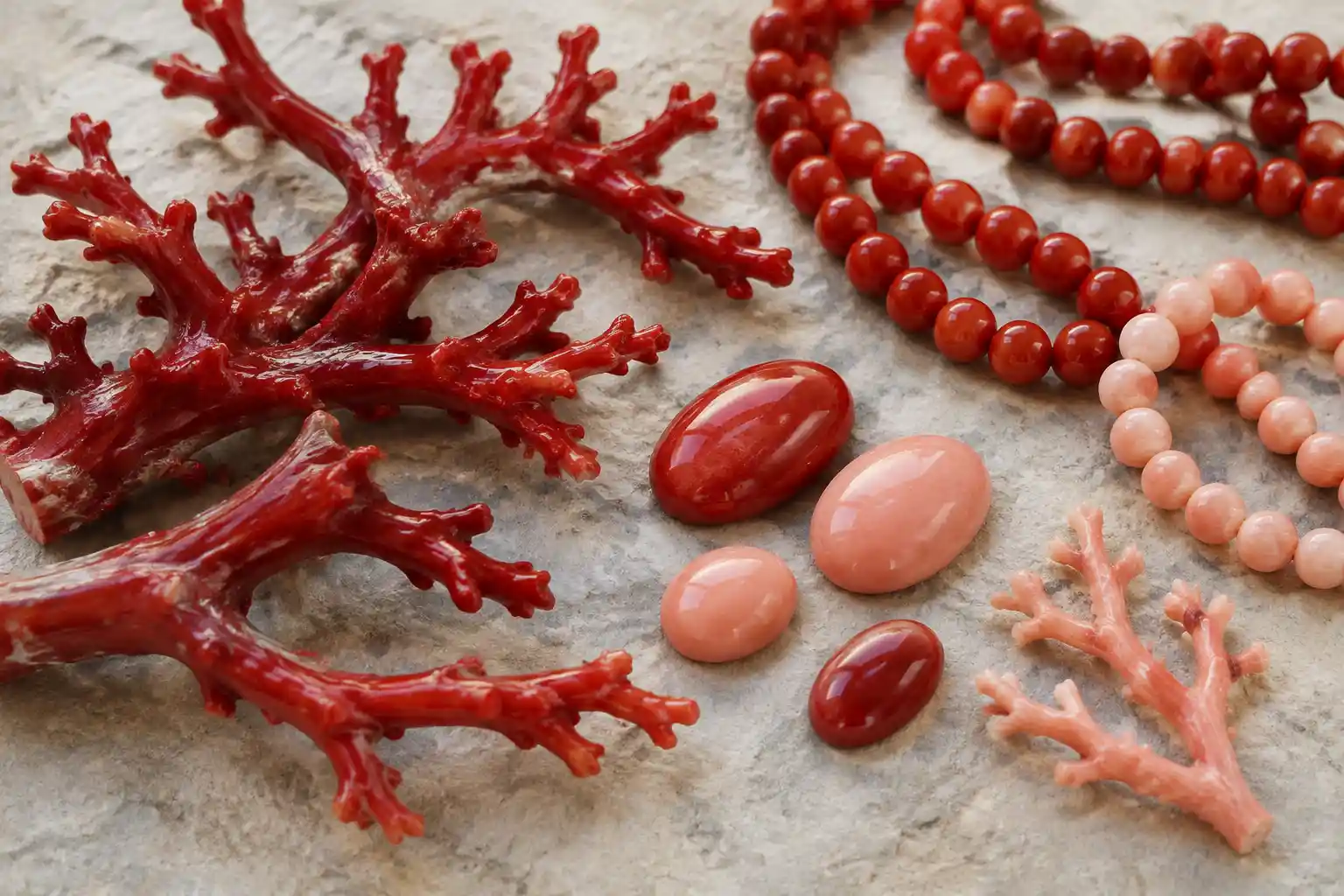
Coral benefits are unusual because coral is not a conventional mineral crystal. Corals are marine animals, and many jewelry-quality coral products are fashioned from hard skeletal structures produced by coral colonies. Precious red and pink coral has been valued for centuries for its warm color, smooth polish, carving potential, and ability to form beads, cabochons, cameos, small sculptural objects, and distinctive jewelry. The most familiar gem coral ranges from deep red and orange-red through salmon, pink, pale pink, and white, although the coral trade includes several biologically distinct groups whose structures, colors, conservation status, and legal requirements should not be treated as interchangeable.
Understanding this biological origin is central to real coral benefits. The polished gem may look stone-like, but its history begins in a living marine organism rather than in a crystal growing from magma, metamorphic rock, or a hydrothermal vein. Precious coral structures are largely calcium carbonate, relatively soft compared with quartz-family gemstones, and capable of taking a smooth polish that emphasizes rich color rather than facet brilliance. These characteristics made coral suitable for beads and detailed carving while also creating clear limits involving scratching, acids, heat, chemicals, and heavy everyday wear.
Coral has also accumulated extensive symbolism across Mediterranean, European, Asian, and other cultural settings, including associations with protection, vitality, family, status, devotion, and the sea. Those traditions are historically interesting, but symbolic coral benefits should remain separate from medical claims. Wearing coral does not treat anemia, cardiovascular disease, fertility problems, hormonal conditions, inflammation, anxiety, or other illnesses, and the calcium contained in coral structures does not become a dietary supplement through ordinary skin contact.
9 Coral Benefits at a Glance
- Rich red, pink, orange, and pale colors create a distinctive organic gem palette for jewelry.
- Fine-grained coral can be polished into beads, cabochons, cameos, carvings, and ornamental details.
- Centuries of jewelry and decorative use give coral substantial historical and cultural interest.
- Biological origin makes coral valuable for understanding the difference between organic gems and mineral gemstones.
- Natural growth structure, color, surface features, and treatments provide useful identification lessons.
- Antique and well-documented coral objects can preserve craftsmanship, provenance, and social history.
- Collectors can compare precious coral species, colors, growth structures, carving styles, and regional traditions.
- Historical and modern symbolism can represent protection, continuity, vitality, or connection with the sea without becoming medical fact.
- Responsible sourcing encourages buyers to consider species, provenance, conservation, legal trade, and long-term stewardship alongside appearance.
Jewelry and Carving Are Among the Most Practical Coral Benefits
The physical structure of precious coral has supported jewelry and carving traditions for a very long time. Rather than being faceted primarily for brilliance, coral is usually polished into smooth forms that emphasize color, shape, and craftsmanship. Beads are especially important because branches can be cut and shaped into rounded, barrel, oval, or irregular forms, while larger pieces may become cabochons, cameos, floral carvings, figures, or small ornamental objects. Fine polishing can create an attractive surface without hiding the organic growth characteristics that distinguish coral from glass or many mineral gems.
These coral benefits help explain why the gem has remained relevant even though it is relatively soft. Coral does not need diamond-like hardness or sparkle to succeed visually. A strand of evenly matched red beads can derive its beauty from color consistency, graduated size, polish, and craftsmanship, while a carved piece may be valued for the skill required to work around natural branch shape, internal structure, pits, or irregular growth. Jewelry design can also make use of coral’s warm color in combinations with yellow gold, high-karat gold, silver-colored metals, pearls, or contrasting dark gems. Because coral can scratch and abrade more easily than quartz or sapphire, earrings, brooches, pendants, and necklaces often provide safer long-term wear than highly exposed rings.
Coral’s Organic Origin Gives It Exceptional Gemological Interest
One of the most educational coral benefits comes from the fact that coral challenges the common assumption that every gem is a mineral. Pearls, amber, shell, jet, and coral demonstrate that jewelry can also be made from substances created directly or indirectly by living organisms. In the case of coral, the skeletal structure produced by colonies of marine animals becomes the part that is cut, polished, drilled, carved, and worn.
This biological origin creates important identification differences. Precious red and pink coral can show characteristic growth structures and fine surface features that are unlike ordinary crystalline gemstones. Different coral groups can also produce structurally different skeletal substances, so the trade name coral should not be treated as though it represents one single mineral species with one fixed composition. This complexity makes coral benefits especially valuable for gemology students because identification may involve microscopic structure, specific gravity, refractive behavior, surface texture, dye concentrations, polishing features, and knowledge of the biological source.
The distinction between living coral ecosystems and finished antique or jewelry coral also deserves respect. A polished bead is the processed skeletal portion of an organism that once formed part of a marine colony. Recognizing that origin makes conservation and responsible sourcing part of gemological understanding rather than an unrelated environmental issue.
Natural Color Gives Precious Coral a Distinctive Visual Identity
Color is one of the most recognizable coral benefits. Fine precious coral can range through intense red, orange-red, salmon, pink, pale pink, and nearly white tones, while other biologically distinct coral groups may produce black, golden, or differently structured products. In red and pink precious coral, color arises from natural organic pigments associated with the coral structure rather than the metallic trace-element mechanisms responsible for many mineral gemstones.
Color quality is not simply a question of choosing the darkest red. Different traditions and markets have valued different shades, and pale pink or evenly colored salmon coral can be highly attractive when the surface, polish, shape, and workmanship are strong. Matching is particularly important in necklaces and earrings because natural coral varies. Producing a visually consistent strand may require sorting many individual beads for size, hue, saturation, shape, and surface appearance.
Dyeing is also common enough that buyers should not assume every vivid red piece has natural color. Bleaching, impregnation, surface coating, reconstruction, and imitation products can complicate identification further. Anyone examining coral quality grading should therefore consider natural versus treated color, surface condition, polish, structure, workmanship, matching, species or type when known, and reliable disclosure rather than focusing on one visual feature.
Historical Jewelry Use Gives Coral Genuine Cultural Depth
Historical significance is one of the strongest coral benefits because precious coral has moved through Mediterranean trade networks and into European, North African, Middle Eastern, South Asian, and East Asian jewelry and decorative traditions for centuries. Red coral in particular acquired protective, religious, ornamental, medicinal, status-related, and amuletic associations in different periods, although those meanings varied considerably between societies.
This history should be treated with cultural precision. A protective belief documented in one region should not automatically be presented as a universal coral tradition. Likewise, historical medicinal uses tell us what people believed and practiced in earlier periods, not whether the treatment was biologically effective. The value of these traditions lies in what they reveal about commerce, symbolism, craftsmanship, family life, religious imagery, fashion, and the human desire to assign meaning to objects from the natural world.
Antique coral jewelry can preserve several layers of history simultaneously. The coral itself reflects marine biology, the carving or beadwork reflects craftsmanship, the mount records jewelry techniques, and provenance may connect the object with a family, region, trade route, or social tradition. These historical coral benefits can be far more interesting than reducing the gem to modern wellness claims.
Collecting Coral Requires Attention to Identity, Treatment, and Provenance
Collecting adds another dimension to coral benefits because natural coral products differ enormously in biological origin, color, internal structure, workmanship, age, and treatment. A collector may focus on antique Mediterranean red coral, carved ornaments, vintage beads, historic cameos, scientifically documented specimens, or examples that demonstrate how genuine coral differs from glass, plastic, dyed calcite, bone, shell, reconstructed products, or other substitutes.
Provenance matters more with coral than with many ordinary gems because biological identity and sourcing can carry conservation and legal implications. Some coral groups are subject to international or domestic trade controls, and regulations can depend on species, country, age, origin, and whether the object is antique, raw, or worked. A seller’s statement that a piece is simply natural coral may therefore be inadequate for an important purchase.
Someone preparing to buy coral benefits from asking what kind of coral is being sold, whether the color is natural, whether the piece has been dyed or reconstructed, whether the claimed origin is documented, and what information supports lawful trade. Good provenance increases understanding as well as buyer confidence because coral is a biological gem whose story begins long before it reaches a jeweler.
Coral Identification Builds Useful Skills Beyond Color Recognition
A red bead is not automatically precious coral. Glass, dyed shell, plastic, ceramic, bone, reconstructed coral, and other substitutes can imitate color effectively, particularly in online photographs. This makes identification one of the more practical coral benefits for anyone developing gemstone-buying skills.
Genuine precious coral may reveal fine growth-related structural features, characteristic surface textures, small natural imperfections, and internal patterns under magnification. Imitations can show molded surfaces, bubbles, obvious dye concentrations, seams, or structures inconsistent with coral, although no single visual clue should be treated as infallible. Well-made imitations and heavily processed products may require professional testing.
Price can provide context but not proof. An expensive red bead can still be misidentified, while an old piece bought cheaply may be genuine. The factors influencing coral price include color, size, shape, condition, treatment, matching, craftsmanship, biological type, provenance, scarcity, and market demand. Identification should therefore come before assumptions about value.
Symbolic Coral Benefits Reflect Life, Protection, and Continuity
Coral’s marine origin and branching structure have encouraged symbolism involving life, blood, vitality, protection, family, continuity, and the sea. Red coral in particular has carried protective and amuletic associations in several historical settings, while necklaces, carved ornaments, and inherited pieces can acquire family meaning independent of any formal spiritual system.
Modern symbolic coral benefits can be interpreted without claiming that the gem produces a physiological effect. A family necklace may represent continuity because several generations wore it. A coral carving may symbolize connection with the ocean because of its biological origin. A red bead may represent vitality simply because the color carries that association for the wearer.
These meanings become strongest when they remain specific. Coral does not need to be described as universally protective in every culture, and a historical tradition should not be converted automatically into proof that wearing coral prevents illness or misfortune. Symbolism records human interpretation, while medical and scientific questions require different kinds of evidence.
Responsible Sourcing Is an Essential Part of Modern Coral Benefits
The biological origin of coral creates responsibilities that do not arise in exactly the same way with a mined quartz crystal. Corals are animals, and many coral ecosystems are ecologically important and vulnerable to warming, pollution, habitat damage, destructive collection, and other pressures. Precious corals harvested for jewelry can also grow slowly and may be vulnerable when extraction exceeds sustainable levels.
Responsible purchasing therefore deserves a place among modern coral benefits. Buyers can prioritize reputable sellers who provide clear identification, provenance, treatment disclosure, and information supporting lawful sourcing. Antique, vintage, inherited, and previously owned coral may also appeal to people who want craftsmanship and historical context, although legal import or export requirements can still apply depending on the item and jurisdiction.
No single label such as natural, vintage, Mediterranean, or sustainable should replace documentation. Coral trade rules can vary by species and country, so important cross-border purchases deserve careful checking. The goal is not to treat all coral jewelry as identical, but to recognize that beauty, history, conservation, and lawful commerce are connected.
Safe Care Protects Coral from Scratches, Acids, Heat, and Chemicals
Coral is considerably softer than quartz-family gemstones and deserves gentle handling. Perfume, hairspray, cosmetics, household cleaners, acids, prolonged heat, and harsh polishing compounds can affect the surface or color, while harder jewelry can scratch coral during storage. Jewelry is best put on after cosmetics and fragrance have dried, then removed before bathing, swimming, strenuous work, or exposure to cleaning chemicals.
A soft slightly damp cloth is usually safer than aggressive cleaning. Steam and ultrasonic cleaners should be avoided because coral’s organic origin, porosity, treatments, drill holes, old stringing, or internal weaknesses can make aggressive cleaning risky. Antique pieces may require a professional conservator or jeweler familiar with coral rather than routine home treatment.
Beaded necklaces also deserve attention at the stringing points because repeated movement can wear thread over time. Periodic inspection protects both the coral and the entire piece. These care-focused coral benefits are simple but important: preserving surface quality, carving, matching, polish, and provenance allows well-made coral jewelry to remain meaningful for another generation.
Health Claims Should Not Be Confused with Coral’s Real Historical Value
Historical cultures sometimes attributed medicinal powers to coral, and modern wellness traditions may continue claims involving blood, bones, fertility, hormones, circulation, inflammation, emotional health, or protection from disease. Historical belief is worth documenting, but it does not establish clinical effectiveness.
Calcium carbonate within many coral skeletons does not turn a necklace or bead into calcium supplementation. Likewise, red coloration does not mean coral improves blood chemistry, and marine origin does not give the gem a medically useful oceanic energy.
The verified coral benefits are already substantial. Coral offers organic gemological interest, distinctive color, jewelry and carving potential, historical depth, collecting opportunities, identification lessons, symbolic value, and a reason to think carefully about conservation and provenance. None of these qualities requires a medical claim.
Conclusion
Coral benefits include rich natural color, carving and jewelry versatility, organic gemology, historical significance, collecting interest, identification practice, symbolic depth, heirloom potential, and responsible sourcing awareness. Coral’s origin in living marine colonies also makes it fundamentally different from conventional mineral gemstones and gives its use an ecological dimension that buyers should understand.
The strongest coral benefits come from appreciating genuine craftsmanship, biological origin, documented cultural history, treatment disclosure, provenance, and careful ownership. Symbolism involving protection, vitality, continuity, or the sea can add personal meaning, but health claims should remain separate from the real qualities that have made coral important for generations.
FAQs
What are the main coral benefits?
The most verifiable coral benefits include jewelry and carving use, distinctive natural color, historical significance, organic gemological study, collecting, identification practice, heirloom value, cultural symbolism, and responsible sourcing awareness. These qualities come from coral’s physical structure, biological origin, workmanship, and history rather than from medically established healing effects.
Is coral a gemstone or a mineral?
Coral is generally classified as an organic gem rather than a conventional mineral gemstone. The jewelry product comes from hard skeletal structures produced by marine coral organisms, and precious red and pink coral used in traditional jewelry is largely composed of calcium carbonate.
Is coral suitable for everyday jewelry?
Coral can be worn regularly in appropriately protected jewelry, but it is softer and more chemically sensitive than quartz, sapphire, or diamond. Earrings, necklaces, brooches, and protected pendants usually experience less abrasion than exposed rings, and gentle handling substantially extends the life of polished coral.
Can coral be dyed or treated?
Yes. Coral may be dyed, bleached, impregnated, reconstructed, coated, or otherwise processed, and imitation products can also resemble natural coral. Treatment disclosure and accurate identification are particularly important when natural color, provenance, or value influence the purchase.
Why is red coral historically important?
Red coral has circulated through major trade networks for centuries and has been used for jewelry, carved objects, amulets, religious objects, and other ornaments. Protective, devotional, status-related, and medicinal symbolism occurred in different cultural settings, although those beliefs should not be treated as universal.
Is buying coral legal?
Legality depends on the type of coral, species, origin, destination, age of the object, and applicable national or international rules. Buyers making significant or cross-border purchases should verify species information, provenance, documentation, and current legal requirements rather than relying on a generic natural coral label.
How should coral jewelry be cleaned?
Gentle cleaning is safest. A soft slightly damp cloth is preferable for routine care, while harsh chemicals, acids, steam, ultrasonic cleaners, excessive heat, and abrasive polishing should be avoided. Antique, repaired, dyed, or unusually valuable pieces may deserve professional care.
Does coral provide calcium to the body?
No. Wearing calcium-carbonate coral does not provide nutritional calcium or function as treatment for bone, mineral, or dietary deficiencies. Chemical composition inside an organic gem is not equivalent to ingesting an appropriate nutrient.
Does coral have healing benefits?
There is no established clinical evidence that wearing coral treats anemia, fertility problems, cardiovascular disease, anxiety, hormonal conditions, inflammation, bone disease, or other medical concerns. Historical and modern healing associations should be understood as cultural or spiritual beliefs.
Coral benefits described as healing, protective, hormonal, fertility-related, emotional, or energetic effects remain spiritual and cultural beliefs and should not replace qualified medical or mental-health care.