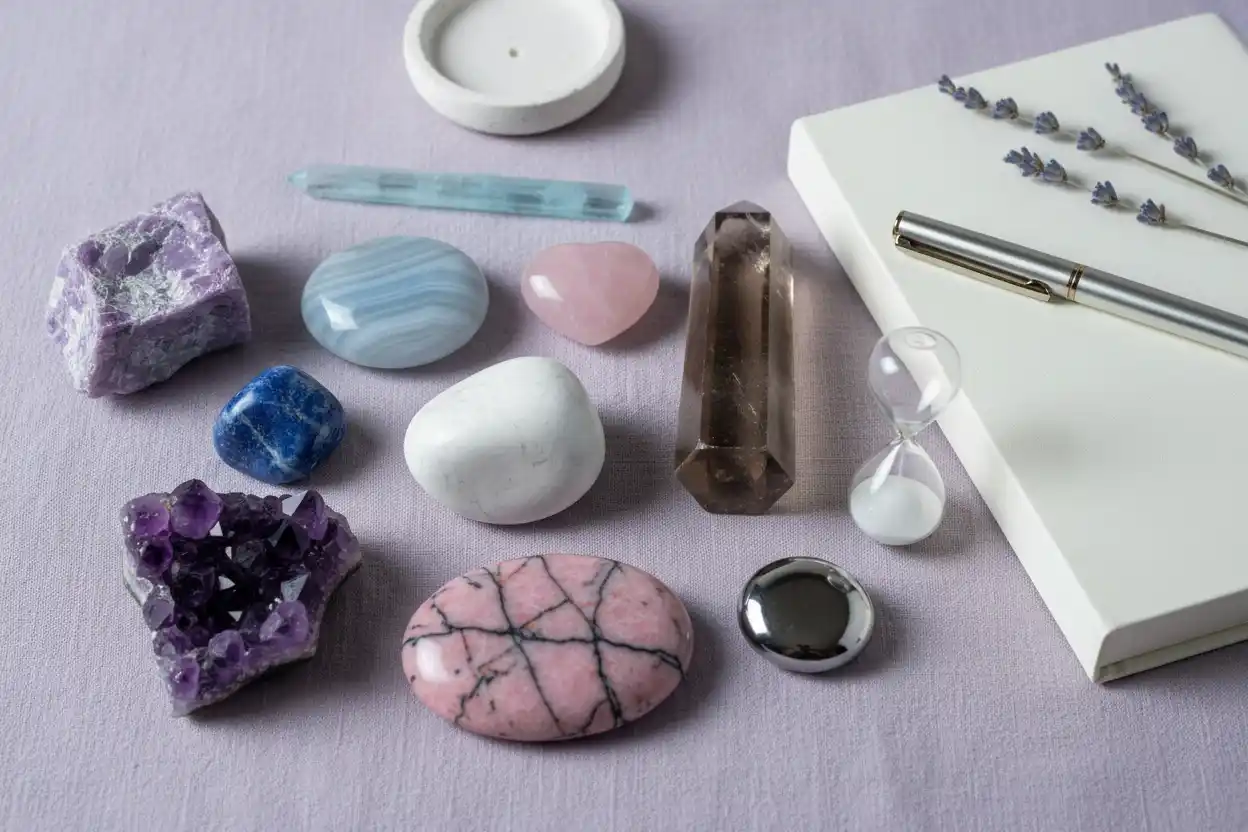
7 Inspiring Crystals for Anger: Positive Meanings & Smart Everyday Uses
Crystals for anger can work as physical reminders to pause, lower the intensity of a reaction, organize thoughts, and choose a more deliberate response, but they do not medically treat anger, aggression, trauma, anxiety, or another mental health condition. Their most practical role is behavioral: connect one stone with an action such as stepping away from an argument, slowing your breathing, writing down what happened, checking an assumption, or postponing a difficult conversation until you can speak more constructively.
Amethyst, howlite, blue lace agate, smoky quartz, rose quartz, lepidolite, and black tourmaline are commonly associated with calm, perspective, communication, patience, compassion, transition, and boundaries. Rather than expecting a crystal to remove anger, use its traditional meaning as a cue to notice what the emotion is signaling and decide what response best protects both your needs and the people around you.
Amethyst for Pausing Before an Angry Reaction Becomes an Action
Amethyst is purple quartz with Mohs hardness 7, making it durable enough for jewelry, pocket stones, and desk use. Its long-standing symbolism often centers on restraint, reflection, composure, and deliberate choices, which makes it a natural fit for routines built around creating space between feeling angry and acting on that feeling.
The traditions surrounding amethyst healing properties become more useful when translated into a specific habit. If you feel tension rising during a disagreement, an amethyst ring or pocket stone can become a reminder to stop talking for a moment, unclench your hands, lower your voice, and decide whether the conversation should continue immediately.
That pause matters because anger itself is not automatically a problem. It can point toward unfair treatment, crossed boundaries, frustration, fear, exhaustion, or another unmet need. The difficulty comes when intensity turns into insults, threats, reckless choices, or physical aggression.
Amethyst cannot regulate the nervous system by itself, but a repeated association between the stone and a chosen response can make the object useful as a cue within a larger self-management routine.
Howlite for Patience When Irritation Builds Slowly
Howlite is usually white or pale gray with gray or black veining. It is softer than quartz and is often carved into beads, palm stones, and small decorative objects. Its visual simplicity has contributed to traditional associations with patience, quiet reflection, and slowing impulsive responses.
The themes connected with howlite healing properties work especially well for irritability that builds across a day rather than appearing in one dramatic moment. A howlite stone on a desk can represent checking basic conditions before assuming another person is entirely responsible for your mood.
Poor sleep, hunger, pain, overstimulation, repeated interruptions, workload, and accumulated stress can all reduce patience. Recognizing those influences does not excuse harmful behavior, but it can reveal practical changes that reduce unnecessary conflict.
Howlite can also fit a short end-of-day review. Instead of replaying an argument repeatedly, write down what triggered the irritation, what you did, what worked, and what you would change next time. That process turns an emotional event into information you can use.
Because howlite scratches more easily than quartz, carry it separately from keys or harder stones.
Blue Lace Agate for Slower Speech and More Constructive Communication
Blue lace agate is pale blue chalcedony with delicate white, blue, or gray bands. Its gentle appearance has made it one of the stones most strongly associated with thoughtful speech, listening, and calm communication.
Traditional blue lace agate healing properties can be translated into a simple anger-management principle: communicate the problem more accurately rather than increasing the volume.
When anger is high, people often shift from describing one event to using absolute language such as always, never, everyone, or nothing. A blue lace agate bracelet or stone can become a cue to replace those generalizations with a specific statement about what happened and what needs to change.
For example, identifying a missed commitment is usually more constructive than attacking someone’s character. Saying that you need ten minutes before continuing a discussion is more useful than staying in the conversation until both people become more reactive.
Blue lace agate belongs to the quartz family, giving it useful durability for jewelry and frequent handling. It still deserves normal protection from sharp impacts and harder gems.
Smoky Quartz for Grounding Attention in What Is Actually Happening
Smoky quartz ranges from pale gray-brown to deep nearly black and belongs to the quartz family. Traditional symbolism frequently connects it with grounding, practical thinking, and returning attention to immediate reality.
The themes around smoky quartz healing properties can be particularly useful when anger becomes mixed with predictions, assumptions, or memories of previous conflicts. A smoky quartz stone can serve as a prompt to ask three practical questions: What happened just now? What am I assuming? What needs to happen next?
That distinction can reduce unnecessary escalation. A delayed reply, for example, is a fact. Deciding that the delay proves disrespect may be an interpretation. Separating observation from interpretation does not mean ignoring genuine problems. It makes the conversation more precise.
Smoky quartz can also be used during a physical reset. Place the stone on a desk while taking several minutes away from an argument, getting water, walking in a safe place, or writing down your next response before speaking.
The goal is not to suppress anger. It is to reduce the chance that a temporary surge of emotion controls the next action.
Rose Quartz for Combining Self-Respect With Compassion
Rose quartz is pale to medium pink quartz traditionally associated with compassion, affection, and emotional gentleness. Those associations can sound unrelated to anger until self-compassion and boundaries are considered together.
The traditions surrounding rose quartz healing properties can support a useful reminder: responding compassionately does not require accepting disrespect, and setting a boundary does not require humiliating another person.
Anger sometimes becomes more intense when someone believes the only options are submission or confrontation. A more useful middle position might involve stating what is unacceptable, explaining what you will do if it continues, and ending the discussion if it becomes abusive.
Rose quartz can also be used after an angry episode when shame begins to replace the original emotion. Accountability is important, but repeatedly attacking yourself can interfere with learning from what happened. A better response is to acknowledge any harm, repair what can be repaired, and identify the behavior you want to change.
This stone is durable enough for many jewelry styles, although heavily fractured pieces should still be protected from sharp impact.
Lepidolite for Anger Connected With Stress and Difficult Transitions
Lepidolite is a lithium-bearing mica commonly found in lavender, lilac, pink-purple, or gray-violet shades. Its layered structure often creates a soft sparkling appearance, and traditional symbolism connects it with patience, transition, and adapting gradually to change.
The themes within lepidolite healing properties can fit situations where anger is partly driven by change that feels unwanted or uncontrollable. Moving, relationship changes, work uncertainty, financial pressure, family responsibilities, and disrupted routines can all create irritability even when no single event seems large enough to explain it.
A lepidolite stone near a journal can symbolize separating what can be changed from what currently has to be managed. That distinction can prevent energy from being spent repeatedly fighting circumstances that are not immediately controllable.
Lepidolite contains lithium within its crystal chemistry, but ordinary handling does not deliver a therapeutic lithium dose. It should never be presented as a substitute for prescribed medication or mental health treatment.
Because mica splits readily along layers, lepidolite is better suited to protected use than rough pocket carrying with harder objects.
Black Tourmaline for Boundaries When Anger Comes From Repeated Pressure
Black tourmaline is commonly associated with grounding, protection symbolism, and personal boundaries. The black variety most often encountered is schorl, which can form elongated striated crystals or polished stones.
Traditional black tourmaline healing properties can be used practically when anger repeatedly arises around the same person, environment, or demand. Instead of expecting the stone to protect you, use it as a cue to identify what boundary is missing.
That might involve declining unnecessary contact, setting limits around work hours, leaving a conversation when insults begin, asking for responsibilities to be shared more fairly, or reducing exposure to situations that repeatedly provoke unsafe behavior.
Boundaries work best when they describe your own actions rather than trying to control another person. Saying that you will end a call if shouting continues is clearer than demanding that someone never feel angry.
Black tourmaline is reasonably durable but can contain fractures and brittle crystal edges. Polished pieces are usually more comfortable for frequent handling than sharp raw specimens.
Anger Is Information, but Aggressive Behavior Still Needs Limits
Anger can signal injustice, disappointment, fear, exhaustion, betrayal, or crossed boundaries. Trying to eliminate every feeling of anger is neither realistic nor necessary. The more useful goal is learning how to notice the emotion early enough that you still have options.
The traditions around crystals for communication can complement this approach by making a stone part of a communication routine. Pause, identify the issue, decide what you need, and communicate it without threats or personal attacks.
Physical movement can also help some people lower arousal when it is done safely. Walking away from the immediate conflict, stretching, or taking a brief period alone may create enough distance to think more clearly. Alcohol or other substances should not be used as anger-management tools because they can reduce judgment and increase impulsivity.
If anger regularly leads to intimidation, property damage, threats, violence, self-harm, or fear within relationships, professional help becomes much more important than crystal symbolism.
A Simple Crystal Routine for Anger Should Lead to a Real Action
Choose one stone rather than carrying a complicated collection. Assign it one function that is easy to remember. Amethyst can mean pause. Blue lace agate can mean speak more slowly. Smoky quartz can mean check the facts. Rose quartz can mean combine compassion with boundaries.
When you notice the stone during a tense moment, follow it with an actual behavior. Put the phone down before sending an angry message. Leave the room if the situation is safe to exit. Write your response before speaking. Drink water. Contact someone you trust. Use a coping strategy learned through counseling.
The traditions around crystals for inner peace are most useful when peace is understood as a practice rather than something a stone creates automatically.
No crystal needs to be placed on the body, soaked in water, or used in an elaborate cleansing ritual to serve as a reminder. A small stone on a desk or a simple piece of jewelry is enough.
Conclusion
The most useful crystals for anger are not substitutes for emotional skills. Amethyst, howlite, blue lace agate, smoky quartz, rose quartz, lepidolite, and black tourmaline can represent pausing, patience, clear communication, factual thinking, compassion, adaptability, and boundaries. Their value comes from connecting those meanings with concrete behaviors that reduce escalation and make difficult conversations safer and more constructive.
FAQs
Which crystal is traditionally associated with calming anger?
Amethyst, howlite, blue lace agate, and smoky quartz are commonly associated with calm, patience, and reflective responses in crystal traditions.
Can amethyst stop angry feelings?
No. Amethyst does not directly stop anger. It can be used as a reminder to pause and choose a more deliberate response.
Is howlite useful when I become irritated easily?
Howlite is traditionally linked with patience. Practically, it can serve as a cue to check stress, sleep, hunger, overstimulation, and other factors that may be increasing irritability.
Which crystal is associated with calmer communication?
Blue lace agate is commonly connected with thoughtful speech and listening traditions.
Can black tourmaline protect me from another person’s anger?
No stone can control another person’s behavior. Black tourmaline can instead symbolize maintaining boundaries and leaving unsafe situations when possible.
Can crystals replace anger-management therapy?
No. Counseling or other professional support can be important when anger is frequent, difficult to control, damaging relationships, or leading to aggression.
Should I suppress anger to stay calm?
No. Anger can carry useful information. The goal is to express and manage it without harmful or unsafe behavior.
What should I do if anger feels physically dangerous?
Create distance if you can do so safely and seek immediate help when there is a risk of violence, self-harm, or harm to someone else.
Crystal meanings and emotional associations are traditional or personal practices, not established mental health treatments.