9 Best Crystals for Children: Positive Meanings & Powerful Everyday Uses
Crystals for children are safest and most useful when treated as interesting rocks, geology objects, decorative keepsakes, or symbolic prompts for habits such as patience, kindness, confidence, curiosity, and thoughtful communication. They should not be presented as treatments for anxiety, ADHD, sleep problems, illness, behavioral difficulties, or other health concerns. Children benefit far more from supportive adults, appropriate routines, education, play, medical care when needed, and developmentally suitable coping skills.
Rose quartz, amethyst, clear quartz, howlite, blue lace agate, green aventurine, tiger’s eye, moonstone, and carnelian are popular choices because polished examples can be visually engaging and their traditional meanings lend themselves to simple positive themes. Safety matters more than symbolism, however. Small stones can become choking hazards, sharp crystals can cut skin, broken pieces can create dangerous edges, and some minerals are unsuitable for unsupervised handling. For younger children, crystal collections should remain under adult control rather than being treated like ordinary toys.
Rose Quartz for Kindness, Friendship, and Simple Gratitude Routines
Rose quartz is pale to medium pink quartz and has Mohs hardness 7, making sound polished pieces reasonably durable. Its gentle color and smooth finish have made it one of the most familiar stones associated with affection and kindness.
Traditional rose quartz healing properties often focus on compassion, friendship, and emotional warmth. With children, those ideas are most useful when connected with real behavior rather than claims that the crystal changes emotions.
A large polished rose quartz stone on a family desk might become a prompt for a short gratitude routine. A child could name someone who helped them, something kind they noticed, or one kind action they want to take.
The stone does not create kindness. The conversation, example set by adults, and repeated practice are what matter.
Rose quartz should be large enough that it cannot be easily swallowed when used around younger children, and adults should inspect it occasionally for chips or fractures. Loose stones do not belong in beds, cribs, or places where a young child may handle them without supervision.
Amethyst for Quiet Reflection and Slowing Down Before Reacting
Amethyst is purple quartz with the same useful hardness as other quartz varieties. It can occur as smooth polished stones, crystal points, geodes, and clusters, although polished pieces are generally safer for children than sharp crystal formations.
Traditional amethyst healing properties commonly emphasize reflection, calm routines, and thoughtful choices. A child can use a large smooth amethyst as a simple pause object when they need a moment before responding to frustration.
For example, an adult might encourage a child to hold the stone, take a few slow breaths, and explain what happened in their own words. The calming part comes from the pause, supportive interaction, and breathing rather than from a proven effect of the crystal.
Amethyst should not be described as treating anxiety, sleep disorders, emotional dysregulation, or another condition. Persistent distress, major behavior changes, or difficulties affecting school and family life deserve appropriate professional attention.
Crystal clusters can have sharp points and should be displayed rather than given to young children for unsupervised play.
Clear Quartz for Curiosity, Observation, and Simple Goal Setting
Clear quartz can be especially engaging for children because transparent specimens reveal fractures, inclusions, crystal faces, and light effects that encourage observation. It can therefore serve as both a geology specimen and a symbolic object.
Traditional clear quartz healing properties often center on clarity and intention. For children, a practical interpretation is to connect a polished quartz stone with one simple, age-appropriate goal.
That goal might be packing a school bag the night before, practicing a musical instrument, reading for a set period, remembering to put toys away, or working on one classroom habit.
The stone does not improve memory or academic ability. It acts as a visual cue for the goal.
Quartz points should be chosen carefully because natural terminations can be sharp. Large rounded pieces or polished palm stones are safer options for supervised handling.
Howlite and Blue Lace Agate for Patience and Thoughtful Communication
Howlite is usually white or pale gray with darker veining. It is relatively soft and commonly carved into smooth beads and polished stones. Traditional symbolism emphasizes patience and taking time before reacting.
The ideas connected with howlite healing properties can support a simple family routine around waiting, turn-taking, or talking through frustration. A howlite stone might represent the reminder, “stop, explain, then solve.”
This should not become a punishment object or something a child is forced to hold when upset. The goal is to create a familiar cue that supports communication, not to make the stone responsible for behavior.
Blue lace agate is pale blue chalcedony with delicate white or blue banding. Traditional blue lace agate healing properties often emphasize gentle communication and listening.
A larger polished piece can be used during a family conversation where each person gets time to speak. An adult might place the stone in the center as a visual reminder to listen before answering.
Both stones should be checked for chips, and small beads need particular caution around young children because beads are easy to place in the mouth.
Green Aventurine and Tiger’s Eye for Confidence, Practice, and Trying Again
Green aventurine is a quartz variety with soft green color and sometimes a subtle sparkling appearance. Traditional symbolism commonly connects it with optimism, opportunity, and trying new things.
The traditions surrounding green aventurine healing properties can be framed for children as encouragement to practice rather than a promise of good luck. A stone might represent trying a new activity, asking a question in class, or continuing after a mistake.
This is particularly useful when adults reinforce the idea that confidence can grow through preparation and repetition. The crystal simply makes that message visible.
Tiger’s eye has golden-brown bands and a moving reflective stripe called chatoyancy. Its optical effect can also make it an interesting geology object because children can observe how the bright band shifts when the stone is tilted.
Traditional Tiger’s Eye healing properties commonly emphasize confidence, observation, and thoughtful decisions. A polished stone can therefore represent looking carefully before acting or trying again after an error.
Both are quartz-family stones with useful durability, but they should still be appropriately sized and supervised for younger children.
Moonstone and Carnelian for Change, Creativity, and Personal Expression
Moonstone is a feldspar gem known for a floating glow called adularescence. White, cream, peach, gray, and related colors are common, and the effect can move across the stone as it turns.
Traditional moonstone healing properties often focus on cycles, transitions, and adapting to change. These themes can be useful for children dealing with ordinary transitions such as a new class, new home, changing routines, or a new activity.
A moonstone can symbolize the simple idea that unfamiliar situations often become easier with time and experience. It does not prevent distress or treat adjustment difficulties.
Moonstone is softer than quartz and has cleavage, so it needs more protection from drops and impact. A parent-controlled keepsake or supervised polished stone is often more practical than rough play.
Carnelian brings warm orange to reddish color and belongs to the chalcedony family. Traditional carnelian healing properties often center on creativity, motivation, and confidence.
For children, a carnelian stone can sit near art supplies, building toys, or a writing area as a playful symbol for starting a creative project. The creative result still comes from imagination, practice, curiosity, and access to suitable activities.
Crystal Safety for Children Matters More Than Traditional Meaning
Small stones, beads, polished chips, and broken crystal fragments can be choking hazards, particularly for infants and young children who explore objects by putting them in their mouths. Stones used around younger children should remain under direct adult control, and small pieces should be kept out of reach.
Large size alone does not solve every risk. Raw crystals can have sharp points, while dropped stones may fracture into smaller pieces with cutting edges. Adults should inspect crystals periodically and remove damaged pieces from child-accessible areas.
Necklaces, bracelets, cords, and strings also need caution. Jewelry can catch on playground equipment, furniture, sports gear, or other objects. Children should not sleep with crystal necklaces or other items around the neck.
Crystals should never be placed in a child’s mouth, used as teething objects, ground into powders, or added to drinking water. Unknown treatments, coatings, adhesives, contaminants, and mineral composition can create unnecessary risks.
Adult supervision should reflect the child’s age, development, behavior, and tendency to mouth or throw objects rather than assuming one rule fits every child.
Avoid Using Crystals as Treatments for Children’s Health or Development
A crystal should not replace medical assessment, therapy, educational support, medication, or another recommended intervention. Claims that a particular stone treats ADHD, autism, anxiety, seizures, sleep disorders, infections, pain, or developmental problems are not supported by established clinical evidence.
The traditions around crystals for students can still provide positive symbolic ideas when they are framed around study habits, curiosity, preparation, and confidence rather than claims of improved brain function.
If a child struggles with persistent anxiety, sleep problems, concentration, behavior, pain, appetite, mood, or developmental milestones, caregivers should seek advice from qualified professionals rather than experimenting with crystal treatments.
It is also important not to tell children that a stone failed because they did not believe strongly enough. That can place unnecessary responsibility on a child for outcomes they cannot control.
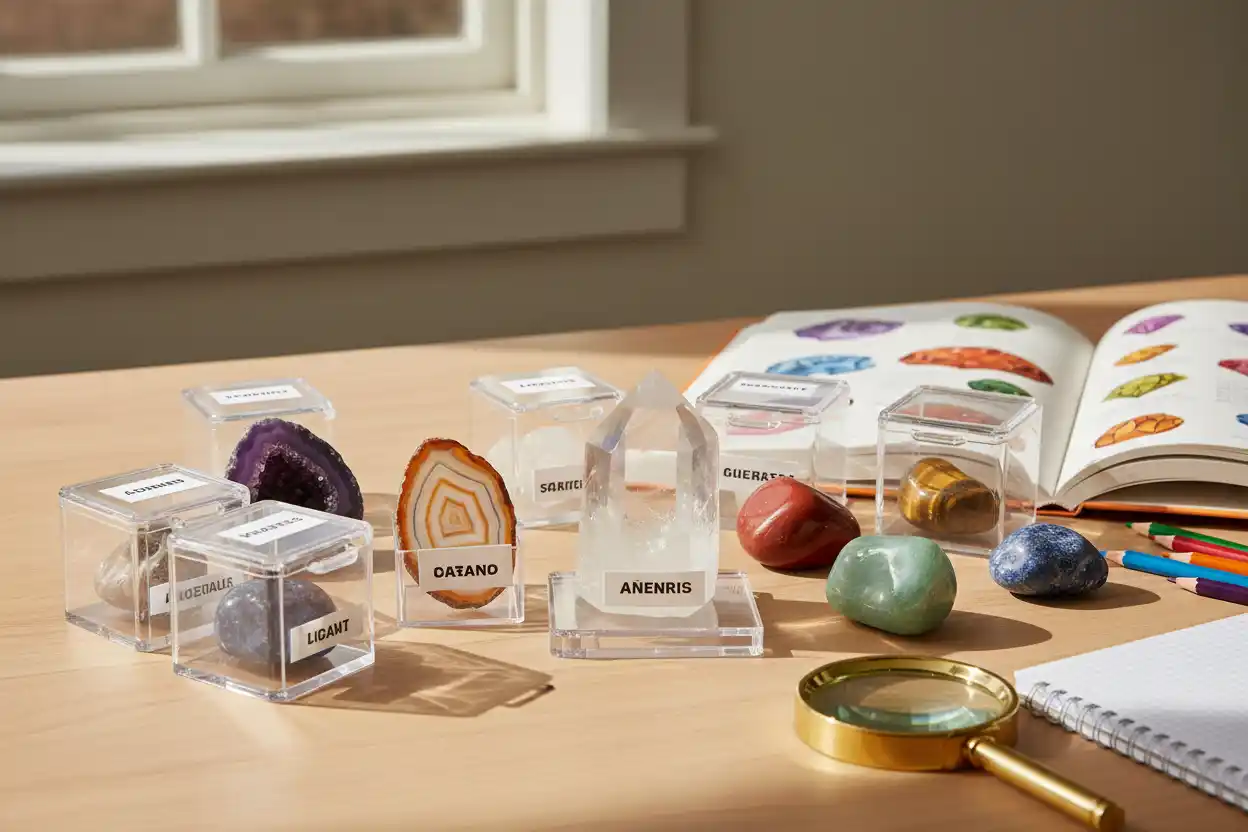
Turn a Crystal Collection Into a Safe Geology and Observation Activity
Crystals can be educational even without spiritual symbolism. Children can compare color, transparency, luster, banding, inclusions, crystal shape, and relative hardness under adult supervision.
Clear quartz can show internal fractures, tiger’s eye demonstrates chatoyancy, moonstone displays adularescence, and blue lace agate reveals banding. These visible characteristics provide real observations that can encourage interest in geology and earth science.
A child can also draw the stones, sort them by color, photograph them, or keep a simple collection journal. Adults can help record the mineral name and where it was obtained.
This approach allows symbolic meanings to coexist with accurate scientific learning. A child can enjoy the idea that rose quartz represents kindness while also learning that it is a variety of quartz.
Choosing Child-Friendly Crystals by Size, Surface, and Durability
For supervised handling, choose large smooth pieces without sharp points, unstable coatings, loose fragments, or obvious cracks. Quartz-family stones such as rose quartz, amethyst, clear quartz, green aventurine, tiger’s eye, and carnelian provide useful scratch resistance.
Howlite is softer but can still work as a protected polished piece. Moonstone requires more care because of cleavage.
The crystal hardness chart can help adults understand why some stones scratch or chip much more easily than others, but hardness does not determine whether an object is developmentally safe for a particular child.
Storage should also be controlled. A closed display box, high shelf, or supervised collection tray is preferable when younger siblings or pets could gain access to small stones.
Conclusion
The best crystals for children are simple, safe, supervised objects connected with positive habits rather than health claims. Rose quartz, amethyst, clear quartz, howlite, blue lace agate, green aventurine, tiger’s eye, moonstone, and carnelian can symbolize kindness, reflection, curiosity, patience, communication, confidence, change, and creativity. Adults should prioritize size, smooth surfaces, secure storage, supervision, and appropriate professional care whenever a child has a health, emotional, behavioral, or developmental concern.
FAQs
Are crystals safe for children?
They can be used safely with appropriate supervision, but small stones can be choking hazards and sharp or broken crystals can cause injuries.
Which crystals are practical for supervised children?
Large smooth pieces of rose quartz, amethyst, clear quartz, green aventurine, tiger’s eye, and carnelian are relatively durable choices.
Can children sleep with crystals?
Loose stones and crystal jewelry should not be placed in a young child’s bed. Necklaces and cords can create additional safety risks during sleep.
Can crystals help children with anxiety?
Crystals can act as comforting symbolic objects, but they are not established treatments for anxiety. Persistent anxiety should be discussed with an appropriate health professional.
Can crystals help with ADHD or concentration?
There is no established evidence that crystals treat ADHD or directly improve concentration. They can serve as simple reminders for study routines or organization.
Should children drink crystal water?
No. Crystals should not be placed in children’s drinking water because composition, treatments, coatings, adhesives, and contaminants may be uncertain.
Are crystal beads safe for young children?
Small beads can be choking hazards and should be kept away from infants and young children unless incorporated into an age-appropriate product designed to meet relevant safety requirements.
Which crystal can symbolize kindness for children?
Rose quartz is commonly associated with compassion and friendship traditions and can be used as a reminder to practice kind behavior.
Can a crystal collection be educational?
Yes. Under adult supervision, children can observe color, luster, transparency, banding, crystal form, inclusions, and other genuine geological features.
Crystal meanings for children are traditional or personal symbolism, not established medical, developmental, or psychological treatments.