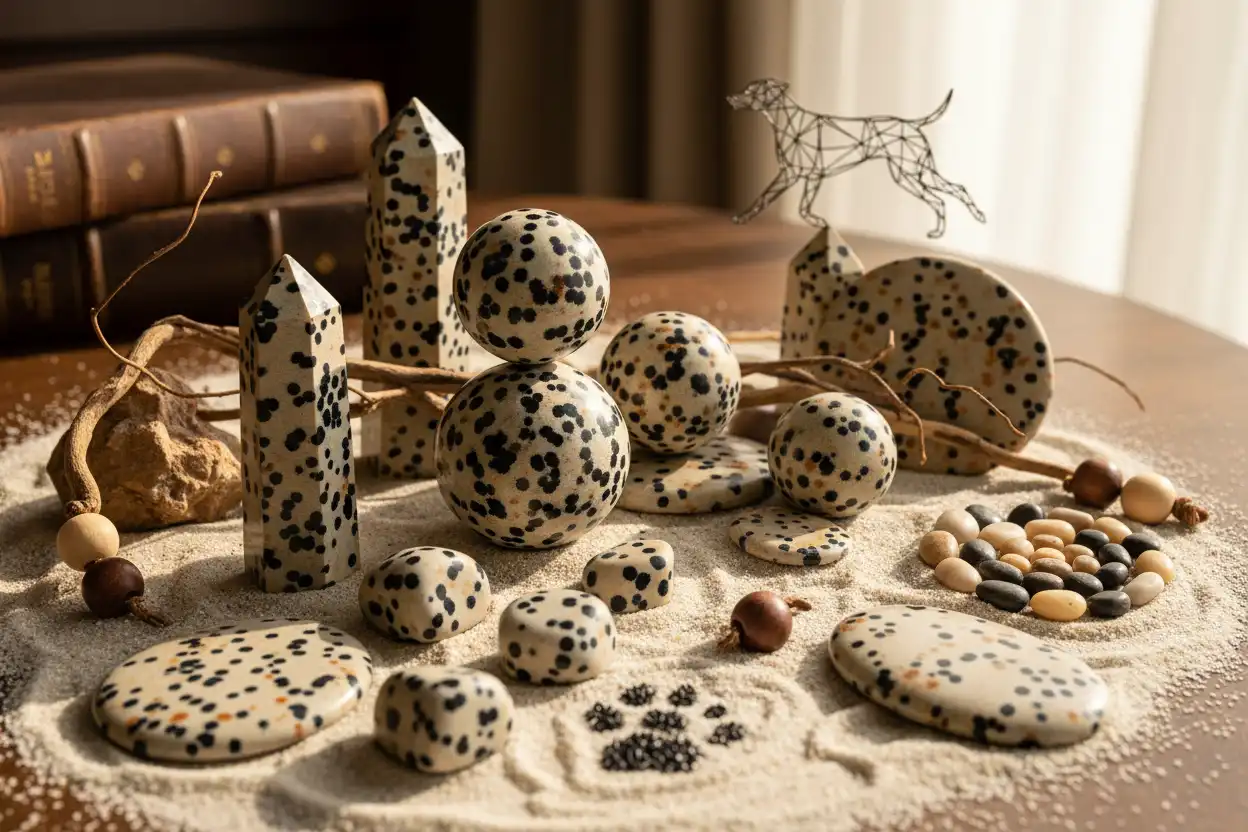
Dalmatian Jasper Meaning: Facts, History & Symbolism
Dalmatian jasper meaning is easier to understand once the familiar trade name is separated from the material’s actual geological identity. Dalmatian Jasper, also widely sold as Dalmatian Stone, is a pale cream, beige, grayish, or tan ornamental rock characterized by conspicuous black or dark brown spots. Despite the word “jasper” in its commercial name, it should not automatically be treated as a conventional microcrystalline quartz jasper. Commercial material is better understood as a spotted, feldspar-rich rock containing several mineral phases, with the exact proportions and identities of the light matrix and dark inclusions potentially varying between specimens and sources. That distinction matters because popular descriptions often repeat that every black spot is black tourmaline or that the entire stone is a form of chalcedony, neither of which should be assumed without mineralogical evidence.
The spotted appearance gives Dalmatian Jasper an immediately recognizable visual identity, and modern crystal traditions commonly connect it with playfulness, grounding, loyalty, protection, confidence, and a less rigid approach to everyday problems. Those interpretations can be discussed as symbolism, yet they should not be used to redefine the rock’s composition or imply scientifically demonstrated emotional effects. Dalmatian jasper meaning is therefore strongest when material identity, geological formation, documented commercial history, modern symbolism, and practical ownership are treated as separate evidence layers.
Within Gems Lore’s Gemstone Guides collection, this page owns that foundational interpretation. Questions about seller selection, microscopy, optical behavior, lapidary work, jewelry engineering, conservation, and provenance remain distinct because repeating those specialist subjects here would make the central dalmatian jasper meaning harder rather than easier to understand.
Dalmatian Jasper at a Glance
| Property | Practical reference |
|---|---|
| Common trade names | Dalmatian Jasper, Dalmatian Stone |
| Material type | Spotted ornamental rock rather than one mineral species |
| Typical matrix | Pale cream, beige, tan, grayish, or off-white feldspar-rich material with other mineral components |
| Dark spots | Dark mineral grains or aggregates; exact identity should not be assumed from color alone |
| Structure | Polymineralic rock with visible or microscopic individual mineral phases |
| Typical appearance | Pale background with irregular black or dark brown spots |
| Transparency | Usually opaque, with occasional slight translucency in thin or mineral-rich areas |
| General hardness behavior | Depends on constituent minerals; polished material is suitable for many ornamental uses but should not be assigned one universal mineral hardness without context |
| Common forms | Rough pieces, slabs, cabochons, beads, carvings, towers, spheres, palm stones |
| Main naming issue | “Jasper” is a trade name and does not prove conventional chalcedony/jasper composition |
| Main identification issue | Similar spotted rocks, composites, dyed material, and other ornamental stones can resemble commercial Dalmatian Jasper |
| Symbolic associations | Playfulness, grounding, loyalty, balance, confidence, perspective |
| Evidence boundary | Symbolism is cultural or personal interpretation rather than a scientifically demonstrated property of the rock |
The most important fact in the table is that Dalmatian Jasper is a rock composed of more than one mineral phase. That immediately distinguishes the material from a single mineral species such as quartz, cuprite, fluorite, or corundum and explains why simplistic formulas or claims that every specimen has identical chemistry should be treated cautiously.
What Dalmatian Jasper Actually Is
Dalmatian Jasper is a commercial rock name rather than an internationally defined mineral species. The pale portion of the material is commonly described as feldspar-rich, with quartz and other mineral phases occurring in varying proportions, while the conspicuous dark spots are separate mineral grains or aggregates embedded within that lighter host. Because the material is polymineralic, a single chemical formula cannot describe the entire rock accurately.
That makes the word “jasper” somewhat misleading when interpreted mineralogically. Conventional jasper is generally understood as an opaque, impure microcrystalline silica material related to chalcedony. Dalmatian Jasper does not have to fit that definition simply because the market name contains the same word. Trade names often survive because they are memorable and commercially useful long after more precise geological descriptions become available.
This distinction does not make Dalmatian Jasper fake. A genuine natural rock can have an imprecise commercial name. The appropriate correction is to identify it more accurately, not to dismiss it because historical trade terminology differs from modern petrology.
Why “Dalmatian Stone” Can Be the Clearer Name
Dalmatian Stone avoids implying that the material must be true jasper, while still preserving the familiar reference to its spotted appearance. Both names are widely recognizable, so either can be useful provided the underlying identity is explained.
The “Dalmatian” description is visual. Cream or pale stone scattered with black spots resembles the coat pattern associated with Dalmatian dogs, which is why the commercial name is intuitive. The name does not imply a relationship with biological material, dog breeds, fossils, or organic inclusions.
A reader researching dalmatian jasper meaning should therefore treat “Dalmatian Stone” and “Dalmatian Jasper” primarily as trade labels for the same broad ornamental material category unless a seller provides evidence that a particular product has a different composition.
Formation: A Rock, Not a Single Growing Crystal
Dalmatian Jasper does not grow as one homogeneous crystal. Its spotted appearance records the coexistence of several mineral phases within a rock, and the final texture reflects crystallization, mineral segregation, alteration, and later geological processing rather than one crystal lattice producing cream and black regions simultaneously.
The light and dark components can differ in chemistry, crystal structure, hardness, cleavage, weathering behavior, and polishing response. This becomes especially evident on rough or partially polished material where individual grains may stand slightly proud, undercut, fracture, or weather at different rates.
The geological details belong in Dalmatian Jasper formation and deposit geology, where rock texture and mineral relationships can be considered without forcing the material into the formation model used for agate or conventional jasper. For dalmatian jasper meaning, the important lesson is that the spots are geological components of a multi-mineral rock rather than symbolic marks created after formation.
What Causes the Pale Background?
The cream, beige, off-white, or light gray background commonly associated with Dalmatian Jasper is produced by its pale rock-forming mineral components. Feldspar-rich areas are an important contributor, while quartz and other light-colored minerals can also participate depending on the specimen.
Grain size affects appearance. A fine-grained pale matrix can seem visually uniform from normal viewing distance even though magnification reveals boundaries between individual mineral phases. A coarser piece may show slightly different whites, creams, and grays across adjacent grains.
Weathering can modify the surface further. Rough material may develop duller beige or brownish tones that disappear or become less obvious after cutting exposes fresh interior material. This is why the color of one weathered face should not be treated as a complete description of the entire stone.
What Causes the Black Spots?
The dark spots are the defining feature of Dalmatian Jasper, but their composition is also one of the most frequently oversimplified aspects of dalmatian jasper meaning. Popular crystal descriptions often state that every black inclusion is black tourmaline. That claim should not be accepted automatically.
Dark mineral grains in a polymineralic rock can belong to several mineral families, and black appearance alone is rarely enough for species-level identification. Individual Dalmatian Jasper specimens or commercial batches may contain different dark phases or combinations of phases. Mineralogical testing is stronger evidence than repeating a trade description.
This is particularly important because metaphysical interpretations are sometimes built directly on the tourmaline claim. A seller may argue that Dalmatian Jasper combines the spiritual properties of jasper and black tourmaline, yet that symbolic equation depends first on two mineralogical assumptions that may not be correct for the specific material being sold.
The safer statement is that the rock contains conspicuous dark mineral grains whose exact identity should be established when species-level composition matters.
Why the Spots Are Irregular
Natural Dalmatian Jasper generally shows spots that vary in size, shape, distribution, and edge character. Some are nearly rounded, while others are elongated, angular, clustered, diffuse, or partly connected with neighboring dark material.
That variation makes geological sense. Mineral grains grow and interact within limited space, and later alteration or deformation can modify their boundaries. Natural rocks rarely behave like printed patterns in which every spot has identical diameter and spacing.
Perfect irregularity is not an authentication test, however. Manufactured composites can imitate randomness, and some natural pieces may contain unusually even distributions. Pattern should therefore contribute to identification rather than serve as the only criterion.
Diagnostic Traits That Matter
Dalmatian Jasper is best identified through a combination of rock texture, mineral relationships, color distribution, cutting behavior, and provenance rather than one conventional gemstone test. A typical piece should show a pale multi-mineral matrix penetrated by genuine dark grains or aggregates rather than a surface-only printed pattern.
Examine broken or cut edges where available. Natural spots should generally continue into the stone rather than terminating abruptly at a polished surface. Individual pale and dark grains may show different lusters, fracture behavior, or polish responses because they are not one homogeneous substance.
A uniform glassy fracture across every cream and black region would deserve closer examination, particularly if the spots look printed or suspended in a synthetic body. Conversely, visible grain boundaries and inconsistent mineral behavior can support a natural rock interpretation.
Because it is polymineralic, assigning one refractive index, one hardness number, or one chemical formula to the entire material can oversimplify the specimen. Those properties belong primarily to the constituent minerals.
What Magnification Can Reveal
Magnification is particularly valuable for dalmatian jasper meaning because the unaided eye tends to interpret the rock as a simple cream substance decorated with black dots. Under magnification, that impression often gives way to individual grains, boundaries, small fractures, variations in polish, mineral inclusions, and textural relationships.
The Dalmatian Jasper microscope and inclusion notebook focuses on those features in detail. A loupe or microscope may reveal that one dark spot is an aggregate composed of several grains rather than one solid inclusion, while the pale matrix can display multiple mineral textures rather than one uniform chalcedony body.
Magnification can also expose treatment or manufacturing clues. Surface-reaching dye concentrations, resin-filled fractures, polishing residues, glue, coatings, and seams become easier to detect when the specimen is examined beyond normal viewing distance.
What microscopy cannot do by itself is identify every dark grain chemically. Two opaque minerals can look nearly identical under ordinary reflected illumination, so analytical methods may be needed when exact phase identity is important.
An Original Dalmatian Jasper Specimen Checklist
Begin with the whole specimen and record its format. Rough material preserves more geological information than a cabochon, bead, tower, sphere, or carving because cutting removes weathered surfaces, matrix contacts, and some textural relationships. A polished object can still be evaluated, but the evidence available is different.
Next, examine the spot distribution. Record whether the dark areas occur throughout the visible body, whether some are isolated and others clustered, and whether their outlines are sharp, diffuse, rounded, or irregular. Natural variation is expected; a pattern that looks mechanically printed should invite further examination rather than an immediate conclusion.
Then inspect an existing edge, drill hole, back surface, or fracture. Determine whether the spots continue below the polished surface. A genuine mineral inclusion should occupy three-dimensional volume, although a very thin section through a larger grain can make its geometry difficult to interpret.
Compare the luster of pale and dark regions. Different mineral phases may polish differently, and slight relief can appear where one component is harder or more resistant than another. Uniform artificial coating across every region may conceal those differences.
Use neutral illumination for color. Warm indoor light can make cream matrix appear yellow, while aggressive contrast can turn dark brown grains into pure black. Photograph the same object beside a neutral white or gray reference if color accuracy matters.
Finally, divide conclusions into levels. “Natural-looking spotted polymineralic rock” may be defensible from careful observation. “Every black spot is tourmaline,” “the rock comes from a specific deposit,” or “the material is completely untreated” requires stronger evidence than appearance alone.
A Claim-Reconciliation Table
| Common claim | What can reasonably be retained | What requires correction or stronger evidence |
|---|---|---|
| “Dalmatian Jasper is a jasper.” | Jasper is part of the established trade name | The name does not prove conventional microcrystalline silica jasper composition |
| “Dalmatian Stone is fake because it is not true jasper.” | The trade name can be mineralogically imprecise | A natural polymineralic rock can still be genuine material |
| “The black spots are black tourmaline.” | Some sellers and crystal traditions use this description | Exact dark-mineral identity should be established rather than assumed |
| “Every specimen has the same composition.” | Commercial material shares a recognizable spotted appearance | Rock-forming mineral proportions can vary |
| “The spots are painted on.” | Artificial spotted products are possible | Natural material contains genuine internal dark mineral grains |
| “Dalmatian Jasper has one chemical formula.” | Individual constituent minerals have formulas | A rock composed of several minerals cannot be reduced accurately to one universal formula |
| “It is a grounding crystal.” | Grounding is a common modern symbolic association | No scientifically established grounding field has been demonstrated |
| “The black spots protect against radiation.” | Dark spots may carry protective symbolism | Visual color does not establish radiation shielding or medical protection |
| “It heals blood because it contains iron-rich spots.” | Some dark minerals may contain iron in particular specimens | Element presence does not demonstrate therapeutic transfer or medical effect |
| “It has ancient Dalmatian Jasper lore.” | Spotted stones can acquire modern cultural symbolism | The modern trade material should not be assigned an invented universal ancient tradition |
This table captures the core evidence problem surrounding dalmatian jasper meaning: a memorable trade name has accumulated layers of mineralogical and metaphysical assumptions. The most useful approach is not to reject all tradition, but to identify which parts describe the physical material and which parts are later interpretations.
Dalmatian Jasper Versus Conventional Jasper
Conventional jasper is generally an opaque microcrystalline silica material whose colors and patterns arise from inclusions, impurities, iron oxides, and other fine-grained components distributed through a chalcedony-rich body. Dalmatian Jasper, by contrast, is better treated as a visibly polymineralic spotted rock rather than automatically placed within that same mineralogical category.
The practical differences can appear under magnification and during cutting. Conventional jasper often behaves relatively uniformly because microcrystalline silica dominates the material, while a polymineralic rock may show grain-to-grain differences in hardness, cleavage, and polishing response.
The similarity lies mainly in commercial use. Both materials are cut into beads, cabochons, carvings, slabs, spheres, and ornamental objects, which helps explain why the jasper label remained convenient.
Dalmatian Jasper Compared With Cuprite
Cuprite demonstrates how different a true mineral species is from Dalmatian Jasper. Cuprite has a defined composition, Cu₂O, an isometric crystal structure, characteristic red coloration, and recognizable mineralogical properties. Dalmatian Jasper has no single mineral formula because it is a rock containing several phases.
The contrast is useful because both can be sold as collectible or symbolic stones, yet the evidence required to describe them differs. A cuprite specimen can be evaluated against species-level properties, while Dalmatian Jasper requires petrographic thinking: what minerals are present, how are they arranged, and how much variation exists across the rock?
Neither category is superior. They simply answer different geological questions.
Dalmatian Jasper Compared With Danburite
Danburite is a calcium borosilicate mineral that can form distinct transparent crystals and faceted gems. Its identity is established through one mineral structure and composition rather than the mixed-mineral texture seen in Dalmatian Jasper.
This comparison is helpful when commercial crystal terminology becomes broad. A polished tower made from Dalmatian Jasper and a natural danburite crystal may both be sold under a “crystals” category, but one is a carved polymineralic rock while the other is a mineral species capable of developing its own crystallographic faces.
Shape and spiritual marketing do not erase that difference.
Documented History Versus Invented Antiquity
Dalmatian jasper meaning is primarily a modern commercial and symbolic story. The material is widely used for beads, carvings, cabochons, decorative objects, and crystal collections, but that does not justify projecting the current trade name into ancient societies without documentation.
General historical evidence that people used spotted stones, jasper, feldspar-rich rocks, or amulets cannot automatically be converted into evidence for a specific ancient Dalmatian Jasper tradition. Older descriptions usually lack the mineralogical precision required to identify this exact commercial material retrospectively.
The historically responsible approach is simpler: acknowledge that humans have long valued patterned rocks, while treating the specific Dalmatian Jasper trade identity and its current metaphysical associations as part of a more recent commercial culture unless stronger documentation demonstrates otherwise.
Dalmatian Jasper Meaning in Modern Symbolism
Modern dalmatian jasper meaning commonly emphasizes playfulness, grounding, loyalty, companionship, emotional balance, confidence, and the ability to approach serious situations without unnecessary rigidity. The spotted pattern contributes strongly to these associations because the stone’s appearance is visually playful and immediately reminiscent of an animal coat.
Some practitioners interpret the pale-and-dark contrast as a symbol of integrating opposites: seriousness with humor, caution with curiosity, independence with companionship, or routine with spontaneity. Others connect the darker areas with grounding or protection and the lighter matrix with optimism or mental clarity.
These meanings can function well as personal metaphors. They are not measurable effects of the feldspar-rich rock. Dalmatian Jasper does not scientifically cause happiness, repair emotional trauma, prevent nightmares, improve relationships, protect against electromagnetic radiation, or alter nervous-system function.
A grounded symbolic use might involve keeping a small polished piece near a workspace as a reminder to interrupt perfectionism, make room for play, or avoid interpreting every setback as a crisis. The practical result comes from the habit the object cues.
Why “Playfulness” Is a Plausible Symbol Without Being a Physical Power
The idea of playfulness is one of the most distinctive aspects of dalmatian jasper meaning because it follows naturally from the visual analogy that gives the stone its name. Spotted animals are associated culturally with movement, energy, companionship, and personality, and the irregular black-on-cream pattern can feel less formal than uniformly colored gems.
That makes playfulness a coherent symbolic interpretation. It does not make it a biochemical effect.
Someone may genuinely feel lighter or more relaxed when using an object they associate with humor or companionship. That personal response can be real without demonstrating that the mineral changes neurotransmitters or emits an emotional frequency.
Grounding and the Dark-Spot Narrative
Grounding is another common part of dalmatian jasper meaning. Modern crystal practice often associates dark or black stones with stability, boundaries, seriousness, and connection to physical routines, while pale stones may receive lighter or more expansive symbolism. Dalmatian Jasper visually combines both.
This is one reason the repeated claim that the black spots are tourmaline became so influential in metaphysical descriptions. Black tourmaline already carries strong protection and grounding symbolism, so identifying every dark grain as tourmaline makes it easy to transfer that narrative into Dalmatian Jasper.
Mineralogical caution is therefore especially important. The symbolic concept can be retained without depending on an uncertain mineral identification. Dark spots can symbolize stability because people choose to interpret them that way; they do not need to be black tourmaline for the metaphor to function.
Chemistry Is Not Medicine
Because Dalmatian Jasper contains several mineral phases, chemical elements such as silicon, aluminum, sodium, potassium, calcium, iron, magnesium, or others may be present depending on the specimen’s exact mineralogy. None of those elements should be converted automatically into a wellness claim.
The biological behavior of an element depends on chemical form, solubility, dose, concentration, exposure route, and metabolism. Feldspar is not a nutritional supplement because it contains common elements, and an iron-bearing dark grain does not treat blood disorders merely because iron is biologically important in other contexts.
This boundary keeps dalmatian jasper meaning from turning mineral chemistry into unsupported medical advice.
Safe Ownership
An intact polished Dalmatian Jasper object is generally suitable for ordinary handling when basic mineral-collection hygiene is followed. The main routine concerns are physical ones: chips, fractures, worn polish, loose beads, damaged drill holes, or unstable jewelry settings.
Cutting and grinding create a different exposure environment. Dalmatian Jasper is a silica-bearing polymineralic rock, so lapidary work can generate fine mineral dust whose composition reflects several constituent phases. Dry grinding, sanding, or drilling should not be treated casually. Appropriate wet processing, extraction, ventilation, eye protection, and respiratory controls are more suitable.
The detailed workshop choices belong with Dalmatian Jasper cutting, orientation, and polish, while the site’s Disclaimer provides the broader boundary between general mineral information and individualized health or occupational-safety advice.
Jewelry Suitability
Dalmatian Jasper is widely used for beads, pendants, earrings, bracelets, cabochons, and decorative carvings because it can take an attractive polish and its spotted pattern remains visually recognizable after shaping. However, durability depends on the actual rock texture and the relationship between its constituent minerals rather than on the trade name alone.
A well-consolidated cabochon can perform adequately in many jewelry settings, while material with fractures, weak grain boundaries, pits, or differential hardness may be more vulnerable. Drill holes in beads deserve inspection because repeated string movement can abrade the edges, particularly if a dark or pale mineral boundary intersects the hole.
Setting design is covered separately in Dalmatian Jasper setting and wear engineering. The central point here is that a symbolic association with protection does not provide mechanical protection.
Optical Behavior Is More Complicated Than One Number
A single-mineral gemstone can often be described through a narrow refractive-index range and standardized optical character. Dalmatian Jasper is different because several minerals contribute to its appearance.
The pale matrix and dark grains can have different refractive indices, lusters, cleavage, and scattering behavior, while fine grain boundaries affect how light moves through the polished surface. This helps explain why some areas appear slightly more vitreous, dull, granular, or translucent than others.
The specialist Dalmatian Jasper optical properties and color behavior page addresses those differences directly. For dalmatian jasper meaning, the useful takeaway is that optical variability supports the interpretation of a multi-mineral rock rather than one homogeneous jasper body.
Buying Without Overpaying for the Story
A buyer should first confirm that the product actually resembles natural Dalmatian Jasper material and that the seller identifies it transparently. Look for useful photographs of the entire object, measurements, disclosure of polishing or carving, and any known treatment or stabilization.
A metaphysical description should not substitute for material information. Phrases such as “premium protection crystal,” “high-vibration Dalmatian Jasper,” or “tourmaline-infused jasper” do not establish composition or quality.
The dedicated guide to where to buy Dalmatian Jasper owns seller selection and purchasing criteria. Here, the relevant principle is simply that the physical rock should justify the purchase before the symbolic narrative is considered.
Provenance and Locality Claims
A commercial stone can look highly characteristic while still providing little evidence of where it was mined. Dalmatian Jasper’s cream-and-black pattern is useful for recognizing the trade material but should not be treated as a precise geographic fingerprint.
Cutting removes additional clues. A bead or cabochon no longer preserves much host-rock context, while weathered surfaces, mineral associations, and geological contacts may have been removed completely. At that stage, provenance depends heavily on supplier documentation.
The Dalmatian Jasper provenance disclosure checklist provides the appropriate structure for distinguishing documented source information from inherited seller claims. Locality can add context, but only when evidence accompanies the object.
Conservation of Rough and Polished Pieces
A rough specimen and a polished decorative object require different conservation priorities. Rough material can preserve original weathering, mineral boundaries, fractures, and old collection labels, while a polished item is usually maintained for surface appearance and usability.
Repeated aggressive polishing can erase original textures from a collector specimen, while careless storage can scratch polished pieces against harder minerals or jewelry components. Changes in fractures or spot boundaries should be documented if a specimen has scientific, historical, or sentimental importance.
The Dalmatian Jasper specimen conservation record is useful when a piece has repairs, provenance, unusual mineralogy, or condition changes worth preserving. An ordinary palm stone may need little documentation, while an old labeled specimen can benefit from a much more deliberate record.
What Dalmatian Jasper Meaning Does Not Need to Claim
Dalmatian jasper meaning does not become more meaningful by claiming that the stone detoxifies the body, strengthens nerves, heals cartilage, cures depression, eliminates nightmares, protects against radiation, or automatically improves relationships. Those statements extend far beyond what the material’s geology can establish.
Nor does the stone need an invented ancient civilization narrative. A modern trade material can acquire genuine modern symbolism without pretending that every association is thousands of years old.
The most defensible approach is also the most distinctive: Dalmatian Jasper is a visually memorable polymineralic rock whose commercial name is geologically imperfect, whose spots invite several disputed mineral identifications, and whose modern symbolism draws naturally from pattern, contrast, and cultural associations with playfulness.
How Gems Lore Handles the Naming Problem
The challenge with Dalmatian Jasper is not simply determining whether one seller’s specimen is authentic. The larger issue is that the commercial name itself can encourage inaccurate assumptions. Calling the material “jasper” invites readers to assume chalcedony; calling the dark grains “tourmaline” invites another unverified species claim; combining those two ideas can then produce metaphysical explanations that appear mineralogically grounded even when the starting assumptions are uncertain.
The editorial framework described on the About page treats trade names as labels that must be reconciled with material evidence rather than discarded automatically. That approach preserves the familiar term readers actually search for while making the geological limitations visible.
When new petrographic or analytical evidence clarifies a disputed component, the physical description should be corrected even if the older trade explanation remains more popular.
Frequently Asked Questions About Dalmatian Jasper Meaning
What is Dalmatian Jasper?
Dalmatian Jasper is a spotted ornamental rock with a pale cream, beige, or grayish matrix and conspicuous black or dark brown mineral grains. It is a commercial rock name rather than one mineral species.
What does Dalmatian Jasper mean spiritually?
Modern dalmatian jasper meaning commonly includes playfulness, grounding, loyalty, confidence, companionship, balance, and maintaining perspective during stressful situations. These are symbolic interpretations rather than scientifically demonstrated effects.
Is Dalmatian Jasper real jasper?
The word jasper is part of the established trade name, but the material should not automatically be treated as conventional microcrystalline silica jasper. Dalmatian Stone is often the more mineralogically cautious description.
Are the black spots in Dalmatian Jasper black tourmaline?
They should not automatically be identified as black tourmaline from appearance alone. Dark grains can require petrographic or analytical testing for reliable mineral identification.
Is Dalmatian Jasper a mineral?
No. It is better understood as a rock composed of multiple mineral phases rather than one mineral species with a single chemical formula.
Why is it called Dalmatian Jasper?
The name refers to its pale background covered with dark spots, visually reminiscent of the coat pattern associated with Dalmatian dogs. The term is commercial rather than a formal mineralogical classification.
Is Dalmatian Stone the same as Dalmatian Jasper?
The names are commonly used for the same trade material. “Dalmatian Stone” avoids implying that the material must satisfy the conventional mineralogical definition of jasper.
Does Dalmatian Jasper naturally have black spots?
Genuine material contains natural dark mineral grains or aggregates distributed through the lighter rock. Individual spots should exist within the body rather than merely being printed onto the polished surface.
How can I tell whether Dalmatian Jasper is genuine?
Examine the rock texture, spot continuation through edges or drill holes, variation between mineral grains, polish response, fractures, and overall three-dimensional pattern. Magnification can help, while exact mineral identification may require analytical testing.
Does Dalmatian Jasper have healing properties?
There is no established scientific evidence that Dalmatian Jasper treats disease, changes blood chemistry, relieves clinical anxiety, protects against radiation, or produces medical benefits through normal handling.
Is Dalmatian Jasper good for jewelry?
It is widely used for beads, cabochons, pendants, and other ornamental pieces. Suitability depends on rock cohesion, fractures, constituent minerals, cutting quality, and setting design rather than on the symbolic name.
Can Dalmatian Jasper go in water?
Brief contact with clean water may be less problematic for many intact polished pieces than for highly water-sensitive minerals, but prolonged soaking is unnecessary. Treatments, repairs, matrix, jewelry components, and exact mineral composition can alter care requirements.
Is Dalmatian Jasper rare?
The trade material is readily available enough to support beads, carvings, and decorative objects. Exceptional pattern, large sound rough, unusual documented composition, or strong provenance may be more distinctive than ordinary commercial material.
Does Dalmatian Jasper contain quartz?
Quartz can occur as part of the multi-mineral rock, but Dalmatian Jasper should not be simplified into pure quartz or conventional chalcedony. The exact mineral proportions can vary.
Why is Dalmatian Jasper associated with playfulness?
The symbolism likely draws heavily from the stone’s lively spotted appearance and its visual association with Dalmatian dogs. That makes playfulness a culturally intuitive metaphor rather than a measurable mineral effect.
A More Accurate Dalmatian Jasper Meaning
Dalmatian jasper meaning becomes more interesting once the stone is allowed to be geologically complicated. It is not necessary to pretend that the material is one perfectly defined jasper mineral, that every dark spot is tourmaline, or that one chemical formula explains every specimen. The cream-and-black ornamental rock is distinctive precisely because several mineral phases coexist within one recognizable texture.
Its history should be treated with the same restraint. Patterned stones have been valued for a very long time, but the modern Dalmatian Jasper trade identity does not need an invented ancient spiritual lineage to justify its place in contemporary collecting. Its familiar appearance, usefulness in lapidary work, and unusual naming problem already give it a clear identity.
Modern symbolism can then remain symbolic. The spotted pattern can represent play, contrast, adaptability, companionship, or balancing seriousness with curiosity, while darker grains may symbolize stability within a lighter field. Someone can use those associations in reflection or ritual without claiming that the rock medically changes mood or physically transmits protection.
That layered interpretation is the most useful dalmatian jasper meaning: a natural spotted rock first, a commercial name second, and a symbolic object only after those physical facts are understood. If a specimen presents an unusual composition, treatment, or naming issue that contradicts the descriptions commonly repeated for Dalmatian Jasper, photographs and supporting evidence can be sent through Contact so that the specific material claim can be evaluated rather than generalized from appearance. Any material submitted for that purpose is handled according to the site’s Privacy Policy, keeping specimen review and data handling tied to the actual evidence under discussion.