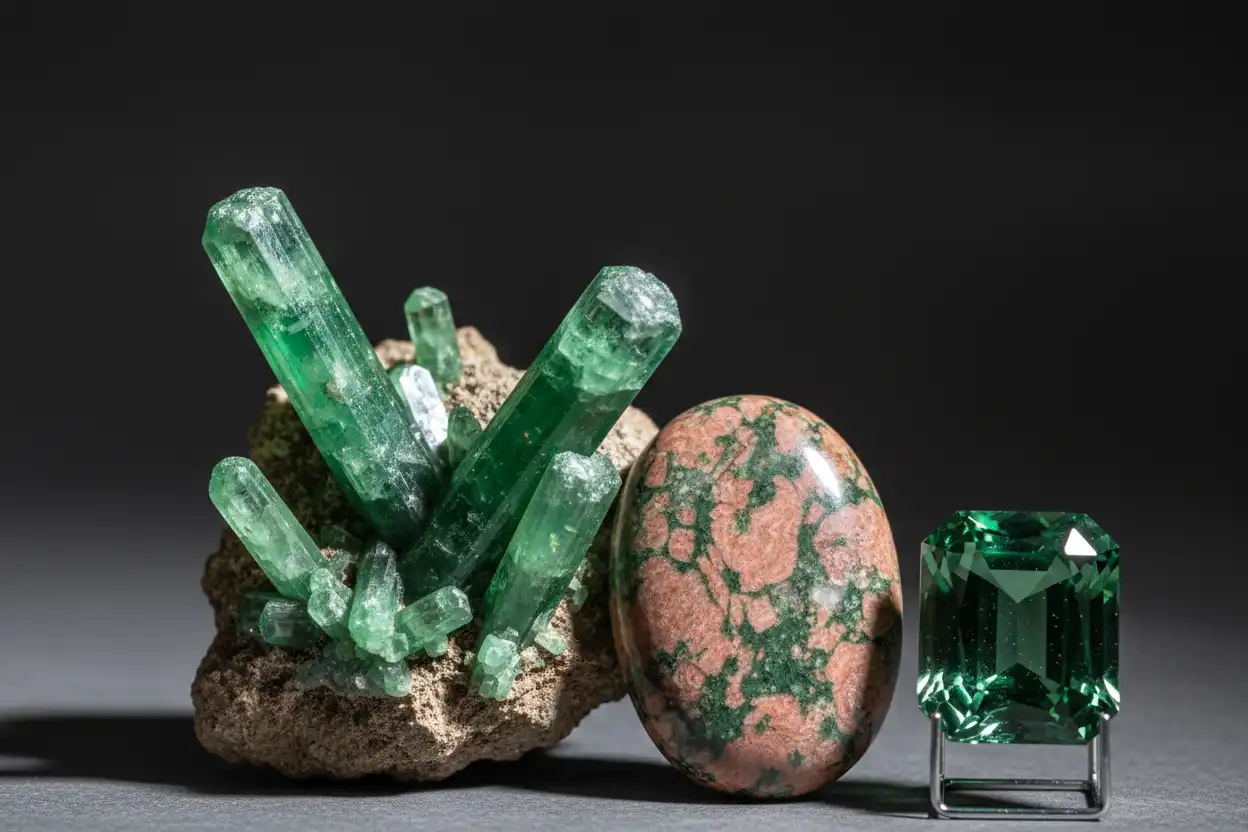
Epidote Meaning: Properties, Uses & Symbolism
Epidote meaning starts with a mineral that is far more chemically and geologically distinctive than its green color suggests. Epidote is a calcium-aluminum-iron sorosilicate whose chemistry is commonly represented as Ca₂(Al₂Fe³⁺)(SiO₄)(Si₂O₇)O(OH), with variation arising because iron and aluminum can substitute within parts of the structure. It crystallizes in the monoclinic system and is especially recognizable in well-formed specimens by elongated or prismatic crystals, strong directional color, vitreous luster and the yellow-green to pistachio-green shades for which the mineral is widely known. Dark green, brownish green, yellowish and nearly black-looking crystals also occur, so color alone is never enough to establish identity.
A useful understanding of epidote meaning therefore separates three things that are often blended together: measurable mineral properties, documented mineral history and modern symbolic interpretation. The first can be investigated through mineralogical and gemological methods. The second depends on historical records and nomenclature. The third belongs to personal, cultural or metaphysical practice and should not be represented as a scientifically demonstrated property. Readers comparing other material-led references can explore the broader Gemstone Guides collection while keeping each mineral’s chemistry and structure distinct.
Epidote Meaning at a Glance
| Feature | Epidote reference |
|---|---|
| Mineral class | Sorosilicate |
| Typical composition | Calcium-aluminum-iron silicate with hydroxyl |
| Crystal system | Monoclinic |
| Common colors | Pistachio green, yellow-green, olive, dark green, brownish green |
| Typical luster | Vitreous, sometimes resinous on certain surfaces |
| Mohs hardness | About 6–7 |
| Cleavage | Perfect in one principal direction |
| Common forms | Prismatic crystals, aggregates, grains and massive material |
| Important color influence | Ferric iron is an important contributor to many green and brown tones |
| Geological context | Metamorphic, hydrothermal and altered igneous environments |
| Gem use | Transparent material may be faceted; attractive crystals are widely collected |
| Symbolic use | Modern reflective traditions often associate it with growth or intentional change; these are beliefs, not mineral properties |
This fact-first structure matters because epidote meaning is sometimes reduced to claims about “energy,” abundance or emotional transformation. Such interpretations may be personally meaningful, but they do not describe what epidote physically is. Mineral identity is determined through chemistry, crystallography and observable properties, not through the intentions assigned to a specimen.
Epidote Is a Mineral Species, Not Simply a Green Stone
The characteristic green of epidote can make visual recognition tempting, yet numerous unrelated minerals overlap with its color range. Olivine, diopside, actinolite, some garnets, tourmaline, prehnite and many other materials can occur in green shades. Epidote meaning should therefore never be built on the assumption that pistachio color alone identifies epidote. Its species identity comes from a particular crystal structure and chemical composition, with ferric iron occupying part of the structure and contributing strongly to many familiar colors.
Epidote can occur as sharply formed crystals, granular masses, veins, rock-forming grains or components within multi-mineral rocks. Some transparent crystals are suitable for faceting, although attractive mineral specimens are at least as important to collectors as gem-cut material. Its hardness is moderate, but good cleavage introduces a mechanical weakness that matters when crystals or gems are struck in unfavorable directions. That distinction between hardness and toughness is important: resistance to scratching does not automatically mean resistance to chipping or cleavage.
Readers assessing a specimen offered for sale should keep identity separate from purchasing decisions. Questions about seller documentation, disclosure and purchase evidence are treated separately in where to buy epidote rather than being folded into the foundational epidote meaning reference.
How Epidote Forms
Epidote is strongly associated with geological environments in which existing minerals react with fluids, heat and pressure. It is common in metamorphic rocks, particularly in conditions characteristic of lower to moderate metamorphic grades, and it frequently occurs in hydrothermally altered rocks. Calcium, aluminum, iron, silica and water-bearing chemical components must be available in appropriate proportions for epidote-bearing assemblages to develop.
In metamorphic settings, epidote may occur with minerals such as chlorite, actinolite, albite, quartz and calcite. In hydrothermal systems, it can develop as fractures and rock volumes are altered by hot fluids. Epidote can also occur in skarn environments and in altered igneous rocks. This broad geological distribution means that a specimen’s green color or crystal habit cannot reliably identify a mine, region or country without supporting provenance.
Formation conditions also help explain why epidote commonly appears as part of a mineral assemblage rather than as an isolated crystal. Matrix minerals can provide useful context, but they should be recorded rather than treated as automatic proof of locality. A detailed examination of host rocks, alteration processes and mineral associations belongs in epidote formation and deposit geology, allowing this page to keep epidote meaning centered on foundational identity.
Why Epidote Is Green
Iron is central to understanding many epidote colors. Ferric iron can substitute for aluminum within the crystal structure, and variations in composition influence color intensity and optical behavior. Many specimens display the familiar yellowish or pistachio-green appearance, while greater visual darkness can produce olive, deep green or brown-green material. Crystal thickness also matters: a specimen that looks almost black in a thick section may transmit much clearer green or brown tones along a thin edge.
Directional optical behavior adds another layer. Epidote can show pronounced pleochroism, meaning its apparent color changes when viewed along different crystallographic directions in polarized or favorable lighting conditions. Yellow, green and brownish tones may become more or less prominent as orientation changes. That behavior can help support identification, but pleochroism is not unique enough to prove epidote by itself.
Surface coatings, internal fractures, inclusions and matrix reflections can further alter perceived color. Photographs can exaggerate these differences through white balance, saturation, exposure and background choice. Consequently, online images are best treated as documentation rather than chemical evidence. Readers who want the more technical optical side can continue to epidote optical properties and color behavior instead of extending that specialist subject here.
Diagnostic Traits That Actually Help
A plausible epidote identification normally emerges from several compatible observations rather than one dramatic feature. Monoclinic crystallography, characteristic prismatic habits, hardness around 6–7, strong cleavage, relatively high density compared with many common silicates, vitreous luster and distinctive optical behavior can collectively narrow the possibilities. Transparent gem material can also show refractive properties consistent with epidote, while microscopic examination may reveal internal characteristics that help distinguish natural material from look-alikes.
Microscopy is especially useful because inclusions, growth structures, fractures and surface features can be recorded without damaging the specimen. Yet inclusions should be interpreted cautiously. A particular needle, crystal or fracture pattern may be compatible with epidote without being exclusive to it. The epidote microscope inclusion notebook provides a more appropriate framework for systematic magnified observations.
The strongest conclusion sometimes requires specialist analysis. Raman spectroscopy, chemical analysis or other instrumental methods may be appropriate when an unusual specimen, valuable gem, disputed label or scientifically important sample cannot be resolved through routine observation. Gems Lore does not claim laboratory testing that has not been performed, and photographs cannot substitute for analytical confirmation when composition is the question.
A Photo and Specimen Checklist for Epidote
The most useful original record is one that distinguishes observation from interpretation. This checklist can be used for a rough crystal, polished specimen or gem offered as epidote without assuming beforehand that the label is correct.
| Record | What to document | Useful inference | Unsupported leap to avoid |
|---|---|---|---|
| Overall color | Green, yellow-green, olive, brown-green or darker zones | Provides descriptive comparison | “Green proves epidote” |
| Color by direction | Rotate the crystal or gem and note visible shifts | May reveal directional color behavior | Pleochroism alone proves species |
| Transparency | Transparent, translucent or opaque areas | Helps determine suitable tests | Transparency proves gem quality |
| Crystal shape | Prismatic form, terminations, striations and matrix | Can support crystallographic comparison | Habit alone proves identity |
| Existing cleavage | Flat break surfaces already present | May be compatible with epidote structure | Intentionally breaking a specimen for testing |
| Luster | Vitreous, resinous-looking or altered surfaces | Useful descriptive evidence | Luster proves treatment status |
| Inclusions | Crystals, fractures, zoning or fluid-looking features | Creates a repeatable microscopic record | One inclusion proves origin |
| Matrix | Quartz, calcite or other associated material | May provide geological context | Matrix proves a specific locality |
| Original label | Photograph wording exactly as received | Preserves provenance history | Old terminology is automatically current |
| Seller locality | Record the precise claimed mine or region | Creates a claim that can be checked | Locality is verified because a seller stated it |
| Treatment claim | “Untreated,” “natural,” coated, dyed or unknown | Defines what requires verification | Absence of disclosure proves untreated status |
| Scale | Photograph beside a ruler or known measurement | Makes later comparisons more useful | Image size alone indicates weight |
This record is particularly valuable before a specimen is cleaned, repaired, mounted or separated from its matrix. If a locality claim matters, retain packaging, invoices, collection labels and correspondence. The epidote provenance disclosure checklist provides a deeper framework for distinguishing recorded provenance from assumption.
Names and Claims That Need Extra Care
Epidote is both a specific mineral species and the name associated with a broader mineralogical family, which creates room for imprecise commercial descriptions. Some specimens marketed casually as “epidote” may be rocks containing epidote, aggregates of several minerals or material whose exact species has not been analytically established. Terms based primarily on appearance should therefore be treated as descriptions until mineral identity is adequately supported.
“Pistachio epidote” is usually descriptive language for color rather than a separate mineral species. Likewise, labels that imply an exclusive mine, rare variety or special metaphysical grade require independent evidence before they should be accepted as more than seller terminology. A vivid green specimen is not automatically rarer, more powerful or geographically distinctive simply because those claims appear beside a product photograph.
Confusion can also arise around unakite, a rock typically composed largely of altered feldspar, epidote and quartz. Unakite contains epidote but is not synonymous with epidote as a mineral species. The distinction is comparable to identifying one ingredient within a rock rather than calling the whole rock by that mineral’s species name.
The Documented History of Epidote
The name epidote traces to a Greek word associated with “increase” or “addition,” traditionally referring to an unequal or extended aspect of its crystal geometry. The term became established during the development of modern mineral classification, when crystallographic observations were becoming increasingly important for distinguishing minerals that had previously been grouped by superficial resemblance.
That historical meaning is mineralogical rather than spiritual. The etymology should not be converted into evidence that epidote causes personal “increase,” multiplies wealth or amplifies emotional states. Those modern interpretations may borrow metaphorically from the name, but the linguistic origin does not demonstrate a physical effect.
This distinction is useful whenever epidote meaning is discussed. Documented history explains how people classified and named the mineral. Cultural symbolism explains what people later chose to associate with it. Neither should be presented as though it were a laboratory property.
Epidote Meaning in Modern Symbolism
Modern crystal traditions often associate epidote meaning with growth, deliberate change, persistence, self-awareness or the idea of noticing what a person is already reinforcing in daily life. These interpretations can function as reflective metaphors. Someone might keep an epidote specimen near a journal as a visual reminder to examine habits, track progress or decide which behaviors deserve more attention.
The boundary is important. Epidote has no scientifically established ability to attract money, repair relationships, cure emotional distress or produce a predetermined outcome. A person may find symbolic value in the stone, but that experience should be described as personal practice rather than an objectively measured mineral effect. The site’s editorial disclaimer explains the broader distinction between educational mineral information and medical, financial or other professional advice.
A practical symbolic exercise does not need extraordinary claims. A collector could associate the mineral’s geological transformation with a question such as, “Which repeated action is actually moving me toward the result I want?” The value of that exercise comes from reflection and behavior, not from a demonstrated force transmitted by the crystal.
Epidote Is Not a Medicine or Nutrient Source
Epidote contains elements such as calcium, aluminum and iron within its mineral structure, but chemical composition should never be confused with nutritional availability or medical action. Wearing, touching or carrying epidote does not provide the body with dietary minerals, and its iron content does not make it a treatment for anemia, fatigue or any other condition.
The same limit applies to mental-health claims. Epidote should not be presented as a treatment for anxiety, depression, trauma, neurological conditions or other health problems. Reflective rituals involving a mineral may be personally calming for some people, just as journaling or keeping a meaningful object can be, but that is fundamentally different from evidence of medical efficacy.
Crystal ingestion and improvised gem elixirs are unnecessary and should not be used as extensions of epidote meaning. A mineral specimen is better appreciated as a geological material rather than treated as something to consume.
Safe Ownership and Handling
Normal handling of an intact epidote crystal or polished stone is substantially different from cutting, grinding, sanding, drilling or heating it. Everyday collectors can usually examine stable specimens with ordinary care, but lapidary operations produce fragments and fine particulate matter and should be approached with appropriate professional controls rather than casual household methods.
Mechanical durability also deserves attention. Epidote’s hardness may sound suitable for jewelry, yet cleavage can make a faceted stone vulnerable to impact. Earrings or protected pendants impose different stresses from rings worn during everyday manual activity. Those engineering questions are addressed more fully in epidote setting and wear engineering.
Cutters face a different problem because crystal orientation affects both optical appearance and vulnerability during shaping. Faceting decisions, orientation and polishing technique are therefore covered separately in epidote cutting, orientation and polish. Keeping those topics separate prevents the foundational epidote meaning page from becoming an incomplete lapidary manual.
Collectors preserving natural crystals should avoid unnecessary alteration. Original matrix, surface condition, repaired areas and historical labels can all contribute to a specimen’s record. Long-term documentation and storage practices belong in epidote specimen conservation and record keeping.
Epidote Compared With Nearby Green and Collector Minerals
Epidote meaning becomes clearer when comparison is based on mineral identity rather than symbolism. Enstatite meaning concerns a magnesium-rich orthopyroxene with a different crystal structure, chemistry and geological context, even though enstatite can also appear green or olive. A photograph showing two similarly colored stones therefore says little about whether the minerals are related.
Erythrite meaning provides an even stronger contrast. Erythrite is a cobalt arsenate mineral commonly recognized for pink to reddish-purple coloration and has different chemistry and handling considerations. The comparison demonstrates why a gemstone or mineral reference should begin with material identity rather than treating all collector crystals through the same symbolic template.
That material-led approach also limits misleading substitution. A seller’s statement that two minerals have the “same meaning” does not make them interchangeable mineralogically, and similar metaphysical descriptions do not establish common composition, formation or durability.
What Epidote Meaning Can Reliably Tell You
Epidote meaning can provide a grounded answer to what epidote is, how its composition contributes to appearance, where it forms, which observations support identification and how its historical name differs from modern symbolic interpretation. It can also help a collector know when a specimen claim is still only a claim.
It cannot determine locality from color, authenticate a mine name from a photograph, prove that a specimen is untreated because no treatment is visible, establish value from mineral identity alone or guarantee a psychological, financial or physical effect. Those questions require different evidence.
Gems Lore describes its material-first approach on About Gems Lore. Readers who find a potentially incorrect identification, disputed mineral name or factual issue can provide the specimen context through Contact Gems Lore. Information submitted through the site is handled according to the Privacy Policy.
FAQ
What is the basic epidote meaning?
The basic epidote meaning is mineralogical: epidote is a calcium-aluminum-iron sorosilicate mineral with a monoclinic crystal structure. Modern symbolic traditions may associate it with growth, awareness or intentional change, but those associations are not scientifically measured mineral properties.
Why is epidote commonly green?
Ferric iron in the mineral structure contributes importantly to many characteristic epidote colors. Composition, crystal thickness, orientation and optical behavior can produce shades ranging from yellow-green and pistachio to olive, deep green and brownish green.
Is pistachio-green color enough to identify epidote?
No. Many different minerals can appear pistachio, olive or yellow-green. Reliable identification requires a combination of mineralogical or gemological evidence rather than color alone.
Is epidote suitable for jewelry?
Transparent epidote can be faceted and worn in jewelry, but its cleavage means impact protection matters. Suitability depends on the cut, setting, jewelry type and expected wear rather than Mohs hardness alone.
Does epidote attract abundance or money?
There is no scientific evidence that epidote physically attracts money or guarantees abundance. People may use it as a symbolic reminder to review habits, decisions or goals, but financial outcomes should not be attributed to the mineral.
Can I identify where an epidote crystal came from by looking at it?
Usually not with confidence. Crystal form, matrix and inclusions may support comparison with documented specimens, but visual appearance alone does not authenticate a mine or country. Reliable provenance depends on records and, in some cases, specialist investigation.
Understanding Epidote Without Flattening Its Story
A strong interpretation of epidote meaning does not require choosing between mineral science and personal symbolism. It requires keeping them clearly labeled. Epidote is physically interesting because its iron-bearing silicate structure, metamorphic and hydrothermal occurrence, directional optical properties and distinctive crystal habits can all be investigated. Its historical name belongs to the development of mineralogy, while its modern symbolic associations belong to human interpretation.
That separation makes the mineral more useful, not less. Collectors can document specimens without exaggerating what photographs prove. Jewelry owners can respect cleavage instead of assuming hardness guarantees durability. Readers who enjoy symbolism can use epidote as a reflective object without turning a mineral into medicine, financial advice or a promise of transformation. In that evidence-aware framework, epidote meaning remains connected to the real stone while leaving room for personal interpretation.