Epidote Healing Properties: 9 Popular Claims, Modern Traditions & Safe Limits
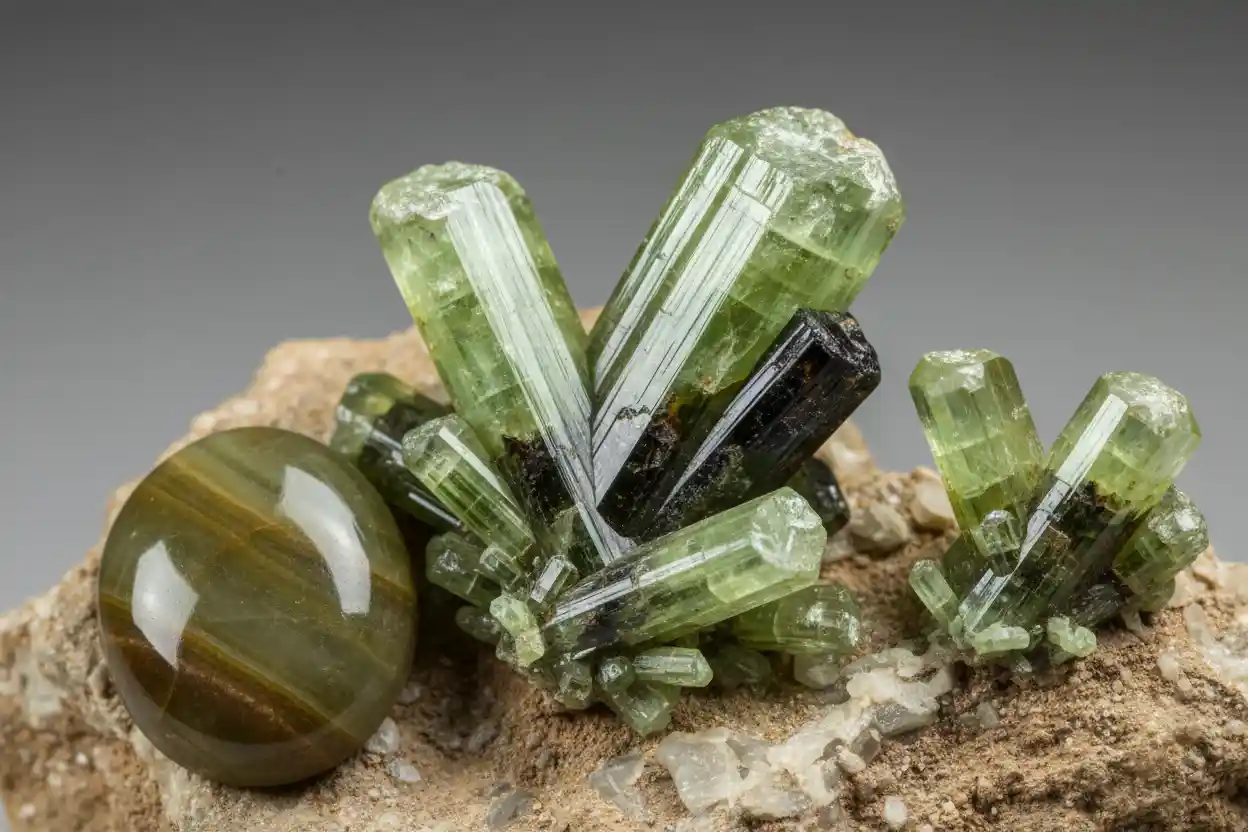
Epidote healing properties are usually described through themes of personal growth, emotional release, motivation, optimism, confidence, concentration, resilience, relationship awareness, and spiritual development. Its green to yellow-green color and elongated crystals have encouraged modern symbolism around growth and constructive change, but epidote has not been demonstrated to treat anxiety, depression, fatigue, pain, cardiovascular disease, hormonal problems, immune disorders, digestive conditions, or any other medical problem. There is also no established mechanism by which wearing or holding epidote changes mood, attracts opportunities, or amplifies personal energy. Mineralogically, epidote is a calcium-aluminum-iron sorosilicate in the epidote group, commonly represented as Ca₂Al₂Fe³⁺(SiO₄)(Si₂O₇)O(OH). It crystallizes in the monoclinic system, is typically around Mohs 6, has vitreous luster, brittle tenacity, and perfect cleavage in one direction. Those characteristics are measurable properties; the healing themes belong to contemporary spiritual and reflective practice.
9 Epidote Healing Claims Behind Its Growth-and-Release Reputation
- Personal growth and constructive change
- Emotional release and letting go
- Motivation and follow-through
- Optimism during difficult periods
- Confidence and personal responsibility
- Focus and clearer priorities
- Resilience after setbacks
- Relationship awareness and healthier boundaries
- Spiritual reflection and self-development
These nine themes can support distinct reflective practices without being treated as nine biological effects. Many epidote benefits described in modern crystal culture become more useful when translated into actions a person controls, such as identifying priorities, starting a delayed task, reviewing a setback, or deciding how to respond in a difficult relationship.
Epidote Mineral Identity: Formula, Crystal System, Color, Hardness, and Cleavage
Epidote is a recognized mineral species and a member of the epidote group. Its chemical composition varies because iron and aluminum substitute for one another within the structure, but a commonly used idealized formula is Ca₂Al₂Fe³⁺(SiO₄)(Si₂O₇)O(OH). The formula contains structural hydroxyl, OH, rather than molecular water written as H₂O, so epidote is not usually treated as a conventionally hydrated mineral in the same sense as minerals whose structures contain essential water molecules.
It crystallizes in the monoclinic crystal system and may form elongated, prismatic, striated, blocky, fibrous, granular, or massive habits. Well-developed crystals can be sharply defined and highly attractive, especially when transparent or translucent. Vitreous luster is typical on fresh crystal surfaces.
Color ranges from yellow-green and pistachio green through darker green, brownish green, brown, and nearly black. Increasing ferric iron commonly deepens the color. Transparent green crystals may resemble other green gemstones at first glance, but epidote’s optical properties, monoclinic structure, cleavage, chemistry, and typical crystal habits distinguish it from stones such as peridot, green tourmaline, diopside, and some garnets.
Epidote is commonly listed near Mohs 6, although reported values can vary somewhat with composition and specimen. It therefore resists scratching better than calcite and fluorite but can be scratched by quartz, topaz, corundum, and diamond. Hardness alone does not describe durability, because epidote is brittle and possesses perfect cleavage parallel to one crystallographic direction. An attractive crystal can split or chip from impact even if its surface has resisted ordinary scratching.
Fracture away from cleavage surfaces may be uneven to relatively flat. These structural weaknesses are important when evaluating crystals for jewelry because a long prismatic epidote crystal may appear robust while still having preferred planes along which it can break. The epidote meaning attached to the stone’s green color is therefore separate from the physical behavior dictated by its atomic structure.
Epidote Name History, Type Locality, Geology, and Important Crystal Sources
René Just Haüy named epidote in 1801. The name comes from the Greek epidosis, referring to an increase or addition, traditionally explained by the characteristic unequal extension of parts of the crystal form. Because the mineral’s formal scientific identity dates to the modern mineralogical era, current crystal-healing associations should not be presented as though people in ancient societies recognized epidote under the same mineral identity and used it for today’s wellness purposes.
The type locality is Le Bourg-d’Oisans in Isère, France. Epidote is nevertheless a widespread mineral rather than a geological rarity. It occurs in low- to medium-grade metamorphic rocks, altered igneous rocks, skarns, contact-metamorphic environments, hydrothermal veins, and fractures where calcium-, aluminum-, and iron-bearing fluids or rocks interact under suitable temperature and pressure conditions.
One of the world’s most famous epidote localities is Knappenwand in Austria, renowned for exceptional lustrous green crystals. Fine collector specimens also occur in Pakistan, including mountainous regions that produce striking prismatic material, while notable epidote has come from countries such as Mali, Brazil, Norway, Mexico, and the United States. Locality may influence habit, associated minerals, transparency, and collector appeal, but it does not change the absence of evidence for therapeutic effects.
Epidote commonly occurs with minerals including quartz, calcite, feldspar, amphiboles, garnet, prehnite, and chlorite depending on the geological setting. These associations matter for identification and care because a specimen may contain several minerals with different hardness, cleavage, and chemical sensitivities.
Personal Growth, Emotional Release, and Motivation Claims
1. Personal Growth as a Deliberate Change Practice
Epidote is frequently described as a stone of growth, expansion, and personal improvement. The mineral itself does not cause psychological development or attract circumstances that make someone grow. A more practical use is to associate the stone with one clearly defined behavior that represents progress. A person might keep epidote near a journal and ask, “What skill, habit, or response would improve this situation if I practiced it repeatedly?” The useful mechanism is deliberate practice rather than mineral energy.
2. Emotional Release Through Naming and Processing
Another common belief is that epidote helps people release emotional burdens. The stone cannot remove trauma, grief, resentment, or unwanted memories from the brain. It can instead become a cue for a structured exercise: identify what happened, what emotion is still active, what part remains under personal control, and whether a conversation, boundary, acceptance, or professional support would help. The ritual gives emotional reflection a beginning and an end without claiming a therapeutic force from the mineral.
3. Motivation and Follow-Through
Epidote is sometimes said to increase motivation or encourage positive action. There is no evidence that its calcium-iron-aluminum silicate structure changes dopamine, physical energy, or executive function. A visible crystal can nevertheless function as a task cue. Each time it is placed on a desk, use that moment to start the predetermined task before checking messages or opening unrelated tabs. The stone does not supply motivation; the consistent cue reduces friction around beginning.
Optimism, Confidence, and Focus Claims
4. Optimism During Difficult Periods
Green epidote is often symbolically linked with renewal and optimism. It cannot guarantee that circumstances improve or make negative events more favorable. A grounded ritual is to distinguish realistic hope from wishful thinking by writing down what is going badly, what evidence suggests improvement is possible, and which action would increase the chance of a better outcome. Optimism then becomes connected to options and behavior rather than to a gemstone.
5. Confidence Through Personal Responsibility
Some practitioners associate epidote with confidence and empowerment. The stone does not change self-esteem through skin contact or an energetic field. A more useful practice is to treat it as a reminder to separate responsibility from blame. Ask what part of a situation belongs to you, what part belongs to someone else, and what action you can take without waiting for perfect certainty. Repeatedly acting on controllable factors can support confidence more plausibly than expecting the crystal to generate it.
6. Focus and Clearer Priorities
Epidote is also used for mental clarity and concentration. It has not been shown to enhance attention, memory, or cognitive performance. As a desk object, however, it can represent a simple rule: when the crystal is in front of you, work on one chosen priority for the planned interval. If another task appears, write it down rather than switching immediately. The behavioral boundary can make concentration easier even though the mineral itself is not affecting cognition.
Resilience, Relationship Awareness, and Spiritual Development Claims
7. Resilience After Setbacks
Modern crystal traditions sometimes describe epidote as encouraging persistence after disappointment. A stone cannot biologically create resilience, but it can be used during a useful post-setback review. Identify what failed, what was outside your control, what can be changed, and which lesson is worth carrying forward. This approach prevents symbolic “healing” language from replacing the practical work of adapting after a difficult experience.
8. Relationship Awareness and Healthier Boundaries
Epidote is sometimes connected with relationships, especially the idea of releasing unhelpful patterns. A gemstone cannot make another person communicate honestly or respect boundaries. It can instead serve as a reminder to notice repeated behavior. Ask whether expectations have been stated clearly, whether a boundary has consequences, and whether the relationship allows mutual respect. The useful part is observing patterns and responding deliberately.
9. Spiritual Reflection and Self-Development
The final major claim connects epidote with spiritual growth, expanded awareness, or alignment with one’s values. These ideas belong to personal spirituality rather than mineral science. Someone can use the crystal during meditation, prayer, or journaling while considering what matters most, what behavior conflicts with those values, and what they want to practice differently. This is best treated as structured contemplation rather than evidence that epidote changes consciousness through a measurable energy field.
Epidote Chakra Associations: Heart-Centered Growth and Solar Plexus Themes
Contemporary crystal systems most commonly associate green epidote with the heart chakra, linking it symbolically with growth, emotional reflection, relationships, compassion, and releasing resentment. Some practitioners also connect yellow-green or darker specimens with the solar plexus chakra when emphasizing motivation, confidence, or personal action. Chakras are a spiritual framework rather than anatomical structures, so these associations should not be interpreted as evidence that epidote changes the heart, digestive organs, nerves, hormones, or measurable physiological energy.
A person who values chakra practice might use epidote during meditation and move from a heart-centered question such as “What am I holding onto?” toward a practical question such as “What action would reflect the value I want to live by?” That keeps the symbolism connected with reader-controlled behavior instead of assigning biological effects to the crystal.
Epidote Physical Care: Cleavage, Scratching, Water, Chemicals, Steam, and Ultrasonics
Epidote requires more care than its moderately high hardness might suggest. Around Mohs 6, it can resist many everyday scratches, but quartz, topaz, corundum, diamond, and other harder stones can mark its surface. Epidote can also scratch softer gemstones. Individual storage is therefore preferable for fine crystals and polished pieces.
Perfect cleavage creates a more significant durability concern. Dropping a crystal, striking a ring against a hard surface, or applying pressure to an elongated crystal can produce chips or separation along a cleavage plane. Specimen clusters are particularly vulnerable because individual crystals may project from the matrix.
Brief contact with plain water is generally acceptable for sturdy, untreated epidote itself. The mineral is not readily soluble in ordinary water, and its formula contains structural hydroxyl rather than removable molecular water. Prolonged soaking is still unnecessary, particularly for specimens attached to matrix, repaired pieces, jewelry with adhesives, or crystals associated with water-sensitive minerals. Lukewarm water, mild soap, and careful drying are sufficient when wet cleaning is appropriate.
Strong acids and aggressive chemical cleaners should be avoided. Minerals in the epidote group and associated matrix minerals may react differently to chemicals, while surface etching can permanently reduce luster. Steam cleaning is unnecessary because rapid heating and cooling can stress brittle or fractured specimens. Ultrasonic cleaning is also a poor default for crystals with perfect cleavage, internal fractures, matrix attachments, repairs, or delicate terminations.
Lapidary cutting, drilling, or grinding generates mineral dust. Epidote is a silicate, so dry cutting should be avoided. Wet methods, local extraction, eye protection, and appropriate respiratory controls are safer than producing airborne dust.
Gentle Ritual Cleansing for Epidote Without Aggressive Treatments
Ritual cleansing is symbolic and should not be confused with physically cleaning dirt from a specimen. There is no scientifically demonstrated negative energy that must be removed from epidote, so spiritual cleansing does not require water, salt, chemicals, soil, or heat.
Sound, dry placement, quiet reflection, intention-setting, or simply putting the stone away for a period are low-risk approaches. A useful ritual might involve holding the stone briefly, identifying the old intention attached to it, deciding whether that intention remains relevant, and then assigning a new reflective purpose.
Saltwater soaking, repeated immersion, steam, flame, chemical sprays, and burying delicate crystals in damp soil create avoidable physical risks. Dry practices are simpler and protect cleavage-sensitive specimens.
Conclusion
Epidote is more interesting when its symbolic reputation and mineral identity are allowed to remain separate. It is a monoclinic calcium-aluminum-iron sorosilicate with characteristic green colors, vitreous luster, moderate hardness, perfect cleavage, and a documented scientific identity dating to Haüy’s work in 1801. Its nine healing themes can serve as prompts for growth, planning, boundaries, resilience, and reflection, but those practices do not demonstrate a therapeutic mechanism in the mineral.
Frequently Asked Questions About Epidote Healing Properties
What are the main epidote healing properties people claim?
Popular claims include personal growth, emotional release, motivation, optimism, confidence, focus, resilience, relationship awareness, and spiritual development. These are modern wellness or spiritual beliefs rather than established medical effects.
What is epidote made of?
Epidote is a calcium-aluminum-iron sorosilicate commonly represented as Ca₂Al₂Fe³⁺(SiO₄)(Si₂O₇)O(OH). Its composition can vary because iron and aluminum substitute within the structure.
Is epidote a hydrated mineral?
Epidote contains structural hydroxyl, written as OH, but its common formula does not contain essential molecular H₂O in the way conventionally hydrated minerals do. It should not be treated as a strongly water-bearing mineral simply because hydrogen is present in the structure.
How hard is epidote?
Epidote is commonly around Mohs 6. It has reasonable scratch resistance but perfect cleavage and brittle tenacity, so it can still chip or split from impact.
What colors can epidote be?
Typical colors include yellow-green, pistachio green, dark green, brownish green, brown, and nearly black. Iron content contributes strongly to many of these colors.
Is epidote scientifically proven to attract growth or positive opportunities?
No. There is no evidence that epidote attracts opportunities, increases luck, or causes personal growth through a mineral-specific mechanism. It can instead be used as a visual reminder to take actions associated with a goal.
Which chakra is epidote associated with?
Green epidote is most commonly associated with the heart chakra, while some practitioners also connect it with the solar plexus chakra. These are spiritual associations rather than anatomical relationships.
Can epidote go in water?
Brief contact with plain water is generally acceptable for a sturdy untreated epidote specimen, but long soaking is unnecessary. Matrix minerals, repairs, fractures, adhesives, and jewelry settings may have different tolerances.
How should epidote be cleaned?
Use a soft cloth or brush and, where appropriate, a small amount of lukewarm soapy water. Avoid aggressive chemicals, steam, ultrasonic cleaners, and hard impacts because epidote is brittle and has perfect cleavage.
Where can collectors find epidote specimens?
Fine epidote is known from several countries, including France, Austria, Pakistan, Mali, Brazil, Norway, Mexico, and the United States. Buyers comparing specimen sources can use the workbook-verified where to buy epidote topic for sourcing considerations.
Crystal healing claims are traditional or personal beliefs and should not replace qualified medical or mental health care.