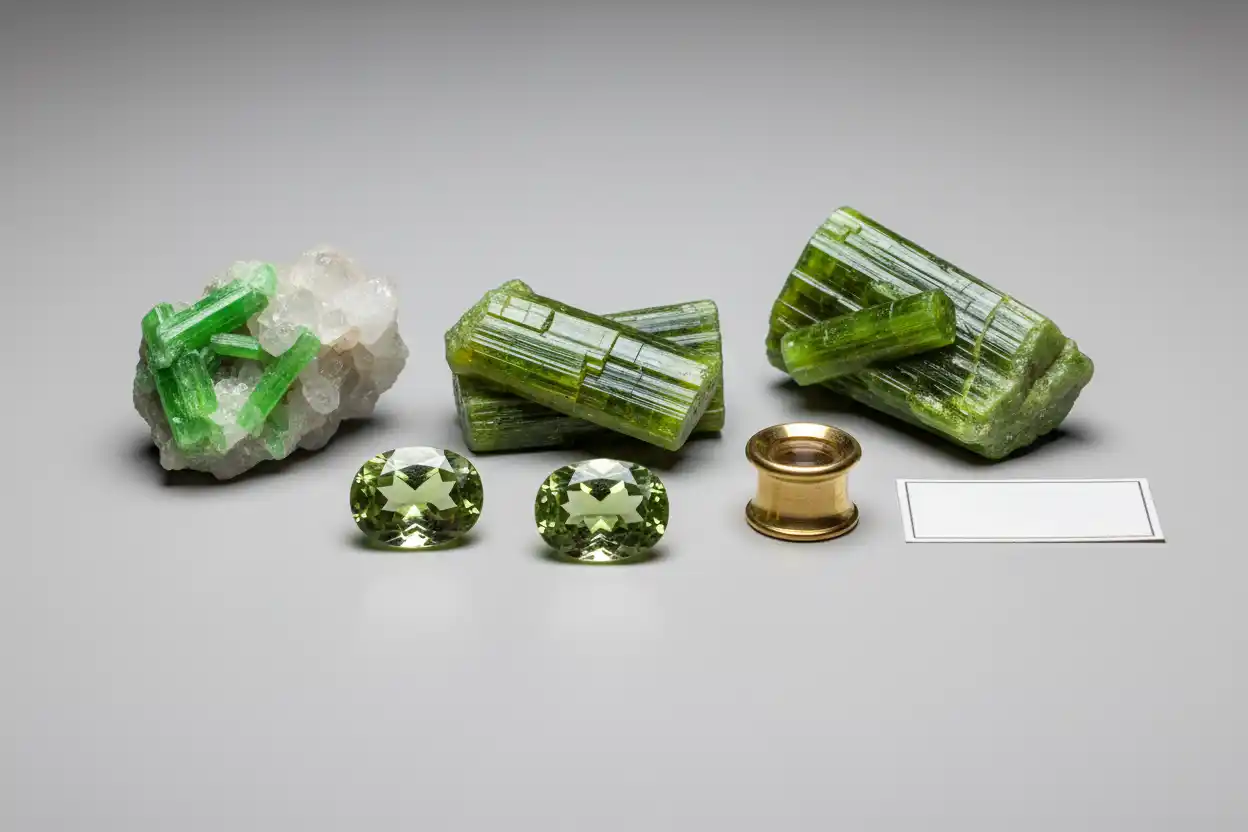
Where to Buy Real Epidote and Avoid Green Glass Fakes
Real Epidote appears in several markets that should not be evaluated by the same standards. Mineral collectors seek sharp prismatic crystals and attractive matrix specimens, lapidaries buy massive green rough, while gem collectors may encounter transparent faceted stones with strong yellow-green to brown-green pleochroism.
Most retail problems involve incorrect identification rather than elaborate synthetic Epidote. Dark green glass, dyed stone, Peridot, Vesuvianite, green Tourmaline, Actinolite-rich rock, Prehnite associations and generic green mineral specimens may receive the Epidote name when sellers rely on color alone.
The Epidote meaning and properties guide covers the mineral’s identity and traditional symbolism. This guide remains focused on choosing sellers, assessing crystal condition, separating Epidote from lookalikes and buying rough, specimens, faceted stones or jewelry at a defensible price.
Understand the Epidote You Are Buying
Epidote is a calcium-aluminum-iron sorosilicate and the principal member of the Epidote group. Iron content commonly contributes to its yellow-green, pistachio-green, olive, brown-green or nearly black appearance.
Well-formed Epidote crystallizes in the monoclinic system. Crystals are often elongated, prismatic, striated and unevenly developed, with one side appearing more extended than the other.
The mineral has approximately Mohs hardness 6 to 7, but it also has perfect cleavage in one direction and brittle tenacity. Consequently, a crystal can resist ordinary surface abrasion while still splitting after an impact.
Transparent facetable material is much less common than opaque or translucent collector specimens. A seller should distinguish gem-quality Epidote from massive rock, crystal clusters and included quartz products.
Choose the Product Form First
| Epidote product | Best source | Main concern |
|---|---|---|
| Natural crystal specimen | Specialist mineral dealer | Cleavage, terminations, repairs and locality |
| Matrix specimen | Experienced mineral dealer | Reattached crystals, unstable matrix and associated-mineral identification |
| Massive rough | Lapidary supplier | Mixed composition, fractures and weak usable yield |
| Epidote in quartz | Mineral or lapidary dealer | Which component dominates, treatment and trade-name accuracy |
| Faceting rough | Rare-gem rough dealer | Transparency, cleavage, dark tone and cutting yield |
| Faceted gemstone | Specialist colored-stone dealer | Identity, pleochroism, windowing and chips |
| Cabochon | Independent lapidary | Mixed mineral content, backing and filler |
| Bead strand | Established bead supplier | Green-glass substitution, mixed rock and drill-hole fractures |
| Jewelry | Jeweler familiar with cleavable gems | Setting pressure, glue and durability claims |
| Classic-locality specimen | Mineral dealer with original labels | Unsupported Knappenwand or old-collection provenance |
A collector should prioritize natural crystal form, locality and condition. A jewelry buyer needs gemological identification, structural soundness and realistic wear advice.
Where to Buy Genuine Epidote
Specialist mineral dealers
A knowledgeable mineral dealer is the strongest source for prismatic crystals, clusters and matrix specimens.
Listings should provide exact dimensions, locality, associated minerals, crystal condition and repair history. Request photographs of every termination, the reverse side, matrix contacts and the specimen base.
A dealer should distinguish naturally contacted faces from fresh breaks. Epidote often grows in crowded environments, so an incomplete side does not automatically indicate recent damage.
Gem and mineral shows
Shows allow direct comparison with Vesuvianite, Peridot, Prehnite, Actinolite and green glass.
Rotate transparent crystals under neutral light. Epidote can display obvious pleochroism, changing between yellowish green, deeper green and brownish tones as its orientation changes.
Use a loupe to inspect cleavage, chipped terminations, surface coating and adhesive. Do not perform scratch tests; directional crystal features and surface alteration can make the result difficult to interpret.
The crystal identification guide explains why habit, luster, associations and measured optical properties should support one another.
Rare-gem dealers
Transparent faceted Epidote should come from a dealer familiar with unusual collector gemstones. The listing should include weight, dimensions, cut, clarity, treatment and identification.
Ask for daylight and warm-light videos because pleochroism and dark tone can change the face-up appearance significantly.
An independent report is sensible when the stone is expensive, unusually large or represented as a rare locality gem.
Lapidary suppliers
Massive Epidote-bearing material may contain quartz, feldspar, Actinolite, chlorite and other minerals. A supplier should describe it as an Epidote-rich rock when it is not a single homogeneous mineral.
Request dry sawn-face photographs. Water and oil deepen green color, conceal scratches and make fractures less obvious.
Ask whether test cabochons from the same parcel polished evenly. Mixed rocks can undercut where minerals differ in hardness or grain structure.
Established online stores
The online gemstone buying guide provides broader checks for seller identity, protected payment methods and return terms.
For Epidote, exact-item photography is essential. One sharp crystal cannot represent every specimen selected from a batch.
Request neutral-light images against white and gray references. Heavy saturation can turn ordinary olive material into vivid emerald green.
What Genuine Epidote Looks Like
Epidote most commonly appears pistachio green, yellow-green, olive green, brown-green or dark green-black. Pale or nearly colorless compositions closer to Clinozoisite also occur within the wider mineral group.
Crystal luster is vitreous, while some cleavage surfaces may appear more pearly. Longitudinal striations frequently run along prismatic faces.
Transparent pieces can show strong color change with viewing direction. That directional color is pleochroism rather than the light-source-dependent color change seen in Alexandrite-type gems.
Natural Epidote may contain internal fractures, growth zoning, mineral inclusions and attached matrix. A flawless green body is possible in small gems, but it is not required for authenticity.
Dark crystals can look almost black until thin edges or strong transmitted light reveal green or brown color. Therefore, a nearly black specimen should be evaluated under more than one lighting condition.
Epidote and Clinozoisite
Clinozoisite is the aluminum-rich, iron-poor relative within the Epidote group. It shares the same general structural family and can resemble pale yellow-green Epidote.
As iron content increases, color commonly becomes stronger and the material moves toward conventional Epidote composition. The boundary cannot always be determined visually.
A seller should not describe a pale stone as rare Clinozoisite solely because it looks lighter than other Epidote. Raman spectroscopy, chemical analysis or X-ray diffraction may be required.
Epidote Versus Unakite
Unakite is a multi-mineral rock containing green Epidote, pink feldspar and quartz.
It is not a separate Epidote crystal variety. The green regions may be genuine Epidote, but the whole object should be described as Unakite.
A cabochon that combines pink, green and pale quartz areas belongs in the Unakite market, where pattern and overall rock stability matter more than transparent Epidote crystal quality.
The future guide to buying genuine Unakite will address dye, composite material and rock-level pattern quality separately.
Epidote Versus Prehnite
Prehnite commonly appears pale green, yellow-green or nearly colorless and may occur with dark Epidote inclusions.
A Prehnite cabochon containing Epidote needles is still primarily Prehnite if the translucent host dominates the stone. Sellers should not call it solid Epidote merely because the inclusions are visually prominent.
Prehnite often has a softer, cloudier or botryoidal appearance, while Epidote crystals are more likely to show prismatic structure and strong directional color.
The future guide to buying real Prehnite owns Prehnite treatment, Epidote-inclusion and lookalike concerns.
Epidote Versus Peridot
Peridot is gem-quality olivine. It commonly displays a brighter yellow-green or olive-green color and is used more widely in conventional jewelry.
Transparent Epidote can resemble dark Peridot, but their refractive properties, birefringence, spectra and crystal structures differ.
The Peridot buying guide covers clarity, cut and jewelry quality, while the Peridot price guide addresses that gem’s market.
A home scratch or density test is unnecessary. A gemologist can separate the materials nondestructively.
Epidote Versus Vesuvianite
Vesuvianite can be green, yellow-green, brown or multicolored and may occur in similar metamorphic or skarn environments.
Vesuvianite commonly forms tetragonal prismatic crystals, while Epidote is monoclinic and often shows different striations and terminations.
Massive green Vesuvianite and Epidote can remain difficult to separate visually. Raman spectroscopy or X-ray diffraction provides a clearer answer.
Epidote Versus Actinolite
Actinolite is a green amphibole that can form fibrous, bladed or prismatic crystals.
Epidote and Actinolite commonly occur together in metamorphic rocks, especially greenschist-type assemblages. A green rock may therefore contain both.
Fibrous Actinolite should not be handled or worked casually. Sellers should identify whether a rough product is massive Epidote, Actinolite-bearing rock or a mixed metamorphic material.
Epidote Versus Green Tourmaline
Tourmaline can form dark green elongated crystals that resemble Epidote at first glance.
Tourmaline often has strongly striated triangular or rounded prism cross sections, whereas Epidote’s monoclinic geometry and cleavage differ.
Transparent gems can be separated through refractive index, birefringence, pleochroism and spectroscopy. The completed Tourmaline buying guide owns Tourmaline color and quality.
Green Glass and Resin Imitations
Green glass can imitate tumbled stones, beads and faceted Epidote. Round bubbles, flow lines, mold seams and abraded facet edges can support a glass identification.
However, some glass is bubble-free, while natural Epidote can contain rounded-looking fluid inclusions. Use several clues rather than one.
Resin may be colored green or mixed with stone powder. Mold lines, soft scratches, repeated patterns and bubbles suggest manufactured construction.
The fake-crystal buyer’s guide provides broader glass, resin and coating checks.
Treatments, Filling and Coating
Epidote is not associated with one dominant routine treatment, but individual products can still be oiled, waxed, coated, fracture-filled, backed or assembled.
Oil and wax may deepen dark green material and improve temporary surface luster. Clear resin can stabilize a fractured carving or fill pits.
A green coating may increase saturation or disguise a mixed stone. Inspect edges, scratches and drill holes for changes in color or luster.
The gemstone treatments guide explains why natural mineral origin does not prove that a finished product is untreated.
How to Evaluate a Crystal Specimen
Crystal form
Look for prismatic or tabular crystals with plausible monoclinic geometry, lengthwise striations and natural variation.
Color and transparency
Evaluate green, yellow-green and brown-green tones under transmitted and reflected light. Dark crystals should reveal some internal color at thin edges when sufficiently translucent.
Terminations
Complete terminations increase collector value, but natural contacts are common. Fresh pale cleavage breaks should be distinguished from growth faces.
Luster
Fresh faces may appear bright and vitreous. Dull surfaces can result from natural alteration, weathering, handling or coating.
Matrix
Quartz, calcite, Actinolite, Prehnite and other minerals may accompany Epidote. The matrix should be stable and geologically coherent.
Repairs
Ask whether any crystal was reattached. Glossy adhesive and mismatched break lines can reveal restoration.
How to Evaluate Faceting Rough
Transparent rough should contain enough clean material between cleavage and fractures to justify cutting.
Ask for videos through several directions. Strong pleochroism can make one orientation look bright green and another nearly brown or black.
The rough’s dimensions matter more than weight alone. A long thin crystal may not provide enough depth for the intended cut.
A cutter must orient color, cleavage and yield simultaneously. Large weight loss is normal, so expensive rough should come with a realistic assessment rather than guaranteed finished size.
How to Judge a Faceted Epidote
Fine gems should show attractive green or yellow-green color without becoming excessively dark face-up.
Cut is critical. Epidote’s relatively high birefringence can produce visible doubling of back facets, while poor proportions can create a large window.
Inspect the girdle and facet junctions for chips. Cleavage-related damage can begin as a small reflective line.
Strong pleochroism should add interest rather than making half the stone appear brown or opaque.
Buying Cabochons and Beads
Cabochons may use translucent Epidote, included quartz or mixed Epidote-rich rock. Ask which material dominates.
A quality cabochon should have stable edges, an even dome and a polish consistent across its components.
Bead strands should show natural variation. Drill holes need close inspection because fractures can spread from the opening.
Ask whether the strand contains solid Epidote, Epidote-in-quartz or green mixed rock. Those constructions should not share one vague “AAA Epidote” grade.
Buying Epidote Jewelry
Faceted Epidote is best suited to collector jewelry, pendants, earrings and protected brooches. Exposed daily-wear rings are risky because of cleavage and brittleness.
The gemstone hardness chart explains its reasonable scratch resistance. The gemstone cleavage guide and toughness-versus-hardness guide explain why impact remains the larger concern.
A low protective setting is preferable to high prongs. Ask whether the stone is glued, backed or fracture-filled.
Locality and Provenance
Knappenwand in Austria is internationally known for fine dark green Epidote crystals and is one of the classic collector localities.
Important material also occurs in Pakistan, Mali, Peru, Norway, Italy, the United States and numerous other metamorphic or hydrothermal districts.
Appearance alone cannot prove a locality. A Knappenwand or rare-source premium requires original labels, collection history or a reliable dealer chain.
The ethical crystal sourcing guide provides practical questions about legal extraction, labor and provenance.
Price and Value
Common massive Epidote and small crystals are affordable. Fine transparent gems and classic-locality specimens can command much higher prices.
Value depends on crystal form, color, transparency, pleochroism, size, condition, matrix aesthetics, locality, provenance and repair.
A large nearly black crystal with broken terminations may be less desirable than a smaller lustrous complete specimen.
Faceted gems gain value from successful cutting because transparent rough is uncommon and cleavage reduces yield.
The gemstone pricing guide explains how rarity, cutting loss, condition and documentation interact.
Questions to Ask the Seller
Ask whether the product is individual Epidote, Epidote-rich rock, Epidote in quartz, Unakite or Prehnite containing Epidote.
Request the locality and the basis for that claim. Confirm coating, oil, wax, resin, fracture filling, backing, glue and repair.
For specimens, obtain photographs of every termination and the base. For faceted stones, request girdle close-ups and gemological identification.
For rough, ask for dry transmitted-light videos and dimensions. Finally, obtain return terms that allow magnified inspection.
Professional Identification
A gemologist can use refractive index, birefringence, pleochroism, specific gravity, absorption spectrum and microscopy to identify transparent Epidote.
Raman spectroscopy and X-ray diffraction can confirm opaque crystals and distinguish Epidote from Clinozoisite, Vesuvianite, Tourmaline and Actinolite.
Chemical analysis can clarify iron and aluminum content within the Epidote group. Multi-mineral rocks require testing at several points.
Cleaning and Storage
Clean sound untreated Epidote gently with lukewarm water, mild soap and a soft cloth. Avoid soaking matrix specimens or stones containing unknown filler.
Steam and ultrasonic cleaning can extend cleavage or loosen repairs. Store crystals so their terminations cannot strike one another.
Remove Epidote rings before manual work and protect collector specimens from vibration or unstable display stands.
Frequently Asked Questions
1. Is Epidote a real mineral species?
Yes. Epidote is a recognized calcium-aluminum-iron sorosilicate and the principal member of the Epidote mineral group.
2. Why is Epidote usually green?
Iron within its structure commonly produces yellow-green, pistachio, olive and brown-green colors.
3. Is Pistacite a different gemstone?
Pistacite is an older varietal term associated with pistachio-green Epidote rather than a separate modern mineral species.
4. Is Unakite the same as Epidote?
No. Unakite is a rock containing green Epidote, pink feldspar and quartz.
5. Is Epidote found inside Prehnite?
Yes. Dark Epidote crystals or needles can occur naturally within translucent Prehnite.
6. How can I distinguish Epidote from Peridot?
Their refractive properties, birefringence, spectra and crystal structures differ. Professional testing is safer than home scratching.
7. Is transparent Epidote common?
No. Facetable transparent rough is considerably less common than opaque or translucent crystal specimens.
8. Is strong color change proof of synthetic material?
No. Epidote can show strong natural pleochroism, appearing greener, yellower or browner from different directions.
9. Can Epidote be fracture-filled?
Yes. Fractured cabochons, carvings or gems may contain resin or oil, although treatment is not universal.
10. Is Epidote suitable for everyday rings?
It is better suited to protected or occasional-wear settings because perfect cleavage and brittle tenacity increase impact risk.
11. Does Knappenwand origin guarantee high value?
No. The locality is famous, but crystal quality, condition, aesthetics and documented provenance still determine value.
12. What is the biggest warning sign in a listing?
Be cautious when a vivid green “rare Epidote” stone has no crystal or matrix description, no treatment statement and no evidence separating it from glass or another green mineral.
Buy the Correct Green Material, Not the Strongest Saturation
Epidote can be a common rock-forming mineral, a fine collector crystal or an unusual faceted gem. The right buying criteria depend on which product is being offered.
The E crystal directory, E gemstone directory and visual gemstone guide provide wider comparison points. Choose the seller who identifies the material, construction and condition before describing its color.
Safety note: Epidote is a silicate mineral. Intact specimens and polished stones can be handled normally, but cutting, drilling, sanding or grinding may create hazardous mineral dust. Use professional wet methods, local extraction and appropriate respiratory and eye protection.