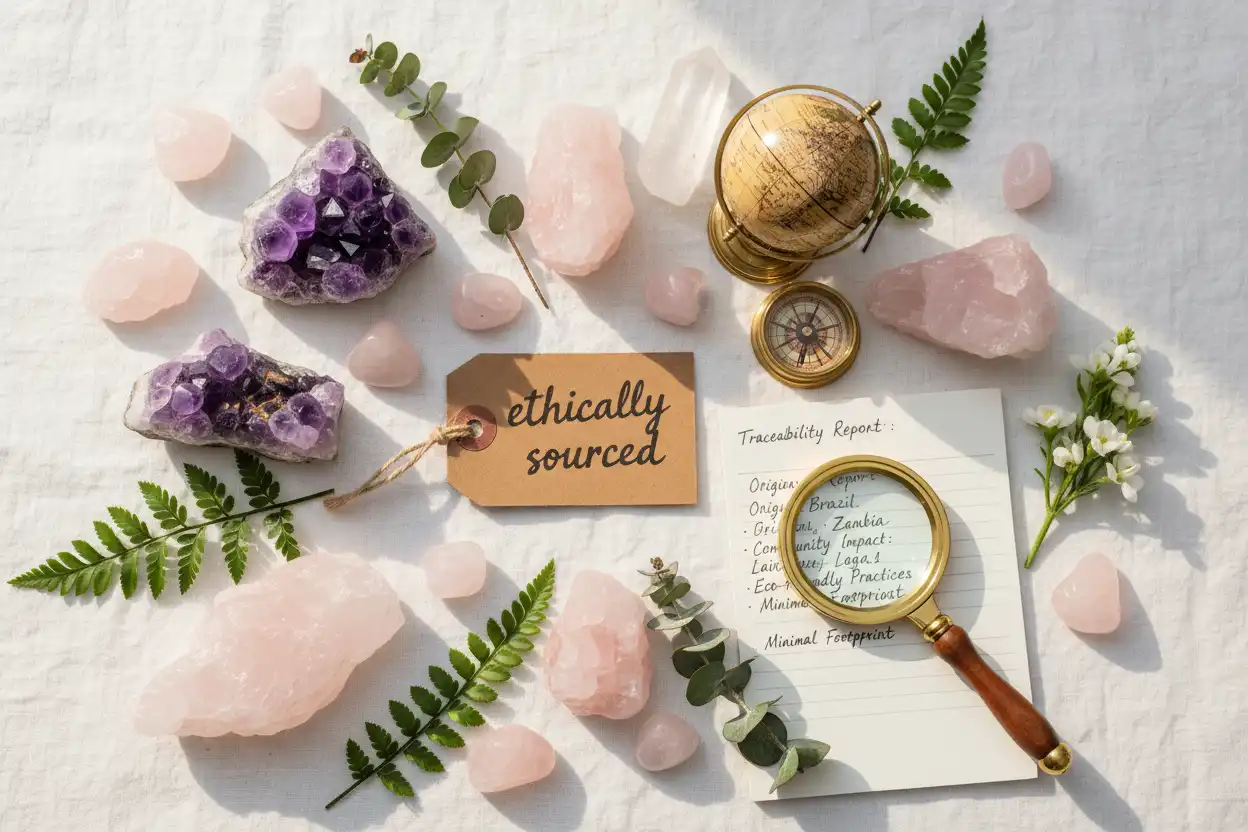
Ethically Sourced Crystals: How to Buy Responsibly
An ethically sourced crystal is obtained, processed and sold with reasonable attention to:
- Worker safety.
- Fair labor.
- Environmental impact.
- Legal extraction.
- Community rights.
- Accurate identification.
- Treatment disclosure.
- Supply-chain transparency.
No purchase is automatically ethical merely because a seller uses words such as natural, healing, small-batch, hand-mined or conflict-free.
Responsible buying requires asking where a crystal came from, who benefited from its sale and what happened between extraction and the finished product.
Perfect traceability is not always available, especially for inexpensive tumbled stones. However, transparent sellers should explain what they know, what they do not know and how they evaluate suppliers.
What Does Ethically Sourced Mean?
Ethical sourcing considers more than a crystal’s country of origin.
A responsibly sourced product should ideally account for:
Legal Extraction
The material should come from a mine, quarry, claim or collection site operating with appropriate permission.
Worker Welfare
Miners, cutters and processors should have:
- Safe working conditions.
- Appropriate protective equipment.
- Fair payment.
- Freedom from forced labor.
- Freedom from exploitative child labor.
- Reasonable working hours.
- Access to grievance processes.
Environmental Responsibility
Extraction should aim to reduce:
- Habitat destruction.
- Uncontrolled erosion.
- Water contamination.
- Toxic chemical releases.
- Unsafe waste piles.
- Unrehabilitated mine sites.
- Unnecessary removal of rare specimens.
Community Rights
Local and Indigenous communities should not be displaced, ignored or deprived of access to land and resources without meaningful consultation and lawful agreement.
Accurate Disclosure
The seller should identify:
- The material.
- Country or locality when known.
- Natural or laboratory origin.
- Treatments.
- Repairs.
- Coatings.
- Stabilization.
- Composite construction.
Fair Distribution of Value
The price paid by the final customer should support more than marketing and retail margins. Miners, local dealers and cutters should receive reasonable compensation for their work.
Why Crystal Traceability Is Difficult
Crystal supply chains are often fragmented.
A specimen may pass through:
- A miner or local collector.
- A village buyer.
- A regional dealer.
- An exporter.
- An international wholesaler.
- A cutting or polishing factory.
- A distributor.
- A retail seller.
At each stage, information may be lost, simplified or replaced with a commercial trade name.
Low-cost products such as mixed tumbled stones may be combined from several mines or countries before reaching a retailer.
Traceability is usually easier for:
- High-value mineral specimens.
- Named mine localities.
- Direct-from-miner purchases.
- Small lapidary batches.
- Documented collector material.
- Gemstones accompanied by laboratory reports.
It is often harder for:
- Cheap crystal chips.
- Mixed wholesale lots.
- Unlabeled carvings.
- Mass-produced towers.
- Marketplace listings copied from other sellers.
- Stones described only by color or spiritual meaning.
Artisanal Mining Is Not Automatically Ethical or Unethical
Artisanal and small-scale mining can provide essential income to communities and may involve less industrial disturbance than a large open-pit operation.
It can also involve:
- Unsafe tunnels.
- Limited protective equipment.
- Informal land access.
- Unstable income.
- Child labor.
- Environmental damage.
- Exploitative buyers.
- Lack of legal protection.
The realities of small-scale extraction are explained in Artisanal Gemstone Mining.
A seller should not use “artisanal” as a decorative marketing term without understanding the conditions behind the material.
Is There One Ethical Crystal Certification?
There is no single universal certification that covers every mineral specimen, tumbled stone, carving and crystal product worldwide.
Certifications and standards may apply to particular:
- Gemstones.
- Countries.
- Mines.
- Metals.
- Jewelry companies.
- Labor programs.
- Environmental management systems.
A logo alone does not answer every ethical question.
Ask what the certification covers:
- The mine?
- The exporter?
- The cutting facility?
- The retail company?
- Worker conditions?
- Environmental management?
- Chain of custody?
- Only legal compliance?
A seller should be able to explain the scope rather than relying on an undefined ethical badge.
Questions to Ask a Crystal Seller
You do not need to interrogate a small business aggressively. A few specific questions can reveal how seriously it treats sourcing.
Ask:
Where Was It Mined?
A useful answer may include:
- Country.
- Region.
- Mine.
- District.
- Deposit.
- Previous collection.
“Imported” or “from overseas” is not a meaningful locality.
Who Supplied It?
The seller may identify:
- A miner.
- A mining cooperative.
- A local dealer.
- A mineral show supplier.
- A specialist wholesaler.
- An estate collection.
- A cutting workshop.
The supplier’s private identity may not always be shared, but the seller should describe the type of relationship.
Is the Material Natural?
Ask whether it is:
- Natural.
- Laboratory-grown.
- Manufactured.
- Dyed.
- Heated.
- Irradiated.
- Coated.
- Filled.
- Stabilized.
- Reconstructed.
- Assembled.
Treatments themselves are not necessarily unethical. Concealing them is.
The main enhancement categories are explained in Gemstone Treatments Explained.
How Were Workers and Communities Considered?
A strong seller may discuss:
- Long-term supplier relationships.
- Direct purchasing.
- Cooperative sourcing.
- Worker-safety requirements.
- Site visits.
- Supplier codes.
- Community projects.
- Independent audits.
- Limits in available information.
Vague statements such as “we only buy good-vibe stones” do not demonstrate labor due diligence.
What Packaging Is Used?
Mining impact is usually more significant than packaging, but excessive plastic, foam and disposable wrapping still matter.
Look for:
- Reused packing material.
- Recyclable paper.
- Minimal plastic.
- Consolidated shipping.
- Durable storage boxes.
- Honest explanation of why fragile specimens need protective packaging.
Signs of a More Transparent Seller
A more credible seller often:
- Uses precise mineral names.
- States the locality when known.
- Separates facts from spiritual tradition.
- Discloses dye, coating and stabilization.
- Shows the actual item for sale.
- Explains supplier relationships.
- Admits when mine-level traceability is unavailable.
- Provides safety warnings for hazardous minerals.
- Avoids impossible environmental claims.
- Corrects errors when new information appears.
The seller does not need perfect documentation for every inexpensive stone, but it should avoid presenting uncertainty as certainty.
Ethical-Sourcing Red Flags
Be cautious when a seller:
- Claims every product is fully ethical without evidence.
- Cannot name even the country of origin.
- Uses the same origin story for every stone.
- Describes laboratory-grown or manufactured materials as mined crystals.
- Hides treatments.
- Sells hazardous minerals without warnings.
- Uses stock photographs instead of the actual specimen.
- Claims purchasing the crystal directly funds a community without explaining how.
- Promotes extraction as harmless.
- Uses “conflict-free” as if it covers labor and environmental issues.
- Sells very rare material at an implausibly low price.
- Refuses reasonable questions about identity or origin.
False identification is both a consumer and ethical problem. The guide to spotting fake crystals covers common warning signs.
Country of Origin Is Not an Ethical Rating
A mineral is not automatically ethical or unethical because it comes from a particular country.
Conditions can differ between:
- Mines.
- Provinces.
- Companies.
- Cooperatives.
- Exporters.
- Time periods.
- Types of material.
Broadly condemning one country may unfairly harm responsible miners while failing to examine poor practices elsewhere.
Evaluate the specific supply chain whenever possible.
Natural Does Not Mean Sustainable
A natural crystal can still involve:
- Habitat loss.
- Unsafe labor.
- Illegal extraction.
- Long-distance transport.
- Heavy machinery.
- Waste generation.
- Community conflict.
Likewise, a laboratory-grown material still uses:
- Electricity.
- Equipment.
- Raw materials.
- Industrial processing.
- Packaging.
- Transport.
The ethical comparison depends on the specific product and supply chain, not the word natural or lab-grown alone.
Consider the Type of Material
Crystal shops may sell minerals, rocks, fossils, natural glass, shell, metal and manufactured products under one broad label.
Different materials raise different questions.
Mineral Specimens
Ask whether the specimen was legally collected and whether removing it damaged a scientifically important site.
Tumbled Stones
Traceability may be limited because large batches are mixed, cut and polished together.
Carvings and Towers
Consider both mining and factory labor. The cutting and polishing stage may occur in a different country from extraction.
Fossils
Check whether collection and export were legal. Fossils may be protected by local heritage laws.
Organic Materials
Shell, coral, pearl and similar materials raise wildlife, aquaculture and conservation considerations.
Manufactured Materials
Goldstone, opalite and laboratory-grown crystals should be described honestly rather than marketed as rare natural minerals.
The types of gemstones guide helps distinguish these categories.
Ethical Crystals vs. Ethical Gemstones
The concerns overlap, but the markets are not identical.
Faceted gemstones may have:
- Laboratory reports.
- Treatment disclosures.
- Formal grading.
- Documented high-value transactions.
- More structured jewelry supply chains.
Crystal specimens and tumbled stones may have:
- Better locality information for collector pieces.
- Less formal documentation for low-cost products.
- Greater variation in trade names.
- More direct purchasing at mineral shows.
- More safety concerns involving raw minerals.
For the jewelry-focused perspective, read Ethically Sourced Gemstones.
Is Buying Directly From a Miner Better?
Direct purchasing can improve transparency and allow more value to remain near the source.
However, “direct from the miner” should still be examined.
Ask:
- Does the seller actually know the miner?
- Was the material legally extracted?
- Were workers protected?
- Was the land used with permission?
- Is the price fair?
- Can the locality claim be supported?
- Is the miner free to negotiate?
Direct trade is promising when the relationship is genuine, long-term and transparent.
Are Secondhand Crystals More Ethical?
Secondhand crystals can reduce demand for new extraction and extend the useful life of existing material.
Sources include:
- Estate sales.
- Collector exchanges.
- Antique shops.
- Mineral clubs.
- Resale platforms.
- Inherited collections.
- Jewelry repair and reuse.
Secondhand material still requires identification. Old labels can be incorrect, outdated or disconnected from the specimen.
Use the observations in How to Identify Crystals before repeating an inherited name or locality.
Is Local Sourcing Always Better?
Local sourcing may reduce transport and improve traceability, but it is not automatically ethical.
A local specimen may still be:
- Illegally collected.
- Taken from protected land.
- Removed without permission.
- Extracted unsafely.
- Misidentified.
- Environmentally damaging.
A responsibly managed distant source may perform better than an unregulated local one.
Evaluate extraction and trade conditions rather than distance alone.
How Much Should an Ethical Crystal Cost?
There is no simple ethical price formula.
A responsible price may reflect:
- Mining labor.
- Cutting and polishing.
- Safety equipment.
- Legal permits.
- Environmental management.
- Waste and breakage.
- Export costs.
- Transport.
- Retail operations.
- Taxes.
- Fair profit.
An unusually low price can indicate:
- Mass production.
- Misidentification.
- Poor labor conditions.
- Hidden treatment.
- Artificial material.
- Supplier distress.
- Clearance of old stock.
A high price does not guarantee ethical sourcing. Transparency matters more than luxury branding.
How to Evaluate an Online Listing
Before buying online, check:
- Is the actual item shown?
- Are dimensions and weight listed?
- Is the mineral name precise?
- Is the origin described?
- Are treatments disclosed?
- Are safety warnings included?
- Does the seller have a return policy?
- Are edited colors acknowledged?
- Can the seller answer a direct question?
- Are rarity claims realistic?
Additional online-purchasing checks appear in How to Buy Gemstones Online Without Getting Scammed.
Responsible Buying Checklist
Before purchasing, ask:
- Do I know what the material actually is?
- Is the locality known?
- Was it legally extracted or collected?
- Does the seller understand its suppliers?
- Are treatments and repairs disclosed?
- Are worker and community conditions considered?
- Is the environmental claim specific?
- Are hazardous components disclosed?
- Is the price plausible?
- Do I genuinely need this item?
You do not need to buy a crystal merely because it is rare, trending or described as spiritually urgent.
Buy Fewer, Better-Documented Pieces
A smaller collection can be easier to:
- Research.
- Store safely.
- Clean correctly.
- Appreciate.
- Trace.
- Display without damage.
- Resell or pass on responsibly.
Responsible consumption includes deciding not to buy.
Care Is Part of Ethical Ownership
A crystal that is quickly damaged and discarded creates unnecessary waste.
Extend its useful life by:
- Learning its hardness and cleavage.
- Keeping it away from damaging chemicals.
- Using stable display stands.
- Storing pieces separately.
- Repairing jewelry where practical.
- Preserving labels and locality information.
- Avoiding destructive home tests.
What Should You Do With Unwanted Crystals?
Do not automatically bury, throw away or release crystals into natural environments.
Instead consider:
- Reselling.
- Donating.
- Gifting.
- Returning to a seller.
- Reusing in art or display.
- Transferring to a mineral club.
- Following local hazardous-waste guidance for toxic materials.
The guide to disposing of crystals respectfully explains these options in more detail.
Frequently Asked Questions
What is an ethically sourced crystal?
It is a crystal obtained and sold with meaningful attention to legal extraction, worker welfare, environmental impact, community rights and honest disclosure.
Can a seller guarantee that every crystal is ethical?
Complete mine-to-retail certainty is uncommon for low-cost mixed material. A responsible seller should state the level of traceability honestly.
Are expensive crystals more ethical?
Not necessarily. Price alone does not prove fair labor, environmental responsibility or legal extraction.
Are lab-grown crystals ethical?
They can avoid some mining impacts but still require energy, industrial materials, labor and transport. Their origin must also be disclosed.
Are all artisanal crystals responsibly mined?
No. Artisanal mining can support livelihoods but may also involve unsafe or exploitative conditions.
Is buying secondhand better?
It can reduce demand for new extraction and extend the life of existing material, provided the item is accurately identified and safe.
Does “conflict-free” mean fully ethical?
No. The phrase may address a narrow conflict-financing issue without covering wages, worker safety, environmental damage or community rights.
How can I verify a crystal’s origin?
Ask for mine or regional information, supplier documentation, old collection labels, photographs and laboratory evidence where appropriate.
Should I avoid crystals with unknown origins?
Not every inexpensive stone has complete documentation. You can favor transparent sellers, buy secondhand or choose fewer well-documented pieces.
What is the most ethical crystal?
There is no universally most ethical mineral. The answer depends on the specific mine, labor conditions, processing, transport, treatment and seller practices.
Continue Exploring
Browse more responsible buying, identification and safety resources in the Crystals 101 collection.