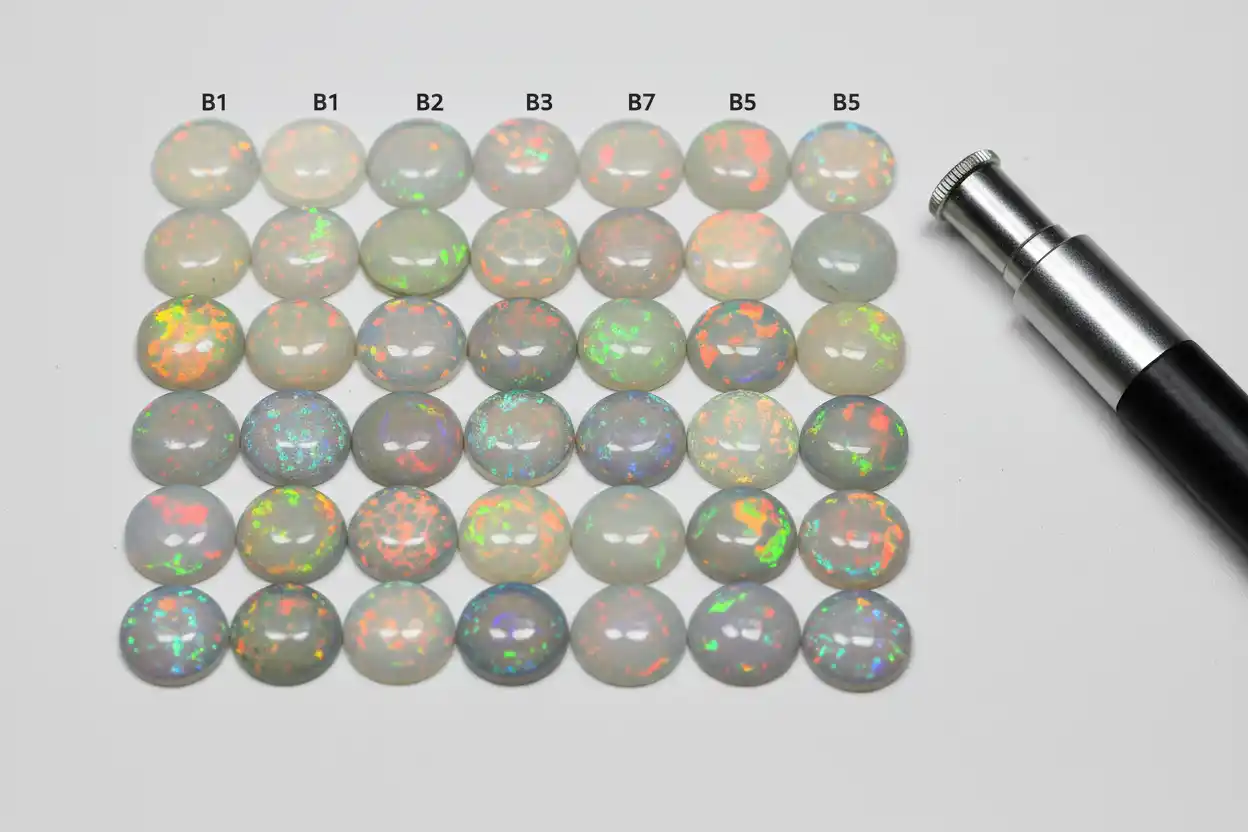
Ethiopian Opal Price: How Value Is Judged, Authenticity, Rarity & Size
Ethiopian opal price is determined by the quality of the individual gem rather than by one universal price-per-carat figure. Brightness and coverage of play-of-color, color range, pattern, bodycolor, transparency, hydrophane behavior, stability, treatment status, cut, size, condition, and documentation all influence what buyers are willing to pay. GIA describes opal quality through color, pattern, and clarity, with play-of-color as the most important visual factor in precious opal.
Ethiopian material adds another layer because much Wollo opal is hydrophane and porous enough to absorb liquids. That can affect transparency, play-of-color, weight, treatment susceptibility, and sometimes durability, so two visually similar stones can belong to different commercial categories if one is natural-color untreated material and the other is dyed or impregnated. A buyer researching value should therefore understand the checks in Gems Lore’s buy Ethiopian opal guide before interpreting any Ethiopian opal price.
Ethiopian Opal Price At a Glance
| Value Factor | Stronger Value Signals | Factors That Can Lower Value |
|---|---|---|
| Play-of-Color Brightness | Strong vivid spectral flashes visible through normal movement | Weak, dull, or angle-dependent color |
| Coverage | Color across most of the face | Large inactive or dead areas |
| Color Range | Broad spectrum, especially vivid warm and cool colors together | Narrow subdued range when other factors are ordinary |
| Pattern | Distinctive, balanced, visually memorable arrangement | Weak, fragmented, or unattractive pattern |
| Bodycolor | Attractive natural bodycolor supporting good contrast | Artificially modified or visually muddy bodycolor |
| Transparency | Appropriate transparency for the opal type | Cloudiness, instability, or poor clarity |
| Hydrophane Behavior | Stable porous material with honest disclosure | Problematic absorption, cracking history, or misleading wet presentation |
| Treatment | Natural color or clearly disclosed enhancement | Undisclosed dye, oil, resin, coating, or impregnation |
| Stability | No crazing or structural fractures | Crazing, cracks, weak edges |
| Cut | Good orientation, polish, dome, thickness, and face-up dimensions | Poor polish, excessive thickness, weak orientation |
| Size | Larger fine stone retaining strong play-of-color | Extra weight carrying weak color or inactive material |
| Origin | Credibly documented Ethiopian provenance | Unsupported origin claim |
| Documentation | Reliable identification and treatment report | Unverified seller certificate or vague disclosure |
Play-of-Color Usually Drives the Largest Value Differences
GIA places play-of-color at the center of opal evaluation because spectral brightness is what separates precious opal from common opal. Assessment includes intensity, percentage of the face showing color, dominant hues, color range, pattern, transparency, clarity, and cutting quality.
A smaller Ethiopian opal with vivid color covering nearly the entire face can therefore command a stronger price than a substantially larger stone whose flashes appear only in isolated spots. The buyer is paying for what the gem visibly does, not simply how much hydrated silica sits on the scale.
Movement matters. Opal that remains bright from several angles generally offers a more impressive jewelry experience than material whose strongest flash appears only from one narrow viewing direction.
Color Range Can Influence Demand Without Creating a Mechanical Formula
Precious opal can display colors across the visible spectrum, and GIA notes that full-spectrum displays with bold patterning can be especially prized. Red play-of-color is comparatively uncommon and can attract strong demand when bright and combined effectively with other hues.
This should not become a rigid red-equals-highest-price rule. A stone dominated by extraordinarily bright green and blue can outperform a mediocre opal containing one dull red spot. Overall brightness, coverage, pattern, transparency, stability, and aesthetics remain part of the valuation.
Price reflects combinations. Spectral rarity contributes most when the rare color appears strongly within an already fine gem.
Pattern Can Create a Collector Premium
Ethiopian opal is capable of producing highly recognizable patterns, including rolling flashes, pinfire, broad color patches, straw or chaff-like structures, and digit patterns. GIA has documented digit-pattern opal from Wollo and shown that these finger-like structures can occur naturally.
Distinctive pattern can create value because two opals rarely present the same visual arrangement. A memorable design that remains bright across movement may attract collectors even when the stone is not the largest available.
Pattern names are still largely descriptive trade language rather than standardized laboratory grades. A premium should come from the beauty and rarity of the appearance rather than the seller’s creativity in naming it.
Bodycolor Affects Contrast and Market Position
Wollo opal can appear white, colorless, yellow, orange, brown, reddish-brown, black, and in other natural body tones. GIA’s Ethiopian field expedition documented this broad range and emphasized that both common and precious qualities occur.
A darker bodycolor can make play-of-color appear more contrasted, while crystal or transparent material can create an internally floating color effect. Neither category is automatically superior because market preference depends on the complete visual result.
Strongly unusual colors deserve additional treatment scrutiny because hydrophane material readily absorbs dyes. GIA’s documented treated examples show that natural Ethiopian opal can be modified into colors far outside the normal untreated commercial appearance.
Hydrophane Character Does Not Automatically Lower Value
Hydrophane opal is porous opal that absorbs water readily. Much Wollo material has this property, making hydrophane behavior normal within a major segment of Ethiopian production.
A stable, beautiful hydrophane opal with exceptional play-of-color can be highly desirable. Porosity becomes a value concern when it is associated with cracking, unstable appearance, treatment uncertainty, or improper presentation.
This distinction matters because buyers sometimes treat the word hydrophane as synonymous with “cheap” or “defective.” It is more accurate to view hydrophane as a structural property that creates specific care, treatment-detection, and stability considerations.
Stability Can Create Large Price Differences Between Similar-Looking Stones
Crazing and active fractures reduce both durability and confidence. GIA notes that crazed opal has little durability in jewelry and typically trades at lower levels than comparable undamaged material.
The Ethiopian market includes stones with different porosity and stability profiles, so buyers should look closely at the surface and edges under magnification. A vivid stone containing a network of cracks should not be priced as though it were equivalent to a sound gem.
A stone’s history can matter as well. If an older polished Ethiopian opal has remained stable through normal wear and storage, that can provide useful practical context, although it does not create an absolute guarantee against future damage.
Treatment Can Change the Appropriate Price Category
Hydrophane opal can absorb dye and impregnation materials readily. GIA has documented dyed Ethiopian-type hydrophane opal as well as oil and resin treatments that enter the porous structure.
A treated Ethiopian opal can be beautiful, but it should be compared with other similarly treated material rather than with verified natural-color opal simply because the two stones look alike.
Treatment value effects depend on the modification, stability, quality of disclosure, and market preference. The most important rule is accurate representation; an undisclosed treatment destroys the reliability of every subsequent price comparison.
Wet Appearance Should Never Be Used as a Hidden Sales Advantage
Hydrophane opal can become more transparent or otherwise change appearance after absorbing water. GIA research documents substantial visible changes in Wollo material during immersion.
That makes the condition of seller photographs important. A stone photographed wet may not look identical after drying, so sellers should disclose whether the opal was recently immersed.
Buyers should evaluate the stone in its normal dry condition rather than paying for a temporary water-induced appearance.
Size Matters Most When Fine Quality Continues Across the Larger Stone
Opal has relatively low density, so large dimensions can occur without the extremely high weights associated with denser gems. GIA notes that opal is available across a broad size range and that larger pieces can remain comfortable in jewelry.
A larger Ethiopian opal can command more when vivid play-of-color, attractive pattern, good stability, transparency, and cutting remain strong. The difficulty lies in maintaining those attributes across a larger surface.
Large size by itself is not enough. A twenty-carat stone with weak color and extensive inactive areas may be less valuable than a five-carat gem filled with bright spectral flashes.
Face-Up Dimensions Are More Informative Than Weight Alone
Two opals of equal carat weight can have different visual size because one may be cut with a higher dome or thicker base. A heavier cabochon can therefore face up smaller even though its numerical weight looks more impressive.
Cutting also influences how much inactive material remains on the back. Retaining additional thickness may be appropriate for stability, but buyers should understand whether extra weight contributes to beauty or mainly supports the structure.
Price per carat becomes most meaningful only after dimensions and cut style are broadly comparable.
Cutting Quality Can Increase Value Substantially
GIA notes that opal cutting should consider symmetry, thickness, polish, sizing, calibration, and the ability to display play-of-color effectively. Domed cabochons often show color well across different viewing angles.
Poor polish can mute an otherwise beautiful surface, while weak orientation can hide the strongest color. Excessively flat stones can be more vulnerable during setting, while overly high domes can be awkward to mount.
Custom or freeform cutting can be appropriate when it preserves unusually fine color. Symmetry should therefore be judged according to the rough rather than through an automatic preference for perfect ovals.
Ethiopian Origin Can Be Valuable Without Being a Quality Grade
Ethiopia has become a major modern source of precious opal, especially after Wollo production expanded. GIA’s field work documents substantial mining activity and wide variety in the material produced.
That importance can create market recognition, but GIA’s opal guidance emphasizes that value is based on quality rather than locality alone. A weak Ethiopian stone does not become valuable simply because of its country of origin, and a fine opal from another source does not become inferior merely because it lacks an Ethiopian label.
Origin works best as provenance layered on top of quality.
GIA Can Provide Geographic-Origin Reporting for Opal
Current GIA services include natural opal among the stones eligible for its Colored Stone Identification & Origin Report. The service adds a geographic-origin opinion when the laboratory can determine one.
This is particularly relevant when a dealer charges a meaningful premium for Ethiopian origin. An independent laboratory conclusion is different from a supplier invoice or seller statement, though both can form part of a provenance record.
The report does not establish market value. It provides gemological evidence that the market can then consider alongside quality.
Ethiopian Opal Versus Black Opal Pricing
Black opal usually belongs to a different market category because its dark background can create exceptionally strong contrast with play-of-color, and GIA describes black opal as among the rarest major opal types.
That does not mean every black opal should cost more than every Ethiopian opal. An exceptional Ethiopian crystal or dark-body opal can be more desirable than an ordinary black opal with weak color.
Gems Lore’s black opal price guide provides the relevant black-opal framework, while buy black opal explains how solid construction, treatment, body tone, and play-of-color should be verified before numerical comparison.
Ethiopian Opal Versus Boulder Opal Pricing
Boulder opal naturally contains ironstone matrix as part of the finished gemstone, so its total carat weight includes host rock. Ethiopian hydrophane opal typically follows a different structural and pricing logic.
Gems Lore’s boulder opal price guide explains why matrix, seam thickness, pattern, and face-up dimensions dominate boulder-opal valuation, while buy boulder opal distinguishes natural host rock from assembled backing.
Comparing these materials solely by dollars per carat can therefore be misleading even when both show equally dramatic rainbow colors.
GIA Does Not Publish a Universal Opal Grade
GIA evaluates opal but does not grade it with an overall letter or numerical quality grade. Its reports establish identity, natural or laboratory-grown status, measurable characteristics, and detectable treatments, while origin reporting is available for natural opal when determinable.
AAA, AAAA, premium, collector grade, honeycomb grade, and similar labels belong to sellers unless a transparent independent methodology is supplied.
Use the stone’s actual brightness, pattern, stability, treatment, size, and cut to determine whether the price is justified.
Retail Asking Price, Appraisal Value, and Resale Value Are Different
Retail Ethiopian opal price can include sorting, cutting, laboratory work, photography, inventory risk, insured shipping, returns, jewelry mounting, and seller margin. An appraisal may estimate replacement value or another defined figure, while a dealer purchasing a used opal must account for verification, possible recutting, condition risk, inventory time, and resale margin.
Those numbers can legitimately differ. A high retail purchase price does not guarantee an equivalent future cash offer.
This broader distinction between rarity and actual market value also appears in Gems Lore’s rarest gemstones in the world and most expensive gemstones guides.
What Usually Raises Ethiopian Opal Price?
Stronger value generally appears when several desirable characteristics coincide: vivid play-of-color, broad face-up coverage, multiple spectral hues, distinctive attractive pattern, stable natural bodycolor, good transparency for the type, excellent polish, strong orientation, useful size, sound condition, and credible treatment disclosure.
Larger fine stones can command more because maintaining exceptional color across a broader area is difficult. Distinctive natural patterns can add collector appeal, and independent origin or treatment documentation can reduce uncertainty.
The key is combination. Size, red color, or a named pattern alone does not establish a premium without overall quality.
What Usually Lowers Ethiopian Opal Price?
Weak play-of-color, large inactive areas, dull pattern, undesirable cloudiness, crazing, fractures, unstable hydrophane behavior, poor polish, misleading wet presentation, undisclosed dye, impregnation, coating, weak documentation, or questionable provenance can all reduce value.
A treated stone can still be worthwhile when accurately represented and priced accordingly. A lower-cost dyed or impregnated opal may provide excellent visual impact for a buyer who prioritizes appearance over untreated rarity.
Value depends on whether the buyer understands the category.
How to Compare Ethiopian Opal Prices Fairly
Compare stones according to:
- Natural versus synthetic or imitation identity.
- Solid opal versus assembled construction.
- Natural versus treated bodycolor.
- Hydrophane behavior.
- Play-of-color brightness.
- Percentage of face showing active color.
- Color range.
- Pattern.
- Transparency.
- Crazing and fractures.
- Carat weight and millimeter dimensions.
- Cut, dome, thickness, and polish.
- Laboratory identification.
- Geographic-origin documentation.
- Retail, appraisal, or resale context.
Only after these variables align reasonably closely does price per carat become a useful secondary benchmark.
Conclusion
Ethiopian opal price reflects visible beauty, physical stability, treatment status, and market confidence rather than one standardized rate. Play-of-color remains the main value driver, but brightness, color range, pattern, transparency, bodycolor, size, cut, condition, hydrophane behavior, and treatment all affect where a stone belongs in the market.
The strongest valuations separate natural hydrophane character from dye or impregnation, judge the stone dry rather than after temporary water absorption, inspect carefully for crazing, and compare only with opals in the same treatment and quality category. Ethiopian origin adds provenance but does not replace individual quality, while current GIA services can provide opal geographic-origin reporting when determinable.
Buyers who keep those distinctions clear can evaluate Ethiopian opal price without relying on generic charts, undefined AAA grades, or misleading comparisons with structurally different opal types.
Frequently Asked Questions
How much is Ethiopian opal worth per carat?
There is no universal Ethiopian opal price per carat. Play-of-color brightness, coverage, pattern, transparency, bodycolor, treatment, hydrophane behavior, stability, cut, size, and documentation can cause major differences between stones of identical weight.
What is the most important Ethiopian opal value factor?
Play-of-color is generally the leading quality factor in precious opal. GIA evaluates its intensity, coverage, color range, and pattern together with transparency, clarity, and cut.
Is red play-of-color more valuable?
Bright red can add strong desirability because red play-of-color is comparatively uncommon, particularly when it appears vividly alongside other spectral hues. A weak red patch does not automatically make a stone finer than a brilliant multicolor opal without red.
Does hydrophane opal cost less?
Not automatically. Hydrophane is a porosity characteristic common in Wollo material. Fine stable hydrophane opal can be very attractive and valuable. Price is more directly affected by play-of-color, treatment, stability, cut, size, and condition.
Does dyeing lower Ethiopian opal value?
Treatment usually places the stone in a different comparison category from natural-color material. GIA has documented dyed Ethiopian-type hydrophane opal. Properly disclosed treated opal can still have decorative and commercial value.
Are large Ethiopian opals rare?
Large material exists, but larger size becomes more valuable primarily when strong play-of-color, attractive pattern, transparency, stability, and cut are maintained. Size alone is not a quality grade.
Is Ethiopian opal cheaper than Australian opal?
No universal comparison applies. GIA historically noted that Wollo hydrophane opal expanded supply at lower market levels than some similar-looking opals from established sources, but individual stones vary enormously in quality. Current valuation should compare specific stones rather than assume country alone determines price.
Can GIA confirm Ethiopian origin?
Natural opal is eligible for GIA’s Colored Stone Identification & Origin Report, with geographic origin included when determinable.
Does GIA grade Ethiopian opal AAA?
No. GIA evaluates opal but does not issue an overall opal quality grade. AAA and similar grades are commercial seller terminology.
Does a GIA opal report provide a price?
No. A gemological report establishes identification, characteristics, treatment, and potentially origin; it is not a market appraisal. Monetary value requires a separate comparison of current relevant market transactions.
Is Ethiopian opal a guaranteed investment?
No. Fine opal can be rare and collectible, but future value depends on quality, treatment, stability, demand, condition, documentation, and market liquidity. No pattern name, origin claim, or retailer grade guarantees appreciation.